What is Djenné Mud Mosque?
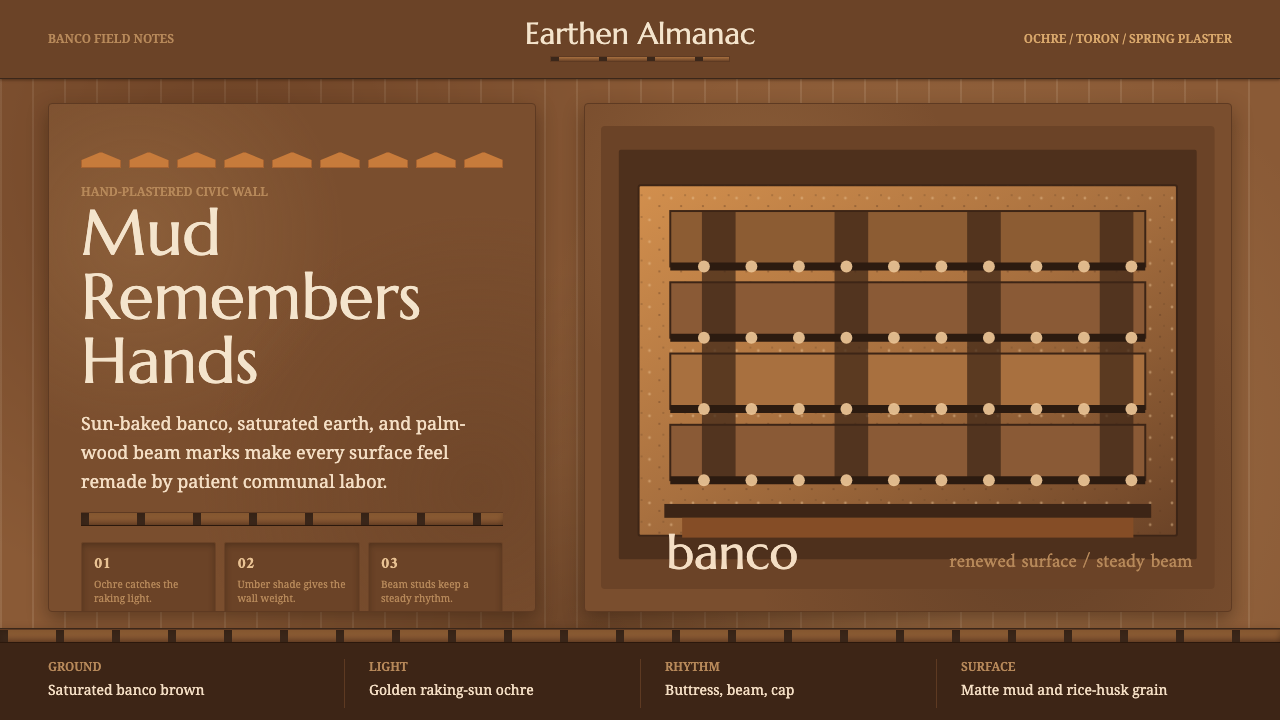
The Great Mosque of Djenné is the largest mud-brick building on earth, re-plastered by the whole town every spring — and this system borrows the warmth, grain, and rhythm of that living, hand-built surface.
Djenné Mud Mosque in brief
Djenné Mud Mosque is a design system drawn from a single, extraordinary building: the Great Mosque of Djenné in central Mali, the largest earthen structure in the world. Built from sun-dried mud brick and finished in a smooth mud plaster called banco, the mosque rises from the flat landscape of the Inland Niger Delta as a warm, monumental mass — thick tapering walls, conical spires, and rows of wooden beams projecting straight out of the facade like ribs.
The system treats this as a material study rather than a pattern to trace. Everything reads as hand-applied rather than machine-printed: surfaces carry the visible grain of mud-and-straw plaster, color shifts from a bright, sun-struck ochre where light hits directly to a deeper umber in shadowed recesses, and the horizontal rhythm of the wall is set by evenly spaced projecting beams rather than a printed grid. Nothing here is meant to look slick or new — the building itself is only ever a season away from needing fresh mud, and the aesthetic keeps that sense of a living, maintained surface rather than a finished, permanent one.
Structurally, the mosque's most distinctive features double as the system's core visual vocabulary: tapering buttress-like piers that thicken toward the ground, a triple-towered facade crowned with cone-shaped pinnacles, and the toron — the projecting wooden beams that serve a real construction purpose as permanent scaffolding for the mosque's annual re-plastering, and read visually as a rhythmic, almost architectural form of texture.
Where does Djenné Mud Mosque come from?
The Great Mosque of Djenné stands in the town of Djenné, in the Inland Niger Delta of present-day Mali, a region that has been a crossroads of trans-Saharan trade for over a thousand years. Local tradition credits an early mosque on this site to the sultan Koi Konboro in the thirteenth century, though the building standing today was constructed in 1907, during the French colonial period, on the foundations of that earlier structure. Its scale and form nonetheless belong to a much older and continuous regional building tradition rather than to any single architect or era.
The mosque is the most famous example of Sudano-Sahelian architecture, a style shared across the historic trading cities of the West African Sahel — including Timbuktu and other towns along the Niger — built almost entirely from earth because stone and timber are scarce in the region while river-deposited clay is abundant. The construction material, known locally as banco, is mud mixed with rice husks or straw for structural strength, formed into sun-dried bricks called ferey, then coated with a smoother mud render that gives the finished wall its warm, continuous surface.
Mud architecture has one unavoidable weakness: seasonal rains erode the plaster surface every year. Rather than treating this as a defect to engineer away, Djenné turned it into a civic ritual. Every spring, before the rainy season, the town holds the Crépissage — a communal re-plastering festival in which residents, organized and directed by the town's masons, mix fresh banco and re-coat the entire mosque by hand in a single coordinated effort, complete with music, food, and friendly competition between neighborhoods. The projecting toron beams that stud the facade are not ornamental; they function as fixed, reusable scaffolding, allowing masons to climb and work the upper walls again each year without erecting new scaffolding from scratch.
This maintenance is carried out by Djenné's hereditary masons' guild, known locally as the barey ton, led by a chief mason whose family has traditionally held the role across generations. The mosque and the old town around it were inscribed as a UNESCO World Heritage Site in 1988, recognizing both the building and the living building tradition — including the annual re-plastering — as inseparable from its value. The mosque remains an active place of worship today, and its upkeep continues to depend on the same community labor and guild knowledge that has sustained it for over a century.
What defines the Djenné Mud Mosque look?
Color
The palette is warm and earthen throughout: a saturated ochre where the surface faces the sun directly, deepening into umber and dark brown in recessed or shaded areas. This is not a flat, single-tone brown but a range that shifts with implied light direction, echoing how raking sun genuinely changes the appearance of a sun-dried mud wall over the course of a day.
Surface Grain
Surfaces are treated to carry the texture of hand-applied plaster made from mud mixed with rice husks or straw — a grainy, slightly irregular finish rather than a smooth digital gradient or flat fill. This grain is what signals a hand-built, maintained object rather than a printed or manufactured one, and it is applied consistently rather than reserved for a single decorative accent.
Toron Rhythm
The projecting palm-wood beams that stud the mosque's facade — used in real construction as permanent scaffolding for annual re-plastering — translate into a steady, evenly spaced horizontal rhythm across the layout, functioning the way a repeating divider or rule line might in another system, but with an organic, slightly uneven spacing rather than a mechanically precise grid.
Buttress Form
Structural elements are shown thickening toward their base, mirroring the tapering, battered piers that support the mosque's real walls against their own weight. This gives shapes throughout the system a grounded, weighty quality — solid and load-bearing rather than thin or floating — reinforcing the sense of a mass built up from the earth rather than assembled from flat panels.
Conical Silhouette
The mosque's minaret towers are crowned with distinctive cone-shaped pinnacles, and this silhouette recurs as a marker for high-priority elements — a way of drawing the eye upward and marking significance, the way the towers themselves mark the mosque's most sacred points from a distance across the flat delta landscape.
Typography
Type is set with a hand-formed quality rather than a crisp, mechanically precise sans-serif — closer in spirit to lettering pressed or carved by hand than to a typeface designed on a screen. This supports the overall sense of a built, maintained surface rather than a printed graphic layer sitting on top of one.

Who shaped Djenné Mud Mosque?
The hereditary guild of masons in Djenné, led by a chief mason whose family traditionally holds the role across generations, directs the mosque's construction knowledge and organizes its annual re-plastering. Their expertise — passed down rather than formally taught — is the reason the building has survived and been maintained in its original earthen form for over a century.
Local tradition credits this thirteenth-century sultan with building an earlier mosque on the site of today's Great Mosque, converting to Islam and marking the town's foundation as a center of the faith in the region. While the present structure dates only to 1907, the tradition roots the site's religious significance many centuries earlier.
The annual spring re-plastering festival is a communal event in which the whole town mixes fresh mud plaster and re-coats the mosque by hand in a single coordinated effort, accompanied by music and food. It is the mechanism that has physically preserved the building and the social ritual that keeps its construction knowledge alive within the community.
The broader regional architectural tradition shared by historic Sahel trading cities such as Timbuktu, defined by earthen construction, tapering buttressed walls, and projecting wooden beams used as permanent scaffolding. The Great Mosque of Djenné is its largest and most famous surviving expression, but the tradition spans mosques, palaces, and homes across the region.
The Old Towns of Djenné, including the Great Mosque, were inscribed as a UNESCO World Heritage Site in 1988, formally recognizing the building and its living maintenance tradition — including the annual re-plastering — as a single inseparable cultural value, rather than treating the structure as a static artifact to be frozen in place.
How do you use Djenné Mud Mosque today?
Djenné Mud Mosque works best where a message benefits from warmth, craft, and permanence-through-care rather than slickness or novelty, because the entire system is built around the logic of a building that is only ever a season away from needing fresh hands on its surface. Applying it well means preserving that hand-built quality — grain, warm earth tones, and a steady toron-like rhythm — rather than simply painting a layout brown.
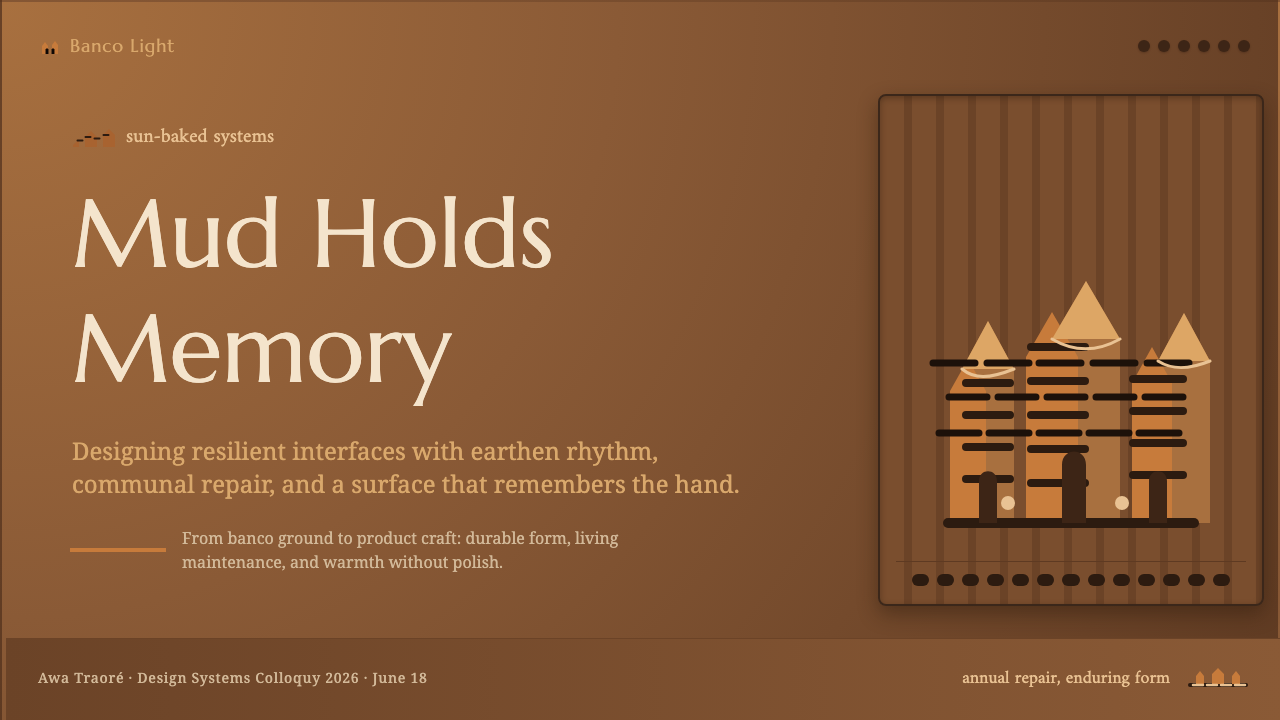
On presentation slides, the system suits cover and section pages where a large, warm ochre field with a subtle grain texture can carry a title the way the mosque's sunlit facade carries its silhouette from a distance. Content slides benefit from using the toron rhythm as a structural divider between sections rather than a decorative flourish, and data should be shown as solid, grounded blocks — mirroring the buttressed, load-bearing forms of the real walls — rather than thin floating lines.
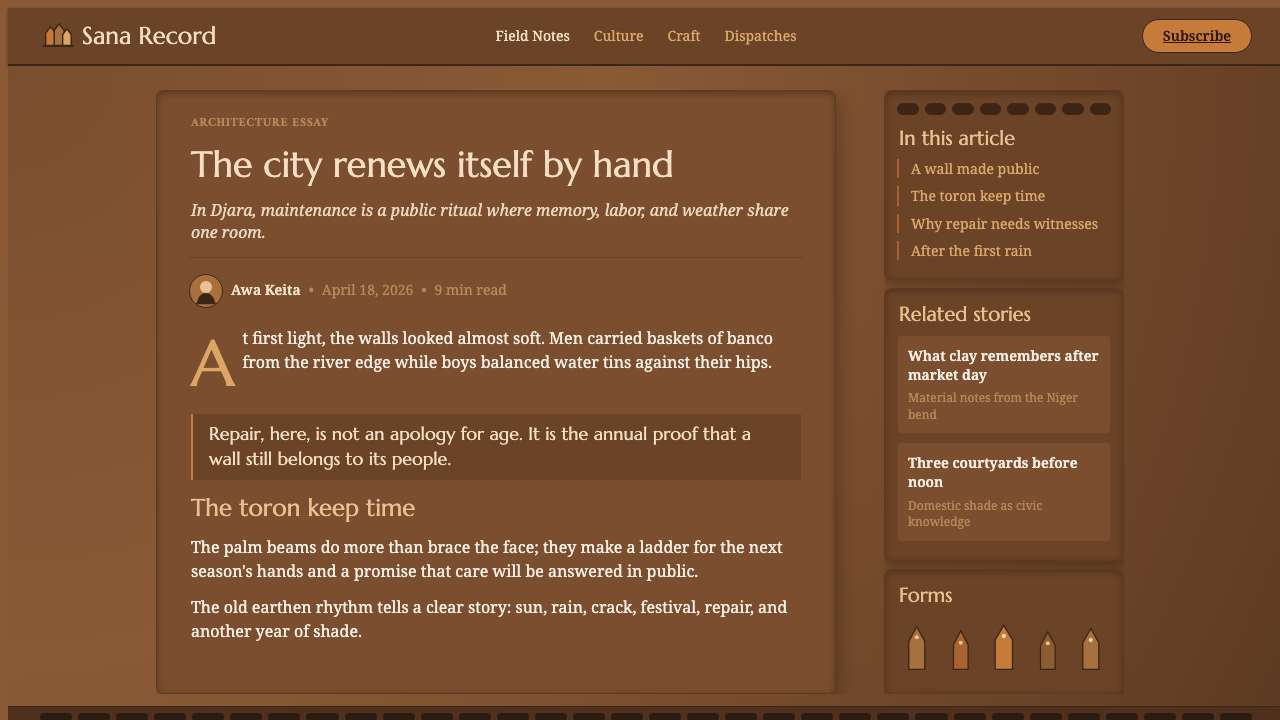
For web interfaces, the system fits products built around craft, heritage, sustainability, or community-made goods, where dashboards and pricing pages benefit from a warm, tactile feel rather than a cold, purely functional one. Cards can taper subtly at their base to echo the buttress form, and section dividers can use the evenly spaced toron rhythm instead of a plain horizontal rule.
In editorial and marketing contexts, the system is well suited to storytelling about tradition, restoration, seasonal ritual, or collective labor — long-form articles benefit from warm ochre-to-umber gradients used sparingly as section backgrounds, and pull quotes can take on the hand-formed typographic quality that distinguishes this system from a clean corporate sans-serif. Marketing hero sections work well when the product is framed as something cared for and renewed, rather than manufactured once and left unchanged.
A common mistake is flattening the palette into a single uniform brown, which erases the light-to-shadow shift from ochre to umber that gives the surface its dimensional, sun-struck quality. Another is overusing the conical silhouette as generic decoration; in the source building, the cone shape is reserved for the mosque's most significant vertical points, and the design should apply the same restraint rather than scattering it everywhere as an ornamental motif.
Djenné Mud Mosque — FAQ
Is the Great Mosque of Djenné really the largest mud-brick building in the world?
Yes — it is widely recognized as the largest mud-brick (adobe) structure on earth, and the most famous example of the wider Sudano-Sahelian earthen building tradition shared by historic trading cities across the West African Sahel, including Timbuktu. Its scale is part of why its annual maintenance is such a significant communal undertaking rather than a small, routine repair.
Why does the mosque need to be re-plastered every year?
Because the entire structure is built from sun-dried mud and finished with a mud plaster called banco, and seasonal rains gradually erode that surface. Rather than switching to a more weather-resistant material, the town preserves the building's authentic earthen character by re-coating it by hand every spring in a communal festival known as the Crépissage, using the projecting toron beams on the facade as built-in scaffolding.
What is banco, and how is it different from ordinary mud?
Banco is the local term for the building material used throughout Djenné's architecture — mud mixed with rice husks or straw to add structural strength and reduce cracking as it dries. It is formed into sun-dried bricks for the wall structure and applied as a smoother render on the surface. The added plant fiber is what allows the material to hold together at monumental scale rather than crumbling like plain dried clay.
What are the projecting wooden beams (toron) actually for?
The toron are bundles of palm wood built directly into the wall as permanent, reusable scaffolding. Rather than erecting new scaffolding every year for the re-plastering festival, masons and volunteers climb and stand on the toron to reach and re-coat the upper walls. Their evenly spaced, rhythmic appearance across the facade is therefore a direct byproduct of a real structural function, not a purely decorative choice.
What is a common mistake when applying this style to a design?
The most common mistake is flattening the color into a single, uniform brown, which loses the shift from bright ochre in direct light to deep umber in shade that gives the real wall its dimensional, sun-warmed quality. A close second is treating the toron rhythm and the conical silhouette as generic decoration to scatter freely, rather than reserving them for structural dividers and points of real significance, the way the actual building does.
Related design styles
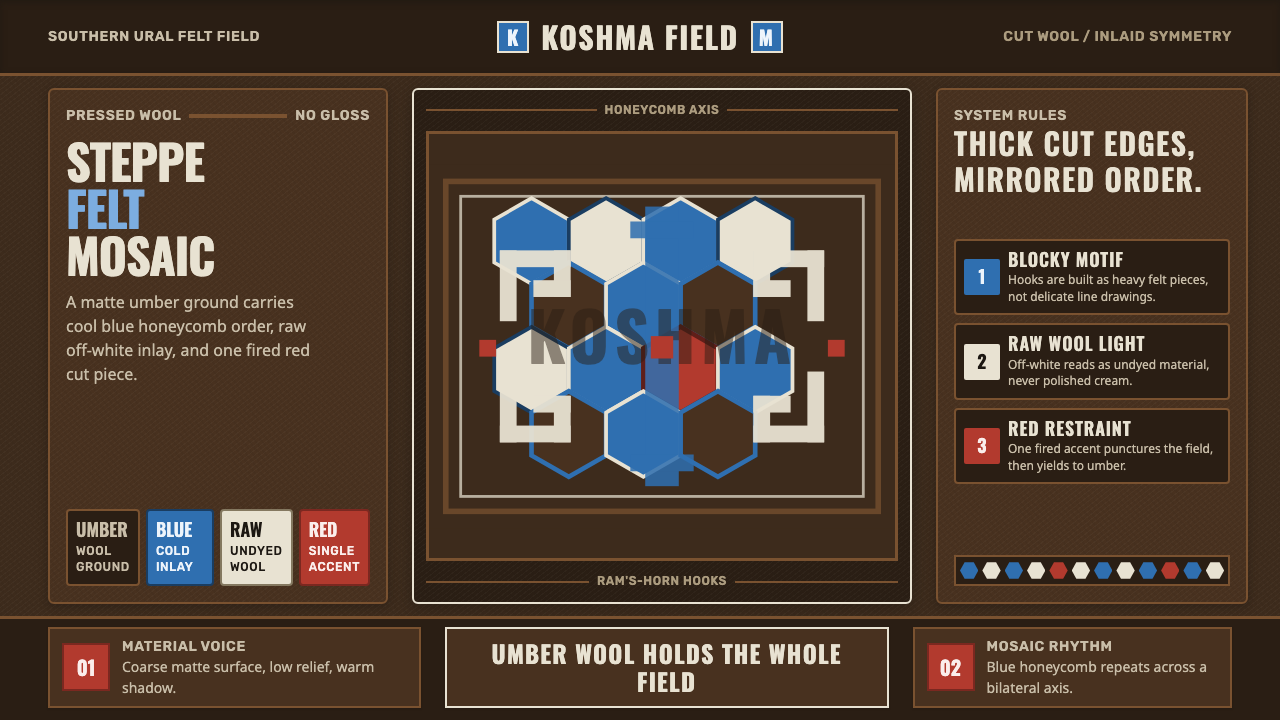 Bashkir Honeycomb Felt OrnamentSteppe craft feels weighty. Umber felt holds blue honeycomb and raw-wool hook…
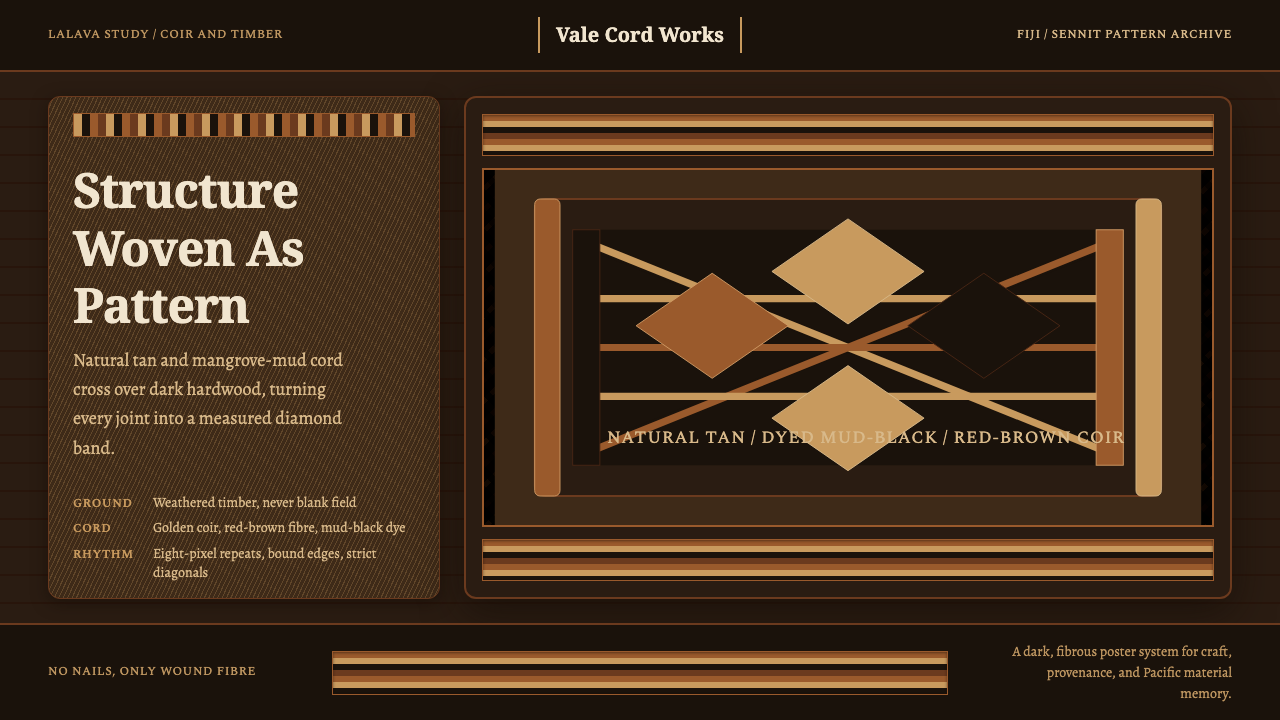 Fijian Magimagi LashingStructure becomes ornament. Tan coir diamonds bind mud-black timber in a stri…
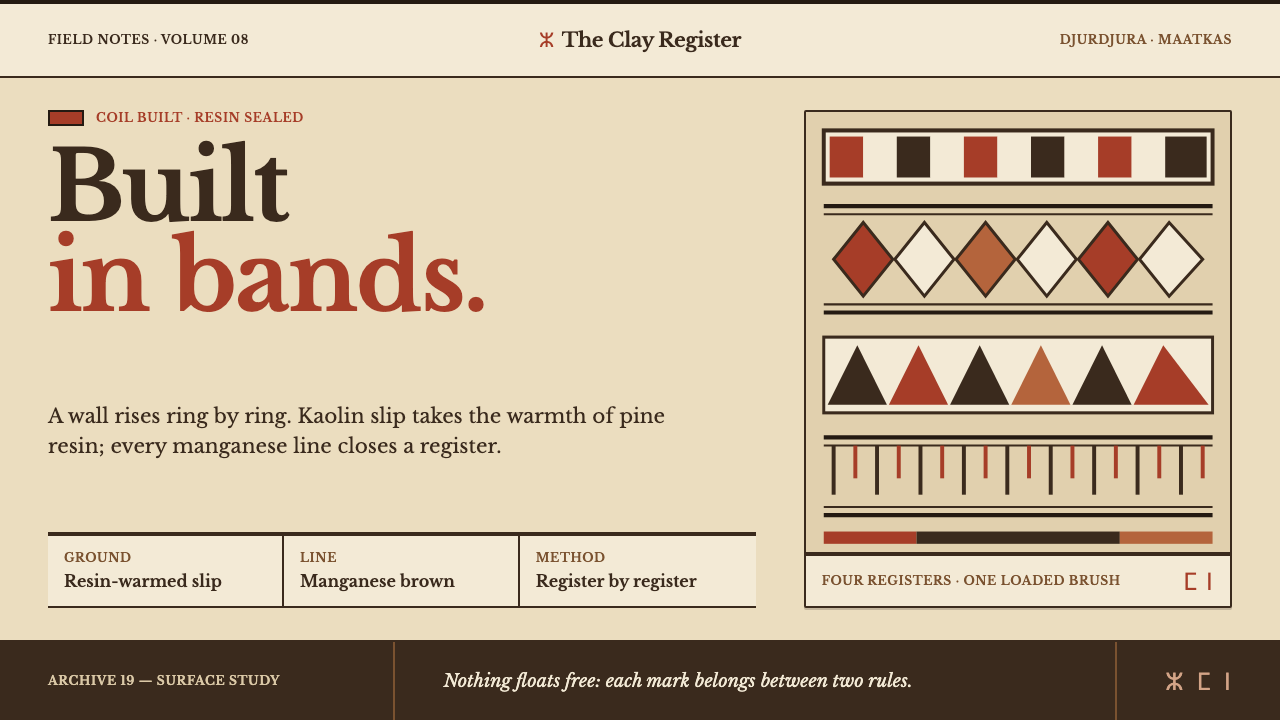 Kabyle PotteryBuilt band by band. Resin-warm kaolin carries manganese rules and iron-red ge…
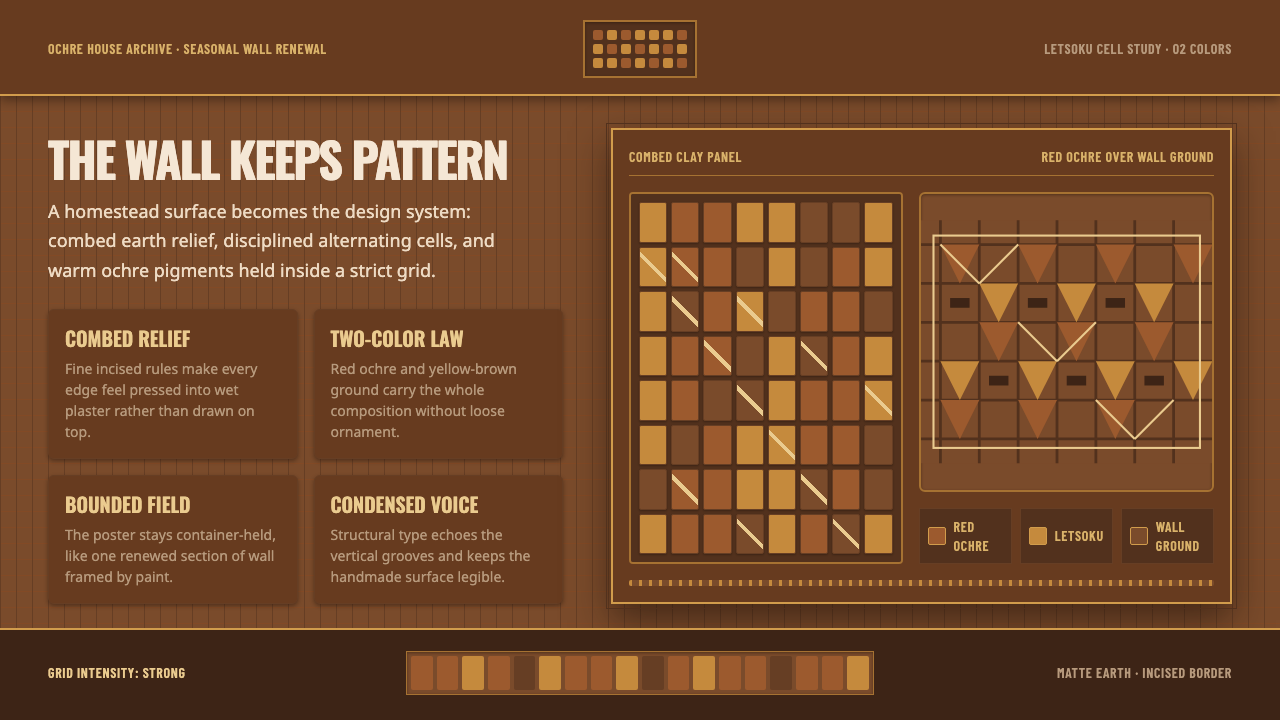 Sotho Litema Wall MuralEarth remembers the hand. Ochre cells and combed borders turn wall into patte…
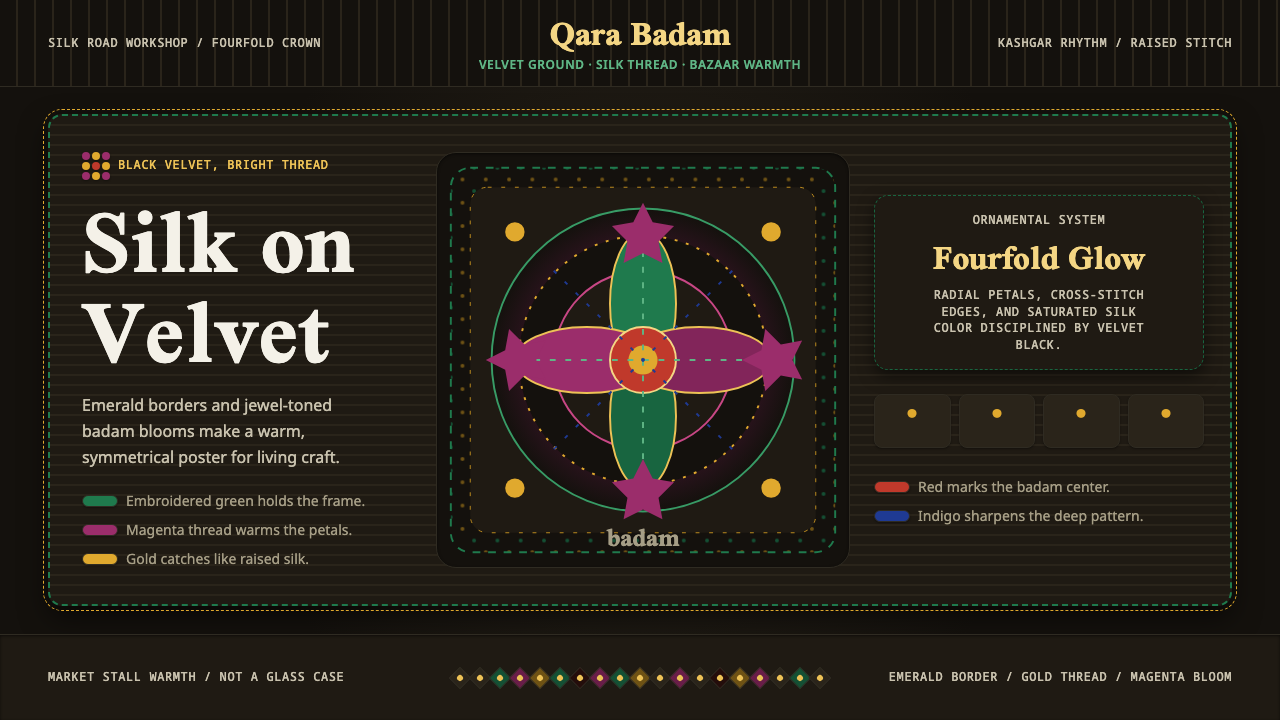 Uyghur Kashgar DoppaVelvet carries the blaze. Emerald borders, gold thread, and badam symmetry gl…
 Ainu Attus RobeProtection is cut, not painted. Indigo bands and square-ended thread hold elm…