What is Swatch Watch (1983)?
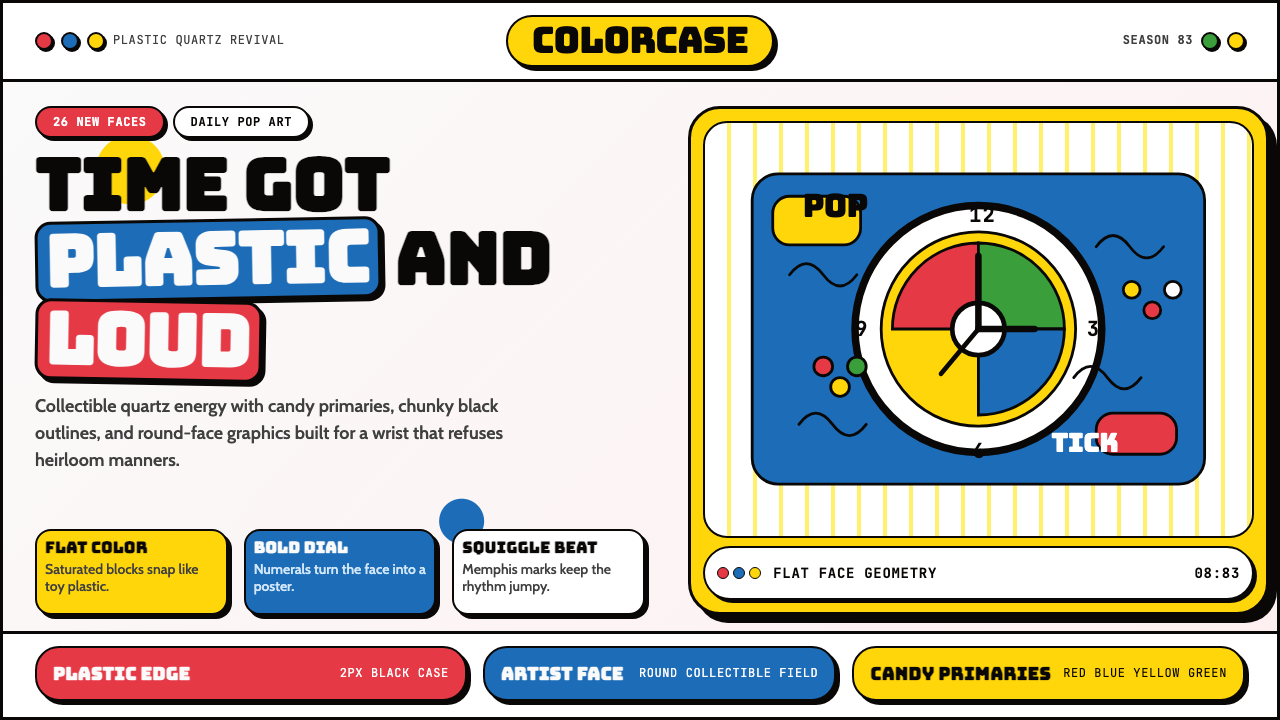
Swatch turned the wristwatch into a daily pop-art accessory — cheap plastic, candy colors, and bold geometry that rescued Swiss timekeeping and redefined fashion's relationship with function.
Swatch Watch (1983) in brief
Swatch is a Swiss watch brand and design language born in 1983 in Biel/Bienne, Switzerland. Its visual identity fuses the playful geometry of the Memphis Group with the saturated optimism of 1980s mass-market consumer culture, producing a look that is simultaneously Swiss-precise and joyfully irreverent. Round dial compositions, thick black outlines, flat candy-bright color fields, squiggle lines, polka-dot grids, and artist-collaborated face graphics define the aesthetic.
The style operates by treating the watch face as a canvas — a small but highly visible circular surface where color, pattern, and typography compete for attention without any of the reserve associated with traditional horology. Swatch dials embrace loudness as a virtue. Background fields are saturated primaries or pastel secondaries; indices and hands are graphic elements rather than functional signifiers; and the entire composition is sealed beneath a plastic crystal that amplifies the toy-like quality of the object.
Beyond the dial, the design language extends to strap graphics, packaging, and marketing materials, all of which share the same vocabulary: flat color, rounded forms, informal hand-drawn lettering alongside bold compressed display type, and an overall sense that the object is meant to be noticed, collected, and worn differently each day. This pop sensibility — the idea that a watch is not an heirloom but a mood — is the philosophical core of the Swatch aesthetic.

Where does Swatch Watch (1983) come from?
The Swatch story begins with a crisis. By the late 1970s, the Swiss watch industry had been devastated by Japanese quartz technology. Brands that had dominated the market for generations suddenly found themselves unable to compete on price or volume. The industry's response, orchestrated in large part by Nicolas G. Hayek and the newly formed SMH group (later Swatch Group), was counterintuitive: instead of competing on precision or prestige, they would compete on personality. The watch would become a fashion object.
Engineers Elmar Mock and Jacques Müller solved the manufacturing puzzle in Neuchâtel: by injection-molding the case and movement together as a single plastic unit, they reduced the part count from around ninety to fifty-one components and enabled a production cost that made a sub-thirty-franc retail price possible. The technical achievement was extraordinary, but it was the design decision that followed which defined the brand. With production costs low enough that the watch could be treated as disposable — or more precisely, as collectible — the surface became free for pure expression. The dial was handed to artists and graphic designers.
The first Swatch collection launched in March 1983 with twelve models. The early releases established the core visual grammar: round white or boldly colored dials, applied graphics that referenced pop art and street culture, and an unmistakable plastic transparency on the strap that showed the mechanism beneath. By 1985, the brand had established its artist-collaboration program, commissioning work from figures including Keith Haring, whose graphic line-figures and thick black outlines translated almost perfectly to the circular dial format. Haring's Swatch designs — produced in 1985 and 1986 — became among the most sought-after collectibles of the decade.
The cultural timing was perfect. The mid-1980s were a moment of intensive cross-pollination between art, commerce, and popular culture. The Memphis Group, founded in Milan in 1981, had spent several years making the case that design could be playful, irrational, and decorative without apology. Andy Warhol had long since established that popular objects were legitimate artistic subjects. Street art was moving from New York walls into gallery spaces. Swatch landed in the middle of all of this as a product that was already all three: functional object, fashion accessory, and collectible artwork. The watch's circular format became a kind of recurring graphic problem solved differently each season, accumulating into an ongoing visual archive of 1980s and 1990s popular aesthetics.
What defines the Swatch Watch (1983) look?
Color
Color is the loudest tool in the Swatch vocabulary. Palettes reach for full saturation without apology: pure primary red, royal blue, canary yellow, and a supporting cast of hot pink, acid green, and electric orange. These are not toned or muted — they are candy-store saturations applied flatly, usually against each other or against clean white. The interaction between high-saturation hues creates the sense of visual energy the style depends on. Pastels appear as a seasonal softening — mint, peach, powder blue — but always retain the flatness and graphic clarity of their louder counterparts.
Round Dial Composition
The circular canvas is the defining constraint of the Swatch design language. Every graphic decision — color fields, pattern repeats, figure placement, typographic elements — must resolve within a circle, a format that encourages radial symmetry, concentric layering, and dynamic rotational balance. This constraint produces a characteristic compositional logic that carries over into non-watch applications: Swatch-inspired design tends to favor circular or oval framing, centered compositions with graphic incidents at the edges, and a strong focal point at the center of a bounded field.
Thick Black Outlines
Heavy black contour lines define and separate color fields, borrowing equally from comic-book illustration, stained-glass craft, and street mural traditions. The outline weight is substantial — thick enough to read clearly at watch-face scale, which is also the scale at which bold graphic mark-making becomes most legible. This technique allows colors to sit adjacent without optically merging, and gives the overall composition a hand-drawn, artisanal quality that contrasts deliberately with the industrial manufacturing context. Keith Haring's collaborations made this characteristic most explicit and most famous.
Squiggles, Dots, and Graphic Pattern
Where the dial surface is not occupied by a primary color field or figurative illustration, it is typically filled with repeat patterns: squiggle lines that evoke neon signage and 1980s interior graphics, regular dot grids, hatched fills, zigzag stripes, or geometric tile repeats. These patterns are drawn from the same visual archive as the Memphis Group — an aesthetic that embraced pattern as decoration and decoration as value. The patterns serve both compositional and expressive functions: they fill space with visual activity and communicate a sense of restless energy.
Flat Plastic Materiality
Swatch design does not pretend to be anything other than what it is: a mass-produced plastic consumer object. The material's glossy, uniform surface is a perfect ground for flat printed graphics — it neither absorbs ink the way fabric does nor adds grain the way paper does. This flatness becomes aesthetic. Color areas are perfectly even, outlines are perfectly crisp, and the entire surface has a slightly unreal, saturated quality that reads as deliberately synthetic. The aesthetic is not in spite of the plasticity but because of it.
Pop-Art Figure and Letterform
When figurative imagery appears on a Swatch dial, it arrives in a heavily reduced form: silhouetted figures, cartoon outlines, pictograms, or expressive line drawings. Letterforms, when used decoratively, lean toward compressed display faces with exaggerated weight contrast, or toward the rounded informal scripts associated with 1980s graphic culture. There is a strong preference for type-as-image — words treated as visual shapes rather than information carriers. The overall effect positions text and image on the same level of graphic materiality.
Collectible Seasonal Variety
Unlike most design systems that aim for a consistent single look, the Swatch visual identity is structurally committed to variation. Each seasonal collection introduces new color combinations, new pattern vocabularies, and new graphic themes. What remains constant is not the specific colors or motifs but the underlying approach: circular canvas, bold flat graphics, saturated palette, thick outlines. The system is a flexible framework rather than a fixed set of components. This makes Swatch a rare example of a brand whose identity is defined by its range rather than its consistency.

Who shaped Swatch Watch (1983)?
As co-founder and chief executive of SMH (later Swatch Group), Hayek was the commercial and strategic force behind Swatch's creation. His conviction that Swiss watches could be repositioned as affordable fashion objects rather than precision instruments was widely dismissed before 1983 and widely imitated after. Hayek oversaw the brand's global expansion through the late 1980s and 1990s, establishing the artist-collaboration program and the collectible model that turned the watch into a cultural event rather than merely a timekeeping purchase.
Mock was the lead engineer who, together with Jacques Müller, solved the technical problem that made Swatch possible: the injection-molded monobloc case that reduced part count and production cost dramatically. Mock later went on to found Creaholic, an innovation consultancy, but his contribution to Swatch was the enabling invention — without the manufacturing breakthrough, the design freedom that defines the brand's visual identity would never have had an economic foundation.
Haring's two Swatch collaborations in 1985 and 1986 are among the most celebrated products of the artist-collaboration program and helped establish the dial as a legitimate gallery-quality surface. His characteristic thick black outlines, radiant figures, barking dogs, and dancing forms translated with uncanny precision to the circular dial format. The Swatch collections brought his work to a mass market audience at a price point far below that of his gallery pieces, while simultaneously lending the watch an artistic legitimacy that reinforced the brand's positioning at the intersection of art and everyday life.
Though not directly involved with Swatch, the Memphis Group — founded in Milan in 1981 under the leadership of Ettore Sottsass — provided the immediate aesthetic climate from which the Swatch visual language emerged. Memphis designs used the same saturated palette, the same bold graphic patterns, the same embrace of plastic as a legitimate material, and the same philosophical rejection of the idea that design must be serious or permanent. Swatch translated Memphis principles from furniture and objects into the watch format, applying them to a mass-market product at a scale and price that Memphis never attempted.
Müller worked alongside Elmar Mock as co-inventor of the Swatch manufacturing concept at ETA SA's Neuchâtel facilities. The two engineers filed the core patents in 1981 and 1982, establishing the technical foundation on which every subsequent Swatch was built. Müller's contribution represents the industrial engineering dimension of the Swatch story — the proof that radical design ambition and radical cost reduction could be achieved simultaneously if the manufacturing problem was rethought from first principles.
How do you use Swatch Watch (1983) today?
The Swatch design language translates surprisingly well to digital and print work far beyond watchmaking. Its core proposition — bold flat color, graphic circular motifs, playful pattern, and the principle that variety is itself a design value — gives designers a rich and immediately recognizable vocabulary. The key to applying it well is understanding that Swatch aesthetics are driven by joyful excess within clear formal constraints: the dial is the constraint, the graphic freedom is the excess. In any application context, the analogous constraint must be identified and honored.
For presentation slides, the Swatch visual language excels on covers and section dividers where high visual impact is the primary goal. A cover slide built in this mode might center a large circular graphic — a bold abstract composition of flat color fields and thick outlines — against a clean white background, with the title set in a compressed display face at large scale. Content slides should strip back to a simpler grid: the pattern-and-color energy is reserved for structural moments (section transitions, data highlights), while body content is carried in legible type against a neutral ground. Data visualization benefits from the candy palette: bar charts and donut charts become graphic objects, with segment colors pulled from the saturated primaries and pastels of the Swatch archive.
For web interfaces, the Swatch aesthetic is most at home in contexts that call for delight and cultural energy: consumer brands, lifestyle applications, portfolio showcases, event pages, and limited-edition product launches. Dashboard and utility interfaces can also use this vocabulary selectively — reserving the saturated color and circular motifs for status indicators, notification badges, and avatar frames while keeping data-dense areas in a neutral register. The risk in web application is visual fatigue: a fully Swatch-saturated interface becomes exhausting over extended use. Apply the vocabulary to the top layer of the experience — hero sections, modals, empty states — and let the operational layer breathe.
For editorial and marketing work, the style's poster heritage makes it naturally suited to high-energy promotional material: event flyers, product launch announcements, campaign landing pages, and social content intended for immediate visual impact. The circular motif works particularly well in circular-cropped photography, record-label style typography layouts, and anywhere a contained graphic unit — a badge, a sticker, a button — needs to carry strong identity. Print work benefits from the style's tolerance for full-bleed saturated color; the flat palette reproduces reliably across screen and offset printing without the color-shift risks associated with gradient-heavy design.
The most common mistake when applying Swatch aesthetics is confusing its loudness with its freedom. The style is not a license to be random. Authentic Swatch design is loud within a tight formal system: the circle is always honored, the outlines are always consistent in weight, and the color palette — however wide — is applied with internal logic, not arbitrarily. A second common error is mixing the saturated pop register with a refined or luxury design language in an attempt to have both. The two systems have incompatible value propositions: Swatch celebrates mass-production, disposability, and democratized joy, while luxury aesthetics depend on restraint, permanence, and scarcity. Attempts to merge them usually satisfy neither.

Swatch Watch (1983) — FAQ
How is Swatch different from Memphis Group design?
Memphis and Swatch share a vocabulary — saturated flat color, bold geometric patterns, decorative surface — but operate at very different scales and with different material philosophies. Memphis was furniture and object design for gallery and wealthy domestic contexts; Swatch was mass-market consumer goods sold at a mass-market price. Memphis rejected modernist functionalism from an intellectual and artistic position; Swatch redirected an entire industrial sector from a commercial one. Memphis pieces were expensive, singular, and collected by design insiders; Swatch pieces were cheap, multiple, and collected by teenagers. The visual results often look similar because both drew on the same 1980s graphic culture, but the underlying logics and cultural positions are distinct.
Can Swatch aesthetics work in a minimal or neutral design context?
Yes, but it requires selective application rather than full immersion. The most effective hybrid approach treats the Swatch vocabulary as a highlight system: a predominantly neutral layout — white ground, restrained typography, generous white space — punctuated by a single circular graphic element or a narrow band of saturated color. This is how the aesthetic appears in many contemporary streetwear and lifestyle brand applications: the surrounding design is quiet enough that the pop element reads as a deliberate, confident choice rather than visual noise. Attempting to apply the full Swatch intensity to a context that depends on calm and restraint will undermine both the original integrity of the style and the communicative goals of the layout.
Does the style work outside of circular formats?
The Swatch design language originated in a circular constraint, and it carries that preference with it: the style naturally gravitates toward circular crops, circular badges, round-cornered containers, and oval framing. That said, the core vocabulary — saturated flat color, thick outlines, graphic pattern — is fully portable to rectangular and grid-based layouts. The approach works in rectangular format when the circular motif is treated as a recurring compositional element rather than the organizing structure. A grid of circular badges on a rectangular page, for instance, or circular color-field inserts within a standard magazine-format layout. The key is that some reference to the circular format should remain as a nod to the style's origin.
How does Swatch aesthetics relate to other 1980s design movements?
Swatch aesthetics sits at the intersection of several 1980s visual tendencies. It shares saturated color and graphic boldness with the Memphis Group. It shares the use of popular culture imagery and the embrace of mass production with Pop Art's later commercial legacy. It shares the layering of pattern and the celebration of surface with 1980s postmodern graphic design as practiced by studios such as April Greiman and the Cranbrook Academy circle. What distinguishes Swatch is the industrial constraint — everything had to work at watch-face scale, in mass production, and at a low price — which forced a simplicity and directness that more academically inclined postmodern work sometimes lacked. The result is postmodern visual culture at its most democratic and most durable.
What makes a Swatch-inspired design feel authentic versus derivative?
Authenticity in Swatch-inspired work comes from honoring the underlying logic rather than copying the surface appearance. The authentic approach starts with the circular constraint: even if the final application is a rectangular web page or a slide deck, the design decisions should be organized around a circular focal point or circular compositional units. From there, color should be applied with conviction — full saturation, not pastel approximations — and outlines, when used, should be consistent in weight and purpose. The derivative mistake is importing the candy palette without the structural logic: saturated colors floating on a layout without containment, without the thick-outline vocabulary that gives them definition, and without the circular motif that gives the whole system its formal identity. Swatch is not a color scheme; it is a compositional philosophy with a color scheme attached.
Related design styles
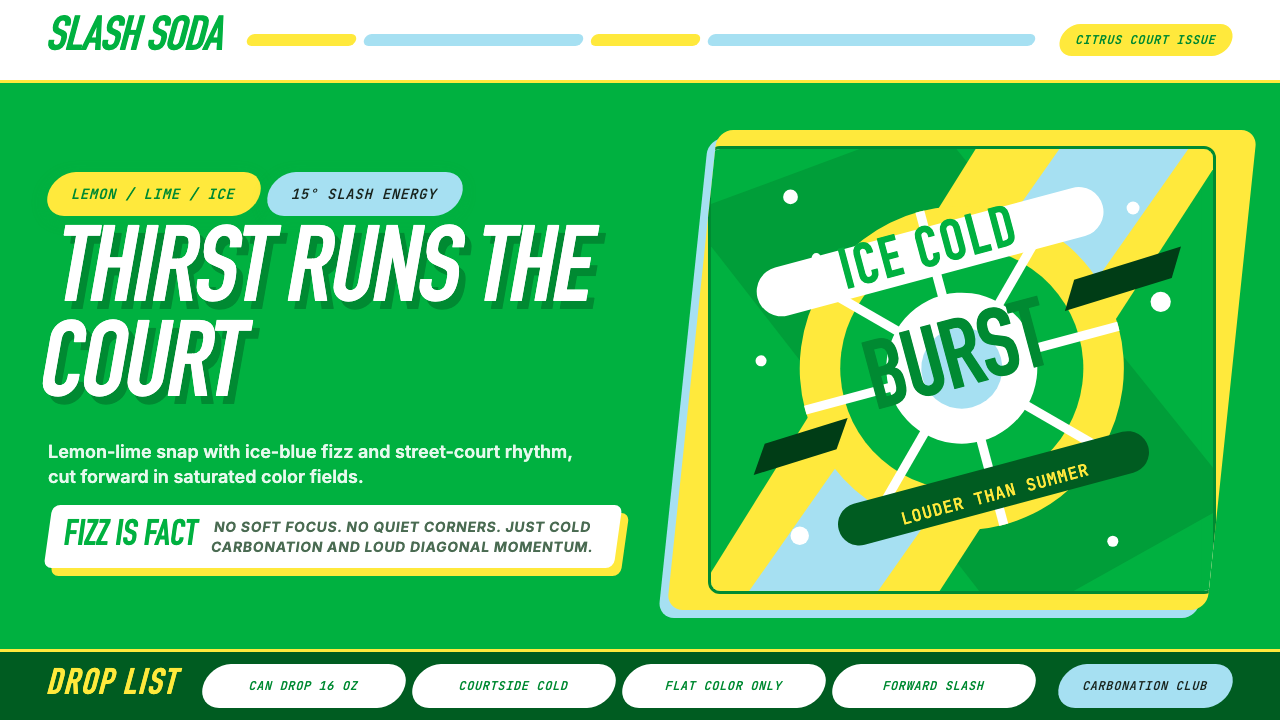 Sprite — Obey Your ThirstCitrus hits like asphalt heat. Saturated green, lemon yellow, and 15° slashes…
 Minecraft VoxelUgly becomes buildable. Grass green, dirt brown, hard bevels, and 16×16 grids…
 Philippines Jollibee Bee MascotJoy shouts first. Red ground, Fredoka curves, yellow pills, chunky grid.
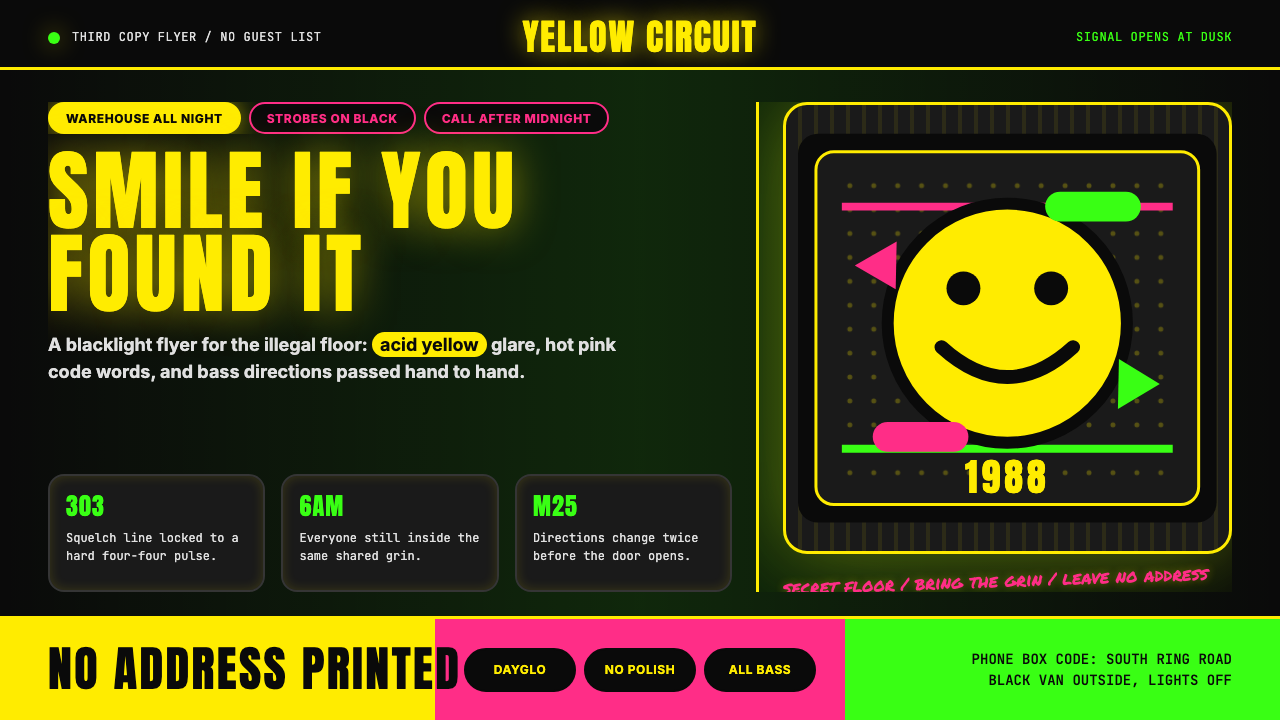 Acid House Smiley (1988)Rave energy hits first. Acid yellow on black, Anton caps, smiley glow.
 Mattel Gak SlimeWet, neon, loud. Acid green gloss smashes through hot orange splats and purpl…
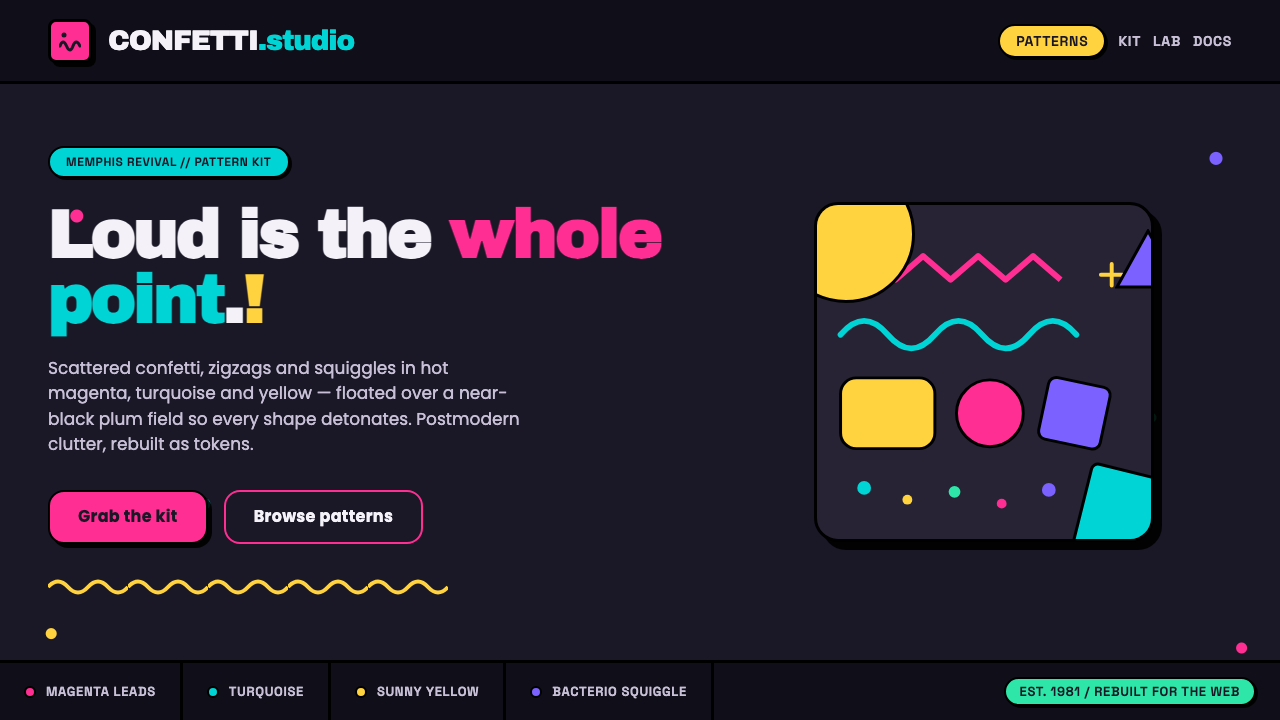 Memphis Web Pattern RevivalLoud is the point. Confetti dots, zigzags and Bacterio squiggles in hot magen…