What is Sprite — Obey Your Thirst?
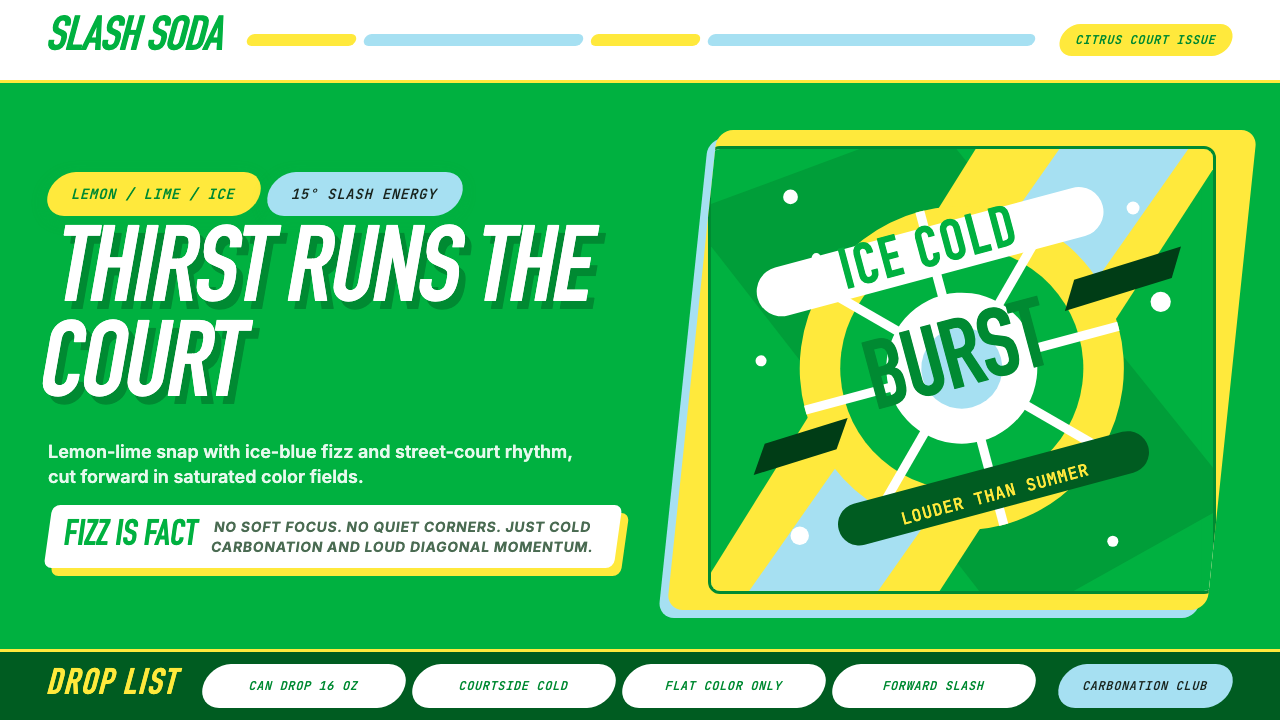
Sprite's citrus-green slash hit the pavement in 1961 and found its cultural soul in 1994 — the moment a soft-drink brand chose hip-hop realness over polished aspiration.
Sprite — Obey Your Thirst in brief
Sprite's visual identity is a citrus explosion — saturated green and lemon-yellow bursts that hit like a cold can on a summer court. The design language is kinetic and unapologetic: diagonal slashes carve through every composition at a consistent angle, ALL-CAPS condensed lettering demands attention without apology, and flat color fields reject atmospheric depth in favor of pure, percussive energy.
What makes this aesthetic distinctive is not individual elements but their choreography. The signature diagonal is not merely a decorative flourish — it is a structural axis that tilts every layout forward, creating a visual momentum that reads as urgency and heat. Green is the dominant note, used at a saturation level that would feel aggressive in almost any other context; against lemon yellow and stark white, it achieves equilibrium through contrast rather than restraint.
The style belongs to a specific cultural moment — the convergence of 1990s street sports culture, the golden era of hip-hop marketing, and the visual vocabulary of athletic packaging — but its underlying logic is timeless: high-contrast color, bold directional geometry, and compressed type that communicates speed. Designers working in this idiom are essentially working with the visual language of confidence.

Where does Sprite — Obey Your Thirst come from?
Sprite was created by The Coca-Cola Company and launched in the United States in 1961, entering a market already contested by 7UP. The early brand visual was functional rather than distinctive — green and silver packaging that signaled lemon-lime flavor without expressing character. For nearly three decades, Sprite occupied a secondary position in the soft-drink category, a reliable product that lacked a cultural identity of its own.
Everything changed in 1994 when Coca-Cola and agency Lowe & Partners launched the 'Obey Your Thirst' campaign. The campaign was built on a direct rejection of the aspirational celebrity endorsement model that had defined soft-drink marketing through the 1980s. Instead of presenting athletes as superhuman achievers whose success was somehow linked to their beverage preference, Sprite's ads placed NBA stars — Grant Hill, Kobe Bryant — in contexts that questioned the very idea of image-driven consumption. The tagline was an instruction: trust your own instincts, not the advertising.
This alignment with hip-hop's foundational value of authenticity over artifice had immediate cultural impact. Sprite became a genuine presence in basketball and rap culture, not through paid placement but through the perception that the brand understood and respected that world. The visual language that accompanied the campaign — saturated green, diagonal energy lines, compressed bold type — was not incidental decoration but an expression of the same attitude: direct, unfiltered, kinetic.
The brand's visual evolution continued into the 2000s and beyond. Turner Duckworth brought systematic identity thinking to Sprite's packaging and communications, sharpening the diagonal-slash motif into a more considered structural element. A significant environmental pivot came in 2022, when Sprite announced the retirement of its iconic green bottle in favor of clear packaging — a decision driven by recycling efficiency rather than aesthetics, but one that shifted the green identity marker entirely onto the label and graphic system. More recently, musician and cultural figure Tyler the Creator appeared in brand campaigns, continuing the brand's tradition of alignment with authentic creative voices rather than conventional celebrity spokespeople.
What defines the Sprite — Obey Your Thirst look?
Citrus Color Pairing
The Sprite palette is built on two colors in extreme tension: a highly saturated mid-green and a sharp lemon yellow, deployed together at full intensity without desaturation or muting. White and stark black serve as structural frames rather than dominants. The relationship between green and yellow is deliberately confrontational — they compete for the eye's attention, and that competition generates visual heat. No neutral intermediaries soften the contrast; the collision is the point.
The Diagonal Slash
Every Sprite composition is organized around a diagonal axis — a hard-edged slash or wedge that cuts across the layout at a consistent forward angle. This is not a decorative accent but the primary structural device: it creates implied motion, divides color zones, and ensures that even a static layout reads as kinetic. The angle echoes the physical form of liquid being poured or a can being opened — organic energy translated into a geometric decision.
Condensed ALL-CAPS Type
Sprite's typographic signature is compressed, uppercase lettering with tight tracking — letterforms that occupy minimal horizontal space while projecting maximum presence. The approach is drawn from sports jersey numbering and athletic advertising, contexts where legibility at speed matters more than elegance at rest. Scale is used dramatically: hero text can dwarf supporting copy several times over, creating an immediate reading hierarchy that requires no decorative scaffolding.
Flat Color Fields
Color areas in Sprite's visual language are applied as flat, unmodulated fields — no gradients, no vignettes, no simulated illumination. This flatness is not minimalism for its own sake but a direct consequence of the style's roots in packaging, poster, and broadcast advertising, where clarity at multiple scales and reproduction conditions is essential. The flatness also amplifies the diagonal geometry: where one color field meets another, the edge is crisp and structural, reinforcing the sense of hard impact.
Sports-Court Energy
The Sprite aesthetic is inseparable from its cultural context: the asphalt basketball court, the worn sneaker, the unrehearsed gesture. This manifests not in literal illustration but in compositional attitude — layouts feel improvised within a tight system, like a pick-up game played under strict rules. Elements are placed at tension with each other rather than in comfortable alignment. The result is designed urgency: something that looks like it happened fast, even when it was carefully constructed.
High-Contrast Legibility
Every Sprite layout is built for immediate legibility under demanding conditions — glanced at from a moving vehicle, seen on a refrigerator door in passing, read on a small screen in bright sunlight. This means maximum contrast at every text-to-background junction, no decorative type treatments that reduce letterform clarity, and no background patterns that compete with foreground information. Legibility is not a constraint on the style; it is constitutive of it.
Anti-Aspirational Directness
Where many consumer brands of the same era used aspirational imagery — lifestyle tableaux, achievement moments, idealized beauty — Sprite's visual language consistently chose confrontation over invitation. Compositions lean in rather than recede; the viewpoint is close and slightly low, a stance borrowed from street photography and basketball court-level camera angles. The aesthetic positions the viewer as a peer rather than an aspirant, which is its most culturally specific quality.

Who shaped Sprite — Obey Your Thirst?
As the parent company that launched Sprite in 1961, Coca-Cola made the pivotal strategic decision in the early 1990s to reposition Sprite away from generic lemon-lime territory and toward authentic cultural alignment. The internal mandate to pursue a younger, street-culture audience — rather than compete directly with 7UP on product attributes — created the conditions for the 'Obey Your Thirst' campaign and the visual identity that accompanied it. Coca-Cola's willingness to let the brand speak in an unpolished register was unusual for a global corporation of its scale at the time.
The advertising agency Lowe & Partners was the creative force behind the 1994 'Obey Your Thirst' campaign that transformed Sprite's cultural position. Their contribution was not merely tagline invention but a complete tonal repositioning: the decision to use hip-hop artists and NBA players in ads that questioned the value of celebrity endorsement rather than celebrating it. This self-referential quality — advertising that critiqued advertising — gave the campaign an authenticity that was rare in soft-drink marketing and drove the visual language toward a rawer, more confrontational aesthetic.
Design consultancy Turner Duckworth brought systematic identity discipline to Sprite at a later stage of the brand's evolution, working on packaging and brand communications to distill the diagonal-slash energy into a cleaner, more scalable system. Their work represents the maturation phase of the visual identity: taking an aesthetic born from advertising energy and translating it into a coherent brand language that could function across packaging, point of sale, digital surfaces, and licensed merchandise without losing its essential attitude.
Tyler the Creator's involvement with Sprite in more recent brand campaigns continues a pattern established in 1994: aligning the brand with artists who represent authentic creative voices rather than sanitized mainstream celebrity. Tyler's visual sensibility — bold color, irreverence, and a refusal to separate personal aesthetic from commercial work — resonates with the brand's original positioning. His presence signals that the 'Obey Your Thirst' ethos remains operative, updated for a generation that consumes brand content through social media and music videos rather than broadcast television.
The NBA stars who appeared in the landmark 1994–2000 Sprite campaigns were not merely endorsers but participants in an argument. The ads placed them in scenarios where their fame and endorsement power were explicitly questioned — a metacommentary unusual in athlete advertising. Grant Hill and Kobe Bryant lent their credibility to a campaign that used their credibility to argue against credibility-based marketing. This paradox was the campaign's central creative tension and the source of its cultural longevity.
How do you use Sprite — Obey Your Thirst today?
The Sprite aesthetic is among the more demanding historical styles to apply correctly in contemporary design work, because it depends on tension as much as composition. The diagonal slash, the saturated color collision, the compressed type — these elements create energy through contrast and confrontation, not through harmony. Applying the style without understanding this principle produces work that feels busy rather than powerful. The designer's primary task is to build controlled tension into every layout decision.
For presentation slides, the style works best when a clear hierarchy is established before any visual treatment is applied. Cover slides benefit from a full diagonal composition: a bold color field occupies more than half the slide, cut by the slash, with the title set in compressed uppercase against maximum contrast. Content slides should resist the temptation to diagonalize everything — the slash is most effective when it appears selectively, as a structural accent on key section breaks or data callouts. Data slides can adopt the visual language of sports statistics: large numerals in condensed type, minimal labels, strong color-coding by category rather than by decoration.
For web interfaces and dashboards, the Sprite palette and compositional logic translate well to environments where information density is high and attention spans are short. Header sections, hero banners, and pricing tier cards are natural fits — the bold color blocking communicates tier differentiation instantly without requiring the user to read fine print. Navigation and body content areas should use a reduced version of the palette, with the saturated green and yellow reserved for key interactive states or alerts. The diagonal motif works in hero sections but should not be repeated at every content level, or it loses its structural meaning.
For editorial and marketing work — social posts, event posters, promotional emails — the style operates at its fullest intensity. A single diagonal axis, two colors from the palette at full saturation, compressed type at strong scale contrast, and flat graphic shapes derived from the brand's circular and wedge vocabulary will produce work that feels authentically in the style. The key discipline is restraint in complexity: one strong idea per composition, not five competing elements. Marketing pages work well with alternating full-bleed panels — green on white, white on green, with yellow as a consistent accent for calls to action and key product claims.
A common mistake when applying this style is treating the saturated green as equivalent to any other brand green, and adding secondary palette elements — tints, gradients, soft shadows, pastels — that neutralize the saturation contrast the style depends on. Equally common is overusing the diagonal: when every element tilts, the tilt loses its meaning and the layout reads as chaotic rather than energetic. Authenticity in this style requires committing to the confrontational quality of the original — high saturation, hard edges, direct hierarchy — and trusting that restraint in decoration produces more energy, not less.

Sprite — Obey Your Thirst — FAQ
How is Sprite's visual style different from general 1990s streetwear graphics?
Sprite's visual identity shares DNA with 1990s streetwear graphics — compressed type, saturated color, diagonal geometry — but is more disciplined in its structural logic. Streetwear graphics of that era drew heavily from skateboarding, graffiti, and underground zine culture, resulting in intentionally rough, layered, maximalist compositions. Sprite's visual system, despite its energy, is a corporate identity refined for mass reproduction at scale: it maintains consistent color relationships, predictable compositional structure, and high legibility across contexts. The key difference is intentionality — Sprite's chaos is designed chaos.
Can the Sprite aesthetic work for premium or luxury products?
Not naturally. The Sprite aesthetic is constitutively anti-aspirational and anti-premium in its foundational logic — it was built specifically to reject the polished, status-signaling visual language of upscale brands. Applying it to a premium product creates tonal dissonance: the high saturation, compressed type, and confrontational diagonal communicate immediacy and democratization, not exclusivity and craft. That said, a sophisticated inversion is possible: some premium brands in streetwear-adjacent categories have used this visual language deliberately to signal that they reject the conventions of luxury, positioning that requires a culturally aware audience to read correctly.
Is the 15-degree diagonal angle a strict rule, or can other angles work?
The specific angle in Sprite's brand system is a proprietary design decision, not a universal principle of the broader aesthetic. What the angle achieves — a sense of forward lean, dynamic division, implied velocity — is the meaningful constraint, not the precise measurement. Other diagonal-led visual systems from the same era used slightly different angles to similar effect. If you are building work inspired by this style rather than reproducing Sprite's actual brand, the key discipline is consistency: choose an angle that reads as active rather than passive, and maintain it rigorously across all compositions rather than varying it element by element.
How does this style handle dark-mode or night-mode contexts?
The Sprite visual system was conceived for light grounds — saturated green and lemon yellow read at their most intense against white or near-white backgrounds, and the structural clarity of the diagonal is sharpest on a light field. A dark-mode inversion introduces complications: on a near-black ground, lemon yellow can become dominant to the point of aggression, while saturated green tends to recede. A well-considered dark-mode variant typically inverts the color logic — using green as a foreground element against near-black, with yellow reserved for accent rather than structural color, and white type rather than black. The diagonal retains its function regardless of ground color.
What is the biggest mistake people make when trying to evoke this style?
The single most common failure is reaching for the color palette while abandoning the structural principles — applying green and yellow to a layout that is otherwise conventionally organized, without the diagonal drive, the compressed type, the flat color fields, and the high-contrast confrontational composition that make those colors meaningful. Color alone does not make the style; the entire system is required. A secondary failure is over-complexity: adding too many competing diagonals, too many type sizes, or too much supplementary color 'to make it more interesting.' The style's energy comes from simplicity in service of impact — one axis, two dominant colors, one clear typographic hierarchy. Additions dilute rather than amplify.
Related design styles
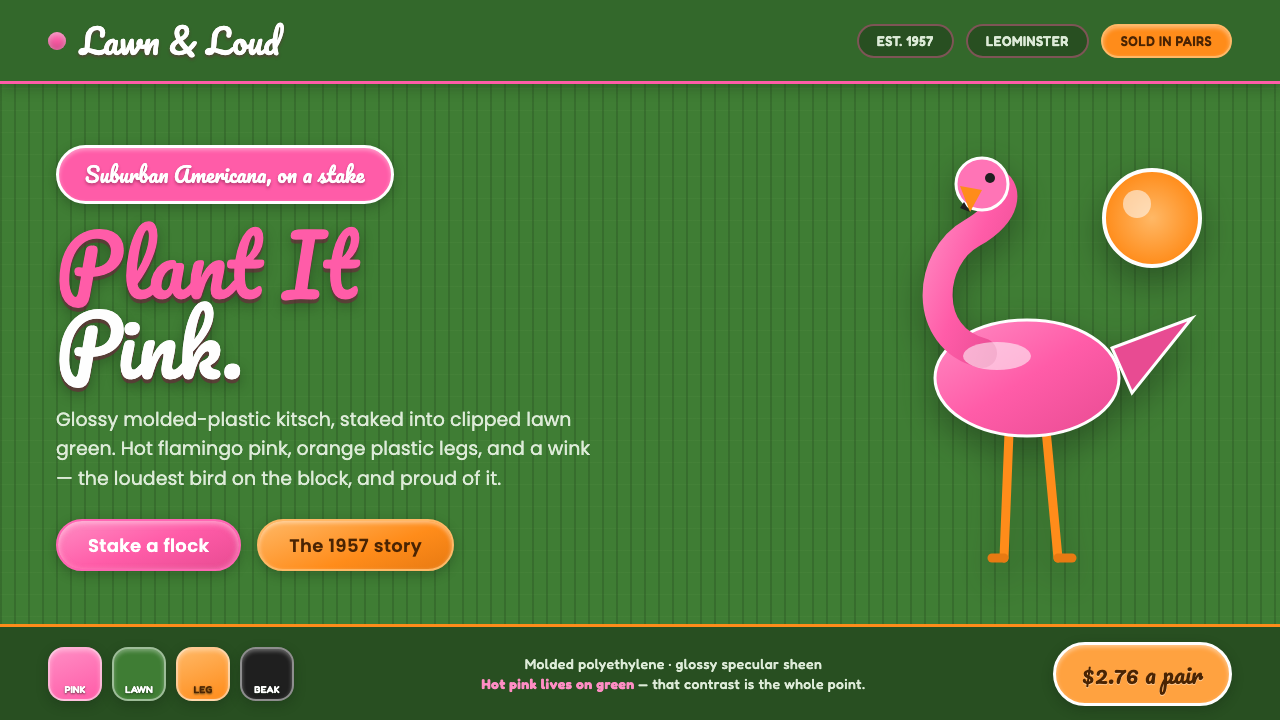 Pink Flamingo Lawn OrnamentLoud on purpose. Hot flamingo pink staked into lawn green, glossy molded plas…
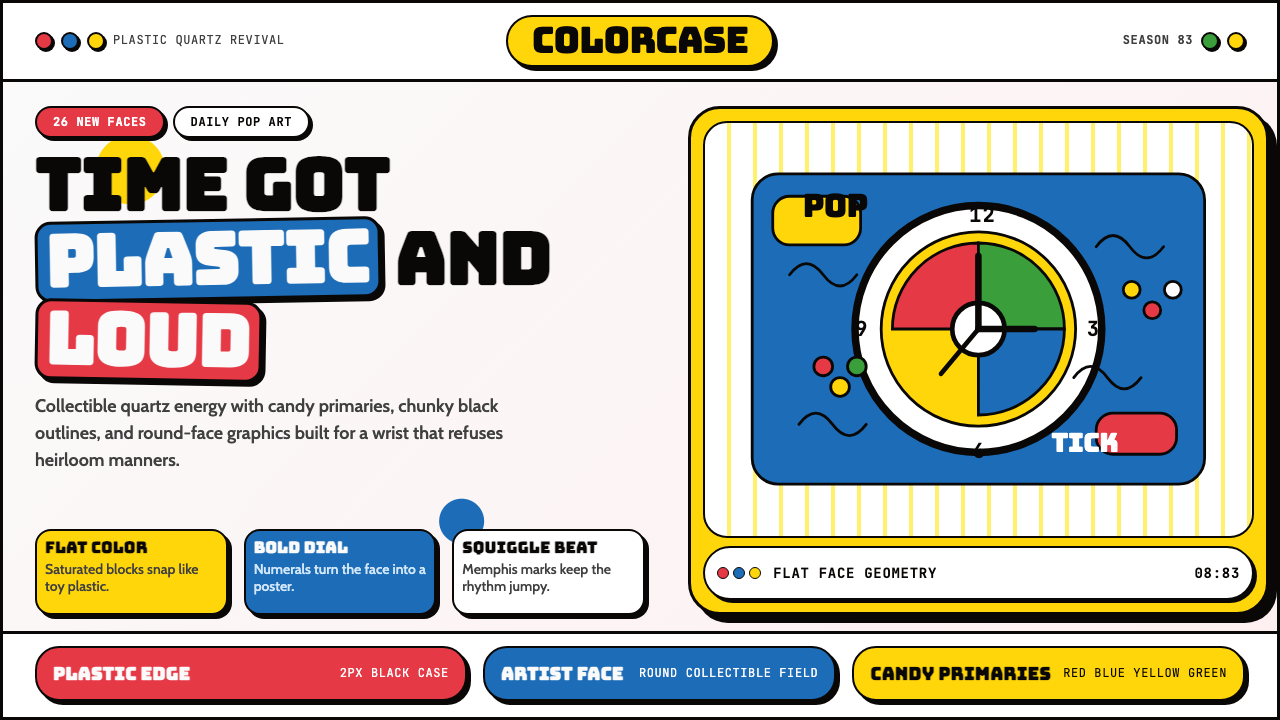 Swatch Watch (1983)Pop plastic optimism. Bungee type, candy primaries, round dials and squiggles…
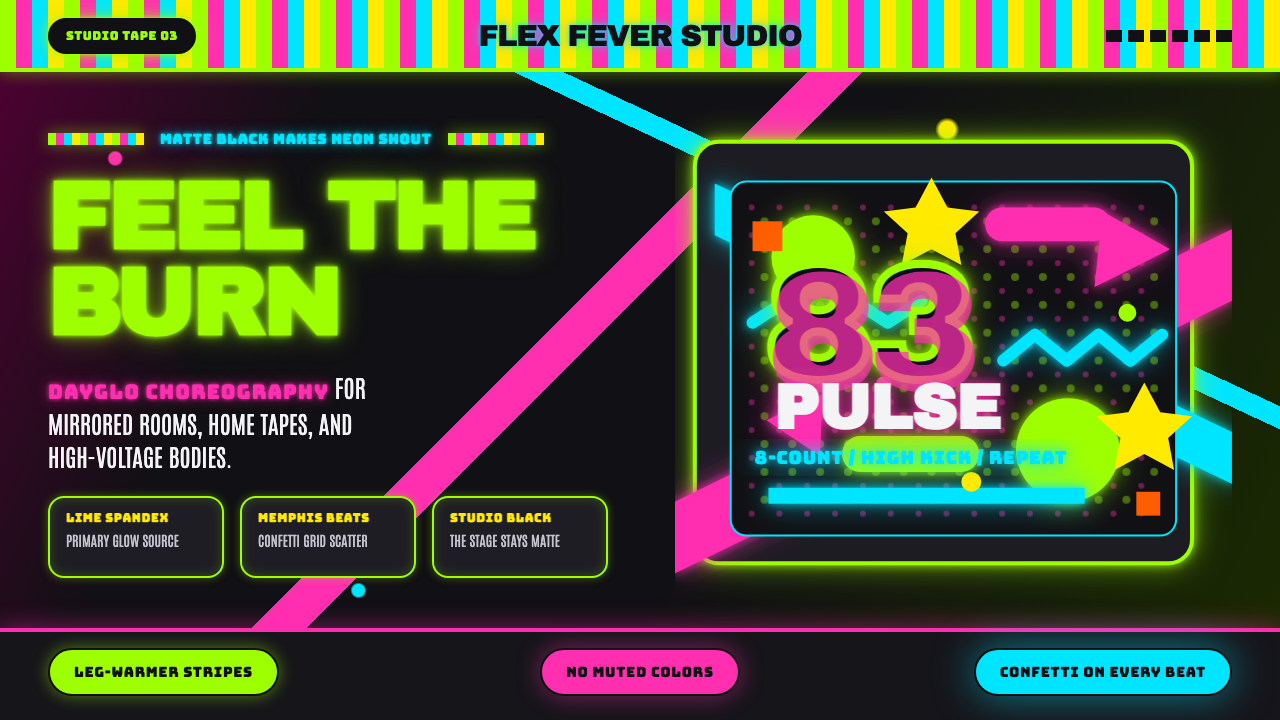 80s Aerobics Fluoro SpandexNeon refuses restraint. Lime spandex, pink-cyan confetti, and black-stage typ…
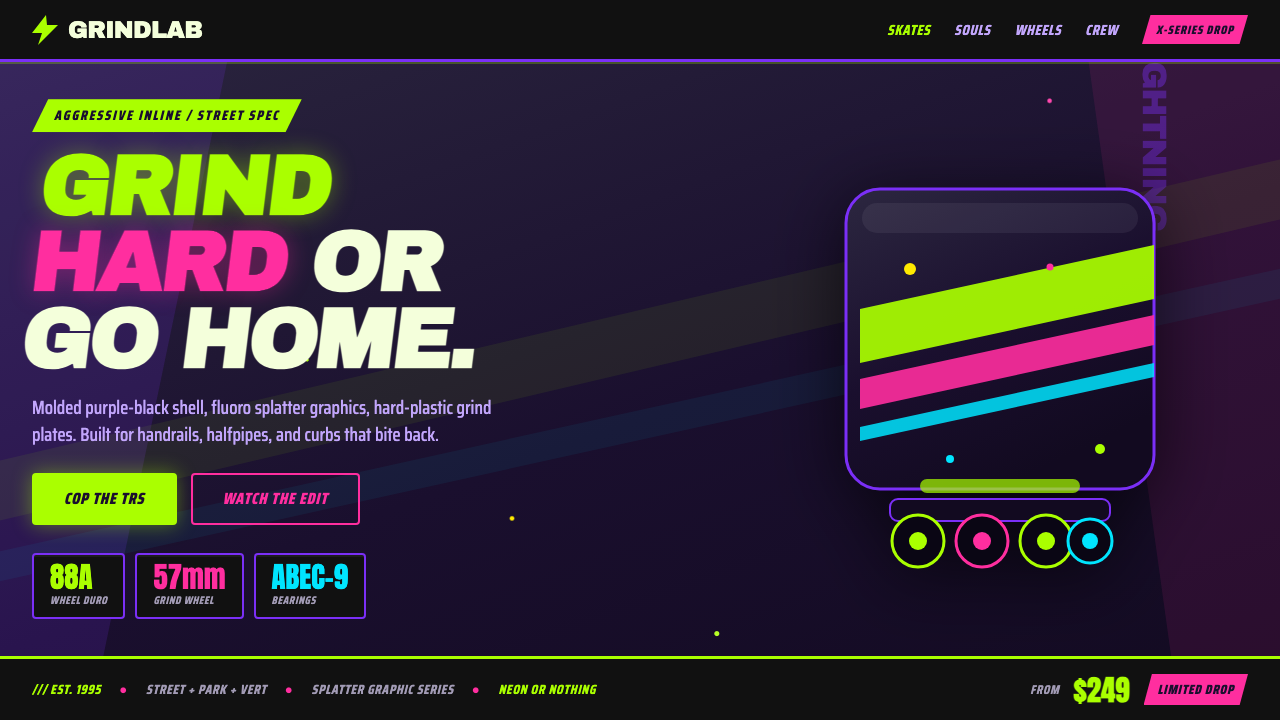 90s Aggressive Inline SkateX-Games attitude in plastic and paint. Fluoro lime and magenta slash across m…
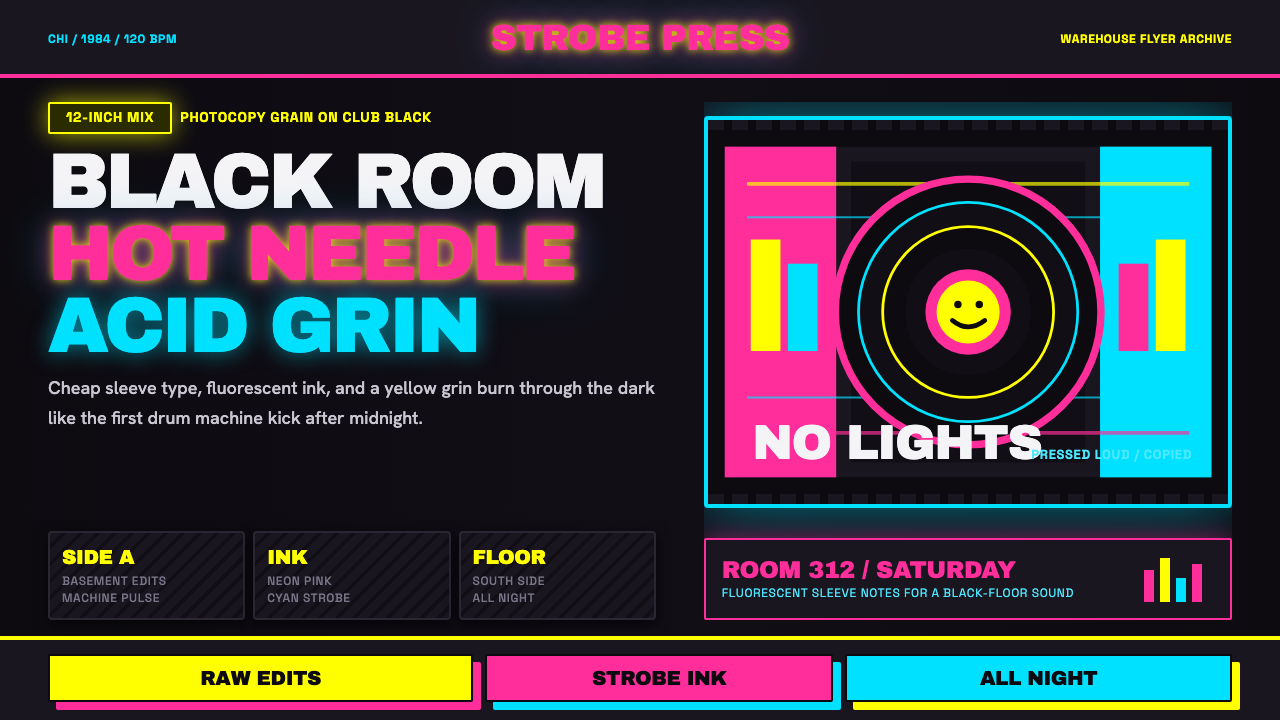 Chicago HouseDarkness starts the track. Neon pink, yellow and cyan hit black like Xerox st…
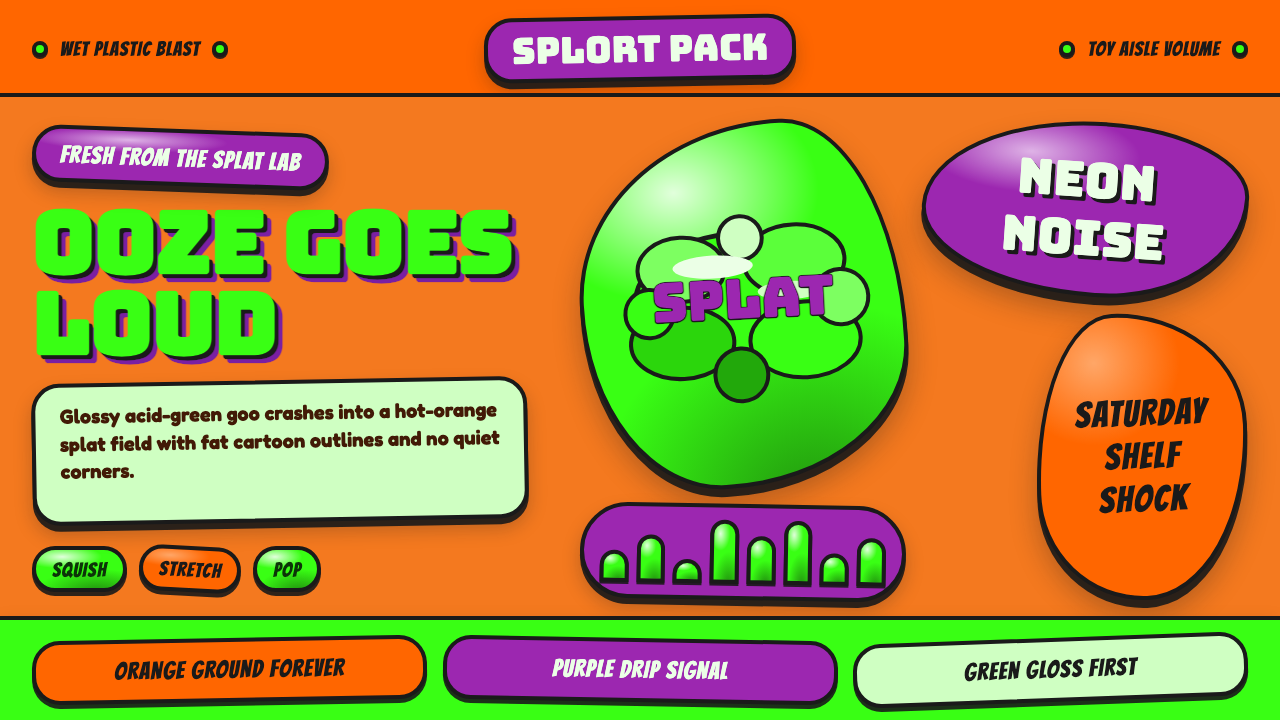 Mattel Gak SlimeWet, neon, loud. Acid green gloss smashes through hot orange splats and purpl…