What is Acid House Smiley (1988)?
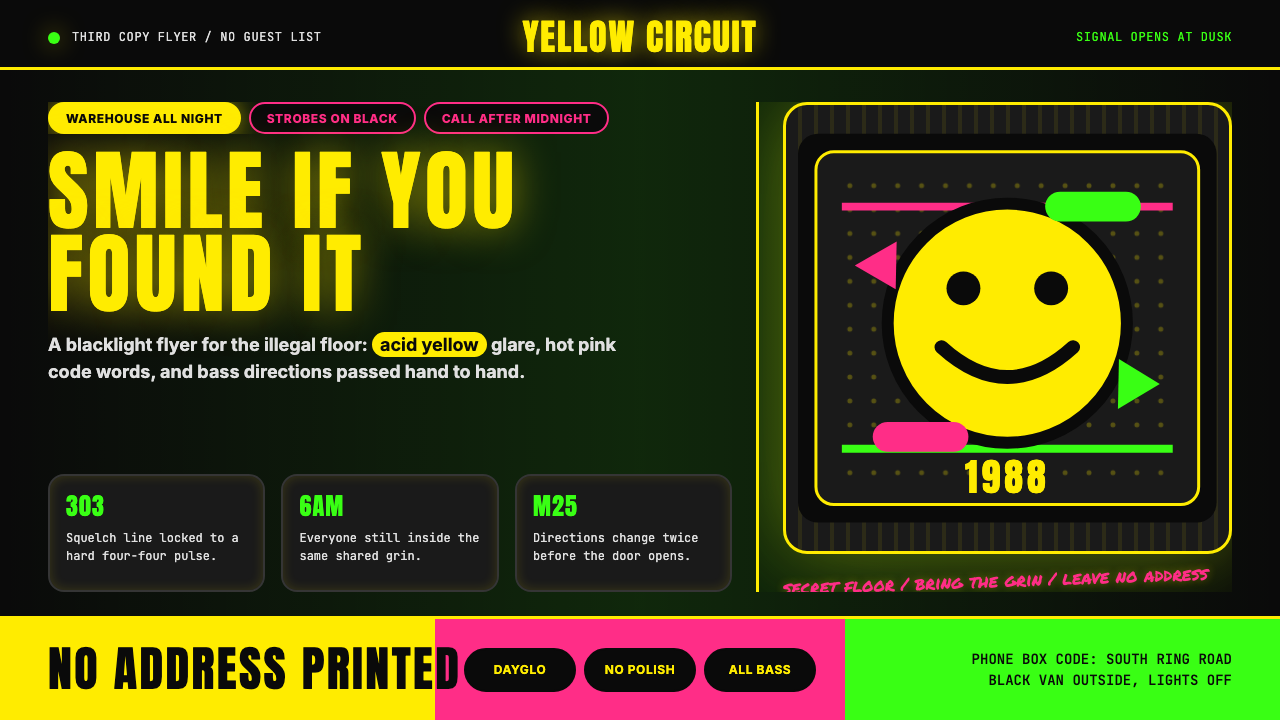
In the summer of 1988, a bootlegged smiley face and a borrowed beat from Chicago turned London's derelict warehouses into the epicenter of a generation-defining cultural explosion.
Acid House Smiley (1988) in brief
Acid House Smiley is a visual language born from the confluence of rave culture, DIY communication, and chemical euphoria on the streets and motorway corridors of late-1980s Britain. Its defining signature is acid yellow — an almost radioactive, dayglo brightness — blazing against absolute black, punctuated by the ubiquitous grinning smiley face that became the movement's universal emblem. The aesthetic is intentionally raw: photocopied textures, chunky all-caps lettering, glow effects that pulse like strobes, and a deliberate roughness that celebrates the artifact of reproduction rather than hiding it.
Unlike design systems built on refinement and polish, Acid House Smiley wears its lo-fi origins proudly. Every element evokes the third-generation photocopy flyer pinned to a lamppost at midnight — the bleed between ink and paper, the slight misalignment of letterforms, the glow halo that appears when black toner saturates at the edges. The result is a visual register that feels simultaneously urgent and joyful, confrontational and communal. It is the aesthetic of a subculture that had no graphic design budget and needed to be seen anyway.
The style's emotional core is euphoric immediacy. Where other bold aesthetics achieve impact through precision and control, Acid House Smiley achieves it through release and abandon. The palette — dominated by that electric yellow, deepened by pitch black, and occasionally punctuated by hot pink or laser orange — is chosen not for refinement but for maximum sensory impact at distance and in darkness. The smiley face, stripped of any nuance or irony, becomes a pure vessel for collective joy.
Where does Acid House Smiley (1988) come from?
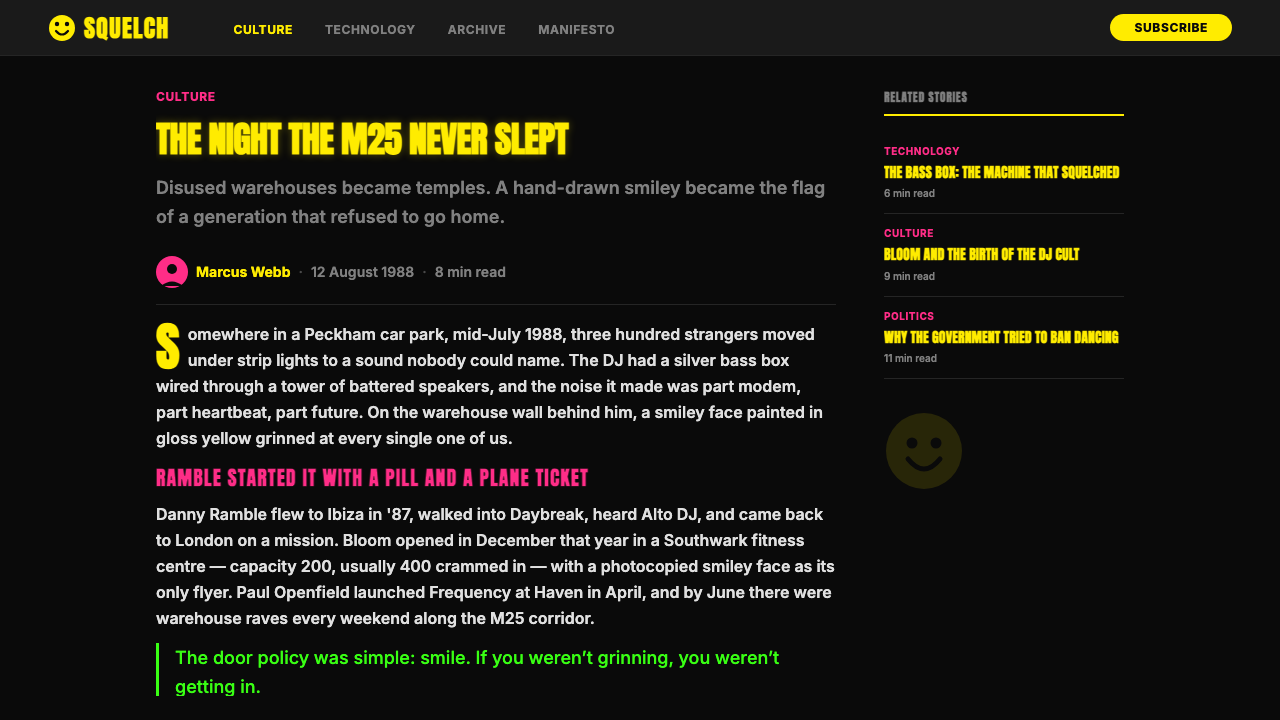
The story begins not in London but in Ibiza, where in the summer of 1987 a group of British DJs — Danny Rampling, Paul Oakenfold, Nicky Holloway, and others — encountered the hedonistic club culture of the Balearic islands. They returned to Britain carrying records, rhythms, and an altered idea of what a night out could be. Within months, Rampling had opened Shoom in a Southwark fitness center, Oakenfold had launched Future at the Heaven nightclub, and a new sonic and visual world was assembling itself out of borrowed parts. The musical catalyst was Chicago house — specifically the acid bass lines produced by the Roland TB-303, a bass synthesizer originally designed to replace session musicians that instead became the defining instrument of a generation when musicians discovered its capacity for writhing, psychedelic sound.
The visual language emerged from necessity. These events were largely illegal — organized in warehouses, disused factories, and fields along the M25 orbital motorway that encircles London — and their promotion relied entirely on word-of-mouth and hand-distributed flyers. There were no budgets for designers or printers. The flyers were produced on photocopiers: a face drawn on paper, some chunky lettering cut from a magazine or hand-stenciled, a phone number that would only be answered hours before the event to give the actual location. The aesthetic of the third-generation photocopy — where blacks bloom and edges lose their sharpness — became inseparable from the culture itself.
The smiley face entered the picture through a combination of accident and appropriation. The yellow button badge with its simple grinning face had existed since the 1960s — designed in 1963 by American commercial artist Harvey Ball for an insurance company's morale campaign, then mass-produced and stripped of its original context. By 1988 it had become generic kitsch. DJ Danny Rampling and his collaborators began using it on Shoom flyers and stamps not as a knowing postmodern gesture but as a direct, unambiguous symbol of the euphoric communal feeling the nights were producing. When the tabloid press in Britain caught wind of the scene in late 1988 and began their predictably panicked coverage, they seized on the smiley face as their visual shorthand, inadvertently amplifying it into a national symbol.
The cultural moment peaked during what participants called the Second Summer of Love — a phrase that deliberately echoed 1967 San Francisco and the first counterculture summer — and then ran hard against institutional resistance. The Entertainments (Increased Penalties) Act of 1990 and then the Criminal Justice and Public Order Act of 1994 specifically targeted rave culture, criminalizing gatherings involving music with repetitive beats. Promoters like Mark Pakenham, who organized massive M25 raves reaching tens of thousands of participants, became the focus of police operations. The movement was criminalized rather than contained; it simply mutated, moving indoors to licensed clubs, fragmenting into drum and bass, jungle, garage, and the dozens of micro-genres that constitute British dance music today. The yellow smiley, briefly an emblem of controlled substances and moral panic, is now a staple of emoji keyboards worldwide.
What defines the Acid House Smiley (1988) look?
Color
The palette is built on maximum contrast: a searing acid yellow — the specific shade associated with dayglo and UV-reactive pigments — set against absolute black. Where secondary colors appear, they lean toward hot pink, laser orange, or electric green, all selected for their visual impact under strobe and blacklight conditions rather than for any ambient coherence. The colors are never muted or graded; they arrive at full saturation, as if overexposed. White rarely appears as a background; when it does, it reads as a negative — a cutout in the black rather than a field in its own right.
Typography
Text is set entirely in capital letters — the all-caps convention reflects both the urgency of flyer communication and the visual compatibility of upper-case forms with photocopier reproduction, where fine details of lower-case letterforms would be lost. The typefaces favored by the original movement were heavy, expanded sans-serifs — particularly the Anton-style condensed grotesques that fill maximum horizontal space with minimum vertical footprint. Letterspacing is tight, sometimes tracking letters so closely they risk merging, creating a visual density that mirrors the packed warehouse floor. Hierarchy is expressed through size alone; there are no decorative dividers or sub-headers in a different typeface.
Glow and Radiation
Shadows — in the conventional sense of depth cues — are absent. In their place is the opposite: glow. Elements appear to emit light rather than cast shade. The yellow smiley face blooms outward against black, its edges softened not by a blur applied in post but by the physical overexposure of a fluorescent object under ultraviolet light. This glow effect is the style's primary depth mechanism — it creates the impression that elements float in darkness rather than sit on a surface. Rendered digitally, it is achieved through layered soft-edged halos rather than any single technique, and it must preserve the feeling of organic saturation rather than clean graphic precision.
Photocopy Grain and Roughness
The aesthetic does not conceal its origins in reproductive technology — it celebrates them. Grain, bleed, the slight smearing of a photocopied edge, ink saturation at corners: these are not flaws to be removed but qualities to be amplified. The roughness signals authenticity within the subculture's own value system, distinguishing handmade communication from commercial polish. In digital applications, this quality is introduced through noise layers, halftone dots, or subtle misalignment of elements — the deliberate imperfection that makes a designed object feel found rather than constructed.
The Smiley Face as Structural Motif
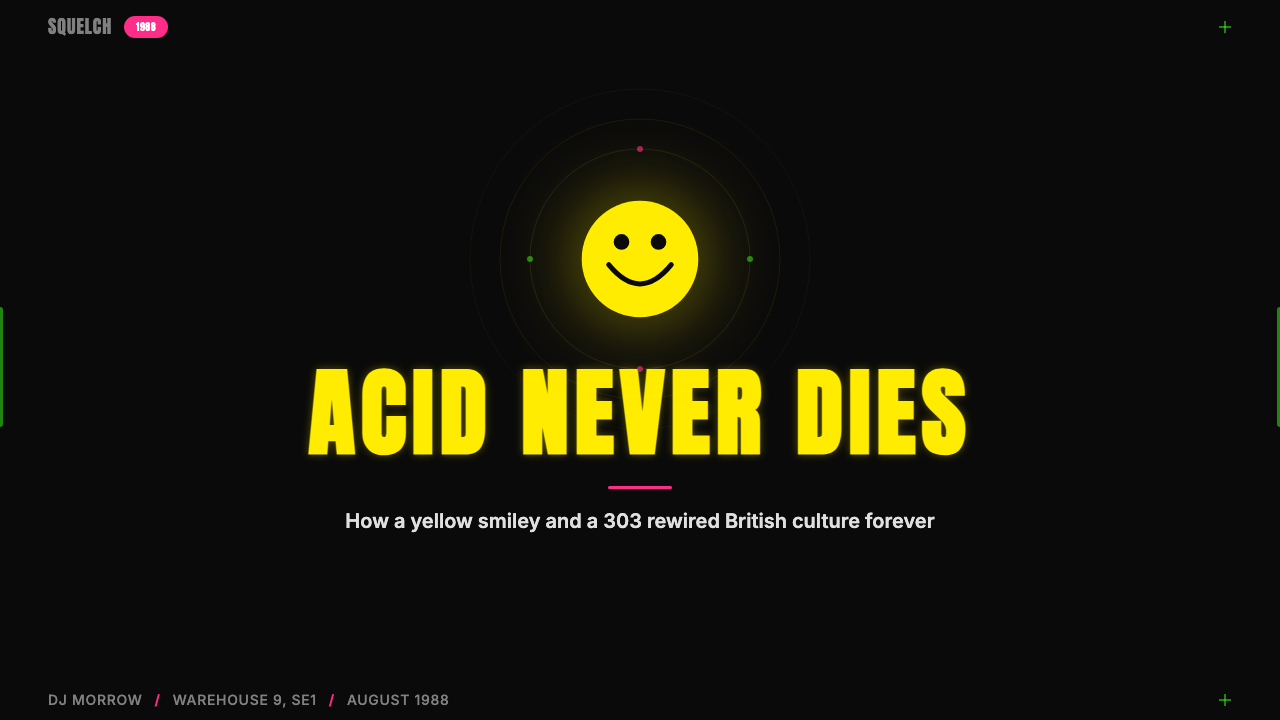
The smiley face in this system is not an illustration or a decorative element — it is a structural anchor. Visually, it functions as a circle with high internal contrast: dark dots for eyes, a curved line for the mouth, against a saturated yellow field, all surrounded by black. Its simplicity makes it infinitely scalable and reproducible without quality loss — equally legible on a small flyer or a warehouse-sized banner. When used at scale, the smiley anchors compositions in the same way a geometric primary form does in other systems: it centers the visual mass and radiates outward through the glow effect.
Composition: Urgency Over Hierarchy
Acid House flyers were not designed — they were assembled under pressure, in the hours before an event, for immediate consumption. The compositional logic reflects this: elements are placed for maximum impact at a glance, not for careful sequential reading. The smiley or primary image occupies the center or fills the frame; text wraps around it or runs beneath in a dense block. There are no margins in the conventional sense — content presses to the edges. Secondary information (phone numbers, dates, location codes) is treated as a text block of uniform weight, different from the headline only in size. The overall impression is of a surface saturated with information and energy, with every element competing equally for attention.
Scale and Repetition
Elements in this system are not drawn from a diverse library — they repeat. The smiley face at multiple sizes, the same typeface in different scales, the same yellow repeated against black in consecutive panels: repetition with variation rather than variety. This reflects both the musical logic of the culture it emerged from (the house track as an extended repetitive loop with small variations) and the practical logic of photocopier flyer production, where a single template could be resized and overprinted efficiently. In contemporary use, this characteristic is an asset: a composition built from repeated identical elements at varying scales achieves rhythm and intensity simultaneously.
Who shaped Acid House Smiley (1988)?
Rampling is the DJ most directly responsible for translating the Ibiza experience into London's acid house scene. His club night Shoom, which opened in January 1988 at a Southwark fitness center, was the crucible in which the aesthetic and social conventions of the movement were first established. Shoom's visual identity — hand-stamped smiley faces on the wrist at the door, photocopied flyers with grinning yellow faces — set the template that the broader scene adopted. Rampling's curation was as important as his DJing: he shaped the specific emotional register of the nights, the sense that the space was a temporary autonomous zone where normal social rules were suspended.
Oakenfold was among the original group of DJs who traveled to Ibiza in 1987 and returned to Britain with a transformed vision of dance culture. His residency at the Heaven nightclub and later at Manchester's Haçienda helped spread the acid house sound and visual language beyond London. Oakenfold's importance is partly strategic: he moved between the underground and the mainstream more fluidly than many of his contemporaries, eventually becoming one of the most commercially successful DJs of the 1990s while maintaining credibility with his original audience. His trajectory mirrors the movement itself — from illegal warehouse to legal venue to global cultural phenomenon.
Holloway was the third key figure in the original Ibiza group and the organizer of Special Branch, one of the foundational acid house party series. His contribution was organizational rather than sonic: he understood how to scale the experience, moving from small club nights to events holding thousands of people while maintaining the intimacy and intensity that had characterized the early Shoom nights. The logistical innovation required to organize an illegal event for ten thousand people in a field off the M25 — with generators, sound systems, and information security tight enough to stay ahead of the police — was as significant a cultural contribution as the music.
Pakenham was one of the key organizers of the massive M25 motorway raves that defined the peak of the movement in 1988 and 1989, with some events drawing crowds estimated between ten and thirty thousand people. These were not clubs or venues — they were temporary cities assembled in fields, complete with multiple sound systems, market stalls, and their own internal social geography. The scale of these events required an entirely new logistical and visual vocabulary: enormous banners, spray-painted directional signage, and flyers distributed through networks that resembled nothing so much as samizdat publishing. Pakenham became a focus of legal action and the 1994 Criminal Justice Act was partly shaped by the challenge his events presented to conventional policing.
Ball designed the original smiley face in 1963 for the State Mutual Life Assurance Company in Worcester, Massachusetts — a simple circular badge intended to boost employee morale following a corporate merger. He was paid a reported forty-five dollars for the design and never trademarked it. By the 1970s the design had been mass-produced by the billions and had entered the global visual commons. His presence in this story is significant precisely because of his absence from it: the smiley that became the symbol of acid house was divorced entirely from its origin. Ball's cheerful corporate morale emblem was transformed by context, chemistry, and collective experience into something he could never have intended — a symbol of collective abandon and subcultural defiance.
How do you use Acid House Smiley (1988) today?
Acid House Smiley is one of the most directionally specific styles in the library — its tonal range is narrow but intense. It works with extraordinary force in contexts where the goal is immediacy, energy, and a kind of joyful confrontation: event promotion, night-time brand experiences, music-adjacent products, and anything that wants to signal authenticity within youth and underground culture. It works less well — and should be used with caution — in contexts that require trust-building over time, professional authority, or visual warmth. The acid yellow on black carries inherent associations with nightlife, altered states, and subcultural resistance. These are powerful associations; they are also limiting ones.
For presentation slides, this style is most effective when used for covers and section breaks rather than extended content. A cover built on acid yellow and black with the smiley face large and centered creates an immediate and memorable first impression. The challenge is the content slides: extended body text in this aesthetic becomes fatiguing quickly, and the all-caps convention that the style demands reads as aggressive over long passages. The practical solution is to use the aesthetic selectively — establish it on the cover and major dividers, then transition to a stripped-down version on content pages that retains the color palette but reduces the density and glow effects. Data slides work well with this approach: dark backgrounds with electric yellow accent bars or lines create genuine visual drama without overwhelming the data itself.
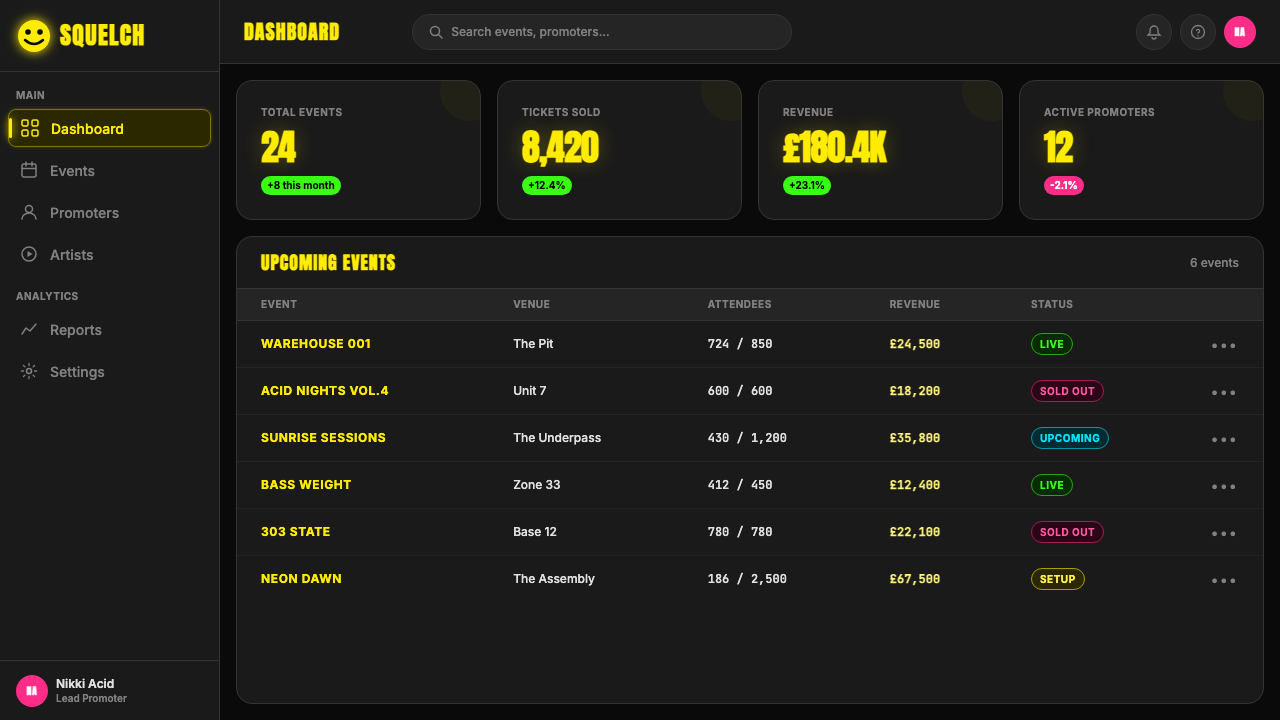
For web interfaces and digital products, this style is best suited to landing pages, event microsites, and marketing one-pagers rather than functional application interfaces. A dashboard built entirely on this aesthetic would be exhausting to use for extended periods — the high contrast and glow effects that make it compelling at a glance create visual fatigue over hours of use. Used selectively, however — as the palette for a dark mode that users can toggle, or as the visual language for empty states, celebrations, and high-impact notifications — it can energize an otherwise neutral interface without dominating it.
For editorial and marketing work, the style excels in contexts where the reader relationship is participatory rather than authoritative. Music journalism, cultural event programs, festival branding, and nightlife-adjacent hospitality are natural homes. The key restraint is hierarchy: because the style pushes every element toward maximum saturation and impact, maintaining readable information hierarchy requires deliberate counterforce — significant size differentials between heading and body text, clear spatial separation between information blocks, and a willingness to let the background black do the work that white space normally does.
The most common mistake when applying this style is softening it into acceptability — using pastel yellows instead of acid yellows, introducing soft shadows to reduce the harshness, smoothing the grain. These adjustments are understandable as attempts to broaden the audience, but they reliably destroy what makes the style interesting. Acid House Smiley's power comes precisely from its refusal to be comfortable. A second common error is deploying the smiley face as decoration rather than as structural anchor: scattered small smileys across a layout read as clip art rather than as the central organizing motif the style demands. Use it large, use it centrally, or do not use it at all.
Acid House Smiley (1988) — FAQ
Is Acid House Smiley appropriate for commercial brands, or is it too subcultural?
It depends entirely on what the brand wants to signal. The style has been successfully adopted by mainstream fashion, streetwear, music streaming platforms, and festival brands — contexts where the association with youth culture, energy, and underground authenticity is a commercial asset. It works less well for brands that need to convey stability, expertise, or institutional trust. The key question is not whether the brand is commercial but whether its target relationship with its audience is participatory and peer-level. A bank should not use this style. A festival ticket platform, a music label, or a streetwear brand might find it precisely right.
How does this style differ from other high-contrast dark aesthetics like cyberpunk or vaporwave?
All three are dark-background, high-contrast aesthetics rooted in specific subcultural moments, but their emotional registers are distinct. Cyberpunk tends toward cool blues, greens, and purples — the palette of surveillance, technology, and dystopian alienation. Vaporwave is pastel, nostalgic, and ironic — the aesthetic of late-capitalist melancholy softened by retromania. Acid House Smiley is warm, communal, and ecstatic — its yellow is not the yellow of caution or technology but of daytime euphoria transported into darkness. The smiley face is the key differentiator: it is the most purely joyful symbol in the visual vocabulary, stripped of irony, and that unironic joy is what makes this style unique among dark aesthetics.
Can this style work on light backgrounds, or is the dark background essential?
The dark background is not merely a preference — it is structural to how the style works. The glow effect that gives the style its signature quality requires darkness to read: a glowing smiley on black looks like it is emitting light; the same treatment on white looks like a blurred print. The acid yellow, which is the style's defining color, reads as electric and intense against black and as simply yellow against white — the psychological impact is substantially diminished. A light-background variant is possible but it becomes a different aesthetic entirely: more pop art than rave, more graphic design reference than subcultural artifact. If a light background is genuinely required by the context, consider whether a different style better serves the project.
How do I use the repetition characteristic without making the design feel monotonous?
The key is variation in scale rather than variation in element. Acid House Smiley uses the same small vocabulary — yellow, black, the smiley, heavy caps — repeated across the composition, but the repetition generates rhythm rather than monotony because the elements appear at radically different sizes. A composition might feature one enormous smiley face filling most of the frame, a medium smiley at the corner, and several small ones scattered in the negative space. The size differential creates hierarchy and movement even when every element is identical in color and form. What to avoid is elements repeated at the same size, which does produce the monotony the style otherwise avoids. Think of it as the visual equivalent of a house music loop: the same elements cycling, but each appearance at a different level of intensity.
What happened to the original acid house scene, and does using this style carry any cultural baggage?
The original scene was criminalized by British legislation in the early 1990s, which scattered rather than destroyed it — the culture simply moved indoors and fragmented into the dozen-plus micro-genres that define British electronic music today. The cultural baggage is real but manageable. The style is historically associated with MDMA use, which gave rise to the tabloid moral panic that defined the movement's public image. In contemporary use, the direct drug connotation has faded: the yellow smiley face is now a global emoji, the music has been absorbed into mainstream pop culture, and the aesthetic reads primarily as energetic, nostalgic, and joyful rather than specifically pharmaceutical. There are contexts — healthcare, education for young children, corporate communications — where the historical associations remain live enough to make the style an inadvisable choice. For most cultural and commercial contexts, however, the aesthetic has passed into the general vocabulary of expressive design, and its origins are now part of its richness rather than a liability.
Related design styles
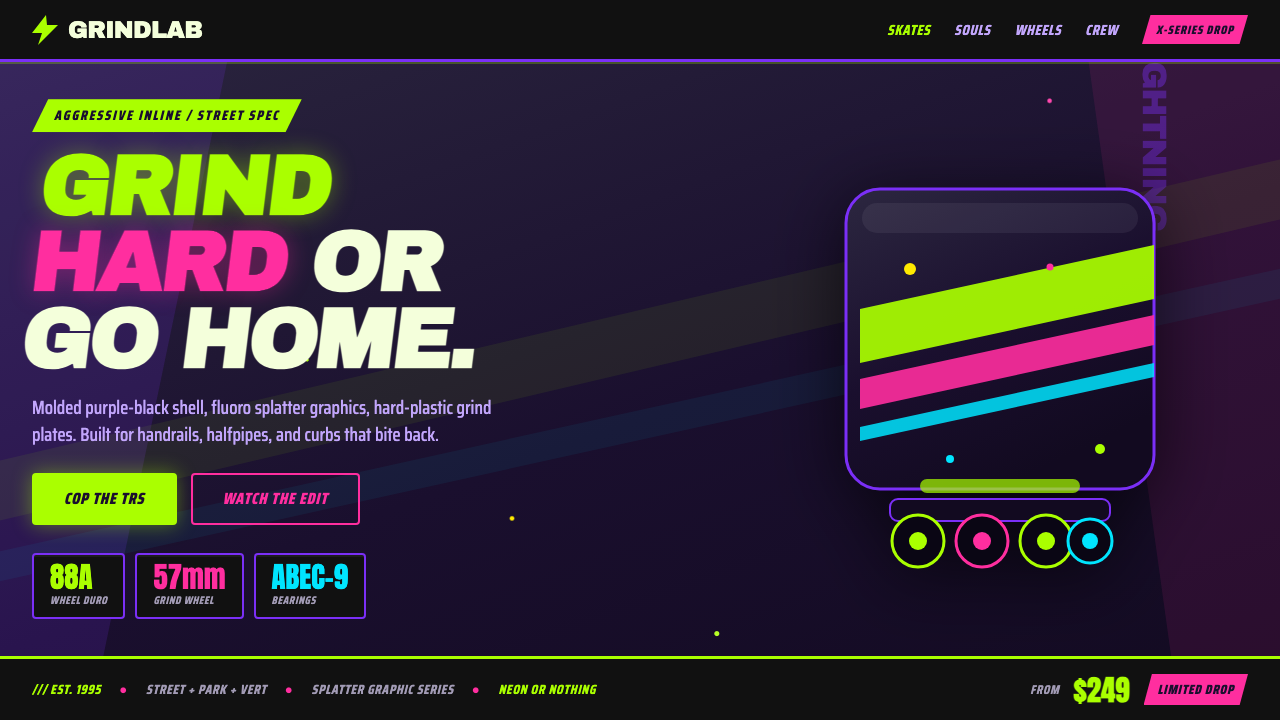 90s Aggressive Inline SkateX-Games attitude in plastic and paint. Fluoro lime and magenta slash across m…
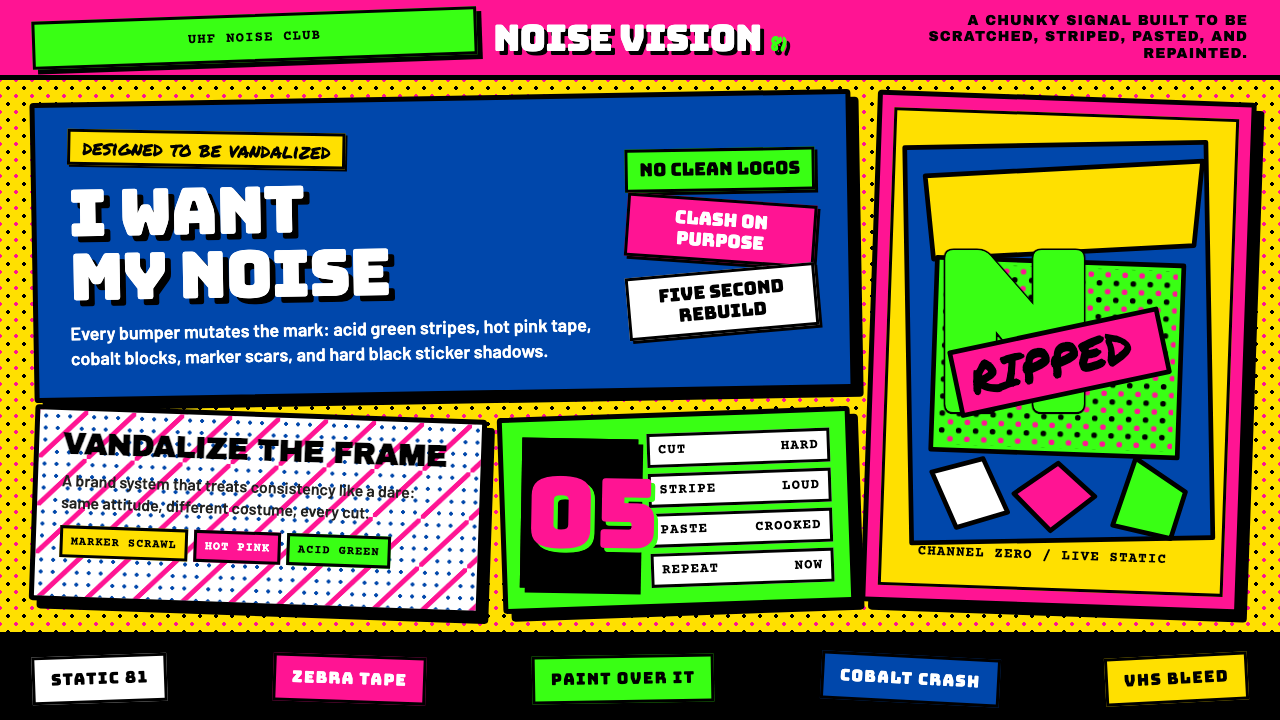 MTV Launch Identity (1981)Built to be vandalized. Hot pink, acid green, Bungee blocks, and crooked stic…
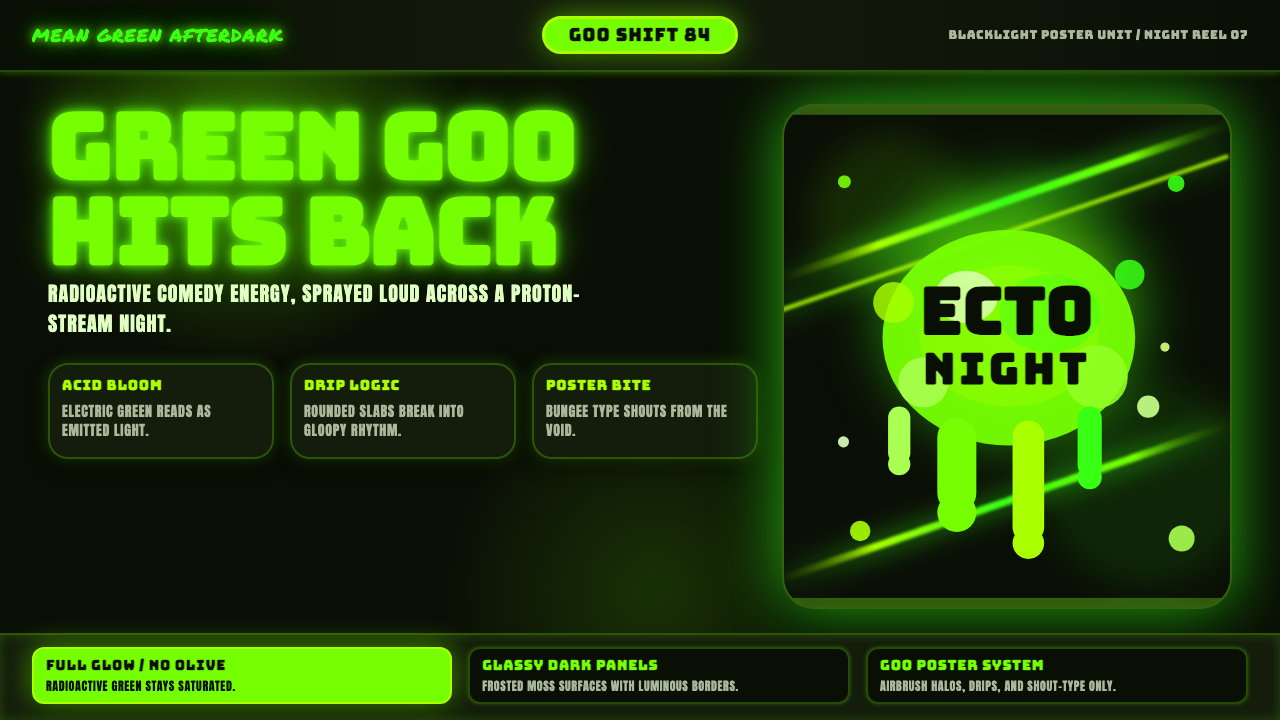 Slimer Ghostbusters GreenBlacklight goo shouts. Ecto-green Bungee type, drips, and proton streaks hit…
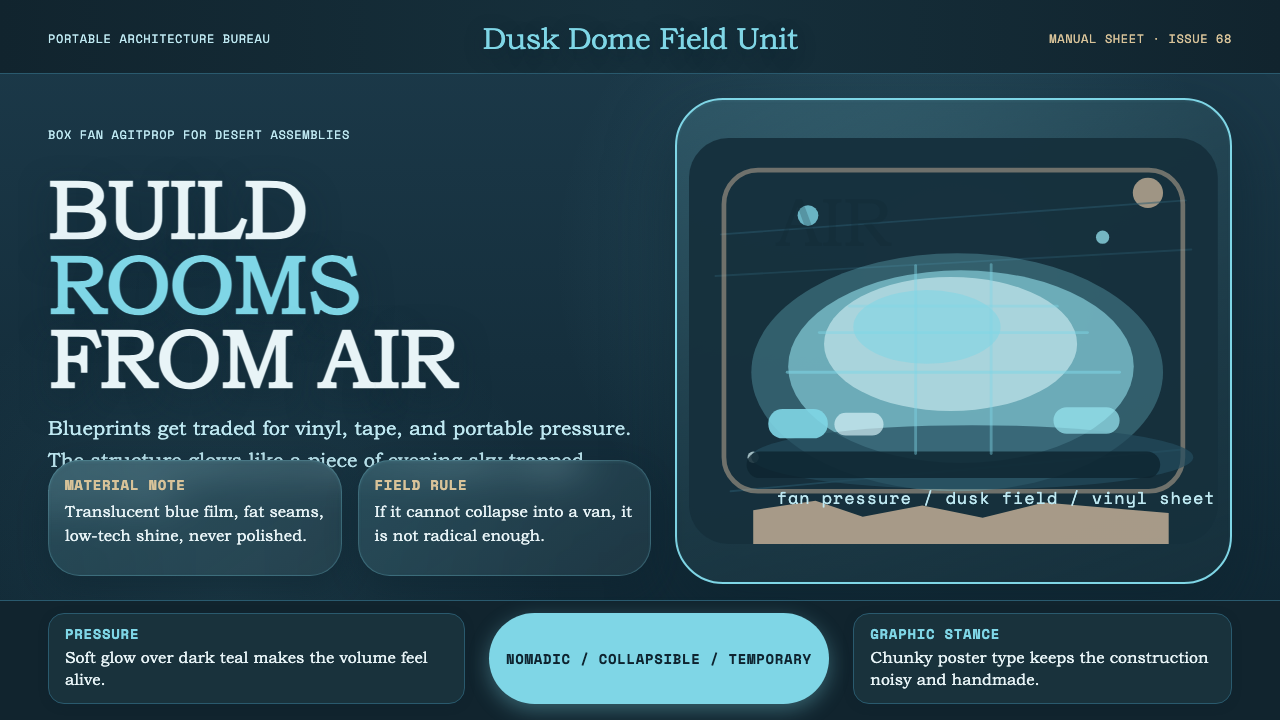 Ant Farm InflatablesTemporary architecture glows. Vinyl-blue domes swell over dark desert teal.
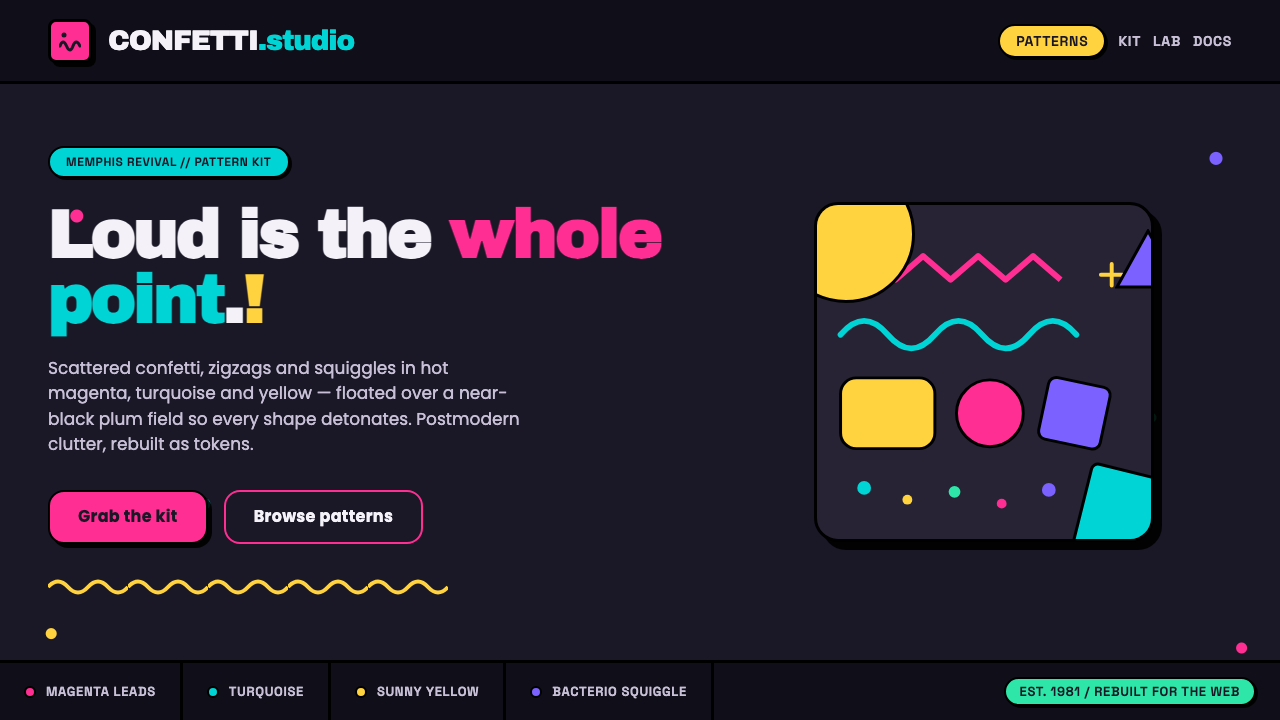 Memphis Web Pattern RevivalLoud is the point. Confetti dots, zigzags and Bacterio squiggles in hot magen…
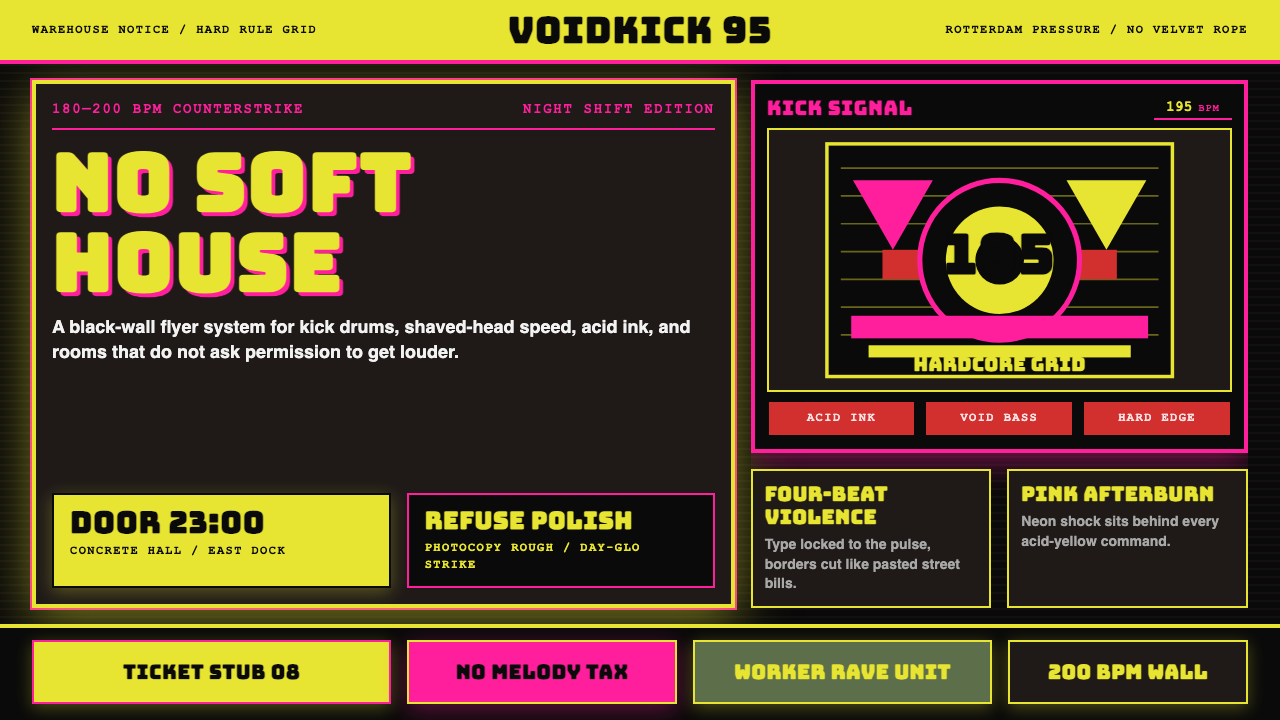 Rotterdam Gabber HardcoreHardcore refuses polish. Acid yellow, neon pink, black grid, and brutal Bunge…