What is Rotterdam Gabber Hardcore?
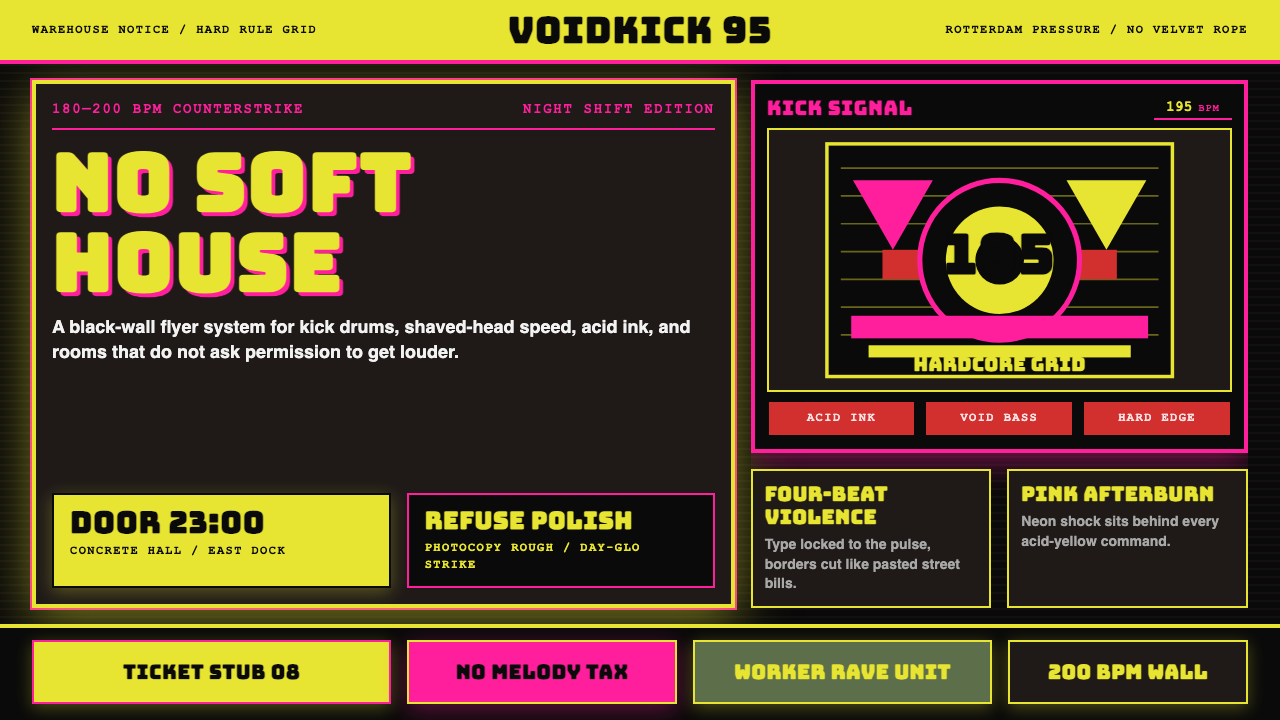
Rotterdam gabber turned 180 BPM rage and photocopier grime into a visual language so loud it practically bleeds through the page.
Rotterdam Gabber Hardcore in brief
Rotterdam Gabber Hardcore is the visual identity of Dutch hardcore-techno — a subcultural graphic language born in the early 1990s from festival flyers, record sleeves, and the brutalist rave-graphic production of labels like Mokum Records and event giants ID&T and Thunderdome. It is a design system built for impact at the expense of elegance: deep black voids, acid-yellow shock, neon-pink Day-Glo collision, and monumental display type that hits the eye like a fist.
Where mainstream electronic music design in the same era gravitated toward smooth gradients, glossy finishes, and polished futurism, gabber went the other direction entirely. It absorbed the visual DNA of street punk photocopied zines, football-club ultras graphics, and industrial-era warning signage — loud, repetitive, aggressive, and proud to be working-class. The aesthetic is unapologetically crude: distressed textures, halftone blowouts, type that screams rather than speaks.
Today the style occupies a curious double life. In its original context — vinyl sleeves, flyer stacks, raver patches — it remains a living subcultural artifact. In contemporary design practice, it has been rediscovered as a source of raw visual energy, applied to streetwear, editorial spreads, festival branding, and digital campaigns that want to project authenticity, speed, and confrontational confidence.

Where does Rotterdam Gabber Hardcore come from?
The story of gabber design begins not with a studio but with a divide. In the late 1980s and early 1990s, Amsterdam's dance scene had settled into a relatively polished house-music identity — cosmopolitan, glossy, internationally connected. Rotterdam, the port city to the south, wanted nothing to do with it. Rotterdam had a working-class industrial identity, a massive immigrant population concentrated in neighborhoods like Spangen and Crooswijk, and a youth culture that found Amsterdam's scene too soft, too expensive, and too remote from everyday life.
Out of this friction came hardcore-techno — music pushed to 180, 190, even 200 beats per minute, with kick drums so distorted they resembled industrial machinery more than musical instruments. The promoters and labels who organized this scene — Mokum Records, founded in Amsterdam but quickly adopted by Rotterdam's crowd; ID&T, producers of the Thunderdome compilation series beginning in 1992 — needed visual identities that matched the music's ferocity. The result was a graphic language developed largely by unknown designers working under extreme deadline pressure, printing thousands of flyers on cheap photocopiers or on offset presses at low cost.
The visual grammar that emerged was shaped by material constraints as much as artistic intention. Cheap printing meant limited color runs — often two colors, sometimes three — which forced designers to maximize contrast. Black was always the dominant field; acid yellow and neon pink were chosen because they reproduced cleanly even on poor-quality paper stocks and held their punch even in small format. Type had to be legible at a glance in a club or on a street pole, which pushed designers toward the heaviest, widest condensed display faces available, many of them originally designed for sports-equipment branding or construction signage.
Thunderdome, which began as a compilation series in 1992 and grew into the Netherlands' largest hardcore festival, became the style's most visible public showcase. Each Thunderdome release carried sleeve artwork that codified the aesthetic: a black ground, a central image rendered in extreme contrast (often a skull, a warrior figure, or an abstract explosion of shape), acid-yellow titling in a condensed display face, and a dense information block for track listings squeezed into a fraction of the available space. Paul Elstak, DJ Promo, The Prophet, and Sandra Welk were among the artists and producers whose names became inseparable from this visual era, their releases acting as recurring proof-of-concept for how brutal the palette could be pushed while retaining immediate legibility.
What defines the Rotterdam Gabber Hardcore look?
Color
The palette is built on a foundation of absolute black, against which acid yellow and neon pink are deployed as maximum-contrast shock accents. These are not colors chosen for harmony or refinement — they are chosen for visibility, for the ability to burn through bad printing and register on the eye at ten meters. White appears only as a secondary structural element, used to separate dense information blocks from the surrounding darkness. The overall chromatic effect is less a designed palette than an alarm signal.
Typography
Display type in the gabber idiom is monumental and merciless. The characteristic letterforms are ultra-heavy condensed or expanded faces — wide stroke, compressed width, minimal counter space — that read as blocks of visual force before they resolve into individual letters. Type is set at scales that dominate the entire composition; a headline might occupy more than half the total vertical space. Body information, where it exists at all, is set in a contrasting utilitarian face at the smallest readable size, creating a sharp two-register system with nothing in between.
Texture and Distress
Clean printing was never the goal. Gabber graphics embrace the artifacts of cheap reproduction: halftone dot-blow, photocopier grain, ink spread on absorbent stock, registration misalignment. These are not simulated imperfections added for nostalgic effect — in the original material they were simply what happened when the budget ran out before the press check. In contemporary applications of the style, this texture must be deliberately reintroduced, used sparingly enough to signal authenticity without tipping into decoration.
Composition and Layout
Gabber layouts are flyer-loud and centripetal — everything pushes toward the center or toward the viewer. Compositions use bilateral symmetry more often than Bauhaus-influenced Western modernism would permit, because symmetry reinforces the confrontational frontality that the style demands. A central skull or figure is flanked by symmetrical bursts of type or shape; radiating lines extend to the edges. The result is a layout that feels less like a designed page and more like a face: direct, inescapable, impossible to glance past.
Iconography
The recurring image vocabulary of gabber is narrow and intentional: skulls, fire, lightning, masked or armored figures, abstract fragmentation suggesting an explosion or impact, and occasionally religious or martial iconography stripped of its original context and redeployed as raw intensity. These images are always rendered in extreme contrast — dense black against the background, or acid yellow against dense black — with no mid-tones and no narrative subtlety. The imagery communicates affect before it communicates content.
Information Density
Gabber flyers were commercial objects first — they had to carry artist names, times, venues, ticket prices, and label information all in one bounded space. Rather than resolving this tension through hierarchy and negative space, the style embraces density: blocks of text are compressed, stacked, and set in the smallest type that remains legible, occupying every available corner of the composition. The result is a visual field that rewards extended looking — there is always more information than the first glance captures.
Dark Ground as Default
Unlike most Western graphic design traditions — which reserve dark grounds for special occasions or luxury registers — gabber treats absolute black as the neutral, unmarked background condition. Light elements emerge from the dark rather than sitting on a light field. This inversion has both practical roots (black is the cheapest printing ground) and tonal ones: darkness implies weight, menace, and the night-time context of the rave itself. A gabber piece on a white background feels wrong in a way that, say, a dark Bauhaus variant does not, because the dark ground is not a choice but a foundation.

Who shaped Rotterdam Gabber Hardcore?
Paul Elstak is among the most internationally recognized names to emerge from the Rotterdam hardcore scene, active as both producer and DJ from the early 1990s onward. His releases on Mokum Records — particularly those that pushed the style toward melodic happy-hardcore — carried the label's visual identity to audiences across Europe and beyond. His persona and release artwork embodied the confrontational directness that gabber graphic language was built to express: faces front, color maximum, text relentless.
DJ Promo, operating from Rotterdam through the 1990s and 2000s, became one of the style's most consistent producers in the industrial-hardcore direction — a harder, darker variant that pushed the aesthetic toward maximum austerity. His output influenced not just the music but the visual register of releases associated with that end of the spectrum: heavier graphics, deeper blacks, iconography oriented toward industrial machinery rather than carnival energy. His career arc illustrates how gabber's visual language could absorb subvariant developments without losing its core logic.
The Prophet — Rotterdam-born, active across the full arc of the scene's commercial peak — bridged the gap between pure gabber brutalism and the more accessible end of the hardcore spectrum. His releases were among the most widely distributed, and the sleeve artwork associated with his name traveled into contexts — retail record shops, mail-order catalogues, early internet — where the gabber aesthetic encountered audiences who had no prior exposure to the subculture. This crossover role made his output formative for understanding how the style translates beyond its immediate community.
Sandra Welk represents the dimension of gabber culture that is most frequently erased in retrospective accounts: the significant participation of women as artists, DJs, and figures whose names and faces appeared prominently on the visual material of the era. Her presence on flyers and sleeves at full graphical weight — not as ambient decoration but as headlining act — is part of the visual history of the style. The subculture's graphic language did not reserve its full visual force exclusively for male presentation.
Thunderdome as a brand — managed by ID&T — functions less as a single figure and more as an institutional voice that codified gabber's visual grammar into a commercially reproducible format. Beginning in 1992 with compilation releases and expanding to festival events that drew tens of thousands of attendees, Thunderdome sleeve artwork became the most widely circulated single body of gabber-style visual material in existence. Each release refined the formula: black ground, central high-contrast figure, acid-yellow headline type, dense track-listing block. The Thunderdome aesthetic is the closest thing the style has to a canonical reference.
How do you use Rotterdam Gabber Hardcore today?
Applying Rotterdam Gabber Hardcore to contemporary design work requires understanding what the visual system is actually doing beneath its aggressive surface. The style is not chaos — it is a tightly constrained set of rules applied at maximum intensity. Contrast is the organizing principle: every element is either dominant or subordinate, with nothing occupying a comfortable middle register. Before touching a specific layout, establish the hierarchy of dominance — what one element must hit first — and then push everything else into relative silence.
For presentation slides, the gabber aesthetic works best on covers and section dividers where confrontational impact is the goal. A cover built in this style commits to a full-bleed dark ground, a single central image treated at extreme contrast, and a headline in the heaviest condensed display face available at a scale that crowds the top or bottom third of the slide. Body-copy slides should treat the dark ground as a fixed condition and resist the temptation to lighten it for readability — instead, increase type size. Data slides benefit from the style's high-contrast logic: charts become high-contrast objects, bars rendered as solid blocks in acid yellow or neon pink against black fields, with axis labels in a utilitarian condensed face at the minimum legible size.
For web interfaces and dashboards, the style translates well to contexts where urgency and immediacy are values — monitoring tools, real-time data displays, event-ticketing platforms, and gaming or esports contexts. The approach demands a dark interface ground as baseline, with interactive elements distinguished by the acid accent colors rather than conventional button shapes. Type scales should be extreme: navigation labels bold and large, supporting information compressed and dense. Pricing pages in this mode use full contrast to differentiate tiers — a featured tier might occupy a neon-pink block while standard options sit in muted dark panels.
For editorial and marketing applications, the style supports high-energy campaigns, streetwear and culture-brand lookbooks, festival communications, and music-adjacent product launches. A gabber-influenced editorial spread uses the dark ground across full bleeds, reserves a single acid-yellow or neon-pink accent for the most critical call-to-action or headline, and treats photography as a high-contrast element — grainy, blown-out, or treated with extreme filters rather than naturalistic and color-corrected. Marketing emails and social cards translate well by using the color shock on a small surface: a deep black panel with a single oversized acid-yellow word and a dense white information block below.
The most common mistake when applying this style is reaching for it as a vibe rather than a system. Designers often add grain, dark backgrounds, and heavy type to an otherwise conventional layout and expect the result to read as gabber — but the style's actual power comes from its refusal of comfort at every decision point. If the background is dark but the type is set at polite proportions, the result is a failed imitation. If the contrast is extreme but the palette expands beyond the core three or four tones, legibility collapses. The second common mistake is over-texturing: distress should reinforce the low-fi authenticity of the reference, not drown it. A single halftone grain layer at low opacity is a reference; five stacked texture effects are decoration.

Rotterdam Gabber Hardcore — FAQ
Is Rotterdam Gabber Hardcore the same as general rave aesthetics?
No. Rave aesthetics is a broad category that encompasses psychedelic fluorescents and cosmic imagery (early British rave), smooth airbrushed futurism (American EDM), and the pastel softness of ambient or chill scenes. Rotterdam gabber is a specific regional and subcultural variant defined by its working-class Rotterdam identity, its association with the 180-plus BPM end of the hardcore-techno spectrum, and its rejection of anything that reads as polished or aspirational. It is harder, darker, and denser than most of what gets called rave design, and it has strong roots in specific labels and festival contexts rather than being a diffuse aesthetic mood.
Can this style work for a brand that has nothing to do with music?
Yes, but the transfer requires honesty about what is being borrowed and why. The gabber aesthetic carries strong subcultural associations — working-class pride, confrontational identity, the specific energy of Dutch hardcore rave — and using it for an unrelated product category can read as either inspired genre-bending or cynical appropriation depending on the execution. It works well for brands that genuinely want to project toughness, speed, anti-luxury positioning, or underground credibility. It is a poor fit for brands whose values are warmth, trust, approachability, or premium refinement, not because the style cannot be technically applied but because the tonal mismatch will undermine the communication at every level.
How do you apply gabber style without it reading as ironic or retro?
Commitment is the answer. Irony enters when elements of the style are deployed at reduced intensity — a dark background but polite typography, a heavy headline but soft supporting visuals — which signals that the designer knows the style but does not fully inhabit it. Retro enters when the reference is explicitly dated: using visual clichés that are culturally recognizable as period markers rather than applying the underlying visual logic. Applying gabber without irony or retro affect means taking its rules seriously at full strength — extreme contrast, maximum type weight, compressed information density, the correct palette — and choosing a context where that intensity is genuinely warranted rather than applied as a knowing wink.
What is the relationship between gabber design and brutalism in web design?
They share an impulse — the rejection of conventional polish, the embrace of raw structure, the willingness to make the viewer uncomfortable — but they come from different directions. Web brutalism is primarily an architectural metaphor, drawing on the raw-concrete aesthetic of Brutalist architecture and applying it to digital layouts through exposed grids, visible system defaults, and undecorated HTML aesthetics. Gabber design is subcultural in origin and print-born, with its rawness derived from production constraints rather than conceptual statements about digital materiality. The overlap is real and useful to understand, but conflating the two will produce work that reads as neither — too aestheticized to be brutalist, too tidy to be gabber.
Does the style have to be dark, or can it work on light grounds?
The dark ground is structural, not merely conventional. In the original material, absolute black was the default printing condition — everything else emerged from it. Inverting to a light ground changes the fundamental logic of the style: acid yellow loses most of its shock value on white, neon pink becomes a decoration rather than an alarm, and the sense of elements emerging from darkness is replaced by elements sitting on a surface. A light-ground gabber variant can exist as an adaptation — for contexts where dark grounds are technically or contextually inappropriate — but it should be understood as a deliberate departure from the source, not an equivalent option. If the dark ground is removed, the remaining elements must work considerably harder to maintain the intensity the style depends on.
Related design styles
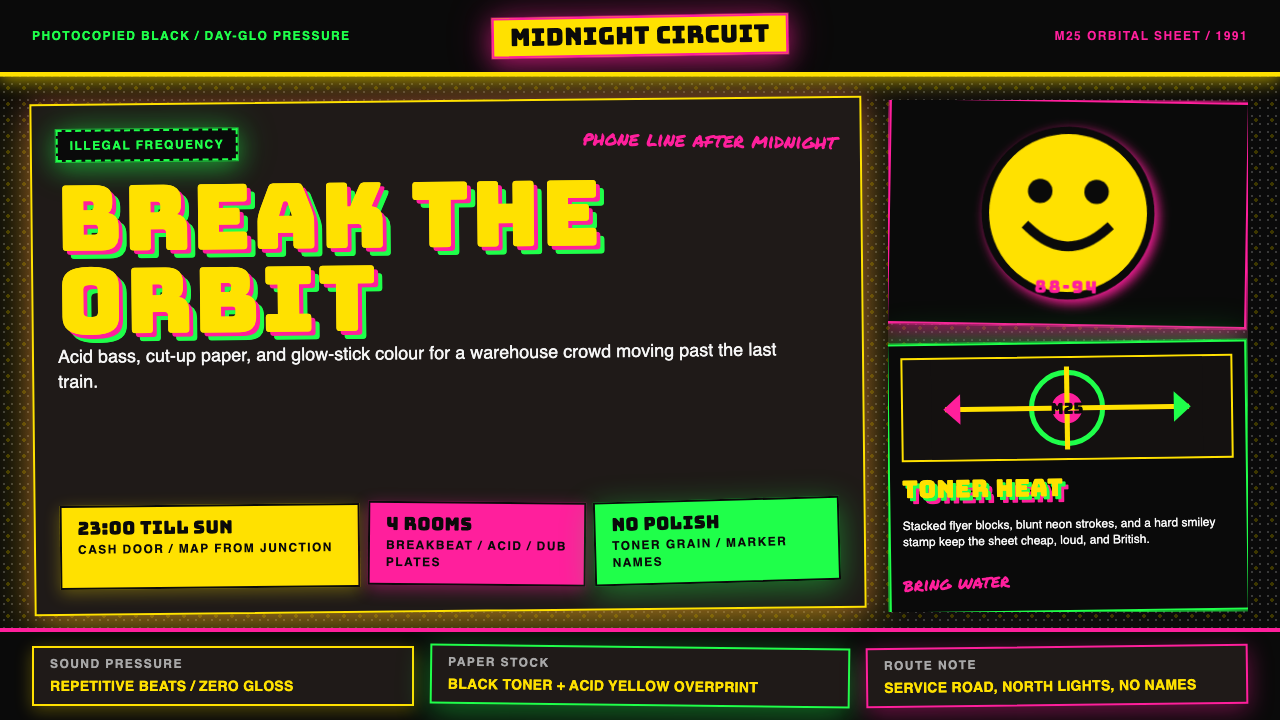 UK Rave Glow-Stick FlyerIllicit euphoria. Acid yellow, rave pink, and laser green slam into photocopi…
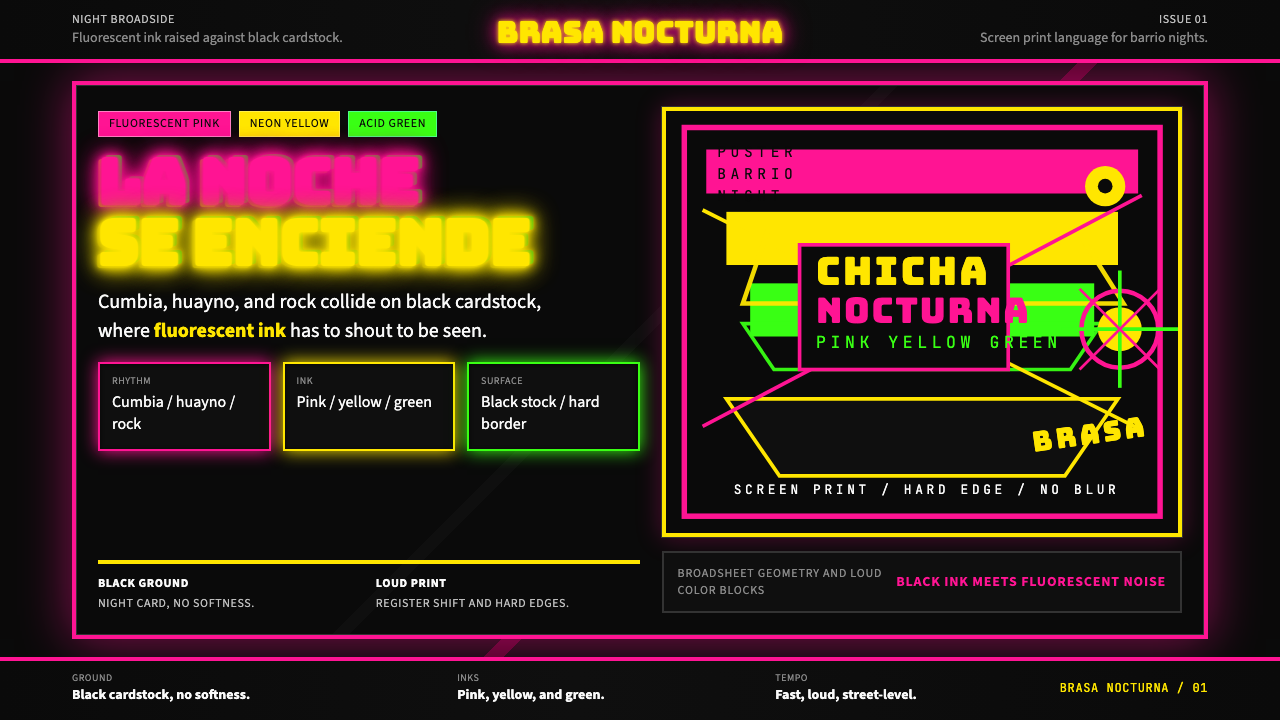 Peruvian Chicha Fluorescent PosterStreet-night fury. Pink, yellow, and green stack on black cardstock in hard b…
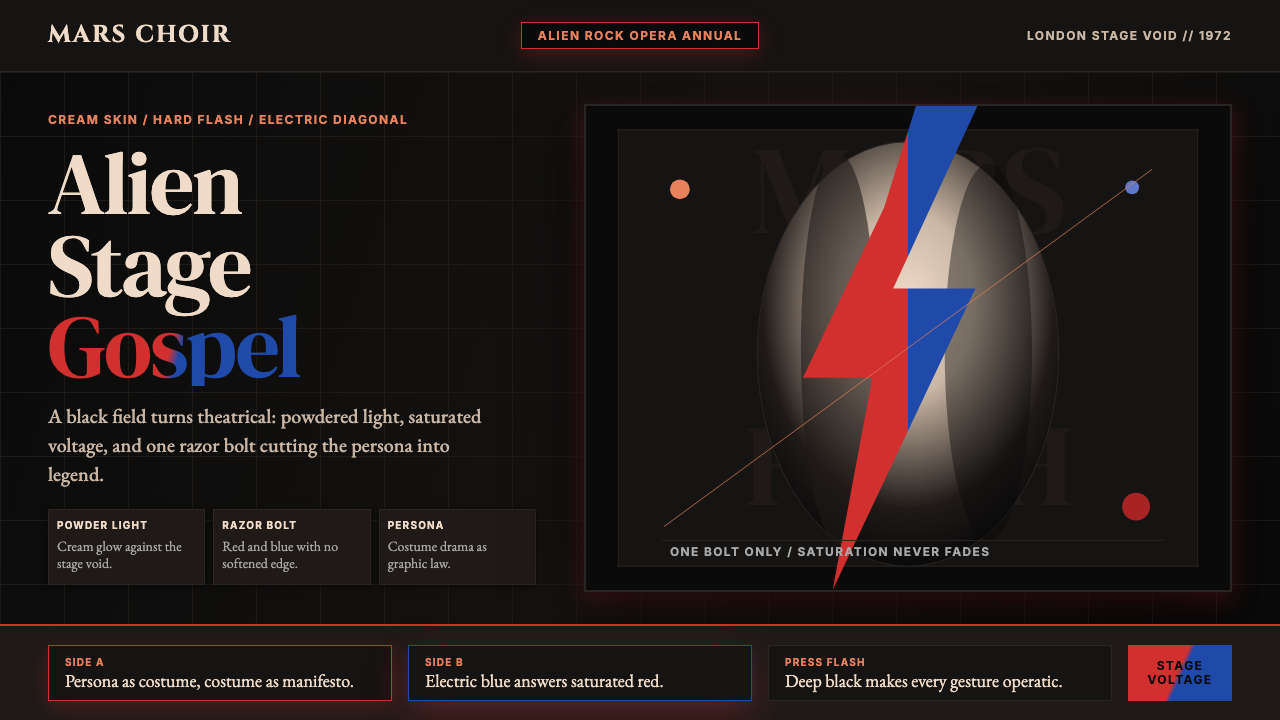 Bowie — Ziggy StardustTheater at full voltage. Cream-on-black portrait cut by one red and electric-…
 Nirvana — NevermindAnti-pop in pool blue. Cream cards, dollar-gold accents, and marker type roug…
 90s Aggressive Inline SkateX-Games attitude in plastic and paint. Fluoro lime and magenta slash across m…
 Acid House Smiley (1988)Rave energy hits first. Acid yellow on black, Anton caps, smiley glow.