What is Neville Brody / The Face?
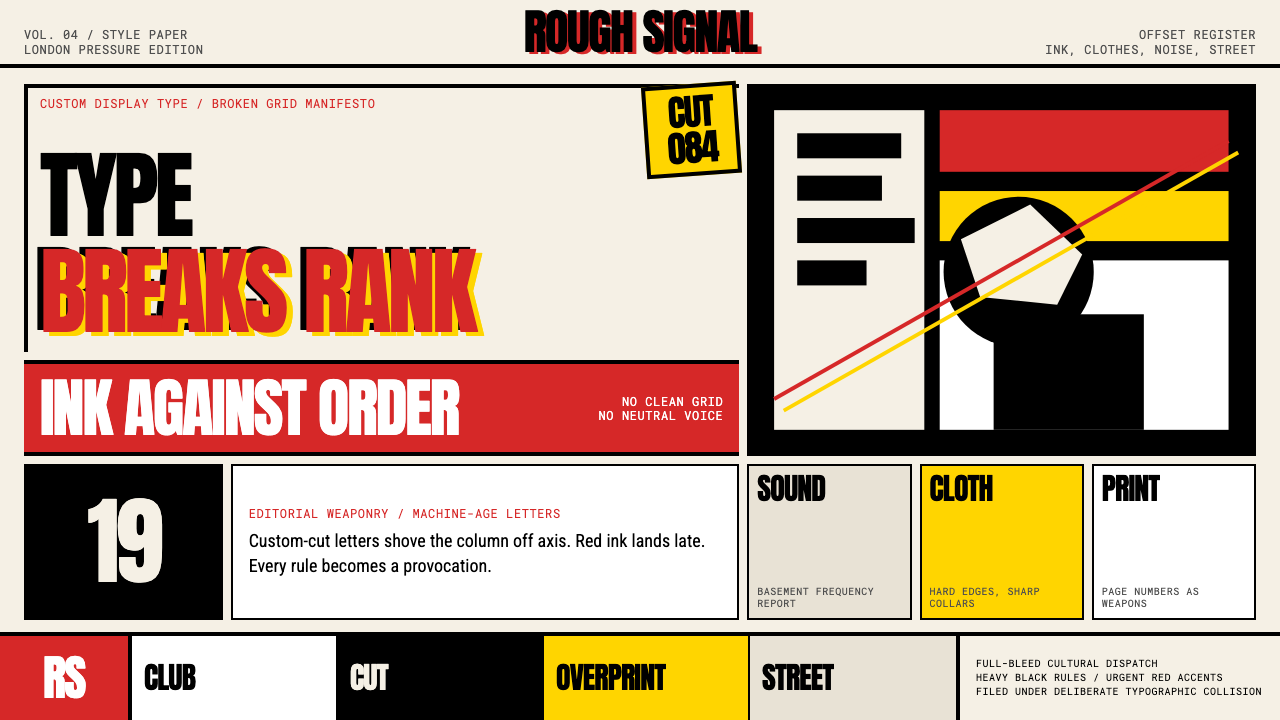
Neville Brody turned a London style magazine into a typographic riot — and in doing so, rewrote the rules of what printed letters were allowed to do.
Neville Brody / The Face in brief
Neville Brody / The Face is a post-punk graphic design system rooted in the art direction Brody produced for the British style magazine The Face between 1981 and 1986. It is a language of maximum typographic tension: heavy black ink pressed against cream or off-white stock, urgent red accents that recall letterpress overprinting, and page layouts where the grid is not a frame to work within but a set of orthodoxies to be conspicuously broken.
Where Swiss International Style sought universal neutrality, Brody's system is emphatically local, urgent, and confrontational. Type is not merely a vehicle for reading — it is a visual object in its own right, placed at angles, scaled to monumental proportions, layered over photography, or reduced to a textural field of compressed marks. Headlines and page numbers receive the same graphic attention as illustrations. The boundary between typography and image-making dissolves.
The system draws on sources that Swiss rationalism had deliberately excluded: Dada and Constructivist experiments in destabilizing the reading act, Art Deco's taste for heavy geometric letterforms, and the raw energy of punk fanzine culture. What makes it coherent despite its apparent disorder is Brody's insistence on strong formal rhythm — every disruption is composed, every collision is deliberate, and the underlying tension is always controlled.

Where does Neville Brody / The Face come from?
Neville Brody was born in London in 1957 and studied at the London College of Printing, graduating in 1979. His student work already showed a restlessness with the prevailing conventions of British commercial typography — clean, inoffensive, largely derived from Swiss practice. After graduation he designed record sleeves for independent labels including Fetish Records, where the urgency and anti-establishment attitude of post-punk music demanded visual equivalents. These early projects gave him a laboratory for typographic experimentation outside the oversight of mainstream advertising culture.
In 1981, Nick Logan — founder of The Face, a London magazine covering music, fashion, and youth culture — appointed Brody as art director. The appointment was consequential. The Face had no large advertising accounts to placate and a readership that actively rejected mainstream aesthetics. Logan gave Brody near-total creative latitude, and Brody used it to treat every issue as a typographic manifesto. He designed custom display typefaces — Industria, Arcadia, and Insignia among them — rather than working from existing commercial fonts, ensuring that the magazine's visual identity was genuinely irreproducible by competitors. Headlines were set at sizes that consumed the visual space normally reserved for photographs; page numbers were designed as graphic symbols that accrued meaning across issues.
The cultural moment was important. London in the early 1980s was charged with the aftermath of punk, the emergence of new wave music and club culture, and a sharp generational rejection of the conservative design establishment. Brody's work at The Face was both a product of that environment and an influence on it — the magazine's aesthetic circulated widely, was photographed and photocopied, and defined what 'contemporary' looked like for an entire generation of British designers and art directors. The Face ran at a time before desktop publishing, meaning Brody's layouts were produced by hand, with physical type and paste-up — a constraint that forced inventiveness and made every formal decision feel earned.
In 1987, the graphic designer Jon Wozencroft organized an exhibition of Brody's work at the Victoria and Albert Museum, accompanied by a monograph — 'The Graphic Language of Neville Brody' — that became one of the best-selling design books of its decade and was translated into multiple languages. The book formalized Brody's influence, bringing his methods to designers who had not encountered The Face directly. In 1990, Brody co-founded FontFont with Erik Spiekermann, a type foundry whose distribution model democratized access to experimental typefaces and whose catalogue extended the spirit of Brody's The Face work into the digital era. His studio, Research Studios, has continued to produce identities, typefaces, and editorial design that extend and revisit the core principles of the system.
What defines the Neville Brody / The Face look?
Typographic Hierarchy as Image
The defining move of the Brody system is treating letterforms as visual objects rather than transparent carriers of language. Headlines are scaled to dominate the spread — larger than any single photograph, sometimes larger than the entire text block. The scale differential between headline and body copy is extreme and deliberate, creating a visual percussion rather than a conventional reading flow. Type can be cropped by the page edge, rotated, or overlaid directly onto photography without a white knock-out.
Broken and Colliding Grid
Brody did not abandon the grid — he used it as a structure to visibly violate. Elements bleed across column boundaries, overlap one another, or sit in deliberate tension with the underlying structure. The grid's ghost is always present; what makes the layouts feel charged is the evidence of rules being broken rather than ignored. A headline might occupy three columns while a caption sits in the fourth at a contradictory angle, creating spatial energy that a conventionally aligned layout cannot produce.
Restricted and Punchy Palette
The palette is built around three elements: a near-black ink (deployed heavily, as though pressure-printed), a warm cream or slightly toned off-white for the ground, and a single urgent accent — most characteristically a dense red — used sparingly but at full intensity when it appears. The red reads like a letterpress overprint: something added forcefully on top of what is already there. Secondary hues are essentially absent. The restraint makes each colored element feel decisive rather than decorative.
Custom and Invented Letterforms
A critical feature of the system is that its display typefaces were designed specifically for the context rather than selected from commercial catalogues. Brody's custom faces — geometric, modular, with visible construction logic — carry a distinct authority that licensed fonts cannot replicate. The letterforms are simultaneously historical (drawing on Art Deco and Constructivist precedents) and invented, giving the work a sense of internal consistency that purely borrowed typography cannot achieve.
Heavy Rule and Structural Ink
Black rules — thick horizontal bars, heavy underlines, bold borders — serve as structural and compositional anchors throughout the system. These rules are not decorative dividers in the conventional sense; they are graphic objects with weight and presence. A rule might separate a headline from its subhead at several times the thickness of the type's own stroke, or frame a photograph as though branding it. The heaviness of the ink is part of the message: this is print that means to be noticed.
Photography as Graphic Raw Material
Photography in this system is not treated as an autonomous image to be presented and protected. It is graphic raw material — cropped aggressively, printed at high contrast, bled off the page, or used as a field over which type is directly placed without separation. The relationship between photograph and typography is collision, not coexistence. This treatment demands that photography be strong enough to survive the intrusion of large type, which in practice means it favors high-contrast, compositionally bold images over naturalistic or softly lit ones.
Graphic Elements as Meaning Carriers
Brody extended the notion of what counts as a significant visual element. Page numbers, section markers, issue dates, and running headers were treated with the same graphic intensity as main headlines. Over successive issues, certain marks and symbols accumulated a kind of visual vocabulary specific to the magazine. This approach transforms the marginal and the functional — items most designers treat as invisible infrastructure — into active contributors to the page's visual argument.

Who shaped Neville Brody / The Face?
The central figure of the system. Brody's five years at The Face produced a body of work that fundamentally altered what editorial design was understood to be capable of. His custom typefaces — Industria, Arcadia, Insignia — were designed within the context of specific layouts rather than as general-purpose releases, which gave them an organic relationship to the pages they appeared on. After The Face, he brought similar thinking to the music magazine Arena and to cultural institutions including the 1990 World Design Conference in Nagoya. The 1987 V&A monograph ensured his influence extended well beyond the magazine's original readership. His ongoing work at Research Studios and his role at FontFont have kept him a central voice in typography and identity design.
Logan founded The Face in 1980 after his success with the music press, particularly with New Musical Express. His editorial vision — that a youth culture magazine could aspire to be a serious cultural document rather than a fan-service publication — created the conditions for Brody's formal radicalism. Without Logan's willingness to prioritize visual ambition over commercial conservatism, and his trust in Brody's editorial judgment, the magazine's significance as a design object would not have materialized. Logan's role demonstrates how much great design depends on enlightened editorial leadership.
Spiekermann co-founded FontFont with Brody in 1990, providing the structural and business counterpart to Brody's formal radicalism. Where Brody's contribution to FontFont was the spirit of typographic invention and the network of experimental designers he brought in as contributors, Spiekermann provided the rigorous typographic standards and the technical infrastructure that made the foundry viable. FontFont's catalogue — which included faces by designers from across Europe — helped institutionalize the idea that a typeface could be a work of graphic authorship rather than merely a commercial tool.
Elms was a journalist and writer whose work appeared regularly in The Face during Brody's tenure. His contributions to the magazine's textual content were an important complement to Brody's visual innovations — the writing shared the magazine's sharp intelligence and cultural confidence. The Face's significance as an artifact depended on the alignment between Elms's generation of writers and Brody's visual practice: neither could have achieved the same effect alone. Elms later became a broadcaster and cultural commentator, continuing to document the London scene that The Face had helped define.
Wozencroft organized the 1987 V&A exhibition of Brody's work and wrote the accompanying monograph 'The Graphic Language of Neville Brody,' which became one of the decade's most influential design publications. By producing a rigorous critical account of Brody's methods — including typographic experiments, rejected layouts, and the developmental logic behind specific design decisions — Wozencroft transformed work that might have remained a subcultural artifact into a formally analyzed body of practice. The book's success gave Brody's methods a pedagogical life that persisted long after The Face's peak years.
How do you use Neville Brody / The Face today?
The Brody / The Face system is usable across contemporary digital formats, but it rewards designers who understand its underlying logic — typographic confrontation, controlled disorder, heavy ink as structural weight — rather than those who simply borrow its surface texture. The aesthetic is high-contrast and demanding; it works where visual authority is the desired register and struggles where warmth or accessibility is paramount.
For presentation slides, the system is strongest on cover pages and section dividers. A cover built in this language sets a large, custom-feeling display word in heavy black against a cream field, with a bold horizontal rule cutting beneath it and a single red element — a rule fragment, a geometric mark, a date — introduced at full intensity. Content slides should be treated as composed grids: one dominant type size for the key message, supporting text at a significantly smaller scale, and ruled lines as the only structural decoration. Data slides take on an editorial quality: charts are treated as graphic objects rather than business visuals, with axes and labels composed as carefully as any headline.
For web interfaces, the system translates well to dashboards, editorial landing pages, and any product that needs to project confidence and cultural intelligence. The approach requires committing to a near-cream or slightly warm white background, black as the primary text and structural color, and a single accent deployed at full saturation for interactive states or critical calls to action. Navigation should be typographic and assertive — wordmarks set large, labels in high contrast — rather than icon-dependent. Card components work with hard or offset borders rather than soft shadows; the heaviness of the containment is part of the visual message.
For editorial and marketing work, the system excels at any context where hierarchy needs to be felt as well as read. An article layout in this idiom uses extreme scale contrast between headline and body text, bold rules to mark transitions rather than whitespace alone, and photography placed without protective white space — let the type touch the image. Marketing pages work well with the style's poster-like directness: section headers that are visual events, not just labels; foreground and background alternating between cream-on-near-black and black-on-cream; a single red element used with full commitment wherever attention is most urgently required.
The most common mistake when applying this system is mistaking surface chaos for the actual method. Randomly sized type, multiple accent colors, and arbitrary angles produce noise, not energy. Authentic application of the Brody language requires that every formal departure — every oversized headline, every rule that breaks the column, every collision of type and image — be a deliberate compositional decision. Restraint in the palette (near-black, cream, one red) is non-negotiable; it is what gives the formal disruptions their visual force. Using more than one accent color, or introducing soft gradients or drop shadows, immediately deflates the system's tension.

Neville Brody / The Face — FAQ
Is this style the same as general post-punk design, or is it specific to Brody?
Post-punk graphic design is a broad category that includes many artists and publications from the late 1970s and 1980s who rejected Swiss rationalism in favor of raw, confrontational visuals. Brody's work at The Face is a distinct subset of that impulse: where many post-punk publications embraced the look of urgency through low-production values and deliberate roughness, Brody's approach was highly crafted and formally rigorous. The apparent disorder in his layouts is composed disorder — every element has been placed precisely, even when the effect is collisional. This makes the Brody / The Face system more transferable to high-quality contemporary applications than the broader post-punk vernacular, which tends to read as deliberately lo-fi.
Can this style work for digital products aimed at mainstream consumers, or is it inherently niche?
The system can reach mainstream audiences when it is used to signal cultural authority, forward-thinking positioning, or creative industry credibility — fashion brands, music platforms, editorial publications, and design-forward technology companies all have consumer audiences for whom this register reads as sophisticated rather than alienating. It becomes genuinely niche when applied without modification to categories that expect warmth, accessibility, or familiarity: banking, healthcare, children's products, or anything where the user's emotional need is reassurance rather than stimulation. The honest test is whether the product's values include the qualities the style embodies — edge, authority, and formal intelligence — or whether those qualities are being applied as a superficial upgrade to something that actually needs a different voice entirely.
How do you maintain the style's energy without it looking cluttered or chaotic?
The key is understanding that controlled tension requires an underlying structure even when that structure is being deliberately violated. Start by establishing a clear grid — column structure, baseline rhythm, margin logic — then make formal decisions about which grid relationships to honor and which to break. Break the grid in one or two specific ways per composition rather than in every direction simultaneously. Maintain strict palette discipline: near-black, cream, one accent at full intensity. Keep the number of typographic scales limited — two or three levels of hierarchy, not five or six. The visual energy comes from the contrast between the underlying order and the deliberate disruptions, not from maximizing the number of disruptions.
The Face existed before digital design. How much can its print logic actually translate to screens?
More than one might expect, because the system's core moves are not dependent on the physical properties of print. The high-contrast palette — heavy near-black against cream — is highly legible on screen and actually benefits from backlighting. The typographic scale contrasts read clearly at any resolution. The use of rules and borders as structural elements translates cleanly to CSS. Where print logic genuinely does not translate is in the tactile dimension: the weight of the paper, the physical impression of letterpress-style inking, the hand-produced quality of the original paste-up. Digital applications of the system should lean into what the screen does well — motion, responsive scaling, interactive state changes — rather than trying to simulate paper texture or printing artifacts, which almost always looks forced.
How does Brody's approach differ from other designers who also broke typographic rules in the same era?
Several contemporaries — David Carson at Ray Gun, Tibor Kalman at Colors, the early work coming out of Cranbrook Academy — also pursued anti-conventional typography in the 1980s and 1990s. The key distinction is that Brody's work at The Face was compositionally rigorous even when formally disruptive. Carson's approach was often more genuinely illegibility-seeking — type set in ways that resisted reading entirely. Kalman's work was more conceptually driven, using visual surprise in service of editorial argument. Brody's disruptions are always in tension with legibility rather than in opposition to it; the reader is challenged but not excluded. This formal rigor is what makes the system teachable and transferable, whereas the more instinctive approaches of some contemporaries are difficult to apply without the original author's specific sensibility.
Related design styles
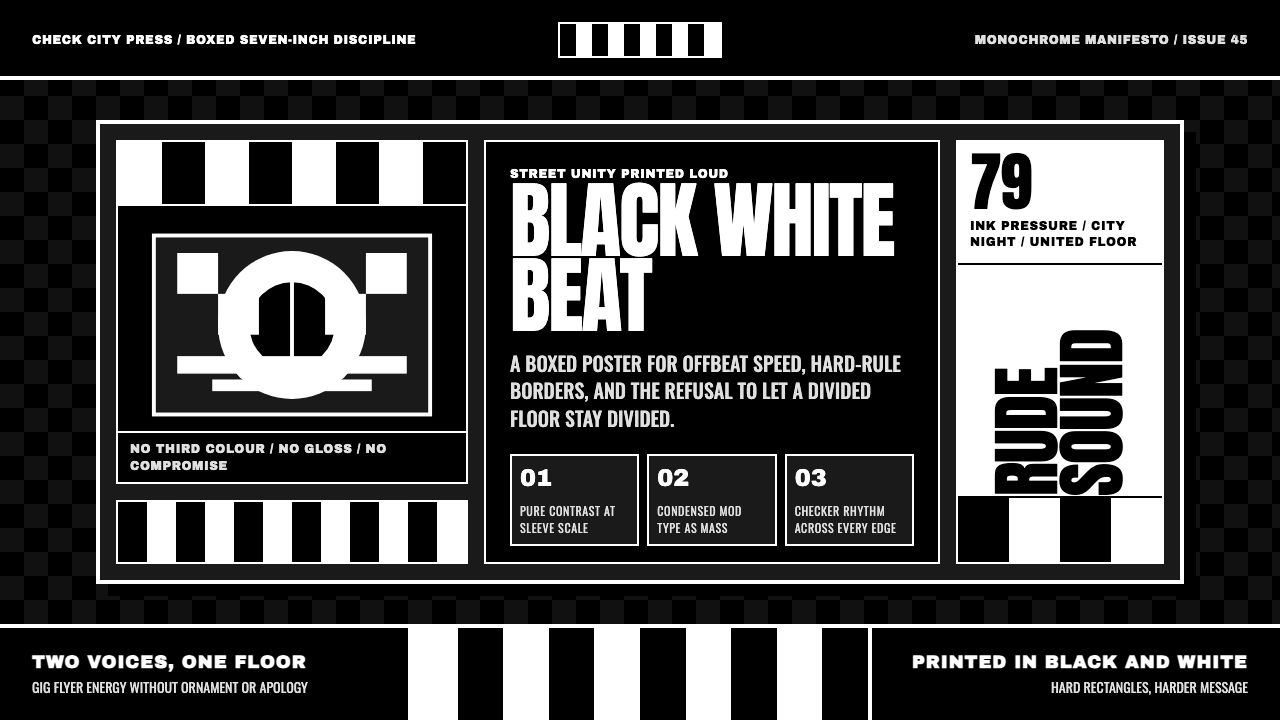 2 Tone SkaContrast as manifesto. White Anton type locks into a near-black checkerboard…
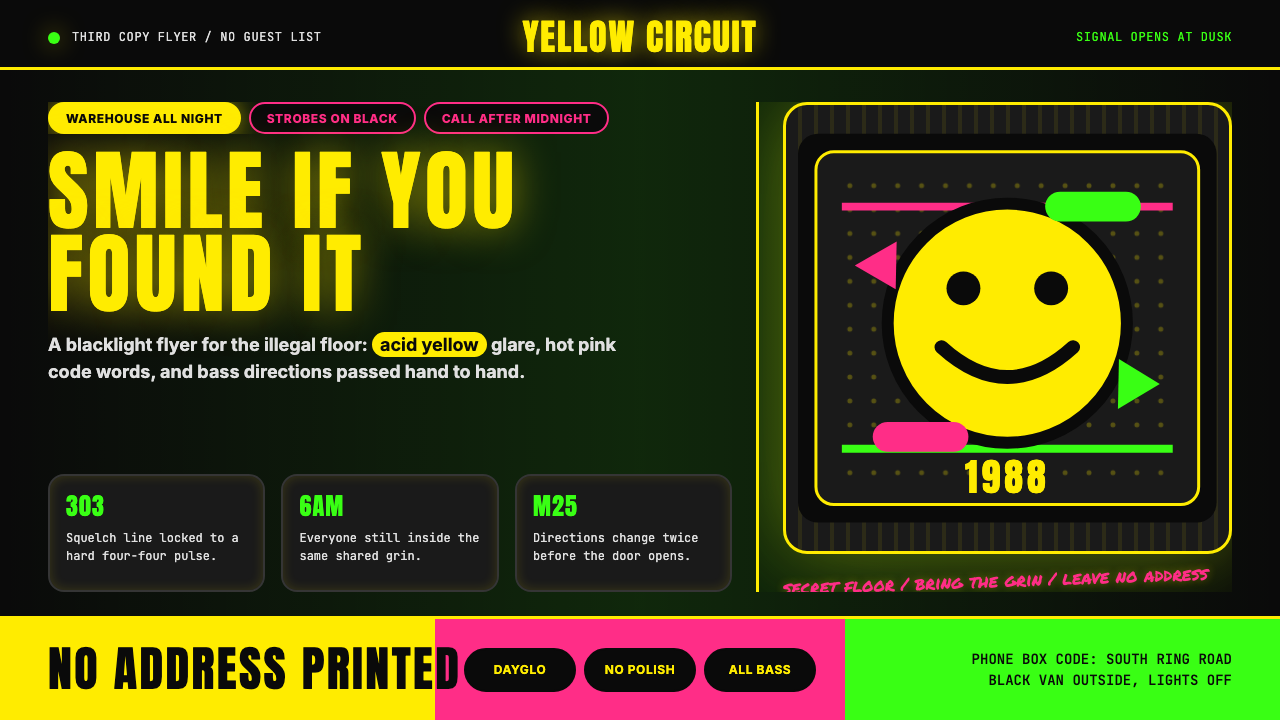 Acid House Smiley (1988)Rave energy hits first. Acid yellow on black, Anton caps, smiley glow.
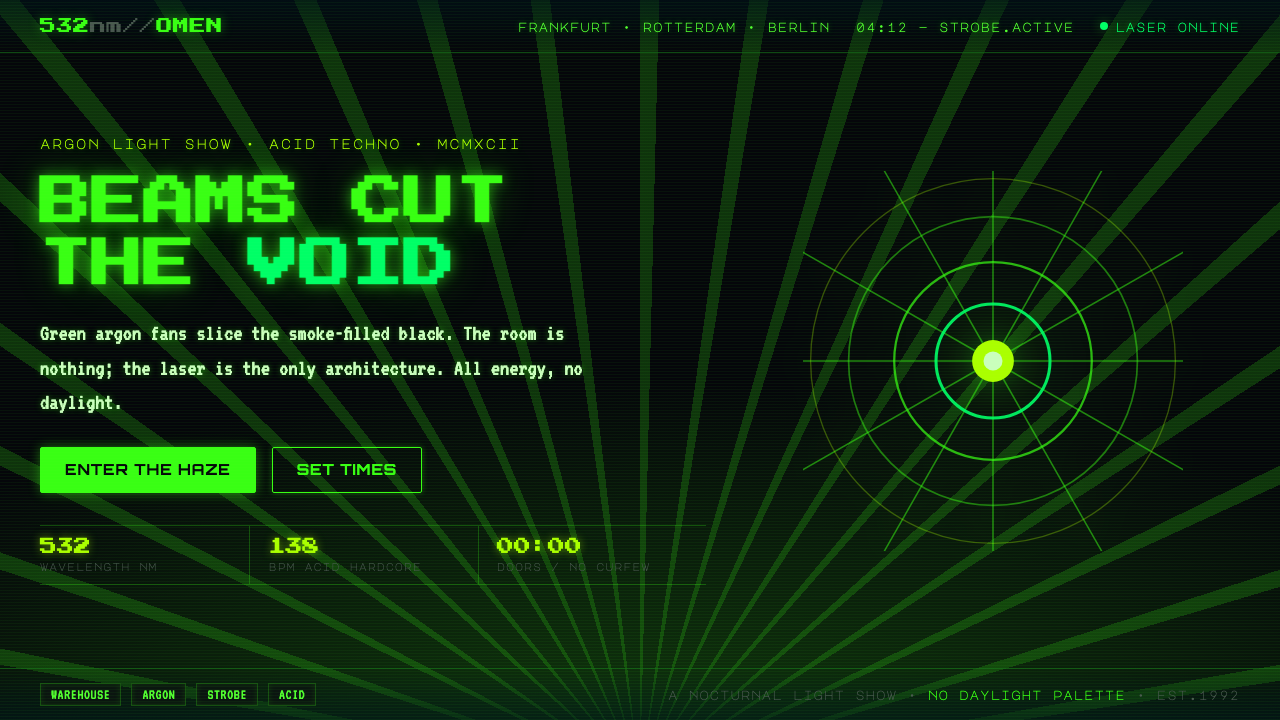 Acid Rave Laser Show 1992Beams cut the void. Argon green on pitch-black smoke, pixel marquee type, add…
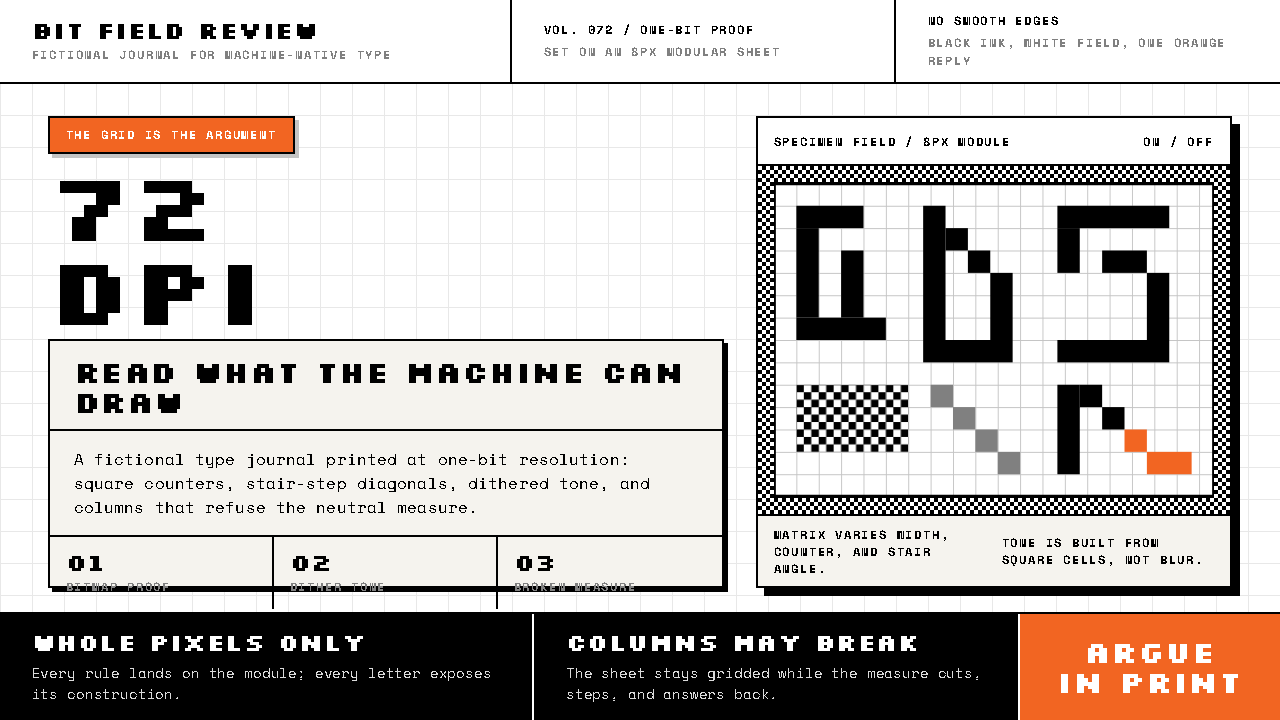 Emigre / Zuzana LickoThe pixel grid argues back. Black bitmap type, dithered grey, and one orange…
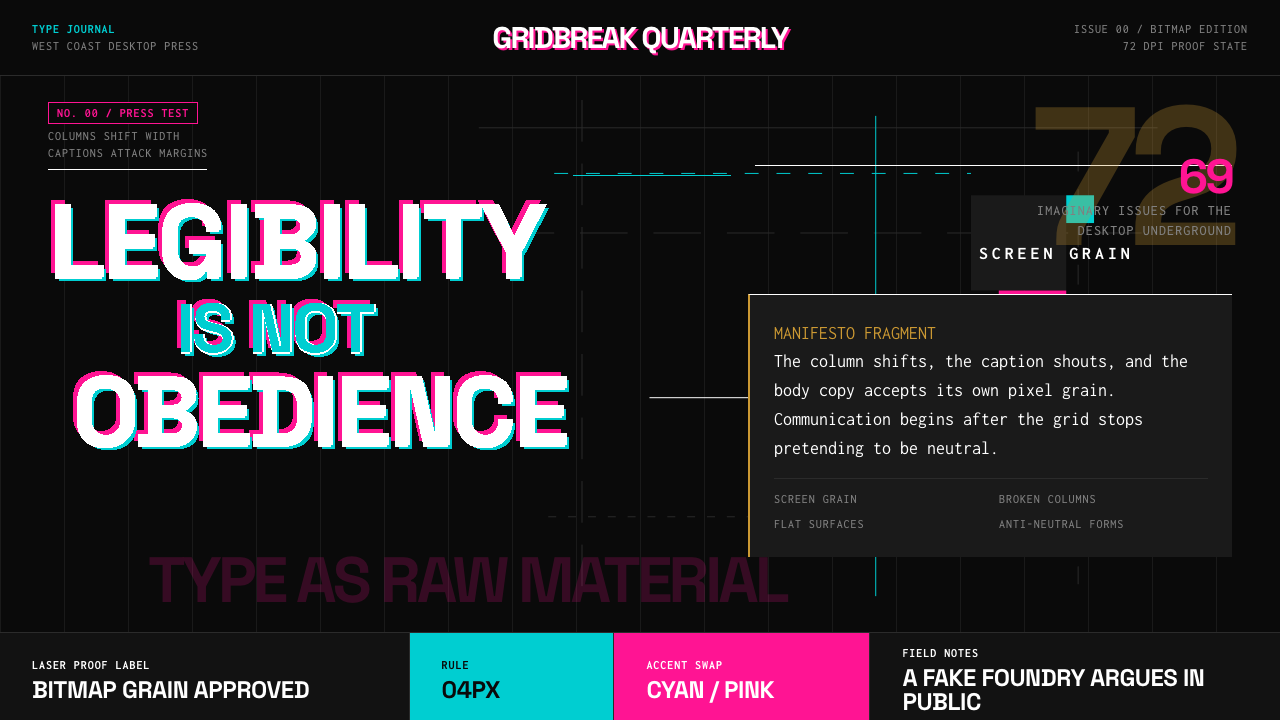 Emigre Magazine (1984–2005)Defies the tidy grid. Cyan, ochre, and hot-pink bitmap type collides on black.
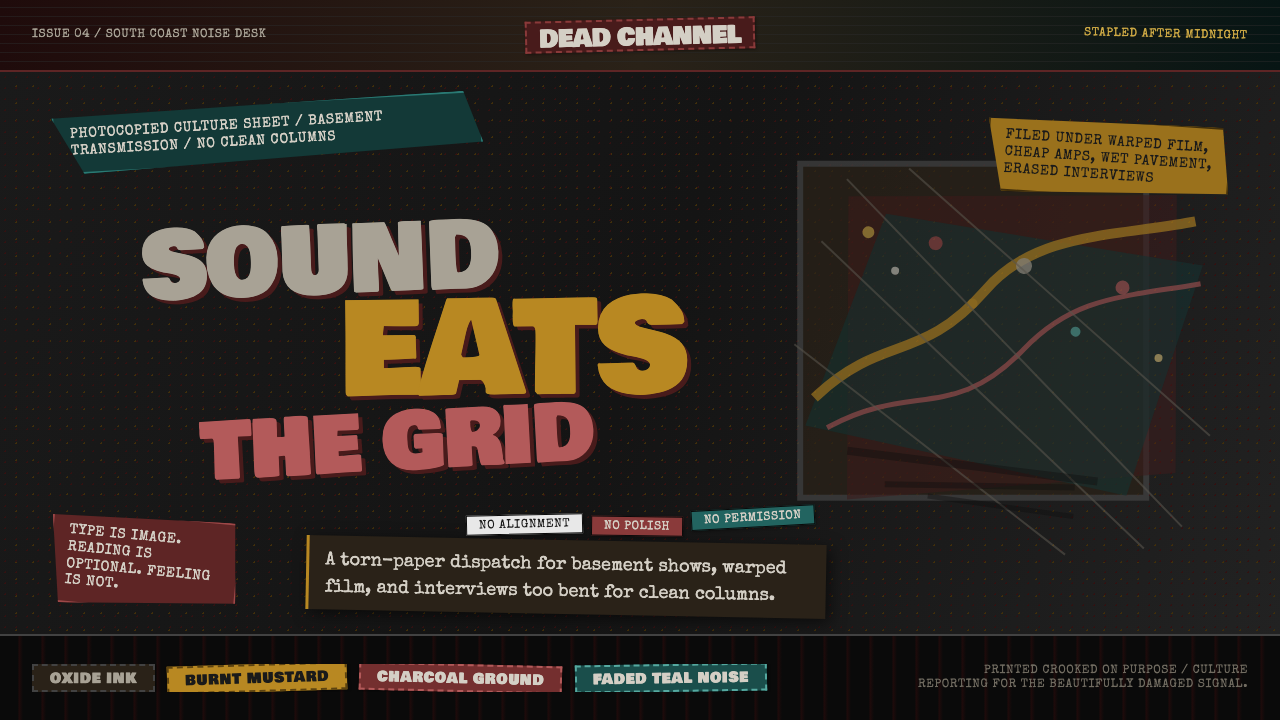 Grunge (Carson 1993)Carson's anti-rules, photocopied. Oxblood on charcoal, distressed type, delib…