What is Svelte Compiler Orange?
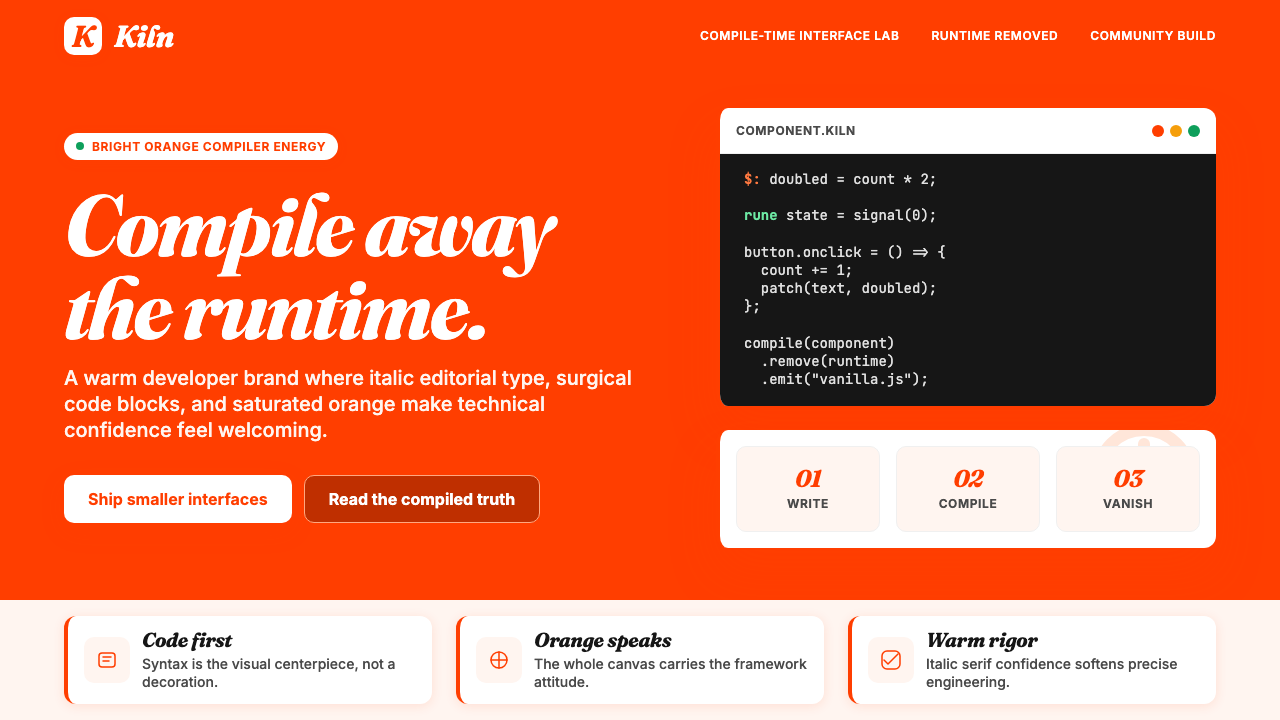
Svelte Compiler Orange is the visual identity that made a compile-time JavaScript framework feel like an invitation — warm, loud, and disarmingly direct.
Svelte Compiler Orange in brief
Svelte Compiler Orange is the design language built around the Svelte JavaScript framework — a visual identity that pairs saturated, warm orange with confident italic typography and treats code samples as first-class visual content. Where many developer tools adopt a cool, neutral palette to signal seriousness, Svelte went the other direction: bold, human, and immediately recognizable.
The system is built on contrast and clarity. Bright orange floods hero sections and calls to action against fields of near-white or lightly tinted off-white, while large italic headlines make declarations rather than descriptions. Code blocks are styled with the same care as any other visual element — syntax-highlighted, generously spaced, and placed prominently rather than buried in documentation footnotes.
What distinguishes this aesthetic from generic developer-tool branding is its editorial confidence. Rich Harris, the framework's creator, came from data journalism at The Guardian and The New York Times, and that background shows in the design: every composition makes an argument. The orange does not merely decorate — it communicates warmth and energy in an ecosystem that often defaults to grey.
Where does Svelte Compiler Orange come from?
Svelte was created by Rich Harris in 2016 while he was working as a graphics editor at The Guardian and later at the New York Times, building interactive data visualizations for news stories. The framework emerged from frustration with the performance cost of runtime-heavy tools: rather than shipping a virtual DOM diffing engine to the browser, Svelte compiles components into minimal, surgical vanilla JavaScript at build time. The brand identity needed to communicate this radical simplicity in a market crowded with frameworks announcing themselves through complexity.
The first public version of Svelte arrived with minimal visual polish, but by the time Svelte 3 launched in April 2019 — the release that brought the celebrated reactive declaration syntax using the dollar-label shorthand — the orange identity was firmly in place. The Svelte 3 announcement post, with its declarative headline and warm color treatment, spread widely and established the aesthetic association: orange meant Svelte, and Svelte meant a different way of thinking about reactivity.
The framework's visual language stayed remarkably consistent through Svelte 4 and into Svelte 5, which introduced runes — a new reactivity primitive — in 2024. SvelteKit, the full-stack application framework built on top of Svelte, reached version one point zero in December 2022 and brought the brand to a wider audience of developers building production applications. Through all these releases, the orange-on-off-white palette and the bold italic headline style remained the stable signals of the Svelte ecosystem.
Rich Harris joined Vercel in late 2021, which provided the framework with institutional backing and a distributed contributor community spanning time zones from London to Southeast Asia. The connection to Vercel also aligned Svelte visually with a broader movement in developer tooling toward friendly, expressive branding — a deliberate departure from the enterprise-grey aesthetic that had dominated the previous decade. Key community contributors including Tan Li Hau, Simon Holthausen, and Brittney Postma helped shape both the technical direction and the community voice that reinforced the brand's warmth.
What defines the Svelte Compiler Orange look?
Color
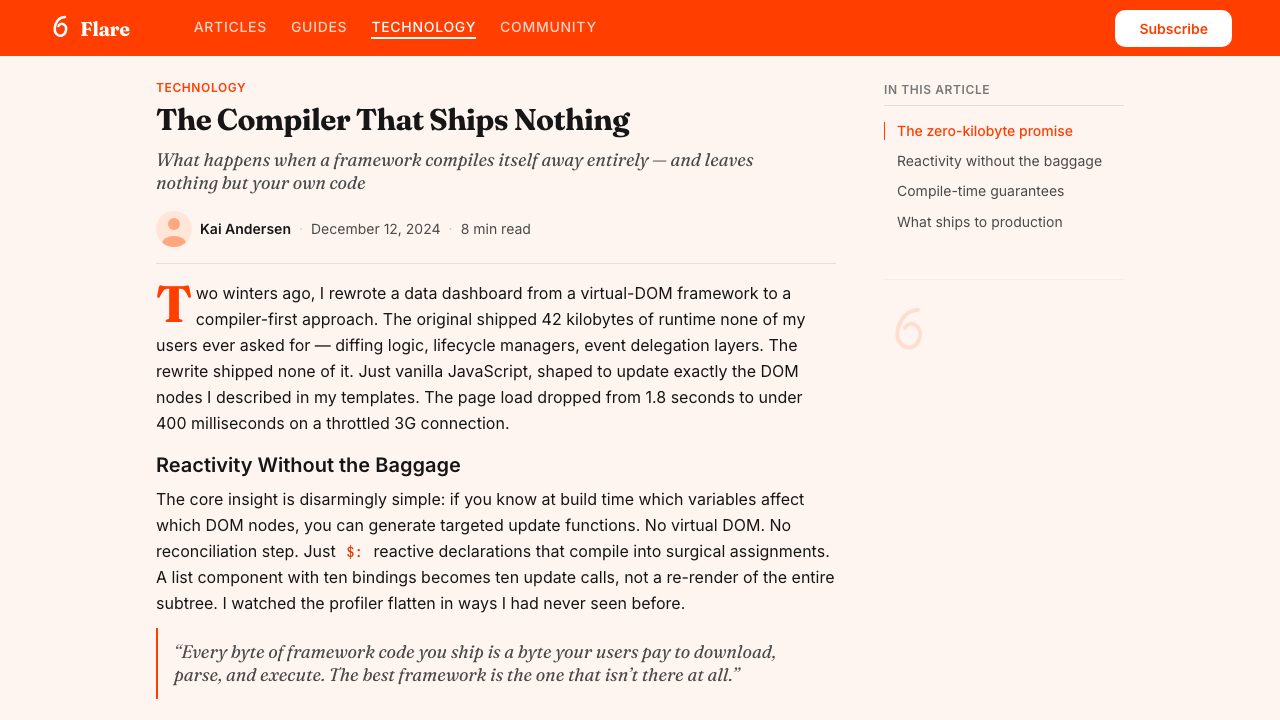
The defining hue is a warm, saturated orange — not the aggressive neon of alert states, nor the muted terracotta of craft aesthetics, but something closer to a ripe citrus at full sun: inviting and energetic simultaneously. This orange is deployed at full intensity against backgrounds that lean toward off-white or a very lightly warmed white, creating generous contrast without harshness. Dark charcoal or near-black anchors body text and structural elements, keeping the orange from feeling untethered. Secondary surfaces use minimal tint variations of the same warmth family rather than introducing entirely new hues.
Typography
Headlines lean into italic weight with editorial boldness — the slant is not timid or decorative but assertive, carrying the personality of a strong byline rather than a polished corporate masthead. The typeface family used for display has bracketed serifs that recall historical newspaper headline faces, giving the tech-forward content an unexpected warmth and weight of authority. Body text and interface labels shift to clean sans-serif forms for readability and technical precision. The pairing of a characterful italic serif at large scales with a utilitarian sans at small scales is the typographic heart of the system.
Code as Visual Content
Unlike systems that treat code samples as supplementary documentation, this aesthetic positions code blocks as primary visual objects. Syntax highlighting uses a palette calibrated to the warm overall tone — ambers, soft teals, and quiet reds against a lightly tinted dark background — making code feel designed rather than generated. Code regions are given wide horizontal margins, generous line spacing, and careful typographic rhythm so that a developer reading a page absorbs the code's structure at a glance, the way a reader absorbs a pull quote.
Warmth in Negative Space
Backgrounds are not pure white but carry a very slight warmth — a near-imperceptible tint that keeps the composition from feeling clinical. This subtle temperature difference between the background and the orange accent prevents the palette from reading as a high-contrast alarm signal; instead, the two values feel harmonically related, like different intensities of the same light source. The warmth in the negative space is the detail that separates this system from aggressive tech-brand orange treatments.
Declarative Headline Register
The copywriting register that accompanies the visual system is inseparable from its impact. Headlines make claims — 'Cybernetically enhanced web apps,' 'Write less code' — rather than describing features. This directness mirrors the design philosophy of the framework itself: compile away the unnecessary, keep only what matters. The italic display type is matched to copy that leans forward with conviction, creating a unity between verbal and visual tone that distinguishes the system from frameworks that dress cautious marketing language in bold fonts.
Interactive Emphasis
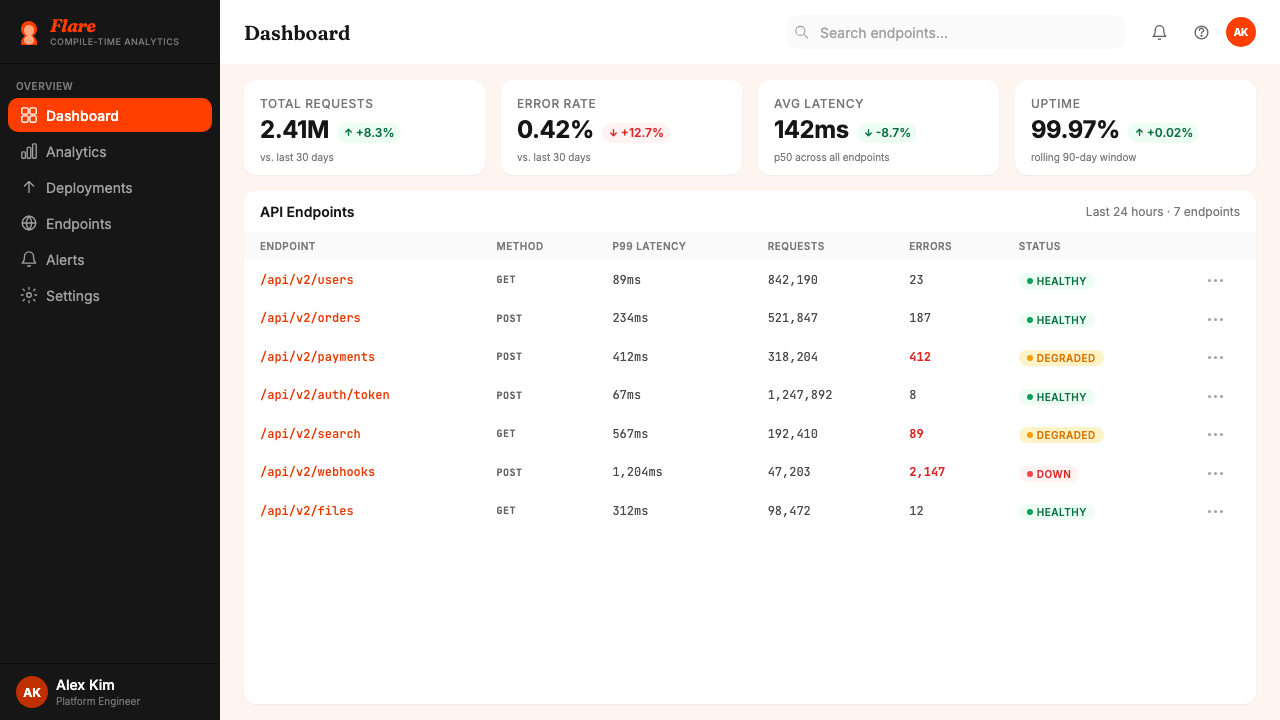
Interactive elements — buttons, links, selected states — use the orange at full saturation as a clear signal of action. Hover states and focus rings are treated with the same warmth rather than shifting to a contrasting cool color, keeping the interaction layer within the palette's emotional temperature. This consistency means that a user navigating through a Svelte site feels the orange as a reliable guide rather than a sporadic decoration. Disabled states and muted elements pull back to pale warm tints, maintaining the family relationship even in reduced-emphasis contexts.
Community-Forward Tone
The overall visual register resists the severity that characterizes many low-level infrastructure tools. Illustration, when it appears, uses rounded shapes and the same warm palette rather than isometric diagrams or circuit-board motifs. Documentation diagrams explain through clarity and generosity of space rather than density of information. The effect is a developer tool that signals expertise without gatekeeping — the design says 'this is sophisticated but it will not punish you for learning it slowly.'
Who shaped Svelte Compiler Orange?
Harris created Svelte in 2016 while building data visualizations for The Guardian and later the New York Times, drawing on his experience as a graphics journalist to prioritize clear, direct communication over architectural elegance for its own sake. His public writing and conference talks — delivered with the same declarative confidence as the framework's own marketing — helped establish the community culture that the visual identity reflects. His move to Vercel in late 2021 gave the project long-term institutional backing while keeping the founder's voice central to the brand.
A prominent contributor to the Svelte core and one of the most active voices in community education, Tan Li Hau has written extensively about Svelte's reactivity model and internal compiler mechanics. His work on documentation and tutorials helped translate the framework's technical confidence into approachable learning materials that align with the brand's direct, warm register. His contributions demonstrate how the visual and verbal identity of the system extends beyond the framework itself into the community's educational output.
Holthausen has been a key contributor to Svelte's language tooling and compiler internals, working on the technical foundations that allow the framework's compile-time philosophy to be maintained as the codebase grows in complexity. His work represents the engineering discipline that the visual identity implicitly promises: that the simplicity presented to developers on the surface is backed by rigorous implementation beneath. The Svelte 5 runes system, which he contributed to significantly, is a case study in making a technically demanding change feel simple and inevitable.
A community educator and developer advocate who has been influential in broadening Svelte's audience beyond its initial core of web performance specialists. Postma's conference presentations and online tutorials have consistently modeled the same accessible confidence that the visual identity projects — demonstrating that the framework's warmth and directness are not just surface qualities but reflect a genuine commitment to developer experience. Her work helped the brand reach audiences who might have been intimidated by a more austere technical aesthetic.
How do you use Svelte Compiler Orange today?
Svelte Compiler Orange translates most naturally to contexts where technical credibility and human warmth need to coexist — developer documentation sites, open-source project landing pages, technical course platforms, and any product whose audience skews toward builders and makers. The core visual move is straightforward: flood the hero with warm orange, pull back to near-white for content areas, use the bold italic display type for claims rather than descriptions, and treat any code samples with the same visual care as headline content.
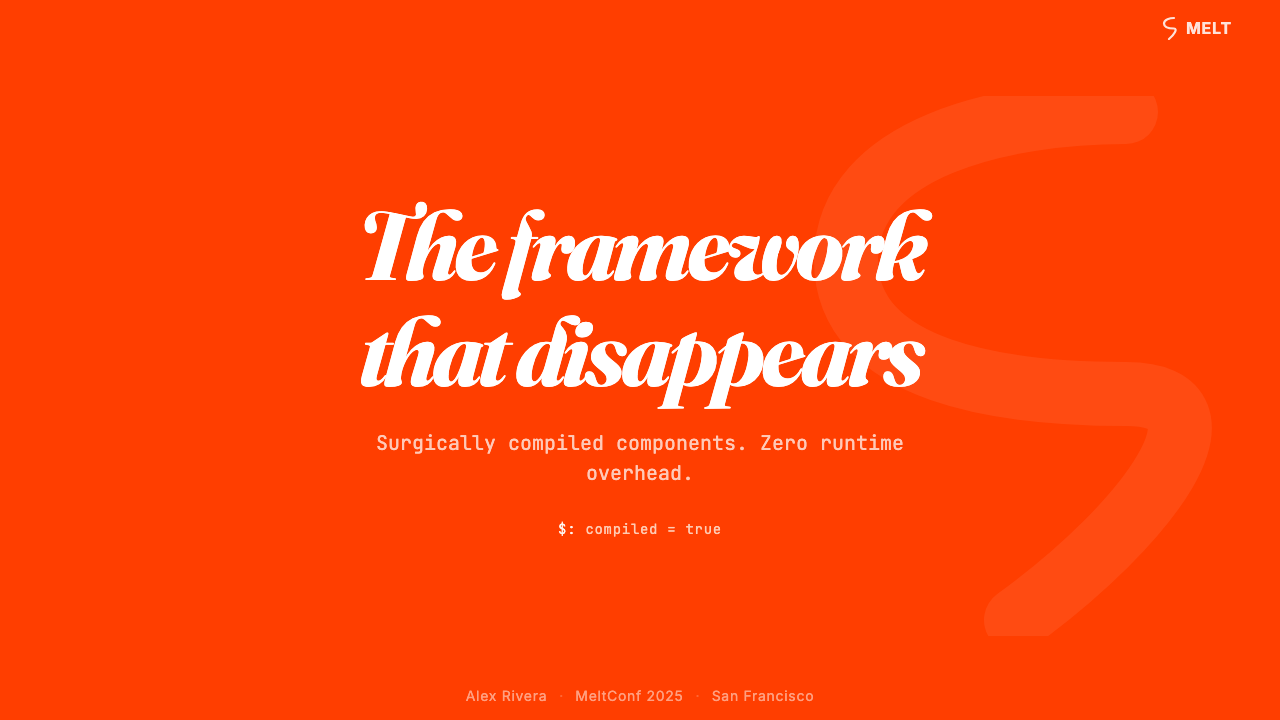
For presentation slides, the system works exceptionally well on cover pages that need to announce a technical topic without feeling cold. A cover might use a full warm-orange background with the title set in large, confident italic type against it — pure saturation as a stage. Content slides benefit from restraint: a warm off-white field, one orange accent used for a single key term or a highlighted data point, and generous blank space that lets the content breathe. Data slides can incorporate the orange as a primary series color in charts, with supporting series in the same warm-neutral family, making the visualization feel integrated with the surrounding slide design rather than imported from a separate tool.
For web interfaces, the system suits developer dashboards, API documentation pages, and SaaS pricing pages where hierarchy matters more than atmosphere. The approach: use near-white as the primary background, reserve the orange for primary calls to action, active navigation items, and interactive highlights. Keep secondary interface elements in warm neutrals rather than cold greys to preserve the overall temperature. Navigation should be typographic and confident — wordmarks and category labels in a legible weight — rather than icon-dominated. For marketing and editorial contexts, the style's poster-like boldness supports strong information hierarchy: alternate full-width feature blocks between orange-on-white and dark-on-white, use the italic display type for section headers that announce rather than label.
In editorial design — long-form articles, newsletters, or documentation — the italic headline style and warm palette support a voice of authority without formality. Section headers can carry the orange as an accent color rather than as a full flood, allowing the orange to punctuate rather than dominate. Pull quotes work well in the italic face at a large size against the warm off-white ground. Code samples should always receive the full visual treatment — syntax-highlighted, well-spaced, given their own breathing room — rather than being treated as secondary content folded into prose.
A common mistake when applying this system is reaching for the orange too liberally and turning a warm, focused identity into a high-saturation noise problem. The orange works because it is used decisively, not continuously. Backgrounds, body text, and supporting UI should be overwhelmingly neutral; the orange earns its energy by appearing against that restraint. A second common error is using a cold, default sans-serif for display text instead of the characteristic italic serif, which strips the system of its editorial warmth and leaves only generic tech-brand orange. The warmth of the backgrounds — not pure white but lightly tempered — is also easy to miss; using stark white instead collapses the palette's temperature coherence and makes the orange read as a warning color rather than an invitation.
Svelte Compiler Orange — FAQ
Is Svelte Compiler Orange only appropriate for developer-focused products?
Not necessarily. The system's warmth and directness transfer to any product that values editorial confidence and clear communication. It works well for educational platforms, technical publications, maker communities, and creative tools aimed at people who build things. It struggles in contexts that require luxury, softness, or cultural specificity — high-end retail, wellness, food, or any brand that depends on sensory richness. The key question is whether the product benefits from the energy and authority that saturated orange communicates; if so, the system can travel well beyond its framework origins.
How is this different from a generic orange tech brand?
The difference is in three details that are easy to miss. First, the background warmth: this system uses an off-white or lightly tinted near-white rather than stark white, which keeps the orange from reading as a warning signal. Second, the typography: the characteristic bold italic serif display face brings editorial weight and personality that a generic rounded sans-serif cannot. Third, the restraint: the orange appears at decisive moments and then withdraws, rather than being applied continuously across navigation, cards, borders, and backgrounds simultaneously. Remove any of these three elements and the system collapses into generic tech-brand territory.
Can this style work in dark mode?
Yes, with care. In a dark variant, the near-white background inverts to a deep warm charcoal or near-black that still carries temperature — not a cold neutral. The orange retains its full saturation as an accent against the dark ground and continues to function as the primary action color. Body text moves to a warm off-white rather than pure white to preserve the palette's family coherence. The italic serif display type remains unchanged. The main risk in dark mode is allowing the orange to flood too much surface area — on a dark ground, a large orange block reads more aggressively than on a light one, so the restraint principle becomes even more important.
What makes the italic headline style essential to this system?
The italic is load-bearing, not decorative. It signals that the system draws from editorial and journalistic traditions — the voice of a reporter making a claim rather than a brand making a pitch. Without the italic, and without the bracketed-serif face that carries it, the orange becomes just another tech-brand accent color applied over a generic sans-serif grid. The italic also creates a natural tension with the code samples, which are set in upright monospaced forms. This contrast between the slanted, humanist headline register and the upright, mechanical code register gives the pages their characteristic visual rhythm and communicates the framework's central idea: that human expressiveness and machine precision can coexist.
How does this system handle imagery and illustration?
Photography and illustration are used sparingly and treated as supporting elements rather than heroes. When illustration appears, it favors soft, rounded shapes in the warm palette rather than sharp geometric or isometric diagrams, preserving the system's overall temperature. Photographs of people — contributors, speakers, community members — are often displayed in warm-toned treatments, sometimes with a tinted overlay that keeps them within the palette. Abstract decorative illustration tends toward flowing or particle-like forms that suggest energy and motion without introducing hard geometric rigidity. The result is that visual variety is achieved through content and typography rather than through a proliferation of illustration styles.
Related design styles
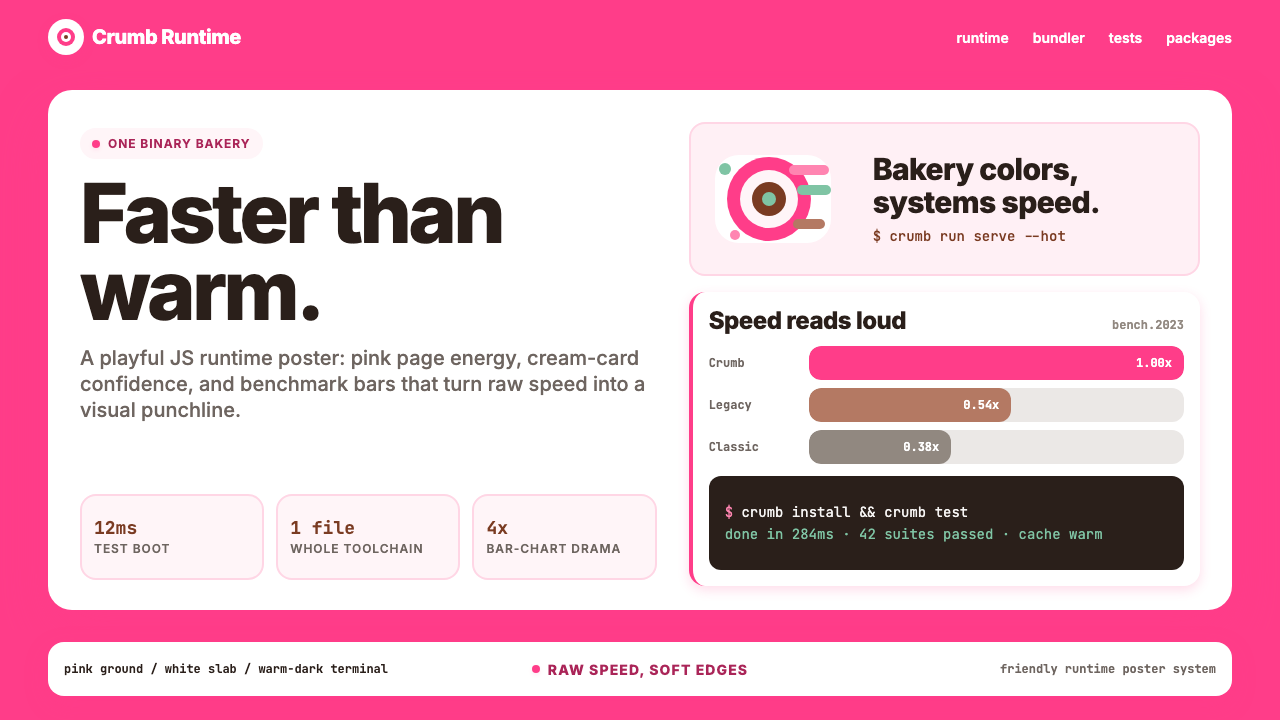 Bun JS Runtime Pink 2023Dev speed gets bakery-bright. Hot pink grounds white slabs, mono bars, and wa…
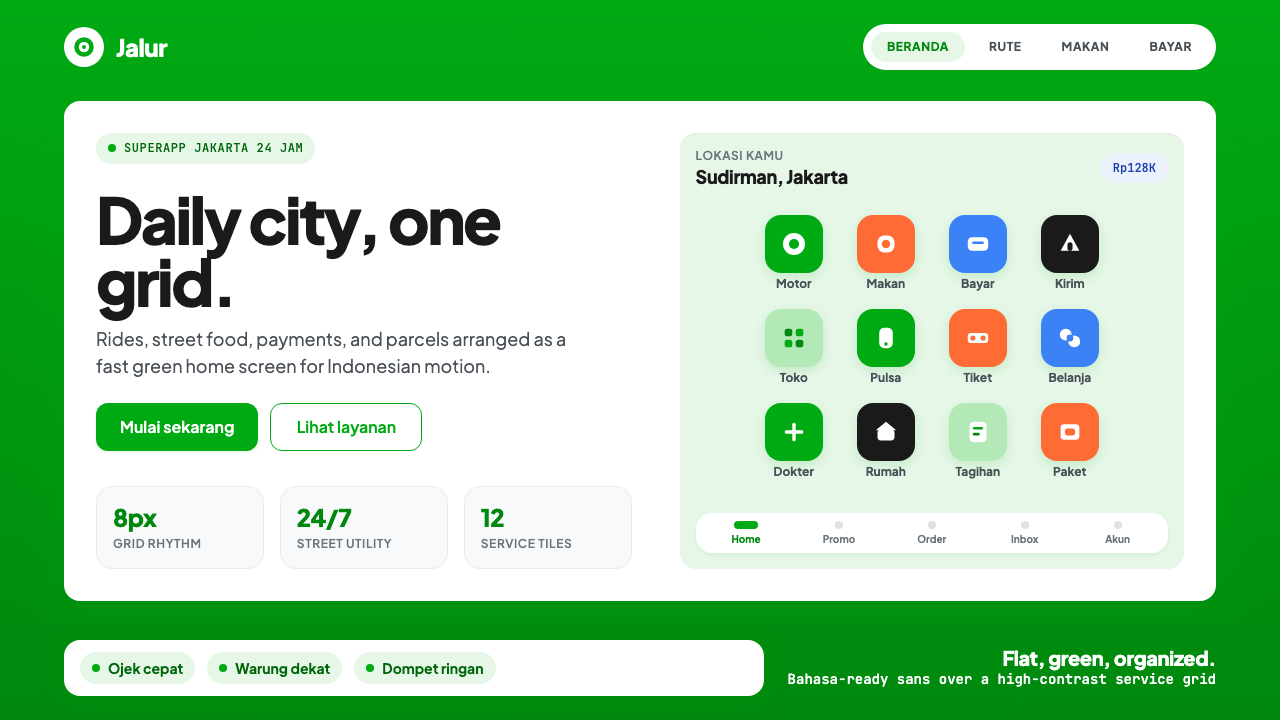 Gojek SuperappCity speed, ordered. Electric green tile grid turns rides, food, and pay into…
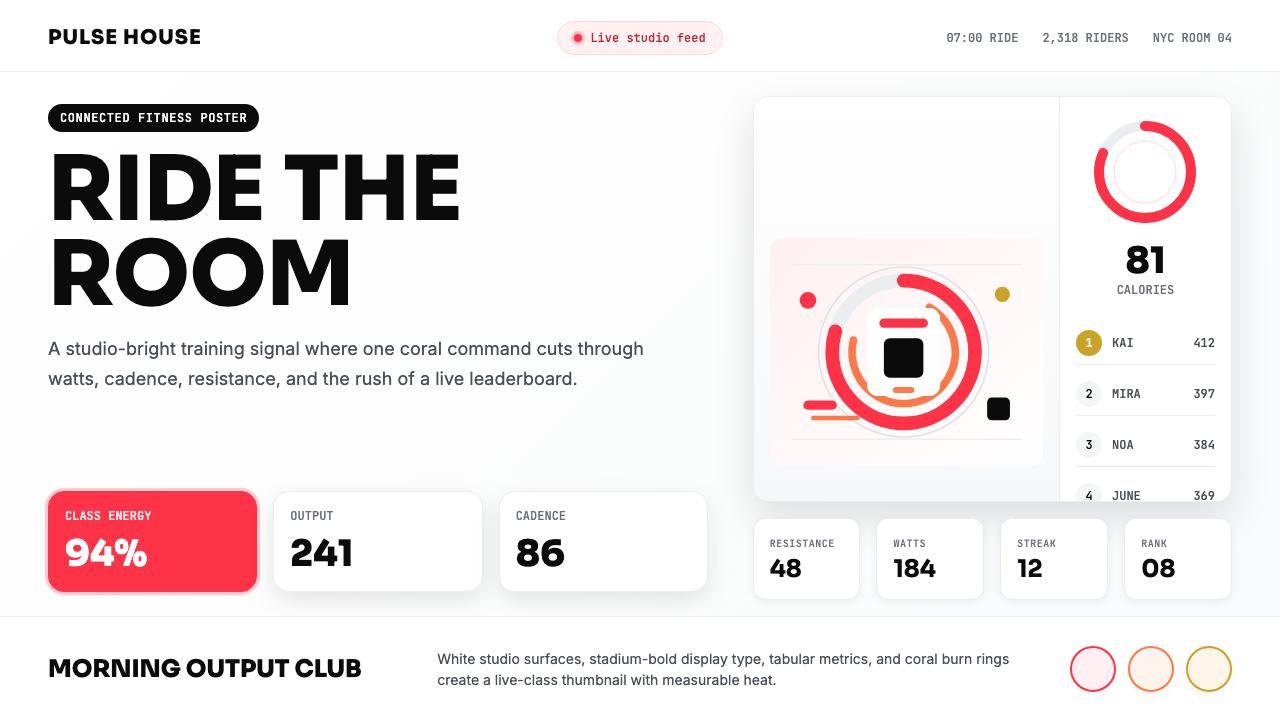 Peloton Fitness Coral (2020)Studio-bright urgency. Coral rings, Sora caps, and leaderboard grids drive th…
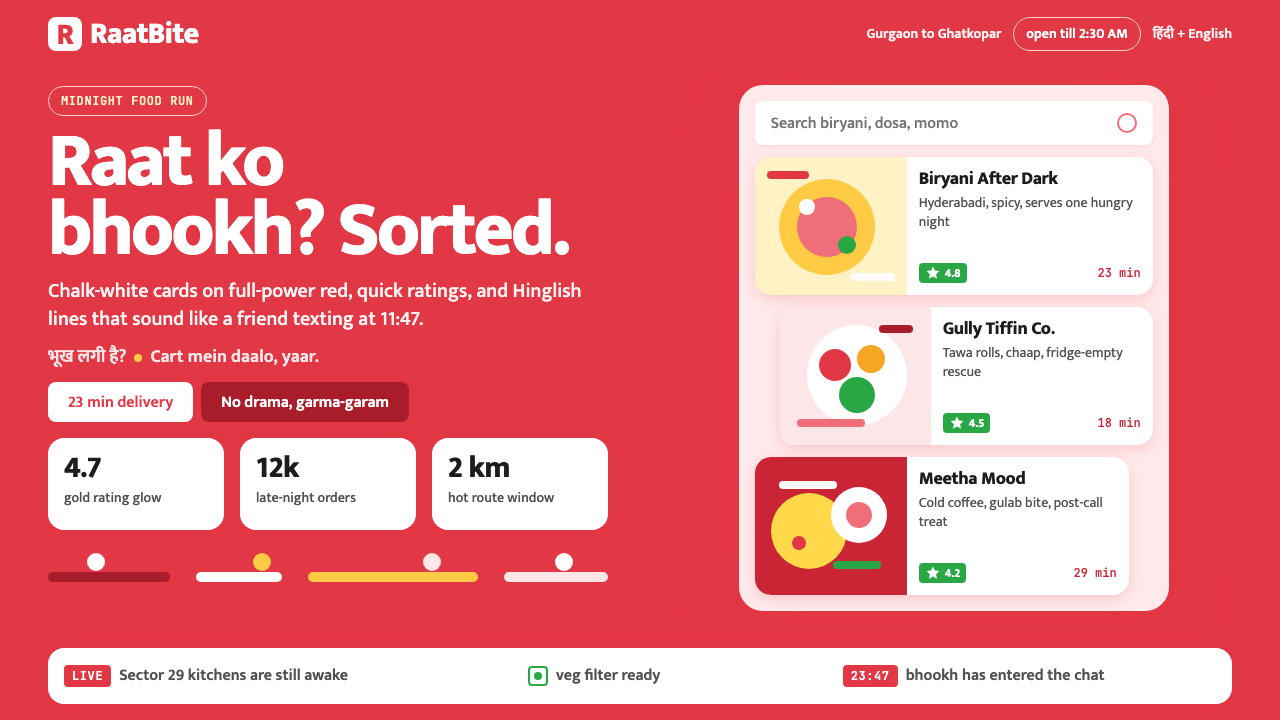 Zomato India DeliveryOwns the midnight scroll. Saturated red, Mukta Hinglish, white cards and gold…
 Discord 2024Blurple cozy. Charcoal grounds, illustrated characters — every surface says '…
 Kīlauea Lava FlowHeat earns its light. Matte basalt grid, molten orange fissures, ember teleme…