What is Discord 2024?
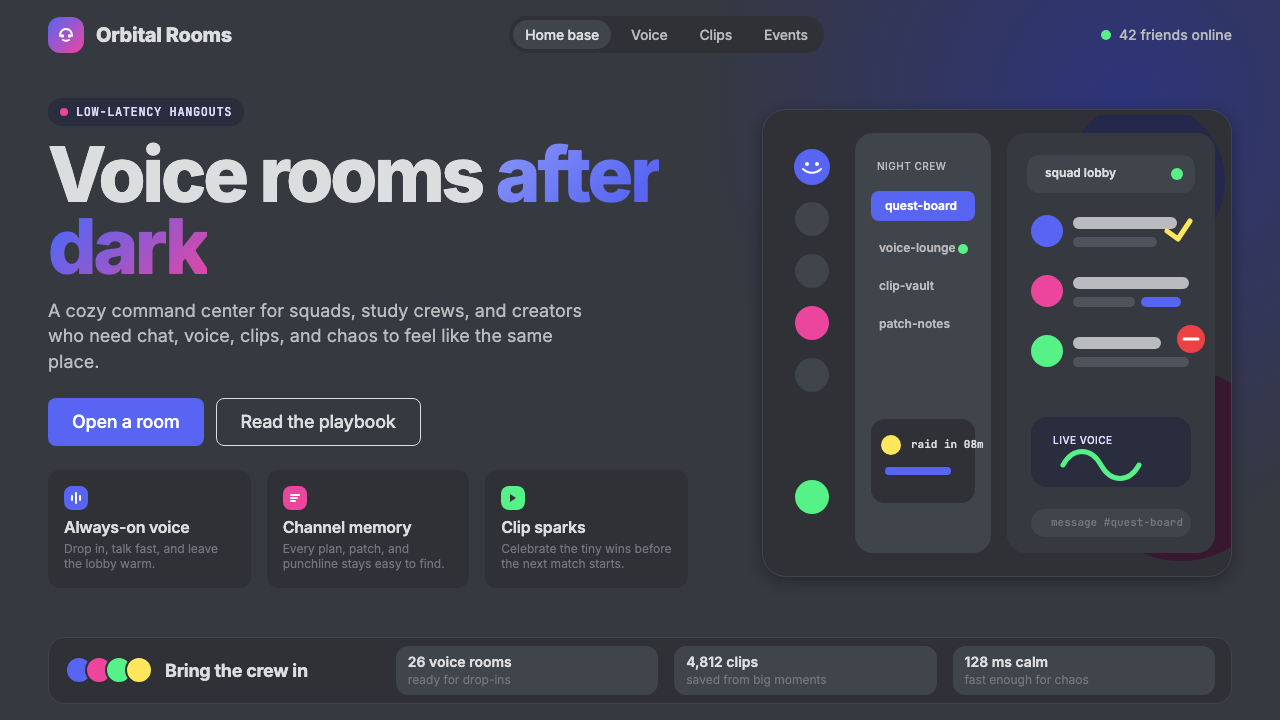
Discord turned a gamer voice-chat tool into a universal community platform by committing to one bold, proprietary blue-purple — and building a deliberately anti-corporate visual language around it.
Discord 2024 in brief
Discord 2024 is the visual identity system that emerged from the platform's 2021 rebrand and matured through subsequent years of product expansion. Its defining characteristic is a signature blue-purple — known within the brand as 'blurple' — deployed against deep charcoal dark-mode backgrounds that evoke the atmosphere of a late-night gaming session. The result is an interface that feels warm and inhabited rather than clinical or transactional.
The design language is built on deliberate contrasts: dark, cozy backgrounds offset by bright, punchy accent colors; rounded, friendly corners on every surface; illustrated characters that are loose and expressive rather than corporate-polished. Typography stays tight and clean, using scaled sans-serif headings to organize information without imposing formality. Color accents — fuchsia, yellow, green, and red — appear selectively as semantic signals rather than decoration.
What makes Discord's visual system distinctive is its explicit rejection of enterprise aesthetics. Where productivity software trends toward neutral greys and restrained palettes, Discord leans into saturation, personality, and the visual grammar of digital leisure. Every design decision reinforces the platform's core proposition: this is a place to hang out, not a place to file reports.

Where does Discord 2024 come from?
Discord was founded in 2015 by Jason Citron and Stanislav Vishnevskiy, initially as a purpose-built voice and text communication tool for video game players. The earliest versions of the product were functional above all else — the design served the need to get voice chat working with low latency, not to make aesthetic statements. Adoption was rapid among gaming communities, particularly those organizing raids, matches, and guild coordination where real-time voice was essential.
By the late 2010s, Discord had outgrown its original audience. Study groups, fan communities, open-source developer teams, and professional networks had discovered that the server-and-channel architecture worked just as well for their needs. This expansion created a branding challenge: the platform needed a visual identity that could serve a vastly broader and more diverse user base without abandoning the authenticity that had earned its original community's loyalty.
The pivotal moment came with the 2021 rebrand, led by Buck, a New York-based illustration and animation studio. Buck's brief was to create a visual system that felt playful, inclusive, and genuinely different from both the gaming-adjacent aesthetic Discord had inherited and the clean corporate look of workplace tools like Slack. The solution centered on the illustrated character Wumpus — a rounded, expressive mascot — and the introduction of blurple as a fully owned brand color. The rebrand also introduced the wider cast of illustrated characters that gave Discord's marketing materials a distinctive personality: loose, warm, and slightly chaotic in a way that felt authentic to internet culture.
The Discord brand team continued developing and refining the system from 2021 through 2024, expanding the character library, codifying the dark-mode UI principles that govern the product interface, and working out how the illustrative warmth of the marketing layer could coexist with the functional requirements of a complex real-time communication platform. The result is a system with two registers: a more expressive, character-driven marketing face and a disciplined, hierarchy-focused product face, unified by the blurple anchor and the consistent language of rounded forms and punchy accents.
What defines the Discord 2024 look?
Blurple as Brand Anchor
The signature blue-purple sits at the center of Discord's entire visual identity. It is saturated enough to be immediately recognizable in any context, but cool enough in tone to read as trustworthy rather than aggressive. All other colors in the palette — the dark backgrounds, the punchy accents, the near-white text — are tuned to work with blurple rather than compete with it. Using blurple sparingly and consistently is what prevents the palette from feeling chaotic despite its breadth.
Dark Charcoal Grounds
Discord's product interface defaults to deep charcoal backgrounds across multiple tonal steps, from the darkest sidebar to the slightly lighter main content area to the elevated surfaces of modals and cards. These dark grounds create a sense of depth through tonal layering rather than cast shadows or gradients. The atmosphere is deliberately nocturnal and immersive — the digital equivalent of a dimly lit room where a group of friends has gathered.
Punchy Semantic Accents
Beyond blurple, the palette includes vivid fuchsia, yellow-green, warm yellow, and red, each carrying a specific semantic role. Green signals online status and positive states; red indicates danger, deletion, or offline; yellow flags warnings; fuchsia appears in marketing and expressive moments. These accents are bright enough to pop on dark backgrounds without requiring large surface areas — they work at the scale of a status dot or a button label.
Rounded, Friendly Surfaces
Every container in the Discord design system — cards, buttons, input fields, avatar frames, modal dialogs — uses generously rounded corners. The effect is a visual softness that distinguishes the product from harder-edged enterprise software. Rounded corners are not merely aesthetic here; they reinforce the brand's social and recreational register, signaling that interactions in this space are lower-stakes and more forgiving than in a productivity tool.
Illustrated Characters
The illustrated character system, developed by Buck, is the most distinctive element of Discord's marketing and onboarding surfaces. Characters are round-headed, expressive, and rendered in a style that reads as hand-drawn without being rough. They populate empty states, error pages, welcome screens, and feature announcements, replacing the cold iconography of enterprise software with something that feels genuinely inhabited. The characters' emotional expressiveness — curiosity, joy, surprise — mirrors the emotional register Discord wants users to associate with the platform.
Two-Register Typography
Discord's type system operates in two distinct modes. Marketing and display typography is large, bold, and set with tight leading — headlines are commanding and take up space confidently. Product and UI typography is compact and precise, optimized for dense information in chat contexts where messages, timestamps, usernames, and status indicators must coexist legibly at small sizes. Both registers use clean, geometric sans-serif letterforms; the shift between them is one of scale and weight rather than style.
Anti-Corporate Personality
Perhaps the most deliberate and consistent characteristic of Discord 2024 is what it avoids. There are no stock photographs of people smiling in offices, no neutral grey color ramps signaling 'serious software', no rigid information hierarchies that would feel at home in a business intelligence tool. The visual choices consistently signal leisure, community, and self-expression. This anti-corporate stance is not naïve — it is a carefully constructed brand position designed to differentiate Discord from both consumer social media and enterprise communication tools simultaneously.

Who shaped Discord 2024?
Citron co-founded Discord in 2015 after selling his previous gaming company, OpenFeint. His background in gaming-adjacent social software shaped Discord's early focus on voice-first, low-latency communication for players. Under his leadership the platform evolved from a niche gaming utility into a general-purpose community platform, and the 2021 rebrand reflected his ambition to make Discord's identity broad enough to serve that expanded audience without losing the authentic, non-corporate character that gamers had responded to.
Vishnevskiy, Discord's CTO and co-founder, was responsible for the technical architecture that made Discord's low-latency voice infrastructure possible at scale. The reliability and performance of the underlying system created the conditions under which the design language could afford to prioritize experience and personality — a platform that drops audio calls cannot compensate with charming mascots. His engineering decisions shaped the product context within which the visual identity operates.
Buck, a New York-based design, animation, and experience studio, led the 2021 Discord rebrand that established the visual foundations still in use through 2024. Buck's contribution was not limited to the blurple color and Wumpus mascot — the studio developed the broader illustrated character language, the expressive illustration style guide, and the principles for how illustration and product UI should relate to each other. The rebrand is widely cited in design industry discussions as an example of how to evolve a brand without alienating its existing community.
The in-house Discord brand team has been responsible for expanding and codifying the system that Buck established, adapting it across Discord's growing product surface and increasingly complex marketing needs. Between 2021 and 2024, the team grew the character roster, developed the dark-mode UI design language in detail, and navigated the challenge of making a playful marketing aesthetic coexist with the demands of a real-time communication product used by millions. Their ongoing work represents the maturation of the original rebrand into a full-scale design system.
How do you use Discord 2024 today?
Discord 2024's visual language is most effective in contexts that call for a social, community-forward, or entertainment-adjacent atmosphere. The style performs well in any setting where the goal is to reduce friction, signal approachability, and distinguish the product from enterprise or productivity software. Understanding what the system is actually built around — the interplay of a dark, cozy background with a single ownable accent color, softened by rounded forms and warmed by character illustration — is essential before applying it to new contexts.
For presentation slides, the style works strongly on cover pages and section dividers where personality is at a premium. A dark charcoal cover with blurple as the dominant accent, a bold and tight sans-serif headline, and a single illustrated character or abstract rounded form creates an immediately recognizable, high-energy opener. Content slides should lighten the touch: use a near-white or very light background to ensure readability for dense text and data, carrying the personality through rounded card components, blurple highlight accents, and small character illustrations used as visual anchors rather than decoration. Data slides benefit from the semantic color system — using the green-yellow-red palette for status-style data and blurple for primary data series gives charts an immediate visual logic.
For web interfaces, the Discord style is well-suited to community platforms, developer tools with a social layer, gaming-adjacent products, and any consumer-facing dashboard where warmth and engagement matter more than austerity. Apply the dark background system with careful tonal layering — sidebar, content area, and elevated surfaces should each read as a distinct depth level without requiring hard borders between them. Reserve blurple for primary interactive elements and calls to action; use the accent colors semantically for status, feedback, and alert states. Rounded components throughout, with generously sized touch targets, reinforce the approachable character.
For editorial and marketing applications, the style's illustrated character library and expressive color system give it unusual versatility. Feature announcement pages work well with large illustrated compositions — characters in playful scenarios, set against dark grounds with blurple and accent highlights. Pricing and feature comparison pages can use the dark-mode palette with card-based layouts, using blurple to highlight the recommended tier and the semantic accent colors to differentiate feature availability. Email campaigns are strongest when they lead with a character illustration and headline, keeping the body copy on a light background for readability while reserving the dark, blurple-heavy treatment for the hero block.
A common mistake when applying Discord's aesthetic is using the full accent palette simultaneously at high saturation — fuchsia, yellow, green, red, and blurple all competing for attention in a single layout. Authentic Discord design typically leads with blurple as the primary accent and introduces one or two other colors only in their designated semantic roles. Similarly, the illustrated character style is easy to misuse: placing characters on every surface dilutes their impact. Characters work best as intentional moments — in empty states, celebratory screens, and hero marketing blocks — rather than as wallpaper. The dark background system also requires discipline: using too many shades of charcoal without a clear depth hierarchy produces muddy, undifferentiated layouts rather than the layered depth the system is designed to create.

Discord 2024 — FAQ
Is Discord 2024 only suitable for dark-mode layouts?
Dark mode is the canonical register of Discord's product interface, and the visual system is most fully realized against deep charcoal grounds. That said, the style can be adapted to light backgrounds — particularly for marketing and editorial contexts where extended reading is required. A light-mode Discord variant works best when it retains blurple as the primary accent, uses rounded components and the same semantic color system, and carries personality through character illustration rather than background darkness. The key is to compensate for the loss of atmospheric depth with stronger type hierarchy and more deliberate use of the accent palette.
How does Discord's design differ from other 'dark mode first' products?
Many dark-mode products — code editors, video editing software, music production tools — use dark backgrounds primarily for focus and eye comfort during extended professional use. Discord's dark aesthetic is social and expressive rather than professional and recessive. The difference shows up in the accent colors (vivid and semantic rather than muted), the rounded forms (warm and friendly rather than precise and technical), and the presence of illustrated characters (expressive personality rather than information density). Discord is dark because it feels like a cozy late-night hangout, not because it needs to reduce eye strain during an eight-hour work session.
Can the Discord style work for a professional or enterprise product?
With significant modification, elements of the Discord style can be adapted for professional tools — but this requires a clear-eyed understanding of which elements carry the recreational signal and which are more neutral. The dark background system, rounded components, and blurple accent can transfer to professional contexts if the character illustrations are removed, the semantic accent colors are used more sparingly, and the type hierarchy is tightened. What remains is a dark, rounded, accent-forward UI that reads as modern and approachable without being explicitly playful. Attempting to use the full system — characters, vivid multi-color accents, loose illustration — in an enterprise context risks undermining the credibility the product needs to establish.
What distinguishes blurple from a generic purple or blue?
Blurple occupies a precise position between blue and purple — cool enough to carry the associations of trustworthiness and digital modernity that blue brings, warm enough to avoid the coldness of a purely cyan-leaning blue, and distinctive enough in its hue to be immediately associated with Discord rather than any category of product. The name itself — a portmanteau of blue and purple — encodes the intentionality of the mix. In practice, blurple reads differently depending on what surrounds it: against dark charcoal grounds it appears vivid and energetic; against white backgrounds it reads as deep and grounded. This contextual flexibility is part of what makes it a strong brand anchor across Discord's two-register visual system.
How should illustrated characters be used without making a design feel derivative?
The issue is not the use of illustrated characters per se — brand mascots and expressive illustration have a long history — but rather the specific combination of round-headed, loosely rendered characters set against dark backgrounds with blurple accents. If you are designing outside Discord's context, the lesson to take is structural rather than stylistic: use illustration to give personality to moments that would otherwise be emotionally flat (empty states, errors, onboarding), choose a character style that is genuinely distinctive to your product rather than generic, and make sure the illustration style is consistent with the rest of the visual system rather than imported from a different aesthetic register. Discord's character style works because it was purpose-built for Discord; copying it produces pastiche.
Related design styles
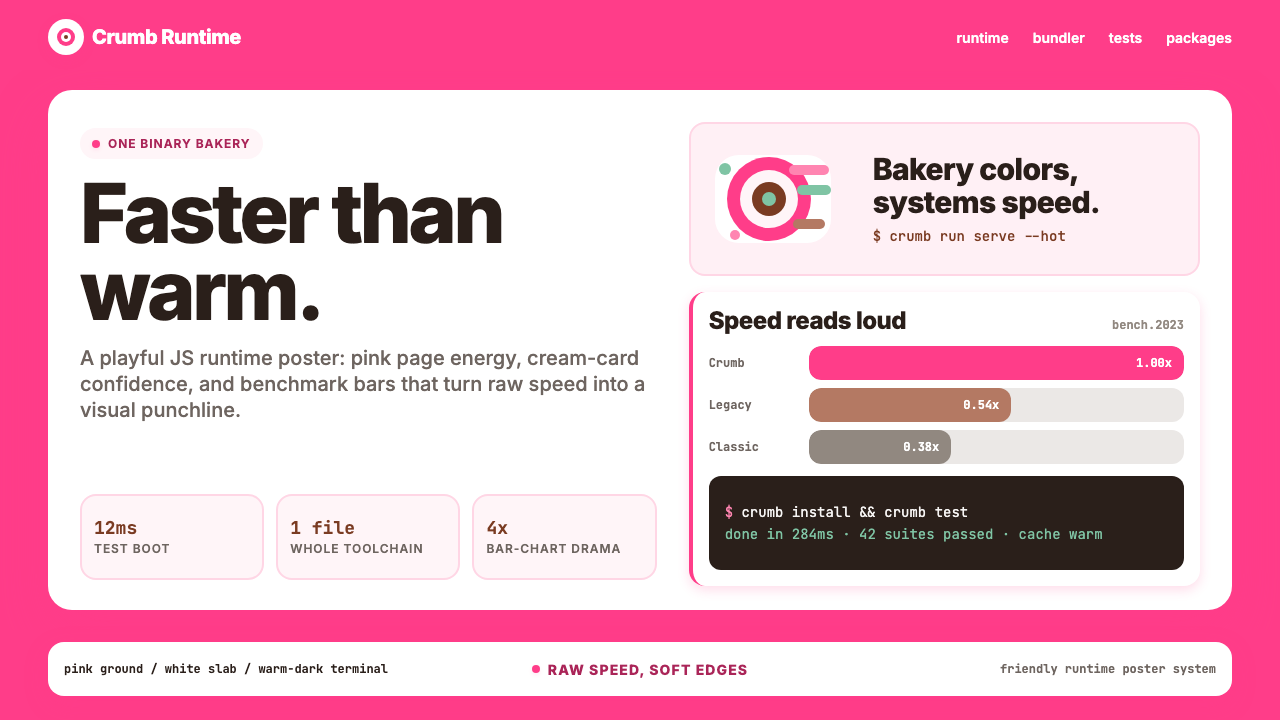 Bun JS Runtime Pink 2023Dev speed gets bakery-bright. Hot pink grounds white slabs, mono bars, and wa…
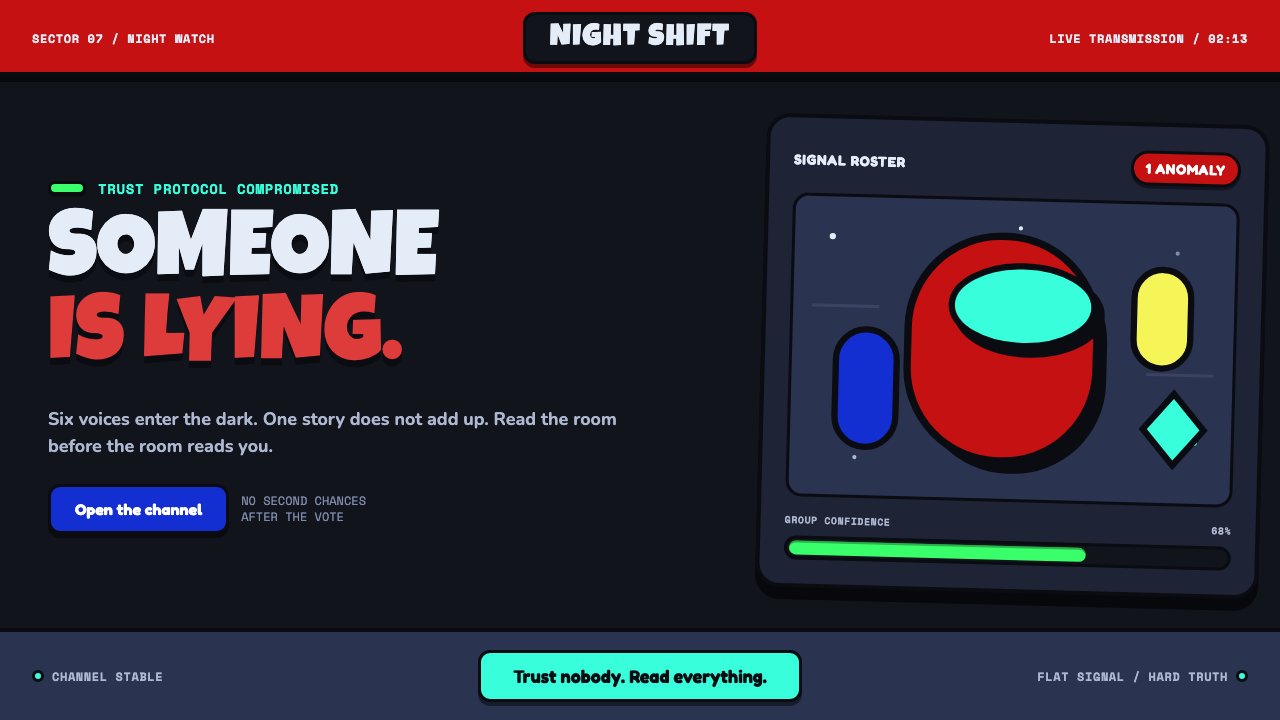 Among Us (crewmate space)Trust is ready to break. Loud capsule colors cut through a navy void with har…
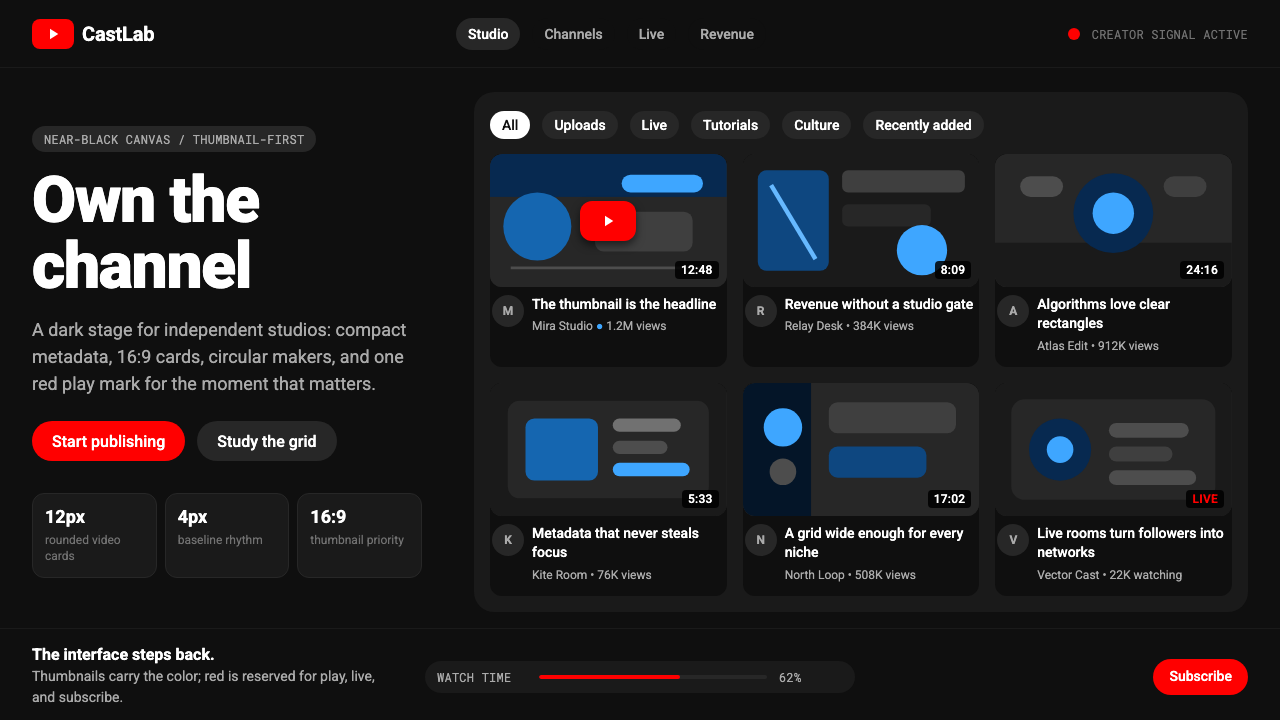 YouTube Creator EconomyThe UI disappears. Near-black Roboto grids let thumbnails shout; red only mea…
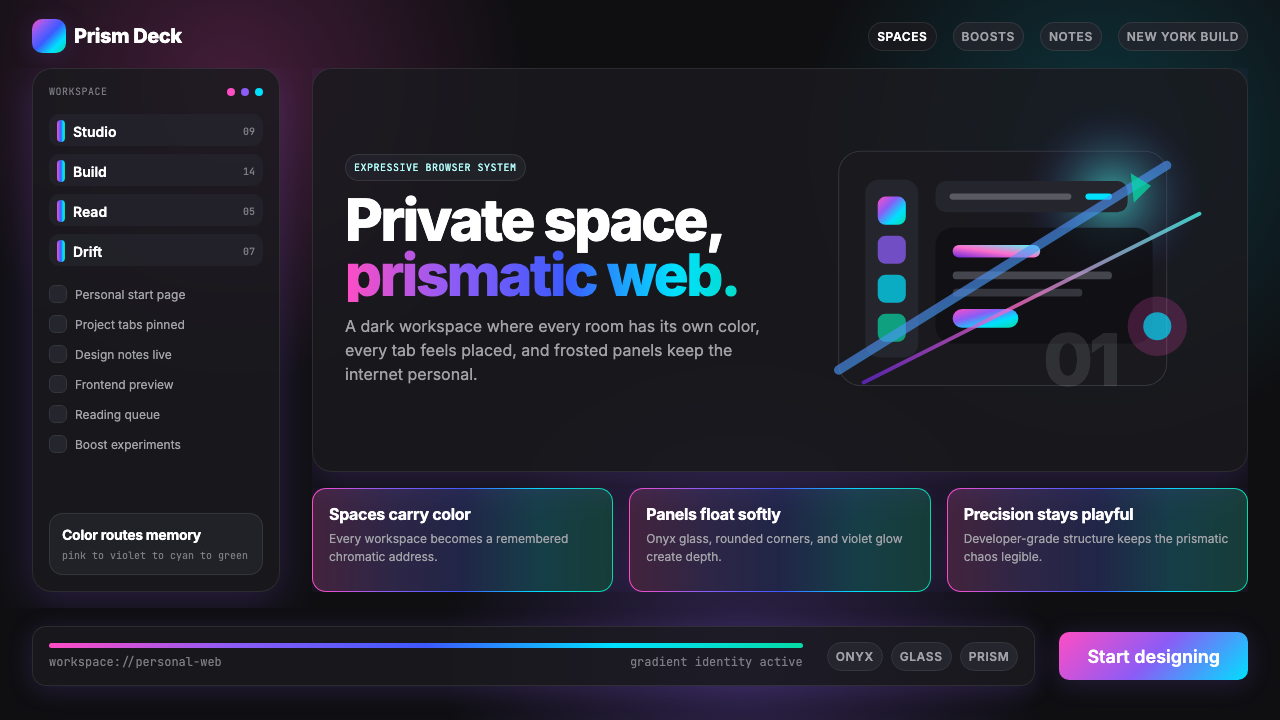 Arc Browser Prismatic (2023)Color is architecture. Pink-violet-cyan ribbons glow over onyx glass and roun…
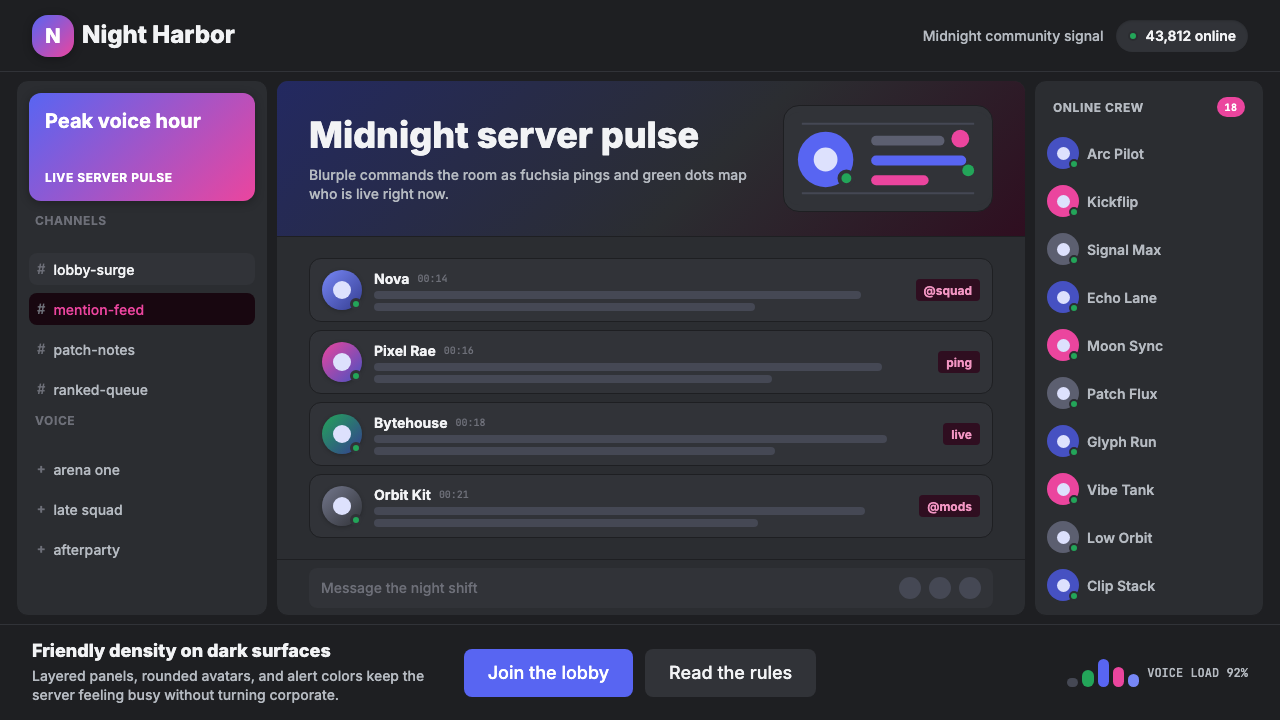 Discord Blurple Server (2020)Midnight server energy. Blurple panels, fuchsia pings, and green status dots…
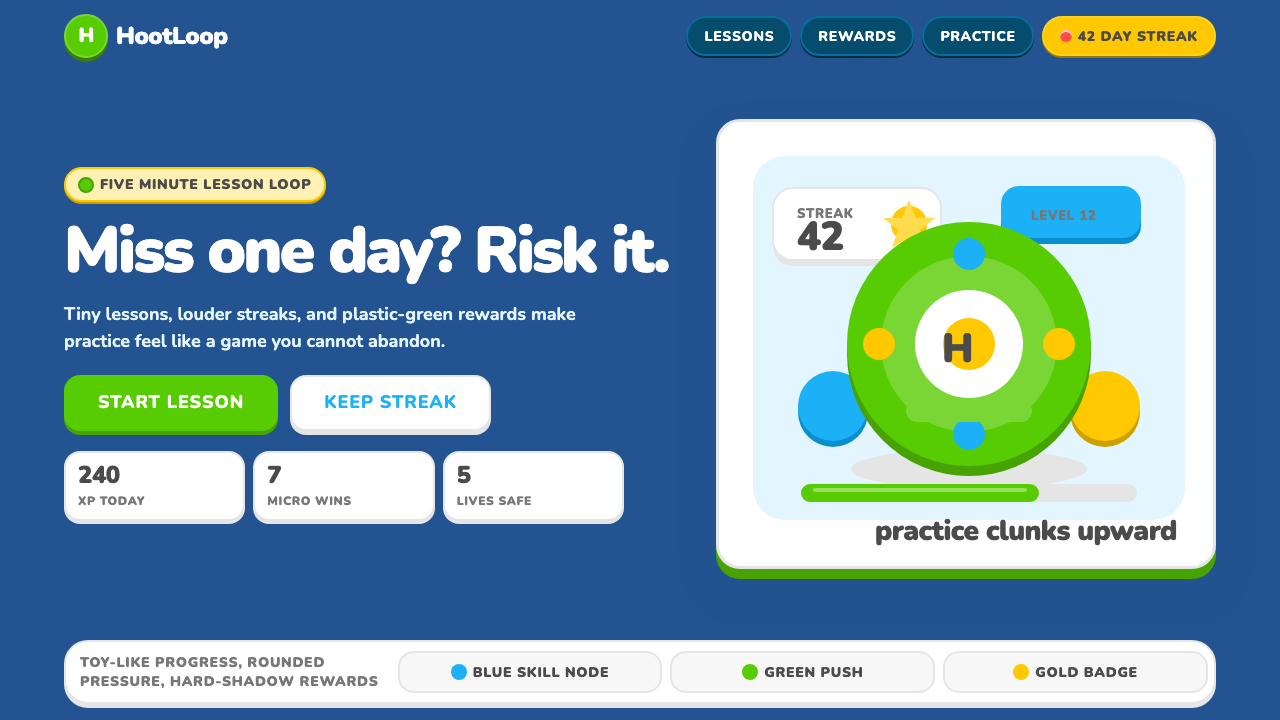 Duolingo 2024Adorable pressure wins. Feather Green, Nunito heft, rounded push-shadows gami…