What is Discord Blurple Server (2020)?
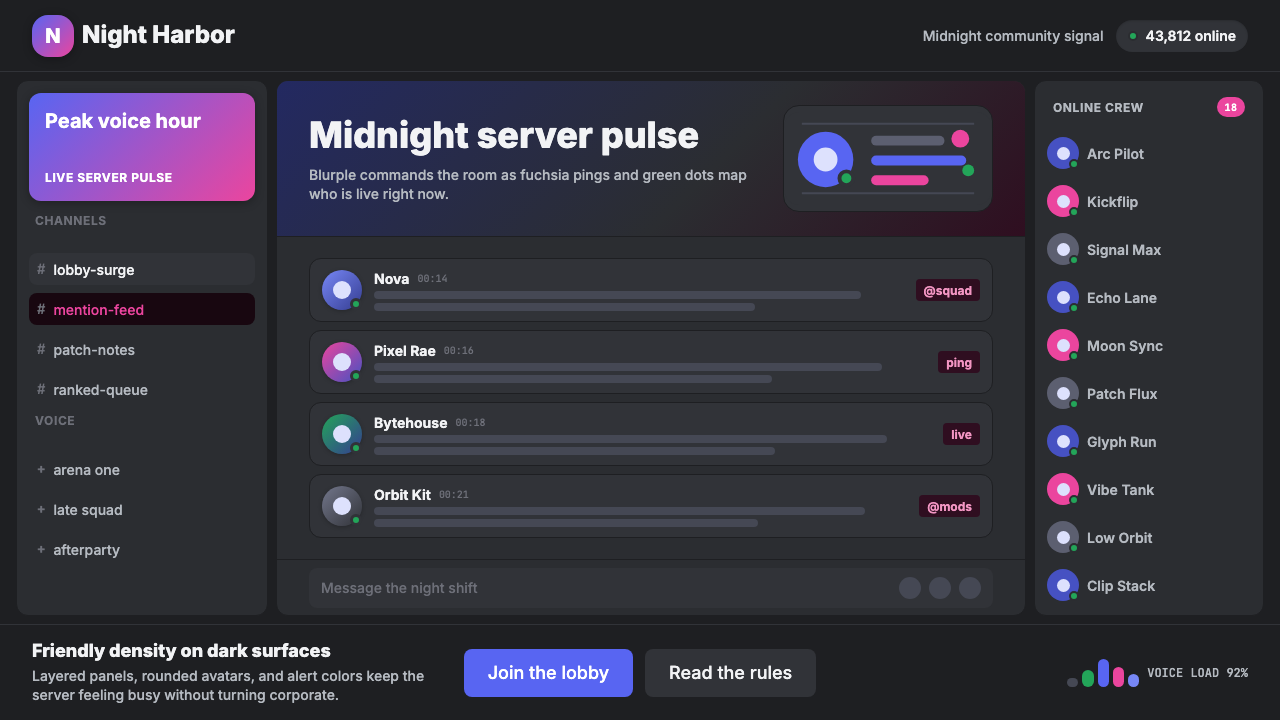
Discord's 2020 redesign turned a scrappy gaming voice-chat tool into one of the most recognizable visual identities on the internet — built around a single invented color that is neither blue nor purple.
Discord Blurple Server (2020) in brief
Discord Blurple Server (2020) is the design language that emerged from Discord's brand overhaul — organized around deep near-black surfaces, a signature blue-violet hue called Blurple, fuchsia mention highlights, online-green status indicators, rounded corners, circular avatars, pill-shaped buttons, and gradient Nitro banners. Together these elements define the 'active server at midnight' aesthetic that hundreds of millions of users associate with real-time community.
The system is unmistakably dark-mode first. Where most productivity software treated darkness as an accessibility toggle, Discord built its personality around the deep-panel experience. A sidebar of server icons, a dense channel list, a message thread layered with reactions and embeds — not a simplified interface but an intentionally dense one, made navigable through a hierarchy of surface tones from near-black background to lighter panel fill to card-level highlight.
What makes the system coherent across its density is the discipline with which each accent color carries a single semantic role. Blurple means 'brand and interactive.' Fuchsia means 'you were mentioned.' Online-green means 'this person is present.' These are status signals that users learn to read at a glance — the aesthetic emerges from that functional assignment, not the reverse.
Where does Discord Blurple Server (2020) come from?
Discord launched in May 2015 as a free voice and text chat application for video gamers — faster and lower-latency than the dominant tools of the time. Its initial visual identity was scrappy: a cartoonish mascot named Clyde, a name referencing dissonance and chord, and a palette already leaning toward blue-violet without yet committing to it as a brand asset. The product grew to 250 million registered users by 2019, but its design language had accumulated inconsistencies at the same pace.
The 2020 rebrand, led in part by Brent Anderson and the internal design team, resolved those inconsistencies and signaled that Discord had outgrown its gamer-tool origins without abandoning them. The central move was codifying Blurple — a blue-violet hue loosely present since the product's early days — into a precise, named, intentional brand color. Naming it rather than merely specifying it was the key decision: it tells users and designers the color is non-interchangeable, carries brand equity, and belongs to a product confident enough to give its signature hue an invented word.
The choice of deep near-black as the dominant surface came directly from the gaming context in which Discord was born. PC gaming interfaces had long favored dark backgrounds to reduce eye strain during extended sessions in dim rooms. Discord's initial users — streamers, competitive gamers, modders — had grown accustomed to spending hours in dark UI environments. The design team recognized darkness was not merely a preference but an identity marker, and formalized it as the canonical experience.
The 2021 rollout of gg sans completed the typographic dimension of the 2020 system. Designed for legibility at small sizes in dense threads, gg sans is a geometric-influenced rounded sans-serif that carries the Blurple brand's friendliness into the typographic register. Its slightly rounded terminals echo the pill and circular forms throughout the interface — a coherence that earlier reliance on generic system fonts had not provided. The 2020 color codification and the 2021 typeface together established the system in the form hundreds of millions of users now recognize.
What defines the Discord Blurple Server (2020) look?
The Blurple Signature
Blurple — Discord's invented name for its blue-violet brand color — sits in a perceptual middle ground between blue and purple, leaning toward blue enough to read as trustworthy and toward violet enough to carry warmth. In the interface it appears on primary action buttons, active navigation states, selected channel indicators, and verification badges — everywhere the system wants to say 'this is official Discord.' Its distinctiveness comes not just from its hue but from its consistent semantic assignment: it never appears decoratively.
Dark Layered Surfaces
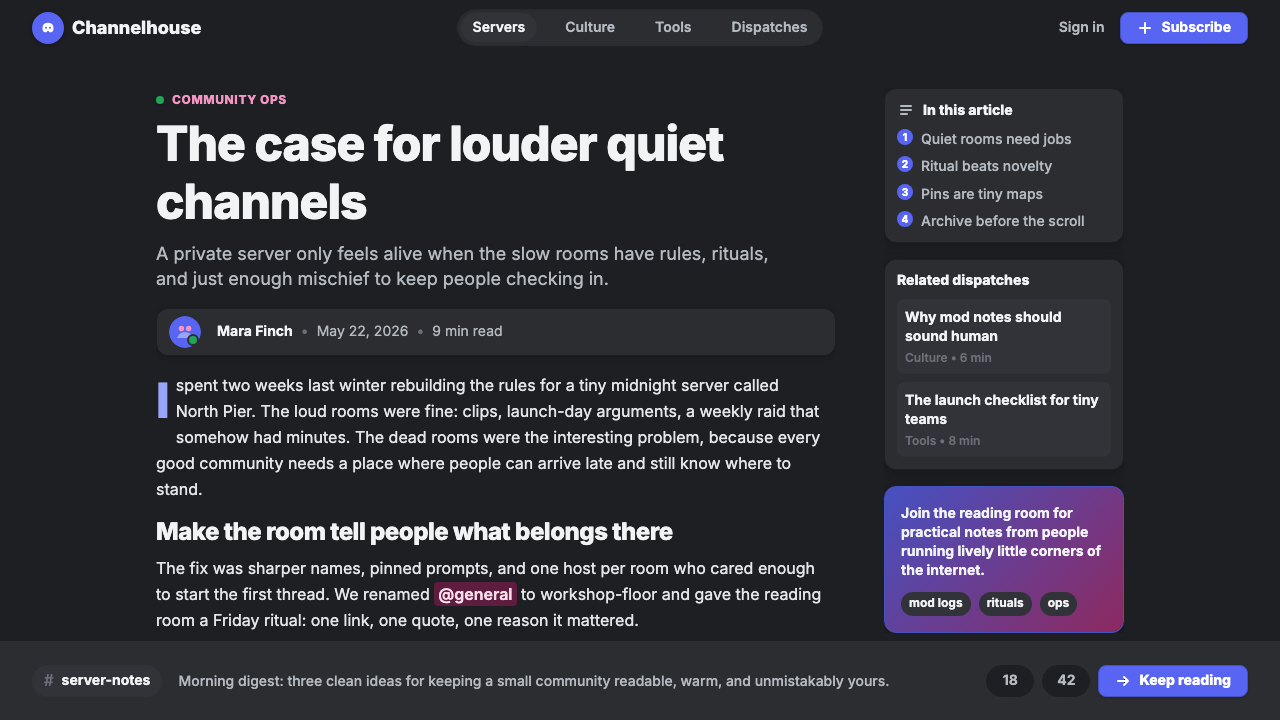
The Discord surface system works through layered near-blacks rather than a single flat dark tone. The server list sidebar is the deepest; the channel list panel is a step lighter; the message area lighter still, with card elements on a subtly elevated surface. This layering creates spatial depth without gradients or drop shadows — depth achieved purely through tone graduation. Users navigate by reading surface brightness as a spatial cue: darker means further back, lighter means closer to the interaction surface.
Semantic Accent Colors
Beyond Blurple, the system maintains a small set of accent colors each assigned a strict semantic meaning. The fuchsia-pink for mention notifications is calibrated to be high-salience against dark backgrounds — drawing the eye without generating alarm. Online-green communicates availability with a single visible mark, distinguishing 'present' from 'away,' 'do not disturb,' and 'offline.' These colors are not interchangeable with Blurple or with each other. The system works because users learn the semantic map quickly: Blurple is action, fuchsia is personal attention, green is presence.
Rounded Geometry
Discord's interface is built on soft geometric forms throughout: circular avatars, pill-shaped action buttons, rounded-corner cards, and rounded-corner inputs. This roundness signals approachability in contrast to the sharp interfaces of professional productivity tools. The degree is calibrated — server icons shift from square to circle when hovered, signaling selection without a label. The roundness operates as a tonal signal — community software, not enterprise infrastructure — without sacrificing the spatial density the system requires.
Gradient as Reward
Gradients appear in the Discord system only in privileged contexts: Nitro subscription banners, profile decorations, and other premium cosmetic elements. Elsewhere the system is resolutely flat. This restriction is a semantic decision — gradient signals 'paid and special' when flatness is the default. The gradients tend to move through Blurple-adjacent hues, reinforcing the brand signature in their most expressive application. Encountering a gradient in a Discord interface is not visual noise but a marker of premium status.
Status as Interface
Discord treats online status as a first-class visual element rather than secondary tooltip or metadata. The small colored dot on each avatar — visible in sidebar lists, message headers, and direct message panels — communicates availability at a glance. In a busy server, the aggregate of these dots creates an ambient indicator of community activity. The design constraint is legibility at icon scale: the dot must communicate clearly at very small sizes, which limits both its form and the hue choices used for each state.
Typography for Density
The gg sans typeface, introduced in 2021, solves a challenge every dense dark-mode interface faces: legibility across many sizes — usernames, message bodies, timestamps, channel names — in a single view. Its geometric-influenced rounded forms avoid reading as cold or corporate; its metrics suit the tight line-spacing dense threads require. Richness comes from repetition and density, not decorative typographic display.
Who shaped Discord Blurple Server (2020)?
Citron co-founded Discord in 2015 after building OpenFeint, a mobile gaming social network acquired by GREE. His gaming-community background shaped Discord's original focus on voice communication and its default dark interface. As CEO through the 2020 rebrand, he championed the transition from gamer-specific tool to general community platform while insisting the visual language remain authentic to its gaming origins — preserving the dark-mode identity rather than lightening it for mainstream appeal.
Vishnevskiy co-founded Discord as CTO and built the voice and video infrastructure that made the product technically distinctive. His architecture — a real-time communication system first, with the visual layer exposing that live data — directly shaped the dense, status-rich design language. Presence indicators, typing indicators, and reaction counters are all consequences of building a UI on top of genuine real-time event streams.
Anderson worked within Discord's design team during the 2020 brand codification. His contribution included formalizing Blurple as a named brand color and establishing the systematic approach to accent color semantics that distinguishes Discord's system from competitors' more casual use of color. Naming the hue 'Blurple' — an invented portmanteau — reflects a design culture that treated color as product vocabulary, not visual decoration.
Marcoullier was an early Discord advisor with consumer community product experience, having co-founded MyBlogLog. His background informed decisions about balancing simplicity for new users with density for power users — a tension the design system resolves through progressive disclosure. He represented the consumer-product sensibility that gave the system its rounded, approachable face.
How do you use Discord Blurple Server (2020) today?
The Discord Blurple system transfers well to any interface that needs to communicate real-time presence, dense information, and community activity. Applying it well means internalizing its core logic: every color carries a specific semantic role, and surfaces communicate depth through tonal layering rather than decorative shadow. Importing the look without the logic produces an interface that feels dark and purple without being useful.
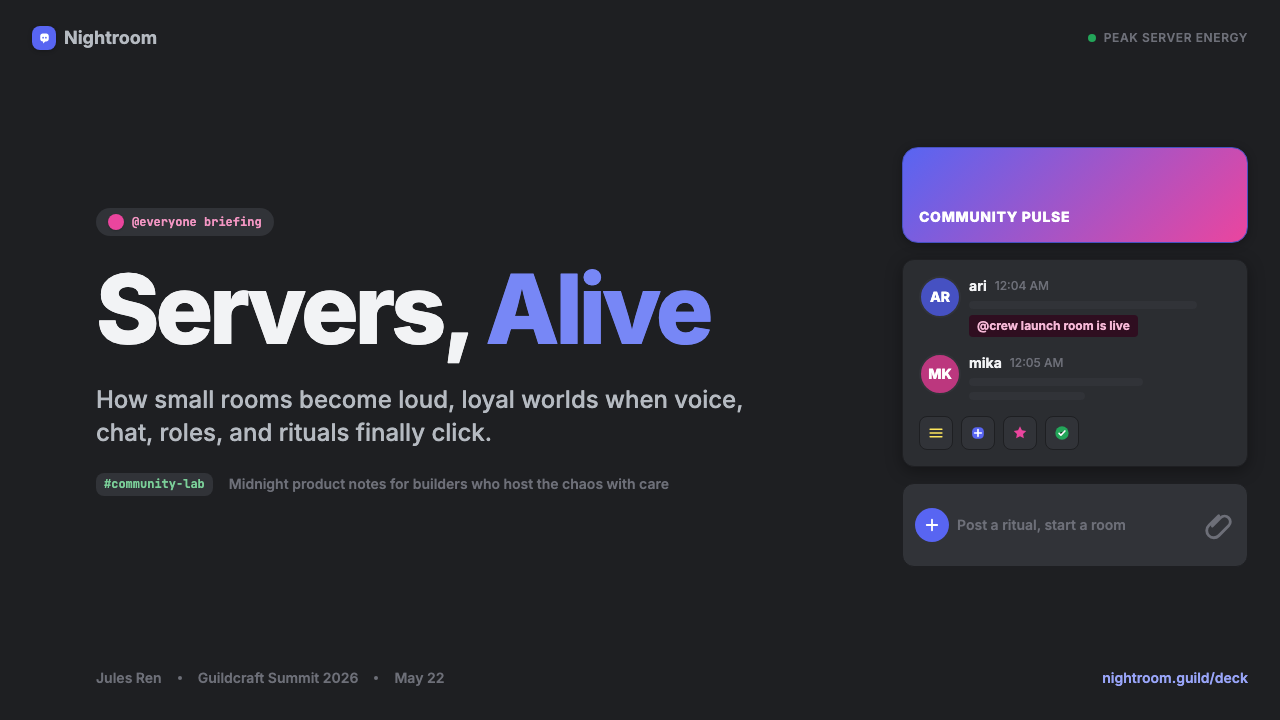
For presentation slides, the dark-background approach demands different composition habits than light-mode work. Cover slides benefit from a bold asymmetric layout: a Blurple-toned geometric element on a near-black ground, title in large rounded sans-serif at high contrast. Content slides treat the dark canvas as a scannability asset — strict typographic hierarchy with accent color reserved for active items only. Data slides have a spatial drama against dark grounds that flat light equivalents lack, provided data series colors stay within the semantic palette rather than introducing new hues.
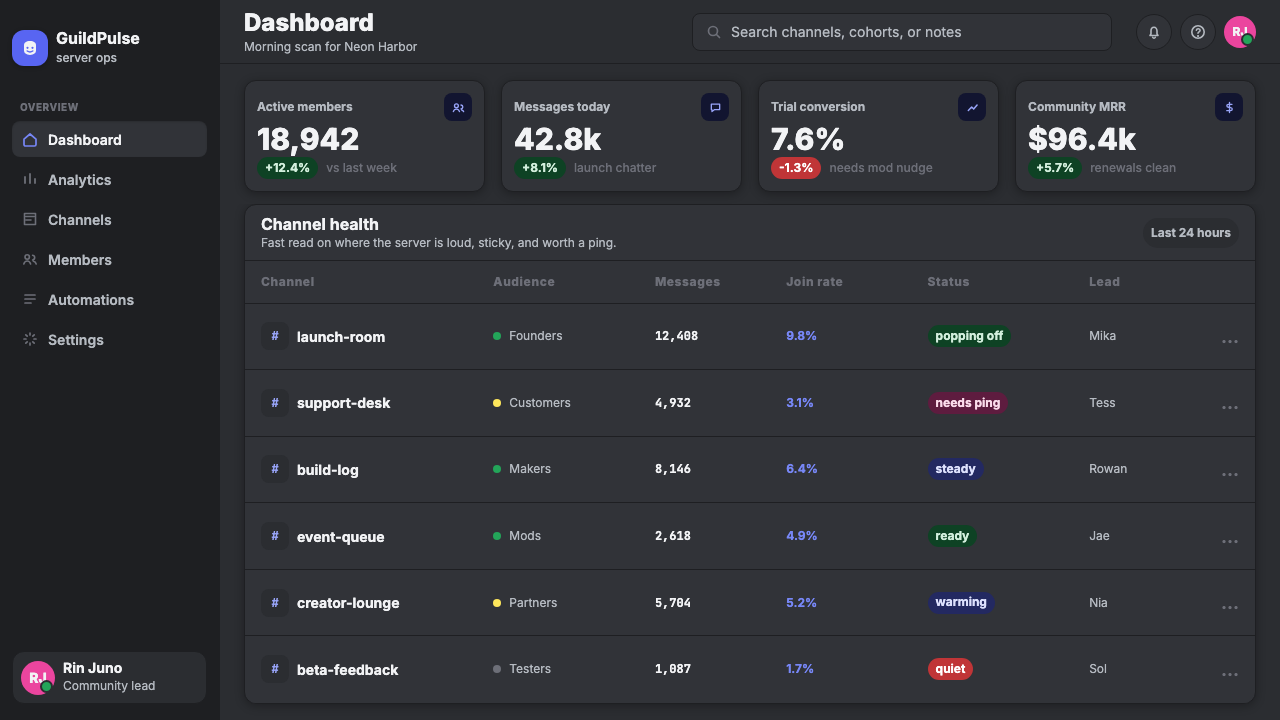
For web interface and dashboard design, the key structural move is establishing the layered dark surface hierarchy before any color is applied: background plane, panel plane, elevated card plane — each at a distinct tonal step. Navigation uses Blurple for selection states, unselected items in muted type against the panel background. Status and notification accents, used sparingly, communicate system events without noise. Pill-button shapes and circular avatar patterns transfer directly to web components.
For marketing work, the style suits technology, gaming, and community subjects. Use alternating dark-panel sections at different tonal depths, Blurple for primary calls to action, other accent hues only for contextual highlights. The rounded geometric vocabulary — circular framing, pill badges — gives layouts a product-interface quality that signals authenticity to audiences familiar with the source.
A common error is using darkness as atmosphere rather than structural information. The Discord system's dark layers are not a mood — they are a spatial map. If background, panel, and card surfaces share the same dark tone, the layering logic collapses and the interface reads as gloomy rather than immersive. Similarly, treating Blurple as a general-purpose accent — on borders, tints, decorative elements — dilutes its semantic weight. In the source system, Blurple is reserved and therefore powerful; spread everywhere, it becomes wallpaper.
Discord Blurple Server (2020) — FAQ
Why is Discord's signature color called Blurple rather than just 'blue-violet'?
Naming is a brand decision, not a color theory one. Calling it 'blue-violet' describes a point on a spectrum, implying it could shift without consequence. Calling it 'Blurple' turns it into a proper noun — a named entity not interchangeable with adjacent hues. The invented portmanteau signals the color is product vocabulary, as specific as the company name. When a color acquires a proper name, it has crossed from visual choice into brand asset.
Is the Discord aesthetic only suitable for dark interfaces, or can it inform light-mode designs?
Discord ships a light mode, but the design language is native to dark surfaces. Its strongest qualities — tonal depth from layered near-blacks, accent drama against dark grounds, the immersive midnight-server feeling — do not translate directly to light backgrounds. A light-mode application can work for community contexts wanting the rounded forms and semantic color discipline without the darkness, but some specificity is inevitably lost.
How does the Discord system differ from other dark-mode design systems like GitHub's or Linear's?
GitHub's and Linear's dark interfaces are utility-first: darkness reduces eye strain and establishes hierarchy for developer and productivity tools. Their accent colors are functional (success, error, link) and typography is optimized for code or task lists. Discord's system is community-first and presence-first: accent colors communicate social states rather than system states, rounded forms signal friendliness rather than precision, and density reflects continuous habitation rather than task completion. Linear leans toward utility, Discord toward personality, GitHub between them.
Can the Discord visual vocabulary be applied to products unrelated to gaming or chat?
Yes, with selectivity. Most transferable outside gaming and chat are the rounded geometric forms, the tonal layering system, and the semantic approach to accent color assignment — principles applicable wherever you need to communicate real-time state or community membership. Least transferable is the strong Blurple brand reference (it reads as 'Discord' to anyone familiar with the platform) and the density expectations, which reflect a habituated user base. A product borrowing the vocabulary while substituting its own brand color and calibrating its density can carry the aesthetic register without being read as imitation.
Why do gradients appear in Discord's Nitro branding but not in the general interface?
The restriction is semantic. In a system where the default is flat and every element carries a specific meaning, gradients function as a reserved signal — they mean 'elevated, premium, beyond the default.' If gradients appeared everywhere, they would lose that meaning. By keeping the standard interface rigorously flat and deploying gradients only in subscription contexts, Discord ensures that encountering one is an event: it marks premium status or a paid customization. Visual restraint in the default state makes expressive elements more powerful when they appear.
Related design styles
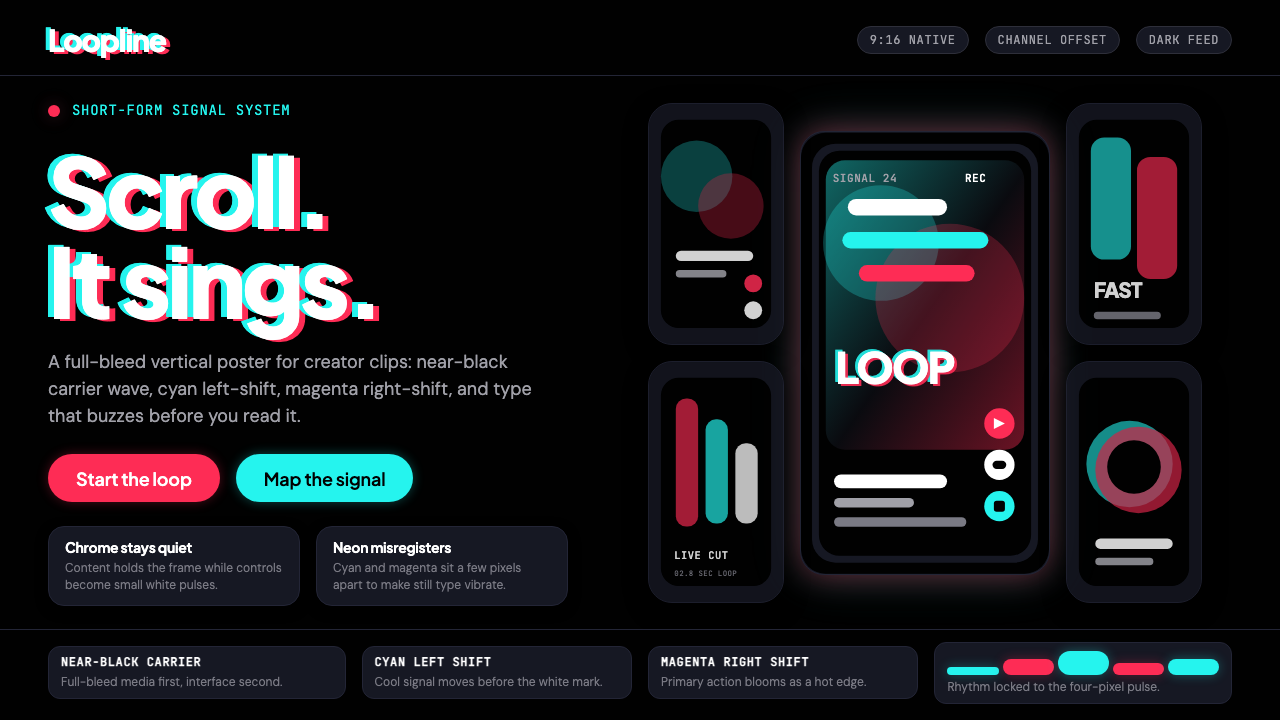 TikTok 2024Attention vibrates. Near-black feed, cyan-magenta offsets, and vertical frame…
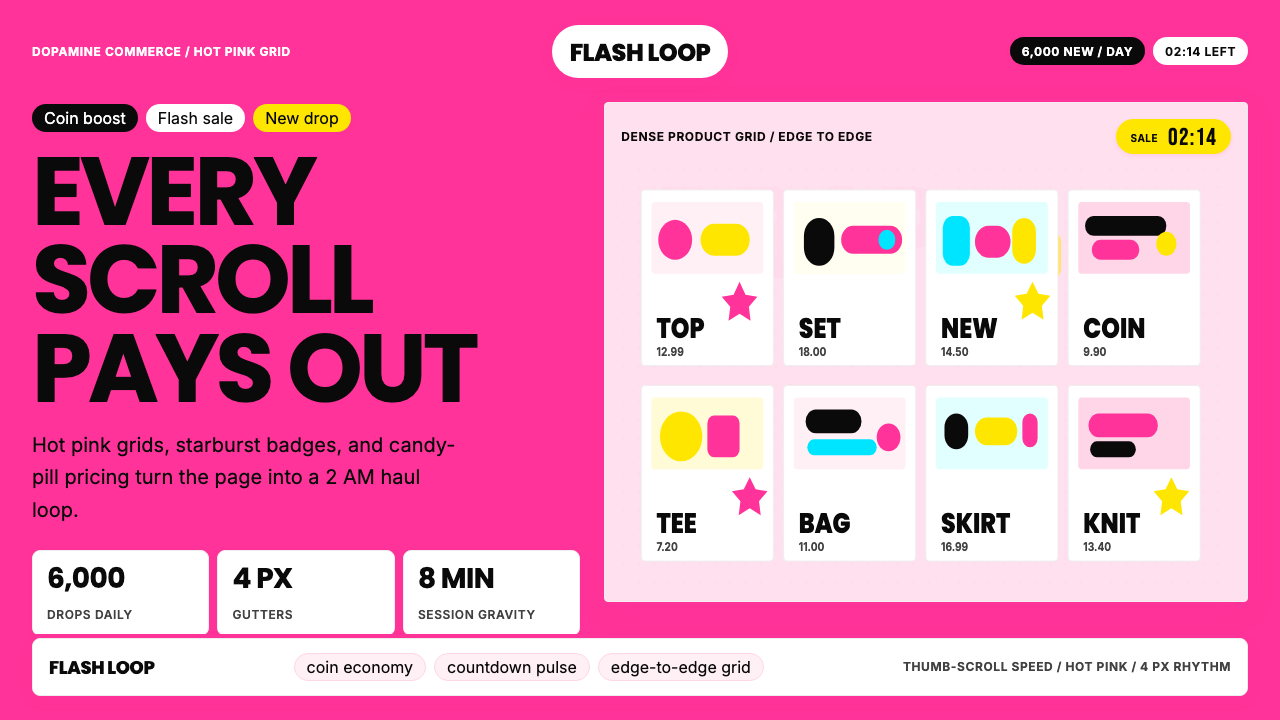 Shein Fast FashionDopamine density wins. Hot pink grids, starbursts, and candy pills pack every…
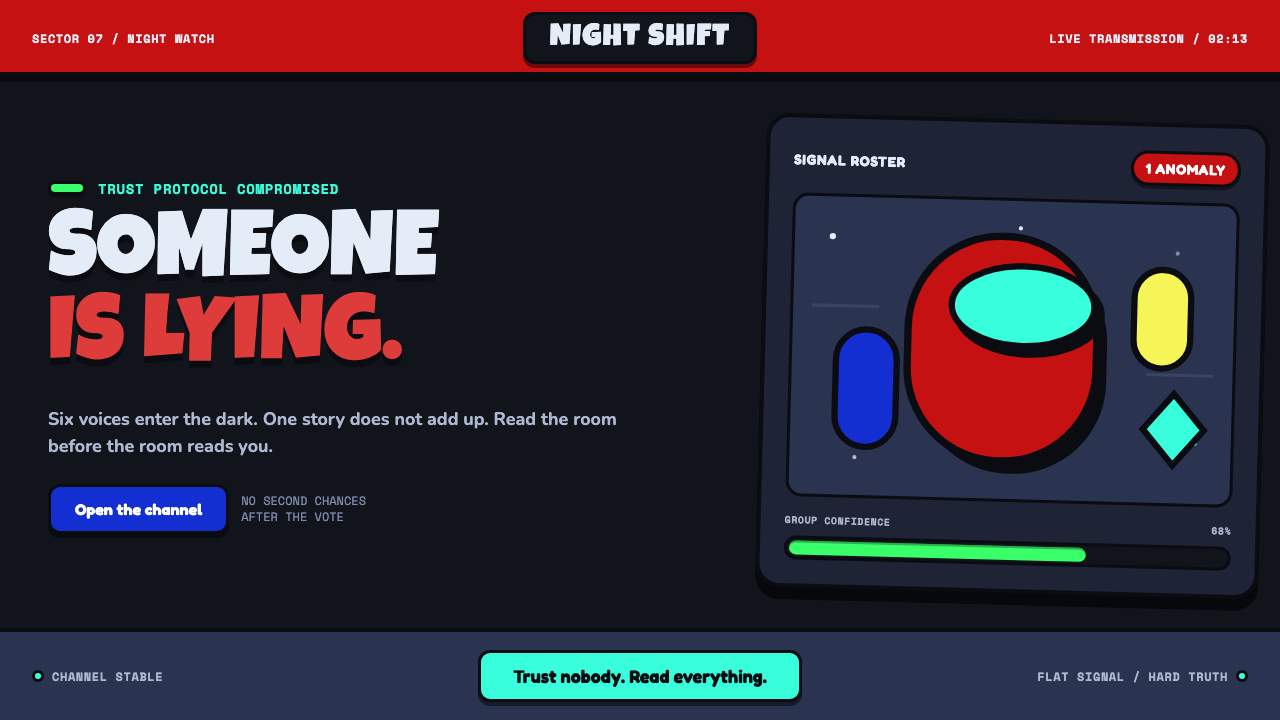 Among Us (crewmate space)Trust is ready to break. Loud capsule colors cut through a navy void with har…
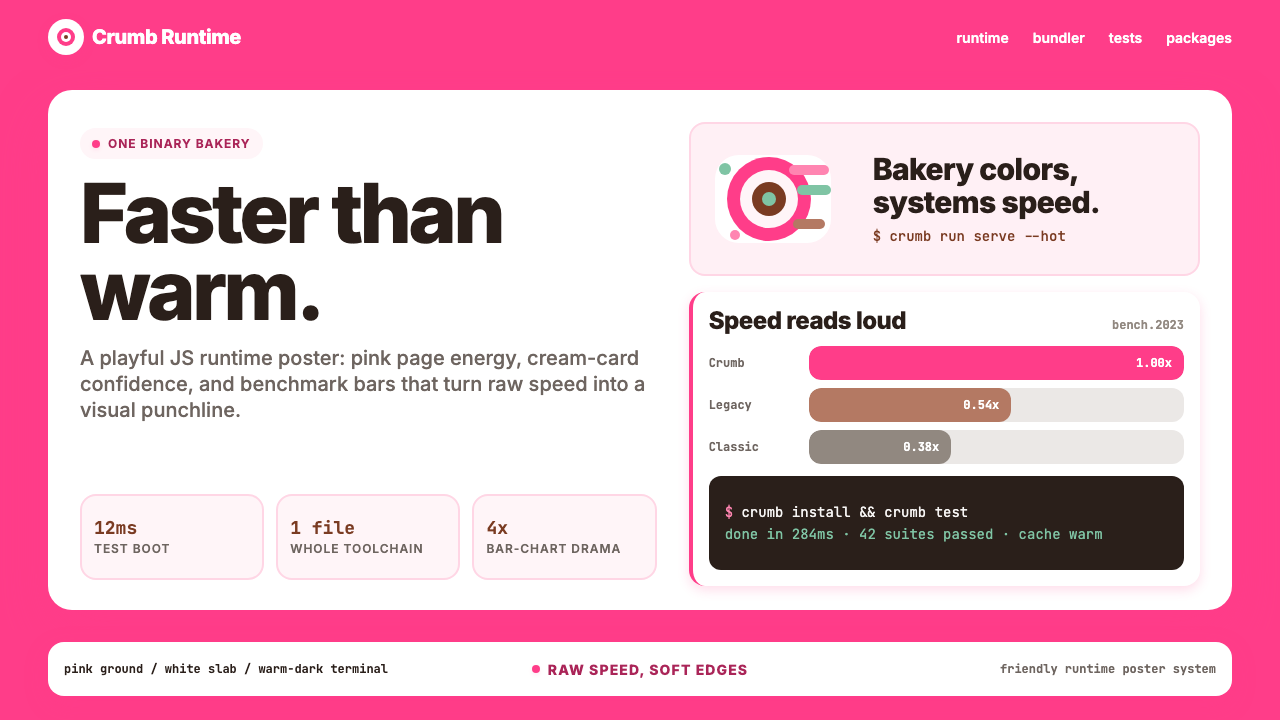 Bun JS Runtime Pink 2023Dev speed gets bakery-bright. Hot pink grounds white slabs, mono bars, and wa…
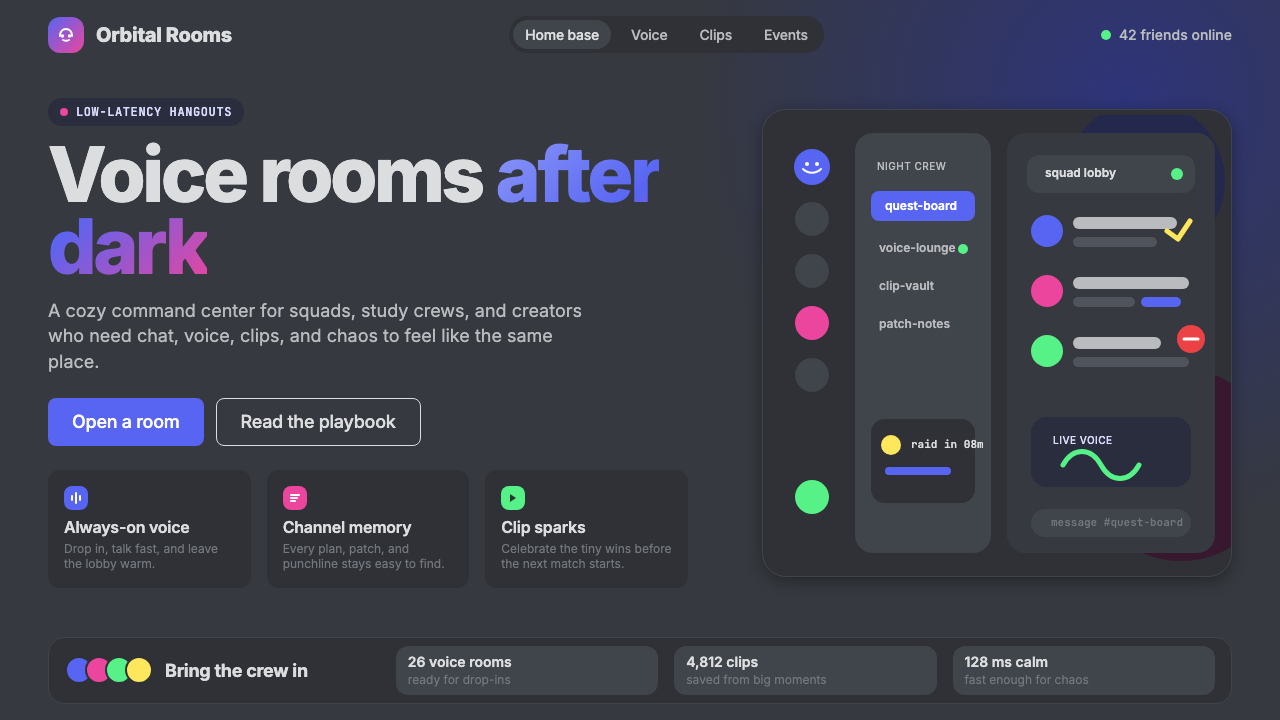 Discord 2024Blurple cozy. Charcoal grounds, illustrated characters — every surface says '…
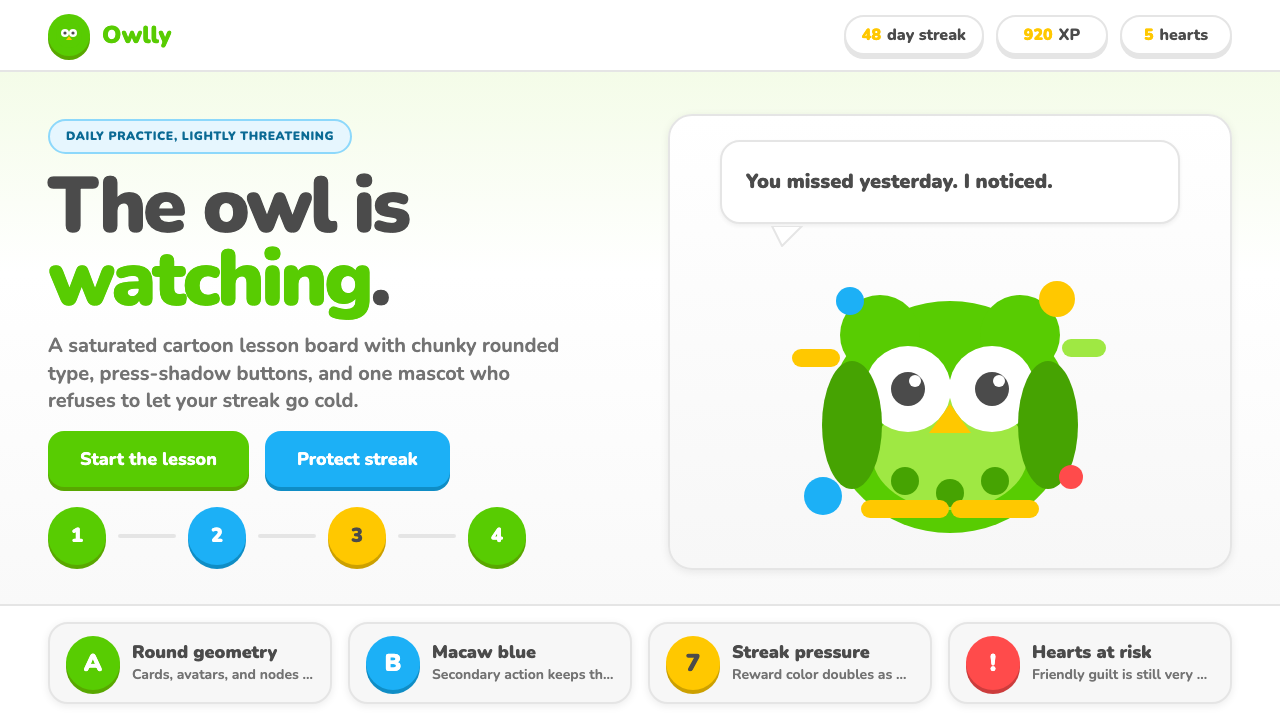 Duolingo Green Owl MascotFriendly guilt goes loud. Saturated green, Nunito heft, and press-shadow butt…