What is TikTok 2024?
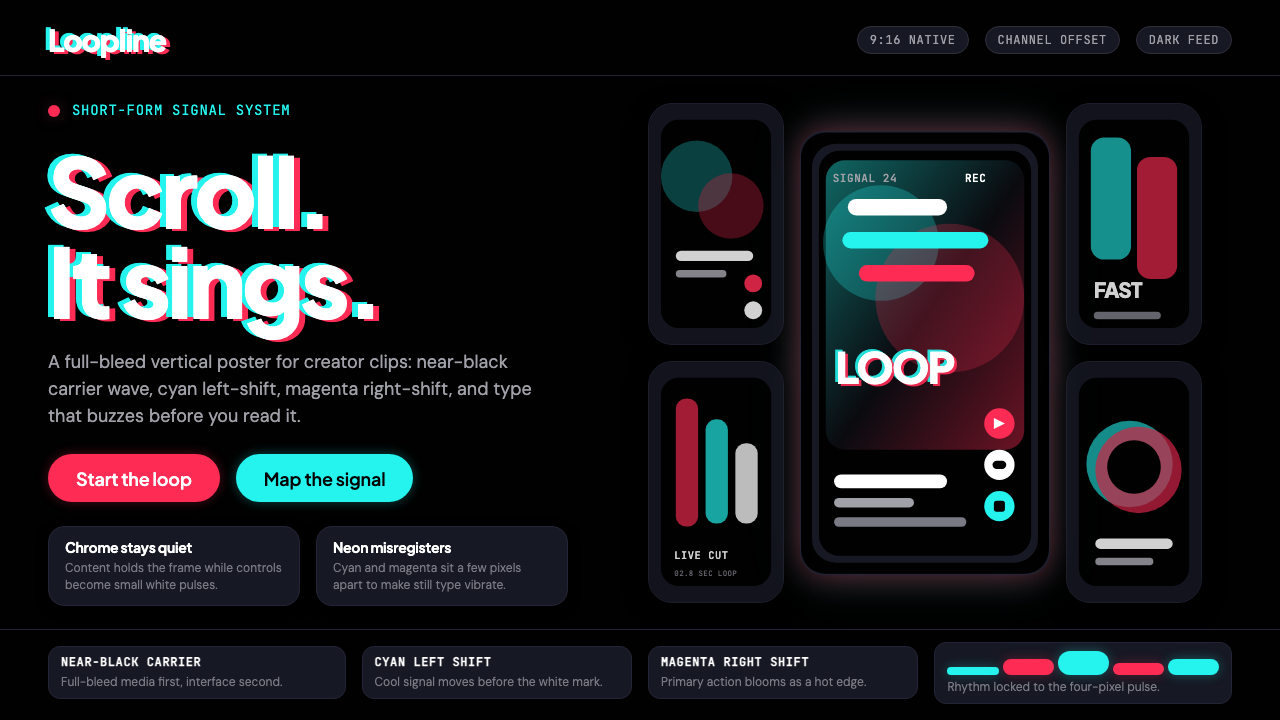
TikTok's visual identity is built on a single, unforgettable trick: two neon channels — one cyan, one magenta — misaligned by just enough to make the entire interface feel like it's vibrating.
TikTok 2024 in brief
TikTok 2024 is the mature form of the visual identity ByteDance built for its global short-video platform across the years 2020 to 2024. It is a dark-mode-native system — not dark mode as an afterthought, but dark mode as the foundational condition. Almost every interface decision flows from that commitment: the near-black canvas exists to make video content appear with maximum luminance, and every chrome element is engineered to recede behind it.
The style's most recognizable signature is the chromatic offset, borrowed from the wordmark, in which a cyan copy and a magenta copy of a graphic element are nudged slightly out of register, creating a glitch-like vibration. This effect — reminiscent of misaligned printing or analog TV signal degradation — gives the identity a kinetic quality without requiring literal motion. Even static applications of the brand appear to buzz with energy.
Beyond the signature effect, TikTok 2024 is a rigorously minimal system. The interface chrome is subordinate to the 9:16 vertical video frame at all times. Typography is rounded and approachable, iconography is reduced to confident outlines, and the overall composition is built for one-handed, thumb-driven scrolling. The aesthetic communicates a single directive: content first, chrome invisible.

Where does TikTok 2024 come from?
The story of TikTok's visual identity begins in Beijing in 2016, when ByteDance launched Douyin — a short-video application aimed at the Chinese market. Douyin's early identity was energetic and youth-oriented, leaning into the neon palettes and kinetic aesthetics that were emerging across Chinese digital culture. The chromatic offset device — the cyan-magenta double exposure on the musical note logo — appeared from the start, signaling disruption and forward motion in a visual vocabulary that Gen Z recognized as authentically digital rather than polished-corporate.
In 2018, ByteDance merged Douyin's international expansion with Musical.ly, a Shanghai-founded lip-sync video platform that had built a substantial following among Western teenagers. The combined product launched globally as TikTok with a visual identity that carried Douyin's energy forward while simplifying and flattening the interface to accommodate a much wider user base. The 2018-era TikTok retained lightness in some interface contexts, but the trajectory toward dark-mode primacy was already underway.
The 2020 visual refresh established the system that would define the 2020–2024 era. The near-black background became canonical. The wordmark — the musical note with its characteristic cyan-magenta offset — was refined and made more geometrically confident. The interface chrome was stripped to essentials: a five-icon bottom navigation bar, a floating action button for creation, and an almost invisible status bar. The total effect was immersive in a way that prior mobile interfaces rarely achieved — the video occupied the screen, and the UI was its servant.
The broader context for TikTok's aesthetic choices was the rise of what media theorists began calling the attention economy's visual mode: interfaces optimized not for comprehension but for affect, not for decision-making but for flow. TikTok 2024 is a precise visual response to that condition. Its darkness removes cognitive distractions; its chromatic signature creates micro-moments of delight; its typographic restraint ensures nothing competes with the video. Whether that constitutes an aesthetic achievement or an interface ethics problem is a debate the design community has not resolved — but as a visual system, it is coherent, distinctive, and widely imitated.
What defines the TikTok 2024 look?
Near-Black Ground
The foundational surface is not pure black but a very deep, slightly warm near-black — dark enough to eliminate distracting context around video content, but with just enough depth to avoid the harsh contrast of a pure void. This ground is the system's single most consequential decision: it positions video as light source rather than artifact, and forces every other interface element to work at the extremes of contrast.
Chromatic Offset Signature
The cyan-magenta double-registration effect is TikTok's most distinctive graphic device. Applied to the wordmark and selectively to graphic elements, it simulates the look of two color layers printed or projected slightly out of alignment. The result reads simultaneously as technical imperfection and deliberate energy — a glitch that is clearly designed, not accidental. The two offset channels, when they overlap, create a near-white highlight; where they separate, they produce chromatic fringing that vibrates against the dark ground.
Vertical-First Composition
Every compositional decision in the system respects the primacy of the 9:16 video rectangle. Interface overlays — comment layers, creator information, action buttons — are arrayed vertically along the right edge and bottom strip of the frame, leaving the center and upper portions unobstructed. This edge-hugging layout strategy is unique to mobile-first vertical video design and represents a departure from both horizontal broadcast conventions and square-format social media grids.
Rounded, Approachable Typography
The typefaces used across TikTok's interface share a rounded, optically friendly quality — terminals are soft rather than sheared, letterforms are open and legible at small sizes against video backgrounds. This contrasts with the harder-edged sans-serifs common in earlier social platforms. The roundness communicates accessibility and informality, signaling that the platform belongs to creators and viewers rather than to institutions. Text hierarchy is established through size and weight contrast rather than color variation.
Minimal, Outline-Driven Iconography
The icon set favors clean outlines over filled shapes, with a stroke weight calibrated for legibility against both dark video backgrounds and the near-black UI chrome. Active states shift an icon from outline to filled or add the signature neon accent color — a state change that is immediately readable without requiring labels. The restraint of the iconography is deliberate: overly detailed icons would compete with video content for visual attention.
Neon Accent Economy
Beyond the chromatic offset in the wordmark, neon accent colors appear sparingly in the interface — reserved for notification badges, record indicators, selected states, and moments of particular emphasis. This economy of application is what gives the accents their force: on a near-black canvas, a single neon touch is immediately noticed. When neon appears everywhere, it becomes noise; when it appears rarely, it becomes signal.
Full-Bleed, Frame-Filling Video
The video frame is not inset, bordered, or contained — it fills the display edge to edge. This full-bleed treatment was a radical departure from the padded, card-based layouts that dominated social media design in the early 2010s, and it became TikTok's most imitated structural innovation. By eliminating the container, the platform removes any visible signal of the interface's authority over the content: the content is the interface.

Who shaped TikTok 2024?
Zhang founded ByteDance in Beijing in 2012 and conceived Douyin in 2016 as a product that would use algorithmic recommendation — rather than social graph or subscription — as the primary mechanism for content discovery. This foundational product decision shaped the visual identity directly: if the feed is algorithmically curated rather than socially chosen, then the interface must minimize friction to the absolute minimum, and the visual system must never distract from the content being served. Zhang stepped back from ByteDance's CEO role in 2021, but his product philosophy — that the algorithm is the experience — remains the conceptual infrastructure on which TikTok's visual identity rests.
Shou became TikTok's CEO in 2021 and has been the platform's most public face through its years of regulatory scrutiny in the United States and Europe. While his role is primarily strategic and political rather than design-specific, his tenure coincided with the consolidation and maturation of the 2020–2024 visual identity — the period in which TikTok's aesthetic moved from a challenger identity to a globally recognized standard. The visual stability maintained through this turbulent period reflects a conscious decision to hold aesthetic ground under institutional pressure.
The anonymous collective of designers — based primarily in Beijing with significant teams in Singapore, Los Angeles, and Dublin — who built and maintained the TikTok visual system represents one of the largest sustained design operations in consumer technology. The team operates across product design, brand, motion, and content design disciplines simultaneously, managing consistency across a platform used in over 150 countries while allowing regional creative teams substantial latitude for local market expression. Their work on the full-bleed vertical video interface has influenced the design direction of nearly every major social platform launched or relaunched since 2020.
The co-founders of Musical.ly — the platform that merged with Douyin to become TikTok — contributed the Western user experience sensibility that shaped the global interface. Musical.ly, founded in Shanghai in 2014, had pioneered the full-screen vertical video feed before TikTok's consolidation and had developed a creator-centric design philosophy that emphasized ease of production over passive consumption. The merger was not merely a business transaction; it was a fusion of two distinct interface philosophies that produced the hybrid visual system TikTok 2024 represents.
How do you use TikTok 2024 today?
Applying TikTok 2024 aesthetics to designed artifacts — presentations, web interfaces, marketing materials — requires understanding what the style is actually optimizing for: immediate impact at high scroll speed, emotional affect over rational comprehension, and the subordination of chrome to content. Those goals translate differently across different contexts, and the style must be adapted rather than copied wholesale.
For presentation slides, the TikTok aesthetic works best when treated as an energy framework rather than a direct interface transcription. Cover slides benefit from the near-black ground with a single neon accent element — a geometric shape in the signature cyan or magenta, or the chromatic offset device applied to a key word in the title. Content slides should keep backgrounds dark but increase text contrast sharply; the style does not support low-contrast body copy the way a minimalist light-mode design might. Data slides gain significant character when charts and graphs are treated as objects on a dark field — bars and segments that glow rather than sit, with neon accent colors used to highlight the single most important data point rather than to color-code all categories.
For web interfaces and dashboards, the TikTok palette is most effective in media-heavy contexts where dark mode reduces eye strain and maximizes content luminance. Dashboard implementations work well with a near-black canvas, white or very light type for primary data labels, and neon accents reserved for alerts, active states, and threshold indicators. Avoid distributing neon color across too many UI elements — the power of the accent depends entirely on its scarcity. Pricing pages in this aesthetic can use the dark ground to create a premium, immersive quality, with tier differentiation achieved through accent color rather than card background color.
For editorial and marketing work, the style's most transferable elements are the full-bleed compositional logic and the chromatic offset device. An editorial spread in the TikTok aesthetic leads with a full-width, edge-to-edge image or video still on a dark background, with typographic overlays arrayed at the bottom or right edge rather than centered. The chromatic offset can be applied to pull quotes, section headers, or brand marks to inject the characteristic kinetic energy without requiring full interface replication. Marketing pages benefit from alternating full-bleed dark sections with moments of high-contrast white — a visual rhythm that echoes the platform's infinite scroll logic.
A common mistake when applying TikTok 2024 to non-video contexts is over-relying on the neon accents as the primary design element. In the platform itself, neon works because it appears against a canvas that is almost entirely content — the accents are highlights on a field of video, not elements in a graphic composition. Translated to a static designed artifact, neon-heavy execution reads as garish rather than energetic. The discipline is to use near-black as the primary visual experience, let the content carry the weight, and deploy neon with the same restraint the platform's own interface designers applied: rarely, pointedly, and always in service of a single communicative purpose.

TikTok 2024 — FAQ
Is TikTok 2024 the same as general dark-mode design?
No. General dark-mode design is typically a surface-level inversion of a light-mode interface — light backgrounds become dark, dark text becomes light, and the underlying visual logic remains unchanged. TikTok 2024 was conceived as dark-mode native from the start: the near-black ground is not a preference setting but the foundational design condition, and every other decision — the neon accent economy, the chromatic offset, the full-bleed video treatment — is designed specifically for that dark foundation. Applying the TikTok aesthetic in light mode produces something that looks generically modern but loses the system's essential character.
Can the chromatic offset effect be applied to non-brand elements without looking derivative?
Yes, with care. The chromatic offset — a cyan layer and a magenta layer nudged out of alignment — is recognizable as TikTok-adjacent, but the underlying technique of color-channel misalignment has a longer history in print, analog photography, and early digital art. Applied to a headline, a graphic motif, or a section divider rather than to a wordmark, it reads as energetic and kinetic rather than as brand impersonation, provided the rest of the visual system does not also mimic TikTok's specific palette and chrome treatment. The mistake is using the offset in isolation on a light background with standard typography — that combination reads as pure appropriation. Used as part of a coherent dark-ground system, it contributes texture and vitality.
How does TikTok 2024 differ from vaporwave or cyberpunk aesthetics that use similar colors?
The color overlap is real — all three use neon cyan and magenta on dark grounds — but the design philosophies are very different. Vaporwave is nostalgic, maximalist, and ironic: it layers references, embraces visual excess, and treats neon as one element in a dense collage of retro-digital imagery. Cyberpunk is dystopian and complex: it piles texture, typography, and grid density to evoke a gritty technological overload. TikTok 2024 is none of those things. It is ruthlessly reductive — the neon accents appear in isolation against a nearly empty dark canvas, and the dominant visual experience is the video content itself. The shared palette is coincidental; the design values are opposed.
Does the TikTok visual system work for B2B or professional contexts?
With significant adaptation, certain elements can translate to professional contexts — particularly the dark-ground dashboard approach and the restraint of neon accent use. A data-heavy analytics tool or a developer platform can borrow the near-black canvas and white-type hierarchy for genuine functional reasons: reduced eye strain in low-light environments, higher perceived contrast for data labels, and a contemporary premium feel. However, the chromatic offset device and any strong neon treatment are difficult to carry into contexts where institutional authority and sober professionalism are required signals. The core rule is that the more emotionally expressive elements of TikTok 2024 are tools for consumer entertainment contexts; the structural and compositional elements are more broadly applicable.
Why has TikTok's visual identity been so widely imitated by other platforms?
Because it solved a genuine design problem that no previous platform had fully addressed: how to make a graphical user interface effectively invisible so that user-generated video content could be the sole focus of attention. The full-bleed vertical frame, the edge-arrayed controls, the near-black ground, the subdued chrome — none of these were inevitable choices, but together they constituted a coherent solution to the problem of the interface competing with the content. Instagram Reels, YouTube Shorts, Snapchat Spotlight, and numerous regional video platforms all adopted similar visual logics within years of TikTok's global expansion, because the solution worked regardless of the specific brand executing it. Imitation in this case is not flattery — it is evidence that the design system identified something structurally true about how human attention responds to full-bleed vertical video.
Related design styles
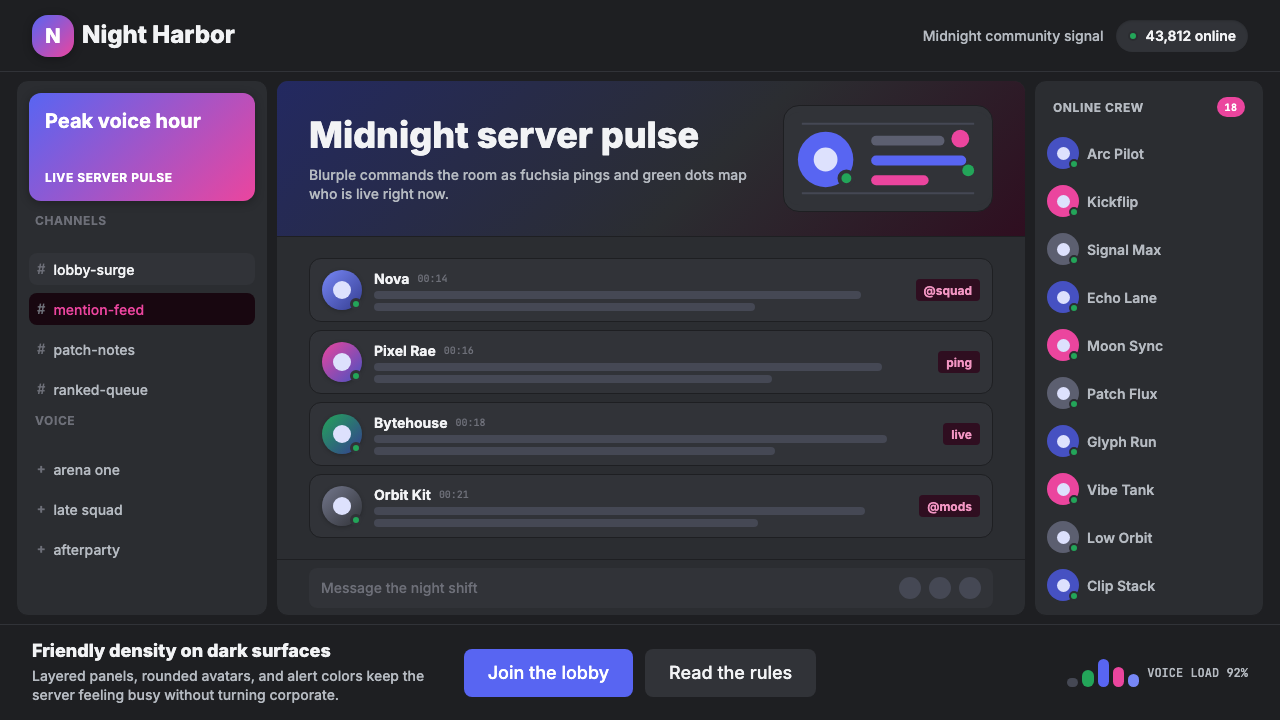 Discord Blurple Server (2020)Midnight server energy. Blurple panels, fuchsia pings, and green status dots…
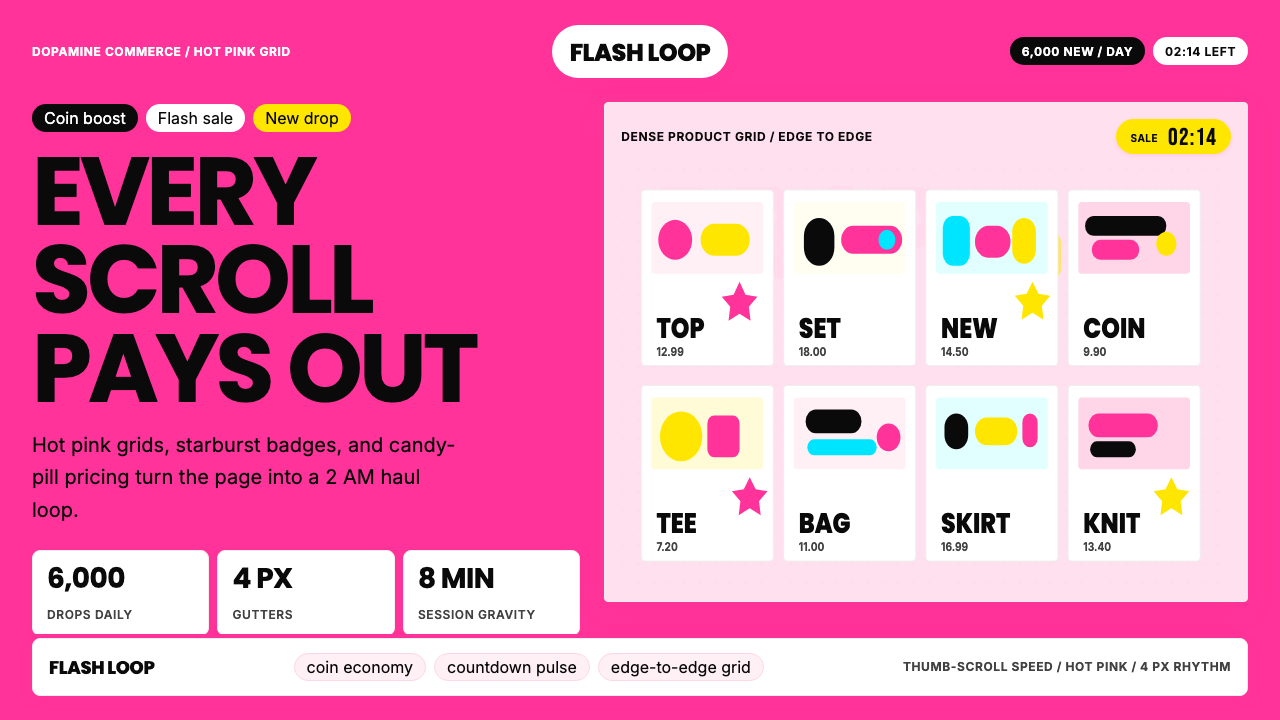 Shein Fast FashionDopamine density wins. Hot pink grids, starbursts, and candy pills pack every…
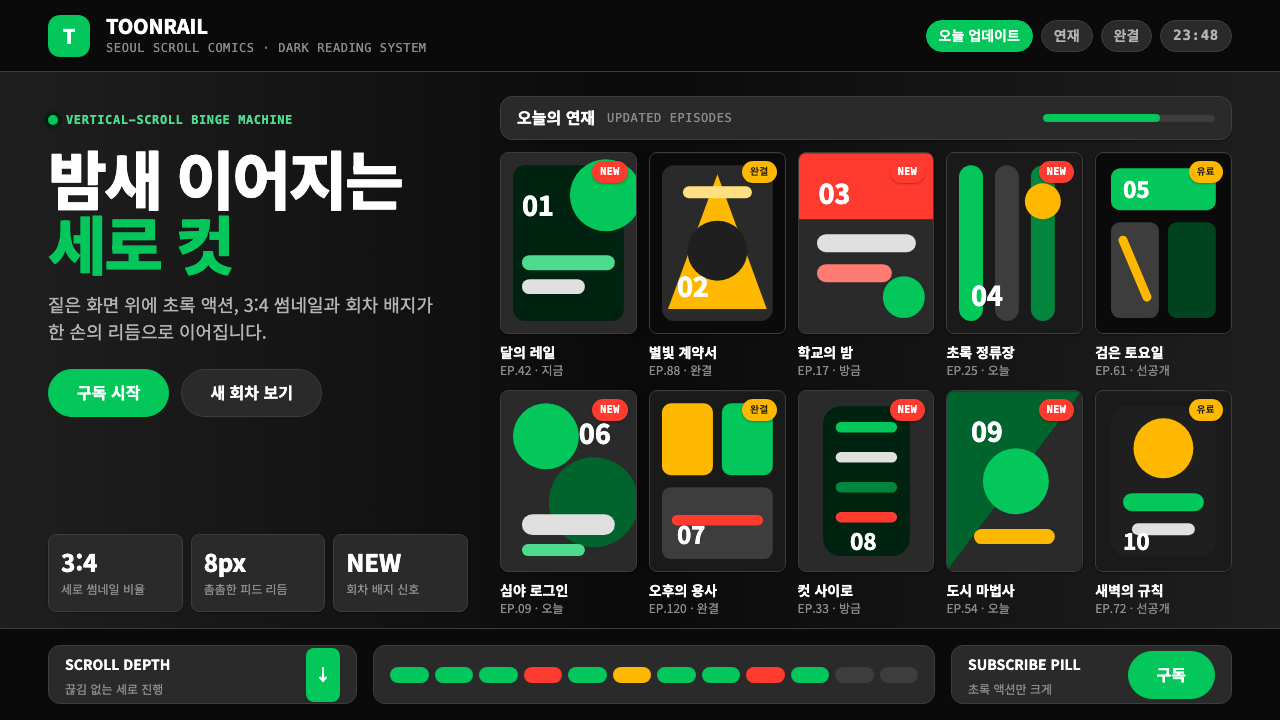 Naver Webtoon (2024)Built for late-night scroll. Charcoal grids, Noto Sans KR, and green episode…
 Among Us (crewmate space)Trust is ready to break. Loud capsule colors cut through a navy void with har…
 Discord 2024Blurple cozy. Charcoal grounds, illustrated characters — every surface says '…
 YouTube Creator EconomyThe UI disappears. Near-black Roboto grids let thumbnails shout; red only mea…