What is Sentry 2023?
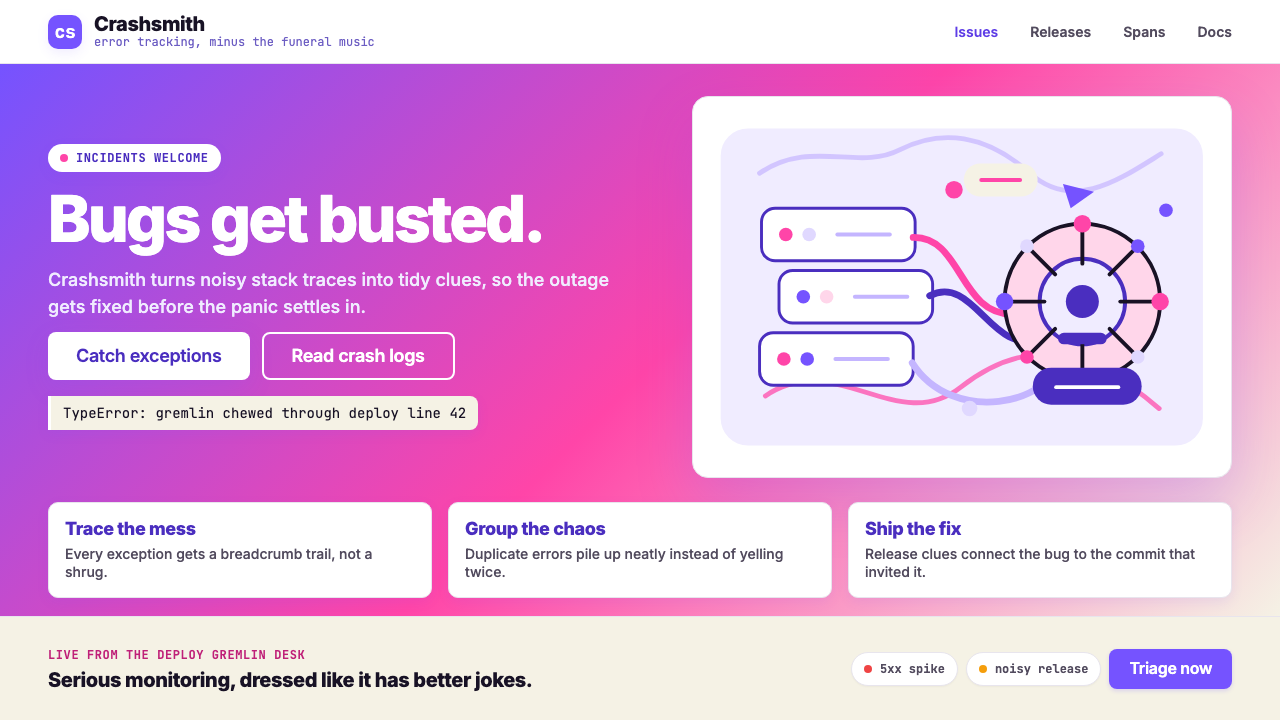
Sentry's 2023 brand dares to celebrate the bug — vibrant purple-pink gradients, hand-drawn chaos, and the irreverent confidence of engineers who know software always breaks.
Sentry 2023 in brief
Sentry 2023 is the brand identity visual system adopted by the application monitoring and error-tracking company Sentry during its major rebrand in the early-to-mid 2020s. Where most developer-tool companies reach for sterile blues and muted grays to project corporate reliability, Sentry chose the opposite direction: a vibrant palette anchored by deep purple and electric hot pink, layered with hand-drawn bug illustrations, loose doodles of tangled server cables, and expressive gradient washes that feel more like a band poster than an enterprise dashboard.
The result is a design language that carries genuine personality. It acknowledges the emotional reality of software development — the late-night panic of an outage, the dark humor that spreads through an engineering team when everything is on fire — and transforms that reality into a visual identity that engineers actually enjoy seeing. Rather than asking users to forget that failure happens, Sentry makes failure the protagonist of its visual story.
As a design style to study and apply, Sentry 2023 belongs to a growing category of developer-first brands that prioritize authenticity and subculture alignment over polish and neutrality. It combines the warmth of illustration-heavy editorial design with the structural clarity required by a data-dense SaaS product, demonstrating that these two tendencies are not in opposition.

Where does Sentry 2023 come from?
Sentry was founded in 2008 by David Cramer as an open-source error-tracking tool, initially a side project that grew out of the practical frustrations of software maintenance. For much of its early life, Sentry's visual presence was functional and unremarkable — the standard fare of a developer tool that assumed its users cared only about the product, not its packaging. This phase reflected a common assumption in the developer-tools market: that engineers are immune to branding and therefore branding is not worth investing in.
The shift began as Sentry scaled from a community-maintained open-source project into a venture-backed SaaS company competing for enterprise and startup engineering budgets. The brand team, led by figures including Chris Jennings, recognized that the market was becoming crowded and that visual differentiation could serve as a meaningful competitive advantage. Rather than competing on the same terms as established monitoring platforms — projecting seriousness, reliability, and enterprise readiness through conservative visual language — Sentry chose to lean into the subculture of its core users.
The developers and site reliability engineers who are Sentry's primary audience have a shared cultural vocabulary: they use dark humor to cope with production incidents, they take pride in their craft while accepting that nothing works perfectly, and they are instinctively skeptical of corporate polish. The Sentry 2023 brand speaks that language directly. Hand-drawn bug characters became mascots rather than symbols of shame; gradient panels that look slightly unhinged reflect the feeling of debugging a production system at three in the morning.
The visual style draws on a broader moment in technology branding where illustration-heavy, personality-forward design systems became popular among developer tools, productivity applications, and direct-to-consumer software brands. Companies across the industry were rediscovering that engineering audiences respond to authenticity in the same way any audience does — and that a brand willing to joke about its own domain earns trust faster than one that projects false confidence. Sentry's execution stands out because the irreverence is consistent and substantive, not a superficial coat of personality over a conventional structure.
What defines the Sentry 2023 look?
Purple-Pink Gradient Identity
The defining color signature is a bold sweep from deep violet-purple through electric hot pink, used as a background wash, hero panel, or accent field rather than as a subtle highlight. This gradient is unapologetically vivid — it saturates without apology — and gives Sentry's materials an immediate recognizability in a landscape dominated by blues and grays. The gradient functions as a mood carrier as well as a brand marker, evoking both the urgency of a real-time alert and the slightly unhinged energy of a developer staring at a cascading stack trace.
Hand-Drawn Illustration Language
Sentry's visual system incorporates a distinctive illustration vocabulary built around hand-drawn characters, doodle-style annotations, and loosely sketched technical objects — bugs with personalities, servers trailing tangled wires, error codes rendered as cartoonish artifacts. These illustrations are executed with deliberate imperfection: visible line wobble, inconsistent fill, and a sketchbook quality that signals human authorship. The effect is warmth and humor inserted into a context that is often stressful, directly opposing the sterile infographic style that dominates developer tool marketing.
Heavy-Weight Type with Personality
Typography in the Sentry 2023 system leans toward heavy weights — thick strokes, assertive presence, the visual mass of a headline that knows it is important. Sentry's brand adopted Inter as a core workhorse typeface, deployed in its boldest registers for display text, allowing letterforms to claim significant visual territory. The typographic tone matches the brand personality: direct, confident, and slightly irreverent. Headline text is often set large enough to feel bold even in a layout that includes complex data or dense interface elements.
Dark Ground with Luminous Accents
While Sentry's marketing materials do use lighter backgrounds in some contexts, a characteristic mode is dark — near-black panels that make the purple-pink gradients glow with particular intensity, like neon on pavement. This dark base gives the brand an association with after-hours technical work and the glow of screens in dim environments. Light text on dark ground, combined with gradient bursts and brightly colored illustration details, creates a composition that feels energized rather than somber.
Confident Spatial Generosity
Despite the visual richness of its palette and illustration work, Sentry 2023 does not feel cluttered. Hero sections give key messages room to breathe; gradient panels are used as large fields rather than squeezed accents; the overall layout structure maintains clear hierarchy even when illustration and typography compete for attention. This spatial generosity reflects a brand with the confidence to leave things out — to trust that the strength of the core visual identity can carry a page without filling every corner.
Technical Honesty as Visual Theme
Sentry makes the subject matter of its business — errors, crashes, stack traces, broken builds — the actual content of its visual identity rather than hiding it behind aspirational abstractions. Error messages appear in marketing imagery, bug characters are depicted with humor rather than shame, and the color palette itself suggests a system under some degree of stress. This thematic honesty is a design decision as much as a brand strategy: it creates immediate visual resonance with the audience because it represents their daily experience without sanitizing it.
Gradient as Structural Element
Rather than using gradients as atmospheric backgrounds, Sentry 2023 treats them as deliberate layout zones — a gradient panel defines a section, creates a visual anchor, or marks a transition between types of content. The gradients are directional and purposeful: they flow from corner to center or across horizontal bands in ways that guide reading order. This structural use of gradient is distinct from decorative gradient application and gives Sentry's pages a dynamic sense of movement that static flat color cannot achieve.

Who shaped Sentry 2023?
David Cramer co-founded Sentry in 2008 as an open-source error-tracking tool, originally building it to solve his own frustrations with production debugging. His engineering-first orientation shaped the company's early culture and its commitment to developer experience as the primary product value. While the visual evolution of the Sentry brand came later and through a dedicated brand team, Cramer's founding ethos — that developers deserve honest, practical tools that acknowledge the real difficulty of software maintenance — provides the philosophical foundation that the 2023 visual identity expresses.
Chris Jennings played a key role in shaping the Sentry brand identity during its evolution toward the 2023 visual system. As part of the brand leadership, Jennings helped articulate the strategic decision to embrace developer subculture as a brand positioning — to move away from generic enterprise aesthetics toward the irreverent, illustration-driven identity that Sentry is now known for. This work required arguing for a brand direction that many conventional advisors would have considered risky for an enterprise-aspiring SaaS product.
The Sentry Brand Team — the collective of designers, illustrators, and brand strategists who built and maintain the 2023 visual system — deserves credit as a creative unit. The coherence and depth of the Sentry identity, from the illustration vocabulary to the gradient system to the typographic voice, reflects sustained collaborative effort rather than a single authorial vision. The team's willingness to develop a distinctive illustration language, rather than licensing stock imagery or adopting a generic icon set, was the single most consequential creative decision in defining what Sentry 2023 looks like.
While not a Sentry employee, the designer of the Inter typeface — Rasmus Andersson — contributed an essential component of the Sentry 2023 visual identity. Inter was designed specifically for screen interfaces, optimized for legibility at both large display and small UI sizes, and became the default choice for a generation of digital products seeking a neutral yet characterful sans-serif. Sentry's adoption of Inter and deployment of it in heavy weights for display use gave the brand its typographic backbone — the voice of the brand's written tone depends significantly on how Inter reads at scale.
Sentry 2023 did not emerge in isolation — it belongs to a broader movement of developer-first companies that began rethinking the assumption that technical audiences are indifferent to design. Companies like Vercel, Linear, Raycast, and Tailwind Labs demonstrated in roughly the same period that well-considered visual identity could function as a developer recruiting tool, a community signal, and a competitive differentiator simultaneously. Sentry's contribution to this movement was to push further into humor and illustration than most, betting that authentic irreverence would resonate more deeply than polished minimalism.
How do you use Sentry 2023 today?
Sentry 2023 works best when the product or communication being designed shares its core tension: something serious delivered with personality, technical content that benefits from approachability, a brand that wants to be remembered as different rather than merely competent. The style is a strong fit for developer tools, engineering blogs, error-monitoring dashboards, incident retrospectives, and any product whose audience is comfortable with technical humor.
For presentation slides, Sentry 2023 creates striking covers with minimal elements: a large gradient panel sweeping from deep purple to hot pink behind bold display type, perhaps a single hand-drawn bug or doodle motif in a corner, and a brand mark that floats freely in the composition. The goal is a cover that feels like a concert poster for a band that also writes production code. Content slides should reserve gradient backgrounds for section openers or data highlights; body slides work better with a near-black or very dark ground with light type, using the gradient sparingly as a horizontal accent band or card background. Data slides should treat charts as compositional objects — bar charts in gradient-filled bars, alert counts in vivid pink numerals — making the data itself feel as dynamic as the brand.
For web UI, dashboards, and pricing pages, Sentry 2023 translates into a dark-ground interface where gradient cards mark important states, bold typography creates instant hierarchy, and illustration details (small bug characters, doodle annotations) humanize what would otherwise be a purely data-driven experience. Pricing tables benefit from the style's boldness: a highlighted plan tier with a gradient background and heavy type at large scale immediately signals the recommended choice without requiring subtle visual cues. Navigation should remain typographic and spacious — the illustration work lives in hero areas and feature callouts, not in navigation elements where it would create visual noise.
For editorial, marketing pages, and conference materials, Sentry 2023 has direct poster-like applicability. Full-width gradient hero sections with large-scale type anchor the page. Illustration elements — hand-drawn bugs, tangled cable motifs, error messages rendered as visual art — appear as section decorations and serve to break the monotony of text-heavy content. Marketing emails in this style should use a single large gradient block at the header, black background through the body, and a brightly colored call-to-action button that references the brand's hot pink. Conference booth and swag applications benefit from the style's bold contrast and illustration vocabulary, translating naturally to large-format print.
A common mistake when applying Sentry 2023 is treating the gradient as the entire design — simply applying purple-to-pink behind text and calling the work done. What makes the style coherent is the interplay between the gradient system, the typographic weight, and the illustration language; removing any one of these produces a derivative result that lacks the brand's depth. A second frequent error is using the illustration vocabulary without understanding its tone: hand-drawn elements must feel spontaneous and characterful, not clip-art generic. If the illustrations feel like they came from a stock library, the authenticity the style depends on evaporates. When in doubt, apply less illustration with higher quality over more illustration with lower character.

Sentry 2023 — FAQ
Is Sentry 2023 appropriate for a product that is not a developer tool?
The visual language can be borrowed, but the context matters significantly. The reason the Sentry identity works is that its humor, palette, and illustration content are authentically aligned with its audience's culture. Transplanting the gradient-plus-doodle formula to a product whose users do not share that cultural context risks feeling like costume rather than character — the aesthetic without the substance. That said, the structural elements of the style (dark grounds with luminous gradient accents, heavy display type, generous spatial hierarchy) can transfer to other technical or creative products that want to project confident personality. The illustration vocabulary is the element most tightly bound to the developer context.
How do you maintain readability when using such a vivid, high-saturation palette?
The key is contrast management. Sentry 2023 achieves readability not by reducing the saturation of its accent colors but by using them as backgrounds for large-scale display text rather than body text, and by maintaining near-black or near-white grounds for text-dense sections. The gradient panels are not used behind paragraphs of information — they are used behind single headlines, statistics, or calls to action where a few words must communicate instantly. Body text lives on dark-but-not-gradient grounds, maintaining strong contrast without competing with the accent colors. When in doubt, test: legibility always wins over aesthetic fidelity.
Can this style work for light-mode interfaces?
Yes, with adaptation. While Sentry's own brand is primarily associated with dark grounds, the style adapts to light mode by inverting the hierarchy: a near-white or very light gray base, with the purple-pink gradient appearing as card backgrounds, section accents, or interactive state indicators rather than as full-page washes. The illustration vocabulary transfers directly — hand-drawn elements read just as well on light grounds. Typography should remain bold and assertive. The overall effect in light mode is slightly less dramatic but still recognizable as the same design language. Light mode versions work particularly well for long-form content where sustained reading comfort is important.
How much illustration is too much?
A useful principle: illustrations should appear at moments of transition or emphasis — section breaks, empty states, hero moments — not as continuous decoration throughout a layout. When every panel has an illustration, none of them create the punctuation effect that makes the style work. Sentry's own materials demonstrate restraint: large gradient panels are often clear of illustration; a single well-placed bug character in a hero area is more effective than five scattered through a page. The goal is for each illustration to feel discovered rather than applied — something that rewards attention rather than competes for it.
How does Sentry 2023 relate to other developer-tool visual identities like Vercel or Linear?
Vercel, Linear, and Sentry represent three distinct positions within developer-first branding. Vercel's identity is precision minimalism — near-monochromatic, typographic, extremely disciplined — projecting the confidence of an infrastructure company that needs no visual decoration to be taken seriously. Linear occupies a similar minimal pole but with softer gradients and a more editorial feel. Sentry occupies the opposite extreme: it is the loudest, most personality-forward, and most illustration-rich of the cohort. All three are explicitly departing from generic enterprise SaaS aesthetics, but they do so in different directions. Understanding these positions helps practitioners choose which model fits a given product: minimal authority, editorial precision, or expressive personality.
Related design styles
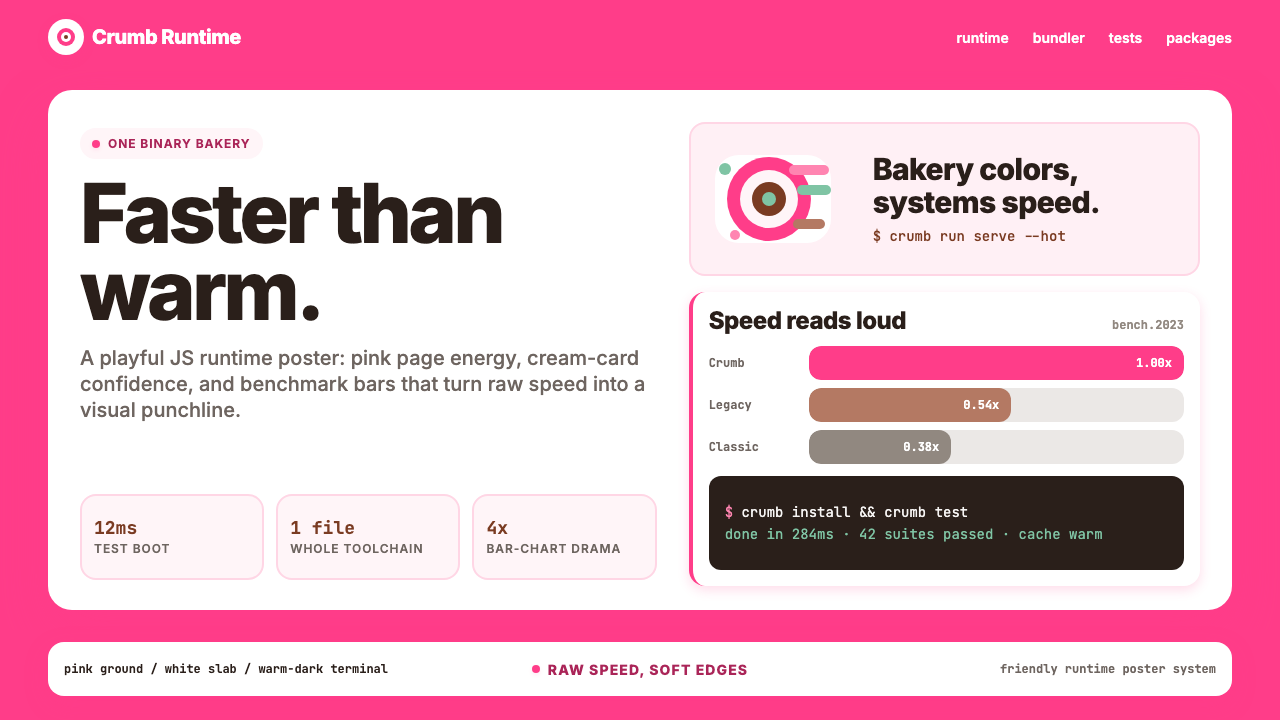 Bun JS Runtime Pink 2023Dev speed gets bakery-bright. Hot pink grounds white slabs, mono bars, and wa…
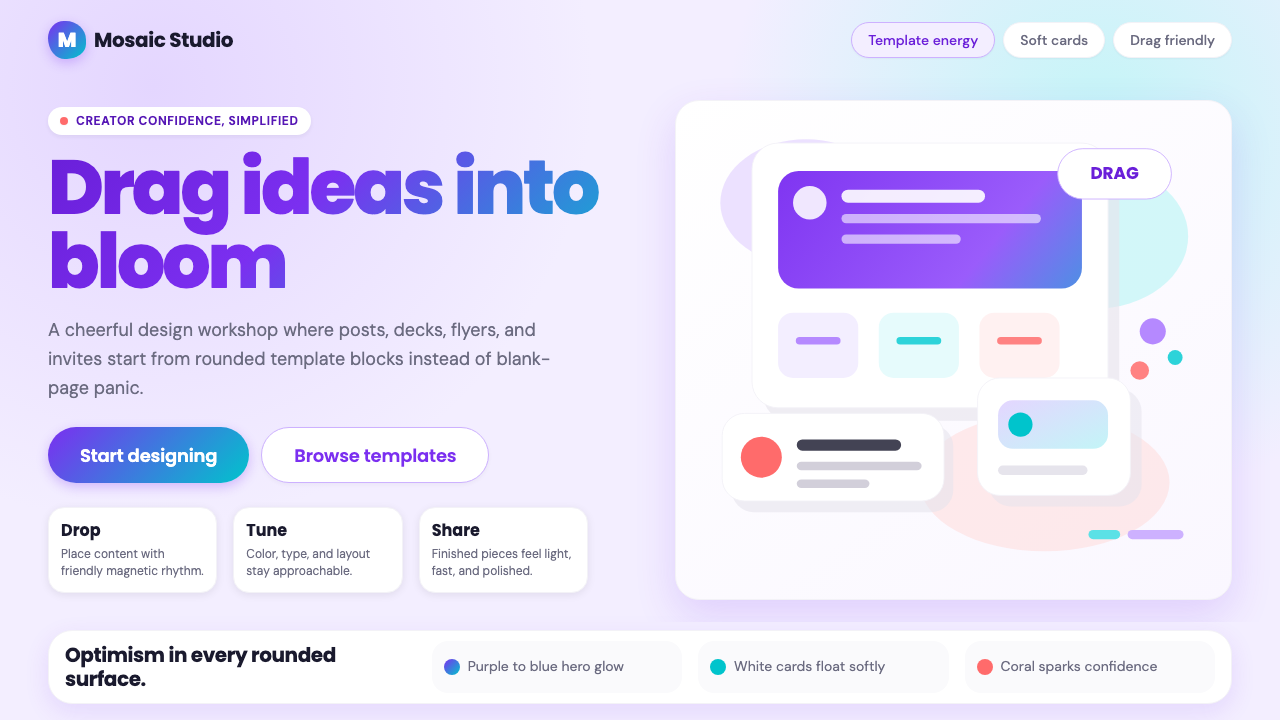 Canva 2024Confidence feels draggable. Purple-blue gradients and floating white template…
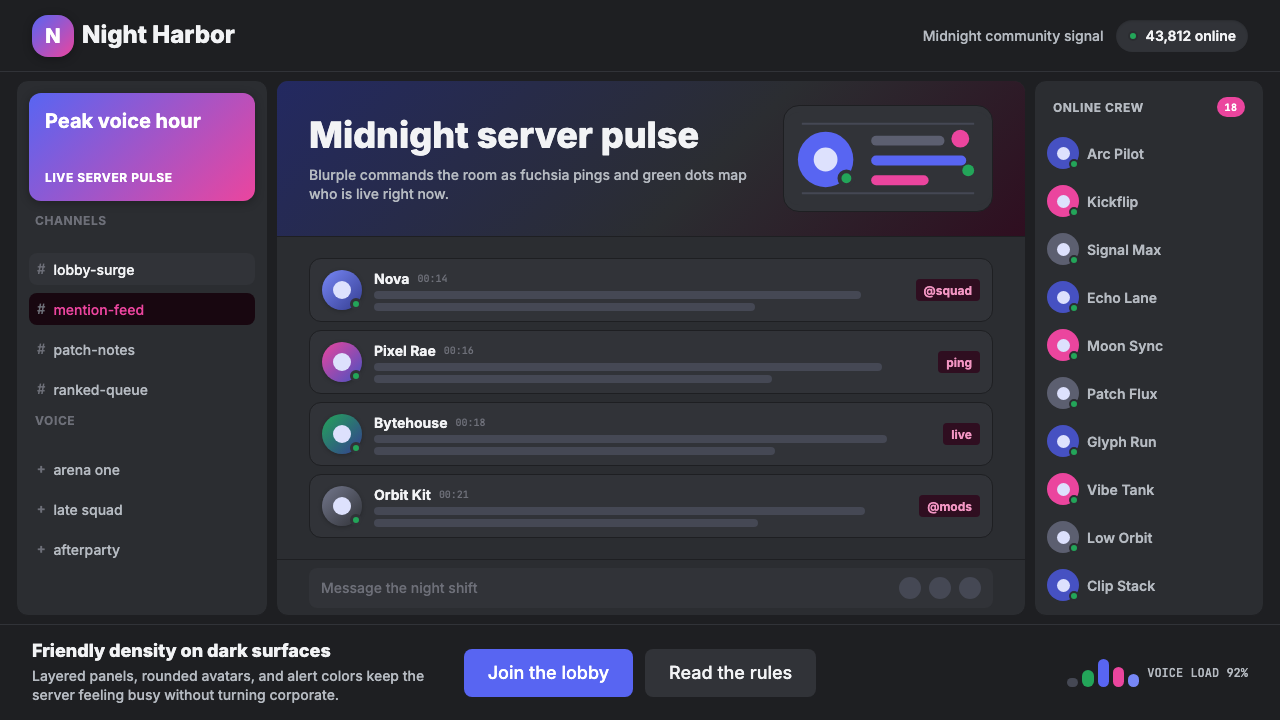 Discord Blurple Server (2020)Midnight server energy. Blurple panels, fuchsia pings, and green status dots…
 Duolingo Green Owl MascotFriendly guilt goes loud. Saturated green, Nunito heft, and press-shadow butt…
 Replit 2024Coding feels warm. Coral buttons, cream panels, rounded code tiles make build…
 Discord 2024Blurple cozy. Charcoal grounds, illustrated characters — every surface says '…