What is Duolingo Green Owl Mascot?
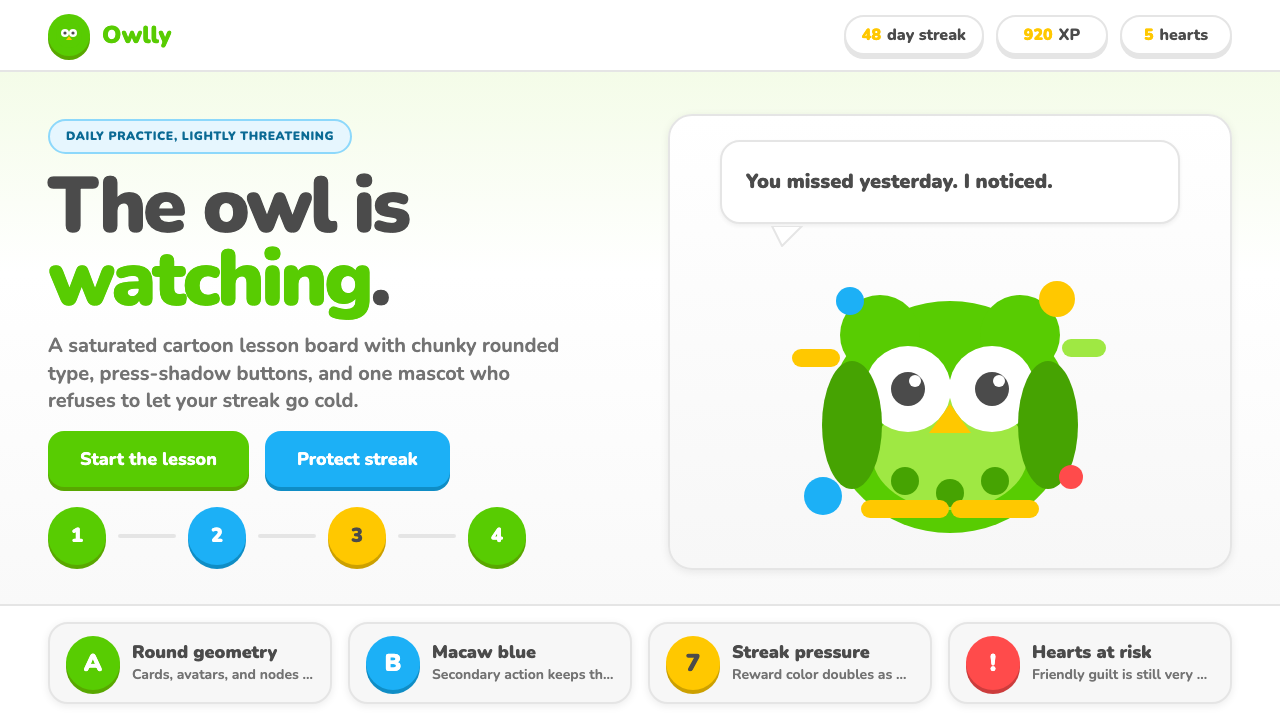
Duolingo's green owl turned friendly guilt into a design language — proving that a single saturated color and a cartoon mascot can build one of the most recognizable visual identities in consumer software.
Duolingo Green Owl Mascot in brief
Duolingo Green Owl Mascot is the visual design language that powers the Duolingo language-learning app — a system built around a single dominant saturated green, chunky rounded geometry, expressive character illustration, and a gamified interface vocabulary that borrows equally from children's-book aesthetics and mobile game UI conventions. The style is deliberately loud, warm, and almost aggressively cheerful, designed to reduce the psychological friction of daily practice by making the product feel more like play than study.
At the heart of the system is Duo, the green owl mascot, who appears in dozens of distinct emotional states: celebratory, encouraging, passive-aggressive, mournful, threatening. Each expression is rendered with the same rounded, cartoonish character art — thick outlines, simple fills, exaggerated proportions — and each state communicates a specific behavioral nudge. The owl is not decoration; it is the primary emotional carrier of the interface, doing work that text notifications and progress bars alone cannot.
The surrounding visual system codifies this energy into repeatable components. Buttons cast a solid pressed shadow downward, giving them a physical, stamp-like quality. Avatars are circular with thick colored borders. Speech and feedback bubbles use rounded tails. The color palette reads like a children's book printed at higher-than-recommended saturation — the greens are vivid, the yellows are warm, the reds signal danger with genuine alarm. Nothing is muted, nothing is subtle, and the cumulative effect is an interface that feels alive and opinionated at every moment.
Where does Duolingo Green Owl Mascot come from?
Duolingo was founded in Pittsburgh in 2011 by Luis von Ahn and Severin Hacker. Von Ahn, a Guatemalan-born computer scientist and the inventor of reCAPTCHA, had already built a reputation for designing systems that harvested collective human effort at scale. Duolingo applied the same logic to language education: if millions of people could be persuaded to practice daily, the aggregate learning data could improve the product for everyone. The challenge was persuasion — turning a daily obligation into a daily habit. That challenge shaped the entire visual philosophy.
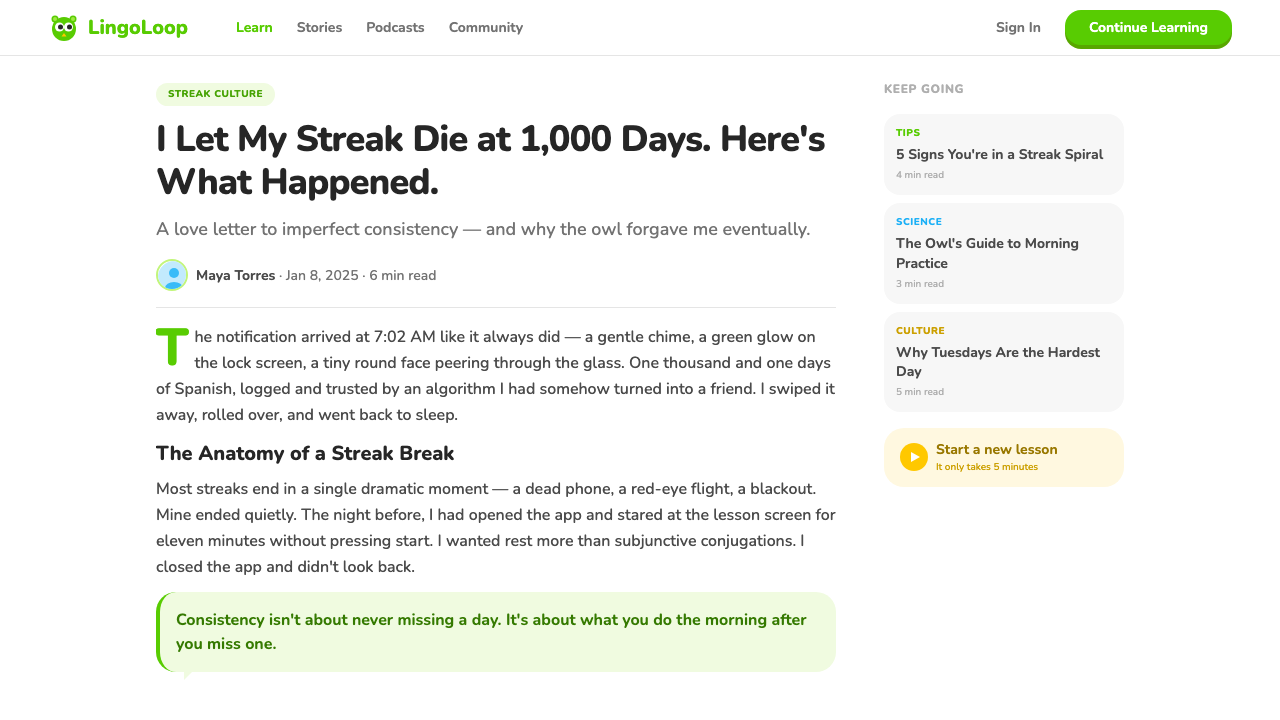
The original interface was comparatively restrained. Duo the owl existed from early on as a brand symbol, but the full emotional range of the mascot — the dozens of expressive states — developed gradually as the product team learned which behavioral signals worked. The 2018 mascot refresh, led in part by design director Mandy Hu, pushed the character into a bolder, more expressive register and committed the brand to character-driven design as a strategic differentiator. The owl's passive-aggressive persona, in particular — the guilt-tripping streak notifications, the mournful expressions when users lapsed — became a cultural phenomenon, producing memes that functioned as free marketing.
The typography underwent a significant evolution in 2022 with the introduction of the custom typeface Feather Bold, designed specifically for Duolingo's display contexts. Before this, the brand had relied on the commercially available Nunito, a rounded sans-serif whose soft geometry aligned well with the mascot's character art. Feather Bold extended that philosophy with letterforms purpose-built for the brand's rounded, high-energy aesthetic — ensuring that type and illustration spoke the same visual language rather than coexisting as separate decisions.
The broader movements that shaped the style include gamified learning, which treats engagement mechanics — streaks, experience points, leagues, and social competition — as first-class product features rather than add-ons. This approach demanded an interface that could credibly celebrate small victories and dramatize small failures, hence the emotional range of the mascot and the reward animations. Mascot brand identity as a movement — the practice of building a brand's emotional character around a single illustrated figure — is less common in software than in consumer goods, and Duolingo's success with Duo influenced a generation of app brands to invest in character design as a retention strategy. Character-driven product design, the third movement, extends this further: the mascot is not just a logo but an actor in the product's narrative, with a consistent personality that users develop a relationship with over time.
What defines the Duolingo Green Owl Mascot look?
The Dominant Green
The Duolingo green is not one shade among many — it is the foundation that everything else is measured against. It sits at a saturation level high enough to read as unmistakably intentional on any screen brightness, and it carries the brand signal so completely that the owl silhouette alone in that color is sufficient for recognition. The green is warm enough to feel friendly rather than clinical, but vivid enough to feel energetic rather than passive. Secondary and tertiary colors — the warm yellows, the alert reds, the softer supporting tones — all operate in relation to this anchor, either reinforcing or punctuating it.
Rounded Geometry
Every structural element in the system — buttons, avatars, cards, badges, progress bars, input fields — is rounded to the point where sharp corners are effectively absent. This is not a casual aesthetic choice: rounded forms read as approachable, non-threatening, and friendly across cultural contexts, and they echo the character art of the mascot himself. The roundedness is applied consistently enough that any element with a sharp corner would feel like a foreign object — an error rather than a decision. This geometric consistency binds the mascot illustration and the UI components into a single coherent system.
Press-Shadow Buttons
The signature interactive component of the Duolingo system is a button with a solid, flat shadow anchored to its bottom and side edges, creating the visual impression of a raised physical object. When pressed, the button appears to depress, the shadow collapses, and the element feels genuinely physical — as though the user is pressing a real surface. This press-shadow mechanism is more than a skeuomorphic detail: it makes every interaction feel consequential and satisfying, reinforcing the gamified logic of the product. The shadow is rendered as a solid darker band rather than a diffuse gradient, keeping the overall aesthetic flat and graphic even while simulating depth.
Expressive Character Art
Duo the owl is not a static logo but a performance. The character exists in a wide range of emotional states — joy, disappointment, passive aggression, threat, pride, sadness — each rendered with clear, readable body language and facial expression. The illustration style uses thick outlines, bold fills with minimal internal shading, and exaggerated proportions that prioritize emotional legibility over anatomical accuracy. This expressiveness is systematized: specific emotional states are deployed at specific product moments, so the mascot functions as an emotional feedback system integrated into the interface rather than a decorative layer applied on top of it.
Gamified Color Signals
Color in the Duolingo system carries explicit behavioral meaning. The dominant green signals correct answers, active streaks, and successful completion. Warm yellow marks the streak flame and reward moments — borrowed from the universal signal of warmth and fire. Red appears for mistakes, lost streaks, and urgent nudges, deployed with enough contrast to create genuine alarm without becoming hostile. Purple and other secondary accent colors mark premium states and special achievement tiers. This color-as-signal logic is borrowed from game UI conventions, where color teaches the player the rules of the system through repetition and consistent consequence.
Reward and Celebration Animation
The system treats animation as an essential layer of the emotional design, not as polish applied after the fact. Correct answers trigger confetti, particle bursts, and character celebrations. Streak milestones produce elaborate animated sequences. Even small interactions — tapping a choice, completing a lesson — carry micro-animations that provide immediate tactile feedback. The animation vocabulary is energetic and exaggerated, calibrated to feel like a genuine reward rather than a token gesture. This commitment to celebration is structurally important: in a product whose core value proposition is consistency over time, each daily interaction needs to feel worthwhile on its own terms.
Typographic Personality
The typography of the Duolingo system is rounded, hefty, and designed to feel sturdy and friendly rather than refined or elegant. The brand's custom display typeface carries letterforms with soft terminals and generous proportions that echo the rounded geometry of the UI components and the character art. Body text is set at weights and sizes that prioritize readability on mobile screens. The type is never delicate, never thin, never precious — it occupies its space with the same confident presence as the owl. Decorative or novelty typefaces are absent; the personality comes from weight, proportion, and roundness rather than from ornamental detail.
Who shaped Duolingo Green Owl Mascot?
Von Ahn co-founded Duolingo and established its foundational product philosophy: that language learning could be made genuinely engaging if the interface made every practice session feel like a game rather than a lesson. His background in designing systems that harness human attention at scale — he had previously created reCAPTCHA and the ESP Game — directly informed the behavioral mechanics of streaks, experience points, and social competition that the visual design system was built to support. The gamified logic is inseparable from the visual language, and Von Ahn's conviction that engagement is a design problem gave the visual team the mandate to build a loud, expressive, emotionally committed system.
As design director, Hu led the 2018 mascot refresh that transformed Duo from a relatively simple brand mark into a rich emotional actor with a systematic range of expressions and personality states. This work was decisive: it committed the brand to character-driven design as a core strategy and established the emotional vocabulary — the passive aggression, the guilt, the celebration — that made the mascot culturally resonant far beyond the app itself. The refresh required developing a systematic approach to character expression, ensuring that Duo's personality was consistent and recognizable across dozens of distinct states.
Parvez served as Duolingo's social media manager and is credited with developing the brand voice that transformed the passive-aggressive owl into a social media phenomenon. Her work on TikTok and other platforms extended the mascot's personality far beyond the app itself, establishing a tone — sardonic, self-aware, alternating between guilt-tripping and absurdist humor — that became widely imitated by other consumer brands. This social presence was not separate from the visual design system; it amplified and extended it, demonstrating that the mascot's character could operate coherently across formats far removed from the original interface context.
Hacker co-founded Duolingo alongside Von Ahn and served as its chief technology officer. While his contributions were primarily technical, his role in establishing the product's core infrastructure — the systems that tracked streaks, experience points, and lesson completion — created the behavioral framework that the visual design was built to celebrate and reinforce. The press-shadow buttons, the celebration animations, the emotional mascot states are all in service of the underlying gamification mechanics that Hacker's engineering made possible. In this sense, the visual language is a direct expression of the technical architecture.
How do you use Duolingo Green Owl Mascot today?
The Duolingo style works best in contexts where the primary design challenge is motivation and retention rather than authority or refinement. It is a system built around emotional momentum — the feeling that progress is happening, that effort is being recognized, and that the next step is immediately rewarding. Applying it correctly means understanding which moments in a user journey call for celebration and which call for gentle pressure, then deploying the mascot's emotional range accordingly.
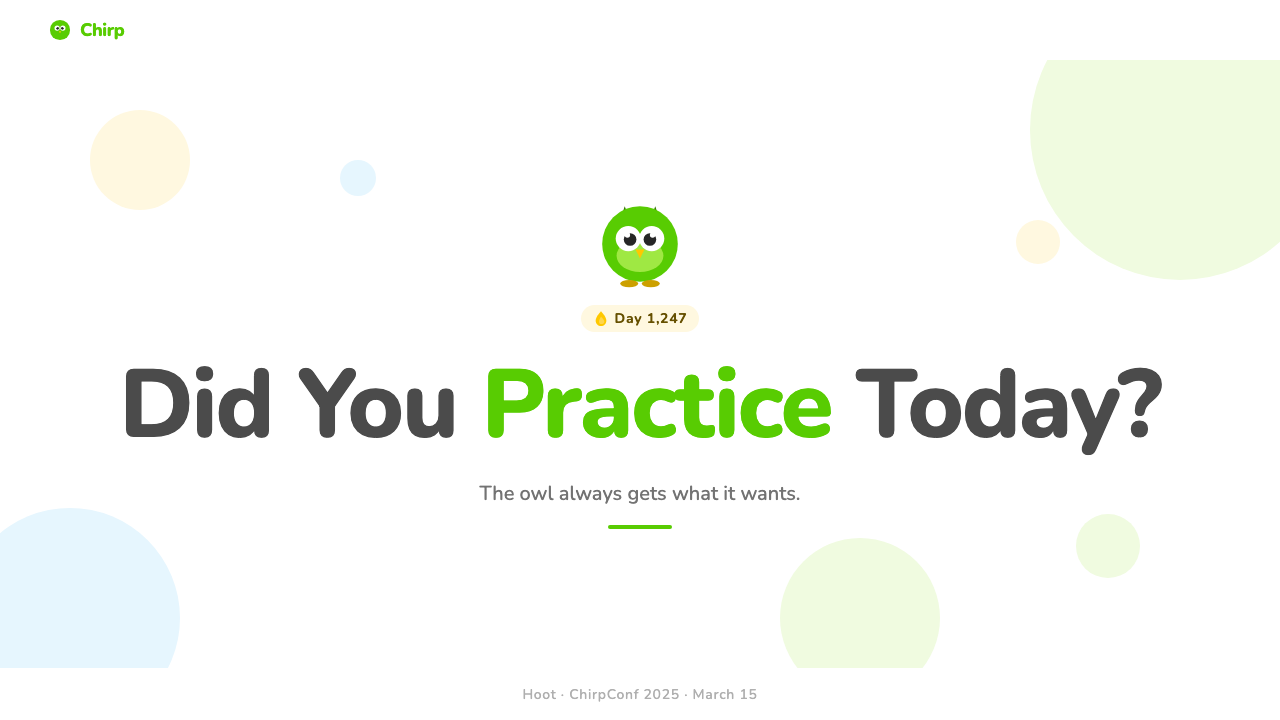
For presentation slides, this style is highly effective for product pitches, educational content, and consumer-facing decks where warmth and approachability matter more than corporate polish. Cover slides can use the dominant green at full saturation against a white ground, with rounded display type scaled large enough to command the frame. Content slides work well when treated as single-idea layouts: one mascot expression in the corner, one headline, one supporting element. The press-shadow button treatment can be adapted as a bold callout component — a rounded rectangle with a downward solid shadow used to frame a key statistic or action point.
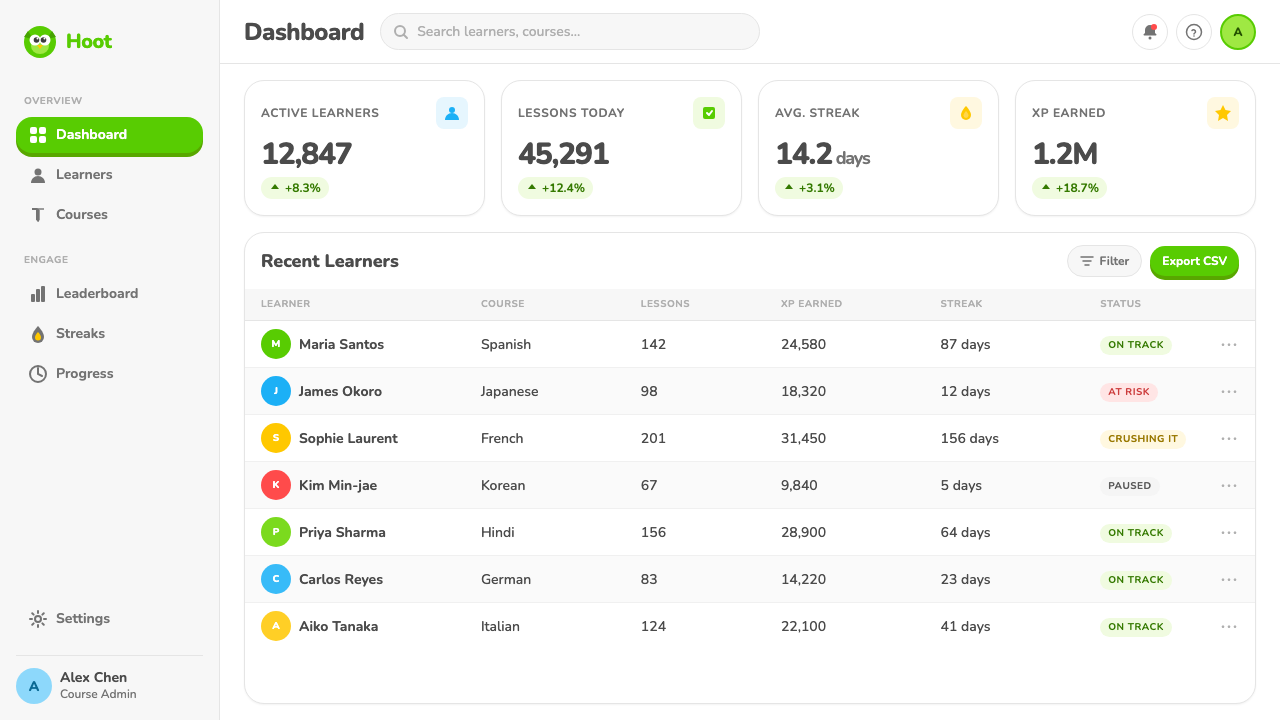
For web interfaces, the style is most at home in consumer-facing products with an educational or self-improvement dimension: language apps, fitness trackers, habit builders, onboarding flows, and any dashboard where progress visualization is central. The approach should establish the green as the primary action color and reserve the warm yellow for streak or milestone indicators. Navigation should be clean and rounded, with typographic labels at confident weights. Cards and panels benefit from the press-shadow treatment adapted as a subtle downward offset rather than a dramatic game-button depth.
For editorial and marketing work, the style supports energetic brand communications and social content where stopping power and emotional directness matter. A campaign layout in this style uses the mascot expression as the emotional anchor — choosing the right expression for the message's tone — then builds the surrounding composition from rounded type and strong color fields. The style is particularly effective for before-and-after narratives, progress stories, and anything that benefits from making the user feel seen and celebrated. Marketing emails, social posts, and onboarding screens all respond well to the system's high-contrast, round-everything logic.
A common mistake when applying this style is mistaking loudness for the goal. The Duolingo system is loud in service of warmth — every element of high saturation and expressive character is calibrated to make the user feel encouraged rather than overwhelmed. Applying the visual vocabulary without that emotional calibration produces interfaces that feel aggressive rather than friendly. Similarly, using the mascot expression without matching the appropriate emotional state — deploying the celebratory owl at a moment of failure, or the guilt-tripping owl at a moment of success — breaks the system's logic entirely. The expressiveness only works when it is contextually honest.
Duolingo Green Owl Mascot — FAQ
Is the Duolingo style appropriate for serious or professional products?
The Duolingo style is calibrated for contexts where approachability and emotional engagement are primary values. In professional or enterprise contexts — analytics dashboards, financial tools, legal platforms, medical applications — the style's loudness and character-driven expressiveness can undermine the credibility signals that users in those contexts require. The rounded geometry and saturated palette can be borrowed selectively: softer roundness, lower saturation, the gamified progress indicators without the mascot. But the full system, mascot and all, is hard to transplant into contexts that require authority or formality without creating tonal dissonance. The honest assessment is that this is a consumer entertainment aesthetic that works best when the product's emotional register matches its own.
How does the Duolingo style differ from general gamification design?
General gamification design borrows game mechanics — points, badges, leaderboards — and drops them onto otherwise conventional interfaces. The Duolingo style is more integrated than this: the visual vocabulary (the rounded forms, the press-shadow buttons, the expressive mascot, the celebration animations) and the game mechanics (streaks, experience points, leagues) were designed together as a single system. The aesthetics reinforce the mechanics and the mechanics justify the aesthetics — neither layer feels grafted on. This integration is what distinguishes the Duolingo style from interfaces that add a progress bar to a standard design and call it gamified. The commitment is total, not selective.
Can this style work in dark mode?
The Duolingo style is fundamentally a light-mode system. Its dominant green is designed to read against light grounds, and the character art is optimized for the contrast ratios that white and near-white backgrounds provide. A dark-mode inversion is technically possible but requires care: the green will appear more intense and possibly neon-like against dark grounds, which can shift the emotional register from friendly to aggressive. The press-shadow buttons and the character illustrations both depend on their relationship to a light surrounding field. A dark variant works best when it is treated as a deliberate nighttime or focus mode — reducing animation intensity, softening the saturation slightly — rather than a simple palette flip.
What makes the mascot emotionally effective rather than just decorative?
The mascot's emotional effectiveness comes from its systematic deployment at behaviorally significant moments — it is a feedback system, not a logo. Each expression is paired with a specific product state: the celebratory owl at a lesson completion, the guilty owl at a missed day, the threatening owl before a streak expires. Users learn to read these expressions as signals, the same way they learn to read color or sound. The mascot becomes emotionally effective because it is contextually honest: it expresses what the situation warrants, not what the brand wishes the user felt. When the owl looks genuinely disappointed, users respond because the emotion matches the reality of having broken a streak. Decoration does not earn that response; earned behavior does.
How should the style handle failure states and error messages?
Failure states are one of the Duolingo system's most carefully designed moments. The style treats failure not as a neutral information event but as an emotional beat — an opportunity to acknowledge what happened and immediately redirect toward recovery. The mascot's mournful or gentle-reproach expressions are deployed here, paired with warm, non-punishing language and an immediate path forward. Error messages use the alert colors — particularly red — but the surrounding composition softens the blow: rounded components, the mascot in a sympathetic pose, a prominent recovery action. The principle is that failure should feel like a temporary setback in a game rather than a judgment. This requires using the full visual system, not just the error color, to communicate tone.
Related design styles
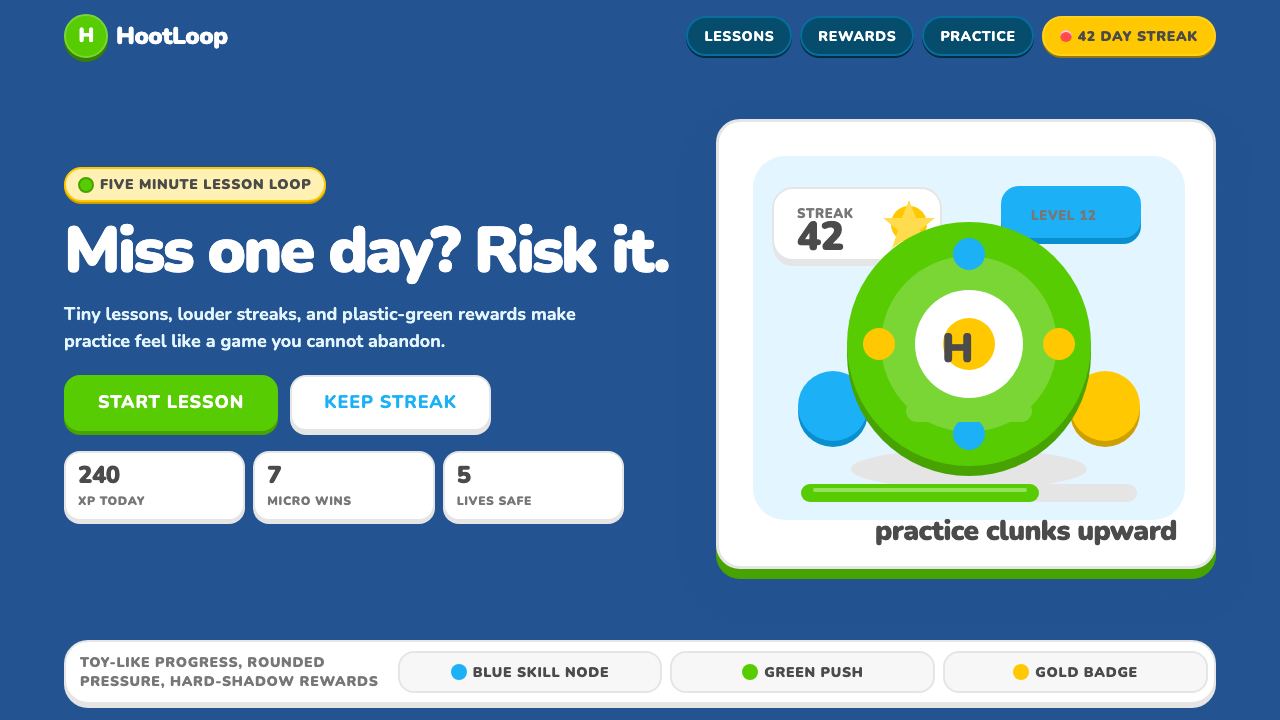 Duolingo 2024Adorable pressure wins. Feather Green, Nunito heft, rounded push-shadows gami…
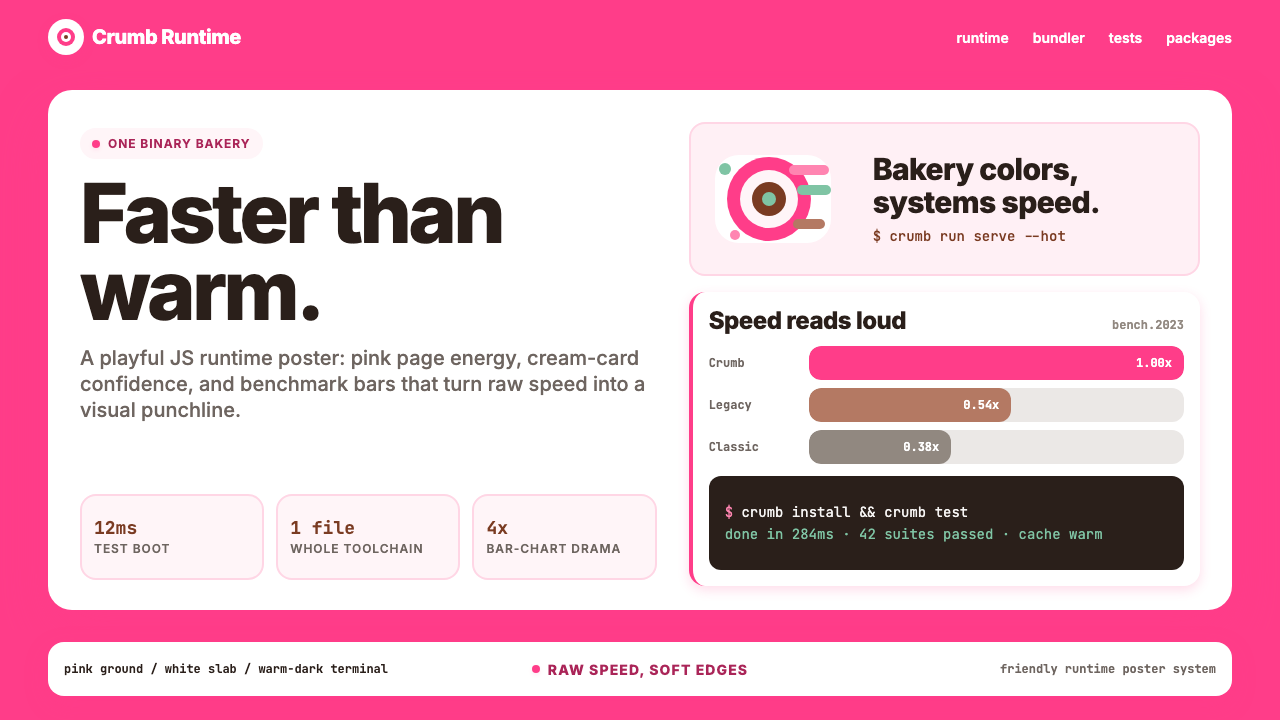 Bun JS Runtime Pink 2023Dev speed gets bakery-bright. Hot pink grounds white slabs, mono bars, and wa…
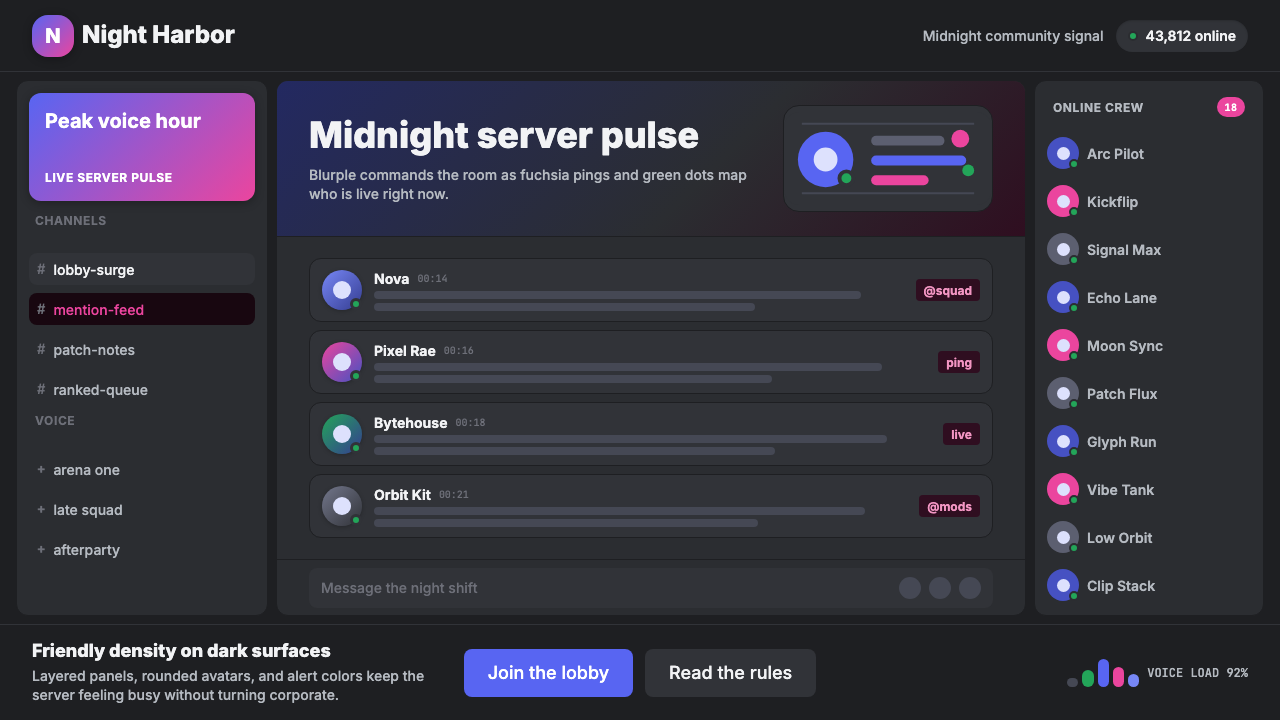 Discord Blurple Server (2020)Midnight server energy. Blurple panels, fuchsia pings, and green status dots…
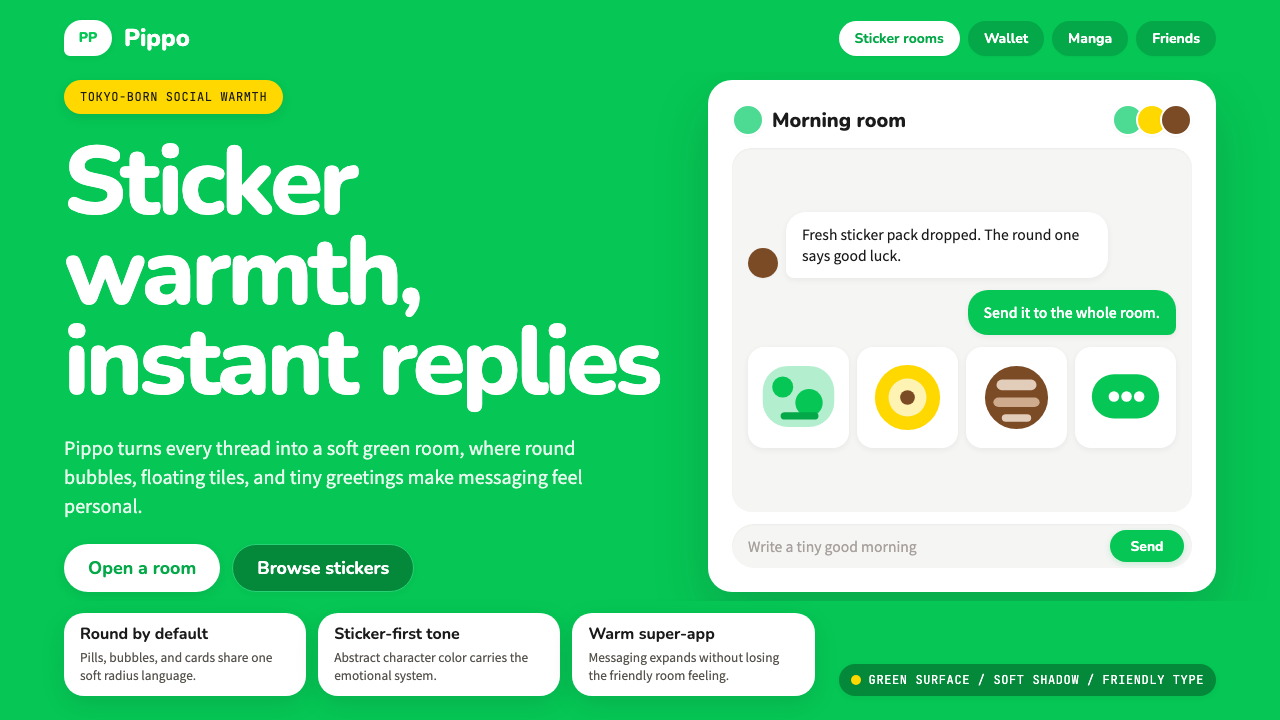 LINE Messenger GreenChat feels like a sticker. Bright green, pill bubbles, and rounded Nunito kee…
 Replit 2024Coding feels warm. Coral buttons, cream panels, rounded code tiles make build…
 Sentry 2023Debugging gets weird on purpose. Purple-pink gradients, Inter heft, and doodl…