What is Taobao (淘宝)?
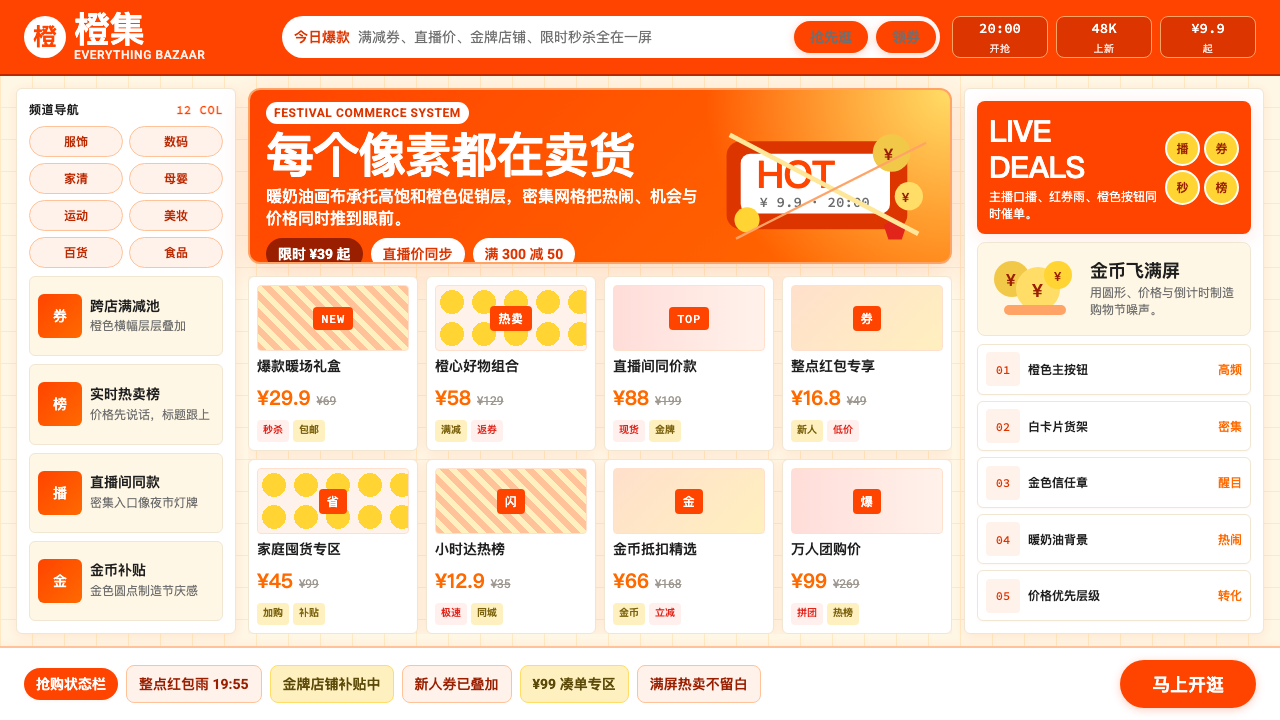
Taobao turned the Chinese street bazaar into pixels — saturated orange on warm cream, dense grids of goods, and a visual language where abundance is the message.
Taobao (淘宝) in brief
Taobao is the visual dialect of Chinese consumer e-commerce — a design system built not to calm or reassure but to excite, tempt, and convert. Its signature is layered abundance: warm orange banners stacked over cream backgrounds, product grids packed to the edge of the canvas, countdown timers ticking above price badges, and animated gold coins drifting across the screen during promotional festivals. Nothing about this system is accidental. Every element is engineered for the attention economy of a platform where millions of merchants compete for the same scroll.
The aesthetic grew directly from the physical markets it replaced. Chinese street bazaars and wholesale districts have always communicated through density and volume — the more goods displayed, the more trustworthy and prosperous the stall appears. Taobao translated this logic into digital form: information density is not a bug but a signal of legitimacy and opportunity. Where Western e-commerce platforms trend toward editorial whitespace and restrained product photography, Taobao fills every available zone with promotional text, social proof indicators, seller certifications, and live video previews.
The style reached its mature form across the 2010s and consolidated through the Singles Day shopping festival, which Taobao and its Alibaba sibling Tmall turned into the world's largest retail event. The festival's visual language — explosive oranges and reds, cascading countdown timers, fireworks and coin motifs — became inseparable from the Taobao brand identity itself. Today the style encompasses the entire ecosystem of Chinese consumer commerce: the static banner, the livestreaming overlay, the mobile cart, and the animated storefront — all speaking the same loud, generous, irresistible visual language.

Where does Taobao (淘宝) come from?
Taobao was founded in Hangzhou in May 2003 by Jack Ma and a small team at Alibaba with an explicit mission: defeat eBay China. At the time, eBay had acquired EachNet and controlled roughly eighty percent of the Chinese consumer-to-consumer market. Taobao's early design choices were partly strategic and partly improvised — the platform needed to look trustworthy enough to attract sellers while signaling abundance to buyers. The warm orange that would become its defining color was chosen for its cultural resonance: in Chinese tradition, orange and gold connote prosperity, good fortune, and harvest. The color did not arrive from a brand consultancy; it emerged from the practical logic of competing in a market steeped in these associations.
eBay's Chinese interface at the time was adapted from its American parent — relatively sparse, transactional, and neutral in palette. Taobao went the opposite direction. Dense product listings, prominent seller ratings, real-time chat through Wangwang (the platform's built-in messaging tool), and heavy promotional graphics created an experience closer to a market day than a catalog. By 2006, eBay China had shut down its domestic platform. The design language that defeated it was not refined by any aesthetic doctrine — it was validated by conversion rates and seller adoption.
The Singles Day shopping festival, launched in 2009 under Daniel Zhang, transformed the platform's visual identity permanently. Originally a quirky celebration of single life on November 11 (the date 11/11 comprising four ones), it was repurposed as a twenty-four-hour sales event whose visual branding required something immediately recognizable as festive, urgent, and abundant. The design team developed the explosive red-and-orange countdown aesthetic that today millions of designers associate with the style. Livestreaming commerce, which accelerated dramatically after 2016, added another layer: the style now had to function as a broadcast overlay — text badges, real-time viewer counts, and promotional banners sitting on top of live video — demanding even greater contrast and visual punch.
The current consolidated visual identity — overseen during the tenures of Jiang Fan and later Eddie Wu as Alibaba restructured its commerce business — reflects over two decades of optimization for the mobile screen. The shift from desktop to mobile between 2012 and 2016 compressed the canvas and intensified the density. On a smartphone, the margin between a tap converting and a user scrolling past is a fraction of a second, and every refinement to the visual system since has been calibrated for that moment. Taobao Orange is not a color selected for beauty; it is a color selected because it performs — in low-light conditions, on screens of varying quality, at thumbnail scale, and under the competitive pressure of a feed where a thousand other products are one swipe away.
What defines the Taobao (淘宝) look?
Signature Orange and Warm Palette
Taobao Orange is a deeply saturated, warm reddish-orange — vivid enough to anchor banners and call-to-action buttons at a glance, culturally loaded enough to carry associations of prosperity and festivity. It sits on warm cream or off-white backgrounds rather than cold white, maintaining a sense of warmth even at maximum saturation. Promotional periods introduce intense reds alongside the orange, and gold appears as a secondary accent, reinforcing the celebration-and-abundance register. Cool neutrals are rare; the palette stays in the warm half of the spectrum almost without exception.
Maximal Information Density
Where most design systems treat empty space as a breathing room to protect, Taobao treats it as inventory awaiting goods. Product grids run edge to edge with minimal gutters. Price badges, discount percentages, seller ratings, shipping promises, and social proof figures coexist in the same compact card. Far from feeling chaotic to the intended audience, this density communicates competence and abundance — a seller who fills their space confidently is, by Chinese retail convention, a seller with something to offer.
Countdown and Urgency Mechanics
Time-limited offers are not a minor feature but a structural pillar of the visual system. Countdown timers — hours, minutes, and seconds displayed in high-contrast numeral blocks — appear across banner placements, product cards, and checkout flows. Flash-sale indicators, stock-level warnings, and buyer-count displays create a persistent sense that inaction has a cost. The typography used for countdowns is characteristically large, monospaced in rhythm, and rendered in contrasting color against the orange or red ground, giving each timer the visual weight of a headline.
Celebratory Motion and Festival Graphics
Static design is supplemented by motion in ways that have no direct equivalent in Western e-commerce aesthetics. Animated gold coins tumble across promotional pages during major shopping events. Fireworks and confetti sequences punctuate successful purchases. Livestreaming interfaces carry constant motion: scrolling comments, floating heart animations triggered by viewer interactions, and real-time gift animations overlay the video content. Even in static banner work, the compositional language borrows from festival graphics — radial bursts, diagonal energy lines, and layered badge elements that imply motion even at rest.
Typographic Aggression and Hierarchy by Scale
Taobao typography is blunt and functional, organized almost entirely by size contrast rather than typographic refinement. Key price figures and promotional headlines appear at dramatic scale — sometimes occupying a third or more of a banner's height — to be readable as a thumbnail in a crowded feed. Supporting copy is compressed into small but legible text, often stacked vertically or wrapped tightly around product imagery. Weight and scale create hierarchy in the absence of generous spacing. The overall impression is of text that shouts where it needs to shout and whispers where it merely informs.
Layered Badges and Trust Signals
Because buyers and sellers are strangers transacting across a decentralized marketplace, the visual system dedicates significant real estate to trust infrastructure. Seller level badges, official brand certifications, logistics guarantee icons, buyer protection emblems, and platform-verified labels stack onto product cards alongside pricing. These elements use a distinct sub-language: rounded rectangles, shield shapes, and star clusters rendered in the warm palette of the broader system but with their own internal hierarchy. The density of trust signals on a single card can seem excessive by Western standards but reads as reassurance in context.
Mobile-First Compression
The Taobao visual system was substantially redesigned around the mobile canvas between 2012 and 2016, and the compression this demanded became a defining characteristic rather than a constraint. Horizontal navigation collapsed into icon-driven bottom bars. Product cards narrowed to fit two across a phone screen while retaining all their commercial information. Banner formats adapted to vertical scrolling rather than horizontal browsing. The result is a design language that looks dense but not broken on small screens — every element has been ruthlessly right-sized for a thumb-navigated context where a few pixels of extra margin can push a critical price point below the fold.

Who shaped Taobao (淘宝)?
Jack Ma co-founded Alibaba in 1999 and launched Taobao in 2003 with a clear competitive brief: build a platform that could outmaneuver eBay by understanding Chinese consumer psychology rather than importing American e-commerce conventions. His insistence on free listings for sellers — against the paid-listing model eBay used — was both a business strategy and a design statement: abundance is created by lowering barriers, and abundance would define what the platform looked like. Ma's vision of an everything-store rooted in Chinese market culture established the cultural foundation on which the visual language was built.
Daniel Zhang joined Alibaba in 2007 and became chief operating officer in 2013, eventually serving as CEO. He is credited with transforming Singles Day from a niche cultural observation into the world's largest retail event, beginning in 2009. The visual identity of that festival — the countdown clock aesthetic, the orange-and-red explosion of promotional graphics, the real-time sales dashboard broadcast to hundreds of millions of viewers — was developed under his operational leadership. Zhang's contribution to the Taobao style is less about individual design decisions than about institutionalizing the festival as a recurring visual event that reset expectations for promotional design annually.
Jiang Fan served as president of Taobao and Tmall during a period of intense mobile and livestreaming expansion in the late 2010s. Under his leadership the platform deepened its integration of short-form video and live commerce, which required substantial evolution of the visual system to handle the layered overlays, animated interaction states, and real-time information displays that livestreaming commerce demands. The current mature form of Taobao's mobile-first visual language — with its densely annotated video surfaces and commerce-native motion vocabulary — took shape during his tenure.
Eddie Wu, one of Alibaba's original co-founders, returned to lead the Taobao and Tmall businesses as Alibaba undertook a major structural reorganization beginning in 2023. His tenure coincides with a period of refinement rather than reinvention — sharpening the platform's identity amid intensifying competition from Pinduoduo and Douyin e-commerce, and adapting the visual system for an era of AI-driven personalization and content-commerce integration. Wu's leadership represents the phase in which the Taobao visual language, now approaching its third decade, is being calibrated for sustained relevance rather than initial conquest.
How do you use Taobao (淘宝) today?
Applying the Taobao aesthetic requires committing to its fundamental premise: density is a feature, not a failure. Designers accustomed to editorial whitespace may instinctively reduce product counts, increase padding, and mute the orange — but each of those moves dilutes the system's logic. The style works because it is complete: the warm background, the saturated orange, the dense grid, the badge system, and the countdown elements reinforce one another. Pulling any element toward restraint without rebalancing the whole produces something that is neither Taobao nor its restrained alternative — it becomes incoherent.
For presentation slides, the style translates most effectively onto cover pages and section dividers rather than dense content pages. A Taobao-inspired cover uses a warm cream or pale ground with a bold orange headline at large scale, a product or data visualization rendered as a dense grid inset, and one or two badge-like callout elements to anchor key figures. Data slides adopt the countdown aesthetic: key metrics are given large, high-contrast numeral treatments in orange or warm red, with supporting context in compact supporting text. Avoid applying the festival-explosion graphic language to data — the motion and radial-burst elements belong on promotional surfaces, not analytical ones.
For web UI and dashboards, the style is well-suited to commerce-adjacent contexts: pricing tables, promotional landing pages, product comparison pages, and conversion-focused interfaces. The approach requires maintaining a warm ground color throughout, using the signature orange consistently for primary interactive elements and active states, and building card components with visible borders or warm-toned shadows rather than cool drop shadows. Trust-signal infrastructure — badge elements, guarantee icons, and certification indicators — should be treated as first-class design components rather than afterthoughts, sized and positioned with the same care as pricing information. Navigation should be compact and icon-forward.
For editorial and marketing work, the style operates best at the scale of a campaign or event — posters, festival graphics, promotional email headers, and social media cards. A Taobao-derived poster composition uses a diagonal energy structure: the dominant orange mass sits at an angle rather than in a symmetric block, promotional headlines strike boldly across the composition, and supporting elements (prices, countdowns, certification badges) layer on top in descending scale. The style is less well suited to long-form editorial where sustained reading requires the kind of visual calm that this palette actively resists.
A common mistake when borrowing this aesthetic is treating the orange as a pure accent color used sparingly against white — the way a Western brand might use a brand color for calls to action only. In the Taobao system, the warm orange is the ambient temperature of the whole surface: it appears in the background warmth, in the dominant promotional elements, and in the interactive states simultaneously. Used sparingly on a cold white ground, it simply looks like an orange button on a minimal interface. The style only reads correctly when the warm palette saturates the entire composition and the orange has company — warm cream, promotional red, and gold — rather than sitting alone against a neutral field.

Taobao (淘宝) — FAQ
Is Taobao design the same as general Chinese internet aesthetics?
Not exactly. Taobao is the most prominent representative of Chinese e-commerce visual style, but it is one school within a broader spectrum. Chinese social platforms like WeChat and Weibo, news aggregators like Toutiao, and utility apps like Alipay each have their own visual register, which varies considerably in density and palette. What distinguishes the Taobao style specifically is its commerce-first orientation: every visual decision is in service of transaction. Other Chinese platforms balance commerce with content, community, or utility in ways that produce different visual outcomes. Taobao is best understood as the maximalist commerce end of the Chinese digital design spectrum.
Can this aesthetic work for luxury or premium product contexts?
With significant modification, but in its full form, no. The Taobao visual system communicates value through abundance and competition — the crowd, the countdown, the layered social proof. Luxury goods derive their perceived value partly from scarcity signals: limited visual noise, generous space, restrained type, and the absence of competitive comparison. A full Taobao treatment applied to a luxury product would undermine the product's positioning. However, elements of the style — particularly the warm palette and the use of gold as an accent — can be drawn into more restrained luxury-adjacent compositions without importing the density and urgency mechanics.
How does the style handle dark mode or night themes?
The Taobao visual system is fundamentally a warm-light-ground system, and dark inversions require careful handling. On a dark background, the warm orange retains its energy but loses the warmth contrast it gets from the cream ground — it can begin to read more aggressively as a pure attention device rather than a celebration signal. Gold accents work well on dark backgrounds, and deep warm neutrals (dark brown or very dark amber) can replace pure black while maintaining palette coherence. The density of the system remains compatible with dark contexts, but the festival warmth — which depends on the cream-and-orange relationship — needs to be rebuilt through deliberate material choices rather than simply inverting the lightness.
Does using this style risk looking like a knockoff of Taobao itself?
The risk is real if the full system is replicated without adaptation. The combination of the specific orange, the dense grid, the gold coins, the countdown typography, and the layered badge system in its complete form will read as Taobao to Chinese audiences in particular. The style is more transferable when specific elements are drawn from it selectively: the warm-palette energy, the density principle, the trust-signal approach, or the festival-bold typography can each be applied in contexts adapted to different product categories, geographic markets, or brand languages without producing a Taobao replica. The goal is to apply the style's underlying logic — density as trust, warmth as invitation, boldness as confidence — rather than its specific surface inventory.
How does this style relate to the broader live-commerce and short-video era?
Taobao's visual style has evolved in direct dialogue with livestreaming and short-form video commerce, and in many ways the platform's design vocabulary expanded to absorb the new medium rather than being replaced by it. The core elements — the orange palette, density, countdown urgency, and trust signals — translated naturally into the livestream overlay format, where they compete for attention against the video content itself. Douyin (TikTok in China) and Kuaishou brought competing visual dialects into the space, generally with more emphasis on the personality of the host and less on the product grid. The Taobao aesthetic remains distinctive for privileging the product and the transaction over the entertainer — it is commerce wearing a costume of celebration rather than entertainment that also sells.
Related design styles
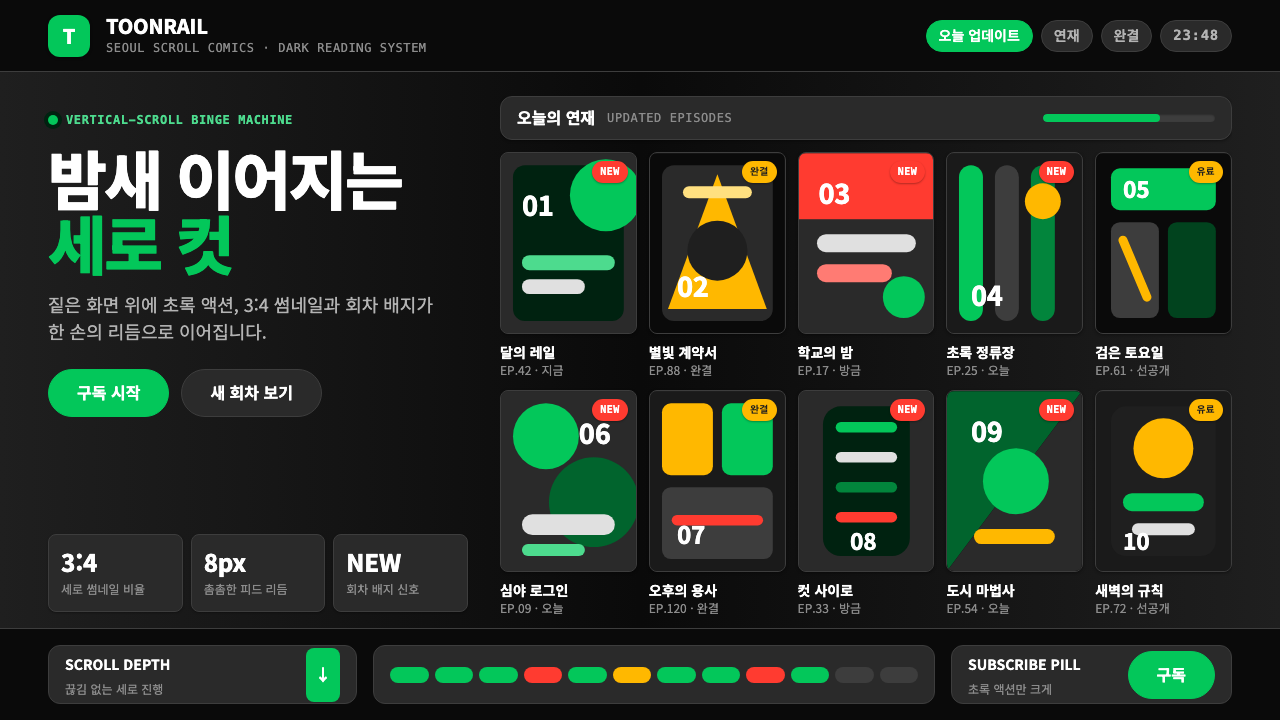 Naver Webtoon (2024)Built for late-night scroll. Charcoal grids, Noto Sans KR, and green episode…
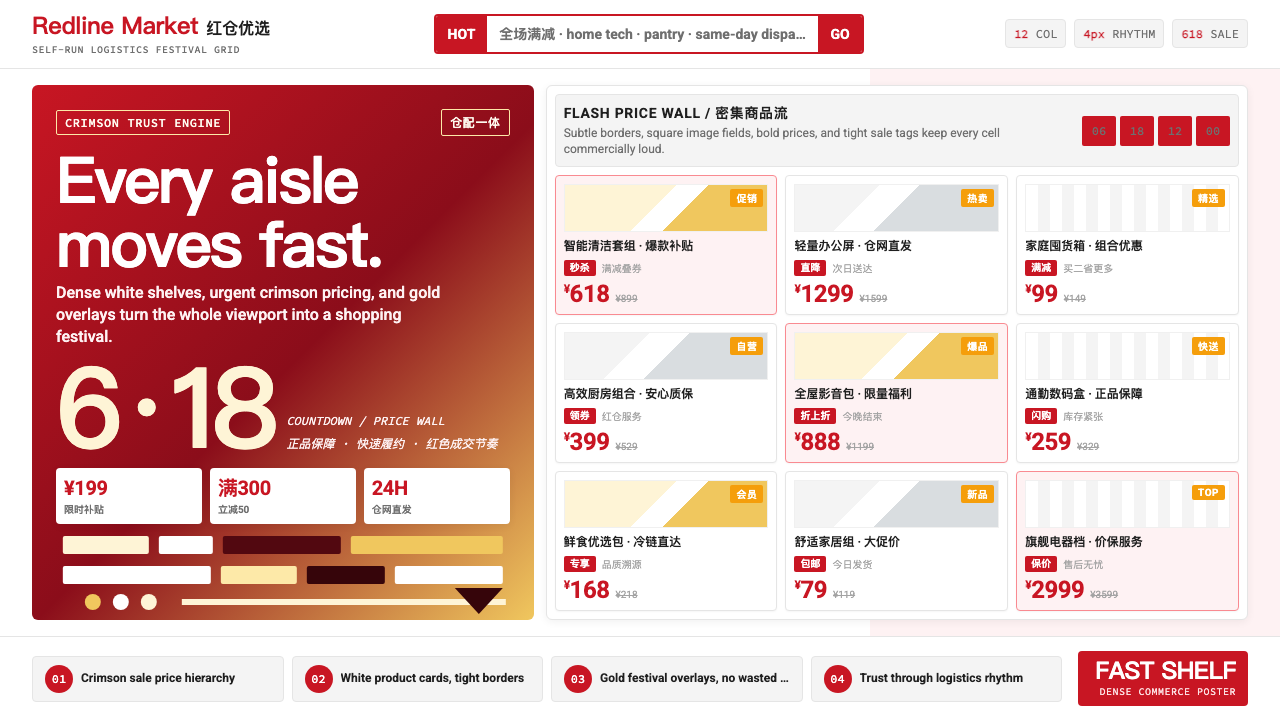 JD.com (京东)Urgency earns trust. Deep red prices pack a white 12-column grid with gold fe…
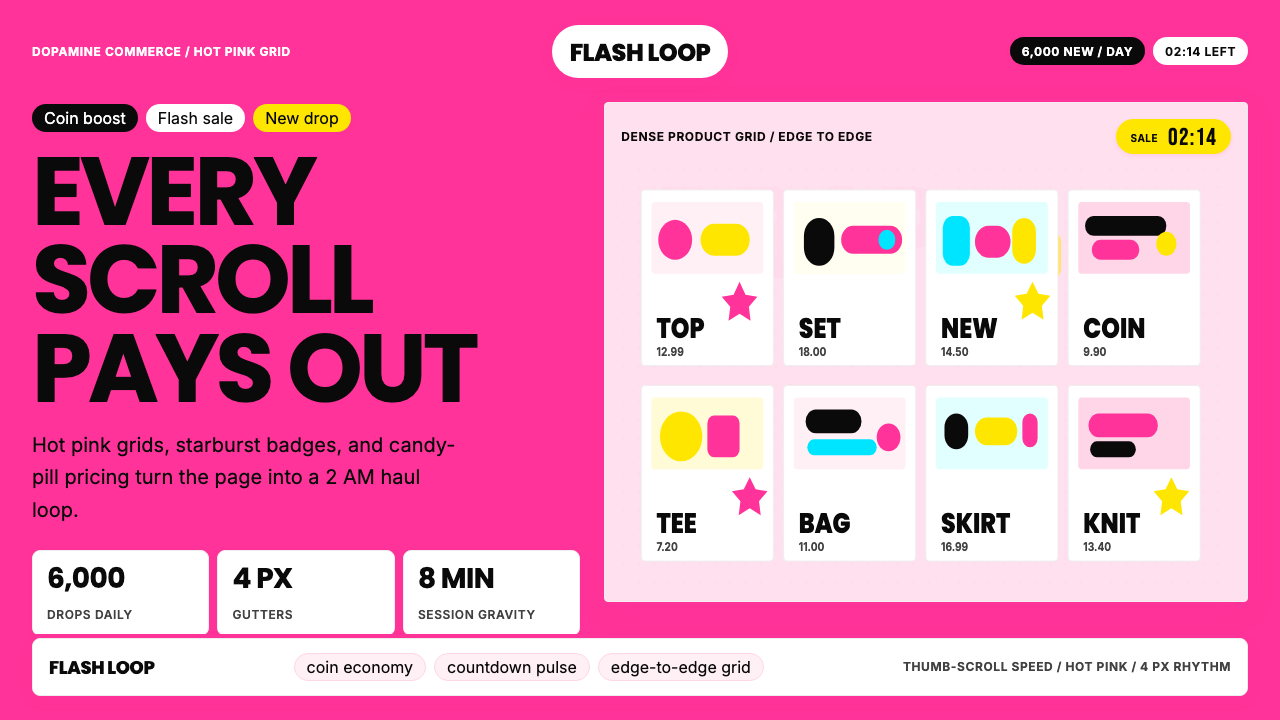 Shein Fast FashionDopamine density wins. Hot pink grids, starbursts, and candy pills pack every…
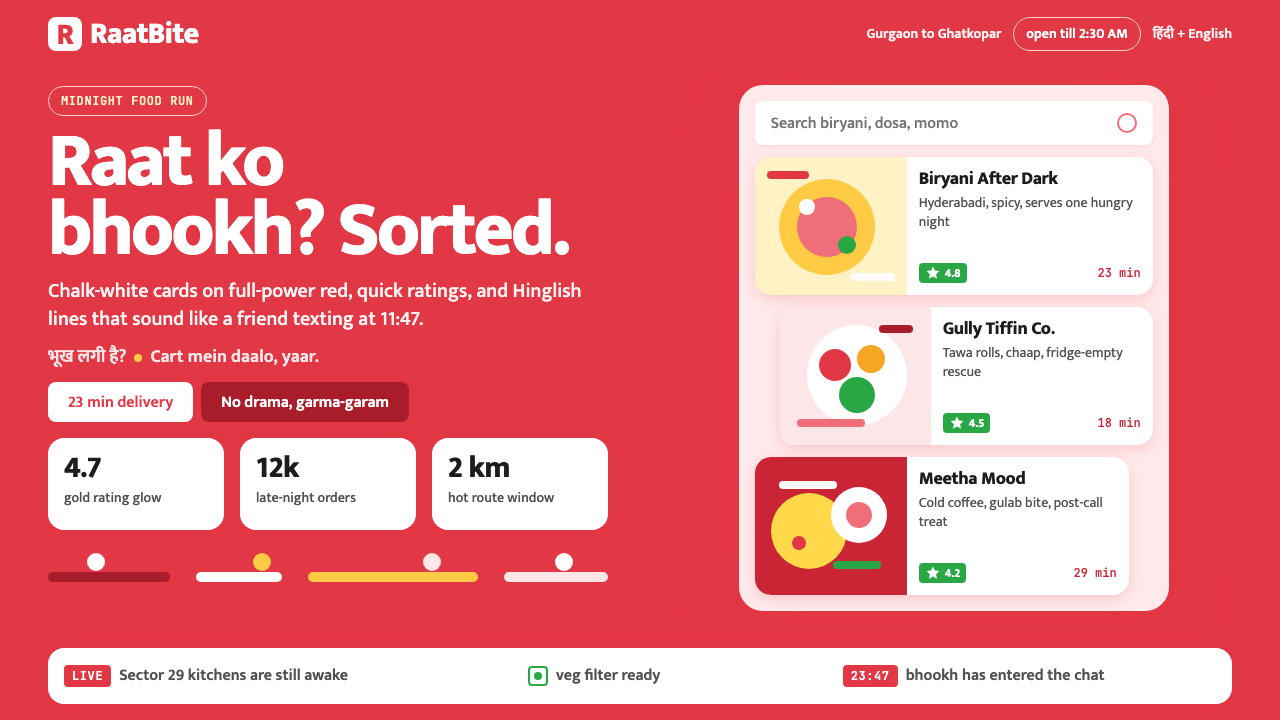 Zomato India DeliveryOwns the midnight scroll. Saturated red, Mukta Hinglish, white cards and gold…
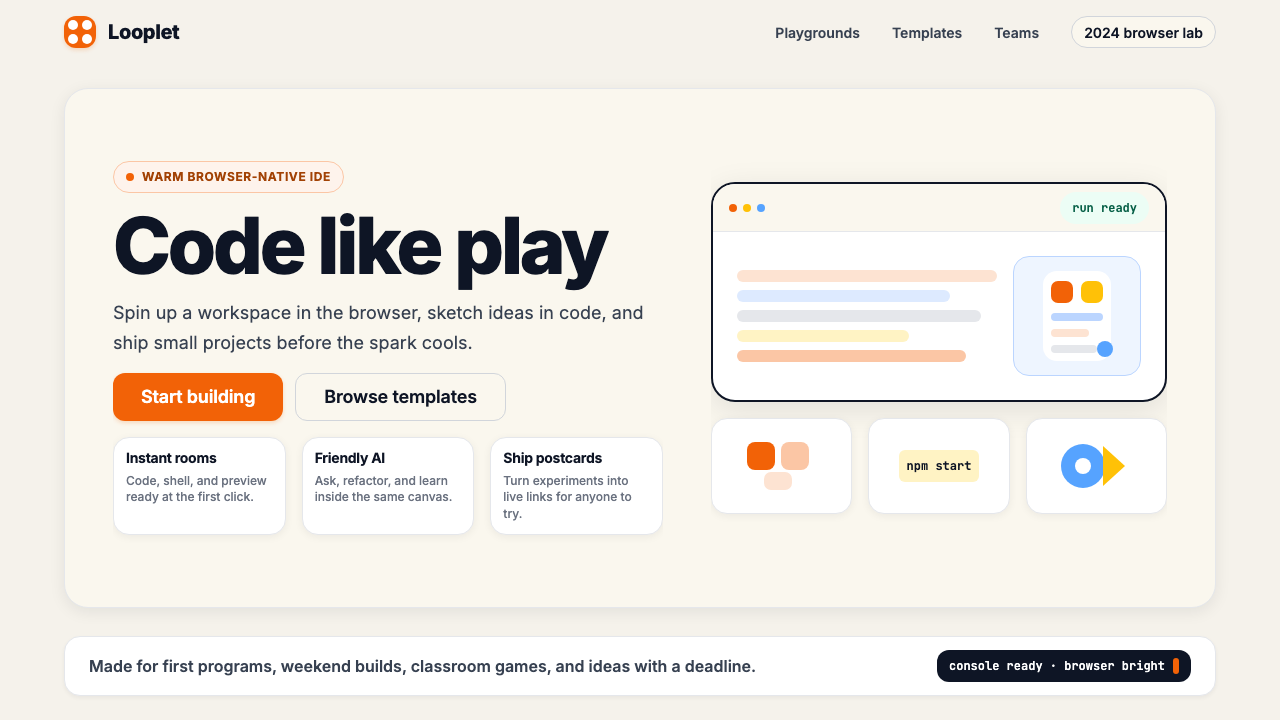 Replit 2024Coding feels warm. Coral buttons, cream panels, rounded code tiles make build…
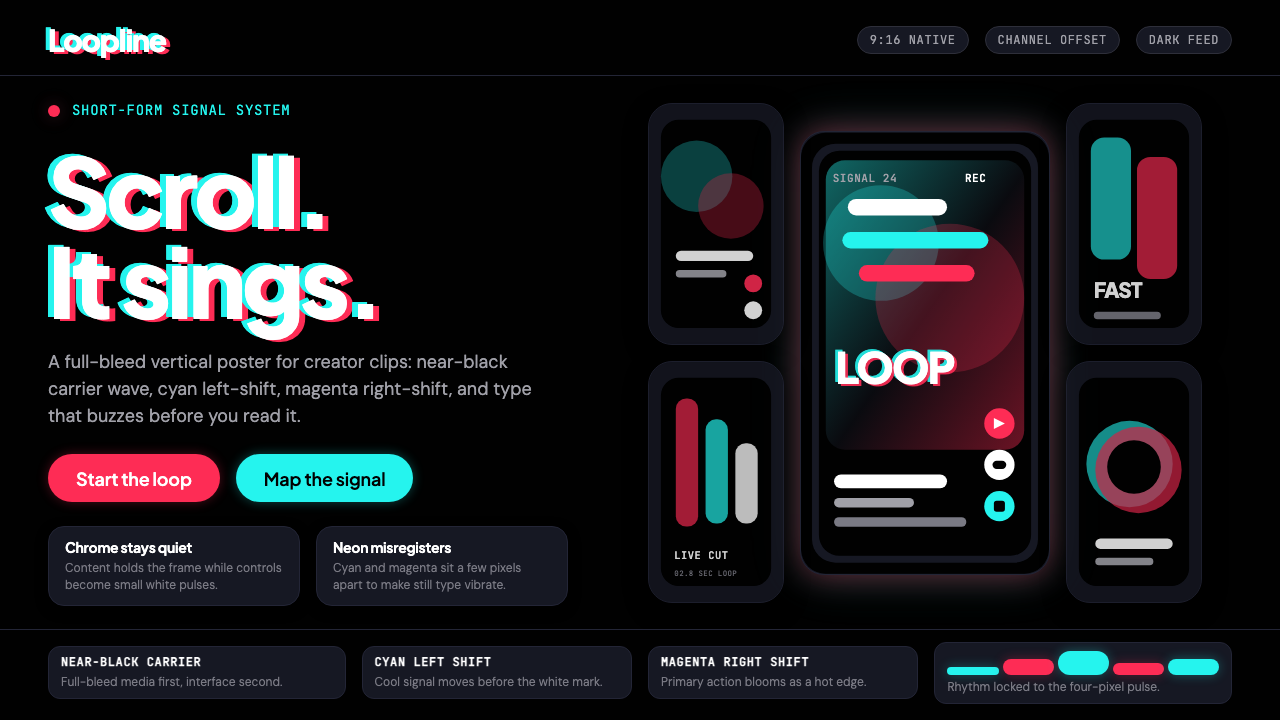 TikTok 2024Attention vibrates. Near-black feed, cyan-magenta offsets, and vertical frame…