What is JD.com (京东)?
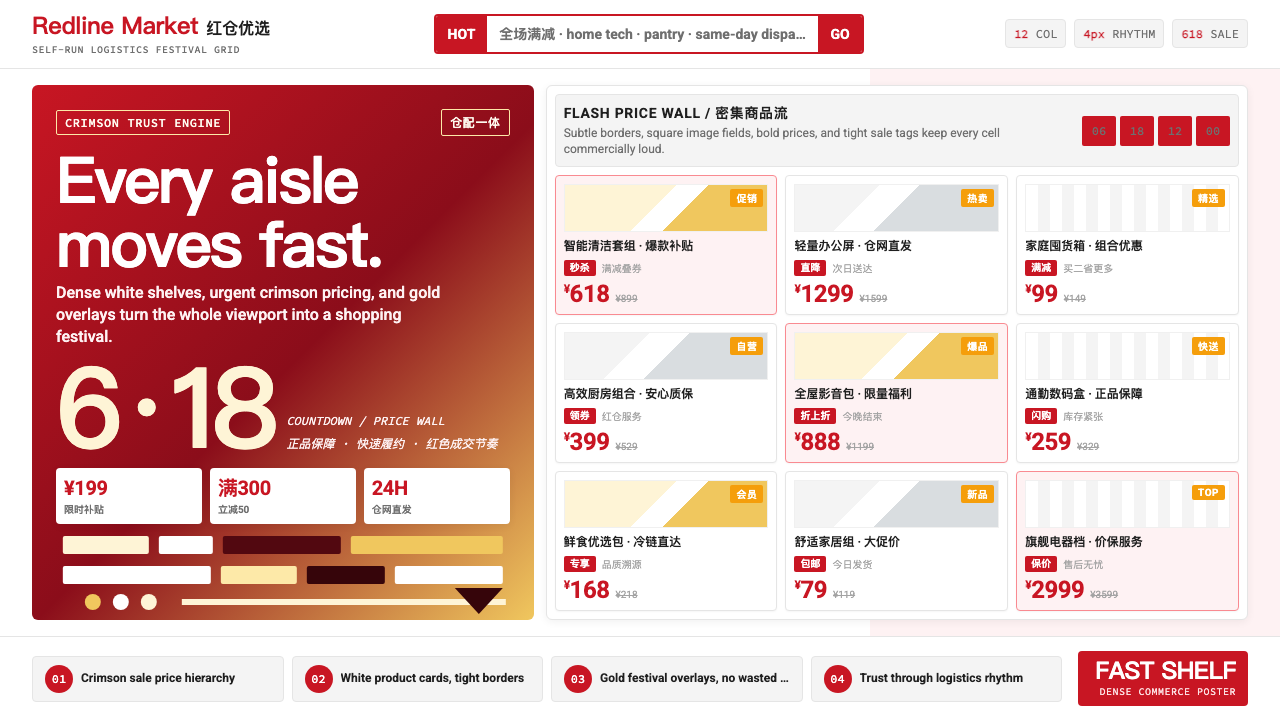
JD.com turned deep crimson and dense grids into the unmistakable grammar of Chinese e-commerce trust — where every pixel earns its place by selling.
JD.com (京东) in brief
JD.com's visual identity is one of the most commercially refined design systems in the world. It is built on a specific shade of deep crimson that the brand has claimed as its own, deployed against crisp white grounds in a dense multi-column grid that maximizes the number of products a user can see at a single glance. The system communicates two things simultaneously: festive urgency and institutional dependability — the energy of a shopping festival and the confidence of a company that owns its own warehouses and delivery fleet.
At its core, the style is a negotiation between information density and legibility. Chinese e-commerce users are highly trained scanners who make purchasing decisions in fractions of a second; the design system responds by making price the largest, heaviest typographic element on any product card, surrounding it with visual cues — crossed-out original prices, promotional badges, countdown timers, gold-accent sale tags — that tell the full commercial story before the user consciously reads a word.
The style is also deeply seasonal. During the 618 Shopping Festival in June and Singles Day in November, the palette shifts toward an intensified red-and-gold combination drawn from the visual vocabulary of Chinese New Year celebration. These promotional overlays sit on top of the everyday system rather than replacing it, creating a layered visual language that can escalate from standard retail mode to full festival mode with a predictable set of additions.

Where does JD.com (京东) come from?
JD.com traces its origins to 1998, when Liu Qiangdong opened a small counter in Beijing's Zhongguancun electronics district selling magneto-optical storage products. The company operated as a physical retail chain until 2003, when an outbreak of SARS forced the stores to close. Faced with no foot traffic, Liu pivoted to online sales, initially through forum posts and later through a purpose-built website launched in 2004. This forced transition proved decisive: JD.com would become one of the first major Chinese retailers to recognize that the internet was not a supplement to physical retail but a fundamentally different commerce infrastructure.
The visual identity evolved through two distinct phases. In the early online years, JD.com's design language was broadly similar to that of other Chinese e-commerce platforms — busy, color-heavy, and organized around a red-dominant palette that most Chinese internet retailers used to signal discount and excitement. The deep crimson associated with JD.com today began to consolidate as a proprietary visual asset in the mid-2000s, as the company grew into a genuine national retailer and needed to distinguish itself from the sprawling Taobao marketplace model that Alibaba was building.
The company's self-owned logistics network, built from approximately 2007 onward, fundamentally shaped its visual culture. While Alibaba operated as a platform connecting third-party sellers and buyers, JD.com controlled its own inventory and delivery. This operational difference expressed itself visually: where Taobao felt like a bazaar — chaotic, individually branded, seller-defined — JD.com developed a more unified, more institutional aesthetic that telegraphed reliability. The use of a consistent crimson across all touchpoints, combined with the famous JOY dog mascot introduced in later years, reinforced the message that users were dealing with a single coherent company rather than a marketplace of strangers.
The 618 Shopping Festival, established by JD.com around 2010 as a company anniversary promotion each June 18th, was both a commercial event and a design forcing function. Building an annual promotional campaign of sufficient scale to compete with Alibaba's Singles Day required developing a scalable visual system capable of accommodating thousands of product categories, dozens of participating brands, and both homepage hero banners and individual product-level pricing graphics. The red-gold promotional palette that now defines the festival mode was refined through successive 618 and Singles Day campaigns during the 2010s, converging on a system that balanced maximum visual energy with enough structural order to remain shoppable under conditions of high cognitive load.
What defines the JD.com (京东) look?
Signature Red
The defining element of the JD.com palette is a deep, saturated crimson that carries both Chinese festive meaning and brand authority. It is not the orange-leaning red of urgency signage, nor the bluish-red of Coca-Cola — it sits in a specific range that reads as simultaneously traditional (evoking Spring Festival decorations and lucky envelopes) and contemporary (signaling digital confidence and retail scale). This color appears on every primary call-to-action — the buy button, the price tag, the promotional badge — while the surrounding canvas stays white to maximize contrast and readability.
Dense Grid Architecture
The layout system is built on a multi-column grid calibrated to display maximum product count without visual chaos. Product cards are tightly packed, with consistent spacing that is generous enough to allow breathing room between items but minimal enough to preserve density. The grid is hierarchical rather than uniform: featured products and promotional placements occupy larger grid cells while standard listings fill the tighter sub-grid. This architecture is optimized for the browsing behavior of experienced Chinese e-commerce shoppers, who scan horizontally and vertically simultaneously and expect to find a large selection above the fold.
Price Typography
Price numerals are the typographic hero of the JD.com design system. They appear in the largest, heaviest weight on any product card, set in a rounded but confidently structured letterform that reads clearly at small sizes. The sale price appears in the signature red, while the original or crossed-out price appears in a lighter gray, creating an immediate visual hierarchy that communicates the discount without requiring the user to calculate. Promotional prices during major sales events may be accompanied by additional contextual labels — indicating membership pricing, coupon reduction, or tiered purchase incentives — each in its own consistent typographic style.
Red-Gold Festival Mode
During major promotional events — most prominently the 618 Shopping Festival in June and Singles Day in November — the standard red-and-white system extends into a red-and-gold register. Gold is drawn from the visual vocabulary of Chinese New Year: it connotes fortune, abundance, and celebration. In festival mode, banner backgrounds shift to rich red fields, headlines and countdown timers gain gold accents, and decorative motifs borrow from traditional Chinese festive imagery — coins, ribbons, and geometric prosperity patterns. This overlay system is designed to escalate emotional intensity without abandoning the underlying grid logic.
JOY Mascot Integration
The JOY dog — a metallic-silver cartoon dog rendered in a smooth, almost toy-like three-dimensional style — provides moments of personality relief within an otherwise commerce-dense interface. The mascot appears at moments of brand delight: empty states, successful order confirmations, holiday greetings, and mascot-themed promotional campaigns. Its silver-and-white coloring is deliberately neutral against the dominant red system, ensuring it does not compete with commercial information while still anchoring an emotional register that humanizes the brand. JOY is a studied contrast to the functional density of the rest of the design system.
Promotional Badge System
JD.com operates an extensive system of visual badges that attach to product cards to convey deal status, shipping speed, authenticity guarantee, and membership benefits. Each badge type has a consistent color and shape within the system: shipping speed indicators, authenticity labels for imported goods, membership-exclusive price markers, and flash-sale countdown indicators all occupy a designated position within the product card grid. The cumulative effect of multiple badges on a single card is deliberate — it creates information density that signals a rich commercial ecosystem without relying on prose description.
Carousel and Hero Banner Rhythm
Homepage and category-page hero banners are treated as high-impact editorial spaces within an otherwise grid-organized environment. They rotate on a short interval, creating kinetic rhythm that contrasts with the static product grid below. Each banner is a self-contained visual unit: a strong background color field (most often red or a brand color supplied by the featured merchant), a product or lifestyle photograph, and a headline and price call-out set in large, confident type. The rotation speed and visual weight of banners are calibrated to draw the eye upward from the product grid, then release attention back downward once the banner cycle completes.

Who shaped JD.com (京东)?
Liu Qiangdong founded JD.com in 1998 as a physical electronics retailer in Zhongguancun and led the company's pivot to e-commerce during the 2003 SARS epidemic. His insistence on building a self-owned logistics network — against the asset-light platform orthodoxy of the time — defined not only JD.com's operational model but its visual identity: the red courier uniforms, the branded delivery vehicles, and the uniform product packaging became extensions of the JD.com design system into the physical world. Liu's emphasis on authenticity and anti-counterfeiting, in contrast to Taobao's open marketplace model, also shaped the brand's visual communication of trust and institutional credibility.
Xu Lei served as President of JD Retail and later as CEO of JD.com, overseeing the period during which the company's design and brand system matured into its current form. Under his leadership, JD.com invested significantly in brand marketing — including the JOY mascot program and major co-branding campaigns with international luxury and premium consumer brands — that elevated the visual identity beyond its origins in discount electronics retail toward a broader quality positioning. The expansion of JD.com into categories including fresh food, fashion, and international goods required the design system to accommodate a wider tonal range while preserving the core red-and-white structural identity.
The internal design and brand team at JD.com is responsible for maintaining one of the most operationally demanding design systems in digital commerce. Managing a platform that displays millions of SKUs across hundreds of categories — while maintaining visual coherence from the homepage hero banner to the individual product detail page to the physical delivery box — requires a system approach rather than a project approach to design. The team has developed and enforced template libraries, component systems, and seasonal campaign frameworks that allow thousands of merchant partners to participate in JD.com's promotional calendar without breaking the structural consistency of the overall platform experience.
The JOY dog mascot was developed as part of JD.com's broader brand humanization initiative, representing a deliberate counterpoint to the commerce density that dominates the platform's everyday interface. The design brief for JOY balanced the need for cross-cultural appeal — as JD.com expanded its international aspirations — with deep resonance in the Chinese cultural context, where dogs carry positive connotations of loyalty and good fortune. The three-dimensional, metallic-silver rendering was chosen to give JOY a premium, contemporary feel distinct from the flat cartoon mascots common to other Chinese internet brands, while the character's expressions and poses were designed to convey warmth and reliability consistent with JD.com's service promise.
The 618 Shopping Festival — named for JD.com's founding anniversary on June 18 — is not a person but a cultural institution that has been as formative to JD.com's visual identity as any individual designer. Established around 2010 and gradually growing into a national retail event that now rivals Singles Day in scale, 618 forced JD.com to develop a scalable promotional design system capable of handling simultaneous campaigns across every product category. The creative demands of producing a visually coherent festival experience at this scale, year after year, drove the maturation of the red-gold palette, the promotional badge system, and the modular banner architecture that now define the JD.com aesthetic during its highest-traffic periods.
How do you use JD.com (京东) today?
The JD.com design language is well suited to contexts where commercial urgency, product density, and consumer trust must all be communicated at once. It is not a style that achieves elegance through restraint; it achieves impact through disciplined abundance. Applying it well requires understanding the internal logic of the system — the hierarchy of color signals, the role of density versus breathing room, and the difference between promotional escalation and visual noise.
For presentation slides, the JD.com aesthetic works effectively on both cover and content pages oriented around commercial or product-launch narratives. A cover slide benefits from the approach's signature high-contrast structure: a deep red field occupying a substantial portion of the slide, with a headline in bold white type and a secondary element — a product image, a key metric — given strong visual presence against the dark ground. Content slides should use the white-dominant register with red reserved for primary data points, headline figures, and calls to action. Data slides take on the character of a retail dashboard: bold numbers in the signature red anchor the key metric, with supporting figures in black and contextual labels in gray. Avoid distributing red evenly across all data elements — it should emphasize the single most important number on each slide.
For web UI design, particularly dashboards, pricing pages, and product catalog interfaces, the system transfers directly. Establish a multi-column grid with consistent gutter spacing, use white as the primary background, and deploy the deep crimson exclusively for interactive states, primary buttons, pricing callouts, and alert conditions. Card components should have defined borders or light shadows rather than borderless floating — the system's legibility depends on clear edge definition at high product density. Promotional or featured sections can use a red background field to signal elevated priority without requiring additional typographic weight. Navigation and utility elements should remain neutral — dark gray or black — to preserve the chromatic impact of red for content that actually requires action.
For editorial and marketing work — campaign landing pages, promotional emails, social cards — the style supports a poster-like boldness that communicates scale and confidence. Full-width banner sections can use the deep red as the primary background with gold-accent typographic elements for a high-energy festival register. Promotional countdown timers, price-reveal mechanics, and tiered-offer structures are all native to this visual language and translate directly into marketing communication design. When adapting for editorial contexts outside of explicit promotions, reduce the promotional badge density and lead with product photography at greater scale — the photography does commercial work while the red typography provides structural anchor.
The most common mistake when applying the JD.com design language is confusing density with disorder. The system operates at high information density, but each element has a fixed position in a deliberate hierarchy. Introducing additional colors beyond the core red-white-gold system — purple, teal, or orange accents — breaks the chromatic logic and produces visual noise rather than richness. Similarly, using red for too many competing elements simultaneously removes its ability to signal priority: if every label, border, and button is red, nothing is. Reserve the signature crimson for the single most important commercial signal on any given surface, and let the surrounding white ground do the work of contrast.

JD.com (京东) — FAQ
Is the JD.com style the same as general Chinese e-commerce design?
They share common roots but are distinct. Early Chinese e-commerce design was broadly red-dominant across all platforms, reflecting a shared understanding that red signals discount and festivity to Chinese consumers. JD.com's style has evolved away from that generic starting point toward a more specifically branded system: a proprietary shade of crimson rather than generic red, a more institutionally ordered grid rather than the bazaar-like chaos of early Taobao, and the JOY mascot as a brand-specific personality layer. The main differentiator is institutional versus marketplace feeling — JD.com's design system communicates a single coherent company, while the generic Chinese e-commerce aesthetic reflects the aggregate noise of thousands of individual sellers.
Can the JD.com style work for non-retail contexts?
The style's core vocabulary — high-contrast red-and-white, dense information grids, strong price typography — is deeply optimized for retail contexts and reads as commercial in almost any application. That said, specific elements of the system translate well to other high-information-density contexts: internal dashboards for logistics or operations teams benefit from the system's ability to surface key metrics at a glance; pricing pages for software products can borrow the tiered-offer visual structure; data-heavy editorial designs can use the bold numeral treatment for pull-quote statistics. The key is selective adoption — using the structural logic of the system without importing the full promotional register, which will feel out of place in a non-retail context.
How does the JD.com style handle premium or luxury product positioning?
This is a genuine tension within the system. JD.com has invested significantly in building credibility with premium and luxury brands — its self-owned logistics and anti-counterfeiting position make it attractive to brands that would never sell through an open marketplace. In practice, the platform handles this by creating differentiated sub-environments: premium product pages reduce information density, increase image scale, use more generous spacing, and suppress the promotional badge layer. The signature red may retreat to a single accent or disappear entirely in favor of neutral dark typography on a white ground. This modulation demonstrates that the base system is a default rather than a constraint — luxury mode on JD.com is essentially a subtraction exercise.
Why does JD.com use such high information density rather than a cleaner layout?
The density reflects a deep understanding of its user base rather than a design oversight. Research consistently shows that experienced Chinese online shoppers interpret sparse layouts as a sign of limited selection — the visual abundance signals a large, trustworthy inventory. High density also reflects the practical reality of Chinese smartphone usage patterns: users scroll quickly, tap frequently, and expect to see a large number of options before making a purchase decision. The design system's density is calibrated for this behavior, not for the contemplative browsing pattern of a minimalist lifestyle brand. This is why direct aesthetic comparisons to Western e-commerce platforms — which tend toward more whitespace and fewer products per viewport — often misread JD.com's density as noise rather than intentional design.
How should the JD.com festive register be used without feeling like a costume?
The festive red-gold overlay works because it is a genuine cultural signifier — not just a color combination but a visual vocabulary that Chinese audiences recognize and respond to emotionally as tied to celebration and fortune. When applying this register outside of JD.com itself, the key is contextual legitimacy: the red-gold combination makes sense for a product launch that coincides with a major Chinese festival, a brand communication targeting Chinese diaspora audiences, or a promotional campaign explicitly celebrating a milestone. It does not make sense as a generic excitement palette applied to contexts with no festival connection. The festive register also requires the structural discipline of the underlying system — without the grid logic and typographic hierarchy of the base JD.com aesthetic, the red-gold combination quickly tips into generic festive decoration rather than a purposeful commercial communication.
Related design styles
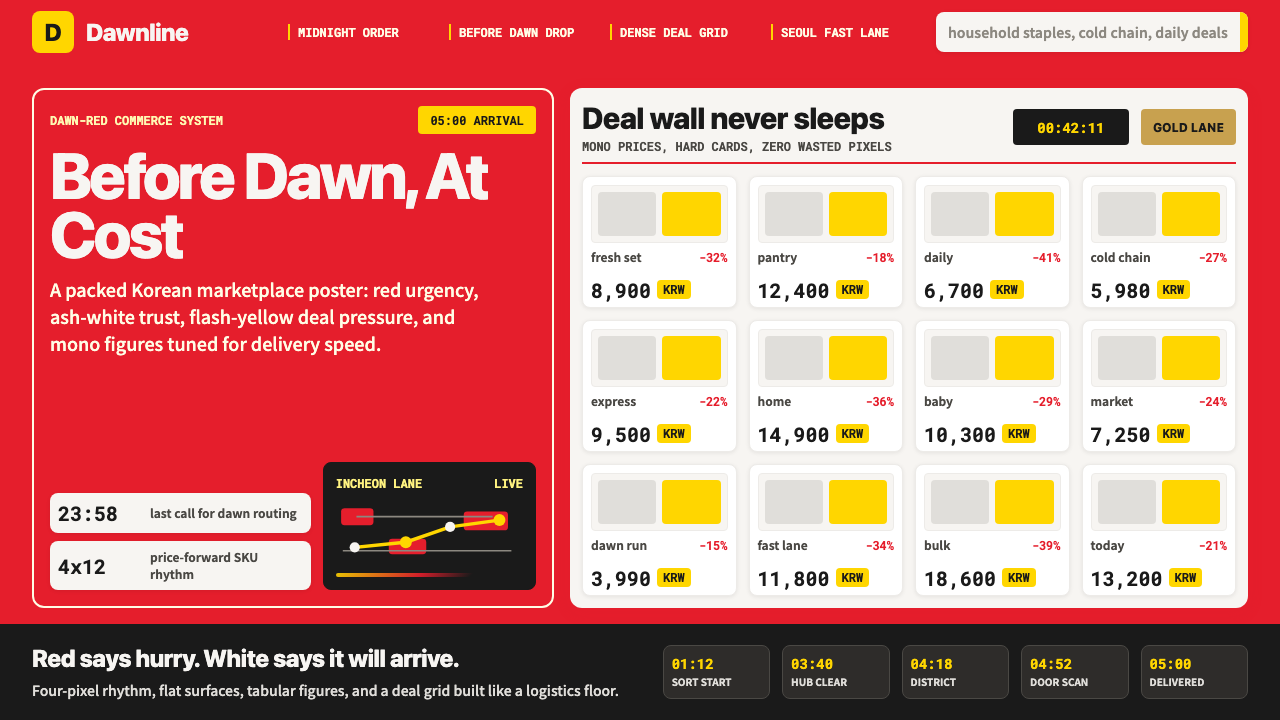 Coupang Rocket DeliveryUrgency made trustworthy. Rocket red, flash yellow, mono prices and packed gr…
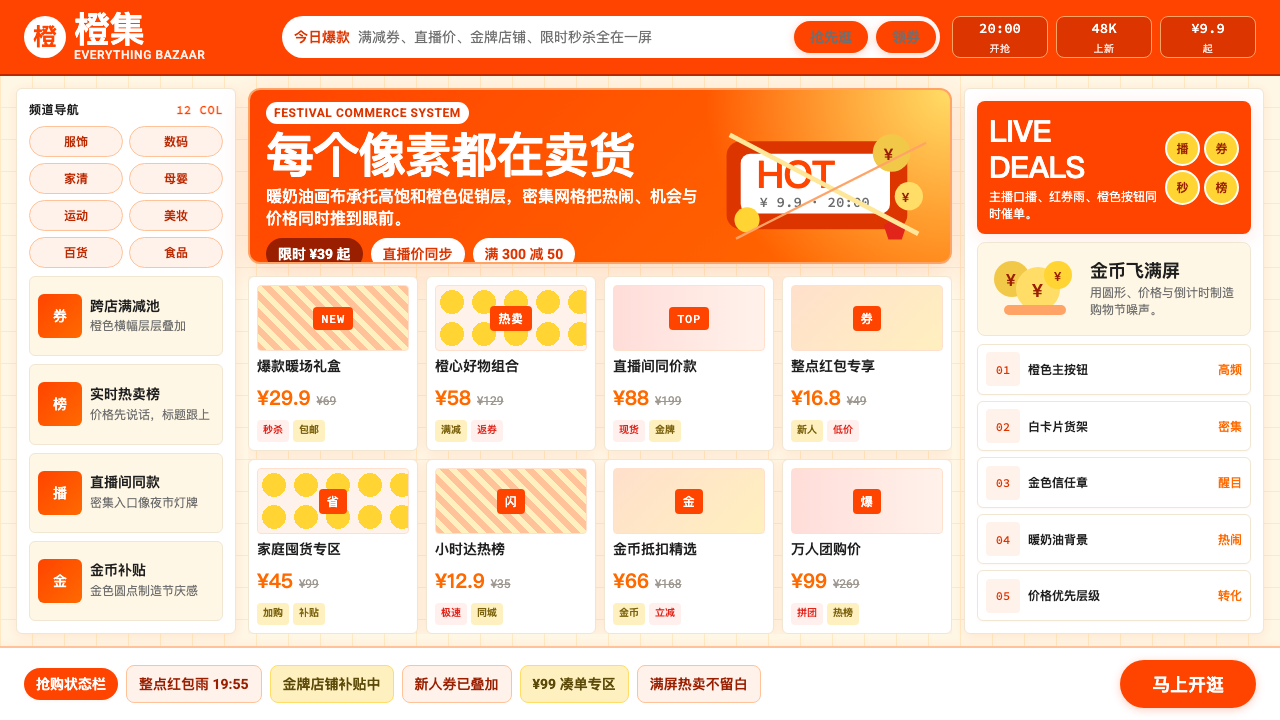 Taobao (淘宝)Every pixel sells. Orange on cream, dense price grids and gold coins shout ab…
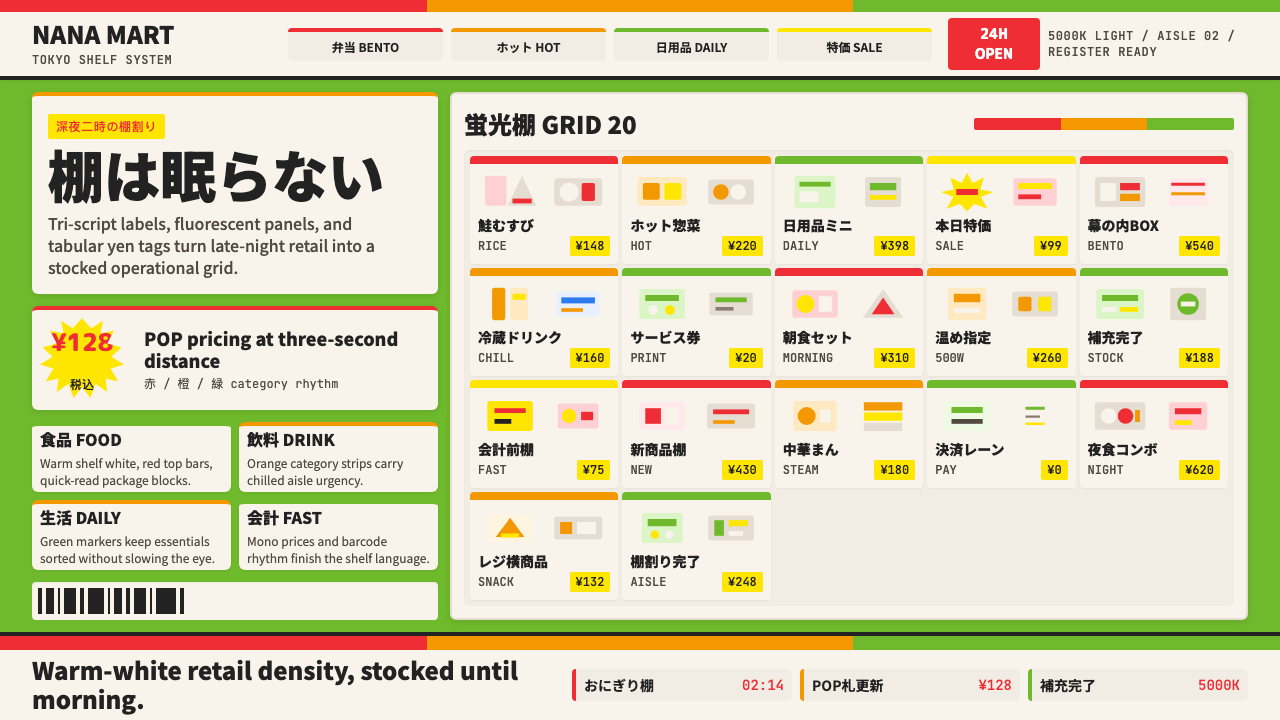 Japanese Konbini 7-ElevenAlways stocked, always bright. Green canopy, warm shelves, POP yen tags, tigh…
 Adobe Creative CloudUnified, not uniform. Red anchor, white space, and saturated app tiles organi…
 Cohere Coral-AIEnterprise AI feels humane. Coral panels, sky-blue chips, and organic curves…
 Databricks LakehouseWarm enterprise confidence. Flame red-orange gradients meet DM Sans and clean…