What is Cohere Coral-AI?
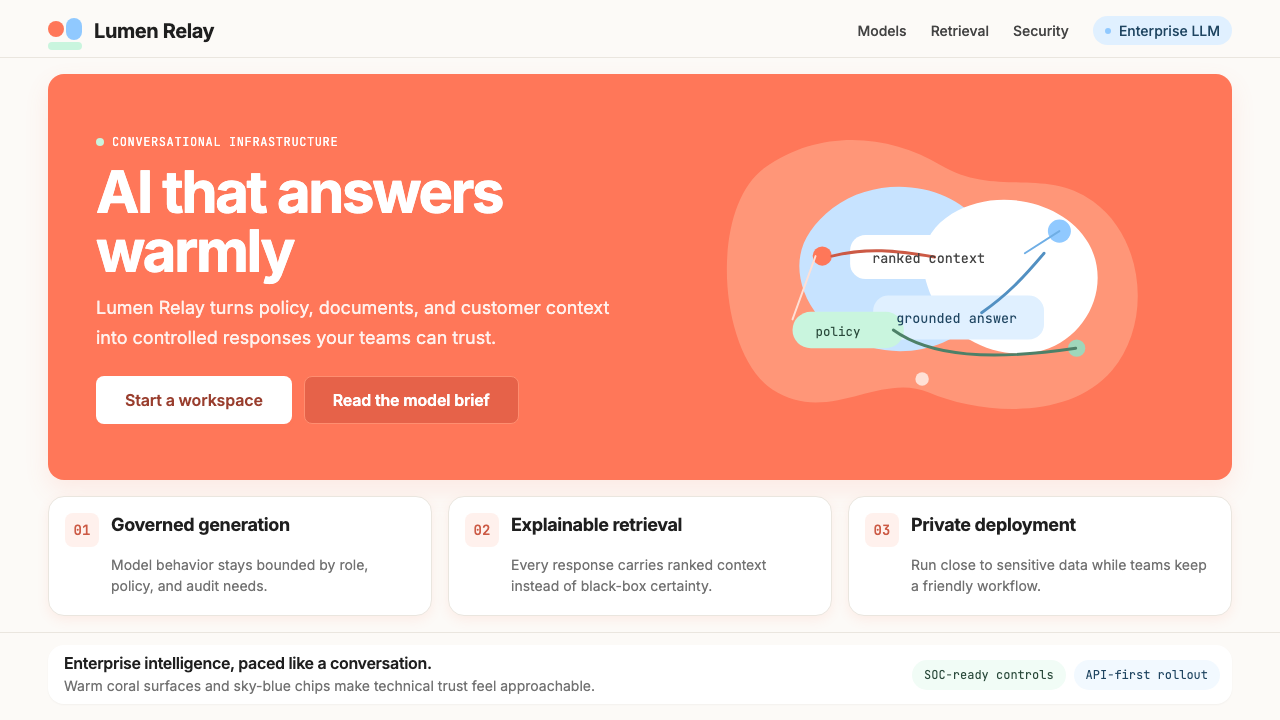
Cohere's brand proves that enterprise AI can feel warm — coral panels, sky-blue chips, and organic curves make machine intelligence seem almost approachable.
Cohere Coral-AI in brief
Cohere Coral-AI is the visual design language of Cohere, an enterprise large-language-model platform founded in Toronto in 2019. The style combines a warm coral-pink ground with a complementary sky-blue accent, anchored by cream whites, and softened throughout by organic, blob-like illustration forms. Where most AI companies reach for cold metallics, stark neutrals, or severe monochrome, Coral-AI leans into warmth — treating enterprise software as something that should feel conversational and human-scaled rather than imposing and clinical.
The aesthetic rests on three interlocking ideas. First, warmth as a strategic differentiator: coral-pink is physiologically associated with approachability, and deploying it as a primary brand ground is a deliberate departure from the cool restraint of dominant AI platforms. Second, organic form as counterpoint to technical content: the curving illustration style — loose biomorphic shapes reminiscent of mid-century scientific diagrams abstracted into pure color areas — softens the angularity inherent in data-heavy interfaces. Third, modernist type discipline: a clean, contemporary sans-serif used at clear hierarchical scales keeps the palette from tipping into informality.
The result is a visual register that reads simultaneously as technically credible and humanly accessible — an important balance for an enterprise product competing on both capability and developer experience. Coral-AI sits distinctly apart from OpenAI's restrained grayscale minimalism, Anthropic's letterpress-inflected cream, and the generic deep-blue professionalism of legacy enterprise software. It is, in its own terms, a 2020s argument that AI infrastructure can carry warmth without sacrificing authority.

Where does Cohere Coral-AI come from?
Cohere was founded in 2019 by Aidan Gomez, Ivan Zhang, and Nick Frosst — three researchers who had worked at Google Brain in Toronto. Gomez is a co-author of the 2017 paper "Attention Is All You Need," the landmark publication that introduced the Transformer architecture now foundational to essentially every large language model in existence. The company launched at a moment when the enterprise LLM market was rapidly forming, with organizations across finance, healthcare, and logistics beginning to recognize that private, customizable, on-premises-deployable language models would be a competitive necessity.
The current Cohere visual identity — defined by the coral-pink and sky-blue palette, the organic illustration style, and the modernist sans-serif discipline — emerged through a brand refresh that solidified during the early-to-mid 2020s as the company scaled. The decision to build around coral rather than the blue or gray that dominates enterprise software was a deliberate positioning choice. It acknowledged a broader cultural shift: that the 2020s enterprise user was increasingly a developer or knowledge worker who had formed aesthetic expectations through consumer-grade products, and who would respond to warmth and clarity over severity and abstraction.
The warm-modernist AI brand aesthetic that Cohere helped define exists within a broader movement of post-Transformer AI company identity work. Where first-generation AI product design often borrowed the cold futurism of science fiction — dark interfaces, glowing elements, terminal aesthetics — companies like Cohere sought a vocabulary rooted in craft, conversation, and approachability. The organic curve illustration tradition Cohere embraced has antecedents in mid-century information design, particularly in the scientific and educational publishing of the 1950s and 1960s, where biological and systemic concepts were rendered as flowing, interlocking shapes rather than rigid diagrams.
As Cohere expanded its enterprise reach — building Command, Embed, and Rerank model families, and competing directly with OpenAI and Anthropic for large-scale commercial contracts — the visual identity had to carry increasing weight. The coral-pink ground needed to read as credible in contexts ranging from a developer documentation portal to a slide deck presented to a Fortune 500 board. The success of Coral-AI as a system is partly the success of that credibility argument: warmth and authority are not opposites when the underlying palette is precise, the type is disciplined, and the illustration language is consistent.
What defines the Cohere Coral-AI look?
Coral-Pink Ground
The most distinctive element of Coral-AI is its use of a warm, medium-saturation coral-pink as a primary surface color — not as an accent or highlight, but as the ground itself. This is unusual in enterprise software, where backgrounds are almost universally near-white, light gray, or dark navy. The coral ground creates an immediate warmth that signals approachability, and its medium saturation prevents it from reading as either frivolous or aggressive. It works in harmony with cream whites and is robust enough to carry black type without legibility issues.
Sky-Blue Accent
Against the coral ground, a clear, airy sky-blue functions as the primary accent — appearing on chips, tags, interactive states, and informational callouts. The two colors are complementary in temperature rather than hue: coral is warm and advancing, sky-blue is cool and receding. This thermal contrast creates natural visual hierarchy without resorting to high-contrast value differences or aggressive saturation. The sky-blue reads as data-linked and trustworthy, softening what might otherwise feel like the coral palette alone overreaching into the consumer-lifestyle register.
Organic Blob Illustration
Cohere's illustration language uses loose, curving biomorphic shapes — sometimes overlapping, sometimes isolated — rendered as flat color areas without outlines or gradients. These forms abstract neural-network and biological-system metaphors into pure aesthetic objects: they suggest interconnection, flow, and distributed intelligence without representing anything literally. The absence of hard edges and right angles in the illustration layer provides a deliberate visual relief from the inherent grid-discipline of the interface components they accompany.
Modernist Sans-Serif Discipline
Typography in Coral-AI is governed by a contemporary, geometrically inflected sans-serif used at clearly differentiated scales and weights. Headlines carry authority through generous size and confident weight; body text is set at a comfortable reading size in a lighter weight; labels and metadata appear at compact scales in regular or medium weight. The typographic system acts as ballast against the warmth of the palette — it is the element that keeps Coral-AI from sliding toward softness at the expense of technical credibility.
Flat Surface, Minimal Depth Cues
Despite the warmth of the palette, Coral-AI maintains a fundamentally flat surface logic. Shadows, when used, are subtle and functional rather than naturalistic — they signal elevation and interaction affordance rather than simulate a light source. Cards and panels are distinguished from their backgrounds primarily through color surface differences rather than dramatic depth effects. This flatness keeps the visual system legible at high information density and prevents the warmth of the coral palette from degrading into visual noise.
Cream-White as Neutral Anchor
Cream-white functions throughout Coral-AI as the system's neutral — used for text fields, modal backgrounds, content areas where sustained reading is required, and as the foil that makes the coral ground feel warm rather than overpowering. It is a slightly warmer white than pure optical white, which prevents the two from clashing while maintaining sufficient contrast for legibility. Much of the system's balance depends on the ratio of coral surface to cream surface being carefully managed: too much coral and the interface feels hectic; too much cream and the warmth disappears.
Neural-Network Visual Metaphor
Running through Cohere's illustration and decoration system is a recurring visual metaphor of nodes, connections, and distributed networks — rendered in the same organic, non-literal illustration language rather than as technical diagrams. These motifs reference the Transformer architecture underlying the company's products without explaining it, functioning more like a brand mark than a schematic. They appear most prominently in hero sections and editorial imagery, creating continuity between the product's technical identity and its visual personality.

Who shaped Cohere Coral-AI?
Gomez co-founded Cohere and serves as CEO. Before Cohere, he was a researcher at Google Brain in Toronto, and is a co-author of the 2017 paper "Attention Is All You Need" — the work that introduced the Transformer architecture. His academic background and the paper's status as a foundational document of modern AI gives Cohere a distinctive origin story, and the brand's positioning as technically credible yet humanly accessible partly reflects Gomez's public persona as a researcher who communicates AI's possibilities in accessible terms.
Zhang is co-founder and CTO of Cohere, responsible for the technical architecture of the platform. As the engineering counterpart to Gomez's research profile, Zhang represents the implementation side of Cohere's founding story — translating Transformer research into a production-grade enterprise API. The dual identity of Cohere's founding team, combining research authorship with engineering execution, informs the brand's positioning between academic credibility and enterprise reliability.
Frosst is co-founder of Cohere and, outside the company, a musician known for performing under his own name. His background spans AI research at Google Brain and creative practice — a combination that is unusual among AI company founders and that may contribute to Cohere's willingness to invest in a brand aesthetic with genuine warmth and personality. Frosst's public profile as both a researcher and a musician signals that the human and the technical are not opposites, which aligns with the brand's core visual argument.
As part of Cohere's design and product leadership, Nair has been involved in shaping the visual and interaction systems that translate the Coral-AI brand language into functional product surfaces — including the Cohere platform, API documentation, and developer tooling. The challenge his team navigated was making a warm, expressive brand language operational at the component level without losing its personality to the generic conventions of enterprise UI frameworks.
How do you use Cohere Coral-AI today?
Cohere Coral-AI is a remarkably versatile style for contemporary design work precisely because its warmth is intentional and structured rather than accidental. Applying it well requires understanding that the coral-pink is a load-bearing element of the system — it is not a background tint to be easily substituted. The sky-blue accent, the cream-white neutral, and the organic illustration register all calibrate against the coral ground. Change the ground and the whole system requires rebalancing.
For presentation slides, Coral-AI is strongest when the cover uses the full coral ground with the headline set in a large, confident sans-serif weight. Organic blob forms in sky-blue or cream can occupy the right-hand half or a lower corner, establishing the illustration register early. Content slides work best on cream-white grounds with coral used as a section indicator or accent on data callouts — this prevents the coral from becoming fatiguing across a long deck. Data slides suit a diagrammatic approach: use coral and sky-blue as the primary data-series colors, keep gridlines light and near-invisible, and let the warmth of the palette make even dense charts feel approachable rather than intimidating.
For web interfaces and dashboards, Coral-AI is well-suited to overview screens, onboarding flows, and marketing-facing surfaces. Developer documentation portals benefit from restraint: use cream-white as the primary document background with coral reserved for interactive elements, warnings styled with sky-blue, and the organic illustration appearing only in empty states or hero banners. Pricing pages are a natural fit for the style's warmth — coral-ground feature cards or tier headers, cream-white body content, and sky-blue for highlighted or recommended tiers create a system that feels both persuasive and trustworthy.
For editorial and marketing contexts, the style supports strong, poster-like compositions. A Coral-AI editorial spread uses the full coral ground for section openers, transitions to cream for long-form reading sections, and employs the organic illustration as chapter dividers or sidebar elements. Marketing one-pagers or social cards work well with the coral ground filling the majority of the surface, the organic blobs creating compositional movement, and the headline set large enough to read as a single confident statement. Email templates structured with a coral header block, cream content area, and sky-blue call-to-action button carry the system's warmth effectively into the inbox.
A common mistake when applying Coral-AI is using the coral-pink too uniformly — filling every surface with the same hue at the same saturation so that the warmth stops reading as warmth and starts reading as a design error or an overpowering brand statement. The system earns its warmth through contrast with the cream-white and sky-blue. Another pitfall is treating the organic illustration as mere decoration rather than as a structural element: blob forms dropped randomly onto a layout become visual clutter rather than compositional counterweight. They work when they are given scale, placement intentionality, and white space to breathe against.

Cohere Coral-AI — FAQ
Is Coral-AI suitable for dark-mode interfaces?
Dark mode is possible but requires significant recalibration. The coral-pink ground that defines the style loses its warmth register almost entirely when transposed to a dark context — it tends to read either as oversaturated or as a harsh accent rather than a welcoming ground. A dark Coral-AI variant works better when the coral is demoted to accent-only use, sky-blue becomes the primary interactive signal, and a very deep, slightly warm near-black takes the place of the coral ground. The organic illustration retains more of its personality in dark mode than the palette does, so leaning into it can help preserve the style's character. Expect the dark variant to feel more like a technical-AI aesthetic and less like the original warm humanist register.
How does Coral-AI differ from other warm-toned enterprise design systems?
Most warm-toned enterprise design systems — those using amber, peach, or terracotta — treat warmth as a secondary layer: the primary interface is neutral, and warm color appears as accent or brand marker. Coral-AI is unusual in using warm coral-pink as a primary surface, making the warmth structural rather than decorative. Additionally, the combination of a warm ground with an organic illustration language and a specifically AI-product framing places it in a distinct category. It is not lifestyle warmth, wellness warmth, or food-brand warmth — it is engineered warmth, warmth in the service of technical approachability, which gives it a character that other warm-toned systems do not share.
Can the style work for non-AI products?
Yes, with some adaptation. The Coral-AI palette and layout principles are not inherently AI-specific — a SaaS analytics tool, a developer productivity platform, or even a design tool could carry the same warmth effectively. The element most tightly coupled to the AI context is the organic blob illustration, which derives much of its meaning from the neural-network associations it carries in a machine-learning brand environment. In a non-AI context, those forms need to be grounded in a different conceptual metaphor — perhaps biological systems, social networks, or data flows — or replaced with a different illustration approach that delivers the same softening effect. The palette and typography transfer more cleanly than the illustration system.
How should the organic illustration be balanced against data-heavy content?
The organic illustration works as counterweight, not as competition. In a data-heavy context — a dashboard with dense charts, a report with multiple data tables — the illustration should be confined to structural boundaries: a hero section at the top, an empty-state placeholder, a sidebar accent. The body of the data content should sit on cream-white with the illustration absent, so that the quantitative information has room to be read precisely. The mistake is scattering organic blob forms across content-heavy areas where they read as distracting noise. Think of the illustration as marking the thresholds of the experience — entry, exit, and transition — rather than inhabiting the working space itself.
What is the most common mistake when teams try to replicate the Cohere look?
The most common mistake is reducing Coral-AI to its palette and treating the coral-pink as a simple brand color swap applied over a generic enterprise layout. The result looks like a tinted version of a standard SaaS template rather than the Cohere visual system. What teams miss is that the coral works because it is structural — it grounds the whole composition — and because it is supported by a very specific set of companions: the particular quality of sky-blue, the warmth of the cream-white, the organic illustration at appropriate scale, and the typographic discipline that provides contrast. The second most common mistake is over-using the organic blobs, allowing them to appear as wallpaper rather than as purposeful compositional elements. Cohere uses them sparingly and at scale; many attempts use them repeatedly at small size, which reduces them to pattern and strips them of presence.
Related design styles
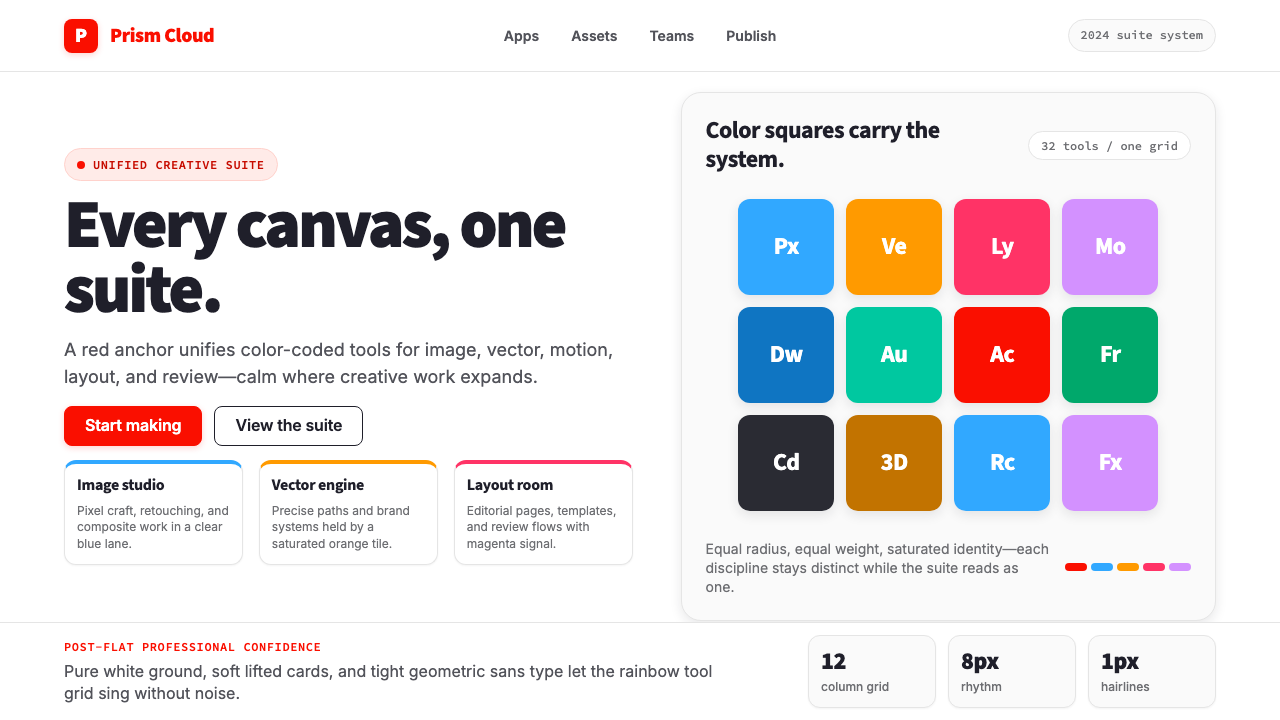 Adobe Creative CloudUnified, not uniform. Red anchor, white space, and saturated app tiles organi…
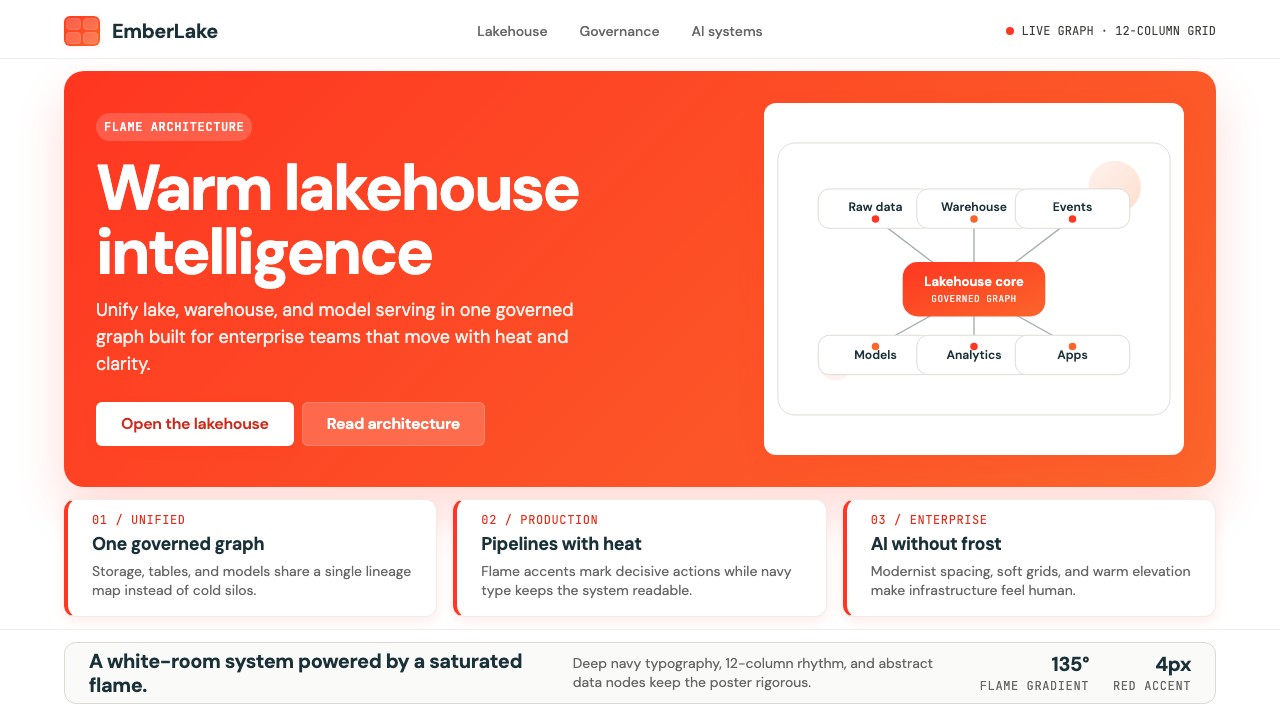 Databricks LakehouseWarm enterprise confidence. Flame red-orange gradients meet DM Sans and clean…
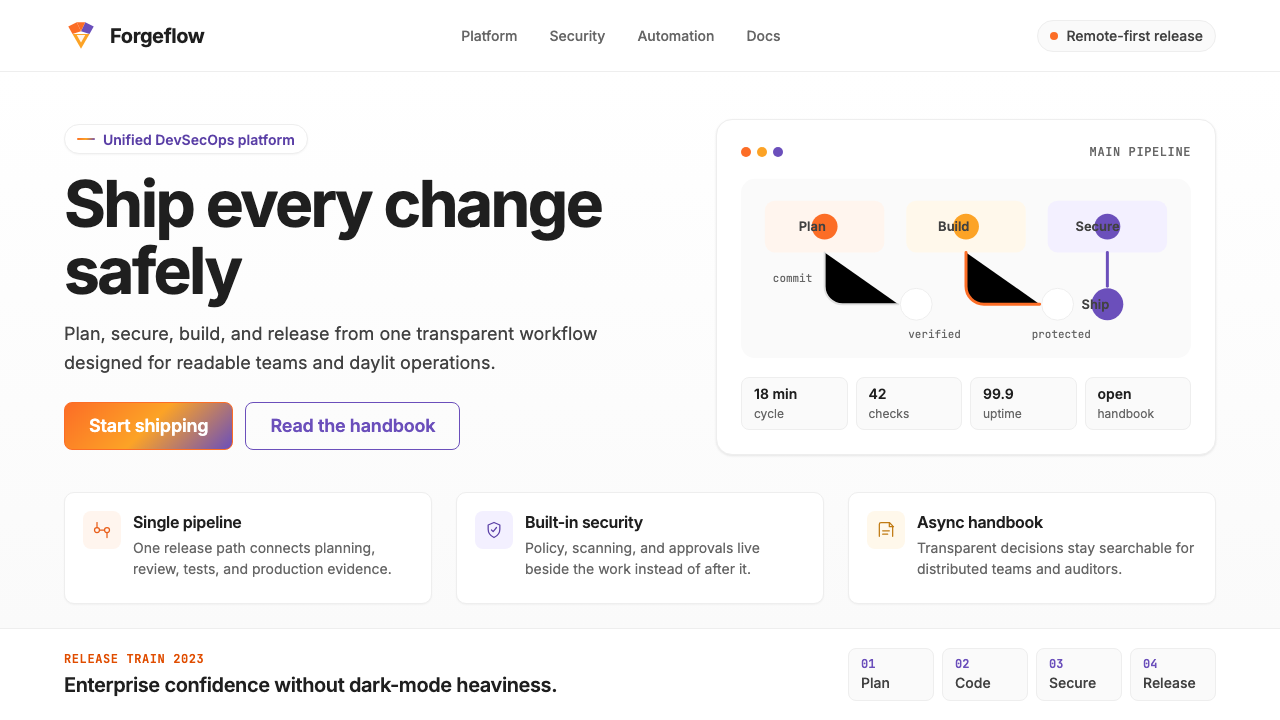 GitLab 2023DevOps in daylight. Tanuki orange-to-purple gradient, Inter, warm enough for…
 Postman 2024Warm APIs feel approachable. Orange gradients, Inter headlines, and dark mono…
 Android Bugdroid GreenFriendly tech, reduced to geometry. Vivid green pops from Grey 900 and rounde…
 AsanaCalm productivity breathes. Cream canvas, lavender panels, coral-blue-yellow…