What is Medellín Comuna 13 Murals?
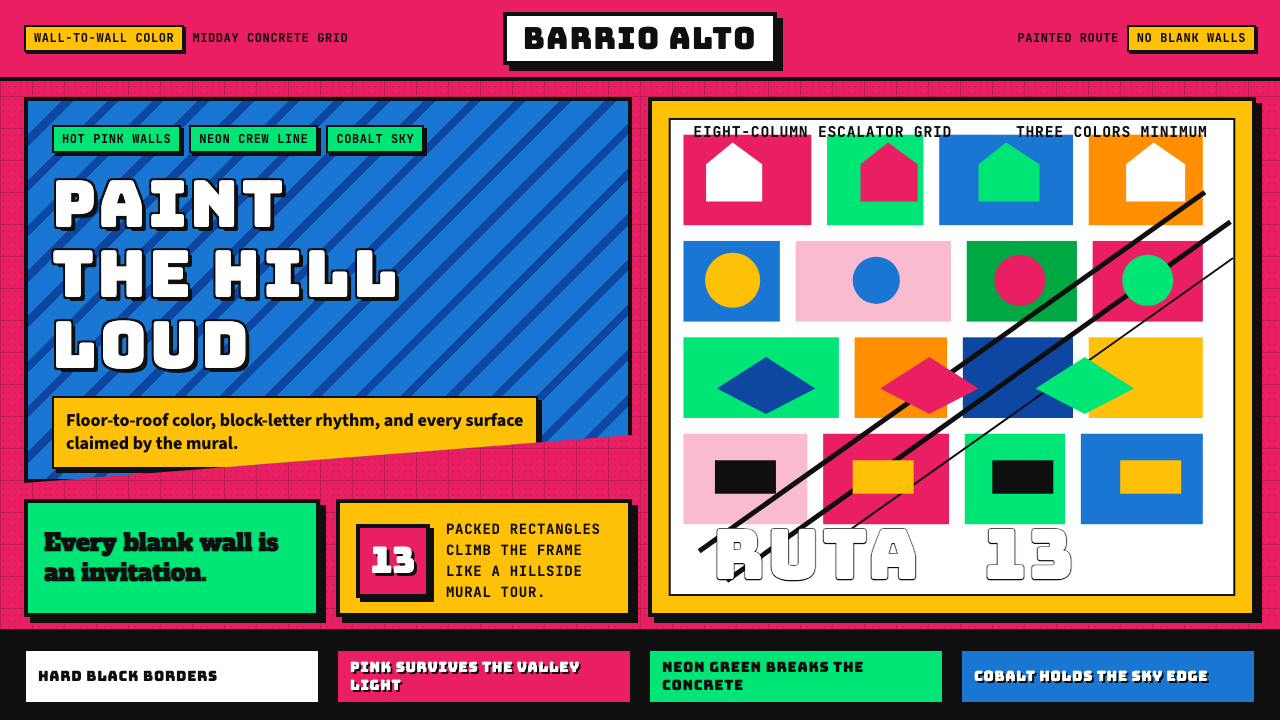
The murals of Medellín's Comuna 13 turned a hillside scarred by violence into Latin America's most powerful proof that color, community, and art can rebuild a city.
Medellín Comuna 13 Murals in brief
The Medellín Comuna 13 mural style is an outdoor urban art movement rooted in the San Javier neighborhood of Medellín, Colombia. It fuses hip-hop visual culture, Andean folk imagery, and community testimony into compositions of extraordinary chromatic intensity. Walls, stairways, rooftops, and escalator columns are treated as continuous canvases, filled floor-to-roofline with saturated hot pinks, neon greens, and cobalt blues that hold their luminosity under the sharp midday light of the Colombian highlands.
The aesthetic is deliberate and maximalist. There is no blank wall, no unpainted corner — every surface participates. Figures are bold and legible at architectural scale: faces drawn with fluid outlines, wings and feathers that explode across multiple stories, text and lettering integrated into composition as pictorial elements rather than caption. Graffiti letterforms coexist with painterly muralism; abstract geometric sections neighbor photorealistic portraiture. What unifies the style is not a single technique but a shared commitment to saturation, density, and communal voice.
As a transferable visual language, the style is defined by its unapologetic loudness and its insistence on treating color as presence rather than decoration. It is not subtle. It communicates pride, survival, and creative reclamation at maximum volume — a quality that makes it equally potent when applied to digital contexts where visual energy must compete for attention.

Where does Medellín Comuna 13 Murals come from?
The transformation of Comuna 13 is inseparable from Medellín's broader effort to reinvent itself after decades of catastrophic violence. Throughout the 1980s and 1990s, the neighborhood was one of the most dangerous in a city already considered among the most dangerous on earth. It was a battleground for rival armed groups — paramilitaries, guerrillas, and gangs — and residents endured military operations, forced disappearances, and sustained poverty. The 2002 military operation known as Operación Orión, in which Colombian armed forces and paramilitaries conducted a large-scale sweep of the neighborhood, left deep trauma that residents and artists would spend the following decade processing through paint.
The physical catalyst for the mural movement was the 2011 inauguration of outdoor electric escalators connecting the steep hillside communities of San Javier to the city below. The escalators — a project of Medellín's social urbanism program under Mayor Alonso Salcedo and continued by Aníbal Gaviria — reduced what had been a forty-five-minute climb to a six-minute ride and brought urban infrastructure into areas that had long felt abandoned by the state. With the escalators came tourism and international attention, and with attention came resources that local artists and collectives could channel into large-scale murals. The walls of the escalator corridors became the first major canvases.
The artistic communities that shaped the style had been organizing for years before the escalators arrived. Casa Kolacho — founded by Jeihhco and other hip-hop artists from the neighborhood — established a cultural center that used rap, breakdancing, and graffiti as tools for youth engagement and conflict prevention as early as the mid-2000s. The collective AKA, led by Yader 'Perrograff' Vargas, and Chota13 developed graffiti vocabularies rooted in the neighborhood's own visual memory: faces of residents, local landmarks, Andean animals, and scenes of daily life rendered at a scale that reclaimed the built environment. Cripta-13 added darker, more symbolic imagery that processed the neighborhood's violent history directly.
By 2013 and 2014, the graffitour — a self-guided walking tour of the murals — had become a fixture of Medellín's international tourism offer, attracting visitors from across Latin America, Europe, and North America. This visibility accelerated the style's development: more resources meant larger walls, more complex compositions, and collaboration with international muralists who brought additional technical vocabularies. By the peak tourism years of 2015 to 2024, the aesthetic had consolidated into a recognizable system — a maximalist chromatic language understood as distinctly Colombian and distinctly of this community, even as it circulated globally through social media, design publications, and travel photography.
What defines the Medellín Comuna 13 Murals look?
Saturated, High-Contrast Color
The palette centers on a triad of hot pink, neon green, and cobalt blue — all pushed to maximum saturation and deployed without dilution. These are not pastel approximations or muted descendants; they are the pure, unmodified versions of those hues, the kind that appear to emit light rather than reflect it under direct sun. Supporting colors — vivid orange, sun yellow, and deep violet — amplify the intensity rather than moderating it. Black outlines and white highlights carve figures from the chromatic field, ensuring legibility at distance without reducing saturation.
Maximalist Surface Coverage
The defining compositional principle is total occupation: no surface is left bare, no zone treated as neutral. Walls from sidewalk to roofline, staircases from tread to riser, utility boxes, escalator columns, and even water tanks are incorporated into the painted environment. This all-over approach creates a visual experience closer to walking inside an illustration than to viewing a discrete artwork. Negative space — in the sense of intentional emptiness — is functionally absent; every gap is filled with pattern, text, or a secondary figure.
Fluid Figure Drawing at Architectural Scale
Human and animal figures dominate the iconography, rendered in a style that merges graffiti line-work with mural painting traditions. Faces are drawn with fluid, confident strokes — thick outlines that define features without requiring shading to read. Bodies and creatures expand across multiple building stories: wings span entire facades, hands reach around corners, and eyes at second-floor height gaze down at the street. The scale is not incidental; it is the statement. The community's figures are made monumental, countering decades of invisibility and marginalization.
Text as Pictorial Element
Lettering — graffiti-derived, hand-painted, and often three-dimensional in conception — functions as a visual form rather than purely linguistic content. Words and phrases curve, stack, and interlock with figurative elements; letters are built from the same saturated palette as the surrounding imagery and rendered at comparable scale. The text is simultaneously readable and decorative, carrying messages of community pride and peace while also functioning as abstract shape. This integration of script into composition is a direct inheritance from hip-hop graffiti culture, where the letter itself is the primary artistic object.
Andean Symbolism and Local Iconography
Beneath the hip-hop visual vocabulary runs a current of Colombian and broader Andean iconography: tropical birds with brilliantly colored plumage, indigenous geometric patterns used as background fill, mountains rendered as stylized silhouettes, and the flora of the Colombian highlands appearing in decorative borders and secondary fields. This local symbolism grounds the work in place — marking it as unmistakably of Medellín and of the Andes — and functions as cultural assertion alongside the political messages carried by the figurative content.
Layered Temporal Accumulation
Unlike gallery muralism, which typically presents a single unified composition, the walls of Comuna 13 show visible evidence of chronological layering: older works painted over, new imagery applied atop weathered surfaces, and different artists' contributions abutting or overlapping at boundaries. This accumulation is not disorder — it reads as living archive, a visual record of the community's ongoing negotiation with its own image. The style therefore incorporates impermanence and change as formal elements, treating the wall as a document in process rather than a finished statement.
Luminosity Under Direct Light
A crucial and often underappreciated aspect of the style is its calibration to the specific quality of Andean equatorial light — intense, near-vertical at midday, and highly saturating. Colors that would appear garish or overwhelming in northern European or temperate-zone light read as vibrant and balanced under this illumination. When the style is applied in digital contexts, maintaining this sense of inherent luminosity requires choosing tones that appear activated rather than flat, and avoiding colors that will appear muddy or heavy on screen — a consideration that guides the style's digital palette toward the warm and brilliant rather than the cool and restrained.

Who shaped Medellín Comuna 13 Murals?
Jeihhco is a rapper, educator, and community organizer who co-founded Casa Kolacho, the cultural organization that became the institutional engine of the graffitour and the mural movement more broadly. Casa Kolacho established hip-hop as a framework for youth engagement and conflict transformation in the neighborhood during the years when armed violence was at its most intense, and later channeled the neighborhood's growing visibility into structured programs connecting young artists with international opportunities. The organization's work exemplifies how the mural style is inseparable from its social function.
Yader 'Perrograff' Vargas is the central figure of the AKA graffiti crew, one of the longest-active artistic groups in the neighborhood. AKA's style set much of the technical template for the district's visual identity: the use of fluid, large-scale figures drawn with thick outlines against saturated fields, the integration of neighborhood-specific imagery into compositions scaled to entire building facades, and the commitment to working in public space rather than controlled gallery environments. Perrograff's practice established graffiti not as transgression but as legitimate community infrastructure.
Chota13 is a collective whose work has been central to developing the distinctly communal and testimonial dimension of the mural style. Where some crews prioritized formal innovation, Chota13 focused on documenting and honoring the neighborhood's residents — painting portraits of elderly women, children, and local figures whose faces became part of the landscape walked past daily. This practice of using the mural as a form of community portraiture, at a scale that matches the buildings rather than the page, is among the style's most distinctive contributions to urban art more broadly.
Cripta-13 brought a darker and more overtly symbolic register to the neighborhood's visual vocabulary. Working with imagery that engaged directly with themes of death, memory, and the armed conflict that defined the neighborhood's recent history, Cripta-13's murals function as public memorials and political statements as much as aesthetic objects. This confrontational dimension — the willingness to address trauma rather than aestheticize over it — adds moral seriousness to the style and distinguishes the movement from decorative street art projects that use similar visual vocabulary for purely commercial or touristic ends.
How do you use Medellín Comuna 13 Murals today?
The visual language of Medellín's Comuna 13 murals is among the most energetically expressive available to a contemporary designer, but its power is proportional to its discipline. The style works because it is rooted in genuine community purpose, and applying it effectively requires understanding that its loudness is intentional testimony, not noise. The designer's task is to channel that energy toward a specific communicative goal rather than simply deploying saturation as spectacle.
For presentation slides, the style is strongest on covers and high-impact section dividers. A cover built in this idiom should fill the entire frame with a large, fluid central figure or landscape rendered in the style's characteristic triad of vivid hues, with the title set in bold, generous type that reads as part of the composition rather than a label placed on top. Content slides require more restraint: use one saturated accent color to mark section identity or highlight key data points, while keeping text backgrounds light enough for comfortable reading. Data visualizations in this style work best when charts are treated as graphic objects — with bars and segments carrying the palette's boldest colors rather than defaulting to corporate blues and grays.
For web interfaces, the style is most persuasive in contexts that need to project creative confidence, cultural vibrancy, or social mission. Community platforms, cultural organizations, music and arts ventures, and impact-driven brands are natural fits. Applied to a dashboard, the approach borrows the style's compositional density selectively: a hero banner or top-of-page element can carry full-saturation color and bold illustrative motifs, while the functional interface below operates with a lighter hand — accent colors drawn from the mural palette used for interactive states, notifications, and calls to action, set against a light or neutral ground. Pricing pages benefit from the style's directness: large, bold tier names, vivid color coding per tier, and confident type that makes each option feel like a statement rather than a commodity.
For editorial and marketing work, the style's poster-like boldness translates into layouts that compete well for attention in crowded visual environments. A feature article in this idiom uses oversized type for pull quotes — filling a column margin or even bleeding across the gutter — with saturated color fields as section backgrounds alternating with white. Marketing materials take maximum advantage of the style's visual energy: hero images that use the full color range at full saturation, headlines rendered in type treated as a graphic element rather than plain text, and a composition that rewards a fraction-of-a-second glance as well as sustained reading. Social cards and digital advertising are particularly well-served by this style's ability to stop the scroll.
A common mistake when applying this aesthetic is mistaking maximalism for chaos. The murals of Comuna 13 are dense but not random: every compositional decision — which figure occupies the center, which color anchors a section, how text relates to image — is deliberate. In digital application, the equivalent discipline means choosing a limited set of three to four colors from the palette and using them consistently across the design system, rather than introducing new saturated colors wherever a decision feels difficult. Similarly, the style's bold figure-drawing tradition should not be replaced by generic stock illustration in similar colors — the distinctiveness depends on the confidence and specificity of the drawn line, not merely on the palette.

Medellín Comuna 13 Murals — FAQ
Is this style appropriate for brands not connected to Colombian or Latin American culture?
Yes, with awareness. The visual language of the murals has circulated globally and functions effectively in contexts unrelated to its geographic origin — just as jazz-derived rhythms, Japanese minimalism, or Scandinavian design are used worldwide without claims of cultural ownership. What matters is that the application respects the style's communicative seriousness: this is a visual system born from testimony, community survival, and creative reclamation. Using it with superficiality — applying the saturated palette as decoration without engaging its compositional logic or its register of bold assertion — produces work that reads as pastiche. Used with discipline and intent, the style's energy is genuinely transferable.
How does this style differ from generic 'street art' or 'graffiti' aesthetics?
The differences are specific. Generic street art aesthetics draw from a wide international pool of styles and often prioritize individual artistic signature over compositional system. The Comuna 13 style is distinguished by its particular chromatic intensity — the specific triad of hot pink, neon green, and cobalt — its Andean and Colombian iconographic content, its architectural scale and total surface coverage, and its grounding in hip-hop visual culture rather than European graffiti or American West Coast traditions. It is also historically specific: the style is inseparable from the social transformation of a particular neighborhood in a particular decade. Applying it correctly means engaging these specifics rather than using a generic 'urban' or 'street' language that could come from anywhere.
Can this style work in a light, airy layout, or does it always require density?
Density is central to the style, but the degree can be modulated for digital contexts. The most direct applications — and the most distinctive — embrace full compositional density: all available space filled, multiple figures, layered text and imagery. A lighter interpretation retains the chromatic intensity and the bold figurative language but applies them to fewer, larger elements with more surrounding space. This works best as a selective quotation of the style rather than full immersion: a single large mural-style figure against a near-white ground, for instance, or a bold typographic element in the style's palette used as a page-defining anchor. The critical element to preserve is the saturation and the specificity of the palette — a version of the style that reduces color intensity loses its defining character faster than one that reduces compositional density.
How should typography be handled to complement rather than compete with the illustrative energy?
There are two effective approaches, both rooted in how the murals themselves handle text. The first is integration: type treated as a graphic element, rendered in bold, display-scale letterforms that participate in the composition rather than floating above it — as the graffiti lettering in the murals does. This requires type with strong visual personality, set at sizes where it functions as form rather than purely as language. The second approach is contrast: clean, relatively neutral type used as a foil to the illustrative elements, creating legible reading zones within or alongside the saturated visual field. Either works; what fails is type that is neither committed to graphic integration nor clean enough to serve as neutral ground — a middling approach that produces visual competition rather than compositional resolution.
Does the style suit dark-background layouts?
The murals themselves exist on light concrete and plaster surfaces, and the palette was calibrated to those grounds. A dark-background application is possible and can produce striking results, but it shifts the style's character significantly. On dark grounds, the hot pinks and neon greens intensify further and can become visually aggressive if used at full coverage; cobalt blue loses some of its vibrancy and reads closer to a neutral. The most effective dark-background applications in this style use a very dark — but not pure black — ground, reserve the brightest hues for focal figures and typographic accents, and allow large areas of the dark ground to show between illustrated elements. This mimics the visual rhythm of the murals' composition without forcing all three signature colors to perform simultaneously.
Related design styles
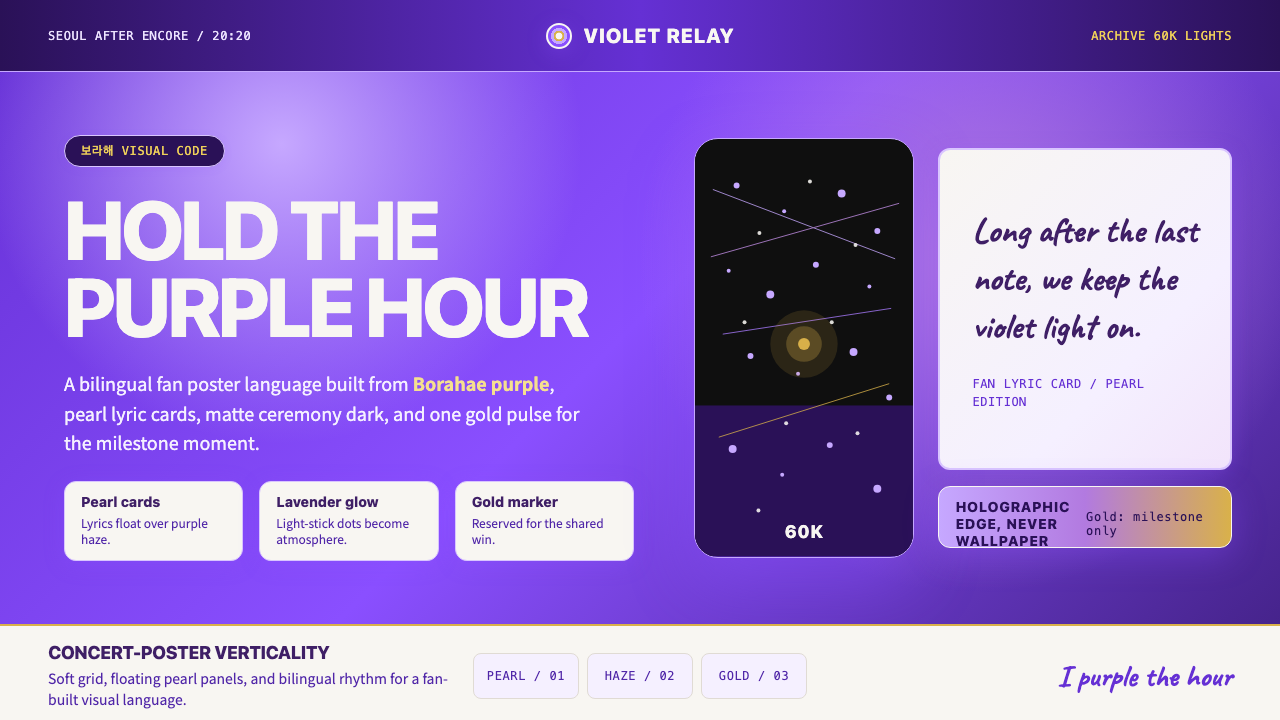 BTS Army Purple 2020Fandom becomes atmosphere. Borahae purple, pearl cards, lavender glow, one go…
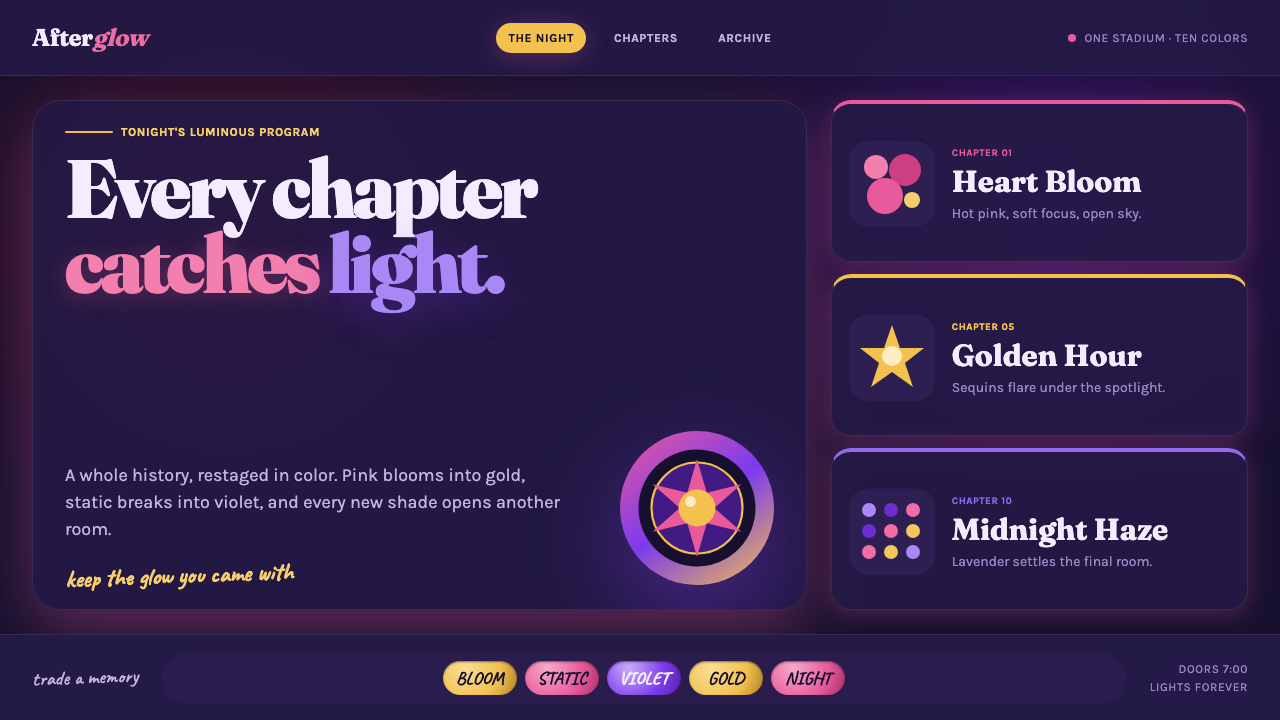 Taylor Swift Eras (2023)Every chapter catches light. Hot pink, lavender, gold and beadwork glow on mi…
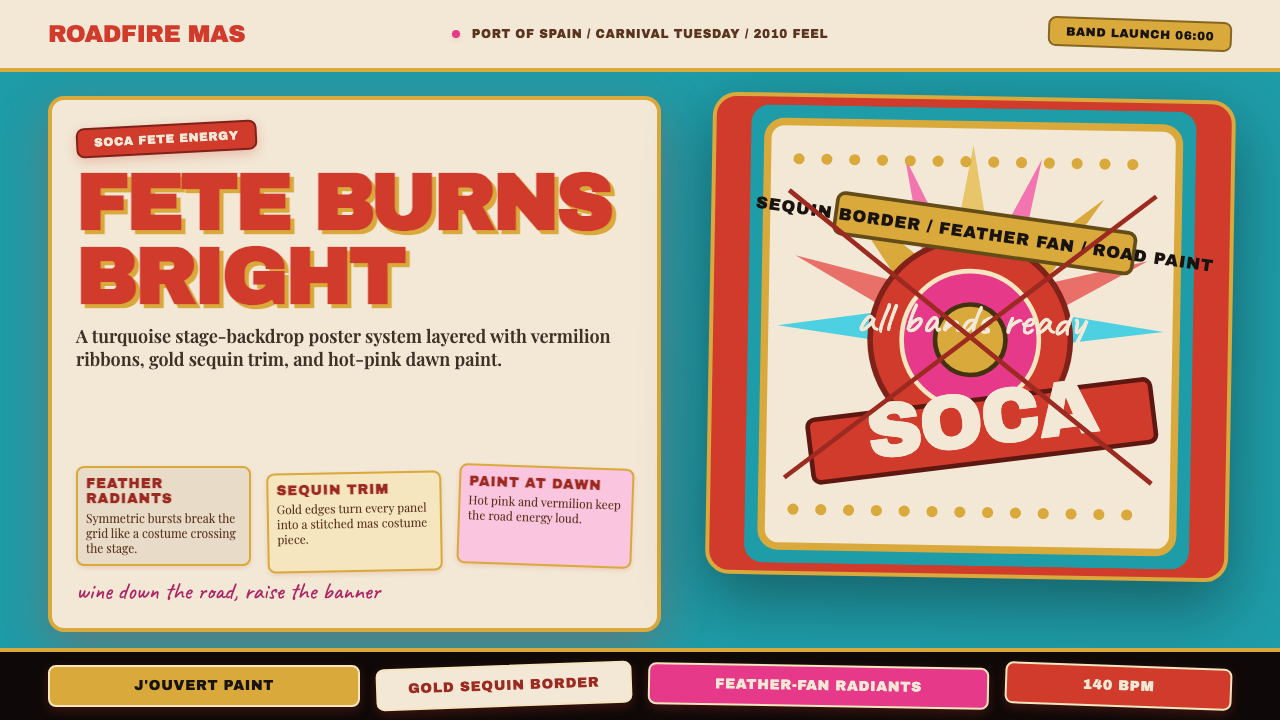 Trinidad Carnival Soca (2010)Joy overload. Turquoise field, vermilion banners, gold sequins, feather-fan g…
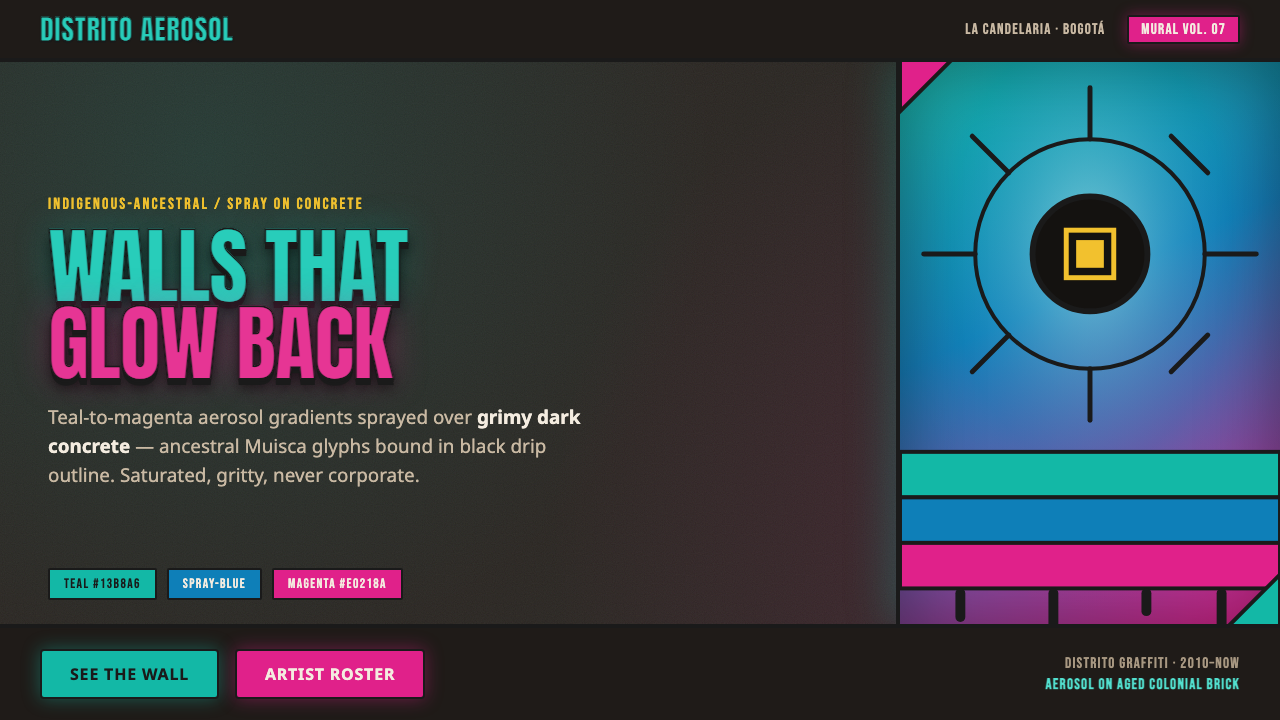 Bogotá Street MuralismNeon spray glowing off the wall. Teal-to-magenta aerosol on grimy concrete, i…
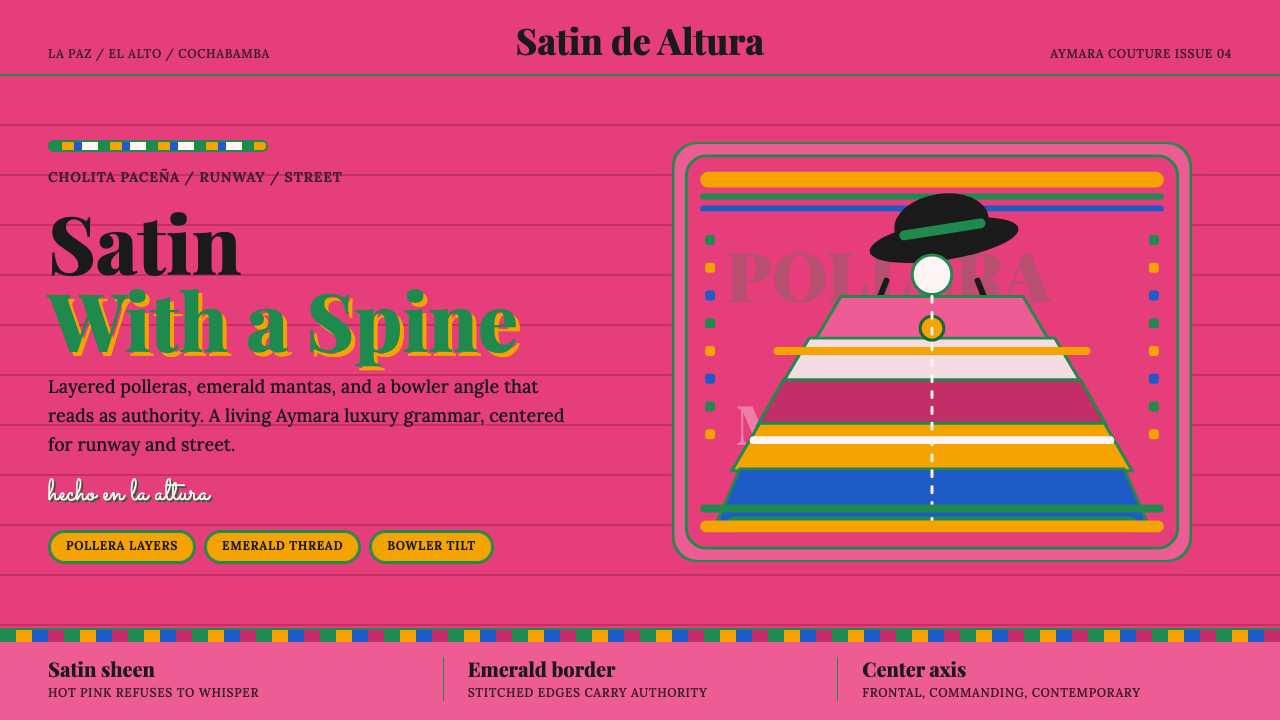 Bolivian Cholita FashionUnapologetic satin power. Hot pink fields, emerald stitches, centered pollera…
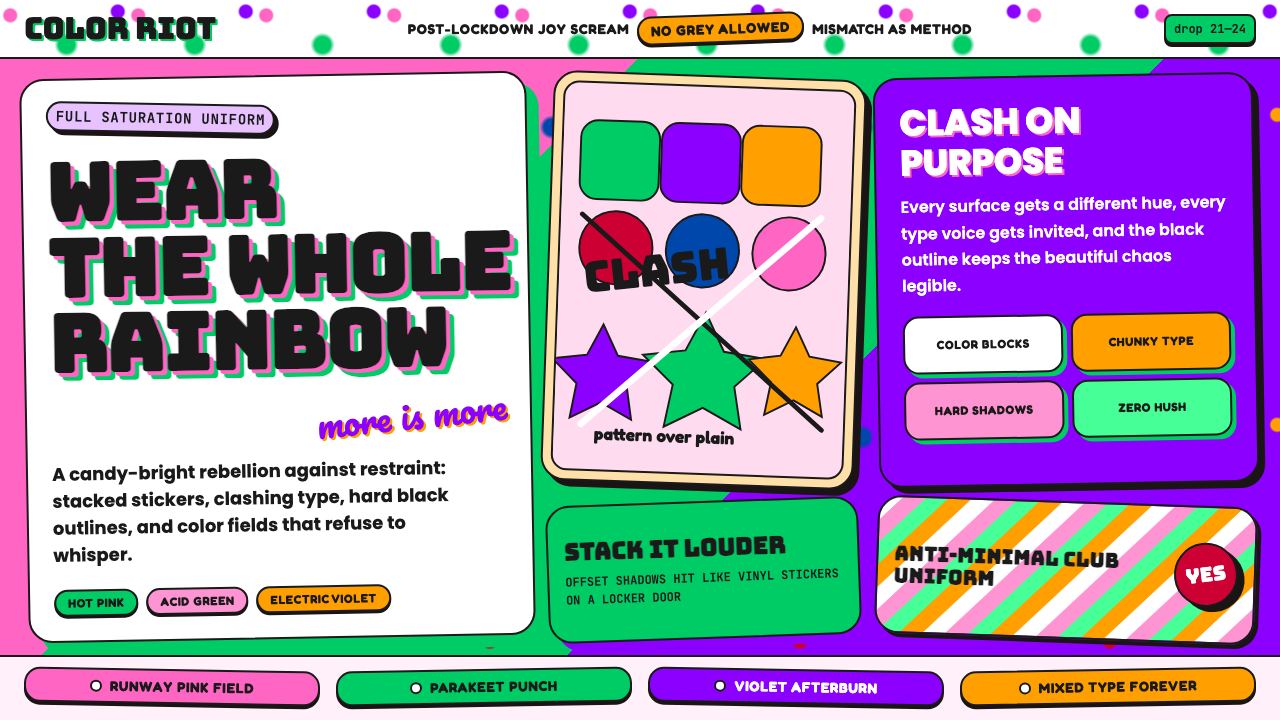 Dopamine Dressing / MaximalismJoy refuses restraint. Hot pink, parakeet green, Bungee type, and brick shado…