What is Natural Wine Low-Fi?
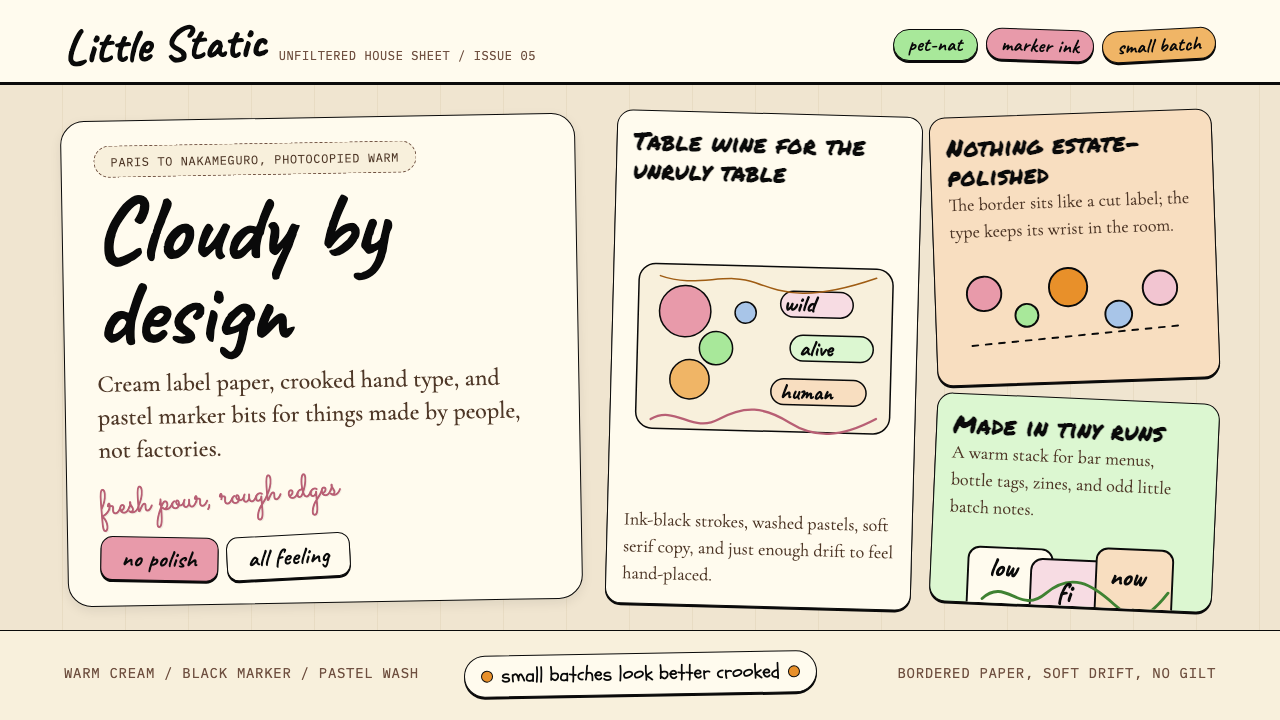
Natural Wine Low-Fi turned the scrappy warmth of a vigneron's marker into a full visual dialect — cream paper, hand-script, and pastel scribbles that feel poured rather than designed.
Natural Wine Low-Fi in brief
Natural Wine Low-Fi is the visual language that emerged alongside the post-2015 natural-wine bar explosion, spreading from Parisian cave à manger counters to Brooklyn bottle shops to Tokyo's orange-wine izakayas. Its hallmarks are warm cream grounds, deliberately imperfect hand-drawn linework, loose hand-script typefaces with generous letter-spacing, and small clusters of pastel-toned organic shapes scattered like stickers across a surface. Every composition feels touched rather than produced — a deliberate rejection of the polished corporate label in favor of something that looks like it was drawn on a napkin at the bar itself.
The aesthetic occupies a specific cultural position: it signals authenticity, small-batch production, and rejection of the mainstream wine industry's heritage codes — gilt foil, Bodoni roman, formal crests, and the implied authority of a grand château. Where those conventions communicate prestige through distance, Natural Wine Low-Fi communicates trust through proximity. The doodle, the wobbly outline, the slightly-off registration of color — each of these is a deliberate gesture of approachability, the visual equivalent of a vigneron pouring you a glass across a zinc bar and saying the wine is alive.
Unlike minimalist design languages that also reject ornamentation, Natural Wine Low-Fi is not sparse. It is deliberately warm and tactile: textures suggest worn paper, line weights vary as if drawn freehand, color sits unevenly as if applied with a brush or crayon. The style shares DNA with independent zine culture, 1990s lo-fi music packaging, and mid-century French bistro illustration, but its contemporary form is distinctly its own — a visual shorthand instantly legible to anyone who has ever queued for a Pet-Nat at a neighborhood natural wine shop.

Where does Natural Wine Low-Fi come from?
The cultural roots of Natural Wine Low-Fi lie in the natural wine movement itself, whose modern intellectual foundations were laid by Jules Chauvet — a Beaujolais négociant and chemist who began arguing in the 1950s and 1960s that wine made without sulfur additions and with minimal cellar intervention was not only possible but superior. Marcel Lapierre, Chauvet's student and neighbor in Villié-Morgon, put these ideas into practice at scale through the 1980s and became one of the movement's canonical producers. By the early 2000s, a loose international network of growers in Burgundy, the Loire Valley, Jura, and Georgia had coalesced around similar principles, and the term 'natural wine' had become shorthand for a broad counterculture stance against industrial viticulture.
The visual identity that now defines the style did not crystallize until after 2015, when natural wine bars proliferated rapidly in Paris, New York, London, Berlin, Copenhagen, and Tokyo. These venues — typically small, typically run by wine obsessives rather than hospitality professionals — created a new context for wine branding: not the shelf of a supermarket or the cellar list of a fine-dining restaurant, but a chalkboard, a paper menu, an Instagram post, a hand-labeled bottle sold to a regular. The economics of small-batch natural wine production meant that labels were often designed by the winemakers themselves or by friends with some graphic sensibility, using whatever tools were at hand. The lo-fi quality was not an aesthetic choice first — it was a production reality that became a celebrated quality.
Isabelle Legeron MW, who founded RAW WINE in 2012 and became arguably the most visible international advocate for natural wine, helped formalize the movement's public identity at a moment when its visual codes were still fluid. The fairs and publications she championed created a concentrated visual culture — the same hand-drawn animals, loose scripts, and warm cream tones appearing across hundreds of small producers from dozens of countries. This cross-pollination, amplified by Instagram from roughly 2016 onward, accelerated the consolidation of the aesthetic into a recognizable genre.
By 2020, Natural Wine Low-Fi had been fully canonized as a style — not just for wine labels but as a broader visual language applied to natural food shops, third-wave coffee bars, independent bookshops, and any brand that wanted to signal the same values of authenticity, craft, and gentle irreverence toward polish. The style's adoption beyond wine is the clearest marker of its cultural success: it had escaped its origin context and become a broadly legible code for a certain kind of contemporary earnestness.
What defines the Natural Wine Low-Fi look?
Color Palette
The foundational ground is warm cream — not white, never stark — evoking uncoated label paper, aged newsprint, or the inside of a cardboard wine box. On top of this ground, colors are drawn from a muted pastel register: dusty terracotta, sage green, soft coral, pale mustard, and washed lavender. These are never saturated or neon; they look as though they have been sitting in sunlight for a season. Occasional pops of deeper, earthier tone — wine red, bottle green, inky plum — anchor the palette without tipping into formality.
Hand-Script Typography
Typefaces feel written rather than set. Hand-script styles with irregular baseline, variable stroke width, and visible pen pressure are canonical — the letters seem to breathe and lean. Letter-spacing is generous to the point of looseness, giving each word room to exist on the page without crowding. When a second typeface appears, it is often a roughened or slightly distressed version of a simple roman or grotesque, rather than a formal second family. Hierarchy is established through size and weight variation rather than through a strict typographic system.
Doodle and Hand-Drawn Motifs
Illustration is central rather than decorative, and it is deliberately imperfect. Grapes, bottles, vines, small animals — rabbits, roosters, donkeys, snails — and abstract botanical shapes appear as quick sketches rather than finished drawings. Lines wobble, proportions are naive, hatching is inconsistent. The effect is intimate and human, recalling the kind of drawing you might find on a winemaker's personal correspondence or a handwritten chalk menu. Illustration is never photorealistic, never vector-clean; it looks like it was drawn in a single sitting with a felt-tip pen.
Tactile Texture and Surface
Even in digital applications, the style simulates physical surface. Backgrounds carry a subtle paper grain or linen texture rather than rendering as flat digital white. Color blocks have slightly uneven edges, as though applied with a broad brush stroke. This textural quality — roughness, grain, the suggestion of physical material — is essential to the warmth of the aesthetic. It signals handmade process and resists the pristine finish associated with corporate production, even when the actual medium is a screen or a printed offset sheet.
Loose Geometric Accents
Scattered across compositions are small, irregular geometric shapes — ovals, rounded rectangles, rough circles — used as sticker-like color fields or label backgrounds. These shapes are not precisely drawn; they have the quality of a quick brush mark or a torn piece of colored paper collaged onto the surface. They function as compositional anchors and color carriers without imposing the rigidity of a formal grid. Their informal placement — slightly tilted, slightly overlapping text — reinforces the lo-fi, handmade register.
Restrained Imperfection
The lo-fi quality is controlled, not chaotic. Natural Wine Low-Fi is not grunge, not deliberately ugly, and not maximalist. Its imperfections are curated: a slightly uneven baseline here, a wobbly line there, a color block with a rough edge — but the overall composition reads clearly and the hierarchy holds. The style occupies a precise middle ground between artisanal authenticity and graphic legibility. Too polished and it loses warmth; too rough and it loses readability. The discipline is knowing exactly how much imperfection signals sincerity without tipping into affectation.
Anti-Corporate Composition
Layouts resist the centered, symmetrical formality of conventional luxury wine design. Compositions are casual and slightly off-balance — a label that bleeds to one edge, a title that sits unexpectedly low, white space used generously but not architecturally. There is no sense of a rigid grid enforcing order. Instead, elements relate to each other with the looseness of a sketchbook page or a handwritten card. This informality is not accidental; it encodes the cultural values of the natural wine world — independence, human scale, skepticism of institutional authority — directly into the visual structure.

Who shaped Natural Wine Low-Fi?
A Beaujolais négociant, chemist, and jazz pianist, Chauvet began articulating the case for sulfur-free, unmanipulated wine in the 1950s. Working from his laboratory in La Chapelle-de-Guinchay, he combined rigorous enological science with a romantic commitment to expressing terroir without technological mediation. His ideas circulated informally for decades before the broader natural wine movement gave them mainstream traction. Chauvet never sought celebrity, but the visual culture that now defines natural wine — humble, handmade, anti-monumental — could be read as a portrait of his working method.
Lapierre was Chauvet's most celebrated student and the figure most responsible for translating natural wine philosophy into a viable commercial reality. His domaine in Villié-Morgon produced Morgon bottlings that became reference points for the movement globally. The labels of his wines — unpretentious, quietly idiosyncratic — became templates of a kind: proof that a wine bottle could communicate authenticity without borrowing the visual grammar of prestige. His cellar and his table became meeting points for winemakers across France and beyond, and the informal, communal culture he fostered is inseparable from the aesthetic that developed around it.
Legeron founded RAW WINE in 2012, creating the first dedicated international fair for natural, organic, and biodynamic wines. Beyond organizing events, she authored the book Natural Wine (2014), which gave the movement a coherent public narrative at a critical moment of growth. Her work created a concentrated visual and cultural milieu — hundreds of small producers from dozens of countries assembled in one context — that accelerated the consolidation of Natural Wine Low-Fi into a recognizable, cross-national aesthetic. She represents the movement's editorial and institutional layer, the force that helped scattered visual impulses cohere into a style.
The American wine writer and journalist Alice Feiring has been one of the movement's most persistent English-language advocates since her 2008 book The Battle for Wine and Love. Her writing — personal, polemical, and grounded in the sensory specificity of individual bottles and people — helped shape the natural wine world's self-image as anti-establishment and deeply human. Her voice contributed to the cultural register that the Low-Fi aesthetic expresses visually: the preference for the particular over the generic, the handmade over the manufactured, the story of a person over the authority of an institution.
Brochet is the founder of Château Feely and Ampelidae, and an early practitioner of biodynamic viticulture in the Loire Valley whose label designs became quiet touchstones of the lo-fi aesthetic. His bottlings — featuring hand-drawn lettering and simple illustrations of birds and botanical elements on uncoated paper — were among the first to demonstrate that the natural wine label could be a complete visual statement without the apparatus of conventional prestige. His work influenced a generation of winemakers who came after him in deciding that their labels should look like letters written to a friend rather than entries in a wine competition.
How do you use Natural Wine Low-Fi today?
Natural Wine Low-Fi translates most naturally into contexts where warmth, craft, and a gentle anti-establishment attitude are core brand values. The fundamental application principle is the same as it is for the wine labels that originated the style: every design decision should feel like it could have been made by a person, not a committee. Loose hand-script headings, cream paper textures, slightly-tilted label shapes, and small doodle motifs are the vocabulary — but they must be deployed with restraint, not crammed together at maximum density.
For presentation slides, the style works best when the deck has a low-formality context: a pitch for an artisan food brand, a portfolio presentation for an independent creative practice, a workshop for a community organization. Cover slides benefit from a generous cream ground with a single large hand-drawn illustration — a botanical motif, an animal sketch — offset asymmetrically against a hand-script title. Content slides should stay open: one or two text blocks set in a loose hand-script or roughened grotesque, with pastel color shapes used sparingly as section markers or pull-quote backgrounds. Data slides are the trickiest; charts should be treated as hand-drawn objects with imperfect lines and muted fill colors from the pastel palette, with annotations in a casual script rather than a formal label style.
For web interfaces, the style is well-suited to e-commerce storefronts for artisan food and drink brands, restaurant and wine bar websites, wellness and organic lifestyle landing pages, and any digital product that wants to communicate warmth and human scale against the polished sterility of conventional consumer tech. The approach: use a cream or warm off-white background throughout, avoid drop shadows with soft blur in favor of hard-edge or no-shadow treatments, set body text in a simple readable typeface and reserve hand-script for headings and accent labels only. Navigation should be typographic and casual. Buttons and calls to action work as rough-edged color shapes rather than polished pill forms. Photography, if used, should feel candid and grain-textured rather than studio-lit.
For editorial and marketing work — magazine spreads, brand identity systems, social cards, packaging copy — the style carries best when it leans into the specific visual vocabulary of the source culture: the wine bar chalkboard, the market stall hand-label, the small-batch bottle with a hand-numbered tag. A brand identity system built on Natural Wine Low-Fi works best when it has one dominant warm neutral ground, one or two signature pastel accent colors used consistently, a single hand-script or quasi-hand typeface for display use, and a simple motif — an animal, a fruit, a botanical — that recurs across touchpoints. Social cards and promotional graphics benefit from a single centered or slightly-off-center illustration with a loose hand-lettered phrase, on a cream or pale pastel ground, with minimal other elements.
The most common mistake when applying this style is mistaking imperfection for anything-goes looseness. Natural Wine Low-Fi has a precise emotional register — warm, earnest, quietly confident — and designs that overshoot into chaos or undershoot into conventional clean minimalism both miss it. A second common mistake is over-texturing: layering grain on grain, adding multiple distressed elements, burying the composition under too much lo-fi signal. The texture and imperfection should be light — enough to read as handmade, not so much that it reads as degraded. A third mistake is applying the palette incorrectly: the muted pastels should sit against warm cream, not against pure white or gray, because the warmth of the ground is what makes the pastels feel organic rather than washed-out.

Natural Wine Low-Fi — FAQ
Is Natural Wine Low-Fi the same as general lo-fi or indie design?
They share influences — zine culture, DIY music packaging, craft print aesthetics — but Natural Wine Low-Fi is a distinct genre with a specific palette, a specific illustration vocabulary (grapes, animals, botanicals), and a specific cultural context. General lo-fi design covers a much broader range from pixel art to cassette-tape nostalgia to hand-stamped stationery. Natural Wine Low-Fi is warm and pastoral rather than nostalgic for technology; it evokes countryside and cellar rather than bedroom studios or record shops. The cream ground, the muted pastel accents, the particular looseness of its composition, and the consistent reference to vineyards and drink culture give it a specificity that distinguishes it from lo-fi as a broad category.
Can this style work for brands outside food and drink?
Yes, and it increasingly does. By 2020 the style had migrated to independent bookshops, slow-fashion brands, wellness and skincare companies, organic household goods, and third-wave coffee bars — anywhere that the same cluster of values applies: authenticity, small-batch quality, craft process, and skepticism of corporate polish. The key test is not product category but value alignment. If a brand's core proposition involves human craft, transparency about process, and a warm relationship with the customer, Natural Wine Low-Fi can translate. It does not work well for brands whose core proposition is efficiency, authority, or technical precision — the warmth and imperfection of the style actively undermine those signals.
How do I avoid the style looking like a pastiche or a trend-chasing imitation?
The difference between authentic application and pastiche is almost always specificity. Pastiche grabs the surface markers — cream, hand-script, a doodle — and combines them generically. Authentic work chooses each element because of what it communicates in this particular context, for this particular brand, about this particular set of values. That means the illustration motif should be specific to the brand's world rather than drawn from a stock vocabulary of wine clichés. It means the color palette should have a rationale — perhaps drawn from the actual colors of the product or place — rather than being borrowed wholesale from what looks like the style. It also means restraint: the fewer lo-fi signals a design uses, the more each one reads as considered rather than decorative. One distinctive imperfection outweighs ten generic ones.
Does Natural Wine Low-Fi work in dark-mode or dark-background layouts?
Rarely, and with significant caveats. The style's warmth is fundamentally dependent on the cream ground — it is what makes the muted pastels read as organic and generous rather than cold and washed-out. A dark inversion strips out that warmth and leaves only the imperfection, which without the cream ground tends to read as grungy rather than artisanal. If a dark variant is required, the most workable approach is to shift the ground from cream to a very dark warm tone — deep brown, charcoal with warmth — and to restrict the palette to one or two lighter accent tones. The hand-drawn illustration style and loose typography can survive the inversion; the pastel color palette mostly cannot.
How many lo-fi signals should appear in a single composition?
As few as necessary. The most common overuse pattern is stacking every marker simultaneously: cream ground plus heavy grain texture plus hand-script headline plus wobbly illustration plus rough-edge color shape plus distressed border plus off-register second color. At that density, the signals cancel each other out and the composition reads as chaotic rather than warm. A considered Natural Wine Low-Fi composition typically uses two or three lo-fi signals at most — perhaps a hand-script headline, a single hand-drawn motif, and a cream paper texture — and lets the simplicity of those choices carry the register. The warmth of the style comes from the quality and specificity of each individual decision, not from the quantity of decisions stacked.
Related design styles
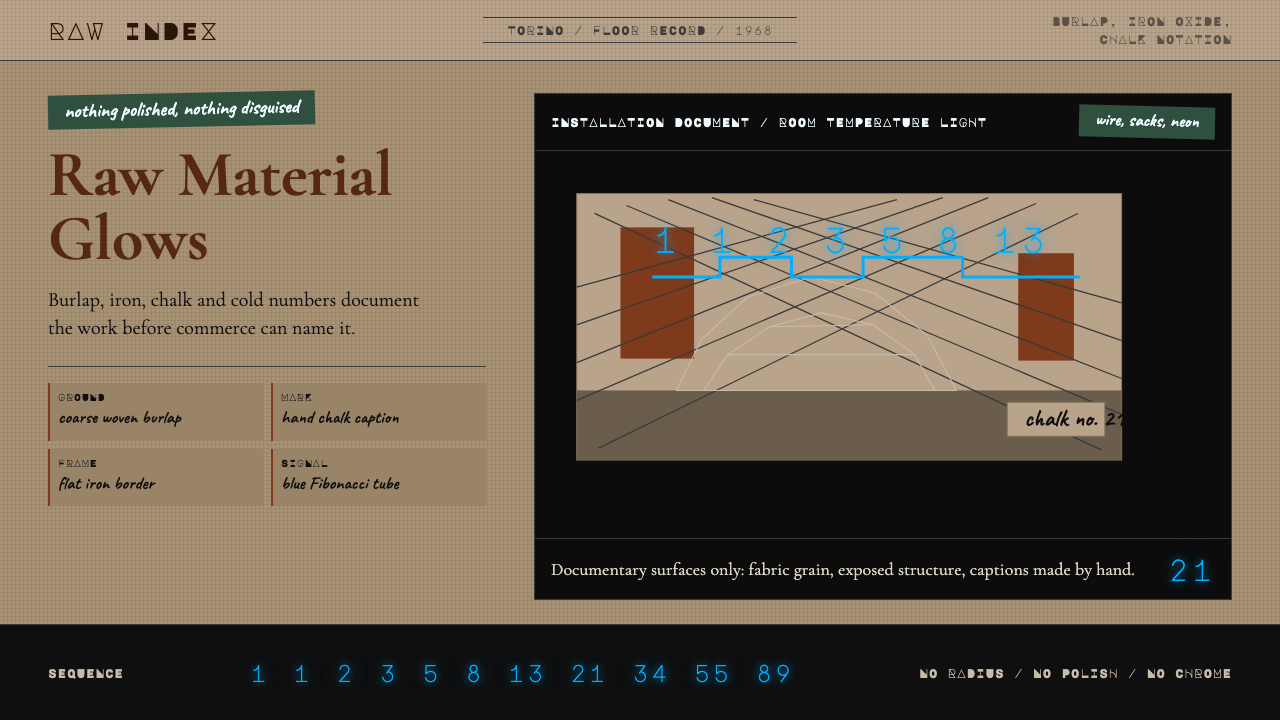 Arte Povera (Merz, 1968)Material refuses polish. Burlap ground, rust serif, chalk marks, neon Fibonac…
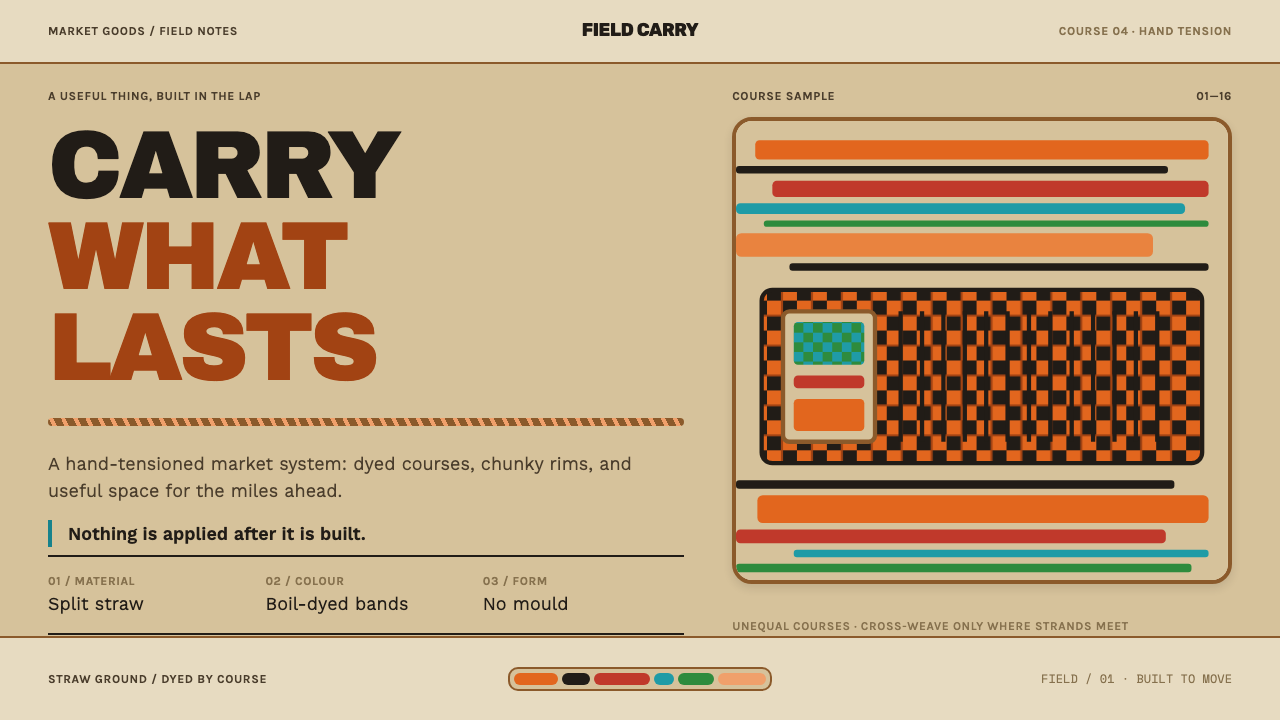 Bolga BasketStructure is the ornament. Unequal orange, red and turquoise bands cross on s…
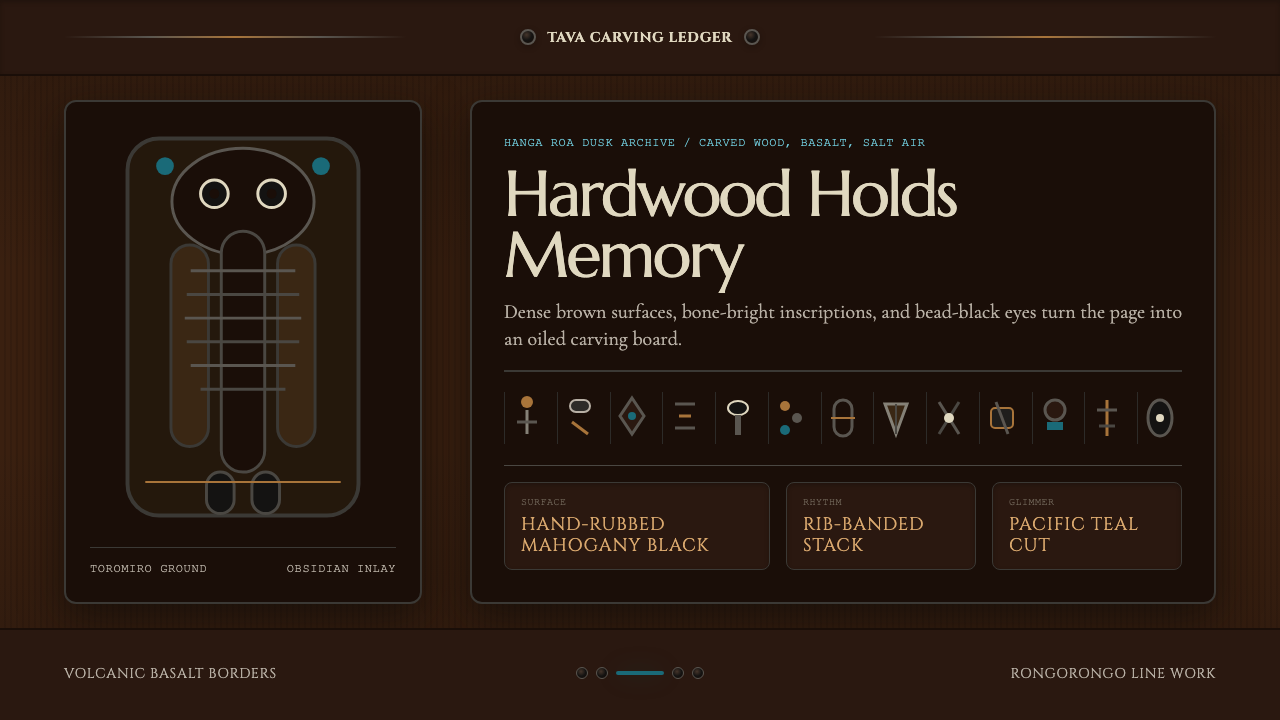 Chilean Rapa Nui Toromiro (Easter Island)Ancient weight, dusk-lit. Toromiro brown, Cinzel capitals, rib bands, obsidia…
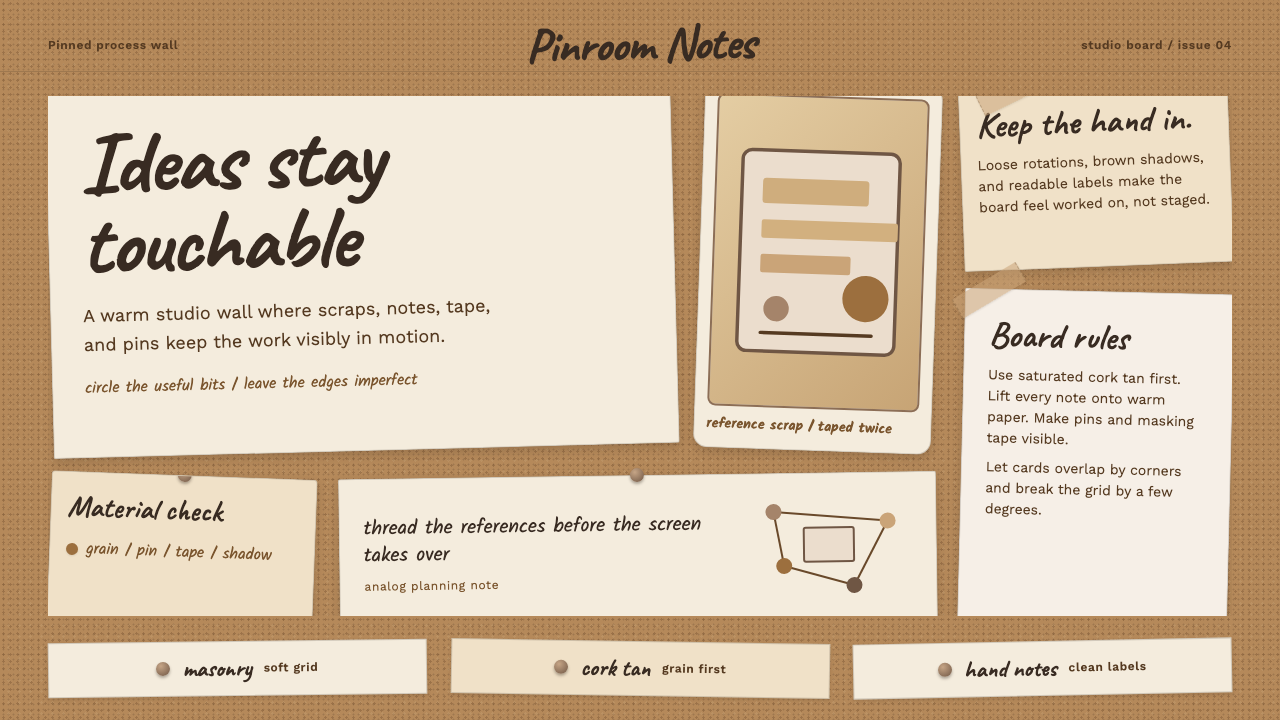 Cork Board StudioWarm ideas stay tactile. Cork tan, Caveat handwriting, pinned paper, and tape…
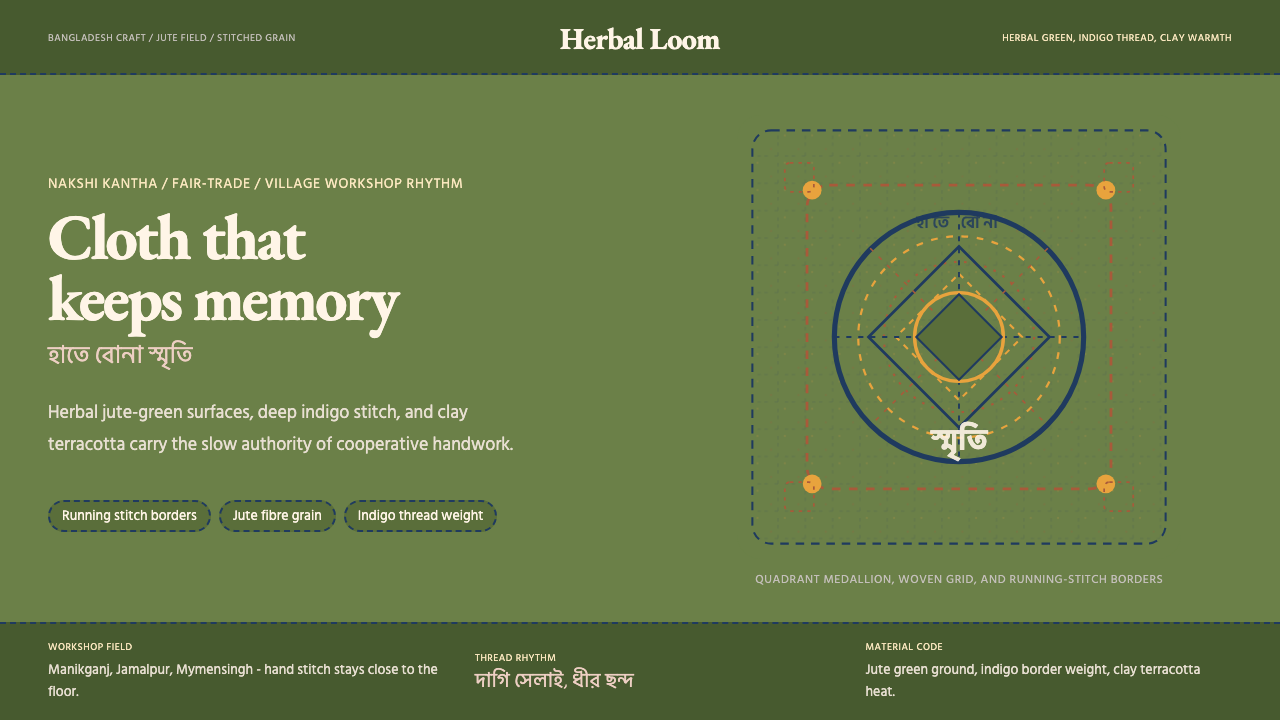 Bangladeshi Jute CraftMemory stays stitched. Jute green, indigo borders, terracotta warmth.
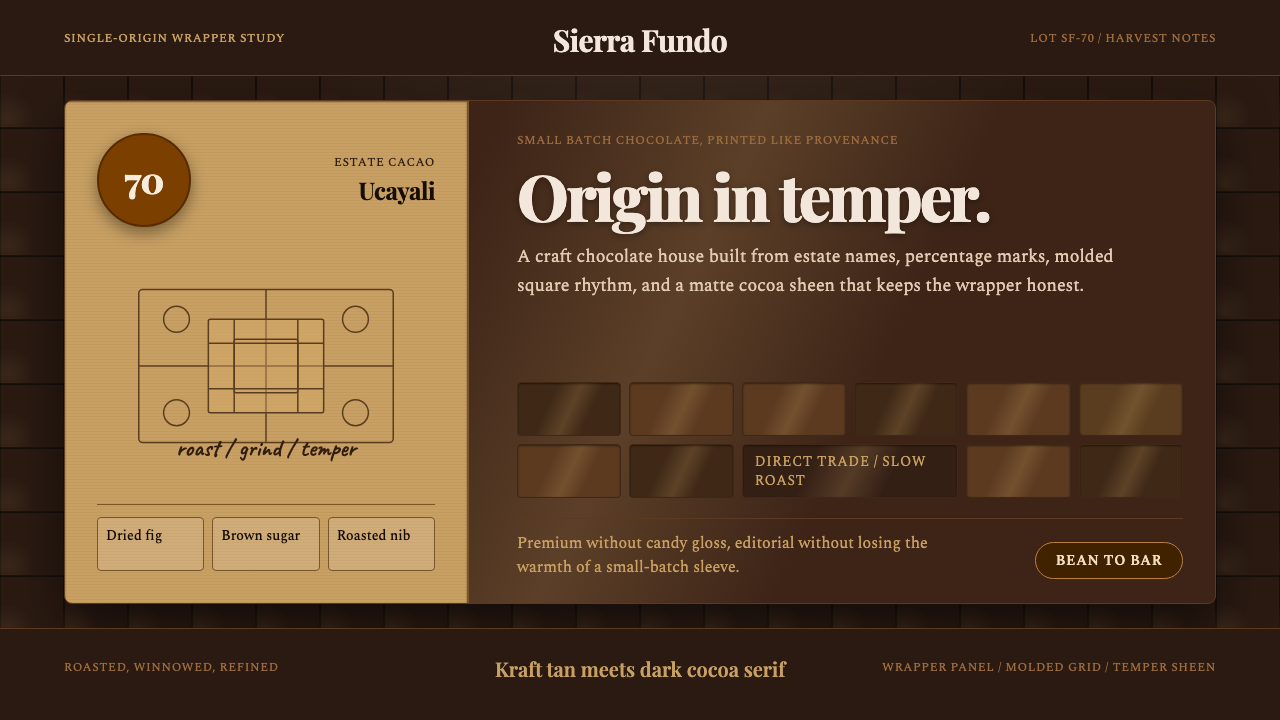 Bean-to-Bar ChocolateOrigin tastes tactile. Cocoa serif, kraft panel, and molded squares carry the…