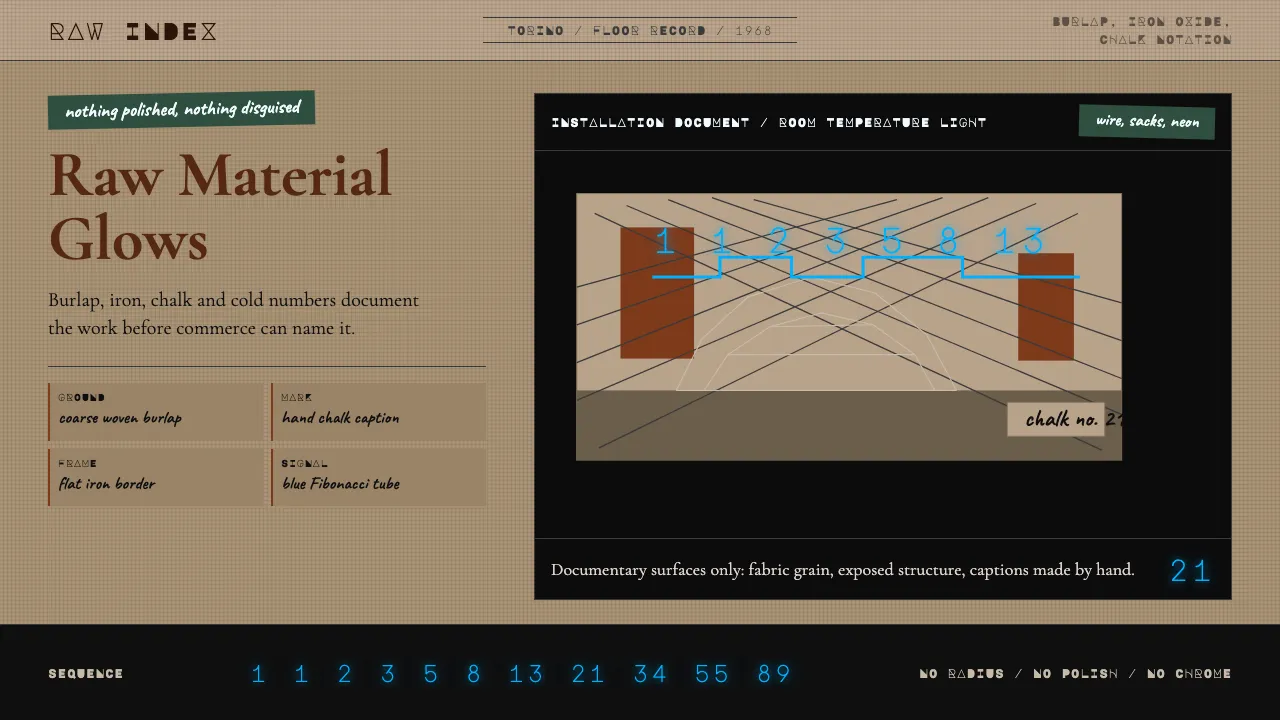
About Arte Povera (Merz, 1968)
Arte Povera — "poor art" — erupted from Turin in 1967 when critic Germano Celant gave a name to what a generation of Italian artists were already doing: building sculptures from dirt, felt, neon tubes, and live horses. Mario Merz's wire-mesh igloos glowed with Fibonacci sequences in cold neon; Kounellis filled a Roman gallery with twelve tethered horses; Pistoletto leaned polished mirrors against the wall and let the viewer become the work.
Translated into a design system, Arte Povera becomes burlap-textured surfaces, iron-oxide earth tones, chalk-handwritten captions, and the occasional cold-blue neon accent tracing Fibonacci numbers. Every element insists on its materiality — nothing is polished, nothing pretends to be anything other than what it is.
- Origin
- Turin / Rome / Milan / Genoa, Italy
- Era
- 1967–1972 peak (Celant manifesto Sept 1967; ongoing through 1980s)
- Key figures
- Germano Celant · Mario Merz · Jannis Kounellis · Michelangelo Pistoletto
- Movements
- Arte Povera · post-Minimalism · Italian neo-avant-garde
Arte Povera (Merz, 1968) design spec
Colors
Typography
The other 11 sections — buttons, cards, spacing, motion, techniques and more — open once you unlock. Download the DESIGN.md or send it to your AI in one click. Unlock once, yours forever.
Sign up nowStyles similar to Arte Povera (Merz, 1968)
Also inspired by art & artists, with a close feel.
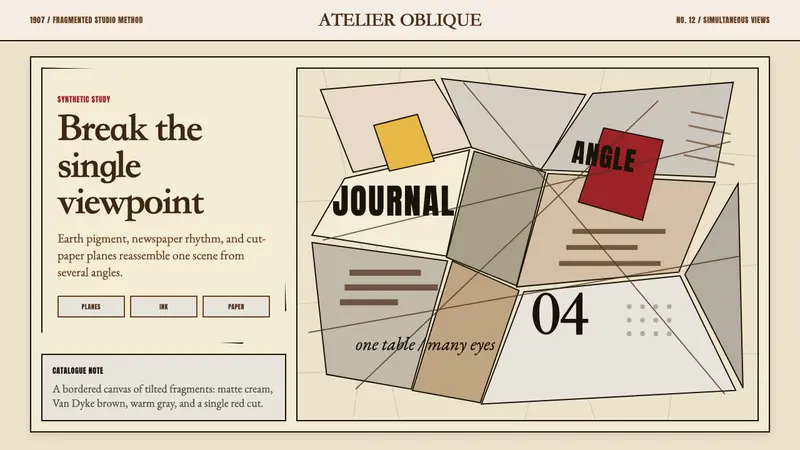 Picasso CubismSingle sight is shattered. Cream collage paper fractures brown-gray planes with one red cut.
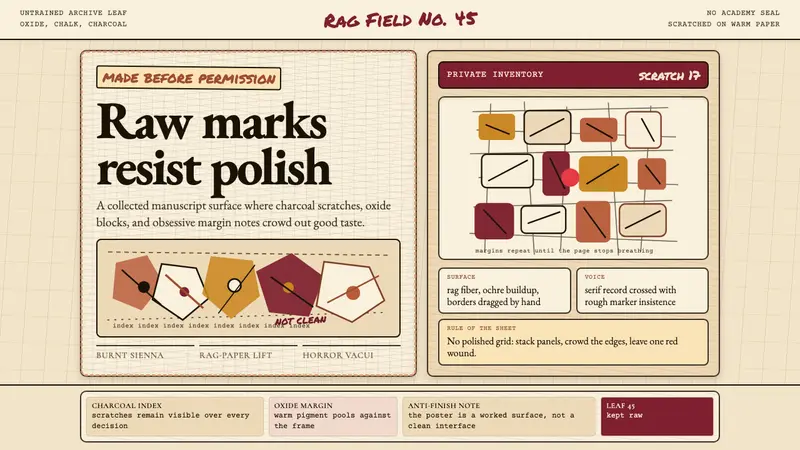 Art Brut (Dubuffet)Polish is refused. Bone-cream paper, earth pigments, scratched borders, dense margins.
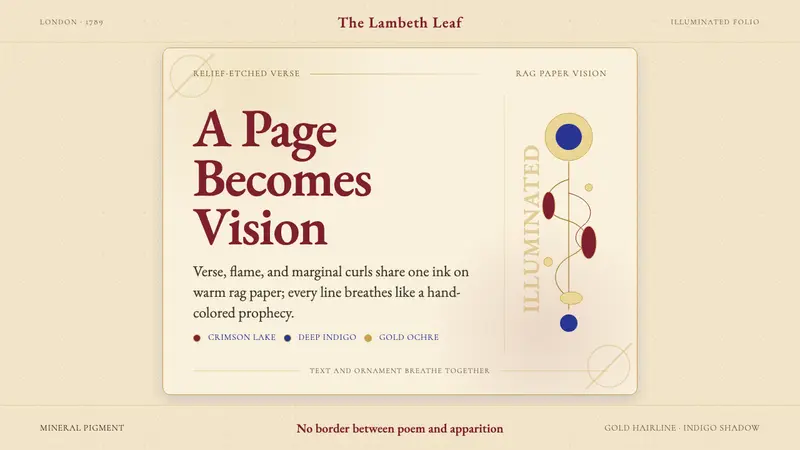 William Blake IlluminatedThe page becomes a vision. Crimson, indigo, and gold ornament breathe on rag paper.
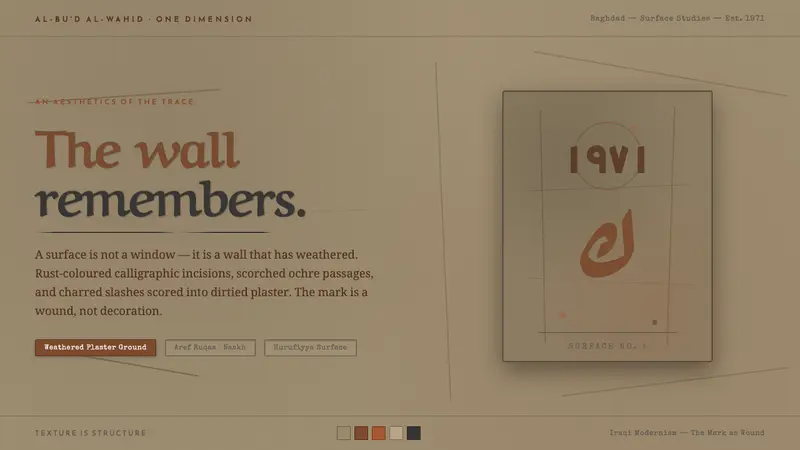 Shaker Hassan Al SaidThe mark is a wound, not decoration. Rust calligraphic scars incised into dirtied ochre-grey plaster.