What is Seurat — Grande Jatte Pointillism?
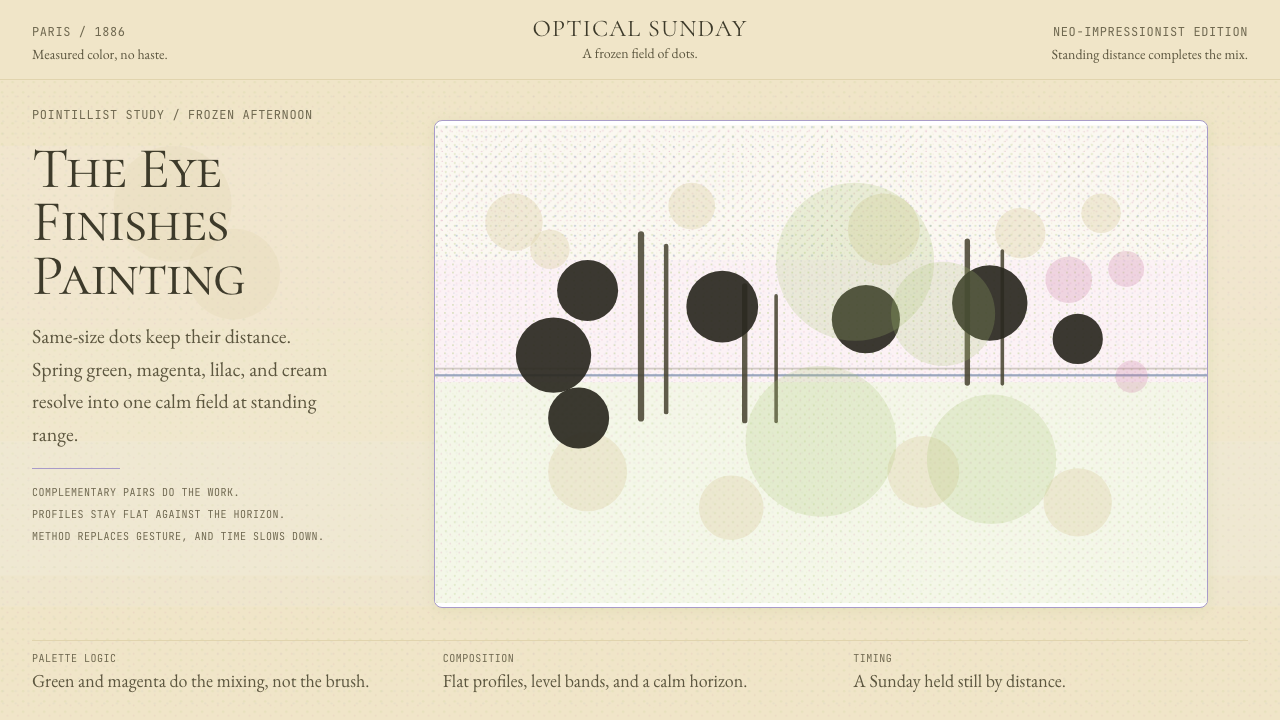
Seurat turned painting into physics — millions of same-size dots of pure color, placed so your retina does the mixing.
Seurat — Grande Jatte Pointillism in brief
Seurat — Grande Jatte Pointillism is a visual style derived from Georges Seurat's 1886 masterwork 'A Sunday on La Grande Jatte,' in which every stroke of pigment is replaced by a small, uniform dot of unmixed color. Neighboring dots of complementary hues — spring green beside magenta-pink, cobalt beside gold-cream — are placed close enough that the viewer's eye merges them into a third color at the correct viewing distance. This technique, which Seurat called Chromoluminarism and critics named Pointillism, transforms painting from a craft of blending into a science of optical mixing.
The resulting aesthetic is one of serene, almost crystalline suspension. Forms are rendered as crisp profile silhouettes against layered horizontal planes; the surface shimmers with a fine, even grain that gives every area — whether deep shadow or bright sky — a consistent tactile energy. Figures feel monumental yet weightless, frozen in the kind of Sunday stillness that belongs to neither work nor play. The palette is warm but never hot: cream and pale sage underpin everything, with accents of magenta, cerulean, and golden amber.
As a design language, Seurat Pointillism carries a distinctive set of visual principles: a dot-matrix or grain-field texture as a fundamental surface quality; a restricted, scientifically balanced palette where optical mixing does the heavy lifting; strong silhouette over interior modeling; and a measured, unhurried geometry borrowed from the horizontal banding of river, lawn, and sky. It is simultaneously rigorous and sensuous — the only nineteenth-century painting method that feels, in retrospect, like a computational rendering algorithm.

Where does Seurat — Grande Jatte Pointillism come from?
Georges Seurat was born in Paris in 1859 and trained at the École des Beaux-Arts under Henri Lehmann, a student of Ingres. By the early 1880s he had grown dissatisfied with the intuitive spontaneity of Impressionism, which he felt relied too heavily on the artist's momentary perception rather than on any systematic understanding of how color and light actually work. He immersed himself in the color science of his era: Eugène Chevreul's law of simultaneous contrast (1839), which showed that adjacent colors influence each other's perceived hue; Ogden Rood's 'Modern Chromatics' (1879), which described how spinning discs of colored pigment mix optically rather than chemically; and Charles Henry's psychophysical research linking color directions to emotional states. These texts gave Seurat the theoretical scaffolding for what he called a 'scientific' method of painting.
The Grande Jatte canvas — measuring roughly two by three meters — was prepared over two years. Seurat made dozens of preliminary oil sketches on the island of La Grande Jatte, a narrow strip of land in the Seine at Asnières on the northwestern outskirts of Paris, where Parisian bourgeoisie and working-class families spent Sunday afternoons. The final painting, exhibited at the eighth and last Impressionist exhibition in May 1886 and then at the Salon des Indépendants later that year, was met with derision from some critics but electrified the young Paul Signac and the poet-critic Félix Fénéon, who coined the term 'Neo-Impressionism' and became the movement's most eloquent champion.
Seurat refined his method into what he called Chromoluminarism or Divisionism: the systematic separation of color into its component hues and their application as discrete, uniform points. The dots are not purely mechanical — their size and density vary according to the area of the composition — but their uniformity across the entire surface is what gives the painting its distinctive woven, shimmering quality. Seurat also developed a systematic border technique, painting a frame of complementary-colored dots around the edge of the canvas to mediate between the painting's palette and the white of the wall, a detail that most reproductions lose entirely.
Seurat died in 1891 at thirty-one, leaving behind only seven monumental canvases and an enormous archive of drawings. His colleague Paul Signac carried Neo-Impressionism into the twentieth century, writing 'D'Eugène Delacroix au Néo-Impressionnisme' (1899), which codified the movement's principles for a new generation. Signac's influence extended to Henri-Edmond Cross, whose late work became looser and more decorative, and — crucially — to the young Henri Matisse and André Derain, whose encounters with the Neo-Impressionist palette in the summer of 1904 and 1905 at Collioure catalyzed the invention of Fauvism. Seurat's dot grammar thus sits at the root of nearly every twentieth-century color experiment in Western painting.
What defines the Seurat — Grande Jatte Pointillism look?
Dot-Field Texture
The surface of any Seurat-derived composition is defined by a uniform field of small, discrete marks — dots, dabs, or closely spaced stipples — that read as a continuous texture at a distance while revealing their component units up close. This grain is not a filter applied over color areas but the primary means by which color itself is built. The texture is even and consistent across the entire surface: shadow, highlight, sky, and skin all share the same granular weave, unifying the composition at the level of material.
Optical Color Mixing
Adjacent dots of different hues are chosen so that the viewer's visual system blends them into an intermediate tone — a phenomenon Seurat understood through Chevreul's simultaneous contrast law and Rood's additive mixing theory. In practice, this means greens are never made by mixing blue and yellow pigment; instead, blue dots and yellow dots are laid side by side. The resulting color is perceived as brighter and more luminous than any mixed pigment equivalent, because additive mixing of light is inherently brighter than subtractive pigment mixing.
Warm, Scientifically Balanced Palette
The Grande Jatte palette is anchored by a warm cream-and-sage ground, with complementary pairs deployed across the surface: orange-reds against blue-greens in the shadowed grass, magenta-pinks against cool cobalt in the figures' clothing, and golden amber against violet in the ambient light. Each hue is relatively low in saturation at the level of individual dots but rises in perceived vibrancy through optical mixing. The palette is restrained yet luminous — never garish, never muddy.
Silhouette and Profile Geometry
Figures in the Grande Jatte are rendered primarily as profile silhouettes — seen from the side, their outlines crisp and readable against the shimmering dot-field behind them. Interior modeling is minimal; what defines a figure is its outer contour, not its internal shading. This gives the composition an almost Egyptian or bas-relief quality: the people are iconic rather than naturalistic, archetypes of Sunday leisure rather than specific individuals. Applied as a design principle, this means shapes should be defined by clean outer edges rather than interior gradients or highlights.
Horizontal Banding and Layered Planes
The composition of the Grande Jatte is organized into three distinct horizontal bands — a near-ground strip of shadow, a middle-ground spread of sunlit lawn, and a luminous water-and-sky backdrop. This tripartite division creates a stable, measured spaciousness that feels neither crowded nor empty. The planes recede through atmospheric lightening rather than perspective foreshortening. As a design structure, this translates into layouts built from strong horizontal registers: a dark base, a light middle field, a pale upper register — each containing its own visual information at a different tonal key.
Measured Stillness
Unlike Impressionist works that capture motion or flickering atmosphere, the Grande Jatte is conspicuously still. Every figure is caught in a pose of suspension, and the overall composition has a quality of held breath — a Sunday afternoon where time appears to have stopped. In design terms, this translates to generous spacing, deliberate asymmetric balance, and a resistance to diagonal energy or visual urgency. Elements rest rather than move; the composition invites contemplation rather than scanning.
Shadow as Complementary Hue
In Seurat's system, shadows are never simply darkened versions of a surface color. Because he was applying Chevreul's contrast law consistently, the shadow areas of green grass are filled with cool violet and blue dots; the shadows under trees shift toward deep indigo and plum. This gives the painting's dark areas a richness and visual complexity that flat dark tones would destroy. As a design principle, it suggests that shadow and depth should be handled through hue shift rather than simple darkening — violet shadows against warm grounds, cool blue shadows against orange-leaning surfaces.

Who shaped Seurat — Grande Jatte Pointillism?
Seurat was the originator and theorist of Pointillism. Born in Paris in 1859, he fused the new color science of Chevreul, Rood, and Henry into a rigorously systematic painting method, producing a body of work that included seven large canvases and hundreds of oil sketches and drawings before his death in 1891 at thirty-one. Beyond the Grande Jatte, his major works include 'Bathers at Asnières' (1884), 'Le Chahut' (1890), and 'The Circus' (1891), each demonstrating a distinct application of his color and compositional principles. His brief career produced one of the most consequential technical innovations in the history of Western painting.
Signac met Seurat in 1884 at the founding of the Société des Artistes Indépendants, became his closest artistic ally, and outlived him by forty-four years — long enough to ensure that Neo-Impressionism achieved lasting influence. His theoretical tract 'From Eugène Delacroix to Neo-Impressionism' (1899) remains the movement's definitive written statement. After Seurat's death, Signac's own style evolved toward larger, looser mosaic-like strokes and increasingly saturated color, influencing the young Matisse and helping seed Fauvism and early twentieth-century color abstraction.
Fénéon was the critic who named and championed Neo-Impressionism. Writing in the avant-garde journal 'La Vogue' in 1886, he coined the term 'Neo-Impressionism' to describe Seurat's and Signac's work at that year's Salon des Indépendants, providing the movement with both its identity and its intellectual framework. His criticism was itself a form of art: compressed, precise, and syntactically inventive. As an editor at the Revue Blanche through the 1890s, he continued to link the visual arts to Symbolist poetry, anarchist politics, and the broader project of fin-de-siècle cultural renewal.
Cross adopted Divisionism in the early 1890s under Signac's influence and developed it in a direction distinct from Seurat's — warmer, more loosely structured, and increasingly decorative. His large canvases of the Mediterranean coast, painted from the mid-1890s onward, use Seurat's optical mixing principle but apply it with mosaic-like patches rather than tight uniform dots, producing a more overtly sensuous and patterned surface. It was Cross's work specifically that Matisse encountered and was transformed by during the summer of 1904 at Saint-Tropez, making Cross a crucial though often under-credited link between Pointillism and Fauvism.
Rood was an American physicist whose 1879 treatise 'Modern Chromatics' — translated into French in 1881 as 'Théorie Scientifique des Couleurs' — provided Seurat with the scientific foundation for optical mixing. Rood distinguished between additive mixing of colored light (which produces brighter, more luminous results) and subtractive mixing of pigments (which tends toward gray), and demonstrated the effect using rotating color discs. The irony is that Rood himself reportedly disliked what Seurat and Signac did with his research — but without his book, the Grande Jatte as we know it could not have been conceived.
How do you use Seurat — Grande Jatte Pointillism today?
Seurat Pointillism translates into contemporary design work as a system of tactile texture, scientifically calibrated color, and composed stillness. Applying it correctly requires understanding what the original technique was actually doing: building luminous color through optical mixing rather than direct pigment application, organizing composition through horizontal planes and silhouette rather than through diagonal energy or interior modeling, and treating the surface itself as a material presence rather than a neutral carrier.
For presentation slides, the style works especially well on covers and section dividers. A cover in this mode might use a warm cream ground with a large profile silhouette in warm terracotta or deep sage, the background broken into a fine dot-field that gives the flat color areas a gentle shimmer. Section content slides benefit from the horizontal-banding principle: a pale upper zone for the headline, a cream middle field for body text or diagrams, and an optional deeper lower band as an anchor. Data visualization in this style takes on a pointillist quality — scatter plots where individual data points are styled as dots of varying warm hues, or bar charts where bars are rendered with a subtle grain rather than as perfectly flat fills.
For web interfaces and dashboards, the Seurat vocabulary offers a distinctive alternative to both flat material design and soft-shadow neumorphism. The core move is replacing flat fills with a fine halftone or grain texture that adds depth without introducing explicit light-sourcing. Navigation and card components remain structurally clean; the texture lives at the surface level, not in the shadows or depth effects. Color choices follow the complementary-pair logic: a warm cream or pale sage base, with magenta-pink and cobalt used as accent and interactive-state colors, and deep violet-indigo reserved for shadow states. Pricing tables and comparison grids benefit from the horizontal-register approach: each tier presented as a distinct tonal band rather than a card floating on a neutral ground.
For editorial and marketing materials, the style's poster-like silhouette quality and warm palette suit long-form article headers, event posters, and brand campaigns where a sense of cultured leisure is the desired register. A feature article header might use a profile figure rendered in warm amber against a shimmering blue-green dot-ground, with the title set in a serif with generous spacing — the measured unhurriedness of the style carried into the typography. Marketing pages work well when they adopt the tripartite horizontal structure: a hero section that is almost purely visual, a body section organized in a light open grid, and a footer that anchors in a deeper warm tone. The dot-field texture used sparingly on section backgrounds prevents the layout from feeling sterile.
A common mistake when applying this style is reproducing the dot texture as a purely decorative filter — adding a halftone overlay to an otherwise conventional design and calling it Pointillism. Authentic application of the Seurat principle means using the texture as the primary structural means by which color is built, not as a garnish. A second frequent error is choosing colors that are already premixed rather than working through complementary adjacency: placing a flat sage-green panel beside a flat cream panel misses the point entirely — the interaction should happen at the level of individual marks. The style also requires patience with spacing; the measured stillness that makes the original compelling becomes restless and fragmented if the dot density or element spacing is too tight.

Seurat — Grande Jatte Pointillism — FAQ
Is Pointillism the same as Divisionism?
They overlap but are not identical. Divisionism is the broader theoretical principle — the systematic separation, or division, of color into its component hues and the reliance on the viewer's optical system to perform the mixing. Pointillism is a specific application of Divisionism in which the divided color marks are small, uniform dots. Seurat preferred the term Chromoluminarism to describe his own method; his colleague Paul Signac used Divisionism as the preferred theoretical label. The term Pointillism was coined by critics, initially with a dismissive intent, but it stuck and is now the most commonly used name for the style.
Can this style work on dark backgrounds?
The original Grande Jatte palette is built on a light, warm ground — cream, pale sage, and golden afternoon light. A dark inversion is possible but requires careful adaptation. On a dark ground, the optical mixing principle still operates, but the hue choices must shift: complementary pairs built around deep teal and warm amber, or deep indigo and rose-gold, can produce a luminous effect against a near-black or deep charcoal field. The dot-field texture often gains in drama on a dark ground. What does not translate well is the measured, Sunday-afternoon stillness of the original — dark grounds carry more nocturnal or cinematic energy, which may or may not serve the design's intent.
How is Seurat Pointillism different from other textured or grainy design styles?
Contemporary grainy or noisy textures — popular in logo design and brand identity since the mid-2010s — apply a texture over colors that are already chosen and fully mixed. The grain functions as a material quality, suggesting a worn, organic, or analogue surface. Seurat Pointillism is structurally different: the texture is not applied over the color but is the means by which color is constructed. This distinction changes how one must think about color selection: in a grainy brand aesthetic, you choose your green and then add grain; in a Seurat-derived application, you arrive at your green by choosing which blue-leaning and yellow-leaning marks to place adjacent to each other. The visual result may look superficially similar from a distance, but the logic and the craft are fundamentally different.
What kinds of projects suit this style well, and where does it struggle?
Seurat Pointillism works well in contexts where sensory richness, cultured leisure, and a sense of scientific artistry are valued: museum and gallery interfaces, cultural institutions, luxury travel and hospitality, premium editorial publications, and any brand that wants to position itself as thoughtful and analytically rigorous while remaining visually warm. It is less suited to urgent or transactional contexts — e-commerce checkout flows, emergency communications, productivity tools that need to minimize visual complexity, or any interface where the grain texture might impair readability at small sizes. The style's connotations are resolutely European, leisurely, and fin-de-siècle; it carries those associations whether the designer intends them or not.
Must the texture be literal dots, or can other mark shapes carry the Pointillist spirit?
Seurat himself used dots, dabs, and short strokes interchangeably across different canvases and different areas of the same canvas; the uniform round dot is the canonical form associated with the Grande Jatte but is not the only possible expression of the Divisionist principle. In design applications, the spirit of the style — optical color mixing through adjacent marks of different hue — can be carried by square pixels in a mosaic-grid layout, by short horizontal dashes arranged in tonal fields, or by a fine grain where the individual grains resolve into regions of mixed color. What is essential is that the texture is the color-building mechanism, not a decorative overlay, and that the palette it builds follows the warm, complementary-pair logic of the original.
Related design styles
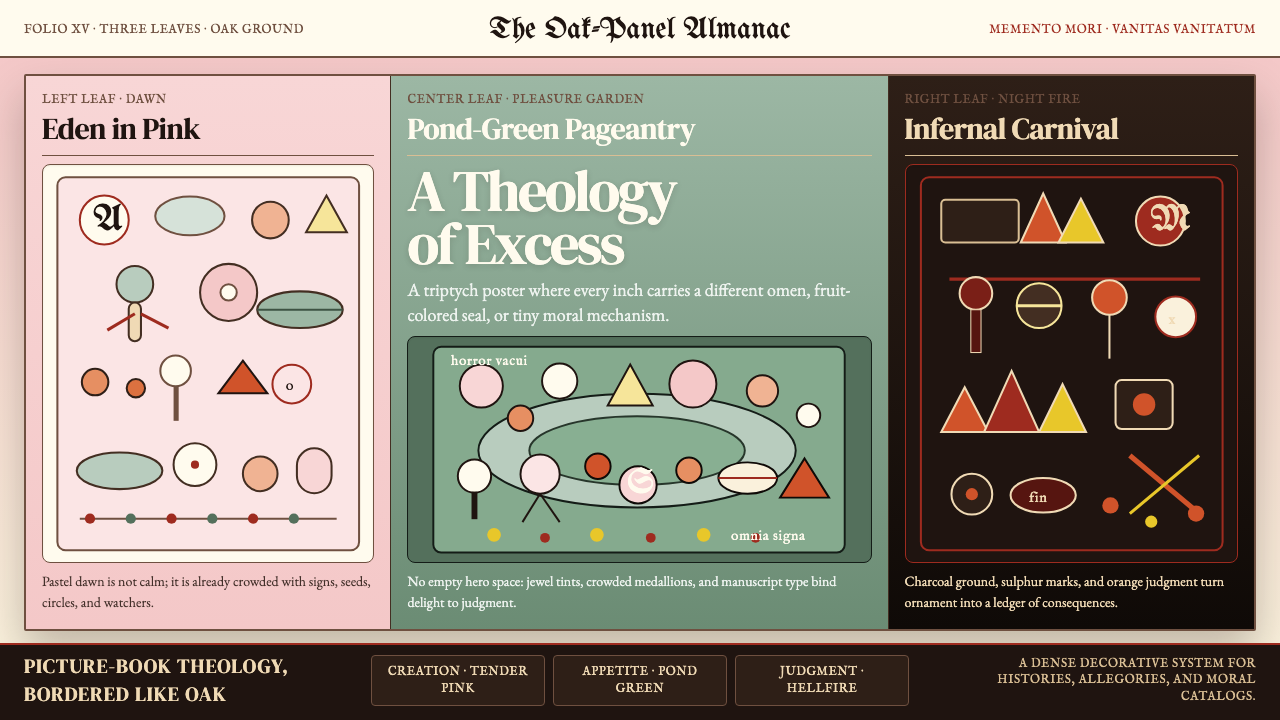 Bosch — Garden of Earthly DelightsHorror vacui becomes doctrine. Pink, green, and hellfire panels swarm with se…
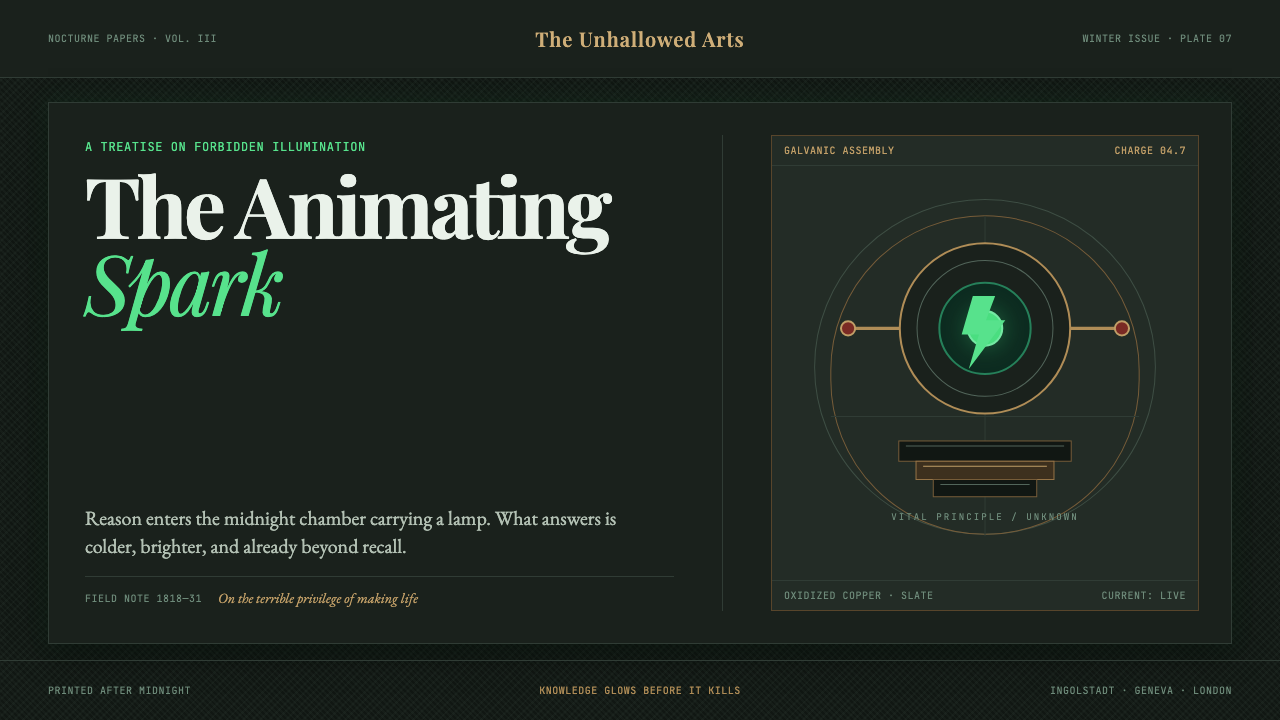 Frankenstein (1818)Knowledge glows before it kills. Acid green cuts through storm-slate and engr…
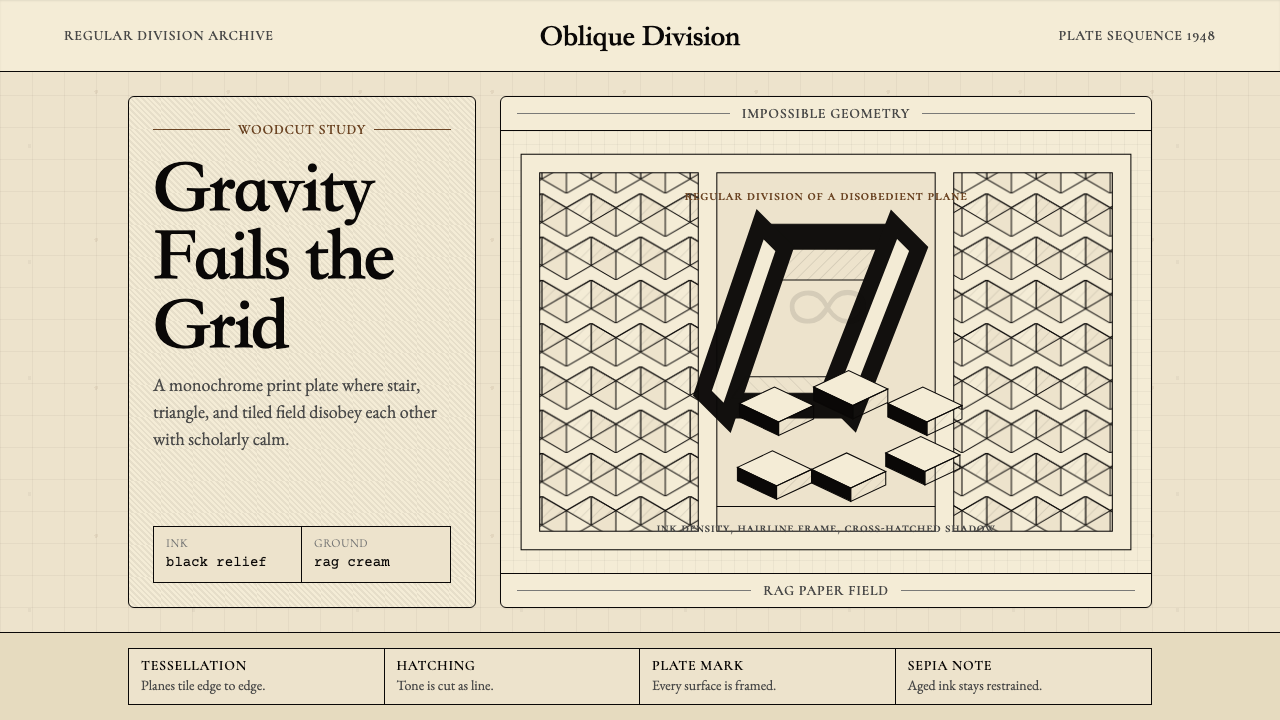 M.C. Escher ImpossibleImpossible calm. Ink-black tessellations and hatching fold cream paper into p…
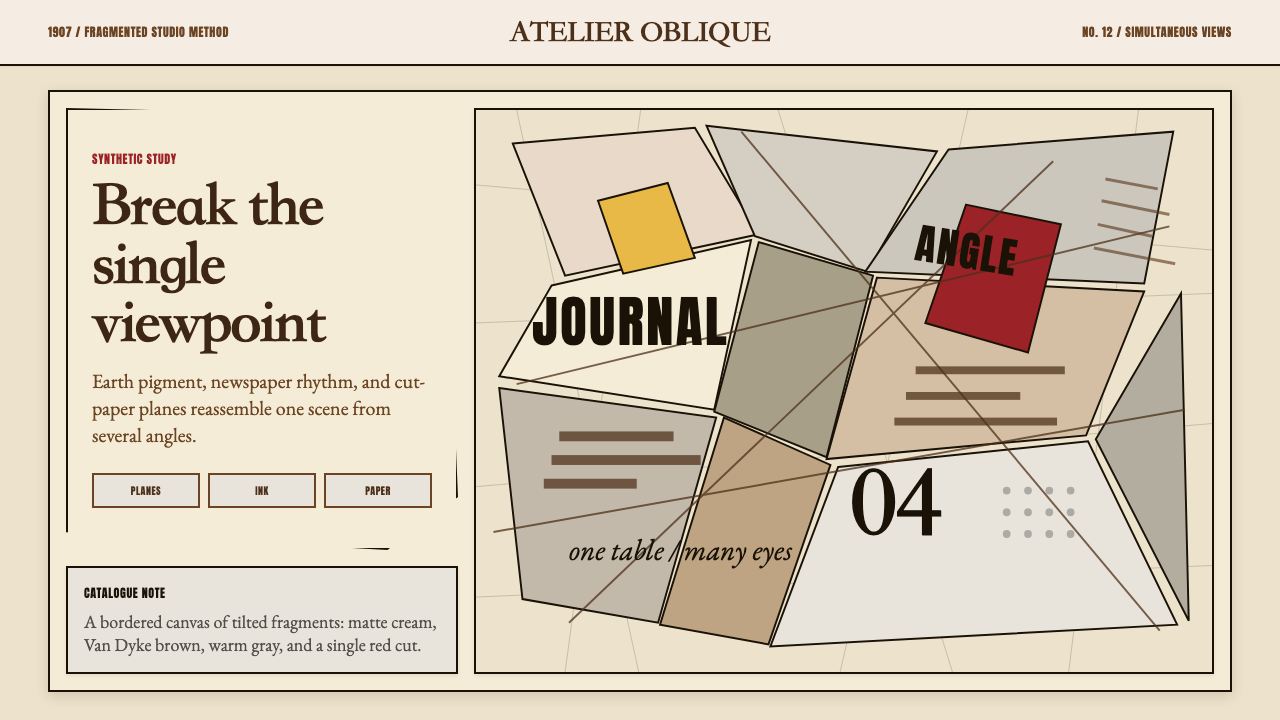 Picasso CubismSingle sight is shattered. Cream collage paper fractures brown-gray planes wi…
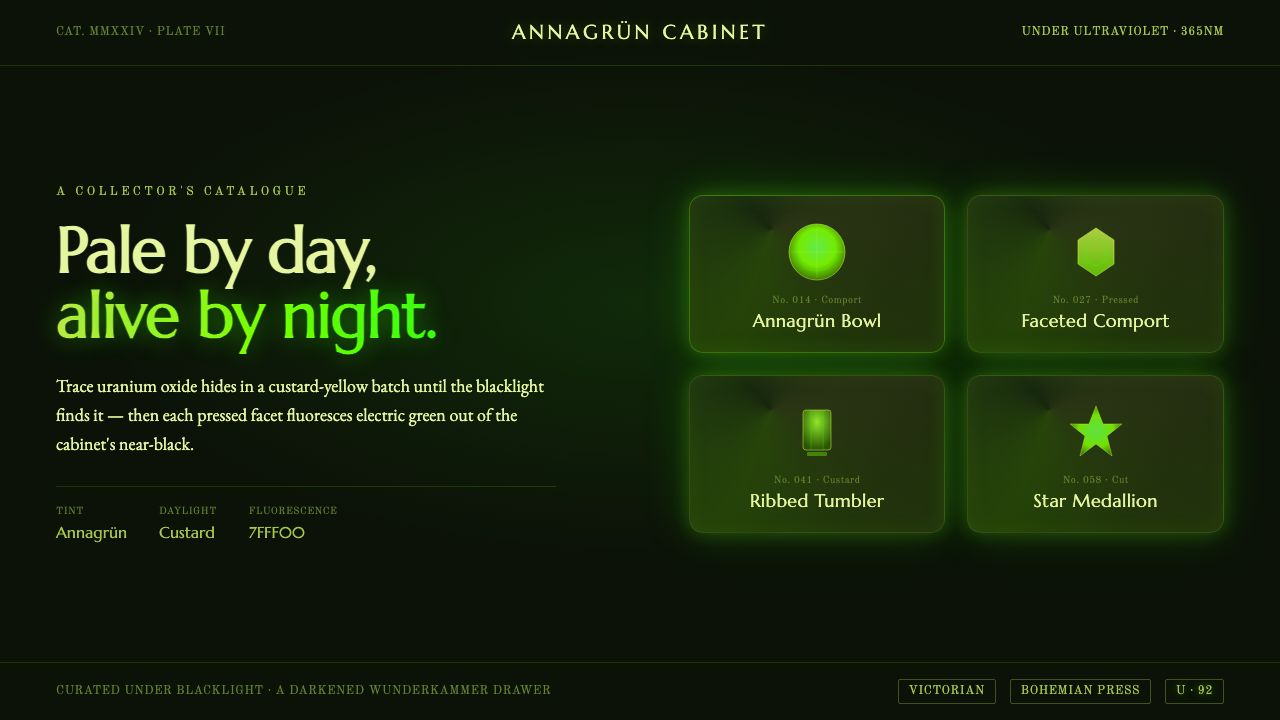 Uranium Vaseline GlassPale by day, electric green by night. Uranium glass fluorescing out of cabine…
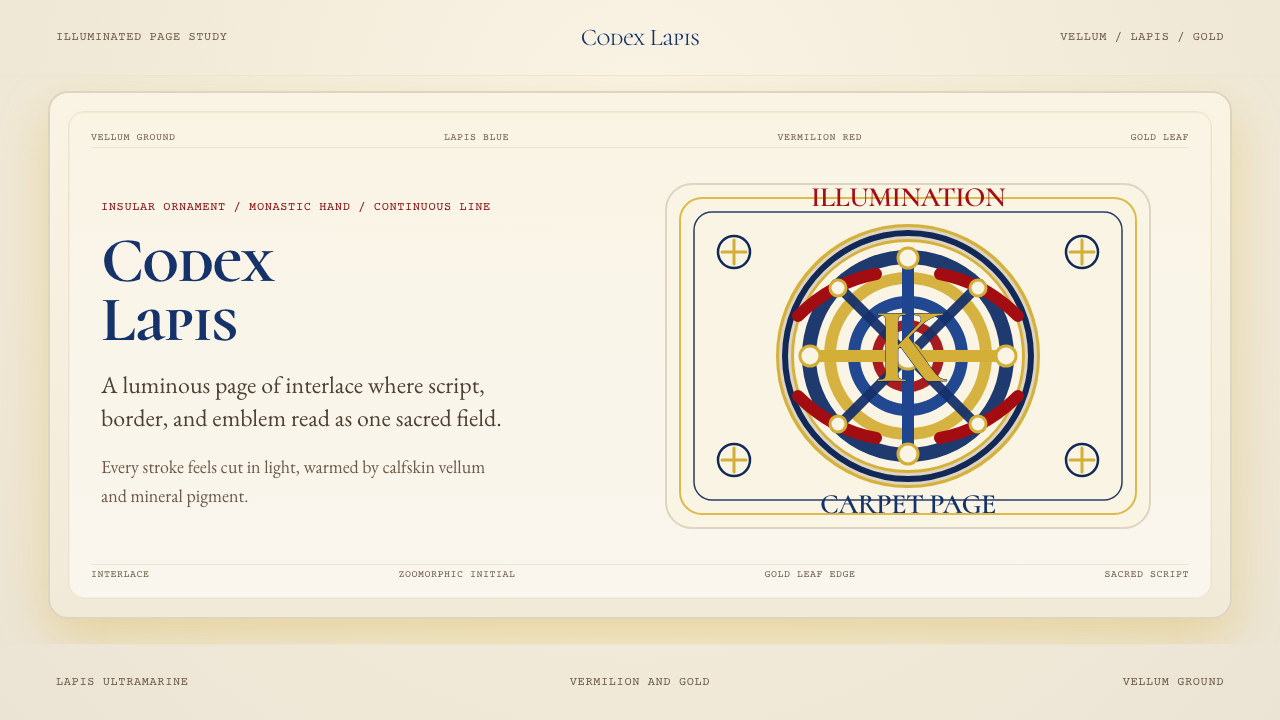 Book of Kells Celtic (800)Sacred and precise. Vellum cream, lapis, vermilion, and gold knotwork.