What is Bosch — Garden of Earthly Delights?
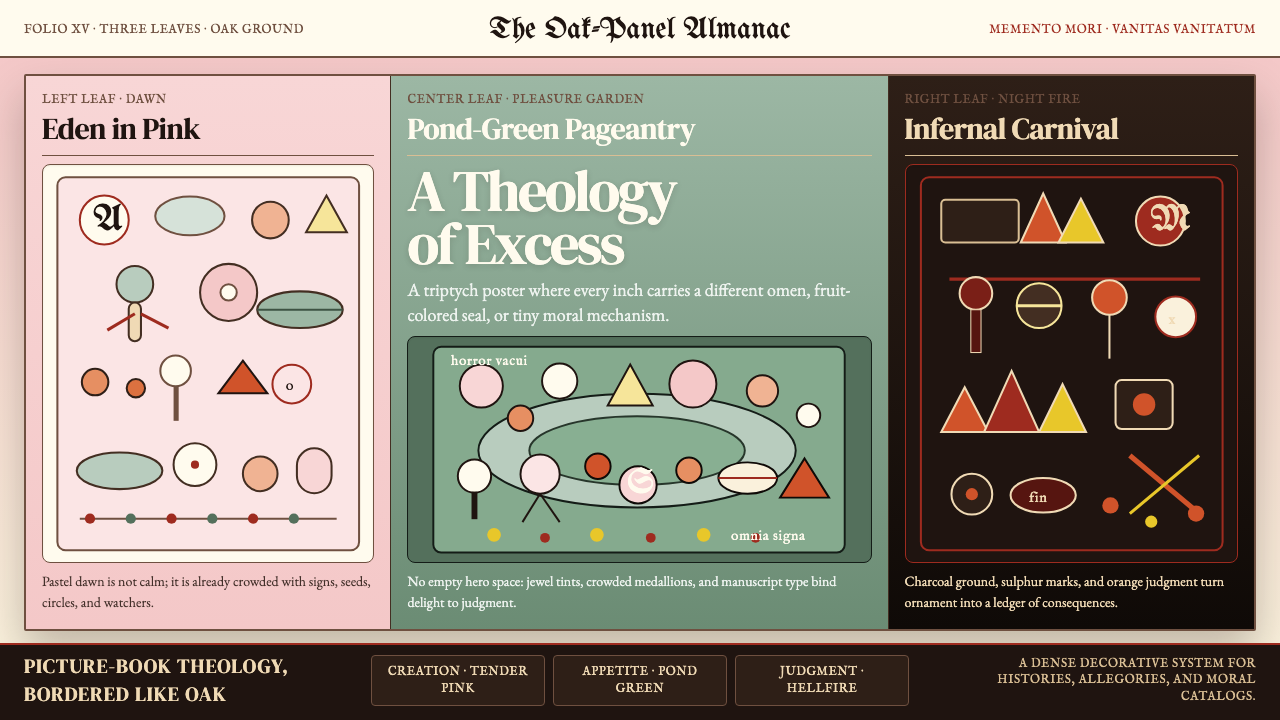
Hieronymus Bosch packed every inch of a three-panel oak triptych with naked figures, monstrous hybrids, and jewel-toned fruit — and made horror vacui into a theological argument.
Bosch — Garden of Earthly Delights in brief
The Garden of Earthly Delights is a Flemish triptych painted by Hieronymus Bosch around 1495 to 1505, now housed in the Museo del Prado in Madrid. Its three oak panels — Eden at dawn on the left, a teeming pleasure garden in the centre, and a nightmarish infernal carnival on the right — form a single continuous moral panorama read left to right. When the outer wings are folded shut, a grisaille painting of the Earth on the third day of Creation appears: a grey, mist-wrapped sphere floating in silence, utterly unlike the chromatic explosion within.
As a design aesthetic, the Bosch triptych insists that density is itself a visual principle. Every segment of pictorial space contains a separate micro-narrative: a half-transparent pink sphere shelters a couple; an owl perches inside a glass globe; a figure is swallowed by a giant bird reading from a book. There is no compositional centre that commands the eye. The viewer is meant to wander, discover, and be perpetually surprised — horror vacui not as a failure of restraint but as doctrine. The visual texture is simultaneously jewel-like and unsettling: pastel flesh tones collide with sulfurous yellows, deep pool-greens, and hellfire oranges.
Unlike the rational grids of modernism or the unified palettes of branding traditions, the Bosch aesthetic is plural, local, and relentlessly strange. Its unity comes not from repetition or reduction but from a consistent density of invention and from the overarching three-part moral structure — paradise, transgression, and consequence — that gives the chaos its shape.

Where does Bosch — Garden of Earthly Delights come from?
Hieronymus Bosch was born around 1450 in 's-Hertogenbosch, a prosperous cathedral city in the Duchy of Brabant, part of the Burgundian-Habsburg Low Countries. His real surname was van Aken, suggesting Flemish artisan ancestry. He spent his entire career in his hometown — unusual for an artist of his era — and was a member of the prestigious Brotherhood of Our Lady, a religious confraternity that commissioned devotional works and provided both social standing and patronage networks. The city's Latin name, Sylva Ducis ('the Duke's forest'), eventually gave him his adopted surname.
The Garden of Earthly Delights was most likely commissioned by Engelbrecht II of Nassau, a powerful nobleman and art collector, sometime before 1504. Philip I of Castile saw the triptych in Brussels around 1504, and it eventually entered the collection of Philip II of Spain, who kept it not in a chapel but in his private apartments — reportedly meditating on it at length. The work was transferred to the Prado in 1939 when the museum became the repository for Spanish royal collections. The precise theological program of the triptych remains one of art history's great unresolved debates: interpretations range from a straightforward moral warning against carnal sin to an alchemical allegory, a Adamite sect manifesto, and a dream-logic vision with no single authoritative reading.
Bosch worked within the Flemish painting tradition established by Jan van Eyck and Rogier van der Weyden — the precise rendering of detail, the jewel-like local color, the ability to give each figure individual presence. But where his predecessors used this technical mastery in service of decorous religious narrative, Bosch bent it toward systematic fantasy. His monsters are not crude or cartoonish; they are painted with the same careful hand as his saints, which makes them more disturbing. He drew on visual traditions including the drolleries of illuminated manuscripts, moralizing proverb collections, alchemical diagrams, and possibly the carnivalesque popular imagery of the kermesse fairs.
The devotio moderna movement — a lay religious reform emphasizing personal meditation on sin, temptation, and salvation — shaped the spiritual climate in which Bosch worked. 's-Hertogenbosch was a centre of this movement. The triptych's subject matter — the seductions of pleasure, the transience of earthly enjoyment, and the inevitable horror of its consequences — fits naturally into a devotio moderna context of directed moral contemplation. Pieter Bruegel the Elder, working a generation later in Antwerp and Brussels, carried forward Bosch's interest in moral panoramas dense with figures, updating the imagery from hallucinatory theology to Flemish peasant comedy.
What defines the Bosch — Garden of Earthly Delights look?
Horror Vacui Density
Every area of pictorial space is occupied. There is no compositional breathing room — not because the artist lacked discipline, but because the absence of space is the argument. Each creature, fruit, vessel, or fragment of landscape contains its own meaning. The density creates a visual experience closer to reading than to perceiving: the eye must stop, examine, and move on, processing micro-narratives one at a time. In a design context, this principle translates to layered storytelling where no area is inert or merely decorative.
Jewel-Toned Local Color
Bosch employs color in a pre-atmospheric, medieval-Flemish mode: each element carries its own saturated local tone with no aerial perspective to fade distant passages. Pastel pinks and flesh tones describe Eden's innocence; deep pool-greens and cool blues populate the pleasure garden; sulfurous yellows, hellfire oranges, and deep blacks dominate the infernal right panel. Colors do not blend or modulate into one another — they abut, collide, and compete. The overall effect is jewel-box richness: brilliant, dense, and utterly without subtlety in atmospheric terms.
Hybrid Morphology
Bosch's figures are rarely pure examples of any single category. A fish sprouts legs and walks; a fruit swells to human scale and shelters figures inside; a musical instrument becomes an instrument of torture. These hybrids obey an internal visual logic: the transformations are fantastical but rendered with naturalistic precision, as if the artist had witnessed them. The hybrid form is the style's primary unit of meaning — it literalises metaphors, makes moral abstractions into physical things, and ensures that every figure demands interpretation rather than passive recognition.
Three-Panel Moral Sequence
The triptych structure is not merely compositional — it is argumentative. Left panel: divine order and the creation of Eve. Centre panel: the consequence of desire unrestrained, rendered as abundance tipping into absurdity. Right panel: the logical endpoint of the centre, rendered as punishment and inversion — music becomes torture, the warmth of the fire becomes the fire of hell. This three-act structure gives the visual density a narrative spine. Applied to design, the principle suggests that complex information can be organized into progressive revelations where each section modifies the meaning of the last.
Decentered Gaze
Classical Western composition directs the viewer's eye through a hierarchy of focal points — a vanishing point, a principal figure, a dominant value contrast. Bosch's triptych refuses this hierarchy. There is no single place to stand in the painting. Dozens of scenes occur simultaneously at equal visual weight. This decentered gaze is not a compositional error; it is a theological statement: in the moral world Bosch depicts, there is no privileged vantage point. The viewer is implicated, not positioned as a safe outside observer. In contemporary design, this principle can be used deliberately to create immersive environments where exploration is required.
Micro-Narrative Accumulation
Where most pictorial traditions use a single central story supported by peripheral detail, Bosch organizes his surface as a field of equivalent micro-narratives. No single story is primary. The cumulative effect of these parallel stories — each one strange, each one morally charged — produces an experience of overwhelming abundance that mirrors the triptych's theological theme: pleasure so excessive it becomes its own punishment. This accumulative storytelling strategy is the style's most directly applicable contemporary technique.
Precise Naturalism in Service of Fantasy
Bosch's monsters are disquieting precisely because they are painted with the same careful observation as his realistic figures. The feathers on a hybrid bird-demon are anatomically specific; the glass vessels are rendered with the same precision as a Jan van Eyck still life. This technical discipline applied to impossible subjects creates a category of disturbing credibility — the viewer's instinct to trust painted observation is turned against them. In design, this principle corresponds to using realistic rendering conventions for surreal or unexpected content, increasing cognitive dissonance and memorability.

Who shaped Bosch — Garden of Earthly Delights?
Born around 1450 in 's-Hertogenbosch, Bosch spent his entire career in his native city — an unusual choice in an era when successful Flemish painters typically sought metropolitan patronage in Bruges, Ghent, or Brussels. He was a member of the Brotherhood of Our Lady from around 1488, and the confraternity both commissioned and displayed his work. His paintings entered major European collections within his lifetime: Philip I of Castile saw the Garden of Earthly Delights around 1504. Bosch died in 1516 and was buried in the chapel of the Brotherhood he had served for decades. Despite — or perhaps because of — his provincial situation, he produced the most hallucinatory and theologically complex body of painted work in northern Europe.
Count Engelbrecht II of Nassau was a prominent military commander and art patron in the Burgundian-Habsburg court, and is the most plausible identified commissioner of the Garden of Earthly Delights. The triptych later passed to his nephew Henry III of Nassau, through whose estate it eventually came to William of Orange and then, via Philip II, into the Spanish royal collection. Engelbrecht's patronage network connected the prosperous provincial culture of 's-Hertogenbosch directly to the highest levels of Burgundian aristocratic taste, making it possible for Bosch's singular vision to survive and be collected rather than treated as heretical or merely eccentric.
Philip II acquired the Garden of Earthly Delights in 1591 from the estate of William of Orange and chose not to relegate it to a storeroom or chapel but to hang it in his private quarters at El Escorial, where contemporaries reported he meditated on it privately. His reception of the triptych as a devotional and contemplative object — rather than as erotica, curiosity, or heretical imagery — was decisive for its preservation and its subsequent art-historical seriousness. Philip II was also the patron who brought the painting physically to Spain, beginning the chain of custody that led to its current home in the Prado.
Working a generation after Bosch, Bruegel is the most direct inheritor of Bosch's appetite for dense, morally-freighted panoramas populated by dozens of equally-weighted figures. His canvases — including Netherlandish Proverbs, The Triumph of Death, and Children's Games — share Bosch's decentered compositional strategy and his fascination with moral taxonomy rendered as visual catalogue. Where Bosch's imagery tends toward the hallucinatory and theological, Bruegel's is rooted in observed Flemish peasant life; both share the conviction that the surface of the world, looked at hard enough, reveals its moral structure.
The Brotherhood of Our Lady was a prestigious religious confraternity based in the cathedral of 's-Hertogenbosch, with membership drawn from the city's civic and merchant elite. Bosch joined around 1488 and remained a member until his death. The Brotherhood commissioned altarpieces, devotional sculptures, and liturgical objects, and provided Bosch with a stable patronage context outside the major Flemish art markets. The confraternity's emphasis on personal piety, meditation on sin and salvation, and the devotio moderna movement's spiritual disciplines almost certainly shaped the moral and theological content of Bosch's most ambitious works.
How do you use Bosch — Garden of Earthly Delights today?
The Bosch aesthetic is one of the most demanding historical styles to apply well precisely because its power comes from sustained, disciplined accumulation — not from surface decoration. Borrowing a single motif (a half-transparent sphere, a hybrid creature) without committing to the density principle produces kitsch rather than the original's overwhelming moral weight. Designers who work with this style must be willing to treat every available surface as meaningful rather than neutral.
For presentation slides, the Bosch approach works most forcefully on editorial covers and storytelling decks where visual impact rather than information efficiency is the primary goal. A cover slide can carry the style's horror vacui density: layered surreal illustration fills the entire field, with title text appearing as if carved into the texture rather than placed on top of it. Section-break slides can use the triptych's three-panel structure — left context, centre argument, right consequence — as an explicit compositional logic. Data slides, however, should resist the style: Bosch's decentered gaze makes quantitative comparison difficult. Reserve the visual richness for framing and narrative moments; use restraint at the data layer.
For web interfaces, the Bosch palette and density principle are best applied in editorial contexts — longform articles, cultural institution sites, immersive storytelling microsites — rather than in transactional product interfaces. A dark background loaded with jewel-toned illustration and medieval-manuscript-style ornamental borders creates an atmosphere of depth and discovery appropriate to cultural heritage, publishing, and arts organisations. Navigation and interactive controls should be clean against this richness rather than competing with it; the illustration carries the ambient meaning while typography remains legible. Dashboard and SaaS interfaces should avoid this style entirely — the decentered gaze is antithetical to scannable hierarchy.
For editorial and marketing work, the style is strongest in limited, high-contrast deployments: a poster where a single Bosch-derived hybrid creature occupies the full field, with sparse typography anchored at the bottom; a book cover where the triptych's jewel-like color palette structures the composition but the density is controlled; a social card that takes one micro-scene from the visual vocabulary and gives it space to breathe. Marketing copy paired with this aesthetic should match the style's register — layered meaning, moral undertone, a slight sense of menace beneath the surface richness — rather than defaulting to corporate optimism.
A common mistake when referencing this style is treating it as license for undisciplined clutter. Bosch's density is organized — morally, theologically, compositionally — even when it appears chaotic. Random accumulation of unrelated imagery produces visual noise, not the triptych's overwhelming coherence. A second frequent error is using the style's medieval color palette — pinks, greens, oranges — without committing to the flatness and the lack of atmospheric perspective that gives the original its jewel-box quality. Soft gradients and drop shadows immediately dissolve the effect. If the Bosch aesthetic is to be invoked, commit to its density, its precision, and its conviction that every inch carries meaning.

Bosch — Garden of Earthly Delights — FAQ
Is the Bosch triptych style the same as general surrealism?
They share a surface vocabulary of impossible combinations and dreamlike imagery, but their underlying logic is different. Bosch's imagery is theological and moral — every hybrid creature and fantastical scene can, at least in principle, be interpreted within a Christian allegorical framework of sin, temptation, and punishment. Surrealism, which emerged in the 1920s, draws on psychoanalytic ideas about the unconscious and dreams; its imagery is meant to bypass rational interpretation, not to encode a fixed theological program. Bosch's triptych is more like an extremely dense illustrated text than a free-associative dream. The difference matters for design: Bosch references tend toward weight, moral seriousness, and encyclopedic completeness; surrealist references tend toward lightness, wit, and deliberate logical rupture.
How do you apply horror vacui density without making a design illegible?
The key is Bosch's own solution: maintain locally clear rendering within globally dense composition. Each micro-scene in the triptych is individually legible — a specific figure doing a specific thing — even though the overall field is overwhelming. In design, this means that each element within a dense composition must have crisp definition: clear edges, unambiguous silhouettes, no detail merging into adjacent detail. Color zoning also helps: Bosch uses the left-to-right panel transition from pink to green to orange-black to help the eye navigate. In a design context, distinct color temperature zones can perform the same function. The failure mode is when density comes from layering low-contrast elements, which produces mud rather than richness.
Is this style appropriate for digital product interfaces?
Rarely, and only in specific contexts. The Bosch aesthetic is fundamentally unsuited to interfaces that require rapid scanning, clear affordances, or predictable information architecture. Its decentered gaze, moral density, and horror vacui composition create an experience of immersion and discovery, which is valuable in cultural, editorial, or experiential contexts but counterproductive in transactional or analytical ones. The style works well for microsites, cultural institution landing pages, editorial headers, immersive introductions, and splash screens. It should be avoided for navigation systems, data dashboards, form interfaces, settings panels, and any context where the user needs to quickly locate a specific piece of information. When in doubt, confine the Bosch visual richness to decorative framing elements and keep the functional UI layer clean.
What is the difference between Bosch's color palette and conventional medieval illumination?
Both traditions employ saturated local color without atmospheric perspective, and both use gold or bright grounds as a base. But Bosch works at a scale and with an ambition that illuminated manuscripts rarely approached: his panels are large enough to sustain the kind of micro-narrative density that would be illegible at manuscript scale. More significantly, Bosch's color does moral work that illumination does not: the progression from the delicate pinks of Eden to the fire-oranges and deep blacks of hell is a theological argument made entirely through color temperature and saturation. Manuscript illumination tends to distribute its jewel tones evenly for decorative effect; Bosch organizes his into a directed moral sequence. This makes his palette more structurally complex and harder to borrow as mere decoration.
Can the Bosch style work in a minimal or restrained layout?
It can, but the result is not really the Bosch aesthetic — it is a quotation from it. Taking a single hybrid creature or a single jewel-toned detail and placing it in generous white space produces an elegant, editorial effect, but this is using the triptych as a source of motifs rather than as a visual system. The Bosch aesthetic as a system requires density; stripped of density, what remains is just medieval-Flemish illustration style, which is a different and less specific reference. This is not a criticism of restrained quotation — it can be highly effective — but designers should be honest with themselves about whether they are working with the style or merely sampling from it. For the full system, commit to the accumulation. For a light touch, credit the source and simplify deliberately.
Related design styles
 Beetle Specimen CabinetGreen burns in darkness. Emerald elytra grids glow under brass keylines and b…
 Bird of Paradise MonographTheatrical plate-book darkness. Flame plumes blaze from a bordered forest-bla…
 Book of Kells Celtic (800)Sacred and precise. Vellum cream, lapis, vermilion, and gold knotwork.
 Cellarius Celestial AtlasCelestial luxury on lapis. Gilt serif type, star fields, and concentric chart…
 Delft Blue PotteryRestrained, yet every inch speaks. Cobalt hairlines crowd a cream tile grid.
 Dutch Tulip ManiaSpeculation burns in shadow. Flame red petals, violet stripes, gold frames on…