What is Senegalese Sous-Verre?
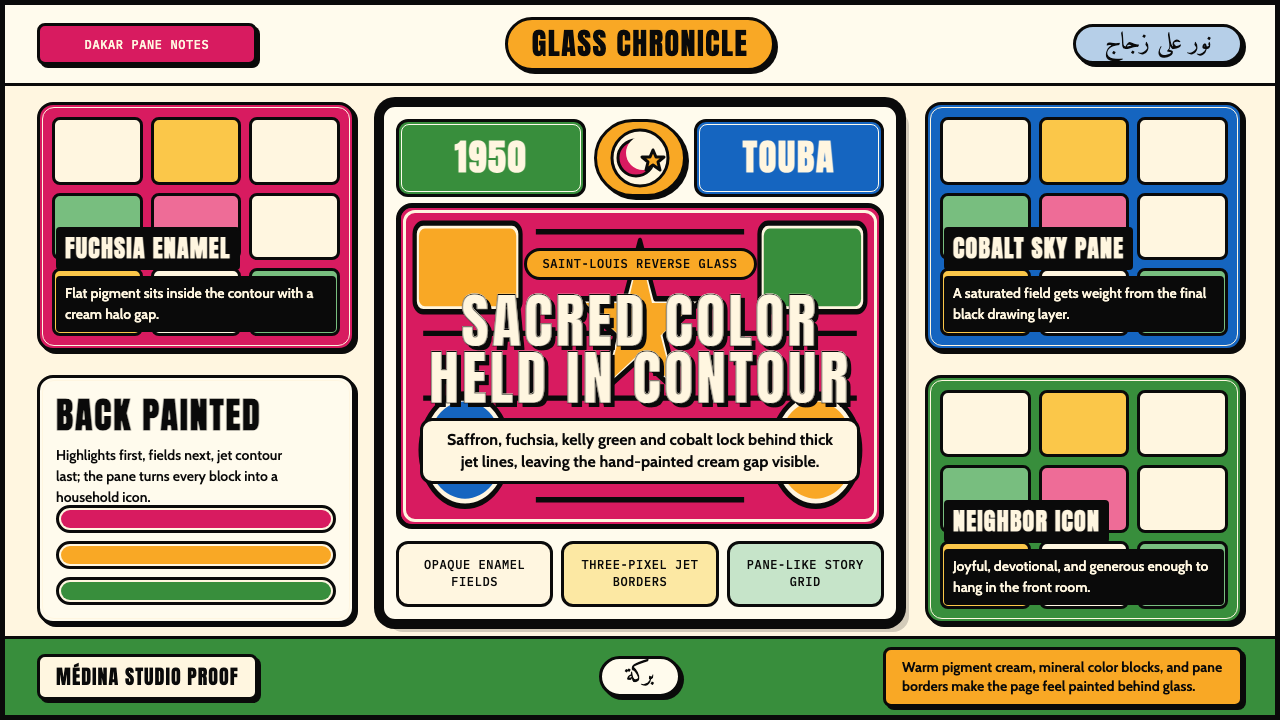
Senegalese sous-verre turns the painter's process inside out — building every image backwards through glass, highlights first and bold black contours last, in colors as saturated and joyful as a West African market at midday.
Senegalese Sous-Verre in brief
Senegalese sous-verre — the name comes directly from the French for 'under glass' — is a West African folk painting tradition in which artists work on the reverse side of a flat glass pane, applying pigments in the exact opposite order from conventional painting. Highlights and fine interior details go on first; mid-tones and flat color fields follow; the defining black contour lines come last. When the glass is turned face-forward, the image appears fully formed, with colors locked behind a transparent surface that gives the work its distinctive luminous depth.
The aesthetic is simultaneously sacred and exuberant. Flat, opaque enamel pigments — fuchsia, saffron yellow, kelly green, cobalt blue, vermilion — fill each shape completely, with no blending or gradation. Thick, jet-black outlines separate every color region, functioning like the lead lines of a stained-glass window but without any actual structural armature. Each color field sits fractionally inside its outline, leaving a faint halo gap that is the unmistakable signature of the hand-painted form. The result has a stained-glass radiance but a warmth and narrative intimacy that is entirely its own.
The tradition encompasses a wide range of subject matter. Its most prominent images are devotional portraits of Cheikh Amadou Bamba, the founder of the Mouride Sufi brotherhood, whose image became ubiquitous in Senegalese homes and taxis from the mid-twentieth century onward. Alongside these sacred icons, painters produced Quranic verse panels, scenes of Wolof daily life, Serer wrestling matches, Lebu fishermen hauling nets, and the elaborate social ceremonies — baptisms, weddings, political celebrations — that structure community life. The tradition holds popular and spiritual registers with equal ease.

Where does Senegalese Sous-Verre come from?
The technique of painting on the back of glass reached Senegal through multiple overlapping channels during the colonial era. Reverse glass painting had long traditions in China, southern Europe, and the Ottoman world, and its arrival in West Africa is linked both to trade networks along the trans-Saharan and Atlantic routes and to the direct presence of European missionaries and traders in coastal cities. The Saint-Louis workshop tradition — the earliest documented center — took shape in the 1920s in a city that had been the administrative capital of French West Africa since the eighteenth century. There, Senegalese artists absorbed the technique and immediately transformed it: the European devotional subjects and the Indian chromolithograph prints that may have served as early models were set aside in favor of local Islamic iconography and Wolof narrative.
The decisive turn came with the mass production of devotional imagery centered on Cheikh Amadou Bamba (1853–1927), the Sufi mystic who founded the Mouride brotherhood and became the most important religious figure in modern Senegalese history. Bamba's encounters with French colonial authorities — his exile to Gabon in 1895 and then to Mauritania in 1902 — transformed him into a symbol of spiritual resistance, and demand for his portrait was enormous. Sous-verre painters provided affordable, portable sacred images for a population with limited access to photography and no tradition of religious oil painting. By the 1940s and 1950s, the Dakar workshops in the Médina and Plateau neighborhoods had become the primary production centers, with painters working in informal ateliers and selling through market stalls.
The peak of production ran roughly from the 1950s through the 1990s, a period during which the tradition simultaneously served popular devotional need, became a recognized art form, and attracted the attention of collectors, ethnographers, and eventually international curators. Artists such as Mor Gueye, Babacar Lô, and Souleymane Keita developed recognizable individual styles within the shared visual vocabulary of the form, producing works that ranged from small domestic devotional pieces to large-format narrative panels. The tradition was never organized into a formal school or guild; transmission was workshop-based and familial, with techniques passing from established painters to apprentices and relatives.
In the decades after Senegalese independence in 1960, sous-verre underwent a complex double movement: as a popular devotional medium it remained deeply embedded in everyday life, while simultaneously being framed by cultural institutions and the international art market as a distinctive African modernism worthy of museum attention. This dual status — folk craft and fine art — is not a contradiction but an accurate description of a tradition whose practitioners have always moved freely between the sacred domestic interior and the gallery wall. Contemporary artists working in the tradition continue to expand its subjects, incorporating political commentary, urban experience, and engagement with the wider world of image-making.
What defines the Senegalese Sous-Verre look?
Reverse-order construction
The defining technical discipline of sous-verre is that the painter works in the inverse of normal pictorial sequence. What will appear in front — highlights, white details, fine interior linework — must be painted first, directly onto the glass surface. Color masses follow, and the bold black outlines that hold the composition together are applied last of all. This reversal demands that the artist hold the completed image fully in mind before making a single mark, since corrections require painting over areas already committed to glass.
Saturated flat color
Color in sous-verre is applied as opaque, fully saturated fields with no internal gradation, shading, or blending. Fuchsia, saffron, kelly green, cobalt blue, and vermilion are characteristic hues, chosen for their intensity under the glass surface. Because each color must be laid down before neighboring colors are added, there is no optical mixing between regions; instead, the black contour line performs the work of separation. The palette reads as festive, warm, and assertive — closer in spirit to folk textile than to academic painting.
Bold black contour
Thick black outlines drawn in the final stage of painting are the visual signature of the style. They separate every color region, define every figure, and hold the entire composition in a web of firm, decisive lines. The line quality is confident and fluid — not mechanical, but not hesitant either. This approach shares a visual logic with leaded stained glass and with cloisonné enamelwork, both traditions in which a rigid barrier between color zones is a structural necessity. In sous-verre, the contour has no structural function; it is purely visual, and its boldness is a deliberate aesthetic choice.
The halo gap
Because each color field is painted before the surrounding outline is applied, the color inevitably sits just inside the contour rather than touching it flush. This produces a characteristic thin gap — a sliver of light or bare glass — between the edge of each color mass and its surrounding black line. Far from being a flaw, this halo gap is recognized as the authentic mark of hand-painted sous-verre; it is absent in photomechanical reproductions of the style. In composition, it gives each color shape a subtle luminous breathing room and emphasizes the layered, time-based nature of the process.
Frontal, hieratic figures
The dominant figure convention in sous-verre is frontal and hieratic: subjects face directly toward the viewer, occupy the center of the composition, and are often framed by decorative borders or inscriptions. This posture carries devotional weight — in sacred portraiture, direct gaze conveys spiritual authority and the intimacy of a personal encounter. It also reflects a broader West African aesthetic preference for figures that address the viewer rather than being observed from a distance. Even in secular narrative scenes, human figures tend toward a composed, frontally oriented dignity rather than the dynamic foreshortening of Western academic painting.
Decorative framing and inscription
Sous-verre compositions are frequently bordered by ornamental bands that echo the geometric and floral vocabularies of West African textile, architecture, and leatherwork. Within the image field, Arabic calligraphic inscriptions — Quranic verses, the names of religious figures, blessings — are often integrated as formal visual elements rather than added as captions. The text becomes part of the pattern, its cursive letterforms weaving among figurative and geometric motifs. This integration of word and image reflects the central role of literacy and scripture in Mouride devotional culture and the broader Islamic artistic tradition of treating calligraphy as a supreme visual art.
Luminous surface quality
Glass as the painting support is not neutral; it transforms the optical behavior of the pigments. Colors viewed through a transparent surface have an interior glow that cannot be achieved on paper, canvas, or board. The effect is particularly vivid when the painting is held toward a light source — the glass functions almost like a back-lit panel, amplifying saturation and giving the image a quality of radiance that aligns naturally with its sacred subjects. This luminous quality is fundamental to the style's emotional register and is irreproducible by photographic or digital means.

Who shaped Senegalese Sous-Verre?
Mor Gueye was among the most celebrated sous-verre painters of Dakar's Médina neighborhood, working from the mid-twentieth century through the height of the tradition's commercial and artistic vitality. His paintings of Cheikh Amadou Bamba were known for the intensity of their saturated color fields and the assured quality of his contour work — lines that combined decisive weight with a fluid, almost calligraphic rhythm. His work circulated widely beyond Senegal, entering collections in France and elsewhere, and helped establish sous-verre as a form worthy of serious attention outside its devotional context.
Babacar Lô extended the formal range of sous-verre beyond its most iconic devotional subjects, producing large-scale narrative panels depicting Wolof ceremonies, wrestling matches, and scenes of urban Dakar life. His compositional ambition — organizing multiple figures across horizontal formats with a control of spatial rhythm unusual in the folk tradition — pushed the form toward something closer to mural painting while retaining the opaque enamel palette and black contour vocabulary that define sous-verre at any scale. His work is frequently cited in scholarship on the intersection of West African folk art and modernism.
Souleymane Keita represents the generation of sous-verre painters who worked during the period of greatest international visibility for the form, from the 1970s through the 1990s. His practice was notable for the refinement of his decorative border systems — geometric and arabesque bands that frame the central image with a density and precision drawn equally from Senegalese textile traditions and Islamic ornamental geometry. His work brought attention to the ways in which sous-verre participates in a much broader West African and Islamic visual culture, rather than standing apart as an isolated folk curiosity.
Though not a painter himself, Cheikh Amadou Bamba (1853–1927) is the indispensable figure in the cultural history of sous-verre. As the founder of the Mouride Sufi brotherhood and the most revered spiritual authority in modern Senegal, his image generated the most sustained demand in the tradition's history. His biography — his refusal of accommodation with French colonial power, his exiles, his eventual return and the recognition of Touba as a holy city — is the primary narrative content of devotional sous-verre painting. Understanding his significance is prerequisite to understanding why this tradition became so central to Senegalese visual life.
The anonymous and collective dimension of sous-verre is as important as its named masters. Saint-Louis — Senegal's oldest colonial city and the documented origin of the workshop tradition — supported a community of painters whose individual identities were often subsumed in the workshop output. These painters established the visual conventions, the standard subject repertoire, and the production rhythms that would define sous-verre for generations. Their collective contribution represents the folk tradition at its most generative: a shared visual language refined across hundreds of hands rather than credited to any single author.
How do you use Senegalese Sous-Verre today?
Sous-verre is a style of bold clarity, warm spirituality, and exuberant color — qualities that translate well into digital design when the underlying logic is understood rather than simply imitated. The core principle is that every element is flat, clearly bounded, and saturated; there is no atmospheric depth, no soft falloff, no gradual transition. Applying this to a digital context means working with hard edges, fully opaque fills, and black or very dark outlines that give the design its structural definition. A surface that looks like it glows from within, rather than one lit from above, is the right target.
For presentation slides, sous-verre works particularly well as a framework for cover pages and section dividers that need to carry both visual impact and cultural warmth. A cover built in this style would use a large, centrally composed figure or icon — rendered in flat saturated color against a light background, bounded by a bold dark outline — with title text treated as part of the visual pattern rather than layered over it. Section slides can deploy the decorative border vocabulary: a geometric band running along one or two edges, drawn in one of the accent colors, signals a transition while maintaining the style's sense of ceremonial structure. Data slides benefit from the tradition's comfort with bold, pure-hue color fields; chart bars or segments in fuchsia, saffron, and cobalt gain presence and legibility without any three-dimensional styling.
For web interfaces, the style suits contexts where warmth, cultural richness, and legibility must coexist — a landing page for a creative studio, a cultural institution, a festival, or a social platform with an African or diasporic audience. The approach centers on a contained color palette of three or four saturated hues applied as flat fills, hard-bordered card components that echo the contour logic of the paintings, and typography that is either bold and assertive for headlines or cleanly neutral for body text — never decorative for its own sake. Dashboards and pricing pages can adopt the hierarchical simplicity of the devotional icon: one primary figure or number, large and centered, surrounded by secondary information arranged with the same frontal dignity.
For editorial and marketing work, sous-verre offers a way to bring festive, saturated color into layouts without the visual noise that heavy illustration often introduces. An editorial spread using this vocabulary would employ flat color blocks as background fields rather than photography, with any figurative content reduced to the style's characteristic bold-outline, flat-fill treatment. Marketing materials — event posters, social cards, campaign headers — are the natural home of the style's poster-like directness. A single icon or portrait, full-bleed or centered in a saturated color field, with a bold text treatment integrated into the image rather than floating above it, captures the devotional intensity of the tradition while functioning perfectly as contemporary visual communication.
A common mistake when applying sous-verre is to pile on multiple saturated colors simultaneously, producing visual confusion rather than the clarity the tradition achieves. Authentic sous-verre images are organized: one or two color fields dominate any given region, the black contour does the work of separation, and the palette is consistent across the piece. In digital application, choose a lead color and one or two supporting hues, then let the dark outline — whether expressed as a border, a shadow, or a stroke — do the work of organizing the surface. Equally common is importing the color palette while abandoning the flatness: adding gradients, drop shadows, or texture to a sous-verre-derived composition breaks the visual logic entirely, because the style's luminous quality comes from the absence of those effects, not despite it.

Senegalese Sous-Verre — FAQ
Is sous-verre a uniquely Senegalese tradition, or does it exist elsewhere in West Africa?
Reverse glass painting exists in several West African countries — most notably in Senegal, Côte d'Ivoire, and Guinea — but the Senegalese tradition is by far the most developed, most prolific, and most internationally recognized. What makes the Senegalese version distinctive is its deep integration with Mouride Sufi devotional culture, which gave it a specific iconographic program, a sustained popular market, and a spiritual weight that comparable traditions elsewhere have not developed to the same degree. The Saint-Louis and Dakar workshops produced work at a scale and with a consistency that makes the Senegalese tradition the reference point for the form across the region.
How does sous-verre relate to other African art traditions that also use bold outline and flat color?
The visual logic of bold outline plus saturated flat fill appears across many African artistic traditions — in kente and kanga textile design, in the geometric decoration of West African architecture, in the beadwork of East and Southern Africa, and in the painted surfaces of Ndebele houses in South Africa. These traditions share a fundamental preference for color as flat field rather than modeled volume, and for a strong demarcating line that defines each element clearly. Sous-verre belongs to this broader aesthetic culture while being shaped by its own specific technical constraints and its particular relationship with Islamic visual traditions. The connections are genuine but should not be flattened into a single 'African aesthetic'; each tradition has its own history, function, and formal logic.
Can this style work effectively in dark-mode or low-light interface contexts?
Dark mode presents an interesting challenge for sous-verre. The historic tradition is a light-ground one — white or pale backgrounds maximize the luminous effect of the glass and the intensity of the saturated pigments. However, the style's core vocabulary of saturated flat color and bold outline adapts reasonably well to dark grounds, because the colors are already maximally saturated and the black contours simply merge with the dark background. The effective approach is to treat the dark ground as the equivalent of the unlit glass — a neutral field — and let the saturated color fields carry the luminous quality. The greater risk is choosing colors that become too aggressive or difficult to read at high saturation against a deep background; muting just slightly while increasing fill area tends to preserve legibility while retaining the style's spirit.
What distinguishes an authentic sous-verre-derived design from a surface-level imitation?
Surface imitation typically takes the color palette — the fuchsia, saffron, and cobalt — and applies it to a layout while retaining gradients, soft shadows, or textural treatments that belong to other visual systems. Authentic sous-verre-derived design commits to the underlying logic: every color region is flat and fully opaque, edges are hard and defined, outlines are present and decisive, and there is no atmospheric depth. The luminous quality comes from the combination of pure saturated color and firm boundary, not from the addition of glow effects. Additionally, authentic application respects the tradition's compositional habits: central, frontally oriented focal elements; decorative framing as part of the design rather than afterthought; and a color palette where one or two dominant hues organize the surface with supporting accents placed deliberately rather than broadcast everywhere.
Is it appropriate to apply this style in commercial contexts given its sacred origins?
Sous-verre has always operated simultaneously as sacred and commercial: the workshop tradition was from its beginnings a market-oriented practice, producing devotional images at scale for popular consumption. Painters sold their work in stalls, it appeared on household walls and on the dashboards of sept-place taxis, and it circulated widely as affordable popular art. The tradition has no history of being restricted to ritual use only. Commercial application is entirely consistent with how the form has always been used — as long as it does not reproduce or mock specific sacred imagery, particularly the portrait of Cheikh Amadou Bamba, without understanding the significance of that subject. Borrowing the visual vocabulary of flat color, bold outline, and frontal composition is a legitimate form of creative engagement with the tradition; specific devotional content is another matter.
Related design styles
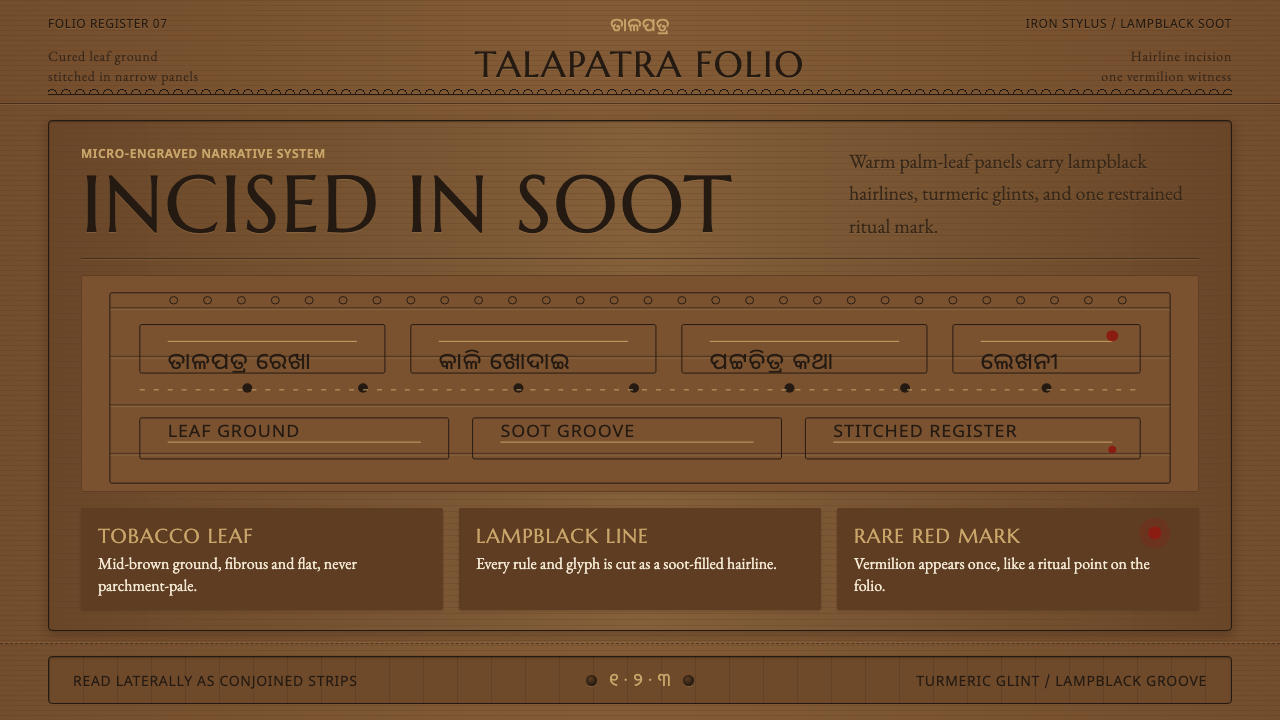 Odisha Palm-Leaf EtchingSacred narrative goes microscopic. Lampblack hairlines cut tobacco-brown leaf…
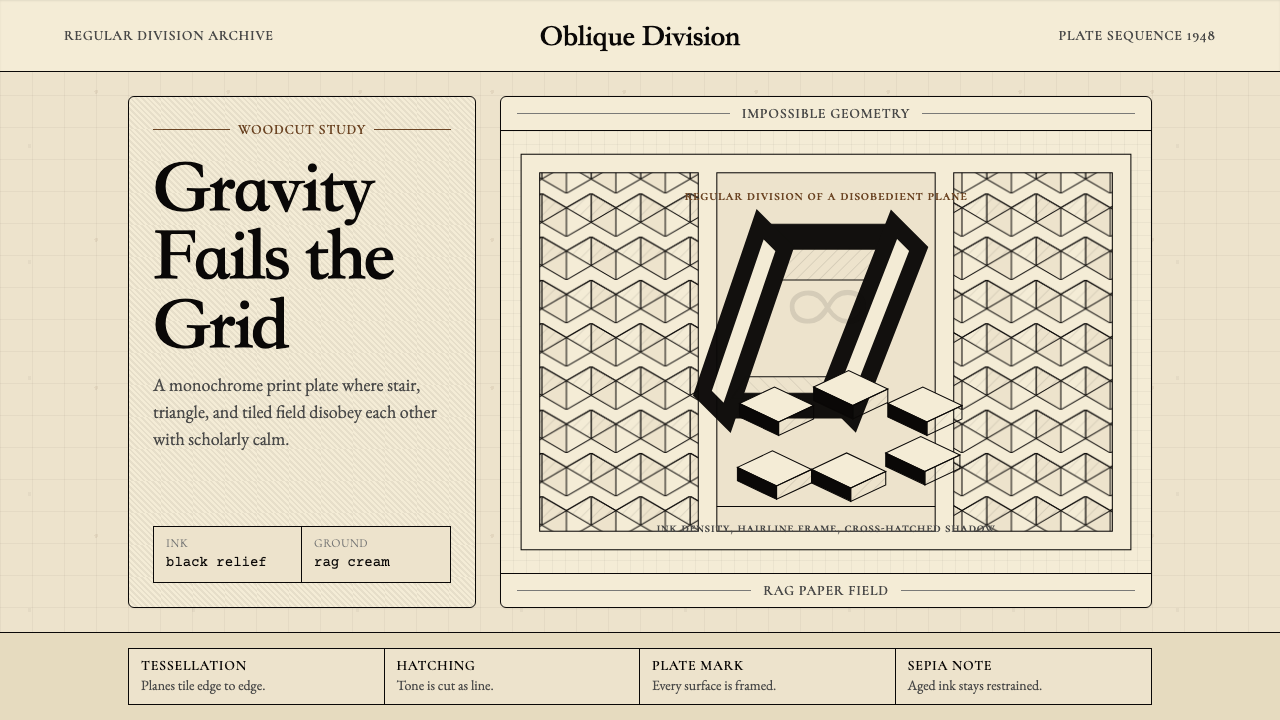 M.C. Escher ImpossibleImpossible calm. Ink-black tessellations and hatching fold cream paper into p…
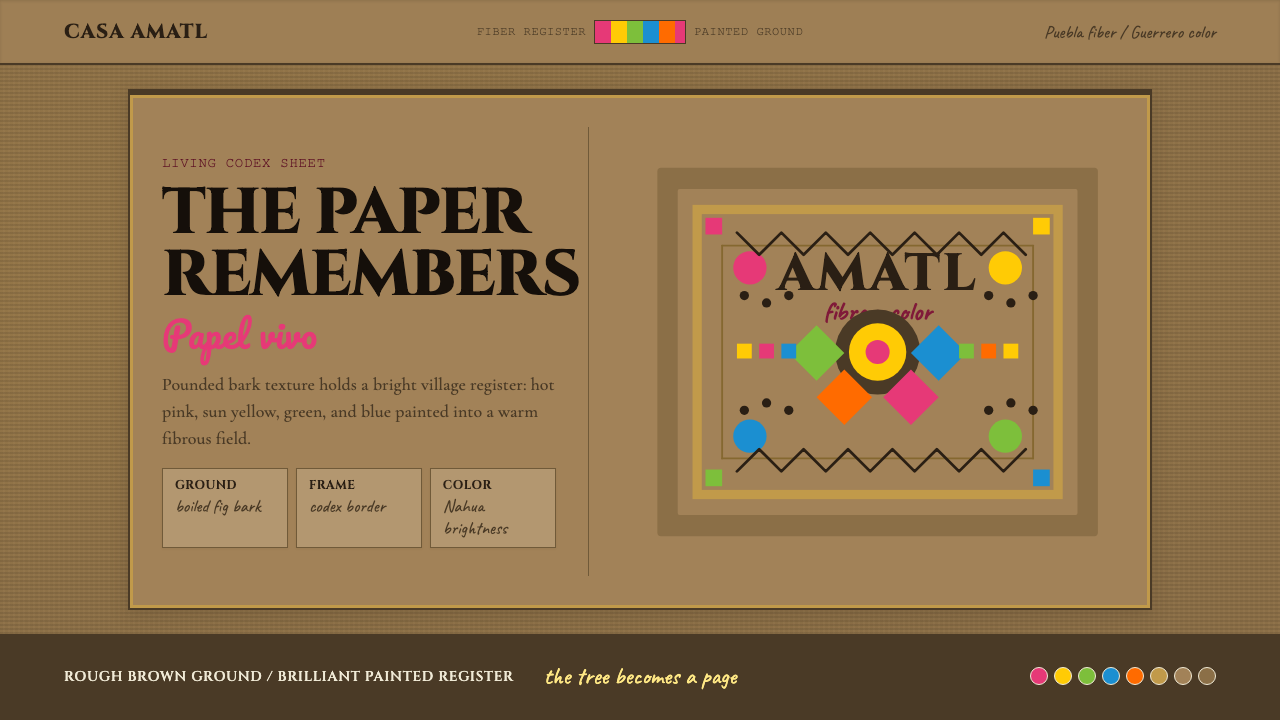 Mexican Amate Bark PaperLiving craft, not nostalgia. Bark-brown fiber carries hot pink and sun-yellow…
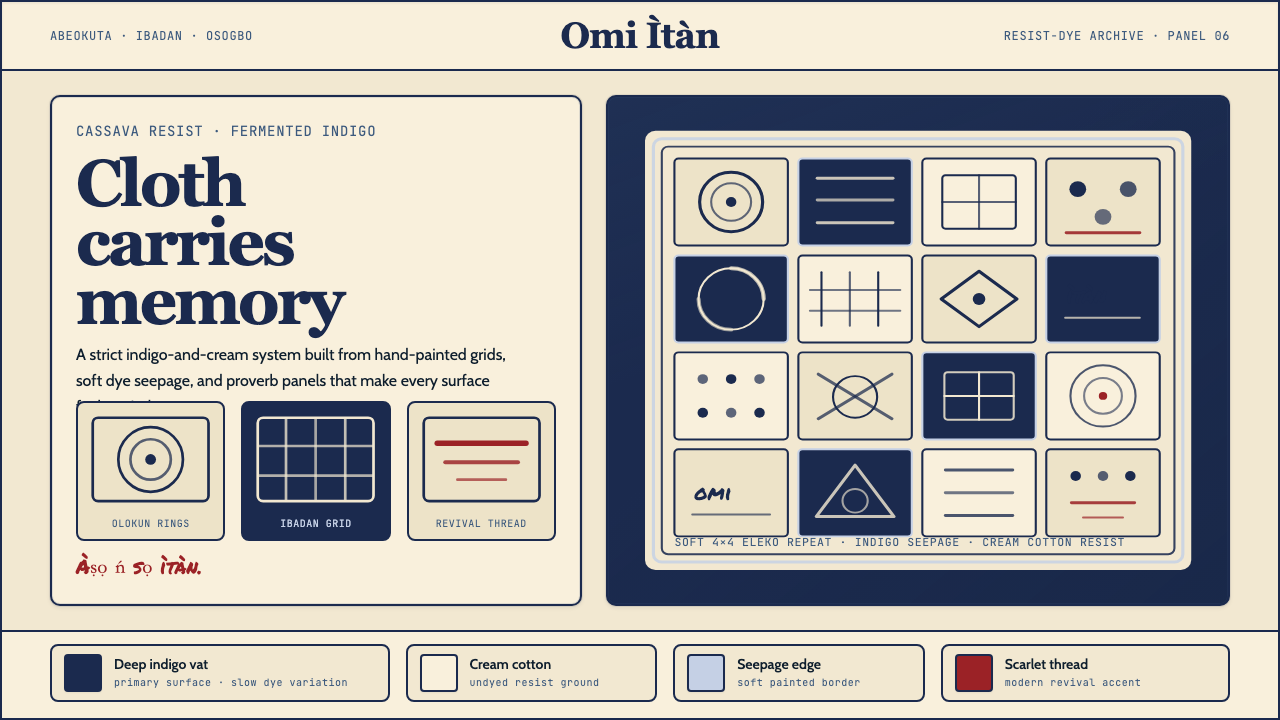 Yoruba Adire IndigoMemory lives in cloth. Deep indigo grids on cream cotton carry hand-painted p…
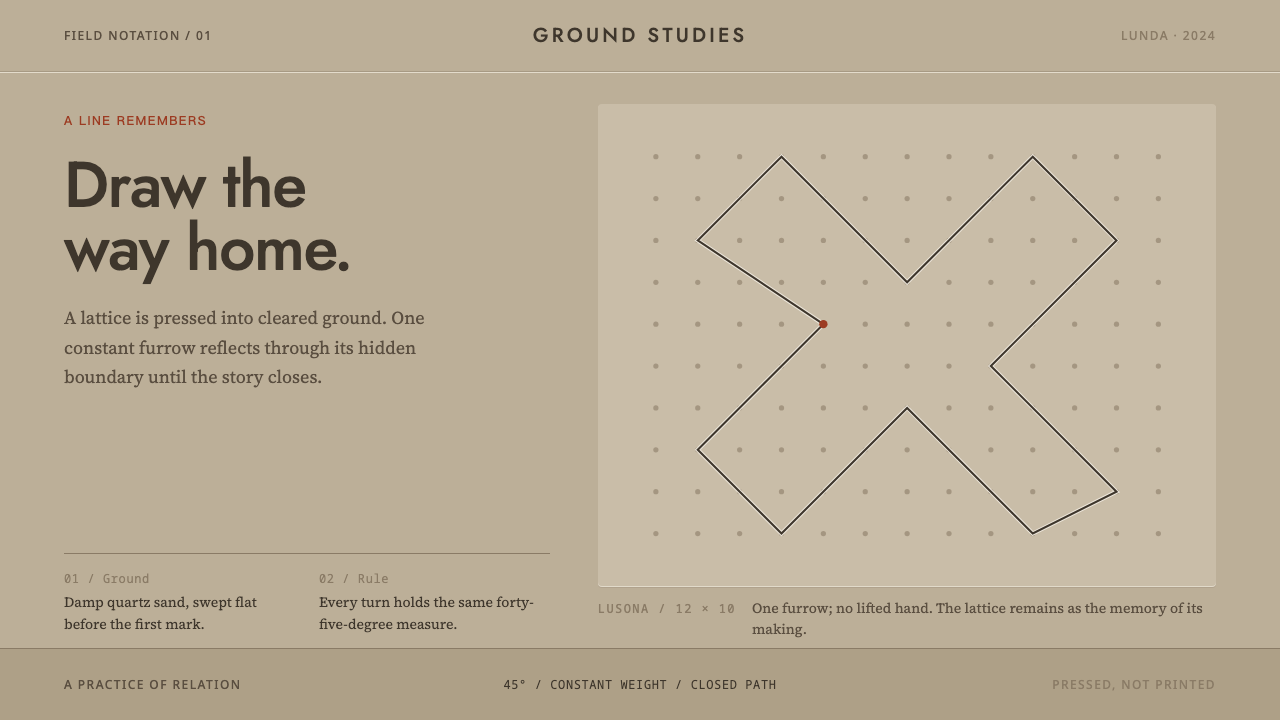 Angolan SonaA story closes in one stroke. A 45° furrow crosses visible dots on damp sand.
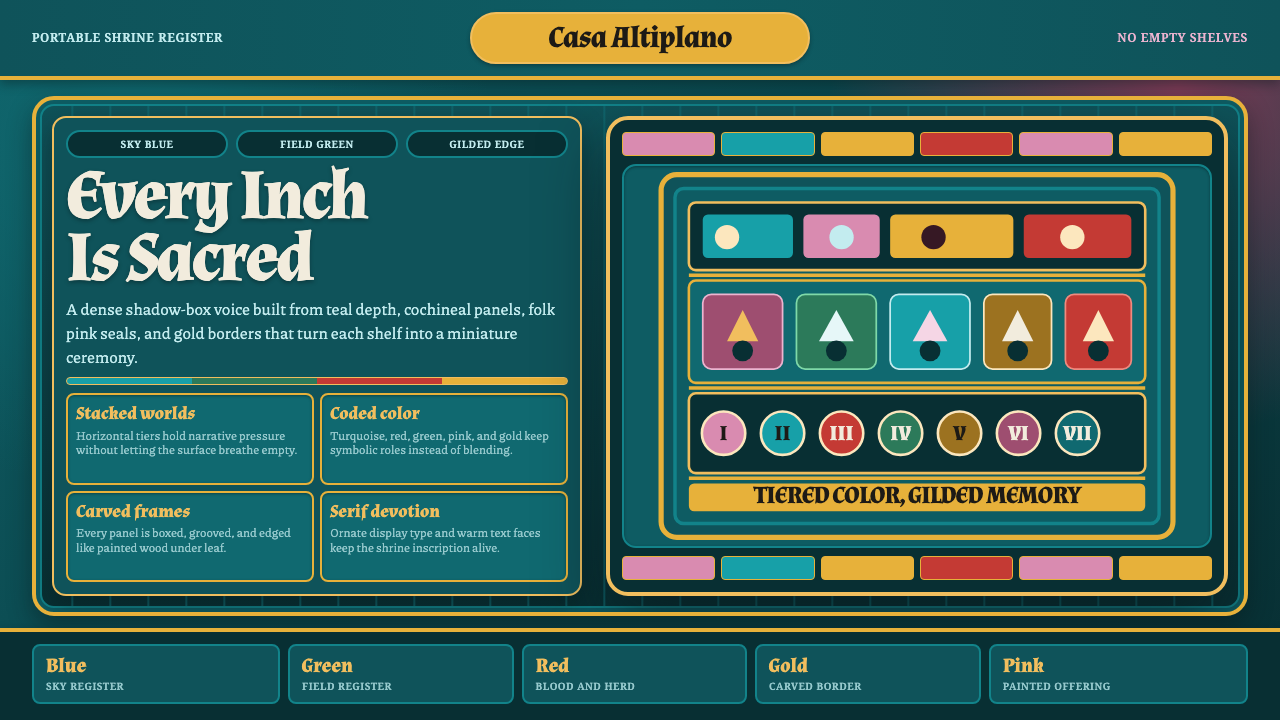 Ayacucho Retablo BoxSacred density. Deep teal shelves pack turquoise, cochineal, folk pink, and g…