What is Mexican Folk Art (Frida-era)?
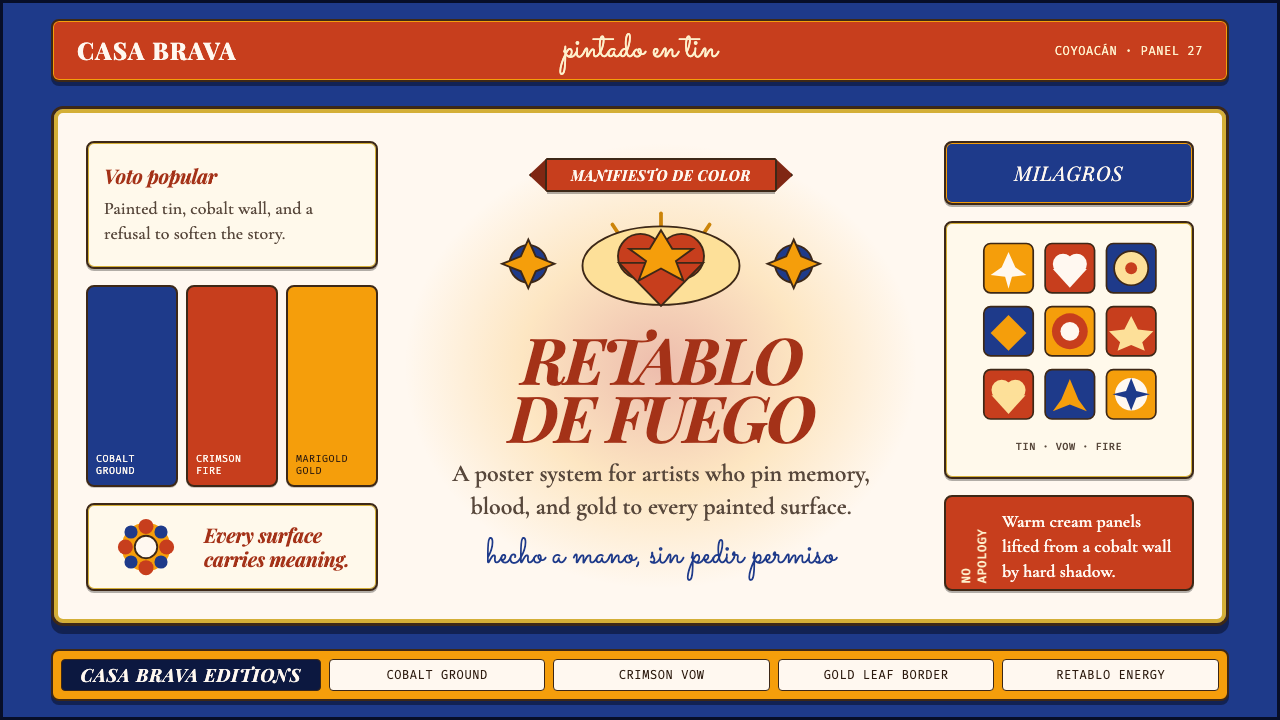
Mexican Folk Art of the Frida era turns every surface into an act of cultural defiance — cobalt grounds, crimson sacred hearts, marigold gold, and hand-lettered banners that refuse to whisper.
Mexican Folk Art (Frida-era) in brief
Mexican Folk Art of the Frida era is a saturated, hand-painted visual language rooted in indigenous Mexican identity. It draws from retablo votive paintings, Tehuana embroidery, Day-of-the-Dead iconography, and the post-revolutionary Mexicanidad movement, which sought to reclaim native artistic traditions against the long dominance of European modernism. The result is maximalist, warm-blooded, and uncompromising: every element carries symbolic weight, every color is declarative rather than decorative.
The aesthetic is built around a fearless palette — deep cobalt blue, crimson red, marigold gold, and warm earth tones layered against one another without apology. Forms are bold and flat, with hard outlines that recall both pre-Columbian craft and hand-painted tin ex-votos. Pattern and ornament are not afterthoughts but structural arguments: floral borders, embroidered chevrons, and curling folk script fill space that European modernism would have left empty. Shadows, where they appear, are cast and hard rather than ambient, giving painted objects a presence like objects placed on an altar.
Applied to contemporary design, this aesthetic offers what few historical styles can: an unapologetically full visual field that still communicates hierarchy. The imagery vocabulary — sacred hearts, marigolds, calaveras (decorated skulls), birds, and botanical motifs — is internationally recognizable yet culturally specific. The system works because its rules are rooted in ritual: in traditional Mexican folk art, every symbol has a place, a meaning, and a relationship to the whole. Translated into digital surfaces, that same discipline produces layouts that feel deliberate and alive.

Where does Mexican Folk Art (Frida-era) come from?
The Frida era spans roughly the 1920s through 1954, the year of Frida Kahlo's death, and its visual culture cannot be understood outside the political upheaval that preceded it. The Mexican Revolution (1910–1920) had shattered the Porfiriato's Eurocentric cultural hierarchy and created a new national identity crisis that artists and intellectuals rushed to fill. The Mexicanidad movement — championed by intellectuals such as José Vasconcelos, who served as Minister of Public Education from 1921 — argued that Mexico's authentic cultural foundation lay not in European classical tradition but in the indigenous, mestizo, and popular arts that had survived centuries of colonial suppression.
Retablo painting was perhaps the single most important visual ancestor of this aesthetic. Retablos — also known as ex-votos — are small devotional paintings on tin or copper sheet, produced by anonymous folk artists to thank saints for miraculous intervention in accident, illness, or crisis. The format is rigid: a scene of peril in the upper portion, the miraculous resolution below, a painted caption in folk script identifying the grateful subject. The visual language is direct and unselfconscious — flat figures, saturated color, hard outlines, and a complete absence of atmospheric perspective. Frida Kahlo collected hundreds of them and hung them throughout the Casa Azul; their compositional logic infuses her painting and, through her, the wider Frida-era aesthetic.
Tehuana dress and Zapotec embroidery contributed equally to the iconographic vocabulary. Kahlo adopted the traditional dress of the Tehuantepec isthmus — heavily embroidered huipiles, floral headdresses, and layered skirts — both as political statement and as visual system. The embroidery patterns themselves, with their dense floral geometries, became a template for how ornament and ground could coexist at equal intensity: neither the figure nor the field submits to the other. This approach to pattern — where decoration is not applied to a neutral ground but constitutes the ground itself — distinguishes this aesthetic from European decorative traditions.
José Guadalupe Posada, the printmaker whose calavera illustrations appeared in Mexico City broadsheets from the 1880s through the 1910s, supplied the skeleton iconography that would become central to Day-of-the-Dead imagery and, later, to the Frida-era aesthetic's confrontational relationship with mortality. Posada's prints were not made for museums but for mass distribution — sold on street corners, plastered on walls, folded into political pamphlets. Their hand-cut lines and dense hatching defined a graphic vernacular that valued legibility at a distance and immediacy of impact over refinement. Diego Rivera, Kahlo's husband and the most prominent muralist of the era, absorbed Posada's vocabulary and scaled it to the walls of government buildings, bringing folk-art symbology into the mainstream of post-revolutionary Mexican visual culture.
What defines the Mexican Folk Art (Frida-era) look?
Color
The palette centers on deep cobalt blue, crimson red, and marigold gold — the three colors most associated with Kahlo's painted self-portraits and with Mexican ceremonial life. These are supported by warm earth tones, terracotta, forest green, and near-black. Color relationships are maximalist and simultaneous: no single hue dominates by neutralizing the others; instead, all colors are deployed at high saturation and asked to coexist. The effect is richly warm and slightly confrontational, resembling the layered surface of a hand-painted ex-voto where every inch of the tin has been claimed.
Ornament and Pattern
Ornament is not applied on top of this aesthetic — it is structurally inseparable from it. Borders are not frames but active participants: floral garlands, embroidery-derived chevron bands, and repeating botanical motifs define edges, sections, and hierarchies. Empty space is treated as an opportunity for pattern rather than a moment of rest. This runs directly counter to modernist design orthodoxy and is, in fact, a deliberate cultural argument: in Tehuana embroidery and retablo painting, a fully occupied surface signals care, devotion, and abundance.
Iconography
A specific set of symbols recurs across the tradition and carries stable meanings: the sacred heart (love, pain, devotion), the marigold (death and remembrance, used to guide spirits in the Day of the Dead), the calavera or skull (mortality celebrated rather than feared), the hummingbird (luck and love), and the serpent (both pre-Columbian divinity and earthly danger). In design contexts, these icons function as high-recognition graphic marks that carry cultural weight even when their users do not know their full symbolic history. They should be used with specificity rather than as generic decorative elements.
Hand-Lettering and Typography
The typographic voice of this aesthetic is the curling, looped script of retablo captions and market-stall signage — hand-rendered letterforms with slightly uneven weight, visible pen-lift, and a quality of sincerity that no mechanical typeface can replicate. Headlines in this system feel painted rather than set. When display type must be used at scale, the spirit of hand-lettering should govern: letterforms with personality, uneven baseline, and organic variation. Body text, by contrast, can be set in more neutral forms so that the hand-lettered accent elements remain visually primary.
Hard Outlines and Flat Depth
Figures and objects in this tradition are consistently outlined in a dark, definite line — not a soft glow or a gradient edge but a hard boundary, like the lead channels between pieces of stained glass. This outline strategy gives individual elements strong silhouette legibility even within a very busy compositional field. Depth is achieved not through shading gradients but through compositional layering: objects overlap, and where an object casts a shadow, that shadow is a solid dark shape at a fixed angle rather than a diffuse darkening of the ground beneath.
Altar Composition
The underlying compositional logic in Frida-era Mexican folk art resembles the ofrenda — the Day-of-the-Dead altar — rather than the classical Western picture plane. An ofrenda is tiered, symmetrical in its overall structure but asymmetric in the placement of individual objects, and organized by meaning rather than visual balance alone. Applied to layout, this produces compositions with strong vertical tier structures, a tendency to center the most symbolically significant element (rather than the largest), and a sense that each visual zone has a distinct ritual purpose.
Warmth and Tactility
Unlike design systems built on the cool authority of mathematical grids or the austere logic of function-only form, this aesthetic has a quality of handmade warmth — the sense that something has been painted, embroidered, or stamped by a person with intentions. Slight imperfection is not a flaw but a marker of authenticity. In digital implementation, this translates to textures that suggest painted or printed surfaces, color fields that have some visible variation rather than perfectly flat fills, and type that reads as drawn. The aesthetic is fundamentally human-scale and human-temperature.

Who shaped Mexican Folk Art (Frida-era)?
Frida Kahlo (1907–1954) is the central figure through whom Frida-era aesthetics are understood internationally. Her self-portraits are simultaneously folk-art objects and psychic autobiography: painted on metal or masonite in the format of retablo ex-votos, they use the saturated palette, hard outlines, and symbolic iconography of the popular tradition while addressing interior experience with unprecedented directness. Her adoption of Tehuana dress as her daily costume — political, theatrical, and visually total — transformed the embroidery and textile traditions of the Tehuantepec isthmus into internationally recognized graphic signatures. The Casa Azul in Coyoacán, where she lived and worked, remains the primary spatial reference for the aesthetic: cobalt walls, terracotta floors, folk-art ceramics, and retablos hung floor to ceiling.
Diego Rivera (1886–1957) was the principal architect of Mexican muralism and the most influential figure in translating pre-Columbian and popular art vocabularies into monumental public form. His murals in the National Palace, the Ministry of Public Education, and the Detroit Institute of Arts brought the visual grammar of retablo painting, Aztec codex illustration, and market-stall craft to audiences numbered in the millions. Rivera was also a major collector and advocate of pre-Columbian antiquities, and his insistence that indigenous visual culture was as historically significant as European art helped shift the intellectual framework within which folk objects were understood. His relationship with Kahlo was volatile and mutually generative; the aesthetic they developed together, and separately, is the defining double axis of the era.
José Guadalupe Posada (1852–1913) was a Mexico City printmaker whose calavera illustrations — skeletons dressed in the clothes of politicians, socialites, soldiers, and street vendors — appeared in cheap broadsheets distributed throughout the city in the late nineteenth and early twentieth centuries. Posada worked in the tradition of popular graphic satire, using hand-cut zinc plates to produce images that were reproduced by the thousands and sold for pennies. His most famous image, the Calavera Garbancera — later named La Catrina by Rivera — shows a female skeleton wearing an elaborate European-style hat, satirizing Mexican elites who aped French fashion while indigenous culture was suppressed. The image became the defining icon of Day-of-the-Dead aesthetics and one of the most cited visual sources in Frida-era folk art.
Tina Modotti (1896–1942) was an Italian-born photographer and political activist who spent her most creatively productive years in Mexico City during the 1920s and 1930s. Her photographs of Mexican workers, markets, folk objects, and architectural details provided some of the first international documentation of the visual world that the Mexicanidad movement was working to valorize. Modotti's eye for the graphic quality of everyday Mexican objects — the geometry of stacked sombrero brims, the pattern of a lily's center — helped translate folk-art aesthetics into the international language of modernist photography, giving the material a visibility it had not previously enjoyed outside Mexico.
José Vasconcelos (1882–1959) was a philosopher and politician who, as Mexico's Minister of Public Education from 1921 to 1924, commissioned the murals that would make Rivera, David Alfaro Siqueiros, and José Clemente Orozco internationally famous. Vasconcelos's theory of the 'cosmic race' — the idea that Mexico's mixed indigenous and European heritage was not a liability but a unique civilizational synthesis — provided the ideological scaffolding for the Mexicanidad movement. His public art commissions were explicitly intended to build a new national visual identity rooted in indigenous and popular imagery, and they established the institutional framework within which Frida-era aesthetics developed and received official sanction.
How do you use Mexican Folk Art (Frida-era) today?
Mexican Folk Art (Frida-era) is one of the few historical styles that succeeds at maximum visual density without collapsing into noise. Applying it correctly requires embracing rather than moderating the style's fullness — the instinct to simplify, to remove pattern, to add white space, works against the system's fundamental logic. Instead, the design challenge is to organize abundance: to make a fully occupied surface that still guides the eye through clear hierarchy.
For presentation slides, this aesthetic works best when it commits fully to the visual world it creates. A cover slide in this style sets a deep cobalt or terracotta ground, uses a central symmetrical composition with the title treated as a hand-lettered banner, and surrounds the content with a floral or embroidery-derived border that frames rather than clutters. Content slides should establish clear tier zones — a title band at top, a content field in the center, a decorative footer — and keep the number of active iconographic elements to two or three per slide so that individual symbols retain their legibility. Data slides benefit from treating chart elements as folk-art objects: bar shapes filled with solid saturated color, axis labels in a script-inflected display face, a border that gives the data field a contained ceremonial quality.
For web interfaces, the style is best suited to contexts where warmth, cultural identity, and festivity are the product's primary emotional register: food and beverage brands, cultural institutions, travel platforms, and artisan markets. Dashboard and product pages in this style require a strong grid discipline to prevent the richness of the visual vocabulary from overwhelming functional elements. The recommended approach is to treat the UI chrome — navigation, cards, containers — as the decorated surface, and to keep interactive data elements (inputs, tables, charts) slightly more restrained so users can distinguish between the expressive and the functional. Pricing pages work well with this style's altar-composition logic: tier cards stacked vertically with the recommended tier positioned as the central, symbolically elevated element.
For editorial and marketing work, the style excels at creating standout visual identity in crowded content environments. A Frida-era inspired editorial layout uses a warm colored ground rather than white, sets headlines in a bold display face with folk-lettering character, and deploys iconographic spot illustrations at section breaks in place of conventional dividers. Marketing pages benefit from the poster quality inherent in the aesthetic: full-bleed feature sections with a single dominant icon at large scale, surrounded by a pattern border, create the visual drama of a Mexican market banner or a retablo display. Email campaigns in this style perform well because their warm palette and recognizable iconography stand out strongly against the typically neutral backgrounds of email clients.
A common mistake when applying this style is treating it as surface decoration — adding marigold borders and calavera icons to an otherwise neutral layout and expecting the result to feel authentic. The visual logic of Frida-era folk art requires that color, pattern, and iconography be structural rather than ornamental: the border defines the zone, the color signals the meaning, the symbol carries the weight. A second mistake is flattening the cultural specificity of the iconography by mixing symbols from unrelated traditions, or by using folk-art imagery ironically. The aesthetic carries the history of a political and cultural movement; it communicates most powerfully when its symbols are used with knowledge of what they mean.

Mexican Folk Art (Frida-era) — FAQ
How is Frida-era Mexican Folk Art different from generic 'colorful' design?
The difference lies in iconographic specificity and compositional logic, not simply in the quantity of color used. Generic colorful design uses a broad palette to create visual energy without a governing symbolic system. Frida-era folk art has a fixed set of symbols — sacred hearts, marigolds, calaveras, birds, botanical motifs — each with stable cultural meanings, and a compositional tradition — the retablo, the ofrenda, the embroidered textile — that dictates how elements relate to one another. Color in this tradition is not decoration; it carries meaning. Cobalt blue has associations with protection and the divine; marigold gold signals remembrance and the passage between worlds; crimson red is associated with the sacred heart and with sacrifice. Applying this style authentically requires using these elements as a vocabulary rather than as a mood board.
Can this style work in a digital product that requires high functional clarity, like a SaaS dashboard?
Yes, but it requires a clear division between the expressive and the functional layers of the interface. The approach that works is to treat the decorative elements of the style — borders, background patterns, iconographic accents — as the chrome of the interface, and to keep data-display elements (charts, tables, status indicators) in a more restrained register that the decorative frame sets off rather than competes with. The danger is applying the full visual density of the folk-art tradition to every element including interactive and data-display components, at which point the user can no longer distinguish the surface from the signal. Used with this discipline, the aesthetic can make a data-heavy dashboard feel warm and culturally grounded in a way that purely neutral design systems cannot achieve.
Is it appropriate for a brand without Mexican heritage to use this aesthetic?
This is a question worth taking seriously. The Frida-era aesthetic is not a generic decorative style; it is the visual expression of a specific political and cultural movement that emerged from Mexican indigenous and popular traditions during a period of anti-colonial identity reclamation. Using its symbols without acknowledging that context — deploying calaveras as edgy decoration, lifting embroidery patterns as graphic assets without engagement with their origin — is a form of cultural extraction that the movement itself was a response to. The most defensible uses are those that engage with the tradition knowingly: citing sources, collaborating with Mexican artists or cultural organizations, using the symbols with specificity rather than generic appeal, and communicating to audiences where the aesthetic comes from. The style can be used in good faith by brands outside Mexico, but that use requires intentionality and honesty about what is being borrowed and from whom.
What is the relationship between this aesthetic and Day of the Dead (Día de los Muertos) design?
Day-of-the-Dead design is a subset of the broader Frida-era Mexican folk aesthetic, not its entirety. They share iconography — marigolds, calaveras, ofrendas, candles — and many of the same visual conventions: saturated color, hard outlines, pattern-filled surfaces. But the Frida-era folk art tradition encompasses a much wider iconographic range, including sacred hearts, Tehuana embroidery, retablo narrative painting, pre-Columbian motifs, and the specific symbology of the Mexicanidad movement. Day-of-the-Dead design is also now a well-established commercial genre with its own conventions and a risk of genericness; the Frida-era framing is broader and historically richer, and tends to produce more specific and culturally grounded design work when applied with care.
How should this style handle text-heavy content without losing its visual character?
The key is to treat the text environment as distinct from — and visually framed by — the decorative system, rather than applying the full folk-art visual density to the type itself. In practice: set body text in a clean, legible face with no folk-lettering characteristics, maintain clear line spacing, and use a near-neutral warm ground for extended reading passages. Reserve the hand-lettering style for display elements: headlines, pull quotes, section labels, call-to-action text. Use iconographic spot elements and border patterns to delineate the zones where long-form text lives rather than penetrating those zones with visual complexity. This approach creates the effect of a richly decorated context — a hand-painted room — in which readable text sits as a clear, protected element.
Related design styles
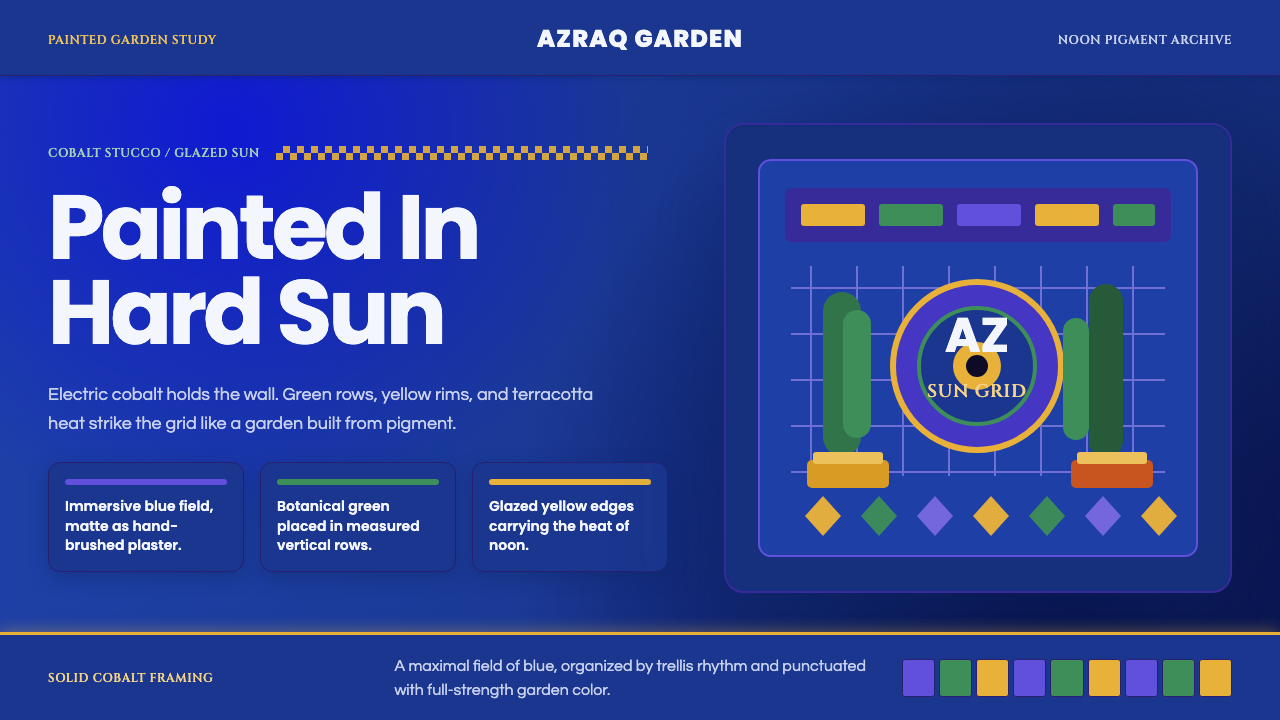 Jardin Majorelle BlueCobalt refuses restraint. Electric blue, glazed yellow and grid rhythm turn s…
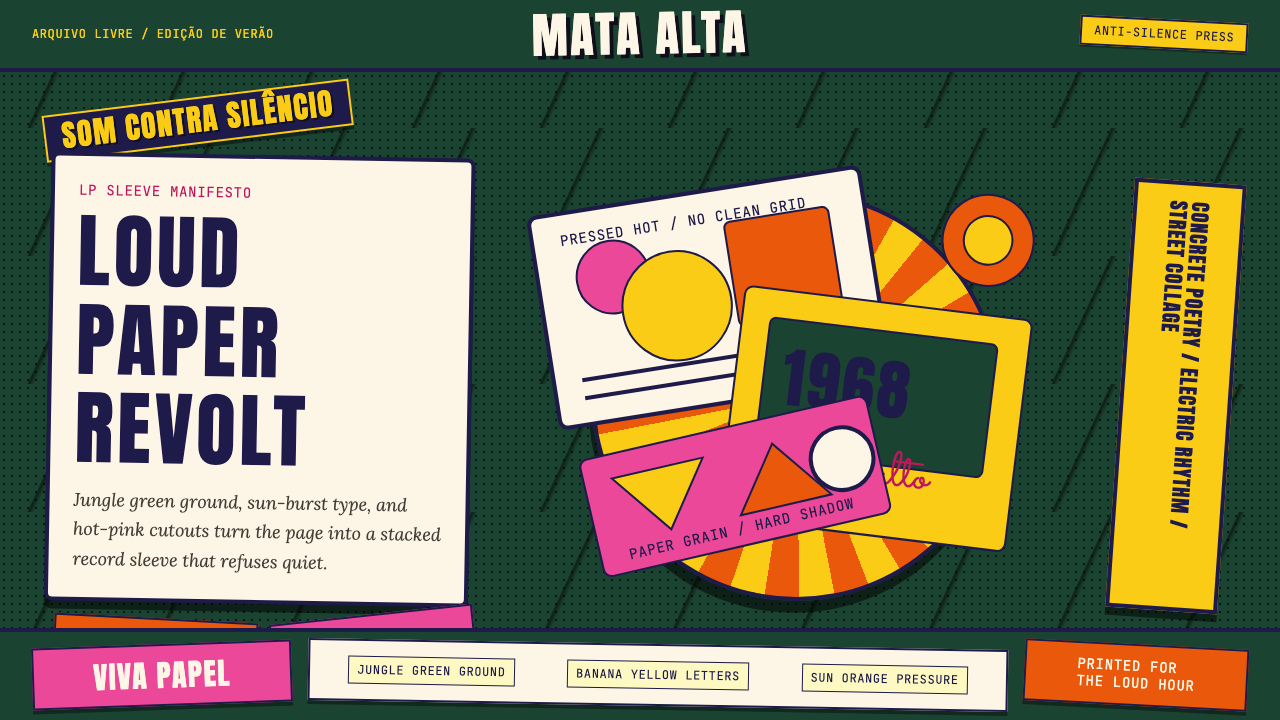 Brazilian Tropicália (1968)Art must be loud. Jungle green, banana yellow Anton type, and hard-shadow col…
 Alpine Ski PosterCold speed sells winter. Cobalt sky, snow planes, sun rays, and one resort-re…
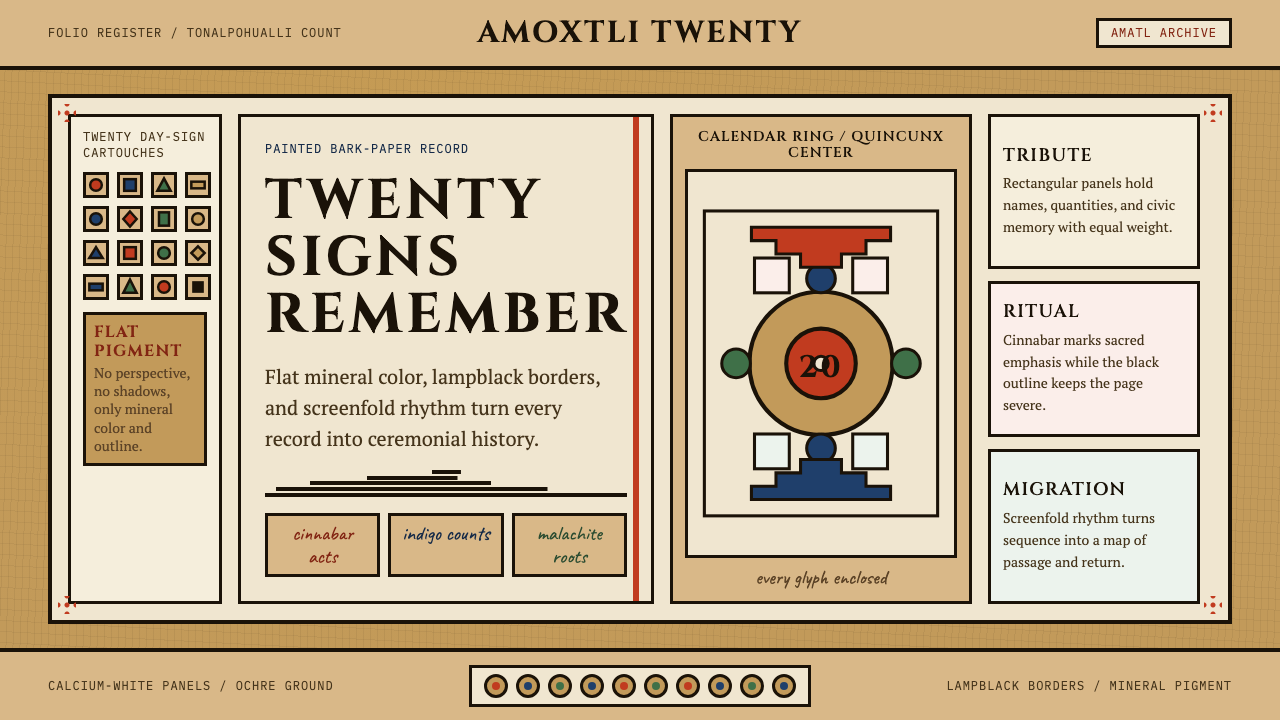 Aztec CodexSacred records stay severe. Ochre amatl ground, Cinzel capitals, black cartou…
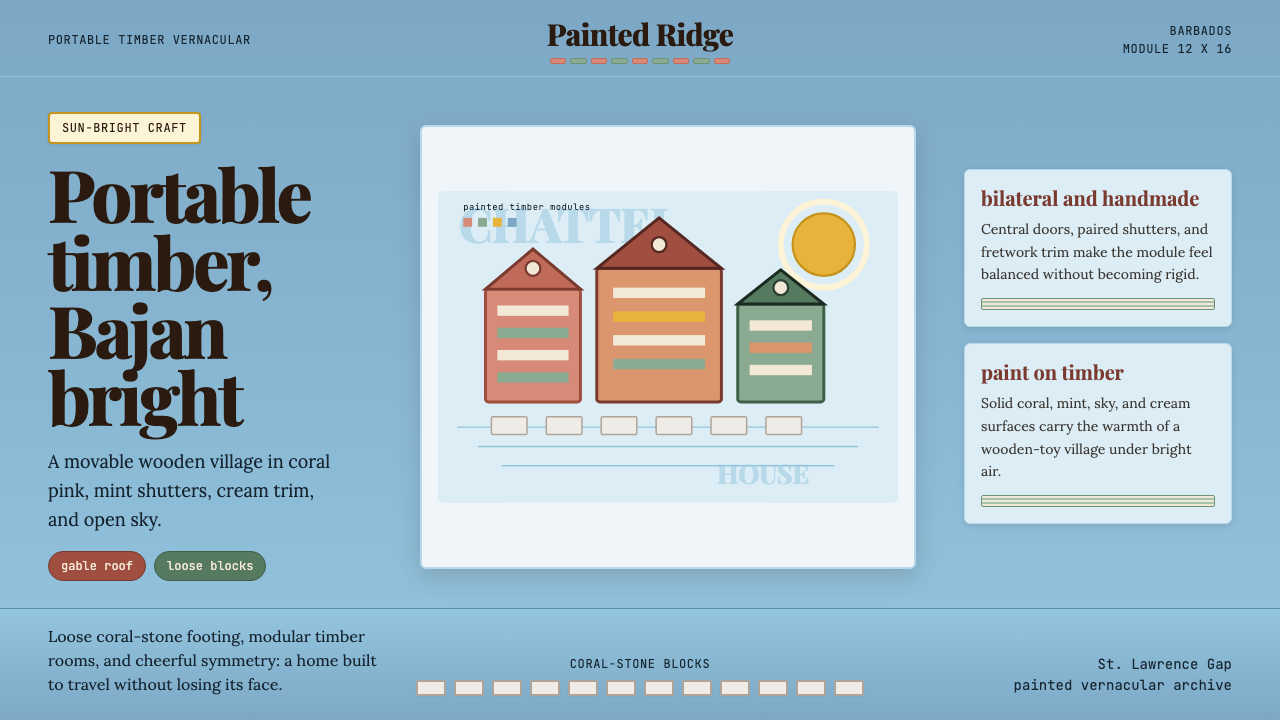 Barbadian Chattel HouseJoy made portable. Coral pink timber, mint shutters, sky-blue space, modular…
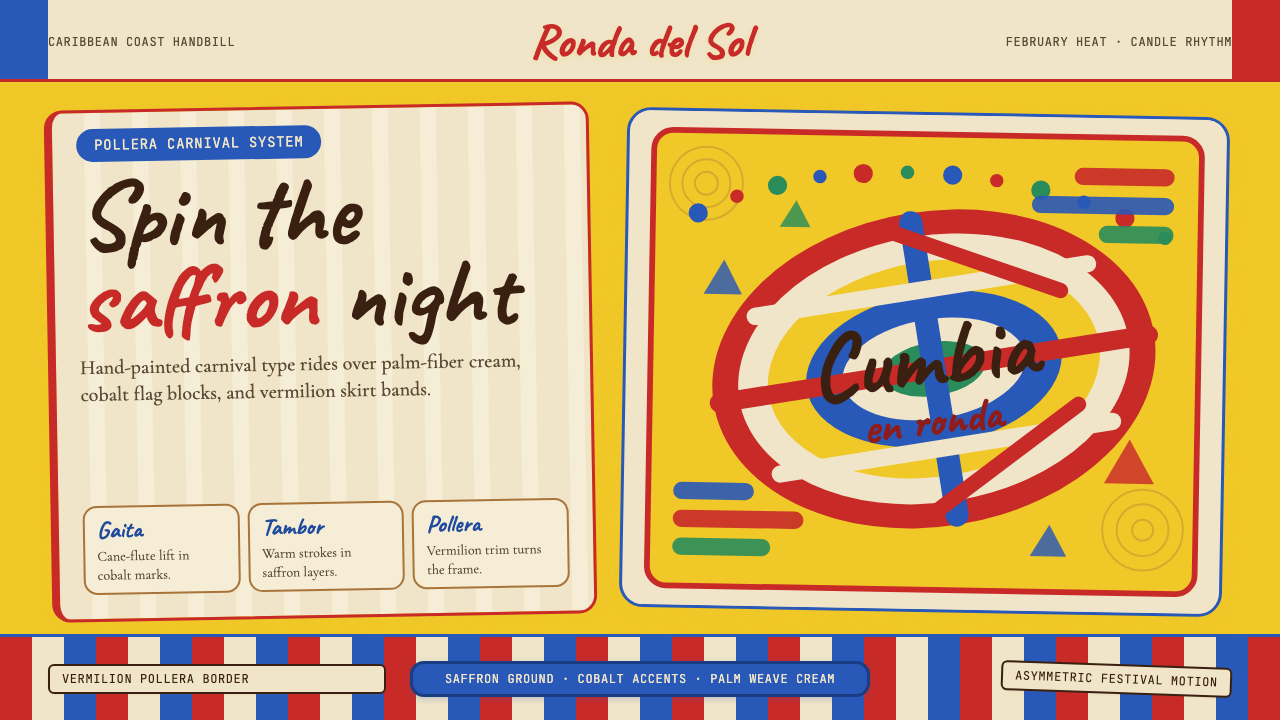 Colombian Cumbia (Pollera Carnival)Carnival heat spins. Saffron ground, Caveat script, vermilion stripes, cobalt…