What is Psychedelic Haight-Ashbury 1968?
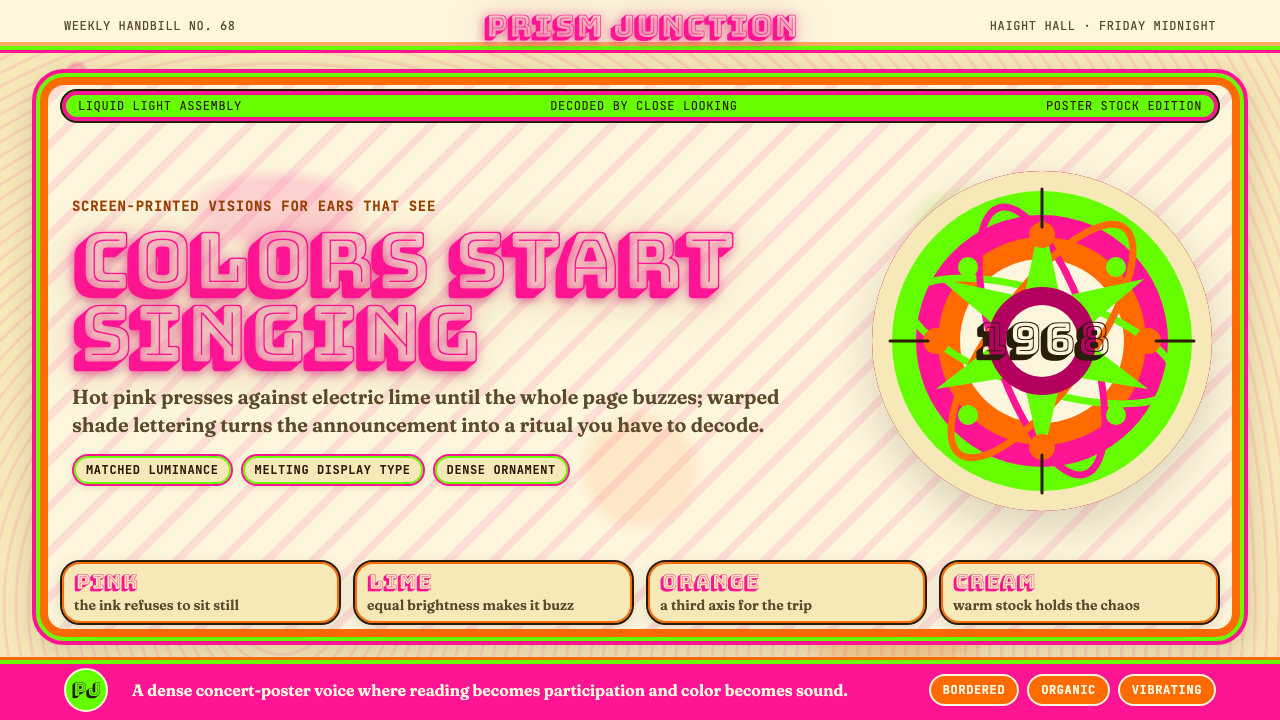
When Wes Wilson and Victor Moscoso made concert posters for the Grateful Dead and Jefferson Airplane, they turned color theory into controlled hallucination — hot pink against lime green, letterforms melting into vines, ink that vibrated on paper before you even read a word.
Psychedelic Haight-Ashbury 1968 in brief
Psychedelic Haight-Ashbury 1968 refers to the concert poster art that erupted in San Francisco's counterculture neighborhoods between roughly 1965 and 1971, reaching its visual peak during the Summer of Love in 1967 and the turbulent political year of 1968. It is a style defined by maximum chromatic tension: complementary colors — typically hot pink and acid lime, or deep violet and blazing orange — paired at nearly identical luminance so that the boundary between them appears to oscillate. The eye cannot resolve where one color ends and the other begins, producing an optical shimmer that was partly deliberate and partly a visual analog for the chemical experience the posters were advertising.
Typography in this style is radically anti-legibility. Letterforms swell, pinch, curve, and spiral; serifs extend into tendrils; counters fill with decorative infill. The Art Nouveau lettering of Alphonse Mucha and the Vienna Secession provided the historical template, but the psychedelic artists pushed those curves past elegance into something approaching visual dissolution. A poster by Wes Wilson might require real effort to decode — that difficulty was part of the point, rewarding the initiated viewer who paused long enough to read.
Ornamental illustration surrounds and interpenetrates the type: paisley swirls, celestial motifs, stylized faces and figures drawn in sinuous continuous line, all rendered at a density that leaves almost no bare ground. The overall effect is maximalist and immersive — a designed object that asks to be stared at rather than glanced at. This is a style built for posters pinned to walls and gazed at in dim light, not for quick navigation.

Where does Psychedelic Haight-Ashbury 1968 come from?
The geographic and cultural epicenter was San Francisco's Haight-Ashbury district, a Victorian neighborhood that became the gathering point for the counterculture beginning in 1965. The Fillmore Auditorium, operated by promoter Bill Graham, and the Avalon Ballroom, run by the Family Dog collective, were the primary venues commissioning the poster art. Both venues required weekly promotional posters for their concert series, creating an unusually high-volume, fast-turnaround context for a style that was simultaneously inventing itself. By 1967, poster artists were producing work that had no precedent in the mainstream commercial design of the time.
The historical antecedents were eclectic and self-taught. Wes Wilson, who designed some of the most recognizable early posters, discovered the sinuous letterforms of Alfred William Finch and the Vienna Secession through library browsing rather than formal art education. Victor Moscoso held a formal fine-arts education — he had studied at Yale under Josef Albers, whose color interaction theory directly informed Moscoso's strategy of pairing colors at matched luminance to maximize optical vibration. Moscoso was unusual among the group for consciously applying academic color theory to counterculture ends; most of his peers worked more intuitively.
The movement was also shaped by its production constraints. Early psychedelic posters were printed on newsprint-weight paper using offset lithography with limited color separations. Artists learned to exploit the way ink behaved on cheap stock — the slight dot gain and warm yellow cast of uncoated paper became aesthetic assets. The warm cream ground that characterizes many canonical posters was often simply the unprinted paper itself. When the posters gained collector status and began to be reprinted on heavier coated stock, they looked slightly wrong: too bright, too crisp, the color relationships subtly altered.
By 1968, the style had evolved and splintered. Rick Griffin — whose work for the Grateful Dead included some of the most complex and mystically charged imagery of the period — had pushed letterforms toward the edge of pure abstract pattern. Alton Kelley and Stanley Mouse, collaborating as a team, introduced imagery drawn from Art Deco, biker culture, and American vernacular that diversified the movement beyond its Art Nouveau origins. Bonnie MacLean, who took over many of the Fillmore poster commissions after Wilson, brought a cooler palette and tighter draftsmanship. The style that had been radical in 1966 had, by 1969, become recognizable enough to be parodied and commercialized — a cycle that the artists themselves mostly watched with ambivalence.
What defines the Psychedelic Haight-Ashbury 1968 look?
Vibrating Complementary Color
The defining visual move of the style is pairing colors that sit opposite each other on the color wheel — hot pink against acid lime, electric violet against blazing orange — at nearly identical luminance values. When two colors share the same perceived brightness but differ maximally in hue, the human visual system cannot process the boundary cleanly, producing an optical shimmer that appears to move. This is not an accidental effect: Moscoso studied it directly under Josef Albers and applied it deliberately. The palette is always high-saturation, never muted or dusty, and the warm cream of the poster ground reads as a neutral buffer between the competing chromatic fields.
Organic Morphing Letterforms
The typography of this style defies conventional readability. Letterforms inflate and deflate along their strokes, curve into arabesques, grow tendrils from their terminals, and merge with the surrounding illustration. The model is Art Nouveau lettering — especially the hand-lettered headings of the Vienna Secession and Alphonse Mucha — but pushed past decorative elegance into something that approaches dissolution. Reading becomes an act of decipherment. The implicit message is that this kind of seeing rewards time and attention; it is anti-scan-culture by design.
Dense Ornamental Ground
Where Bauhaus leaves negative space, the psychedelic Haight-Ashbury style abhors it. Every area of the composition that is not occupied by a letterform is filled with swirling illustration: paisley patterns, flame motifs, celestial bodies, stylized human and animal figures, and continuous flowing line that weaves through the entire composition. The density is intentional and immersive — it creates a total visual environment rather than an organized hierarchy of information. The eye is invited to wander rather than to follow a predetermined path.
Warm Poster-Paper Ground
The baseline tone of the composition is a warm, slightly yellowed cream — not pure white and not a heavily tinted color. In the original posters, this was simply the color of uncoated newsprint-weight paper. It gives the chromatic pairs room to vibrate without competing directly with the ground. When working digitally or on coated stock, this warmth must be deliberately reintroduced, as pure white backgrounds make the color relationships harsher and slightly brittle, destroying the soft luminosity that characterizes the authentic look.
Continuous Sinuous Line
Illustration in this style is built almost entirely from continuous, flowing line rather than flat filled shapes or rendered tonal areas. The line is typically of varied weight — swelling where it curves, thinning at straights — creating an organic rhythm that echoes calligraphy and botanical illustration simultaneously. This line quality connects the style to its Art Nouveau antecedents but also gives it a hand-made immediacy that distinguishes it from the mechanically-reproduced commercial illustration of the same period.
Circular and Radial Composition
Many psychedelic posters organize their composition around a central radial axis — elements spiral outward from a focal point, text arcs around curves rather than sitting on horizontal baselines, and the overall shape of the design tends toward the circular rather than the rectangular. This compositional logic reinforces the sense of movement and transformation, as if the design is itself rotating or breathing. It stands in direct contrast to the grid-anchored asymmetric balance of Bauhaus work or the mathematical column logic of Swiss International Style.
Historical Collage of Influences
The style is a conscious collage of historical references rather than a unified formal system. Art Nouveau organic curves, Victorian ornamental borders, Eastern mandala geometry, Native American decorative motifs, and the optical experiments of Op Art all coexist within single compositions. This eclecticism was partly a product of the self-taught, library-browsing research methods of the artists involved, and partly a deliberate statement that all traditions were equally available to the counterculture sensibility — that no single cultural hierarchy determined what could be combined with what.

Who shaped Psychedelic Haight-Ashbury 1968?
Wilson is generally credited with inventing the warping, barely-legible letterform style that became the signature of San Francisco psychedelic poster art. Working primarily for the Fillmore Auditorium from 1966, he developed his hand-lettering approach by studying the display typography of the Vienna Secession, particularly the work of Alfred William Finch, which he encountered in the San Francisco Public Library. His innovations included the characteristic technique of letting letter spacing tighten to near-collision so that the overall mass of text reads as a dense visual field before individual words resolve. He produced over fifty Fillmore posters before breaking with Bill Graham in 1967 over compensation disputes.
Moscoso is distinctive within the group for having formal academic training in color theory — he studied under Josef Albers at Yale, where Albers's color interaction exercises explored exactly the kind of simultaneous contrast and optical vibration that became Moscoso's primary tool. His posters for the Avalon Ballroom are among the most technically sophisticated of the period, demonstrating a controlled command of chromatic tension that his more intuitively working peers could not always match. After the poster era, Moscoso became a significant figure in underground comics, collaborating with Robert Crumb on Zap Comix and bringing the same high-contrast visual energy to the comics page.
Griffin's work for the Grateful Dead — particularly the iconic skeleton-and-roses imagery that became closely identified with the band — pushed the style toward its most complex and mystically charged expression. A devout Christian who had converted during the psychedelic period, Griffin brought an intense spiritual seriousness to his imagery that distinguished it from the more celebratory or politically charged work of his peers. His letterforms, by the late 1960s, had evolved to the point where they were barely functional as text at all — closer to medieval illuminated manuscript marginalia than to commercial advertising — and his compositions became increasingly dense with symbolic imagery drawn from religious iconography across multiple traditions.
Mouse and Kelley worked as a collaborative team, producing some of the period's most visually inventive posters through a practice that often involved collaging historical imagery — Victorian trade cards, Art Deco graphics, biker culture ephemera — into new psychedelic contexts. Their most famous work, the skull-and-roses image for the Grateful Dead drawn from a nineteenth-century piece by Odillon Redon, established a practice of recycling and recontextualizing earlier imagery that anticipated later postmodern appropriation art. Kelley brought draftsmanship and compositional instinct; Mouse contributed lettering and the entrepreneurial energy that helped establish their poster business.
MacLean took over many of the Fillmore poster commissions following Wes Wilson's departure in 1967 and produced some of the most refined work of the period. Her palette tended toward cooler, deeper hues than the acid pinks and lime greens favored by Wilson and Moscoso, and her draftsmanship — she had a background in fine art — gave her figures and letterforms a sculptural solidity that distinguished her work from the more liquefied quality of her predecessors. MacLean is among the most underrecognized figures of the movement; her relative obscurity compared to her male peers reflects patterns of attribution in art history that the psychedelic poster field shares with many other mid-century design contexts.
How do you use Psychedelic Haight-Ashbury 1968 today?
Psychedelic Haight-Ashbury 1968 is not a neutral or universally applicable style. It arrives with strong cultural associations — counterculture, music, liberation, sensory intensity — and those associations cannot be fully separated from the aesthetic. Used well, it signals a particular kind of playfulness and maximalist confidence; used carelessly, it reads as retro pastiche or, in commercial contexts, as cynical nostalgia marketing. The first question before applying this style is always whether its cultural freight is appropriate to the product and audience.
For presentation slides, the style works best in contexts where the content itself is bold and the audience is receptive to unconventional visual approaches: keynotes for creative conferences, brand narrative decks for music or culture-adjacent companies, internal presentations where personality is valued over formality. A cover slide in this style should commit fully: a warm cream ground, high-saturation complementary color pair for the principal graphic element, hand-lettered or display-weight type for the title, and dense illustrative ornament filling the areas around the headline. Content slides should pull back considerably — use the palette and illustrative border elements to establish continuity, but keep body text in a legible, relatively neutral setting. Data slides can use the color logic — pairing complementary hues for contrast in charts — without attempting to render the charts themselves in the ornamental style.
For web interfaces, this style is most appropriate for music platforms, festival and event sites, wellness and cannabis brands, and cultural institutions with counterculture affiliations. Navigation and functional elements should remain legible — the ornamental intensity should be concentrated in hero sections, feature headers, and decorative dividers, not applied uniformly to every interactive element. A common and effective approach is to use the full ornamental vocabulary at large breakpoints and progressively simplify toward mobile, where the complementary color pairing and warm ground can carry the aesthetic identity without the dense illustration.
For editorial and marketing work, the style is well suited to poster-format content: event announcements, album covers, music festival collateral, brand activations in physical spaces. It is less suited to long-form reading contexts, where the anti-legibility of the typography becomes a genuine obstacle rather than a rewarding puzzle. Marketing pages for the right brands — those with genuine counterculture positioning, not just aesthetic borrowing — can use the style effectively for above-the-fold hero sections with more conventional content treatment below. Editorial spreads benefit from framing body text in a standard, highly readable setting while using psychedelic headers, drop caps, and section dividers to establish visual character.
The most common mistake when applying this style is treating the complementary color pairing as straightforward decoration without understanding the luminance matching principle that makes it work. Simply placing hot pink next to lime green does not produce the optical vibration effect unless both colors are calibrated to a similar perceived brightness. When the luminance relationship is wrong — when one color is dramatically lighter or darker than its complement — the result is harsh contrast rather than shimmer, which reads as merely loud rather than hypnotically energized. A second frequent error is applying the ornamental density without the underlying linear discipline: the psychedelic poster style is extremely detailed but not chaotic — every element is drawn with intention and the continuous line quality gives the whole composition structural coherence even at maximum density.

Psychedelic Haight-Ashbury 1968 — FAQ
Is Psychedelic Haight-Ashbury 1968 the same as general 1960s or 1970s retro?
No. The psychedelic poster style is a specific and technically sophisticated visual system that differs from generic 1960s or 1970s graphic design in several ways. It is not tie-dye, it is not mod geometric pattern, it is not the flat-color simplicity of push-pin illustration, and it is not the earth-tone softness of mid-1970s design. Its defining characteristics — luminance-matched complementary color vibration, organic morphing letterforms, dense continuous-line illustration — are precise techniques, not vague period atmosphere. The style can be applied well or badly, and understanding what distinguishes it from adjacent period looks is the first step toward applying it well.
How do you handle legibility when the typography style is intentionally difficult to read?
The original poster artists worked in a context where the primary delivery mechanism was a physical poster viewed at close range, often in low light, by an audience that was already familiar with the artists and venues and was using the poster as much for aesthetic pleasure as for informational content. Contemporary digital contexts are almost never this forgiving. The practical approach is to apply the anti-legibility typography selectively: use it for display text — headlines, event names, section titles — where decoding effort is appropriate and the text is short enough to reward it. Use standard, highly legible type for all body copy, navigational elements, calls to action, and any text that needs to be read quickly or under adverse conditions. The psychedelic style can frame legible content without requiring that all content be rendered in the distorted mode.
Can this style work for serious or corporate contexts, or is it only appropriate for entertainment and counterculture brands?
It is extremely difficult to apply this style in genuinely serious or conventional corporate contexts without the style dominating and undermining the content. The cultural associations are simply too strong: psychedelic poster art carries connotations of informality, pleasure, and anti-establishment sensibility that cannot be neutralized by careful typography or subdued color choices. Attempting to apply the style to, say, a financial services firm or a healthcare provider is almost certain to produce cognitive dissonance. The exceptions are narrow: a pharmaceutical company with a genuine connection to the history of LSD research, a finance firm specifically targeting creative industry clients, or a healthcare provider in the cannabis or psychedelic-assisted therapy space. Outside those narrow lanes, the honest advice is to choose a different style whose cultural freight aligns more naturally with the product.
How does this style differ from Art Nouveau, which is one of its stated influences?
Art Nouveau, particularly in its fin-de-siècle French and Belgian expressions, sought to elevate the decorative arts to the status of fine art through exquisite craftsmanship, refined color harmony, and organic line of restrained elegance. The psychedelic poster style borrows Art Nouveau's organic line and the sinuous letter forms of its graphic designers, but amplifies them past elegance into deliberate excess. Color in Art Nouveau is sophisticated and often muted — Mucha's palette tends toward dusty rose, sage green, and warm gold. Psychedelic color is maximally saturated and antagonistically paired. Art Nouveau aims at beauty; psychedelic Haight-Ashbury aims at disruption, at overloading the senses in ways that paralleled the chemical and musical experiences it was advertising. The lineage is clear but the intent and effect are quite different.
What makes a contemporary application feel authentic rather than merely retro?
Authenticity in applying a historical style comes from understanding and applying the underlying structural principles rather than copying surface features. A contemporary design that simply reproduces the period palette and adds some wavy text and swirling ornament will read as costume — nostalgia marketing rather than genuine engagement with a visual tradition. What distinguishes an authentic application is the structural logic: actually calibrating the complementary color pair to matched luminance so the optical effect is present and not merely approximated; building illustration from continuous sinuous line rather than from digital fills and shapes; treating the warm ground as a genuine neutral rather than as one of several background options; allowing typography to distort in ways that reflect the organic logic of the style rather than applying a generic warp filter. The counterculture context was not incidental to the style — it was the condition of its production. Contemporary applications that engage with that context meaningfully, rather than emptying the style of its cultural content, are the ones that avoid the retro-pastiche trap.
Related design styles
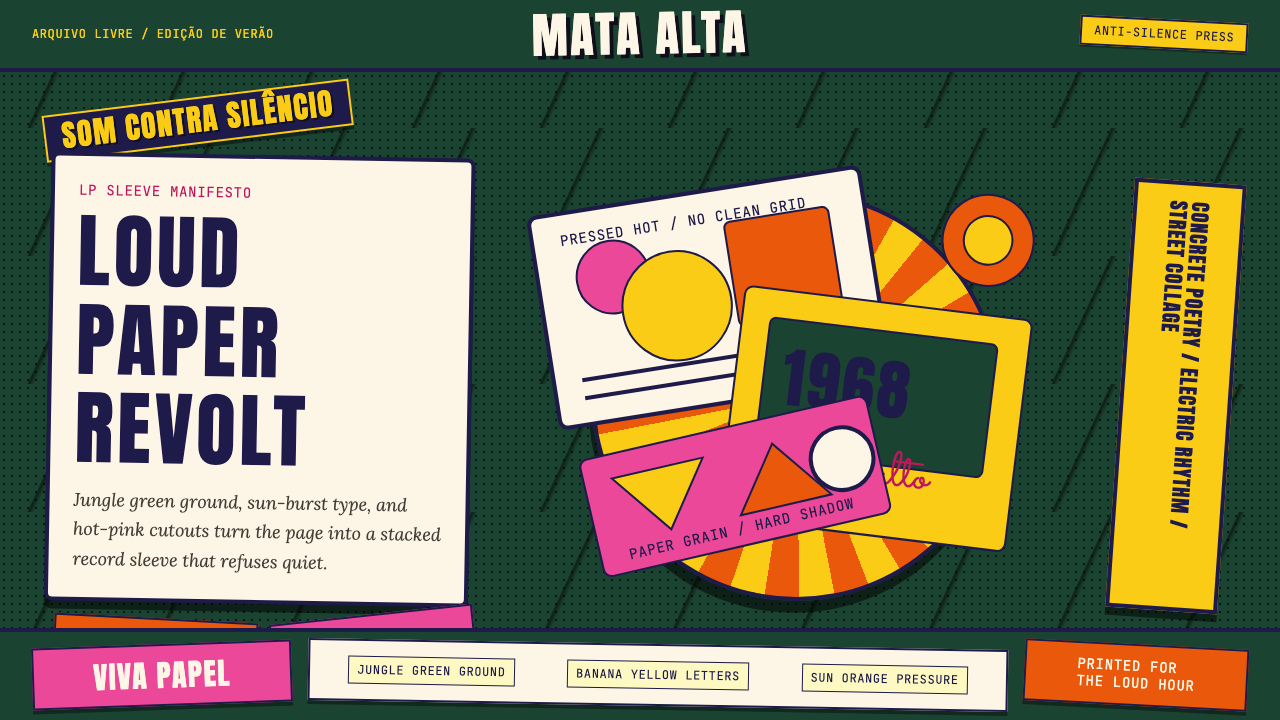 Brazilian Tropicália (1968)Art must be loud. Jungle green, banana yellow Anton type, and hard-shadow col…
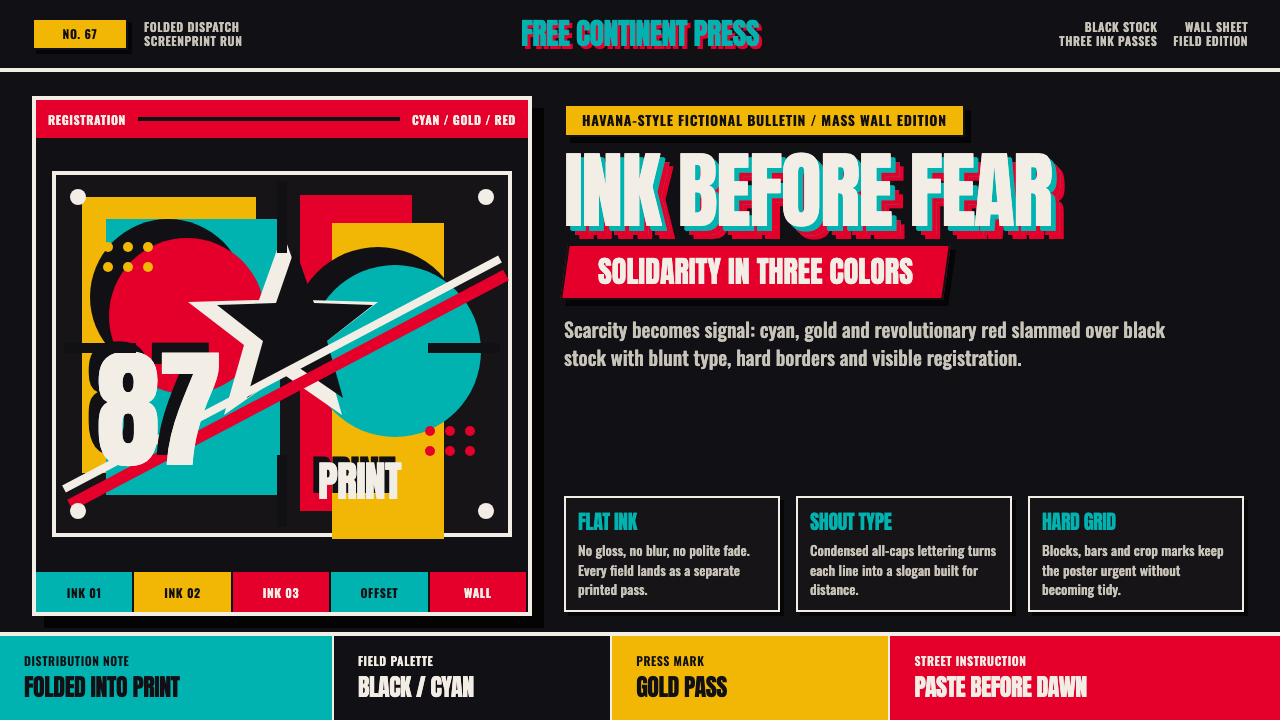 Cuban OSPAAAL Tricontinental PosterUrgency from scarcity. Cyan, gold and red slam over black in blunt silkscreen…
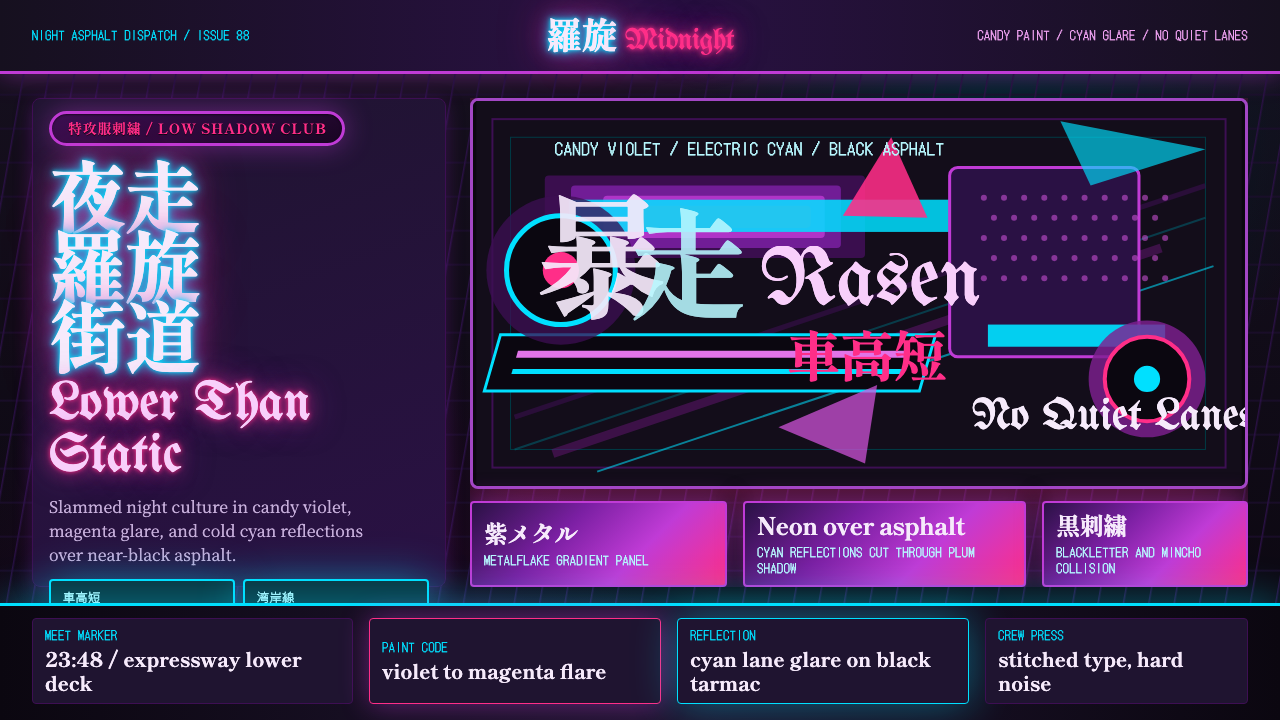 JDM BosozokuNight culture shouts. Candy violet, cyan neon, and stacked Mincho-blackletter…
 Lucha Libre PosterStreet-poster voltage. Yellow Anton banners, crimson diagonals, cobalt grids…
 Aboriginal Dot PaintingAncient story-map energy. Red ochre, bone dots, concentric circles, and U-mar…
 Aboriginal Dot Painting (Papunya 1971)Ochre memory, held steady. Raw umber ground, Cormorant type, disciplined dot-…