What is Mexican Día de Muertos (Marigold Ofrenda)?
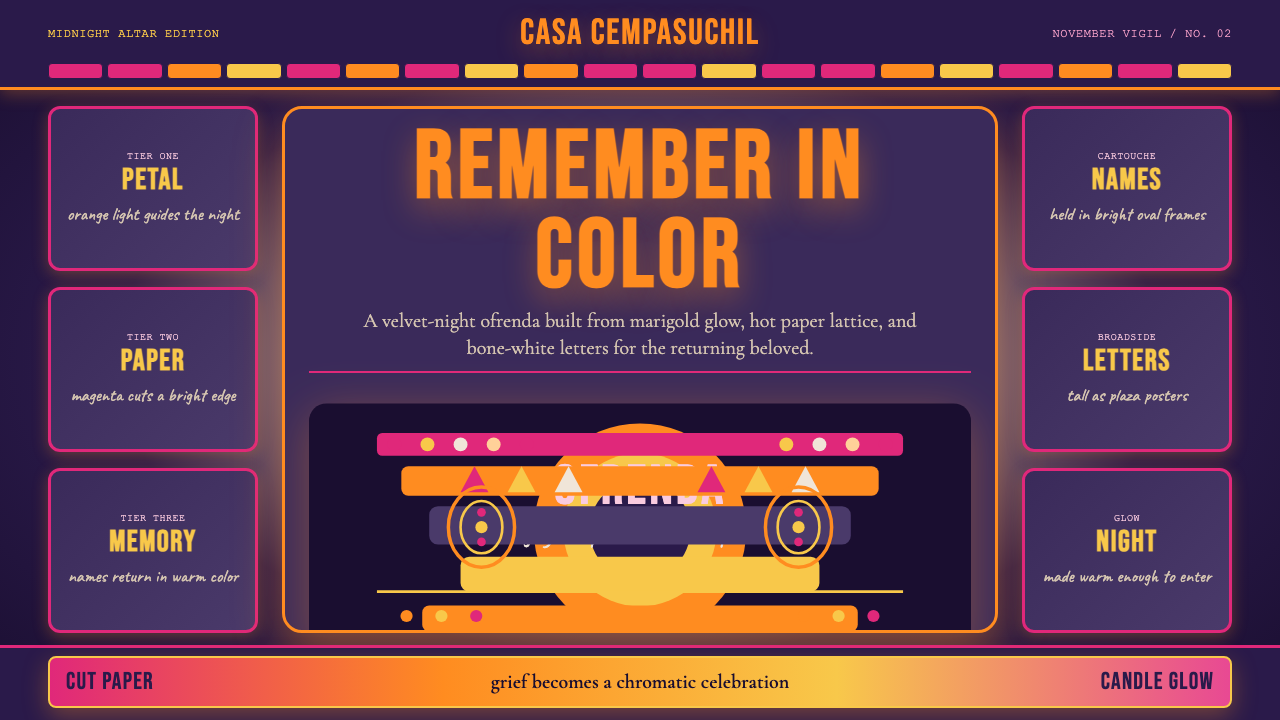
Día de Muertos wraps grief in blazing marigold light — a design tradition where death becomes the most vivid reason to celebrate.
Mexican Día de Muertos (Marigold Ofrenda) in brief
Mexican Día de Muertos (Marigold Ofrenda) is a design system rooted in one of the Americas' most visually arresting ritual traditions: the annual November altar-building ceremony in which Mexican families honor their dead with multi-tiered ofrendas draped in cempasúchil marigold blossoms, cut-paper banners, sugar skulls, candles, and photographs. The visual language that emerges from this tradition is unmistakably bold — deep velvet-purple grounds blazing with marigold orange, hot magenta, and candle-flame yellow, all edged by the crisp geometric lacework of papel picado.
What makes this style distinctive is its treatment of contrast and celebration as moral arguments. The darkness of midnight velvet is not somber — it is a stage that makes the warm fluorescent tones of marigold petals glow with even greater intensity. The style refuses the Western convention that equates death with muted palettes and restrained form. Instead, it insists that remembrance is an act of visual generosity: every element is given maximum presence, every color earns its place by radiating warmth.
The aesthetic operates simultaneously on two registers: the sacred geometry of the ofrenda's tiered structure and the exuberant folk craft of cempasúchil arrangements and papel picado. These two registers — sacred order and festive ornament — are not in tension but in dialogue. The result is a visual system that feels both ceremonially precise and emotionally abundant, organized without being cold, decorative without being frivolous.
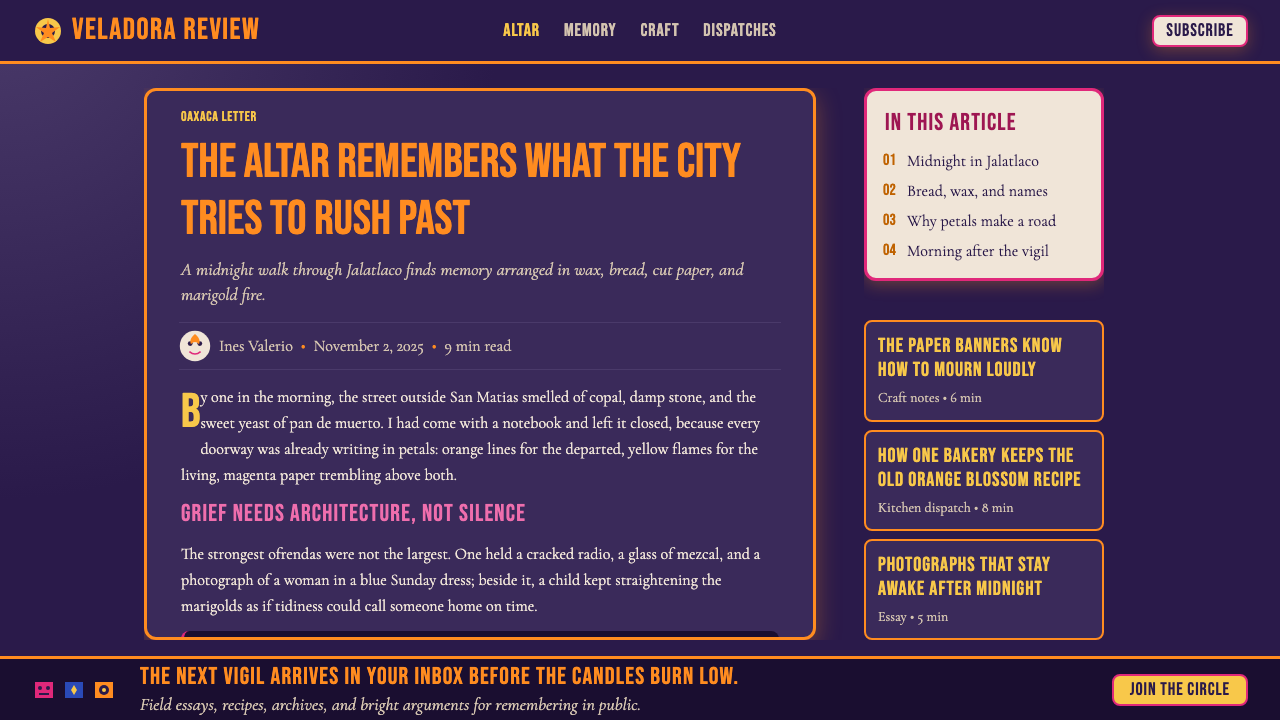
See the Mexican Día de Muertos (Marigold Ofrenda) design system
Where does Mexican Día de Muertos (Marigold Ofrenda) come from?
The roots of Día de Muertos stretch back to pre-Hispanic Aztec civilization, which held elaborate months-long festivals honoring the dead — particularly in the ninth month of the Aztec solar calendar, dedicated to Mictecacihuatl, the Lady of the Dead. Cempasúchil marigolds were central to these rites: their intense fragrance and blazing color were believed to guide the souls of the departed back to the world of the living. The flower's path from field to altar was not merely decorative but navigational, a luminous road of petals.
When Spanish conquistadors arrived after 1521 and Catholic missionaries followed, they encountered these deeply embedded death practices and made a calculated decision to overlay rather than eradicate them. The Aztec festivals were merged with the Catholic feasts of All Saints' Day and All Souls' Day (November 1 and 2), producing a syncretic tradition that retained the marigold petals, the offerings of food and objects, and the idea of the dead returning to visit, while absorbing Christian prayers and iconography. The ofrenda's multi-tiered structure, for instance, reflects both pre-Hispanic cosmological layers and Catholic altar conventions.
The tradition acquired much of its contemporary visual character in the nineteenth century, particularly through the work of printmaker and caricaturist José Guadalupe Posada (1852–1913). Posada's calaveras — satirical broadside illustrations featuring skeletons in everyday bourgeois dress — cemented the irreverent, witty relationship with death that defines the festival's tone. His most enduring creation, La Catrina (a elegantly dressed female skull), was later immortalized by Diego Rivera in his monumental 1947 mural Dream of a Sunday Afternoon in Alameda Park, which helped elevate Posada's folk imagery into the canon of Mexican national art.
After the Mexican Revolution (1910–1920), Día de Muertos became a focal point of postrevolutionary nationalist cultural policy. The muralist movement — Diego Rivera, José Clemente Orozco, David Alfaro Siqueiros — positioned indigenous and syncretic traditions as the authentic foundation of Mexican identity, in explicit contrast to European colonial aesthetics. Octavio Paz, in his landmark 1950 essay collection The Labyrinth of Solitude, argued that the Mexican attitude toward death — festive, intimate, ironic — was itself a philosophical stance, a way of domesticating mortality that distinguished Mexican culture from the death-denial of the industrialized North. UNESCO recognized Día de Muertos as an Intangible Cultural Heritage of Humanity in 2008, which formalized the tradition's global standing while also stimulating careful discussions about authenticity and commercialization.
What defines the Mexican Día de Muertos (Marigold Ofrenda) look?
Color
The palette centers on a deep velvet purple as the primary ground, evoking the midnight sky above an illuminated altar. Against this darkness, marigold orange functions as the dominant accent — warm, fluorescent, and insistent, like the petals themselves. Hot magenta provides the sharpest contrast, drawn from the cut-paper decorations that frame ofrendas. Candle-flame yellow adds warmth without softening the overall drama. These colors are never muted or desaturated; their job is to glow, to be seen from a distance, to guide the way.
Pattern and Surface
Papel picado — the traditional cut-paper banners hung above ofrendas — supplies the style's signature geometric lattice. Designs are based on repeated diamond, skull, floral, and chevron motifs punched or cut with geometric regularity, creating a surface that is simultaneously ornamental and structural. This lacework quality appears as borders, dividers, and background textures. The key characteristic is that the pattern is always defined by what is removed — the negative space of the cut — rather than by what is added.
Typography
The typographic register draws on two distinct traditions: the condensed, high-contrast letterforms of Posada's nineteenth-century broadside engravings (impact-style display type, used for headlines and festival banners) and the more refined literary serif tradition of Mexican editorial culture. In practice, this means headlines carry weight and urgency — tight letter spacing, bold stroke contrast — while body text benefits from serif elegance that grounds the celebratory surface. Decorative letterforms with skull or floral insets appear as special-occasion elements, not as everyday text.
Light and Glow
The ofrenda is a lit environment — dozens of candles illuminate it from within. This quality of internal luminosity is central to the style: warm tones appear to emit light rather than reflect it. Halos, bloom effects, and soft radiance around key elements mimic the candlelight glow that defines the nighttime altar. This is one of the few design traditions where glow is not decorative excess but a direct reference to the ritual context — the light that guides the returning dead.
Iconography
The style carries a specific and historically grounded set of icons: the calavera (decorative skull), the cempasúchil blossom in full face, the monarch butterfly (believed to carry the souls of the dead), the marigold petal path, the ofrenda's tiered silhouette, and the candle flame. These are not arbitrary decorations but symbolic anchors with specific meanings in the ritual context — each item placed on a real ofrenda serves a function, and the same precision carries into design use. Sugar skull motifs, in particular, follow rules: symmetrical decoration, floral patterning in the eye sockets, and a palette that mirrors the overall warm-on-dark scheme.
Composition and Layering
The ofrenda's physical structure — multiple ascending tiers, each level hosting its own arrangement of objects — translates into design compositions that use vertical layering and depth to create hierarchy. Foreground elements (photographs, sugar skulls, candles) sit above middle-ground decorations (marigold carpets, cut-paper banners) which sit above the dark ground. This sense of depth is achieved through scale, overlap, and tonal shift rather than perspective drawing. Compositions are typically centered or radially balanced — the altar's bilateral symmetry is a model — with asymmetric festive elements breaking the formality at the edges.
Texture
Velvet, petal, paper, wax, and bone: the style's material reference points are specific and tactile. In digital work, these translate not into literal texture overlays but into the qualities of surfaces — the slight softness of a velvet ground versus the crisp geometric edge of cut paper, the warm blur of candlelight versus the clean outline of a calavera. Texture is evoked through the relationship between elements rather than applied as a filter. The palette itself carries textural information: deep purple reads as velvet, marigold orange reads as petal, hot magenta reads as dyed tissue paper.
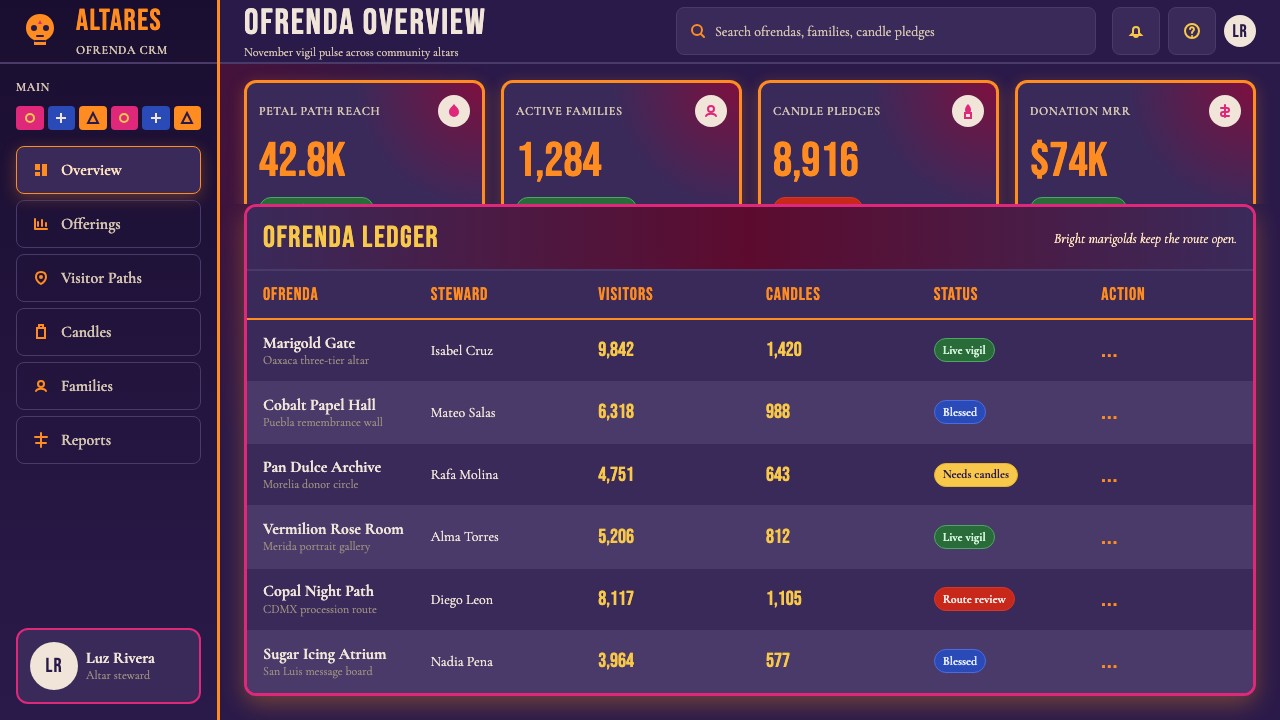
See the Mexican Día de Muertos (Marigold Ofrenda) design system
Who shaped Mexican Día de Muertos (Marigold Ofrenda)?
Posada (1852–1913) was a prolific Mexican printmaker and illustrator whose calavera broadside engravings — skeletal figures dressed as politicians, dandies, and society ladies engaged in everyday activities — established the irreverent visual vocabulary that defines Día de Muertos iconography. His most enduring creation, La Calavera Garbancera (later renamed La Catrina by Diego Rivera), showed death as a dandified aristocrat, skewering class pretension with dark humor. Posada worked in a deliberately popular register, producing cheap printed ephemera distributed on the streets of Mexico City, and his willingness to make death simultaneously funny and fearless set the aesthetic tone for all subsequent design in the tradition.
Rivera (1886–1957) did more than any other figure to elevate Día de Muertos imagery from popular folk art to high national culture. His 1947 mural Dream of a Sunday Afternoon in Alameda Park placed Posada's La Catrina at the center of a grand panorama of Mexican history, surrounding her with figures from the colonial period to the Revolution. Rivera also systematized the use of marigold and ofrenda imagery in monumental public art, and his close collaboration with Frida Kahlo — whose own work absorbed the visual language of death and folk tradition — amplified both artists' influence on how the world understands Mexican visual culture.
Kahlo (1907–1954) brought Día de Muertos iconography — skulls, marigolds, ex-votos, folk saints — into the tradition of self-portrait painting, making the intersection of death, pain, and vibrant color a personal and political statement rather than merely a seasonal ritual. Her palette of deep reds, bright yellows, and warm terracottas against dark grounds closely parallels the ofrenda color logic. Kahlo's work also demonstrated that the tradition's festive relationship with mortality could support genuine emotional complexity, not just celebration — a nuance that design applications of the style must reckon with.
Paz (1914–1998), Nobel Prize laureate and Mexico's most internationally recognized poet-essayist, provided the philosophical framework through which Día de Muertos acquired its cultural meaning for a global audience. His 1950 essay 'The Day of the Dead' in The Labyrinth of Solitude argued that the Mexican relationship with death — festive, intimate, ironic — was a form of philosophical courage: by making death a party guest, Mexicans refused the terror that death-denial produces. Paz's analysis shifted the tradition from ethnographic curiosity to philosophical statement, which in turn shaped how designers and artists approach the style: not as macabre novelty but as a coherent worldview expressed through color and form.
How do you use Mexican Día de Muertos (Marigold Ofrenda) today?
Día de Muertos (Marigold Ofrenda) is a high-presence style — it announces itself immediately and creates strong emotional associations with warmth, celebration, and cultural specificity. Applying it correctly requires understanding that the palette's power comes from the dark ground, not from the warm accents alone. If you lift the marigold and magenta onto a white or light background, you lose the fluorescent glow that defines the style. The deep velvet purple (or near-black) ground is not optional; it is what makes the warm tones sing.
For presentation slides, the style excels on ceremonial or celebratory content: festival announcements, cultural event programs, heritage brand launches, annual report covers for organizations with a strong identity story to tell. A cover slide works best with a deep-ground full bleed, the title set in high-contrast warm type, and a central motif — a marigold rosette, a calavera silhouette, a papel picado border — that anchors the composition. Content slides should use the dark ground with reduced visual density: one warm accent color per slide, geometric dividers in the papel picado lattice style, and body text in a clean legible face that does not compete with decorative elements. Data slides can use marigold orange and magenta as category colors against the dark ground, treating bar charts and donut charts as stained-glass-like arrangements.
For web interfaces, this style is best suited to cultural organizations, festival platforms, artisan marketplaces, and heritage brands where the celebration of cultural identity is the product itself. A dashboard in this style should use the deep purple as the sidebar or header ground, with marigold orange reserved for primary interactive states (active navigation items, primary buttons, key metrics). Hot magenta works well for alert states and secondary calls to action. The papel picado pattern makes an excellent structural divider between sections — rendered as a thin geometric border rather than a full-bleed texture — and iconography should draw from the ritual vocabulary: stylized blossoms, candle silhouettes, butterfly motifs.
For editorial and marketing work, the style supports rich, immersive full-page layouts. A feature article or campaign spread benefits from alternating full-bleed dark sections with marigold accent photography treated as warm-toned cutouts. Marketing materials for cultural events, food brands with Mexican heritage, or tequila and mezcal brands can use the style's full register: deep grounds, the complete warm palette, papel picado borders, and calavera-inspired display lettering. The style also works well for seasonal campaigns — Halloween-adjacent content, Día de Muertos programming, autumn harvest themes — where warmth and darkness together create the right atmospheric register.
The most common mistake when applying this style is treating it as a Halloween palette in disguise: orange and black without the velvet depth, the warmth, the floral density, or the cultural specificity. Authentic application requires committing to the full visual logic — the deep purple ground, the layered composition, the papel picado geometry, and the specific symbolic vocabulary. A second common mistake is desaturating or softening the palette to make it feel more neutral or corporate. The style's communicative power depends on its boldness; taming it produces neither authentic Día de Muertos nor a coherent neutral alternative. If boldness is inappropriate for the context, a different style is the answer.
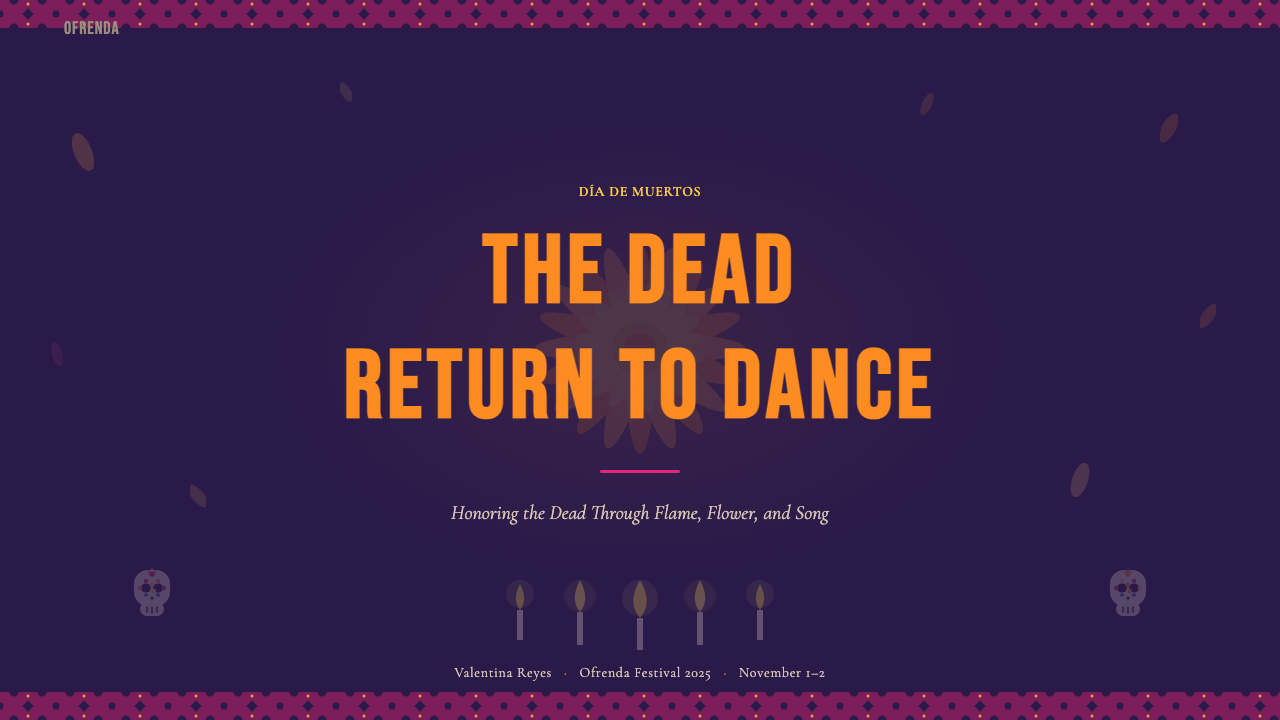
See the Mexican Día de Muertos (Marigold Ofrenda) design system
Mexican Día de Muertos (Marigold Ofrenda) — FAQ
Is this style appropriate for contexts outside Mexican culture?
The style is transferable but carries cultural weight that requires honest handling. It works well for contexts that have a genuine thematic connection to the tradition's values — celebration of life and memory, festive rituals, vibrant cultural identity, seasonal ceremonies — regardless of geography. It works poorly, and risks feeling appropriative, when applied as pure visual novelty with no thematic connection to what it represents. The distinction is between using the style's visual logic to express something genuinely aligned with its meaning, versus borrowing the palette and motifs as decoration while ignoring the tradition's depth. When in doubt, connecting the usage to at least one of the style's core themes — the beauty of remembrance, the warmth of communal ritual, the dignity of honoring the dead — is the honest path.
How do I prevent this style from reading as Halloween rather than Día de Muertos?
The distinction lies in warmth, depth, and specificity. Halloween palettes trend toward flat orange and black with a theatrical, spooky register. Día de Muertos palettes are distinguished by the velvet purple ground (not black), the fluorescent warmth of marigold orange (not pumpkin orange), the addition of hot magenta, and the candle-flame yellow. The iconography is also specific: calavera skulls are elaborately decorated with floral patterns and warm colors, not skeletal and threatening. Marigold blossoms, monarch butterflies, and papel picado banners have no Halloween equivalents. Committing to these specific elements — and avoiding generic cobweb, bat, and jack-o-lantern imagery — keeps the cultural reference clear.
Can this style work for a light-background interface?
Technically yes, but at the cost of one of the style's defining qualities. The ofrenda's visual power depends on warm tones glowing against a dark ground — this is the fluorescent quality that makes marigold orange look alive. On a white or cream background, marigold and magenta become warm accents rather than glowing emitters, and the result reads as a cheerful Latin-inspired palette rather than the specific ceremonial register of Día de Muertos. A light variant works better when used sparingly — perhaps for print materials or a section of a page — and when the deep purple is brought in as a structural element (a header bar, a full-width section) to preserve some of the original contrast dynamic.
What makes skull imagery in this style different from generic skull motifs?
Día de Muertos calavera skulls follow a specific decorative grammar that distinguishes them sharply from the threatening or generic skulls common in heavy metal imagery, pirate iconography, or Halloween decoration. The calavera is always adorned rather than bare: floral patterns fill the eye sockets, chevron and diamond motifs decorate the cranium, and warm colors — marigold, magenta, turquoise — are used rather than bone white or threatening black. The expression is often serene, smiling, or even elegant rather than frightening. The calavera is also associated with specific figures (La Catrina as aristocrat, soldier calaveras, market woman calaveras) rather than being an anonymous death symbol. This specificity is what makes it culturally resonant rather than merely macabre.
How does this style handle text legibility on dark backgrounds?
Legibility on the deep velvet-purple ground requires deliberate choices. The highest-contrast option is warm white or cream text directly on the dark ground — this reads cleanly and maintains the style's thermal quality. Marigold orange works for display-size headings and short labels but should be avoided for body text, where its warmth can cause eye fatigue against the dark background. Hot magenta is best reserved for small interactive elements and never used for extended reading. The key principle is to use the warmest and most saturated tones for the shortest text units, and reserve near-white or light cream for any extended reading — body copy, captions, navigation labels. Decorative elements like papel picado borders should sit below the text layer rather than behind it to avoid competing with legibility.
Related design styles
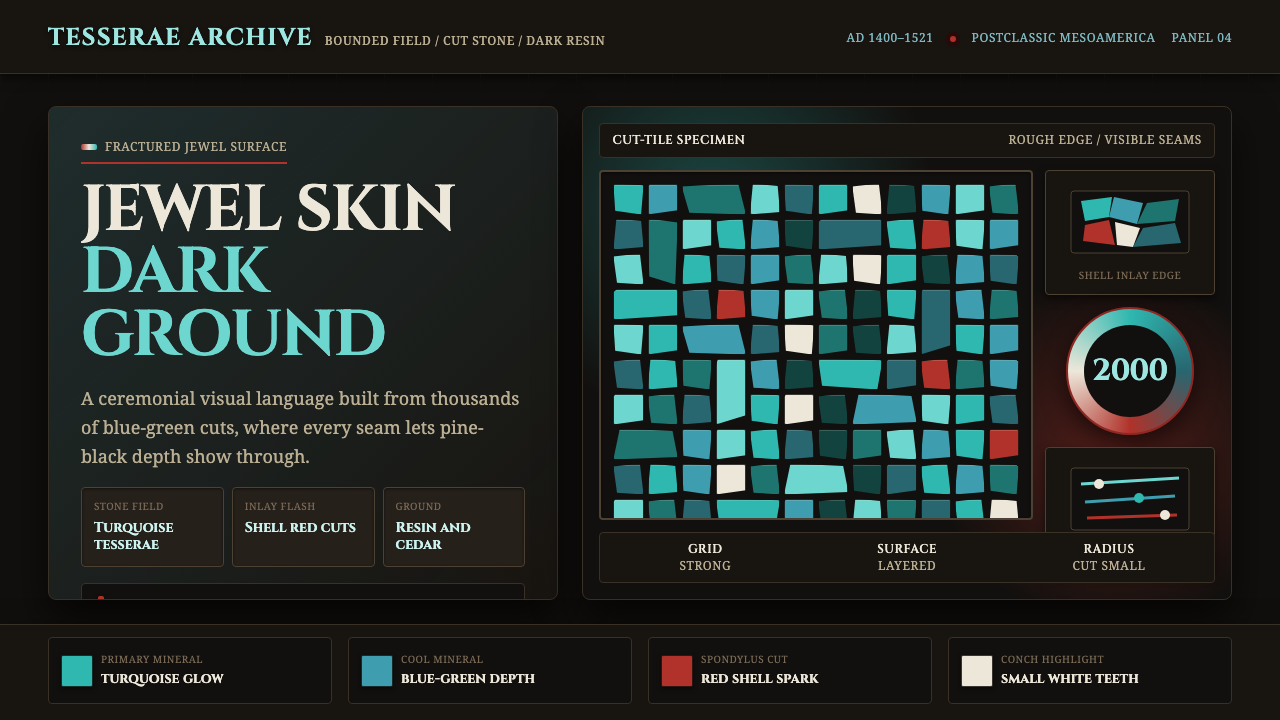 Mixtec Turquoise MosaicDarkness wears a jewel skin. Turquoise tesserae crack open with red and shell…
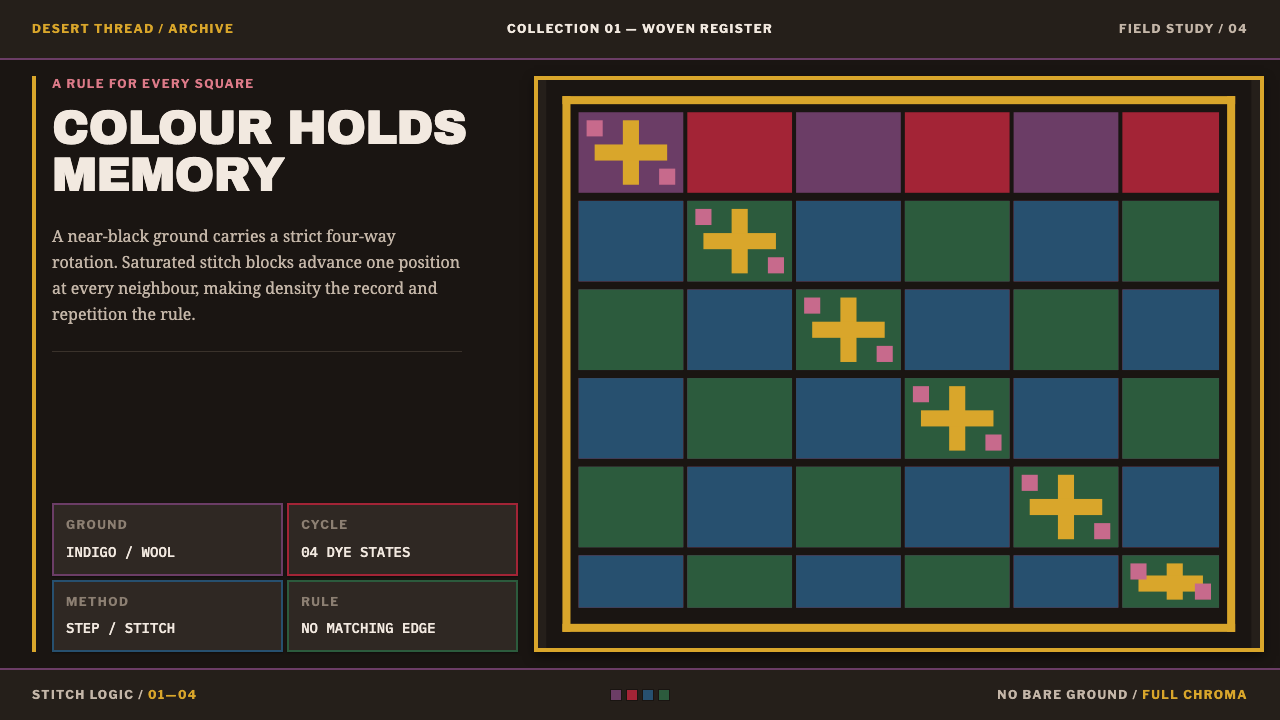 Paracas MantleDensity is the memory. Indigo-black ground drives a four-colour stitched chec…
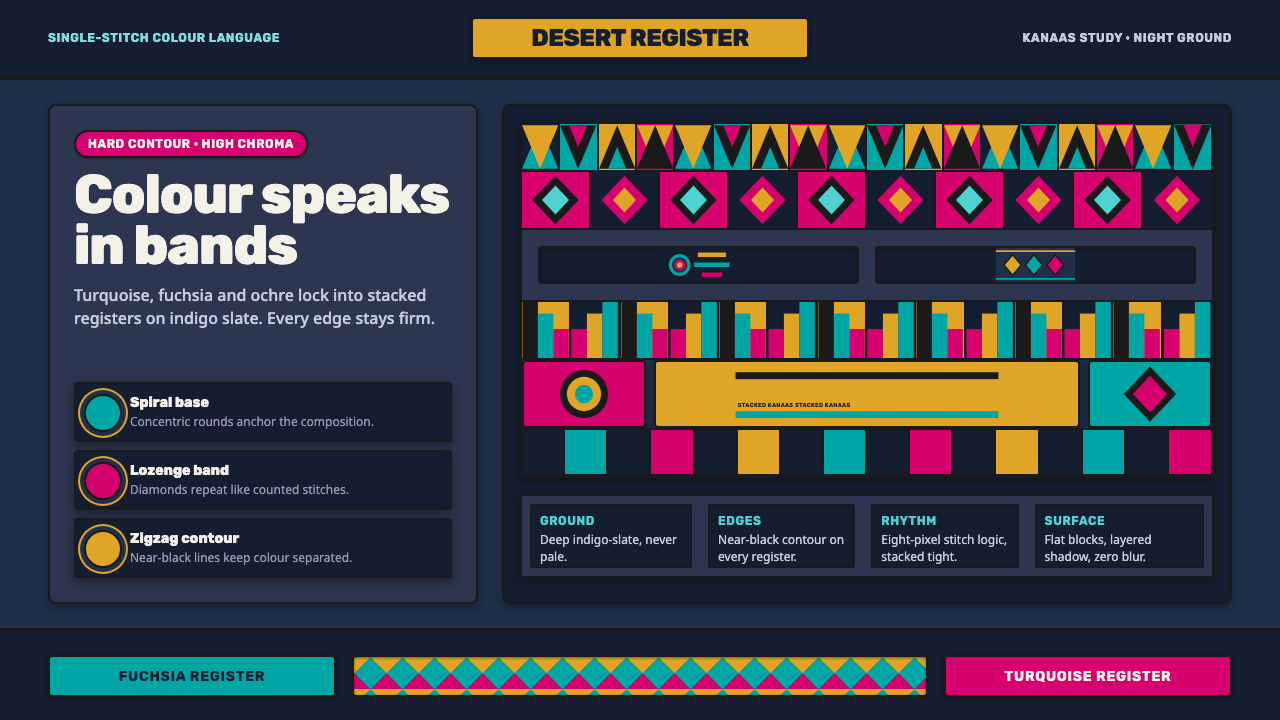 Wayuu Mochila CrochetColour speaks in bands. Turquoise, fuchsia and ochre stack on indigo-slate.
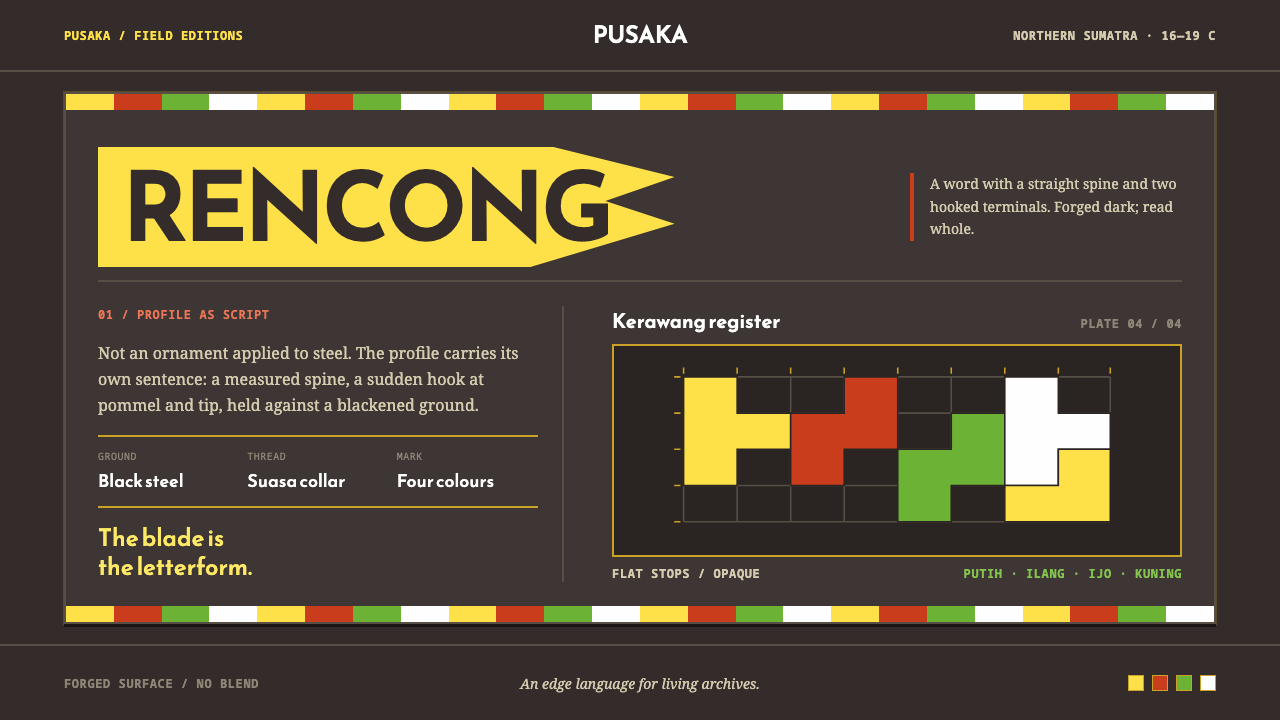 Acehnese Rencong MotifA blade that reads as a word. Flat kerawang red, white, green and yellow lock…
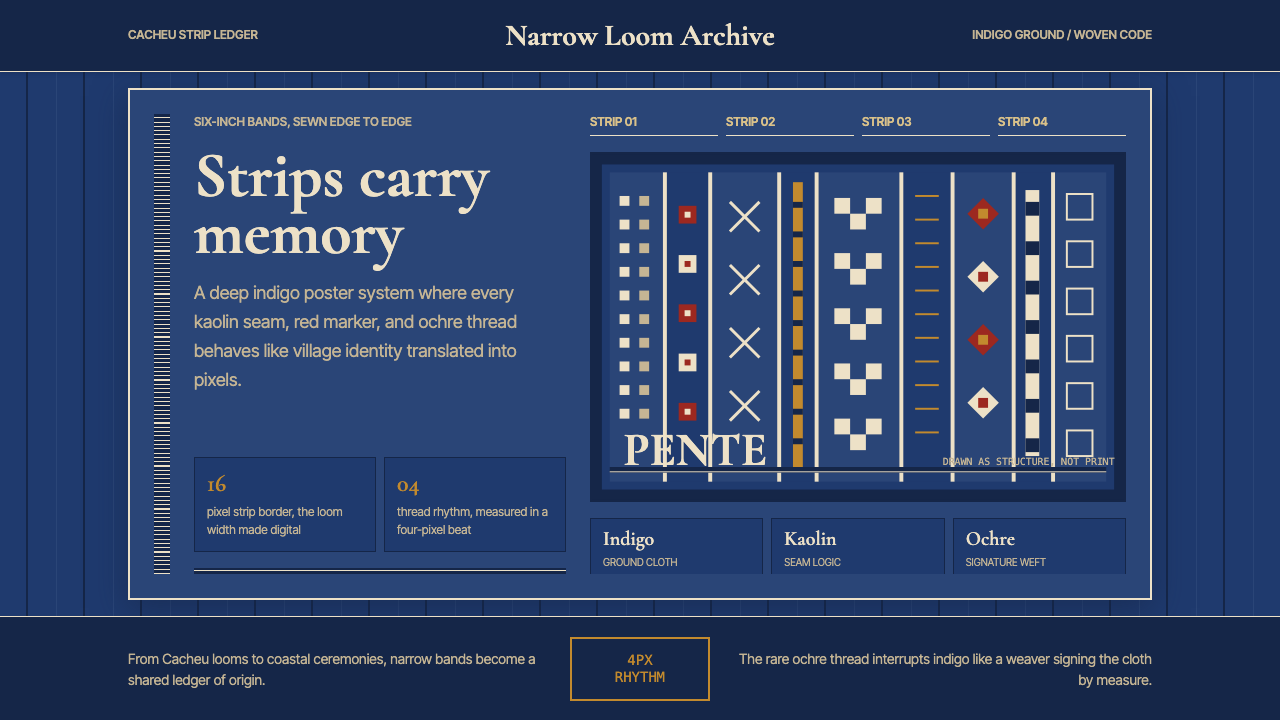 Bissau-Guinean Pano de PenteIndigo remembers. Narrow bands and kaolin seams turn weave grammar into pixel…
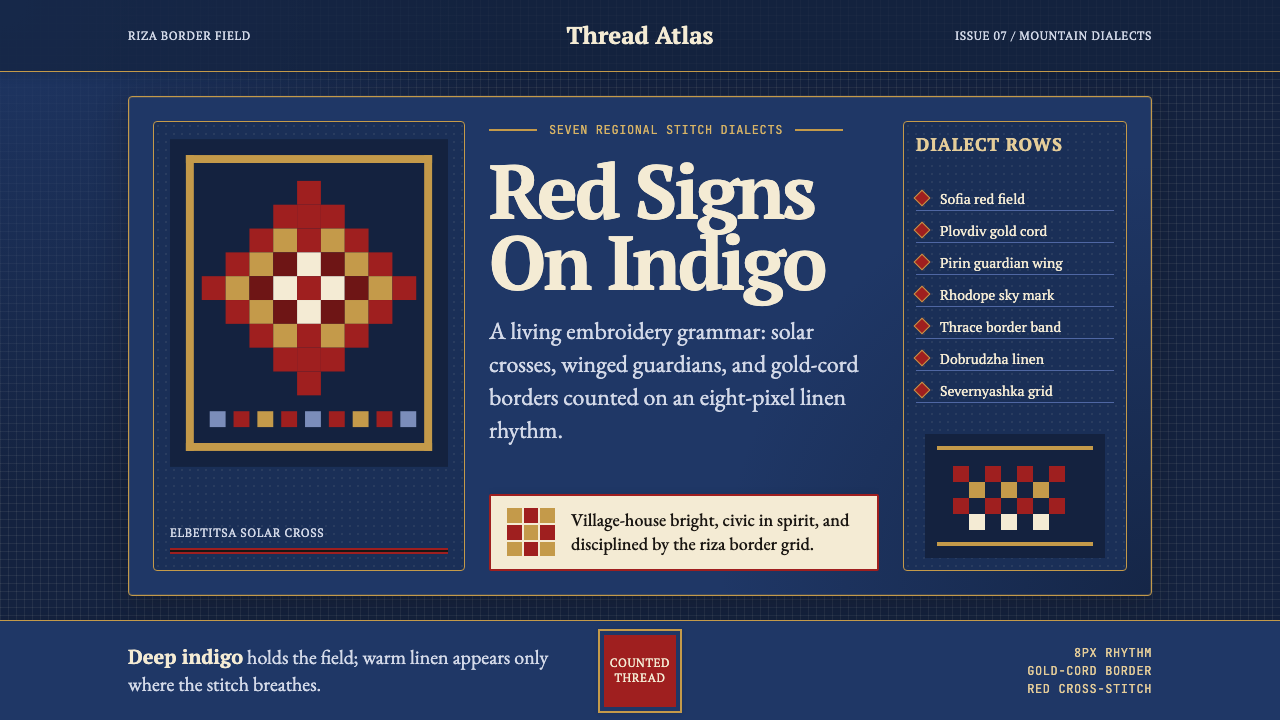 Bulgarian Shevitsa Folk EmbroideryVillage-bright code. Deep indigo carries shevitsa red crosses and gold-cord b…