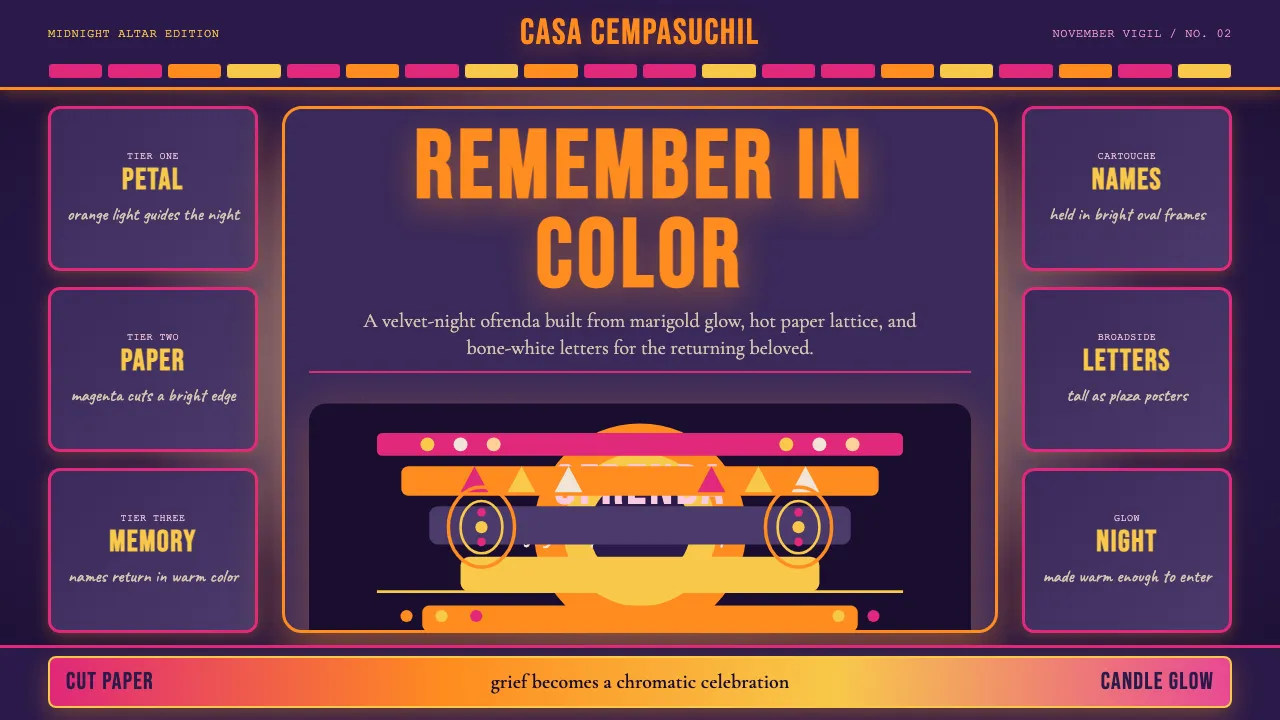
About Mexican Día de Muertos (Marigold Ofrenda)
Día de Muertos wraps death in fluorescent marigold petals. Every November, Mexican families build multi-tiered ofrendas — velvet-draped altars stacked with cempasúchil flowers, papel picado banners, sugar skulls, candles, and photographs of the departed — turning grief into a chromatic celebration that has no visual peer in the Americas.
This design system captures midnight at the ofrenda: deep velvet-purple grounds, blazing marigold-orange accents, hot-magenta cut-paper lattice, and candle-flame yellow warmth. Typography pairs Posada-era condensed impact with literary serif elegance, and every surface carries the crisp stencil-edge of papel picado and the soft fluorescence of cempasúchil petals.
Learn more about the Mexican Día de Muertos (Marigold Ofrenda) style
- Origin
- Mexico (Oaxaca, Michoacán, Mexico City, Puebla)
- Era
- pre-Hispanic Aztec roots; Catholic syncretism post-1521; codified 19th c.; UNESCO ICH 2008
- Key figures
- José Guadalupe Posada · Diego Rivera · Frida Kahlo · Octavio Paz
- Movements
- pre-Hispanic Aztec death ritual · Catholic All Saints syncretism · Posada engraving revival · post-1970s national identity codification
Mexican Día de Muertos (Marigold Ofrenda) design spec
Colors
Typography
The other 11 sections — buttons, cards, spacing, motion, techniques and more — open once you unlock. Download the DESIGN.md or send it to your AI in one click. Unlock once, yours forever.
Sign up nowStyles similar to Mexican Día de Muertos (Marigold Ofrenda)
Also inspired by crafts & folk art, with a close feel.
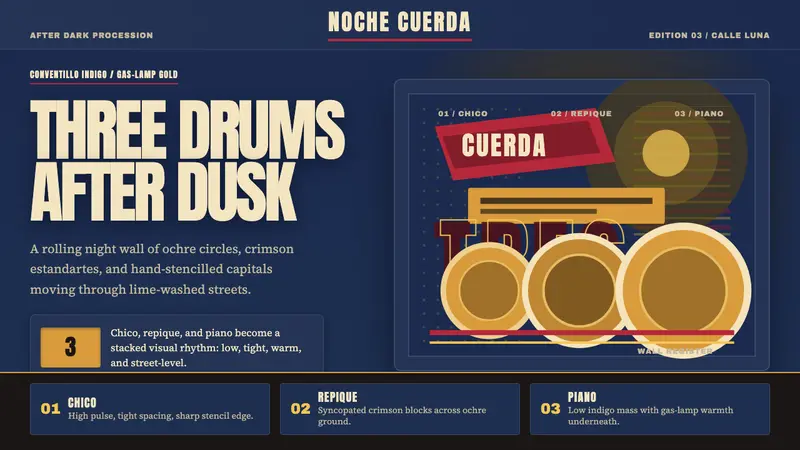 Uruguayan Candombe LlamadasCandombe after dark. Indigo ground, ochre drum circles, crimson banner type.
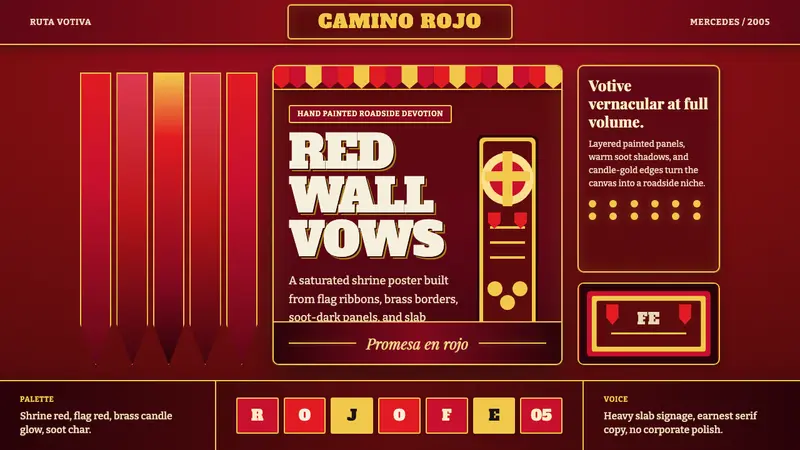 Gauchito Gil ShrineDevotion burns red. Flag ribbons, brass borders, and slab signage glow on soot-dark wood.
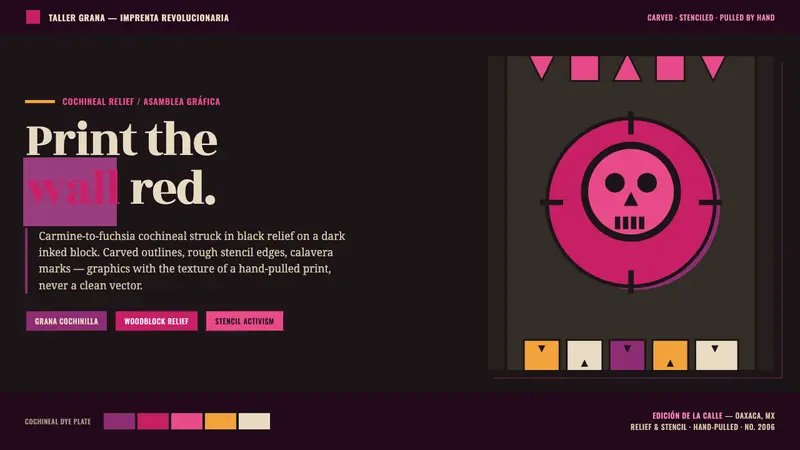 Oaxaca Indigenous-ModernActivist woodblock graphics. Cochineal carmine-fuchsia struck in black relief on a dark inked field.
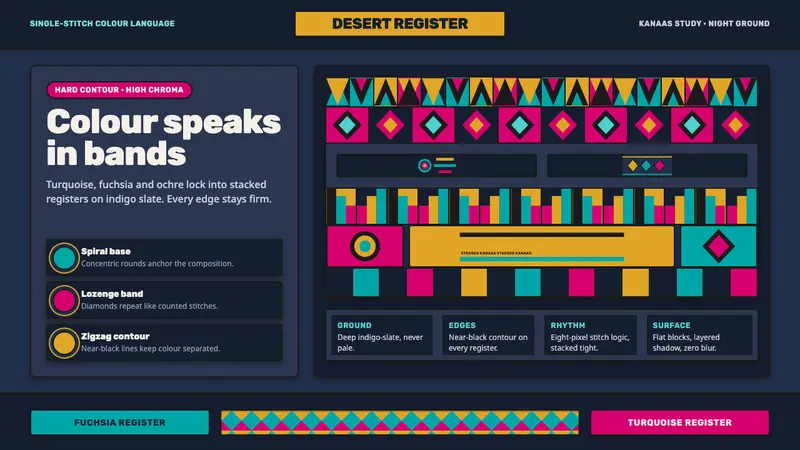 Wayuu Mochila CrochetColour speaks in bands. Turquoise, fuchsia and ochre stack on indigo-slate.