What is Kenyan Kanga Print?
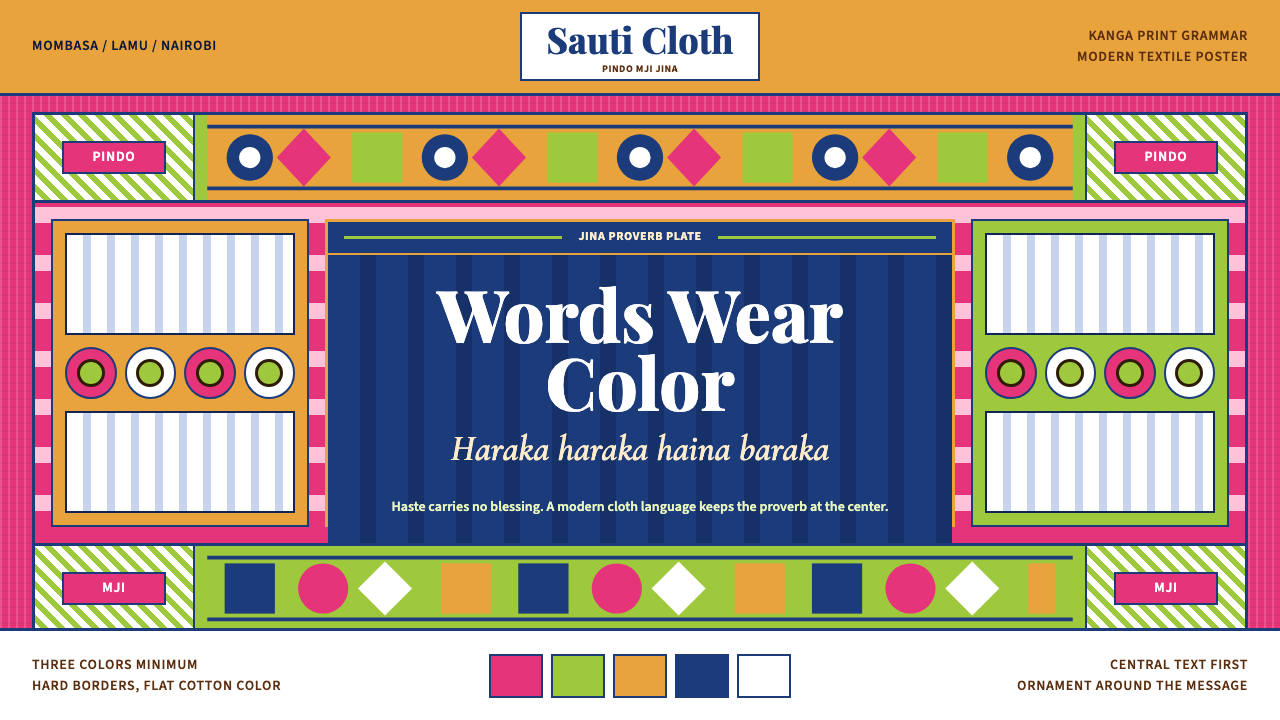
The kanga speaks before you do — a cotton wrap where a Swahili proverb commands the center and hot color blocks refuse to be ignored.
Kenyan Kanga Print in brief
Kenyan Kanga Print is a design language rooted in the printed-cotton fabric tradition of the East African Swahili coast, where rectangular wraps called kanga have been worn, exchanged, and read as social communication since the 1860s. Every authentic kanga is organized around three distinct zones: the pindo, a highly ornamented border that frames the entire cloth; the mji, a densely patterned ground filling the interior field; and the jina, a proverb plate centered within the mji, carrying a Swahili saying in bold, often italic letterforms. This three-zone grammar is the structural engine of the entire visual system.
Translated into digital and print media, the style is immediately recognizable by its collision of warm, saturated color blocks — hot pink, lime green, ochre, and deep indigo meeting without gradient or transition — combined with visible textile-like surface texture and an insistence that text carries as much visual weight as image. Unlike purely decorative fabric-inspired aesthetics, Kanga Print is fundamentally text-forward: the proverb plate is not an accessory to the composition, it is the composition's reason for existing.
The modern design revival of kanga aesthetics, led from Nairobi starting in the mid-2000s, reinterpreted these textile conventions for contemporary fashion, branding, and visual communication. Designers discovered that the system's inherent structure — strong border containment, clear zoning, typographic centerpiece — translated with unusual directness into slides, posters, packaging, and digital interfaces, giving the style a practical utility far beyond nostalgic reference.

Where does Kenyan Kanga Print come from?
The kanga emerged on the Swahili coast in the 1860s, at the intersection of Indian Ocean trade routes, Omani merchant culture, and local Swahili textile practice. The name is thought to derive from the Swahili word for the guinea fowl, whose spotted plumage the earliest printed patterns resembled. Women in Mombasa and Zanzibar began cutting printed handkerchiefs imported from Bombay and Manchester into larger panels, sewing several together to create the characteristic rectangular wrap. By the 1880s, specialized kanga production had begun — first in India and Europe, printing to order for the East African market, then increasingly locally.
The introduction of the Swahili text proverb — the jina — transformed the kanga from a decorative textile into a communicative object. A kanga chosen and worn or gifted with a specific proverb could express affection, issue a veiled rebuke, signal solidarity, or comment on a social situation without a word being spoken aloud. This dimension gave kanga an almost epistolary function: they were folded and given as messages, worn to celebrations as declarations, purchased to mark relationships. By the early twentieth century, the proverb-bearing kanga was firmly embedded in Swahili coastal culture from Lamu to Dar es Salaam.
Lamu, the ancient Swahili trading port on the Kenyan coast, and Mombasa, the region's primary commercial hub, became the two centers of kanga culture in Kenya. Each city maintained its own preferences for border intricacy, ground pattern density, and the genre of proverb considered appropriate. Zanzibar — technically Tanzanian but culturally continuous with the Kenyan coast — contributed its own lineage of designs. The competition among traders, printers, and wearers over which designs were most beautiful and most culturally resonant drove a continuous elaboration of the visual language.
The contemporary revival, beginning roughly in 2005, was driven by a generation of Nairobi-based designers who saw in kanga not just heritage but a living graphic system. Designers including Adèle Dejak, Ann McCreath of KikoRomeo, and Wandia Gichuru of Vivo Activewear reinterpreted kanga structure, color logic, and typographic centeredness for international fashion audiences while insisting on the fabric's social meanings. Their work coincided with a broader Pan-African design consciousness — a movement claiming that African visual traditions were source material as rigorous and generative as any European modernism, not raw material waiting for external refinement.
What defines the Kenyan Kanga Print look?
Color Collision
The palette is built on maximum-saturation contrasts rather than harmonic blending. Hot pink, lime green, ochre yellow, and deep indigo sit against each other in hard-edged color blocks with no transitional gradients. The effect echoes the dye traditions of East African textile markets, where bolts of fabric in competing colors were displayed side by side. Each color is used at full intensity, making the overall composition feel charged and immediate. Secondary neutrals — near-white or warm cream — appear only as ground for the proverb plate or as resting space between high-energy blocks.
Three-Zone Structure
Every composition is organized by the kanga's defining three-part grammar. The outermost zone is the pindo — a border of repeating geometric or floral ornament that contains and frames the entire design. Inside it sits the mji, a densely patterned ground that fills the field with tessellating motifs. At the center of the mji is the jina: the proverb plate, a distinct panel set apart by color or a nested border, within which type commands full attention. This zoning creates a hierarchy that communicates clearly even at a distance or at reduced scale.
Text as Image
In kanga tradition, the proverb is not caption or label — it is the primary visual object. This principle carries directly into design applications: the central text element, whether a product name, headline, or data figure, is treated with the same visual weight as a dominant graphic form. Italic serif letterforms are favored in the proverb plate, lending the text a gestural, handmade quality that contrasts productively with the geometric ornament surrounding it. The text does not illustrate the design; the design frames the text.
Textile Surface
Unlike design systems that aim for perfectly flat digital surfaces, Kanga Print embraces a visible fabric texture — a fine weave grain that reads across both the ground pattern and the color blocks. This texture is subtle enough not to distract from legibility but present enough to signal the system's material origins. In digital applications, this quality differentiates the style from other bold, saturated-color approaches: it carries warmth and handcraft memory even when rendered on screen.
Ornamental Border Logic
The pindo border is not optional trimming — it is a structural member that defines the composition's edges and signals where the design begins and ends. In the kanga tradition, border complexity is a marker of quality and care; thin or sparse borders read as hasty. In design applications, this translates into confident, rule-based framing: thick stripes, repeating geometric bands, or layered ornamental strips that give every composition a contained, finished quality. The border also functions as a transitional zone between the intense ground pattern and the outer context — a page, a screen, a wall.
Pattern Density
The mji ground is never empty. Where other design traditions treat negative space as breathing room, Kanga Print fills the non-proverb field with continuously repeating motifs — stylized flowers, geometric tessellations, abstracted fauna, or interlocking chevrons. This density is not chaos; it is controlled through strong repeat structure and a limited tonal range within the ground pattern itself. The ground reads as texture rather than competing imagery precisely because its internal contrast is lower than the contrast between the ground and the proverb plate.
Symmetry and Centering
Unlike many modernist visual systems that prize asymmetric tension, Kanga Print is structured around bilateral symmetry and centered composition. The proverb plate is always centered within the mji; the pindo border repeats symmetrically on all four sides. This formal symmetry reflects the kanga's function as a wearable object that must look resolved from any folded or draped position. In design applications, this centering creates a ceremonial, declarative quality — compositions feel authoritative and complete rather than dynamic and open-ended.

Who shaped Kenyan Kanga Print?
A Nairobi-based jewelry and accessories designer who became one of the most prominent voices in the contemporary kanga revival. Dejak's work drew directly on Swahili coast textile traditions — including kanga color logic and border ornament — and brought them into conversation with international fashion markets. Her practice demonstrated that the visual conventions of the kanga were not ethnographic artifacts but a living design vocabulary capable of operating at the highest levels of global fashion.
Founder of KikoRomeo, one of Kenya's most internationally recognized fashion labels, McCreath spent decades translating kanga and kikoi textile traditions into contemporary ready-to-wear. Her approach to the three-zone kanga structure — treating it as a modular design system rather than a fixed historical pattern — provided a model for how designers could use the tradition generatively rather than simply reproducing it. KikoRomeo's work helped establish Nairobi as a serious node in African fashion design.
Co-founder of Vivo Activewear, Kenya's largest locally owned fashion brand, Gichuru brought kanga print aesthetics into accessible mass-market retail. Her strategic decision to build a brand around African prints — including kanga-derived designs — at accessible price points demonstrated that the market for this visual language was not limited to international design tourists or luxury consumers but was rooted in Kenyan middle-class identity and pride. Vivo's commercial success gave the kanga revival movement economic credibility.
No single author can be credited with the proverb-text dimension of kanga design, which emerged collectively from Swahili coastal oral and literary culture across the nineteenth and twentieth centuries. The body of Swahili proverbs carried on kanga — covering topics from patience and perseverance to social obligation, romantic longing, and political commentary — represents one of the few design traditions in which vernacular wisdom literature and commercial textile production became inseparable. The proverb tradition is the feature that most distinguishes kanga from other African printed-fabric traditions.
How do you use Kenyan Kanga Print today?
Kanga Print is one of the few historically grounded design systems built around text primacy, which makes it unusually well-suited to contexts where a headline, slogan, call to action, or key number needs to function simultaneously as message and visual centerpiece. The challenge in application is not learning to add pattern and color — it is learning to commit fully to the three-zone discipline so that the composition resolves with the same authority as a well-made kanga.
For presentation slides, the style divides naturally across cover, content, and data pages. A cover slide benefits most directly from the full three-zone treatment: a richly patterned ground, a strong ornamental border, and a centered proverb-plate panel carrying the title in an italic serif or bold display face. Content slides should simplify the ground — reducing pattern density to a border-and-accent register — while preserving the centered or prominently placed text hierarchy. Data slides work well when charts and numbers are placed within contained panels that echo the jina zone: the data becomes the proverb, surrounded by contextual visual structure rather than floating on a bare white field.
For web interfaces, the system's strengths appear most clearly in dashboards, pricing pages, and product landing pages where a single value proposition or key metric needs to dominate. Implement the three-zone logic at the component level: a card or feature block carries a border band, a patterned or textured background, and a centered key figure or label. Navigation and body text should sit outside the high-pattern zones, in near-white or light ground areas, preserving legibility. The hot-pink and lime-green combinations work particularly well for call-to-action elements and status indicators because they command attention without requiring large areas of color.
For editorial and marketing work, the style's declarative quality suits launch campaigns, cultural announcements, and brand identity materials where confidence and distinctiveness are required. A full-bleed poster or social card benefits from the kanga's all-over structure: border, ground, centered declaration. For longer editorial formats, reserve the full three-zone treatment for section openers or pull-quote pages; body text pages should use the palette and border logic at reduced intensity to avoid visual fatigue. Marketing emails work well with a kanga-derived header — patterned band, centered subject line in display type — transitioning into a cleaner body layout.
A common mistake when applying this system is treating the ground pattern and the border as decoration that can be reduced or removed for simplicity. In authentic kanga logic, the pattern and border are not optional ornament — they are the structural context that gives the proverb plate its authority. A centered headline on a plain colored ground without border or texture is not Kanga Print; it is merely centered type on a bright background. The three zones must all be present, even at reduced intensity, for the system to read correctly. A second common error is filling the proverb plate with paragraph text: the jina convention favors brevity — one phrase, one line, one number — delivered at maximum scale within its panel.

Kenyan Kanga Print — FAQ
Is this style appropriate only for African-themed content, or can it work for any subject matter?
The system works for any subject matter where its structural strengths apply: strong hierarchy, text primacy, bold visual confidence. The kanga's three-zone grammar is a genuinely useful composition system, not a costume. The caution is not about subject matter but about application depth: using only the hot colors while ignoring the border and zoning logic produces a surface impression that reads as cultural borrowing without structural understanding. Applying the full system — including the pindo border, mji ground, and jina centering — demonstrates engagement with the visual grammar rather than extraction of superficial markers.
How do I choose which proverb plate text to use when I'm not actually writing in Swahili?
The jina convention is about the function of the text — a single, declarative statement that rewards attention — not the language. In non-Swahili applications, the proverb plate carries whatever text carries the most concentrated meaning: a product name, a campaign headline, a key statistic, a brand value. The formal requirements remain: the text should be brief enough to render at large scale within the panel, visually isolated from the ground pattern, and treated with typographic care — an italic or distinctive letterform that sets it apart from any secondary text in the composition.
Can the style work in a reduced-color version — for example, a two-color or single-color print application?
Yes, with deliberate adaptation. Historic kanga were often printed in two or three colors due to production constraints, and the three-zone structure remains legible when the palette is constrained. In a two-color version, the most effective approach assigns one color to the pindo border and one to the mji ground pattern, with the jina plate rendered as the lightest area — near white or the paper ground — so that text contrast is preserved. Single-color kanga-derived designs work when the three zones are differentiated by pattern density rather than hue: the border is the densest, the ground is mid-density, and the proverb plate is the clearest area.
How does this style differ from other African textile-inspired design systems, such as Kente or Ankara print?
The critical difference is text. Kente (from Ghana and Côte d'Ivoire) and Ankara wax print (originally Dutch-Indonesian but widely adopted across West Africa) are purely visual systems — their meaning is carried by color combinations, strip widths, and pattern geometries, not by embedded language. Kanga is the only major African textile tradition where language is structurally built into the design as the primary communicative act. This makes kanga-derived design distinctly valuable for any application where a verbal message must also function as a visual form. The zoning logic also differs: Kente uses strip-woven linear repetition; Ankara uses all-over repeat print without hierarchical zoning. Only the kanga has the concentric border-ground-plate structure that makes it so directly applicable to poster, slide, and interface composition.
Does the style work for dark-background or night-mode applications?
The historic kanga palette is light-ground — the mji was always a field of color pattern against which the jina plate, typically lighter, provided contrast. A dark inversion is possible but requires rethinking the contrast logic. On a dark ground, the hot pink and lime green read with even more intensity, which can make the overall composition feel overwhelming if all zones are at full saturation. The most successful dark variants reduce the mji ground to a very deep version of one color — deep indigo or near-black — while keeping the pindo border and jina plate in high-energy tones. This preserves the three-zone hierarchy while preventing the composition from becoming illegible.
Related design styles
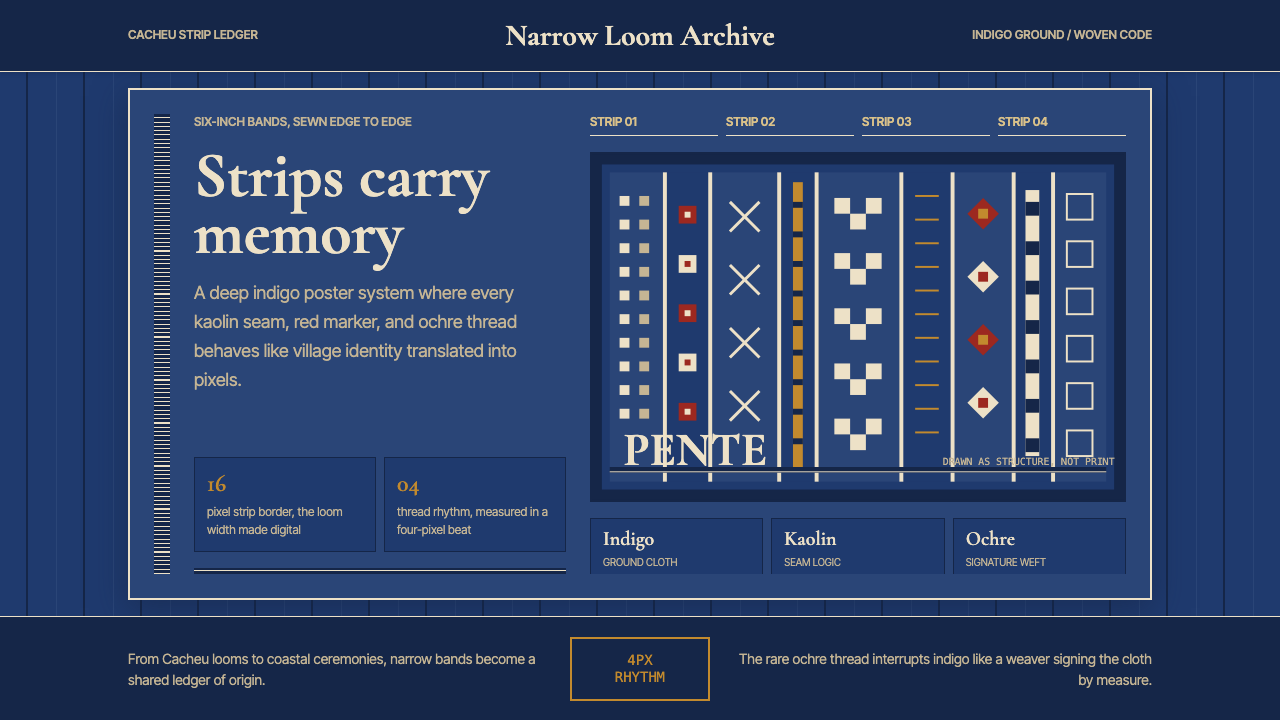 Bissau-Guinean Pano de PenteIndigo remembers. Narrow bands and kaolin seams turn weave grammar into pixel…
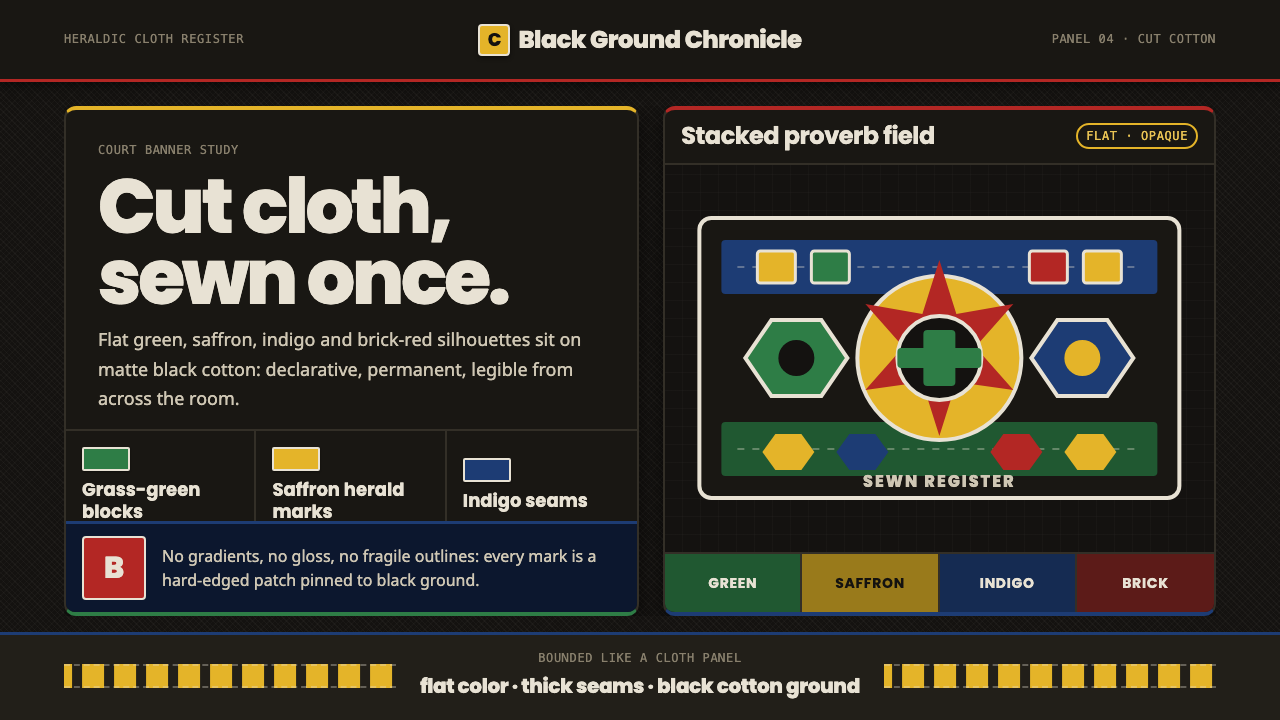 Fon Applique Banner AbomeyRoyal cloth speaks plainly. Flat saffron, green and indigo silhouettes on bla…
 Kongo Nkisi Nkondi FigurePower accumulates in darkness. Black wood, iron studs, and one mirror glint h…
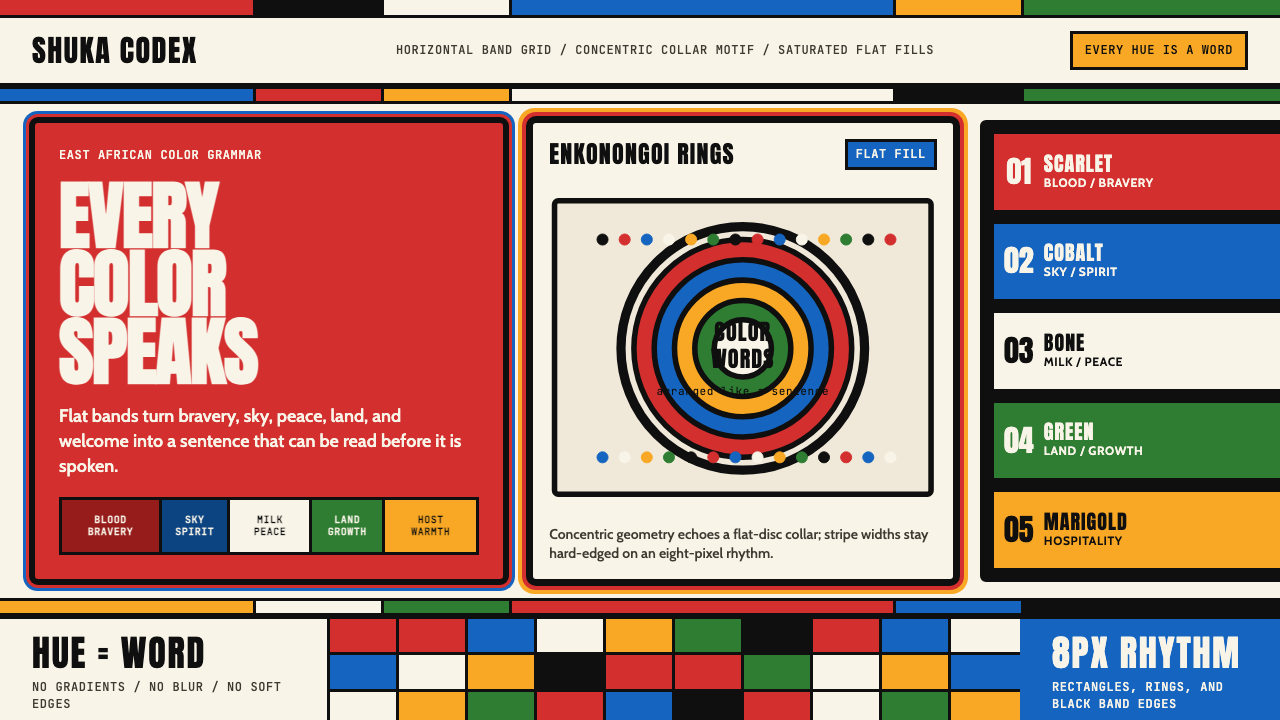 Maasai Shuka & BeadworkColor becomes language. Scarlet bands, cobalt panels, and concentric bead rin…
 Senufo Firespitter MaskRitual darkness has heat. Smoked wood tones hold back tiny orange-gold sparks.
 Yoruba Orisha ShrineThe colour code of the gods. Shango-red beadwork and cowrie white glow on dar…