What is Toulouse-Lautrec Belle Époque?
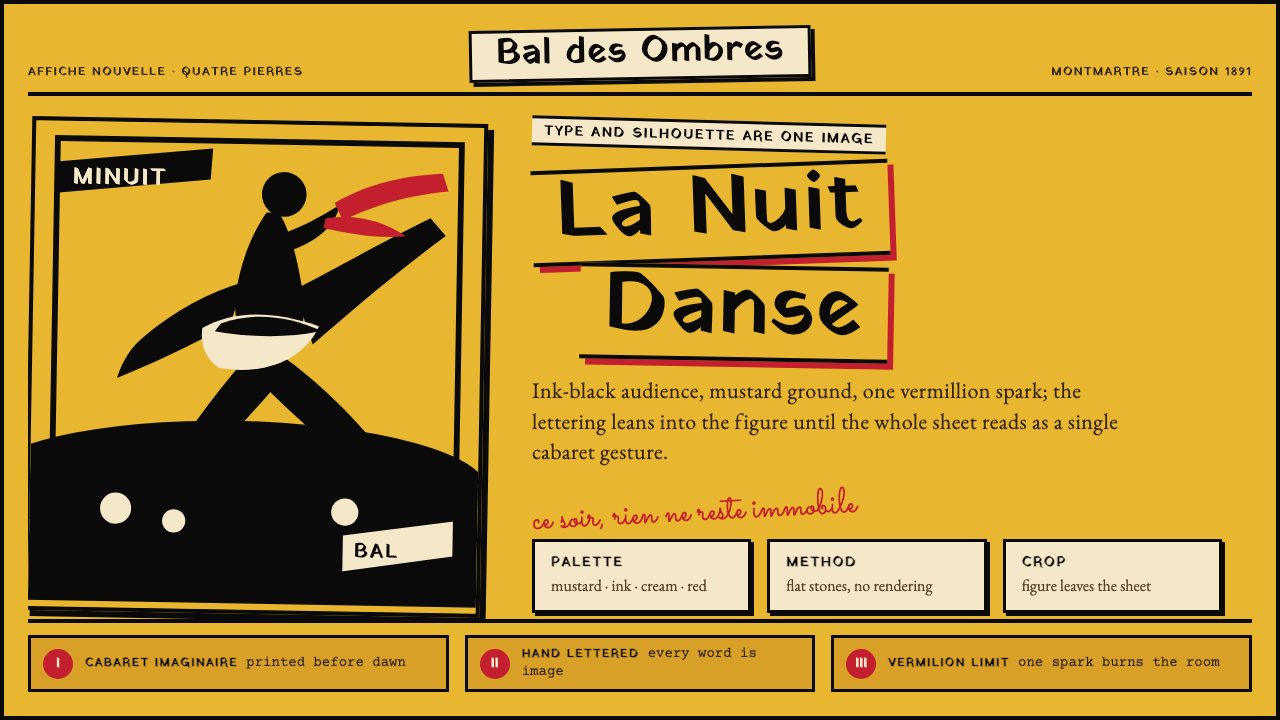
Toulouse-Lautrec collapsed the distance between poster art and painting — mustard ground, black silhouette, a single vermillion spark, and the night of Montmartre becomes a gesture.
Toulouse-Lautrec Belle Époque in brief
Toulouse-Lautrec Belle Époque is the visual language of the chromolithographic cabaret posters Henri de Toulouse-Lautrec produced for Montmartre's entertainment venues between 1891 and 1900. These works — for Moulin Rouge, Divan Japonais, and Folies-Bergère — are widely recognized as the founding documents of modern advertising art, establishing principles of flat color, gestural silhouette, bold cropping, and the integration of lettering into image that remain vital a century and a quarter later.
The aesthetic is defined above all by restraint in the service of impact. Each poster works with no more than four colors: a warm ground (typically a deep mustard or ochre yellow), a near-black for mass and silhouette, an off-white or cream for faces and negative space, and a single hot accent — vermillion, scarlet, or vivid pink — that functions as an ignition point for the whole composition. The flatness is total: no graduated tones, no cast shadows, no illusion of three-dimensional depth. Figures are read as bold ink shapes against the ground.
Typography is not a secondary element appended to an image but part of the image itself. Lautrec's hand-painted letterforms — loose, gestural, sometimes tilted — share the same ink weight and visual authority as the drawn figures. The letters lean into the composition the way a dancer leans into a kick. This inseparability of word and image, of figure and ground, of performance and advertisement, is the style's most radical and enduring contribution.

Where does Toulouse-Lautrec Belle Époque come from?
The Belle Époque — literally 'Beautiful Era' — was the period of relative peace, prosperity, and cultural efflorescence in Western Europe that stretched roughly from the 1880s to the outbreak of the First World War in 1914. In Paris, its epicenter was Montmartre: the bohemian hill on the city's northern edge where artists, performers, writers, and a broad cross-section of Parisian society mingled in a density of cafés, cabarets, music halls, and circus venues unlike anything elsewhere in Europe. The Moulin Rouge, which opened in 1889 on the Boulevard de Clichy, was its most celebrated institution.
Henri de Toulouse-Lautrec arrived in Montmartre in 1882, a nobleman's son whose childhood bone diseases had left him with stunted legs and an outsider's restless need to observe. He became a fixture at the Moulin Rouge and other cabarets, sketching performers from ringside tables night after night. His immersion was not journalistic but empathic: he was drawn to the performers — La Goulue, Jane Avril, Yvette Guilbert — as personalities of extreme physical and theatrical intelligence. When Jules Chéret, the father of the color lithographic poster, had established the medium's commercial viability in the 1870s and 1880s, the stage was set. In 1891, the Moulin Rouge commissioned Lautrec's first major poster. The result was a transformation of the medium.
The decisive artistic influence was Japanese ukiyo-e — woodblock prints depicting the floating world of theater, pleasure districts, and urban life. Lautrec, like many of his contemporaries, was an ardent collector and student of Hiroshige, Hokusai, and Utamaro. From ukiyo-e he absorbed the compositional principle of flat, unmodulated color zones separated by confident contour lines; the taste for bold cropping that cuts figures at the edge of the picture plane; the habit of treating the background as an active shape rather than a neutral ground; and the integration of calligraphic text into the visual field as an equal graphic element. Japonisme gave Lautrec the structural toolkit; Montmartre gave him the subject matter and the urgency.
The technical vehicle was chromolithography — a printing process using separate stones or plates, one per color, that by the 1880s had achieved sufficient registration accuracy and color richness to make large-format, multi-color poster printing commercially viable. Lautrec worked directly on the lithographic stone with brush and tusche (a greasy ink), achieving a spontaneity of line that transferred cleanly to print. He also pioneered the technique of spatter and crayon to create textured mid-tones within his otherwise flat fields. The discipline of working within a strict color count — imposed partly by economics, partly by the process itself — forced a visual economy that became the style's defining strength. Contemporaries Jules Chéret, Théophile Steinlen, and Pierre Bonnard each contributed to the evolving language of the Belle Époque poster, but Lautrec's synthesis of Japanese composition, cabaret subject matter, and chromolithographic economy produced the most influential single body of work.
What defines the Toulouse-Lautrec Belle Époque look?
Flat Color Zones
Color is applied in solid, unmodulated areas with no blending, gradation, or tonal variation within a zone. A skirt is one uniform mustard. A crowd is one uniform near-black. The boundary between zones is a firm contour or a clean edge — never a soft transition. This absolute flatness is the visual cornerstone of the style and its most direct debt to Japanese woodblock printmaking.
Restricted Palette
Each composition operates on a maximum of four colors: a warm, deep ground (mustard, ochre, or olive yellow), a near-black for silhouettes and mass, a light neutral (cream or off-white) for faces and negative space, and a single hot accent — vermillion, scarlet, or vivid pink — that provides the visual ignition point. The accent color is used sparingly, deployed at a single focal node such as a ribbon, a hat, or a pair of stockings. Nothing competes with it.
Gestural Silhouette
Human figures are rendered not through anatomical detail but through the overall gestural shape their body makes — the arc of a kick, the lean of a top-hatted silhouette, the thrust of a raised arm. The silhouette communicates identity and personality more efficiently than a face. Crowds are collapsed into a single undifferentiated dark mass, giving depth and contrast without the labor of rendering individual figures. The ink line is confident, fast, and slightly rough — the mark of a hand that has watched the same performer dozens of times.
Bold Cropping and Off-Edge Figures
Figures are frequently cut off by the picture's edge — a dancer's feet disappear at the bottom, a spectator's head exits at the top. This compositional device, borrowed directly from ukiyo-e, creates a sense of immediacy and participation: the viewer is in the space rather than observing it from outside. It also allows the scale of figures to be dramatically enlarged relative to the poster field, increasing the impact of the silhouette against the flat ground.
Hand-Painted Letterforms Integrated as Image
Display type is not set from a type case but painted by hand, using the same brush and ink as the figures. The letters share the gestural weight, the slight roughness, and the visual energy of the drawn elements. Type is sized, angled, and positioned as a compositional object — it may arc along a curve, lean against a figure, or be embedded within a color zone. The poster reads as a single unified object in which text and image are inseparable, not as an image with a caption.
Warm Ground as Active Color
The background is not a neutral field but the dominant warm color — mustard, straw yellow, or deep ochre — that carries as much visual weight as the figures placed upon it. It sets the emotional register of the whole composition: warmth, artificial light, the atmosphere of gaslit interiors. In many posters, the ground color is the largest color area and the first thing the eye registers. It is chosen not for neutrality but for chromatic character.
Economy of Means
Every mark serves either identification, hierarchy, or atmosphere — nothing is decorative surplus. There are no ornamental borders, no filigree details, no textures applied for visual richness. The style trusts that a silhouette read correctly, a color placed correctly, and a letterform drawn with the right weight will communicate more powerfully than any amount of elaboration. This economy is not impoverishment; it is a form of concentrated precision that makes every element count.

Who shaped Toulouse-Lautrec Belle Époque?
Lautrec (1864–1901) was the originator and definitive master of the Belle Époque cabaret poster. A Post-Impressionist painter trained under Fernand Cormon, he found his true subject in the nightlife of Montmartre and his true medium in chromolithography. Between 1891 and 1900 he produced thirty-one lithographic posters, including the canonical series for Moulin Rouge, Divan Japonais, and Jane Avril at the Jardin de Paris. His synthesis of Japanese composition, flat color, and gestural draftsmanship created a visual language that influenced every subsequent tradition of commercial poster art, from Art Nouveau through mid-century advertising to contemporary graphic design.
Chéret (1836–1932) is often called the father of the modern poster. Working in Paris from the 1860s onward, he developed the technical and commercial infrastructure of large-format color lithographic poster printing and produced more than a thousand posters in a style characterized by jubilant female figures, airborne compositions, and festive color. His work demonstrated that the poster could be a legitimate art form with mass reach, and his technical innovations — particularly in color registration and paper scale — made Lautrec's later, more radical experiments commercially possible. Lautrec acknowledged Chéret's priority even as he dramatically surpassed him in compositional austerity and psychological depth.
Steinlen (1859–1923) was a Swiss-born painter and printmaker who settled in Montmartre and became one of its most prolific visual chroniclers. His posters — most famously the 1896 advertisement for Lait pur stérilisé de la Vingeanne — shared Lautrec's commitment to bold silhouette and restricted color but tended toward a warmer, more socially empathetic subject matter, often depicting workers, cats, and everyday Parisian street life. His work demonstrates the breadth of the Belle Époque poster tradition beyond Lautrec's cabaret focus, and his mastery of the black-and-white lithographic line drawing influenced a generation of illustrators.
Bonnard (1867–1947) was a founding member of the Nabis — the group of Post-Impressionist artists deeply influenced by Japanese printmaking — and his 1891 poster France-Champagne is one of the earliest examples of the new Belle Époque poster language. His work emphasized decorative patterning, sinuous contour, and a more playful palette than Lautrec's. While Bonnard's subsequent career moved toward intimate domestic painting, his early posters document the moment when Japonisme entered commercial graphic arts in Paris and demonstrate how the same set of Japanese influences could be resolved in fundamentally different visual personalities.
How do you use Toulouse-Lautrec Belle Époque today?
Toulouse-Lautrec Belle Époque is a style of theatrical authority and concentrated gesture. Applying it well demands the same discipline Lautrec applied to his stones: strict color economy, silhouettes that communicate immediately, and lettering that participates in the composition rather than being appended to it. The first question to ask of any element is whether it would survive if the palette were cut to four colors. If it would not survive, it is probably doing decorative work rather than communicative work.
For presentation slides, the style performs best on covers and section dividers where a single strong gesture can set the register for everything that follows. A cover works by taking one dominant warm-ground color and placing a bold cropped figure or silhouette against it — the title lettering should be large, hand-feeling, and integrated into the figure's space rather than positioned independently below. Content slides should carry the color economy forward: one ground, one dominant dark, a single accent used no more than twice per slide. Data visualizations work well in this style when bar charts and line graphs are treated as flat shape compositions, with the accent color marking the single most important data series.
For web interfaces, the style suits landing pages, editorial homepages, and event or ticketing sites where drama and urgency are appropriate. A Belle Époque-inspired hero section might use the warm mustard ground at full width, with a large cropped illustrative or photographic figure treated as a flat silhouette, and headline type that is oversized, slightly rough in character, and integrated with the image. Navigation and body type should lean to the bold and relatively large to sustain the poster's forthright legibility. Dashboard applications are a harder fit — the style's theatricality works against the information density and neutral-ground clarity that functional dashboards require.
For editorial and marketing work, the style is most powerful in event promotion, cultural institution branding, and campaigns where a sense of historical depth and artistic ambition is an asset. A Lautrec-inflected marketing poster uses a dominant warm ground, a bold central silhouette, and all supporting text treated as an integral graphic element with scale contrast between headline and detail lines. The single hot accent should appear at one focal point only — the product name, the event date, the one fact the audience must retain. Applying the accent at multiple points dissipates its energy. Campaigns that attempt to use more than four total colors lose the style's defining compression and begin to read as generic retro rather than historically grounded.
A common mistake is misidentifying what makes the style feel 'Belle Époque' and attempting to simulate it through surface signals — Art Nouveau swirls, sepia toning, aged paper textures — rather than through its actual structural principles. Authentic application of this style has nothing to do with distressed texture or nostalgic color treatment. It requires flat color, a maximum of four hues, gestural silhouettes with confident edges, and letterforms that are drawn rather than set. A second frequent error is using the mustard-and-black palette at small scale where the bold cropping and silhouette logic break down: this style was conceived for large-format poster viewing and loses its authority when applied at thumbnail sizes or dense information layouts.

Toulouse-Lautrec Belle Époque — FAQ
How is this style different from Art Nouveau, which is often shown in the same period?
They share a historical moment and some sources — notably Japonisme — but operate on fundamentally different visual principles. Art Nouveau is characterized by flowing organic lines, sinuous plant forms, and an embrace of intricate ornamental surface decoration. Lautrec's Belle Époque poster style is the opposite: flat, geometrically simplified, silhouette-driven, and ornament-free. Art Nouveau celebrates the decoration; Lautrec eliminates everything that is not gesture. Where an Art Nouveau poster fills its surface with interlocking botanical curves, a Lautrec poster uses three bold color areas and a single decisive silhouette. The two styles feel related because they are contemporaneous and both reference Japan, but in execution they are near-opposites.
Can this style work for digital products, or is it inherently a print style?
It translates well to digital contexts when the fundamental principles are respected, not the surface details of aged lithography. The flat color zones, bold silhouettes, and integrated type all work effectively on screen. The warm ground colors — the mustard yellows and deep ochres — render well in digital color spaces and maintain their warmth. What does not translate is any attempt to simulate the grain, registration variation, or tactile quality of nineteenth-century lithography: on screen, those effects read as low-fidelity rather than historical. A successful digital interpretation uses the style's structural vocabulary — flat, restricted, gestural, bold — without the period texture. Event sites, editorial platforms, and cultural institution web presences are natural fits.
The style uses very few colors. How do you create depth without shading?
Depth in this style is created through three spatial conventions inherited from Japanese printmaking: overlapping (a dark silhouette placed in front of a lighter ground reads as nearer), scale contrast (a large foreground figure against a small background mass creates recession), and cropping (figures cut off at the picture edge imply continuation beyond the frame, suggesting a space larger than what is shown). Shadows and tonal gradation are not part of the vocabulary at all. The apparent flatness is not a limitation but a deliberate choice that forces the eye to read space through placement and scale rather than through light simulation. This results in compositions that feel immediate and present rather than recessive and illusionistic.
Is the warm mustard ground mandatory, or can the style be executed on other grounds?
The mustard or ochre ground is the historically characteristic choice but not the only valid one. Lautrec himself used pale cream grounds, deep blue-grey grounds, and in some posters a warm salmon. What is non-negotiable is the warmth and the role the ground plays as the dominant color area — it must carry visual weight and establish an atmospheric register, not function as a neutral void. A pale cool white ground tends to work against the style's warmth and theatricality. A deep near-black ground can work for a darker, more nocturnal interpretation, but requires care with the accent color because the visual hierarchy changes significantly when ground and figure-dark are tonally similar.
How do you handle photography in this style — can photos be used at all?
Photography was not part of the original lithographic practice, but it can be incorporated into contemporary applications of the style if it is treated correctly. The key is conversion: a photograph used in a Toulouse-Lautrec Belle Époque context must be reduced to a flat silhouette or a high-contrast duotone that reads as a solid color shape rather than a photographic window. Full tonal range, naturalistic color, or photorealistic detail immediately defeats the style's flat structural logic. The photograph ceases to be a photograph and becomes a shape. Silhouetting against the warm ground, high-contrast treatment with the palette's near-black as the image tone, or isolation of a single figure with all background removed are all workable approaches.
Related design styles
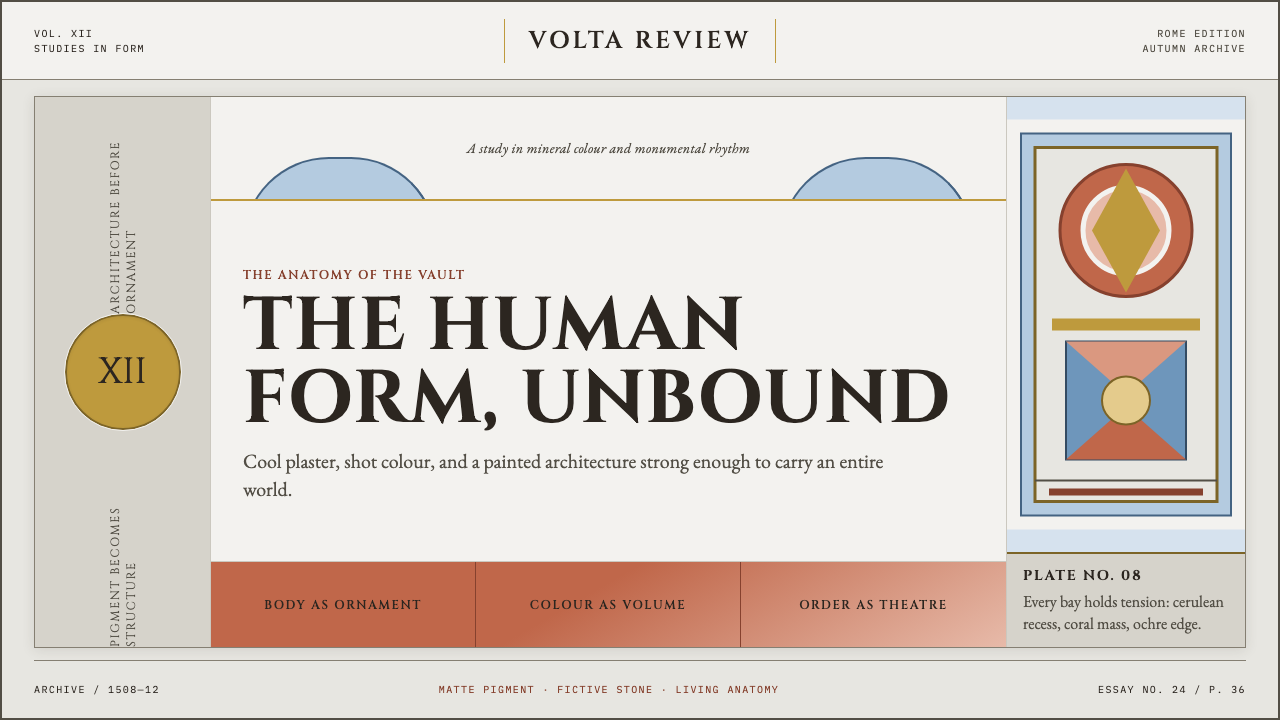 Michelangelo Sistine Ceiling (1512)Paint becomes monumental. Coral, cerulean and ochre figures strain against a…
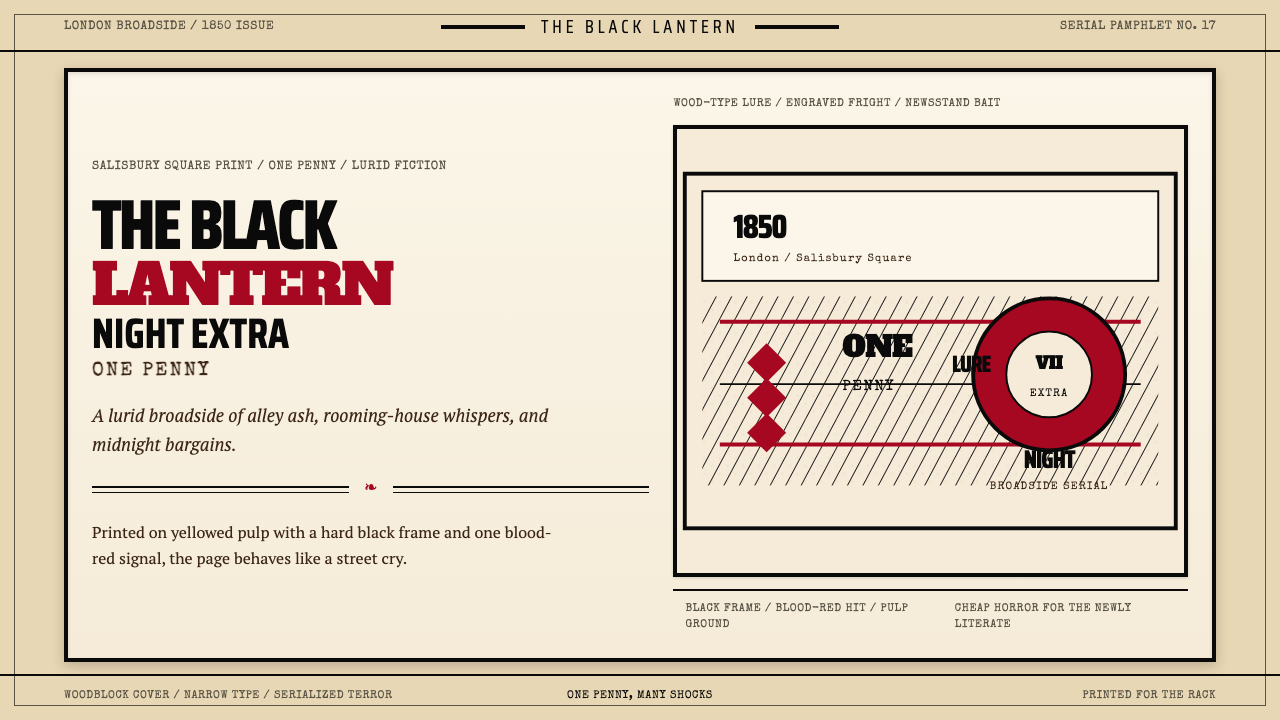 Penny Dreadful Victorian Headline (1850)Cheap terror in full cry. Condensed wood-type, black borders, and one blood-r…
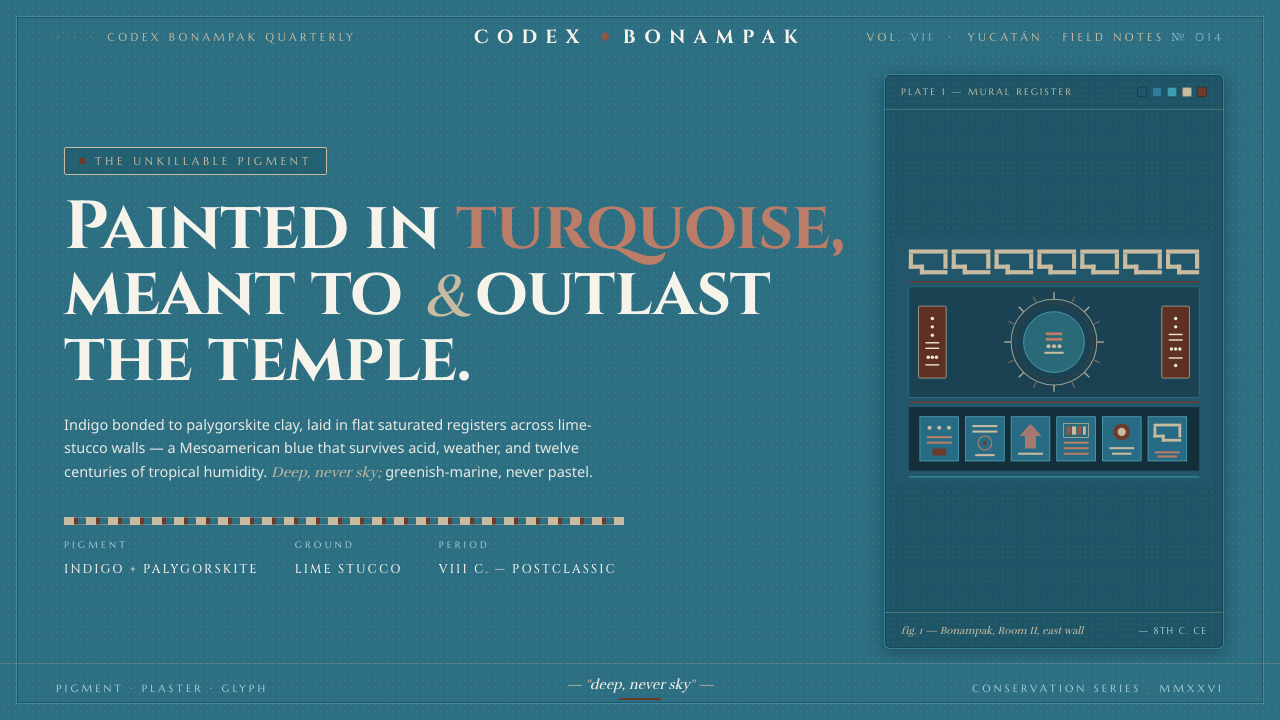 Maya Blue PigmentDeep, never sky. Saturated turquoise mural fields, ochre cartouches, carved-s…
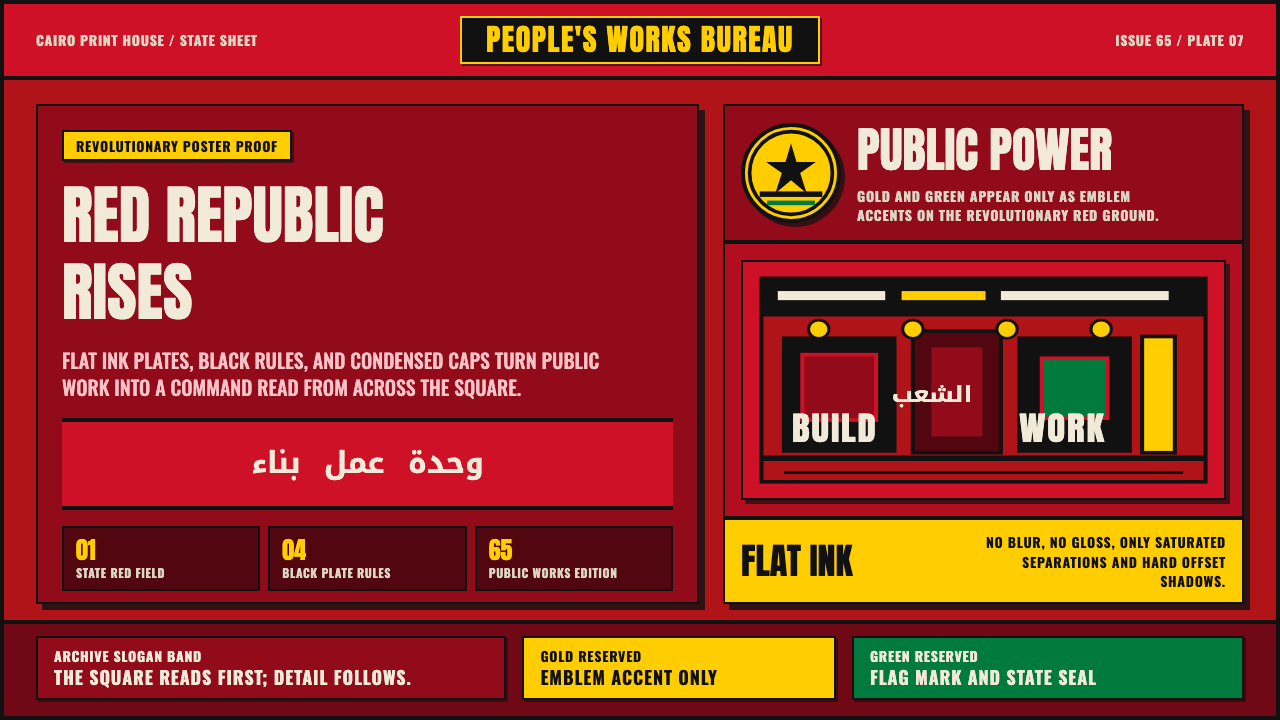 Egyptian Political PosterState power shouts. Red poster grids, black keylines, kufic type, gold-green…
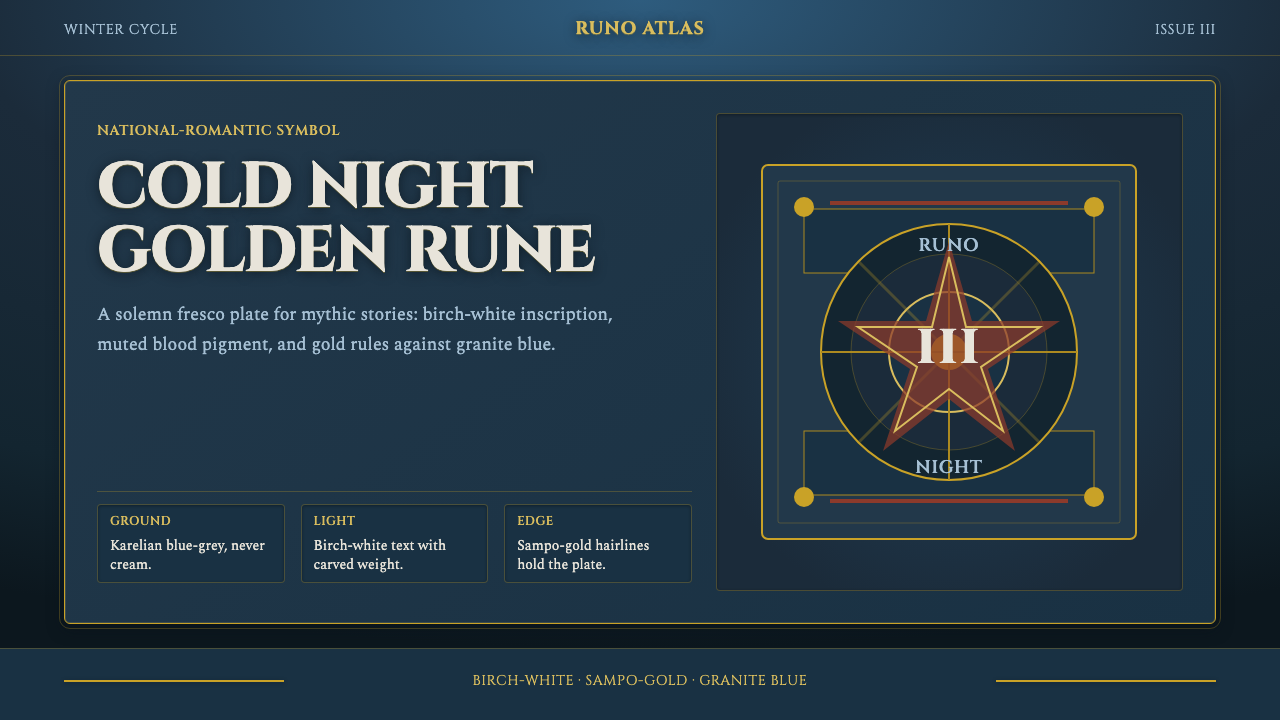 Finnish Kalevala EpicEpic weight in cold night. Birch-white Cinzel, Sampo-gold rules, blue-grey fr…
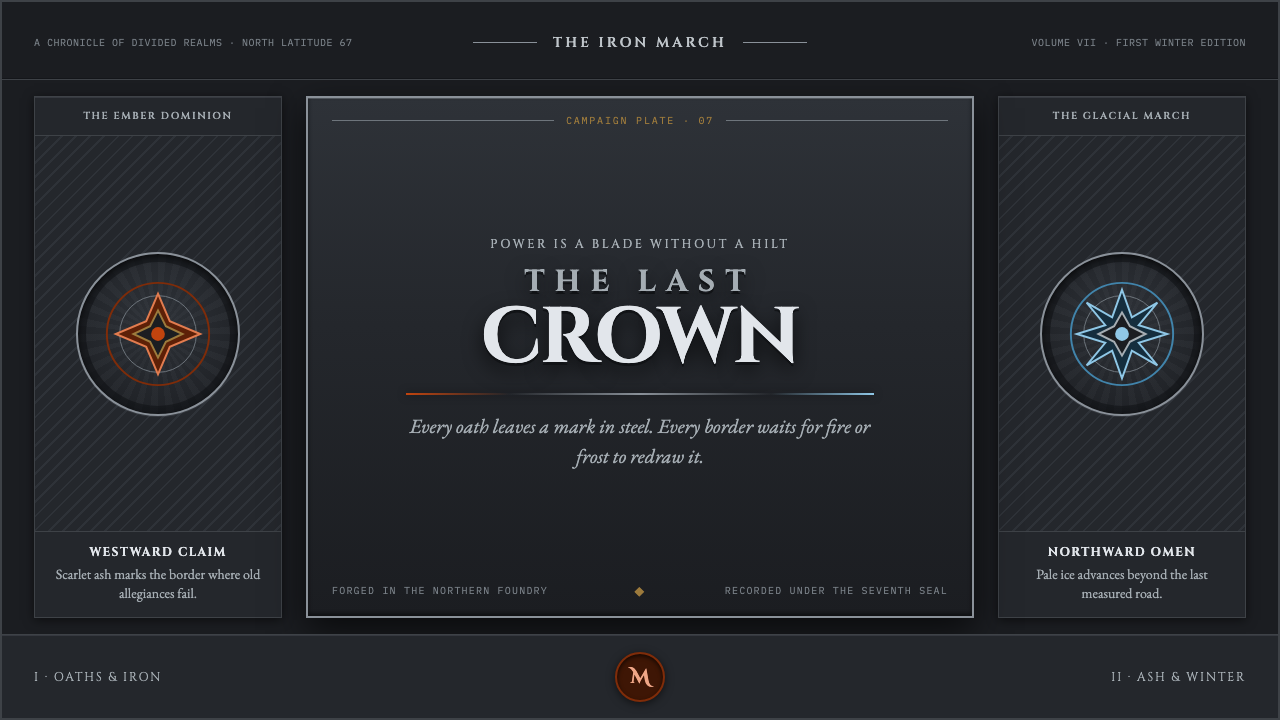 Game of Thrones (2011)Power is forged cold. Chiseled Roman capitals divide ember from glacial ice o…