What is Stefan Sagmeister?
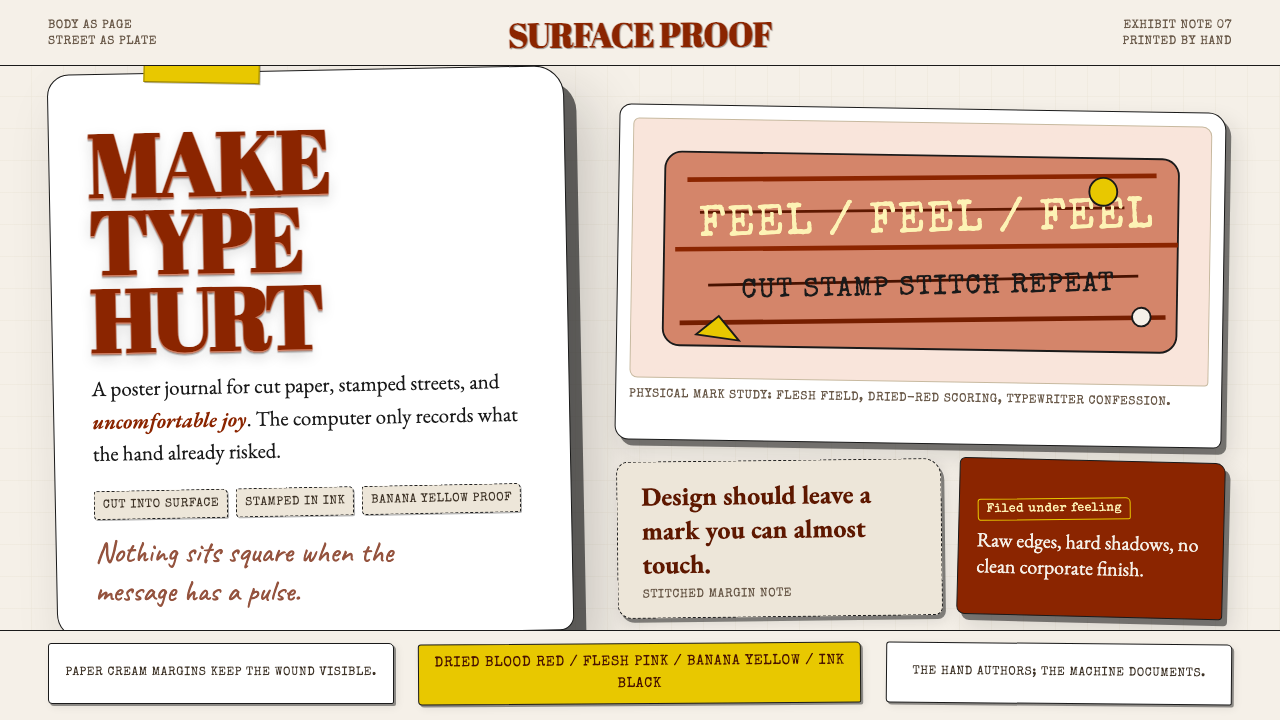
Stefan Sagmeister turned the body into a canvas — cutting event details into his own torso, building type from bananas and stitched thread — to prove that design should make you feel something, even if that something is discomfort.
Stefan Sagmeister in brief
Stefan Sagmeister is an Austrian-American graphic designer whose practice rejects the screen as a primary authoring surface. Where most contemporary design is conceived digitally and printed or published as a final step, Sagmeister begins in the physical world — with skin, fruit, thread, torn paper, inked stamps, street installations — and the camera is the last tool invoked, not the first. The result is a body of work that carries the weight and unpredictability of material reality: surfaces bleed, edges are imprecise, letterforms are alive.
His visual language is built on material derivation. Colors are not sampled from a swatch library; they emerge from the substances that produce them — flesh pink from skin, dried blood from wounds, banana yellow from overripe fruit, paper cream from aged stock, ink black from stamps and stencils. Grids are present but broken, their authority undermined by the organic logic of the material. Scale shifts dramatically, from the intimate size of a journal entry to the monumental footprint of a public installation, and this range gives the work an uncanny ability to operate across formats without losing its identity.
The studio produced some of the most discussed album covers, posters, and exhibitions of the 1990s and 2000s. Clients included the Rolling Stones, Lou Reed, Jay-Z, and David Byrne. The work is not merely provocative for its own sake — the discomfort or wonder it generates is calibrated to the content it communicates. Sagmeister's famous personal diary rule — that every few years he closes the studio for a year-long sabbatical to feed his own curiosity — is itself a design principle: work that loses contact with lived experience loses its capacity to move people.

Where does Stefan Sagmeister come from?
Stefan Sagmeister was born in 1962 in Bregenz, a small lakeside city in the Austrian state of Vorarlberg. He began publishing his own magazine at fifteen, a project that taught him graphic production before any formal instruction. He studied at the University of Applied Arts Vienna, then won a Fulbright scholarship to study at the Pratt Institute in New York in the late 1980s. New York, with its visual density, its music culture, and its willingness to treat street surfaces as design territory, became his permanent base.
His early career included a formative period working for Tibor Kalman at M&Co in New York. Kalman was already legendary for design that provoked, questioned, and occasionally offended — work that used the visual language of commerce against commercial complacency. Sagmeister absorbed Kalman's conviction that design had an obligation beyond service delivery: it could be an ethical and emotional act. After a stint at Leo Burnett in Hong Kong, he returned to New York and founded Sagmeister Inc. in 1993.
The studio's reputation was established almost immediately. In 1999 he designed a poster for the AIGA Detroit conference by having an intern use an X-Acto knife to carve the event's typographic information directly into his torso. The resulting image — raw, methodical, unflinching — circulated through the design world as a kind of manifesto. It said: the body is a material. Pain is a medium. Design that does not cost the designer something is design that will not cost the audience anything either. The poster won numerous awards and became one of the most cited works in late twentieth-century graphic design.
Through the 2000s, Sagmeister continued pushing the boundary between design and fine art. The 'Things I Have Learned in My Life So Far' project, begun around 2004, translated personal aphorisms into large-scale typographic installations using whatever materials the site or occasion suggested — coins pressed into a lawn in Kansas City, bananas arranged on shelves in New York, text painted across an entire building facade in Lisbon. In 2012, he formed Sagmeister & Walsh with Jessica Walsh, expanding the studio's reach into branding, motion, and digital work. The partnership dissolved in 2019 when Walsh relaunched the studio as &Walsh; Sagmeister returned to solo practice and to the ongoing research into beauty, happiness, and the relationship between aesthetics and well-being that continues to define his later career.
What defines the Stefan Sagmeister look?
Material-Derived Color
Sagmeister's palette is not selected from a color system but pulled from the physical world. The tones are those of skin at different temperatures and states, overripe fruit, dried biological fluids, aged paper, and industrial ink. This means the colors carry associative weight that sampled palettes lack: flesh pink reads as vulnerability, blood red as consequence, banana yellow as abundance or decay depending on context. The palette is narrow and often unexpected, but always traceable to a source material rather than a swatch.
The Body as Surface
No other designer of his era used the human body as a primary design substrate with such consistency and seriousness. Sagmeister's body-based work is not shock art — it is an argument about design's relationship to lived experience. When type is scratched into skin, it carries risk, time, and physical cost that computer-set type cannot simulate. The body also introduces organic imprecision: letterforms carved by hand are never identical, and that irregularity is the point. The warmth of the material guarantees the warmth of the response.
Handmade Type Construction
Typography in Sagmeister's work is routinely constructed rather than selected. Letters are assembled from coins, bones, bent wire, stacked books, arranged food, or living plants. This physical construction process means that the letterforms are inseparable from their substance: banana-letter type implies ripeness and transience; coin-letter type implies accumulation and weight. The method forces a fundamental question at the start of every typographic decision — what material should these words be made of, and what does that material say about the words?
Broken Grid and Raw Edge
Sagmeister's layouts acknowledge grid structure but refuse its authority. Elements exceed their boxes, bleed into adjacent areas, or are tilted, stacked, or scattered in ways that register as intentional disruption rather than error. The raw edge — torn paper, uneven ink, the frayed boundary of a stamped letterform — is preserved rather than cleaned up. Where conventional production design would route these imperfections to final correction, Sagmeister's process treats them as evidence of authentic making. The imperfect edge is proof that a human was present.
Intimacy at Monumental Scale
A distinctive quality of Sagmeister's work is its ability to maintain a private, confessional tone regardless of scale. A journal entry scratched into skin becomes a poster seen by thousands; a personal aphorism spelled out in coins on a city lawn is experienced by passers-by who may not even recognize it as design. The content is always personal — drawn from his own journals, his own fears, his own observations about happiness — and this personal origin survives translation into the monumental. The viewer senses that a specific human being made this specific claim, even when the substrate is a building facade.
Confessional Content Strategy
Sagmeister's most influential works use his own biography and psychological state as primary content. This is not autobiography for its own sake — it is a method for achieving specificity. A claim drawn from direct experience carries a different weight than a claim assembled from research. The 'Things I Have Learned in My Life So Far' series, his documented sabbaticals, and his published diaries all function as design demonstrations: showing, rather than arguing, that authenticity and craft are inseparable. The confessional mode is a structural choice with aesthetic consequences.
Ephemeral and Perishable Materials
Fruit rots. Skin heals. Thread unravels. The materials Sagmeister favors resist permanence, and this resistance is meaningful: it foregrounds the temporal dimension of design, insisting that a piece exists in time, not just in space. Work made from perishable substances cannot be fully captured in a photograph — the photograph is always a record of a moment, not the thing itself. This awareness of decay and ephemerality connects the design practice to a broader philosophical position: that designed objects, like all living things, derive some of their meaning from their transience.

Who shaped Stefan Sagmeister?
Born in Bregenz, Austria in 1962, Sagmeister founded Sagmeister Inc. in New York in 1993 after studying in Vienna and at Pratt Institute. He designed covers for the Rolling Stones, Lou Reed, Jay-Z, and the Talking Heads, and produced exhibition work shown at galleries and museums worldwide. His practice spans print, installation, film, and writing. He has taken several year-long sabbaticals — in Bali, in Europe, and elsewhere — which he documents publicly and treats as a fundamental part of his working method. His books, including 'Things I Have Learned in My Life So Far' and 'The Happy Film,' document the intersection of design, happiness research, and personal philosophy.
Walsh joined Sagmeister's studio in 2010 and became a partner in 2012, forming Sagmeister & Walsh. During the partnership, the studio expanded into branding, motion design, and social-platform–native work, bringing a more vibrantly chromatic and surrealist sensibility alongside Sagmeister's material-physical approach. Walsh's contribution broadened the studio's demographic and formal range considerably. In 2019 she relaunched the studio independently as &Walsh, while Sagmeister returned to solo practice. Their collaborative period represents one of the more documented creative partnerships in contemporary graphic design.
Kalman was the founding design director of M&Co in New York and Sagmeister's most formative early employer. Kalman believed that design had a social and moral responsibility, and he used his studio's client relationships — which included the Restaurant Florent, Talking Heads, and eventually Colors magazine for Benetton — to make work that challenged assumptions rather than confirmed them. His influence on Sagmeister was primarily philosophical: the insistence that discomfort, ambiguity, and provocation are not failures of communication but legitimate design strategies. Kalman died in 1999; Sagmeister has cited him as the single most important influence on his practice.
The Talking Heads frontman and solo artist was among Sagmeister's most sustained and adventurous clients. Their collaboration extended across multiple album covers and visual projects, and Byrne's willingness to embrace unconventional, labor-intensive design solutions gave Sagmeister room to develop his material-based approach in a commercial context. The working relationship illustrated that the boundary between art direction and fine-art collaboration could be deliberately blurred, and that a client's intellectual ambition could function as a design brief in itself.
Sagmeister designed several visual identities for Lou Reed, including work associated with Reed's late-career releases. Reed's subject matter — gritty urban experience, emotional extremity, the underside of bohemian life — aligned naturally with Sagmeister's interest in using discomfort as a design resource. The collaborations demonstrate how a designer's sensibility and a client's thematic preoccupations can reinforce each other to produce work neither would generate independently. Reed's cultural authority also helped validate Sagmeister's more extreme formal experiments to a mainstream music audience.
How do you use Stefan Sagmeister today?
Sagmeister's aesthetic is among the most distinctive and least generic in contemporary design history, which makes it both powerful and demanding to apply. It works best when the brief itself calls for authenticity, emotional intensity, or the communication of a personal stake — when the goal is not merely to inform but to make the audience feel the weight of the message. Applied to the right context, it is unforgettable; applied to the wrong one, it reads as gratuitously edgy or incoherent.
For presentation slides, the Sagmeister approach challenges conventional deck structure productively. A cover slide benefits from a single bold material gesture: one idea expressed through a constructed or photographed typographic object rather than a digital layout. The typographic image should dominate the frame, with title text subordinated or integrated into the image itself. Content slides work best when they commit to a single idea per page and express hierarchy through dramatically contrasting scale rather than through color coding or icon sets. Data slides can adopt a handmade quality — sketched charts, annotated diagrams — that signals human interpretation over automated output. The risk on content slides is inconsistency: once the aesthetic establishes an expectation of handmade warmth, a suddenly polished slide reads as an error.
For web interfaces and digital products, the style requires careful translation. Full material-photography implementation is appropriate for editorial landing pages, cultural institution sites, or artist portfolios where the brand can absorb the visual weight. Dashboard and tool interfaces can borrow selectively: a typographically bold hero section with a material texture photograph, transitioning to a cleaner grid for functional content. Pricing pages can use the confessional tone — short, specific, first-person-adjacent copy — without the full visual intensity. The key constraint is that interactive states (hover, focus, active) must remain legible and predictable; material ambiguity that reads as intentional in static work can read as broken in interactive contexts.
For editorial and marketing work, the style is at its most transferable. A campaign built around a central material typographic image — words constructed from the product's own substance, or from a material that metaphorically represents the brand's values — can carry the Sagmeister logic without requiring physical risk or extreme production. Posters and out-of-home advertising benefit particularly: the style's bold scale contrast and material specificity read clearly at distance and reward closer inspection. Long-form editorial can use the confessional content strategy structurally, framing analysis as personal observation rather than impersonal authority.
A common mistake when referencing Sagmeister is mistaking provocation for shock. His most extreme works — the carved torso poster, the installations involving bodily risk — were not designed to disturb for disturbance's sake; the discomfort was proportional to the content. Designers who apply surface-level edge (bloody textures, confrontational typography) without the corresponding intellectual and emotional content produce work that reads as imitative rather than authentic. A second mistake is treating the handmade aesthetic as an excuse for sloppiness: Sagmeister's physical constructions are meticulously executed; the rawness is controlled rawness, not uncontrolled mess. The warmth of the material does not substitute for craft — it requires it.

Stefan Sagmeister — FAQ
Is Sagmeister's approach only for cultural clients, or can it work for commercial brands?
His studio worked with major commercial clients including a global sportswear brand and several financial institutions, so the approach is not inherently restricted to cultural work. The relevant question is whether the brand's identity can support the emotional and material intensity the style demands. Brands built around craft, authenticity, personal narrative, or experiential quality — independent spirits, specialty food producers, independent publishers, performance venues — are natural fits. Brands whose identity rests on precision, neutrality, or institutional scale tend to resist the style's organic irregularity. The confessional content strategy, however, translates more broadly: specific, first-person–adjacent copy is an effective alternative to generic brand voice in almost any category.
How do you apply this aesthetic digitally when the whole point is physical material?
The most effective digital translations begin in the physical world and end in the camera. Design the typographic element physically — construct the letters from a relevant material, photograph it with care — and then use that image as the primary visual asset in the digital layout. The digital layer handles spacing, type hierarchy, and interactivity; the material layer provides the emotional and sensory texture. This hybrid approach is used routinely in editorial photography, luxury brand campaigns, and cultural institution communications. What does not translate is the simulation of material texture through digital filters: a digitally applied grain or scratch overlay reads as pastiche, not authenticity. If physical production is genuinely impossible, a closely related strategy is to use materials that already carry associative weight — aged paper, printed letterpress textures — through high-quality documentary photography.
Does the style work for systematic brand identities, or is it inherently one-off?
Sagmeister himself has argued that the impulse toward systematic identity is often at odds with authentic communication — systems can become formulas, and formulas cannot surprise. That said, several brand applications derived from his approach have been systematic at the level of principle rather than template: the same material logic is applied to each touchpoint, but the specific material and construction may vary by context. An event series might spell its name in a different material each year; a publication might use the same handmade typographic approach but with locally sourced materials for each edition. The system is a method, not a kit, and that distinction is crucial. Designers expecting a set of components to deploy will be frustrated; designers who internalize the underlying principle — material reflects content; specificity builds trust — can maintain coherence across a broad range of applications.
How does Sagmeister's approach relate to the contemporary maximalism or craft revival trends?
Sagmeister's work predates both trends and is distinct from them in its motivations. The current craft revival is often aesthetic in its primary orientation — letterpress, risograph, and hand-lettering are chosen because they look a certain way, generating a retro or artisanal visual signal. Sagmeister's material choices are semantic: the material is chosen because of what it means, not how it looks. Similarly, contemporary maximalism tends to be additive — more color, more pattern, more layering — whereas Sagmeister's work, despite its intensity, is often highly focused: one strong material gesture, one clear message. The apparent similarity to craft-revival aesthetics is a surface convergence; the underlying logic is different. Applying the Sagmeister approach means asking 'what should this be made of?' before 'how should this look?' — a sequence most trend-driven design reverses.
What distinguishes authentic Sagmeister-influenced work from imitation?
The clearest marker is whether the material choice is motivated. In authentic applications, you can answer the question 'why this material?' with a specific answer rooted in the content — the words are made of coins because the project is about economic value; the type is carved into wood because the client is a forest-products company; the letters are assembled from broken crockery because the brief is about a restaurant that failed. In imitations, the material is chosen for its visual texture or shock potential without a corresponding conceptual anchor. The second distinguishing marker is execution quality: Sagmeister's physical constructions are made with the same obsessive precision that conventional designers apply to digital layouts. The rawness is chosen, not defaulted to. Imitations often mistake coarse production for authentic physicality. The test is simple: if you replaced the material with a different one of equal visual interest, would the meaning change? If not, the choice was aesthetic, not semantic.
Related design styles
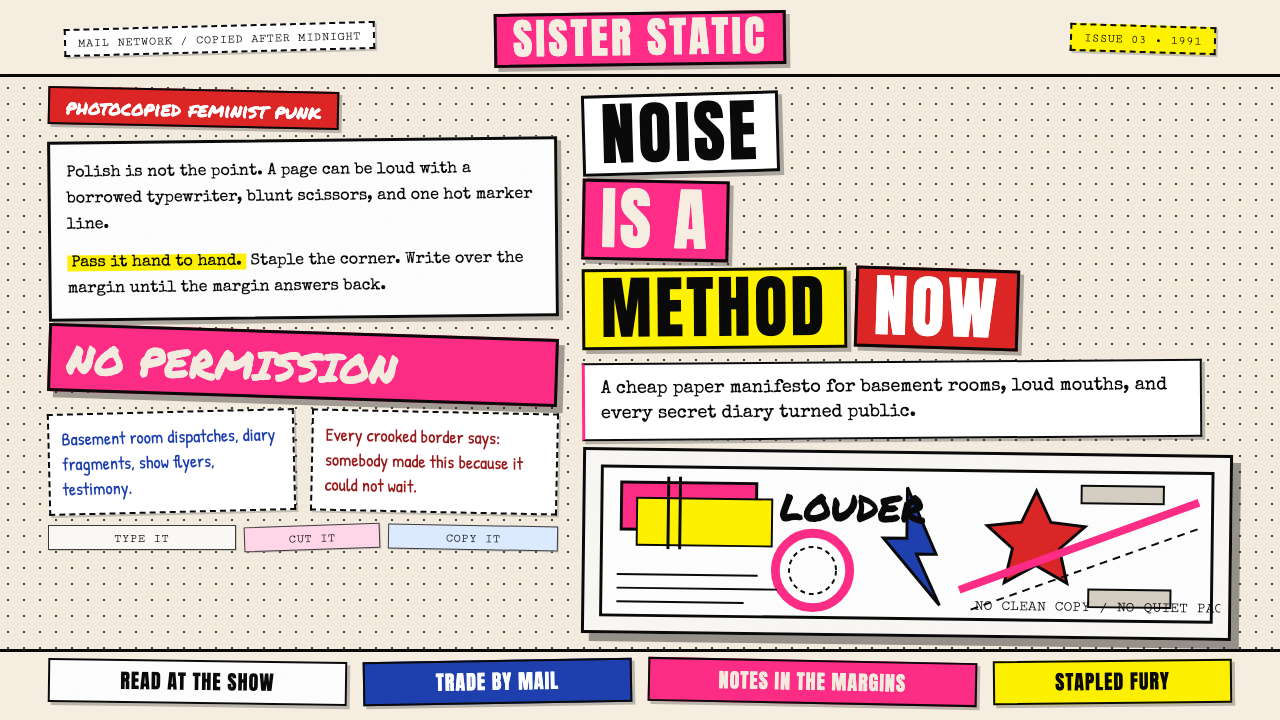 Riot Grrrl Zine (1991)DIY fury, unpolished. Cream Xerox grain, black toner type, hot-pink marker co…
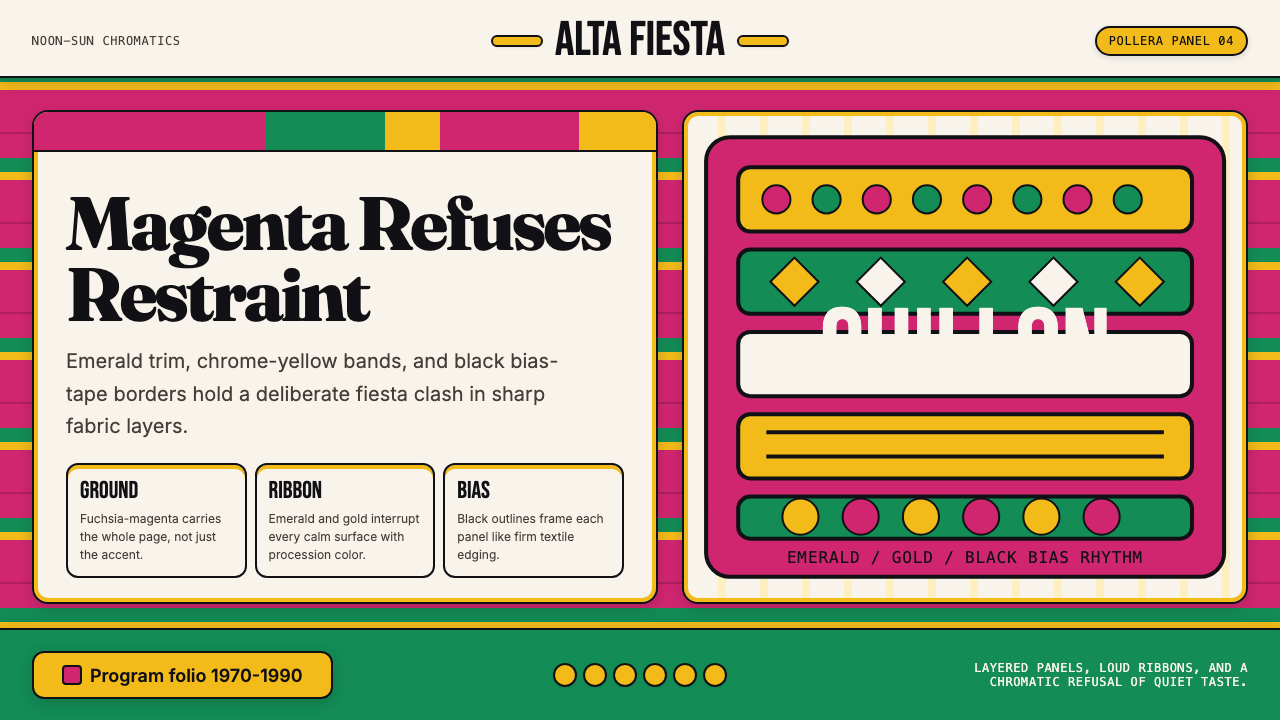 Bolivian Pollera Fiesta MagentaChromatic defiance. Magenta ground, emerald bands and black outlines clash li…
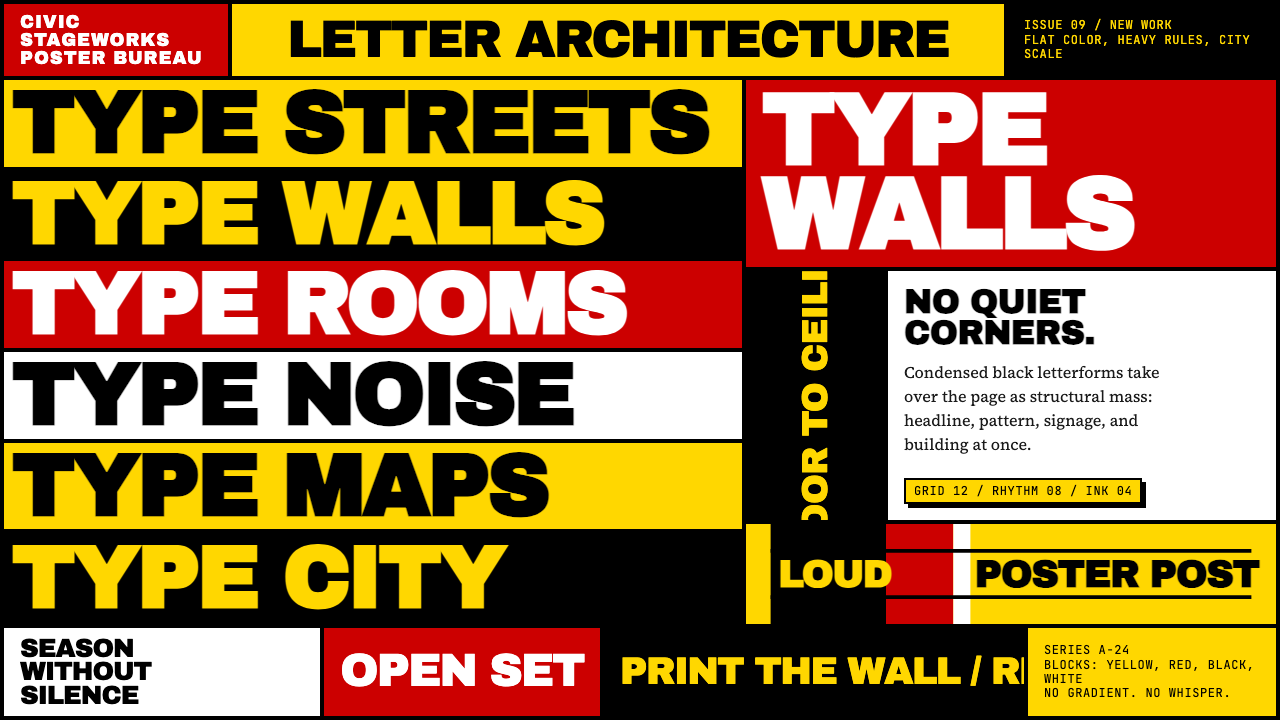 Paula Scher / PentagramType becomes architecture. Yellow-red-black blocks and stacked condensed caps…
 South African Ndebele House PaintNoon color, hard border. Vermilion, cobalt, mustard and emerald lock into a w…
 Greenlandic KalaallisuutColour, kept by rule. Hard-edged bead bands blaze symmetrically across a seal…
 Hopi Katsina TihuEvery colour is a direction. Matte mineral fields meet in smoke-black keyline…