What is Paula Scher / Pentagram?
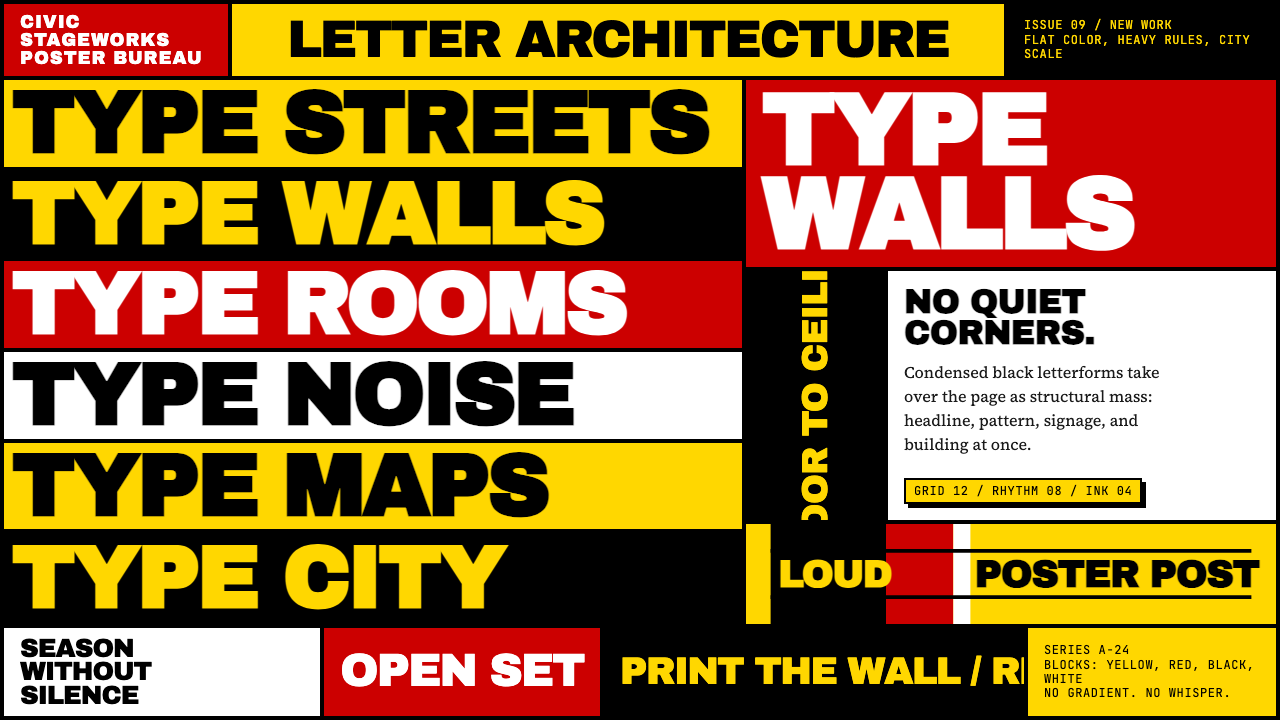
Paula Scher turned condensed type into architecture — stacking letters floor-to-ceiling until the page became the building.
Paula Scher / Pentagram in brief
Paula Scher / Pentagram is a design approach in which typography is not placed on a composition but becomes the composition. Letters — typically heavy condensed capitals — are scaled to fill the entire frame, stacked in dense columns, and treated as structural mass rather than readable text. Color is reduced to a small number of primary or near-primary hues deployed as solid planes: whole backgrounds, entire columns, entire walls. The result is simultaneously poster, signage, and architecture.
The aesthetic owes its directness to the New York School of graphic design — a tradition of loud, flat, commercially urgent visual communication rooted in the advertising and theater cultures of midtown Manhattan. Scher absorbed this energy at CBS Records in the 1970s before developing it into an identifiable language at Pentagram, the international design partnership she joined in 1991. Her work shares DNA with the Russian Constructivists and Dada typographers she admires, but it is fundamentally American in its scale ambitions and its confidence.
Visually, the style is maximalist rather than minimal. Where minimalism removes to reveal clarity, this approach accumulates to create density and force. Hierarchy is achieved not by negative space but by size contrast — a word in enormous condensed black type announces itself as dominant; secondary text is simply smaller and perhaps differently colored. The flattening is absolute: no gradients, no soft shadows, no photographic depth. Everything is hard-edged, opaque, and present.

Where does Paula Scher / Pentagram come from?
Paula Scher graduated from the Tyler School of Art in Philadelphia in 1970 and moved immediately to New York, where she worked as a layout artist before joining CBS Records as an art director in 1972. At CBS through the late 1970s, she designed hundreds of album covers under intense commercial pressure and tight deadlines — conditions that taught her to think in bold gestures and simple visual arguments. Her covers from this period are already typographic in character: the letterforms are the image, not a caption above an image.
After CBS, Scher co-founded the studio Koppel and Scher with Terry Koppel in 1984. The studio's work applied a newly historical consciousness — she was reading extensively in the history of graphic design and became fascinated by the visual energy of early twentieth-century Russian and European avant-garde typography, which she described as 'dangerous' and 'politically charged.' The hand-drawn map work she began making privately in the 1980s — filling the outlines of continents and states with densely packed place names in varying type sizes — grew directly from this engagement with typography as territory.
In 1991 Scher joined Pentagram, the London-founded international design partnership that operates as a group of individually branded partners. Pentagram gave her a platform for large-scale institutional identities. The first and most consequential was the identity for The Public Theater in New York, begun in 1994. Working with artistic director George C. Wolfe, Scher developed a visual language for the institution that fused the scale of urban signage with the urgency of political placards: condensed Wood Type-influenced letterforms, primary colors collaged and overlapped, raw energy that felt both historical and urgent. The identity was immediately successful and has remained essentially intact for decades.
From the Public Theater onward, Scher applied and extended the language to a remarkable range of institutional clients: the identity and environmental graphics for the High Line park in New York, the branding and wayfinding for the New Jersey Performing Arts Center, the environmental graphics for Bloomberg's global headquarters, and the Citibank rebrand — an exercise in making a major financial institution's visual presence feel both confident and approachable. Throughout, the governing logic remained consistent: typography as structural mass, color as architecture, flatness as honesty.
What defines the Paula Scher / Pentagram look?
Typographic Mass
Typography is not a label applied to a design — it is the design. Letters are scaled to fill the entire available area, often leaving almost no conventional margin. Condensed or extra-condensed letterforms are preferred because they can be made very large while still stacking multiple words vertically. The physical weight of letters — their visual density on the page — is treated the same way an architect treats load-bearing columns: the heavier and more numerous, the more structural authority they convey.
Primary Color as Architecture
Color is used in large, unmodulated planes — entire backgrounds, full columns, complete rectangles — rather than as tints, gradients, or accents. The palette draws from primaries and near-primaries: saturated reds, sharp yellows, dense blacks, clean whites. These are not chosen for psychological warmth or brand friendliness but for maximum visual presence and contrast. A yellow field does not suggest happiness; it commands attention the way a painted wall commands attention.
Collage and Layering
Multiple type elements — words at different sizes, set in different orientations, sometimes in different colors — are allowed to overlap and crowd one another. This collage sensibility distinguishes the style from both Swiss grid rationalism and from careful editorial typography. The overlaps are not mistakes or accidents; they are compositional decisions that create visual tension and energy. The resulting density mirrors the visual experience of urban environments: posters layered on walls, signs competing for attention.
Flat, Hard-Edged Surfaces
There are no gradients, soft shadows, glows, or simulated three-dimensionality anywhere in the system. Every element — letter, color block, rule, background — meets every other element at a sharp, clean edge. This commitment to flatness is not a stylistic preference borrowed from digital minimalism; it is a structural conviction inherited from the silk-screen and letterpress traditions that shaped early twentieth-century avant-garde print. Flatness is honest: a surface that is flat admits it is a surface.
Scale as Hierarchy
Information hierarchy is established primarily through dramatic size contrast rather than through color differentiation, spatial separation, or weight gradation alone. The most important word or phrase is often many times larger than the next element in the hierarchy. Secondary and tertiary information is present — the style is rarely cryptic — but it is visually subordinate in a way that is immediately legible even at a distance. This approach is rooted in the logic of street-level signage and theatrical posters, where information must communicate instantly at varying distances.
Historical Eclecticism
The style draws openly on the visual history of typography — Wood Type poster lettering from the nineteenth century, Constructivist propaganda graphics from early twentieth-century Russia, American vernacular signage, Dada typographic experiments. These references are not citations or homages but raw material absorbed and transformed. The result is a visual language that feels simultaneously contemporary and deeply rooted, authoritative without being academic. This is eclecticism deployed as cultural confidence, not as nostalgia.
Environmental Scale Ambition
The logic of the style extends naturally from the printed page to architectural surfaces. Scher's environmental graphic work — for Bloomberg, the High Line, institutional lobbies and atria — applies the same typographic-mass approach to walls, floors, glass facades, and wayfinding systems. The letters that fill a poster at half a meter can fill a wall at twenty meters by the same compositional rules. This scalar flexibility is a genuine strength: the visual system works at the scale of a business card and at the scale of a building.

Who shaped Paula Scher / Pentagram?
The originating intelligence of the style. Scher spent the 1970s designing album covers at CBS Records, developing a facility for bold typographic gestures under commercial pressure. After co-founding Koppel and Scher in 1984, she joined Pentagram in 1991 and became one of its most recognized partners. Her 1994 identity for The Public Theater in New York — condensed Wood Type-influenced letterforms in collaged primary colors — established the visual language that would define her career. Her hand-painted map series, begun privately in the 1980s and exhibited internationally, demonstrate the same underlying principle: fill the available surface with letters until the letters become landscape.
Founder of The Public Theater and the figure whose institutional vision created the conditions for Scher's most famous identity. Papp built The Public as a deliberately democratic, politically engaged theater — Shakespeare in the Park, emerging American playwrights, a downtown sensibility opposed to Broadway's commercial conservatism. That identity — energetic, urgent, populist — gave Scher a brief that demanded maximum visual force rather than institutional restraint. Though Papp died in 1991, before the 1994 identity was designed, his vision of the theater as a public, democratic space defined what the visual language needed to say.
The design partnership that gave Scher the operational platform and client access to realize her language at institutional scale. Founded in London in 1972, Pentagram operates as a co-operative of independent partners — each runs their own team and practice, sharing the firm name and administrative infrastructure. The model is unusual in that individual partners are publicly identified with their work, creating a situation where Scher's identity is both her own and the firm's. Pentagram's prestige and its network of major institutional and corporate clients made possible the breadth of Scher's built and printed work from the 1990s onward.
Artistic director of The Public Theater from 1993, and Scher's collaborator on the institution's 1994 identity. Wolfe's programming vision — ambitious, politically aware, culturally diverse, and always oriented toward a broad public rather than a cultural elite — was directly translated into the graphic identity that Scher designed. The alignment between Wolfe's institutional ambition and Scher's visual approach produced one of the most sustained and coherent institutional identities in American graphic design history: a system that remained legible and vital across decades of changing programs, productions, and cultural contexts.
How do you use Paula Scher / Pentagram today?
Paula Scher / Pentagram is one of the most applicable historical styles for contemporary high-impact communication work — presentations, campaigns, institutional identities, and environmental graphics — because its logic is transferable and its visual rules are clear. Applying it well requires understanding that the style's power comes from commitment: half-measures produce not bold Scher but cluttered pastiche. The typography must genuinely dominate the frame, the color must be used in full planes rather than as accent, and the flatness must be absolute.
For presentation slides, the style works at two levels. Cover slides benefit from a full-bleed typographic approach: a single key phrase — the theme, the proposition, the company name — set in a heavy condensed face large enough to fill the entire slide, potentially in two colors where one large word anchors the top field and a second anchors the bottom. Content slides should be treated as structured typographic compositions: section headers at dramatically large scale, supporting text at correspondingly smaller scale, with no decorative elements between them. Data slides acquire visual force when charts and diagrams are rebuilt in the primary palette — bars colored in full saturated tones, labels set in the same condensed face as the surrounding text, no chart junk.
For web interfaces — particularly dashboards, analytics tools, pricing pages, and marketing landing pages — the style provides a strong structural vocabulary. The approach: commit to a strict column grid, use the full width for key navigational and headline elements, and reserve the primary colors for states that demand attention: error conditions, the recommended pricing tier, the primary call-to-action button. Body text should be restrained in size and weight to create contrast with the large typographic features; the background should be close to white or a very light neutral rather than any color that competes with the primary palette.
For editorial and marketing work — event posters, campaign materials, institutional reports, branded social content — the style is at its most direct. An event poster in this mode commits its entire surface to the key information: the name of the event in the largest possible type, the date and venue at half that scale, the institution's name somewhere within the composition at yet another scale. No photography, no illustration, no decorative border. The hierarchy is total and immediate. Marketing campaign materials work best when the visual system is applied consistently across formats: the same color assignment, the same typeface approach, the same scale logic, whether the format is a full-page advertisement or a social media tile.
A common mistake when working with this style is treating it as merely a typographic style — choosing a condensed typeface and calling it done. The style's actual mechanism is the relationship between massive type, color used as solid architectural plane, and absolute flatness. If any of these three elements is diluted — condensed type on a photographically complex background, or primary colors used as small accents, or soft shadows introduced under cards — the visual logic collapses. Another frequent error is trying to use the style for contexts that call for warmth, softness, or sensory richness. This is a confrontational, urban, physically assertive aesthetic. It is excellent for institutions, platforms, and cultural organizations that want authority and energy. It is wrong for contexts where the user experience depends on approachability, organic texture, or emotional softness.

Paula Scher / Pentagram — FAQ
Is this style the same as maximalist typography in general?
Not quite. Maximalist typography is a broad descriptor that includes decorative lettering, ornamental flourishes, layered texture, and expressive hand-drawn forms — many of which are the opposite of what Scher's system does. The Scher / Pentagram approach is maximalist in its commitment to filling the frame and asserting typographic presence, but it is also rigorously flat, structurally disciplined, and free of decoration. The letters are as large and numerous as possible; they are also as clean, hard-edged, and unadorned as possible. The maximalism is of mass and scale, not of ornament.
Can the style work with more than two or three colors?
The style's natural palette is highly restricted — typically a dominant color, a secondary color, and black and white — and this restriction is part of what gives the work its visual authority. Introducing additional colors is possible but risks fragmenting the architectural clarity that makes the approach work. If more colors are needed — for example, to differentiate multiple brands or categories within a single composition — the discipline should be maintained: each color must be used in full planes at significant scale, not as accents or gradients. Four or five colors of equal weight will tend to produce visual chaos; four or five colors where one clearly dominates and the others are used sparingly can still hold together.
How does this style differ from the Swiss International Style it is sometimes compared to?
Swiss International Style and Scher's typographic approach share a commitment to sans-serif letterforms and grid-based composition, but their underlying values diverge sharply. Swiss Style aims for neutrality, system, and rational clarity — it is designed to recede and let content speak. Scher's approach aims for presence, force, and cultural specificity — the design asserts itself alongside the content, not behind it. Swiss Style is typographic precision; Scher's work is typographic architecture. One aspires to transparency; the other to mass. The visual results are recognizably different: Swiss Style produces quiet authority, Scher's approach produces loud authority.
Is the style appropriate for digital products, or does it only work in print?
The style translates well to digital contexts, with some adaptations. Its flatness and hard edges are natural properties of screen rendering and do not require any special treatment. Large typographic display elements — hero headers, landing page headlines, dashboard category labels — are strong applications. The challenge in digital contexts is interactive states and small-scale UI components: buttons, form fields, dropdown menus, and tooltips all require more visual nuance than the poster logic of the style naturally provides. The approach works best in digital when it is used for structural and display elements — the large-scale architecture of the interface — while the detail-level UI follows a related but quieter system that the bold display elements frame.
What is the single most important thing to get right when applying this style?
Commitment to scale. Every failure mode in applying this style comes down to timidity with type size. If the largest typographic element in a composition is not genuinely large — not slightly larger than normal but dramatically, uncomfortably, surprisingly large — the visual argument collapses. The condensed letterforms at moderate size simply look like a font choice; at extreme size they become structural mass. The rest of the system — the primary colors, the flatness, the collage layering — amplifies that mass. Without the mass, there is nothing to amplify. Start by making the most important thing much larger than feels comfortable, then build the rest of the composition around that commitment.
Related design styles
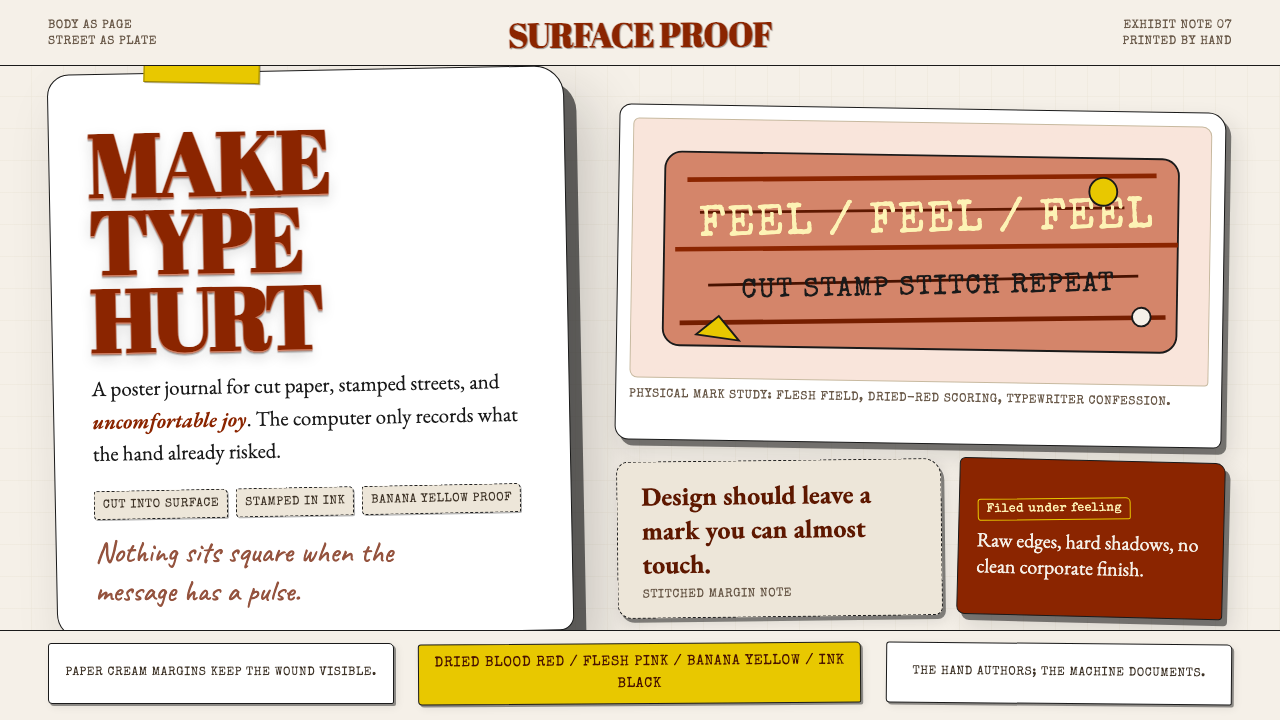 Stefan SagmeisterPain becomes typography. Flesh pink, dried blood red, banana yellow; broken p…
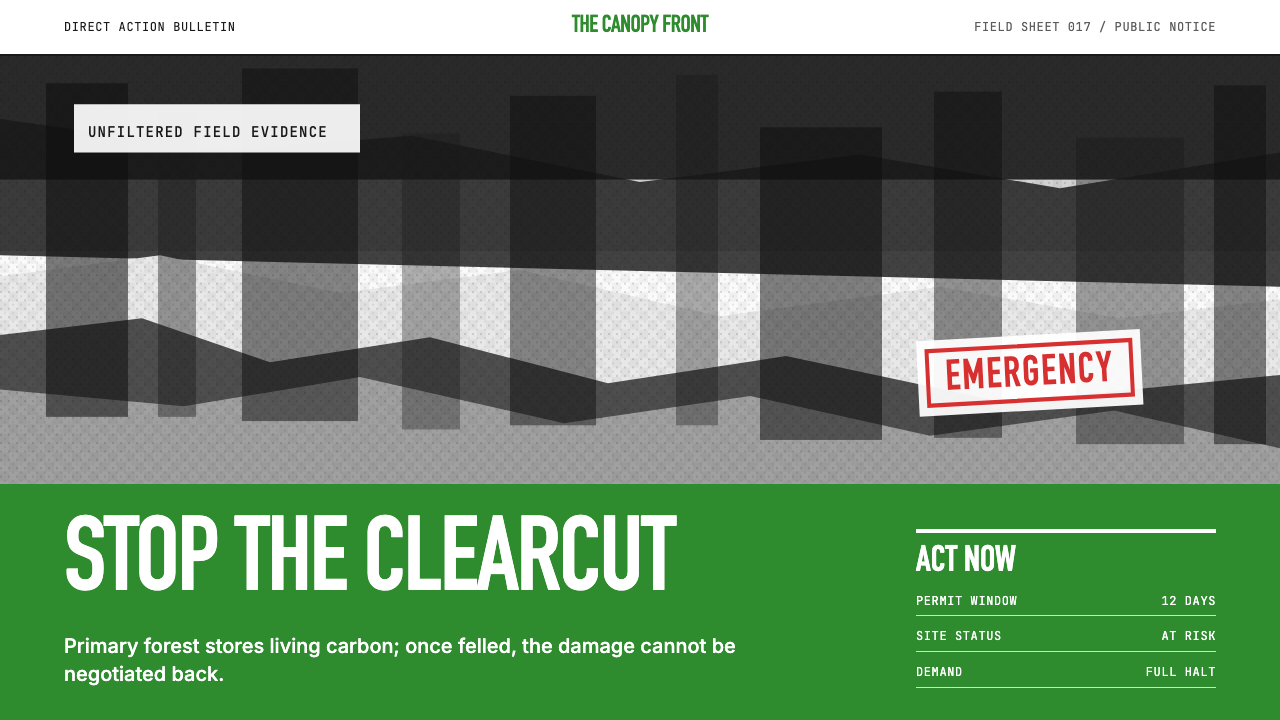 Greenpeace (Activist Poster)Protest without softness. Forest-green caps over monochrome newsprint, one de…
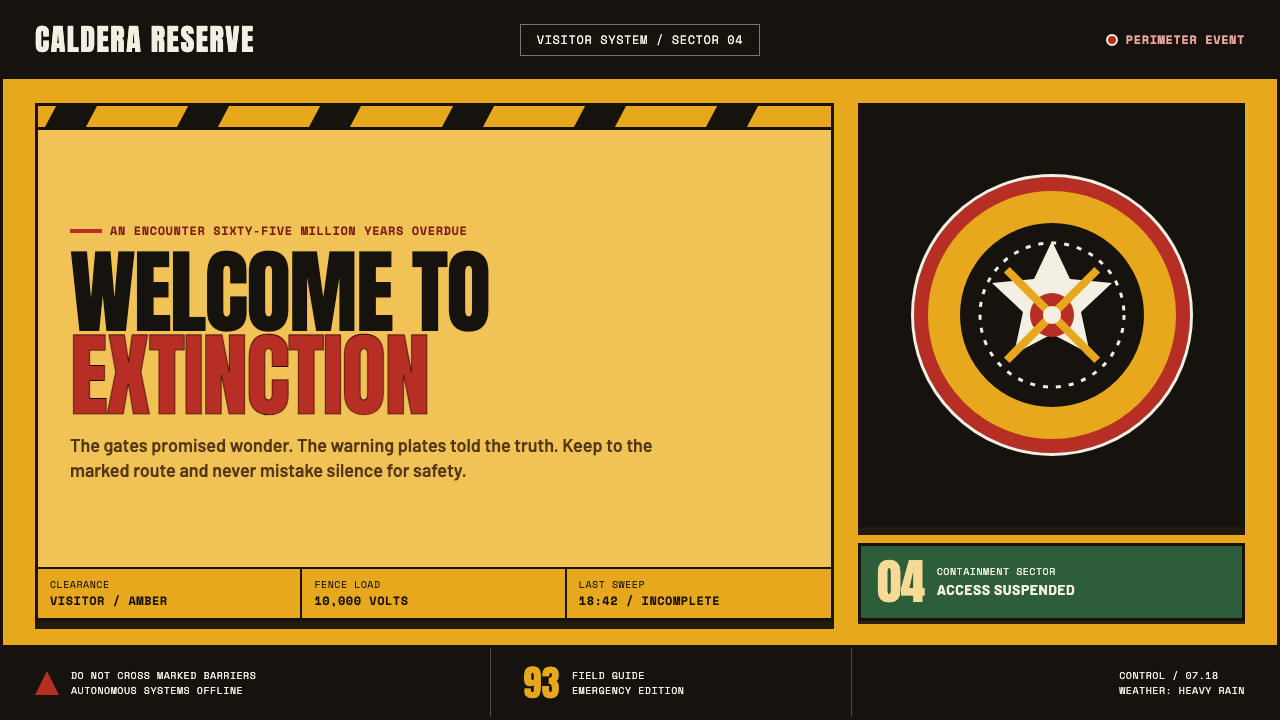 Jurassic Park (1993)Warm welcome, lethal edge. Amber plates, red rings and black chevrons turn aw…
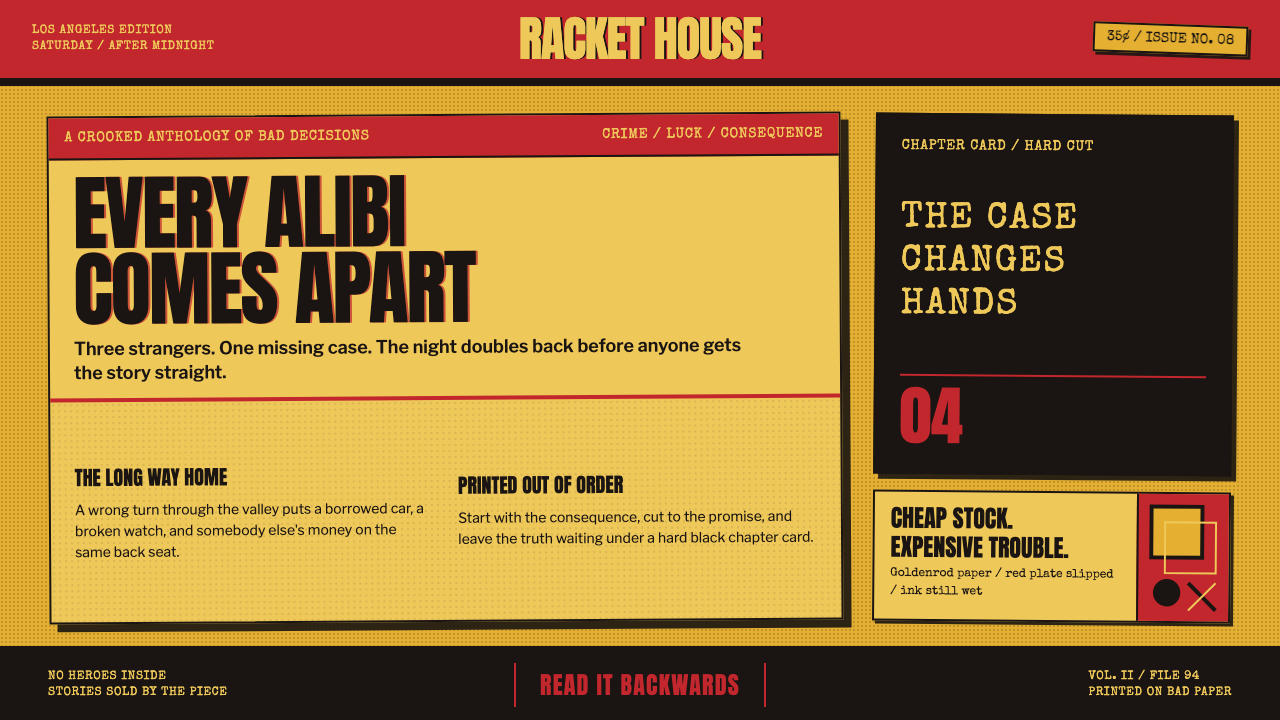 Pulp Fiction (1994)Cheap print, dangerous rhythm. Goldenrod stock, pulp red, and black chapter c…
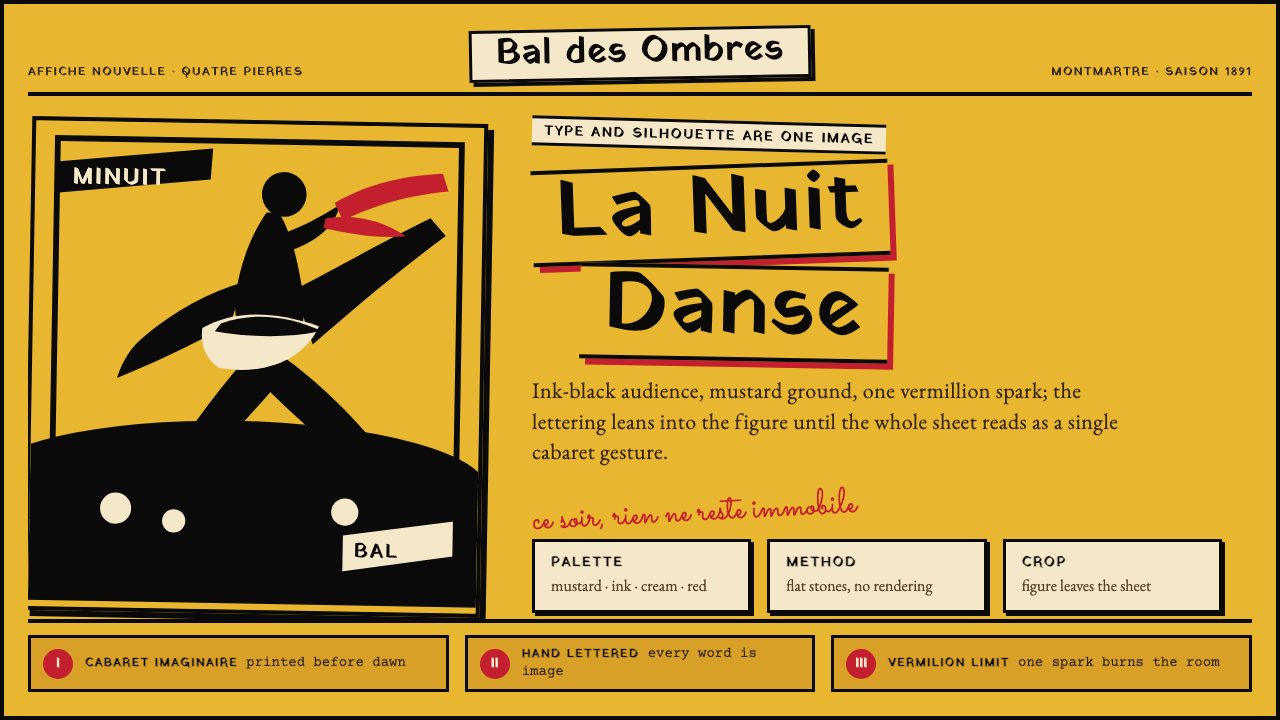 Toulouse-Lautrec Belle ÉpoqueNight becomes gesture. Mustard ground, black silhouette, hand lettering, one…
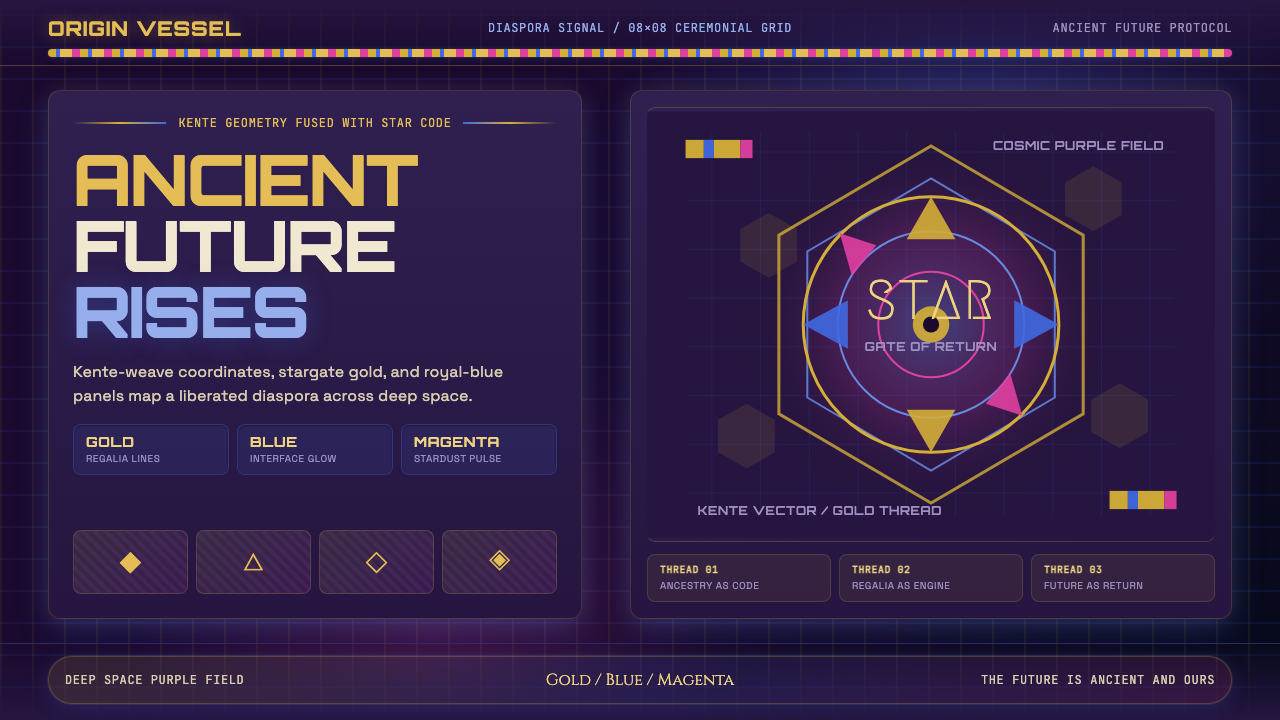 AfrofuturismAncient future, fully luminous. Gold kente grids cut through cosmic purple an…