What is Salvadoran Fernando Llort Naïf?
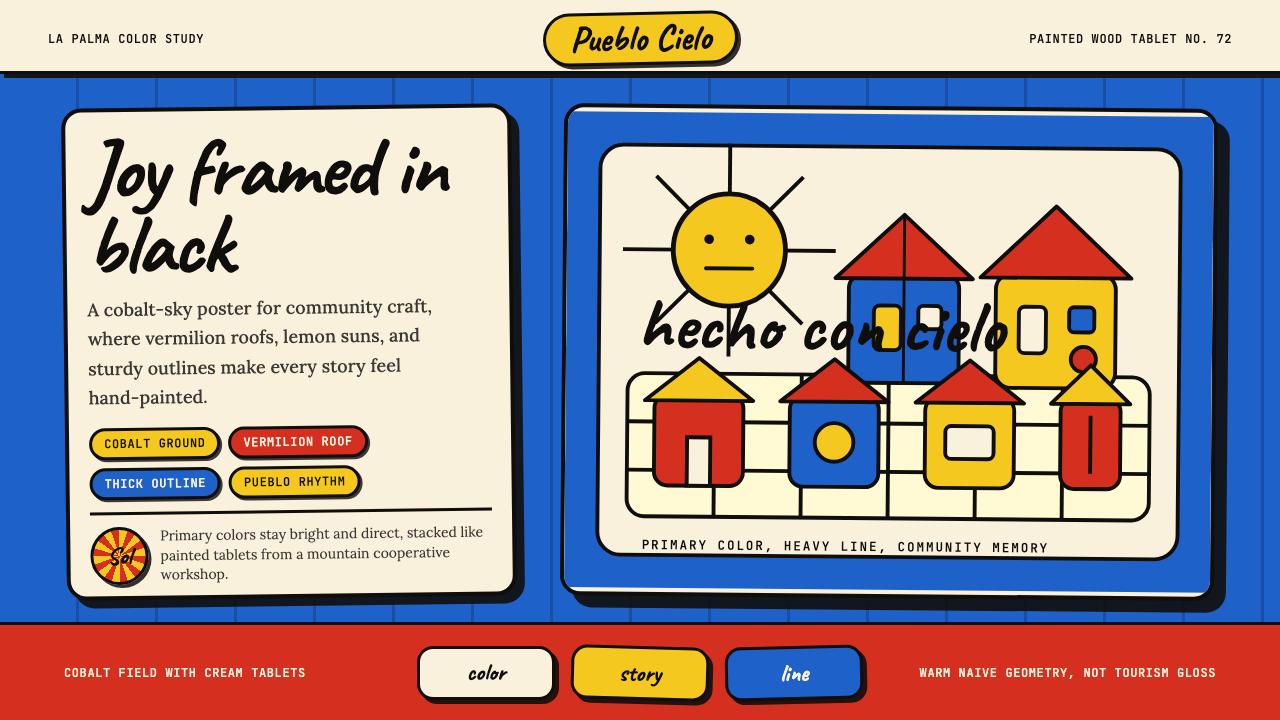
Born in a Salvadoran mountain village during civil war, Fernando Llort's naïf-cubist style turned thick black outlines, cobalt skies, and sun-faced farmhouses into an enduring visual language of communal joy.
Salvadoran Fernando Llort Naïf in brief
The Salvadoran Fernando Llort Naïf style is a visual language rooted in the community art movement that grew up around the mountain village of La Palma in Chalatenango, El Salvador. Its hallmarks are immediate and joyful: thick hand-drawn black outlines enclosing flat areas of vivid primary and secondary color, simplified forms drawn from rural Central American life — farmhouses with pitched roofs, doves in flight, radiant sun-faces, flowering trees, and figures in festival dress — all arranged against skies of deep cobalt that feel simultaneously ancient and festive.
The style belongs to the naïf tradition — art made with deliberate formal simplicity, rejecting academic naturalism in favor of direct emotional expression — but it carries an additional layer of structural intention inherited from Cubism and from the mural traditions of Mexican social realism. Forms are reduced to their most recognizable silhouettes; perspective is flattened or eliminated entirely; colors are chosen for symbolic warmth rather than optical accuracy. The result is imagery that feels hand-made and communal, as if the entire visual world has been rendered in the style of a village festival banner.
What distinguishes this aesthetic from generic folk art is its coherent graphic vocabulary. The thick outline is not merely a drawing convention but a structural principle — it holds forms together, separates fields of color, and gives the composition a quality that translates well from painted wood to printed page to digital screen. The cobalt sky is not a background but an active chromatic anchor that makes the warm reds, yellows, and greens in the foreground radiate with particular intensity.
Where does Salvadoran Fernando Llort Naïf come from?
In 1972, Salvadoran artist Fernando Llort left San Salvador and settled in La Palma, a remote agricultural village in the highlands of Chalatenango department. The move was partly spiritual — Llort had studied theology and was influenced by the Liberation Theology movement then spreading through Latin America — and partly artistic. He wanted to develop a visual practice rooted in the lives of ordinary people rather than in the conventions of fine-art institutions. La Palma, with its traditional craft workshops and close-knit campesino community, offered both the human environment and the material culture he was looking for.
Working alongside local farmers and artisans, Llort developed a visual language that drew on the indigenous and colonial folk-art traditions of the region while incorporating lessons absorbed from the European avant-garde — particularly from Paul Klee's poetic approach to simplified form and from Diego Rivera's conviction that monumental imagery belonged to the public rather than to collectors. The style Llort and the La Palma community evolved was deliberately accessible: anyone could learn to draw a farmhouse, a dove, or a flowering branch in this system. That accessibility was not a limitation but a political and spiritual commitment — a belief that artistic expression was a human right, not a professional privilege.
When El Salvador's brutal civil war erupted in the late 1970s, La Palma found itself in a conflict zone. Rather than abandoning their work, the community of artisans that had formed around Llort's atelier — organized under the cooperative name Semilla de Dios (Seed of God) — continued producing painted crafts: wooden boxes, gourds, tiles, and textiles decorated with the distinctive naïf-cubist imagery. The cooperative became both an economic lifeline for families under extreme duress and a form of cultural resistance — a declaration that ordinary Salvadoran life, with its doves and its corn and its festivals, was worth depicting and worth preserving.
By the 1980s, the La Palma style had spread beyond Chalatenango and had become internationally recognized as a distinctively Salvadoran aesthetic. Llort himself was commissioned to design large-scale public works, including a mosaic for the facade of the Metropolitan Cathedral of San Salvador in 1997, bringing the naïf-cubist visual language from village workshop to national monument. Fernando Llort continued working until health complications limited his activity around 2018; the cooperative tradition he seeded in La Palma remains active, with artisans across El Salvador continuing to produce work in the style he established.
What defines the Salvadoran Fernando Llort Naïf look?
Outline as Structure
The most defining feature of this style is the thick, consistent black outline that encases every form. Unlike a sketched line that describes texture or suggests movement, the outline here is architectural — it functions as a wall that holds color in place and gives each shape a clarity that reads at any scale. The weight of the line is deliberately generous, making the forms feel carved rather than drawn, as though each element is a separate object placed within the composition.
Cobalt Sky as Chromatic Anchor
The deep cobalt blue that fills the sky area in canonical La Palma compositions is not decorative background filler — it is the chromatic fulcrum of the entire palette. Set against this cool, saturated blue, the warm reds, yellows, and greens of foreground forms achieve a vibrancy that neither color could generate independently. The sky field is almost always flat and unmodulated, with no gradients from horizon to zenith, which reinforces the sense that this is a designed surface rather than a representation of observed light.
Flattened Perspective
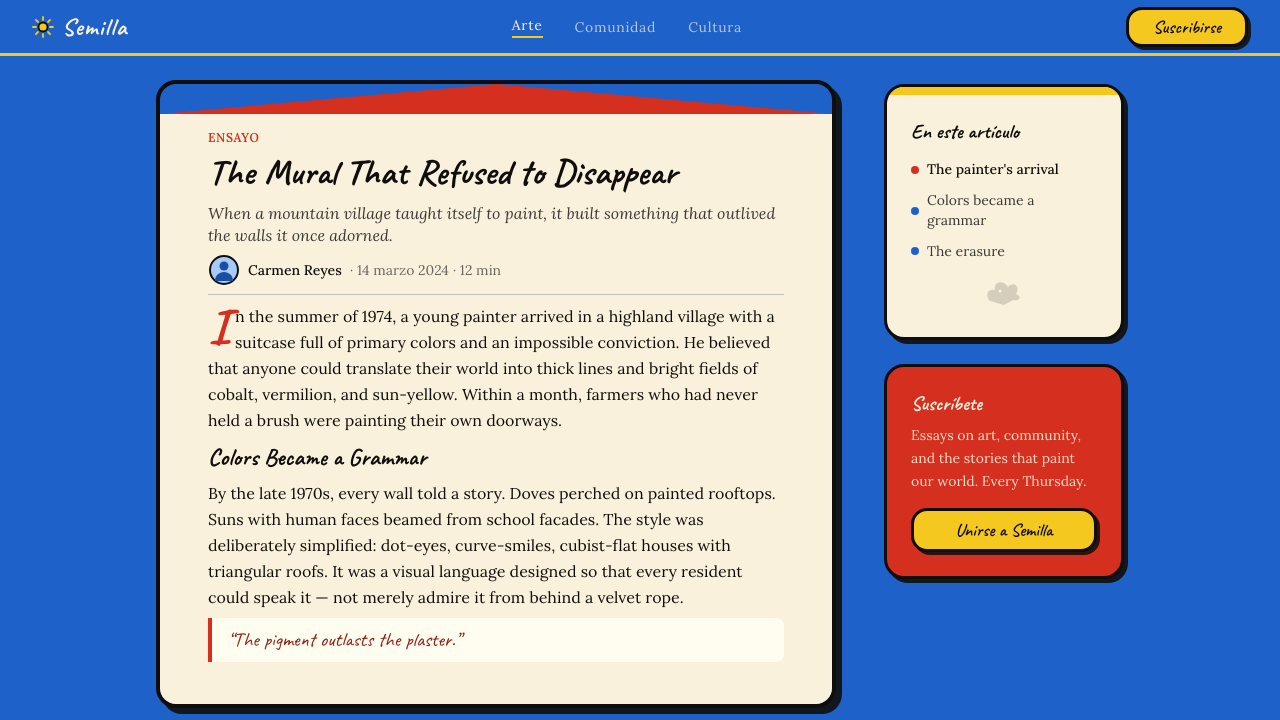
Spatial depth is handled through stacking and size differentiation rather than vanishing-point perspective. Houses are shown in a semi-frontal elevation that reads as both plan and elevation simultaneously — rooflines are triangular and steep, walls show windows as simple grids, and doors are centered rectangles. This flattening gives the imagery a diagrammatic quality reminiscent of children's drawings and medieval manuscript illustration, which is not a naive accident but a deliberate choice that keeps the composition legible as a flat graphic object.
Symbolic Subject Matter
The iconographic vocabulary is specific and recurring: doves representing peace, sun-faces with radiating points symbolizing life and abundance, agricultural imagery rooted in the corn and coffee economy of highland El Salvador, flowers that appear more architectural than botanical, and human figures simplified to silhouettes in festival or everyday dress. This is not decorative imagery selected for pleasantness — each motif carries cultural meaning within the La Palma tradition, and the repetition of the vocabulary across thousands of artisans' works gives it the weight of a shared visual language.
Polychrome Warmth
While the cobalt sky anchors the cool end of the spectrum, the remaining palette is emphatically warm and polychrome. Vermilion, terracotta, and brick reds share space with lemon yellow, golden ochre, leaf green, and flashes of orange. These colors are applied as flat, unshaded fills — no highlights, no tonal modeling — which gives the composition the visual quality of stained glass or painted enamel: luminous, even, and intensely saturated. The warmth of the palette is not incidental to the style's emotional effect; it is its primary instrument.
Handcraft Legibility
The visual system originated in painted wood crafts — small boxes, bowls, and panels painted with brushes by artisans working in village workshops — and it retains the legibility of handcraft even when translated to print or screen. Slight irregularities in the outline, variations in color fill density, and the organic imprecision of the forms are not flaws to be corrected in digital application but properties that distinguish the style from clinical graphic design. The hand-made quality is part of the meaning: it signals origin in a community rather than in a corporation.
Compositional Density
La Palma compositions tend toward fullness rather than minimalist breathing room. The sky is populated with birds or stars; the foreground with figures, plants, and buildings arranged in layers; borders are often filled with repeating floral or geometric motifs. This density is not visual clutter — the strong outlines and flat fills keep each element readable within the whole — but it does mean that empty space is used sparingly and purposefully, always as a pause between active elements rather than as a compositional value in itself.
Who shaped Salvadoran Fernando Llort Naïf?
Llort (1949–2022) is the originating figure of the La Palma naïf movement. Born in San Salvador, he studied theology and fine arts before relocating to La Palma in 1972 with the intention of developing a community-rooted art practice. Over the following decades he trained hundreds of local artisans in his visual system and organized them into the Semilla de Dios cooperative. His most visible public commission — the mosaic facade of the Metropolitan Cathedral of San Salvador, completed in 1997 — brought the La Palma aesthetic from craft workshops to national monument, cementing his status as one of El Salvador's most significant cultural figures of the twentieth century.
One of the earliest artisans to collaborate with Llort in La Palma, Choto helped establish the distinctive visual conventions of the La Palma school during its formative years in the 1970s. His work exemplifies the way the style developed through collaboration — not as a single artist's invention but as a shared visual grammar refined across multiple hands. Artisans of his generation were instrumental in proving that the La Palma system could generate commercially viable crafts without sacrificing its communal artistic identity.
Sister Maddo was a Catholic nun whose presence in La Palma during the early years of the movement connected Llort's artistic project with the Liberation Theology networks active in rural El Salvador at the time. Her role illustrates how the La Palma aesthetic was not purely an art-world development but was embedded in broader social and spiritual currents — the conviction that serving the poor included cultivating their expressive culture. This ecclesial dimension shaped the cooperative's ethos and gave the Semilla de Dios name its particular resonance.
Fernando Llort's son José became a practitioner and advocate of the La Palma tradition in the years following his father's reduced activity. His involvement represents the intergenerational transmission of the style — from founder to family to the wider community of artisans — and his work has helped maintain the cooperative tradition's continuity into the present. He has also been active in efforts to document and promote the La Palma aesthetic as a recognized component of Salvadoran national heritage.
How do you use Salvadoran Fernando Llort Naïf today?
The Salvadoran Fernando Llort Naïf style is among the warmer and more emotionally direct aesthetics in the Central American folk-art tradition, and its application works best in contexts that welcome that warmth — cultural celebrations, community organizations, artisanal brands, and any project where the values of handcraft, accessibility, and collective joy are part of the message. The style is less suited to applications that demand clinical precision, corporate neutrality, or minimalist restraint.
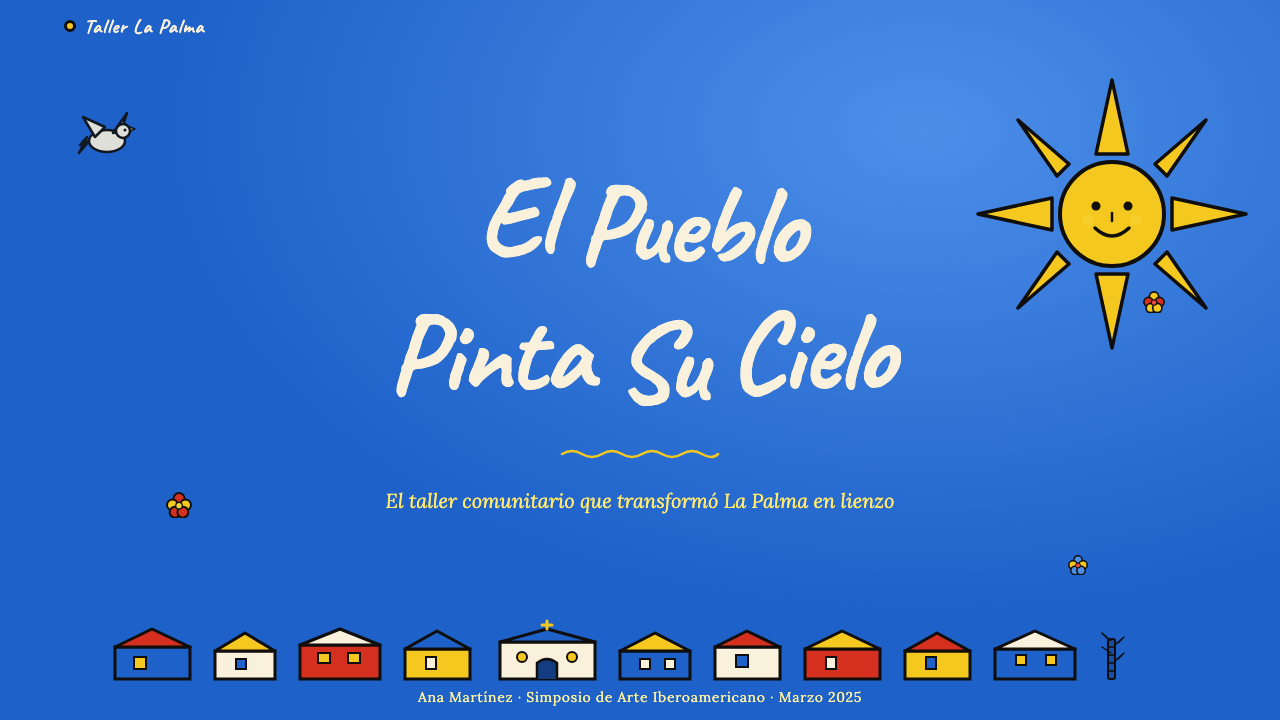
For presentation slides, the style's strength lies in its ability to turn data and content into something that feels human and festive. A cover slide works well with the cobalt sky as the primary field, a large sun-face or dove silhouette at center, and title text set in a rounded, warm typeface that echoes the hand-drawn quality of the outlines. Content slides benefit from the style's natural use of borders and frames: a thick-outlined panel containing text reads like a painted wooden panel, giving information a crafted, material quality. Data slides should lean into the polychrome palette, using the warm reds, yellows, and greens as distinct categorical colors, always separated by a dark outline treatment that keeps segments readable even at small sizes.
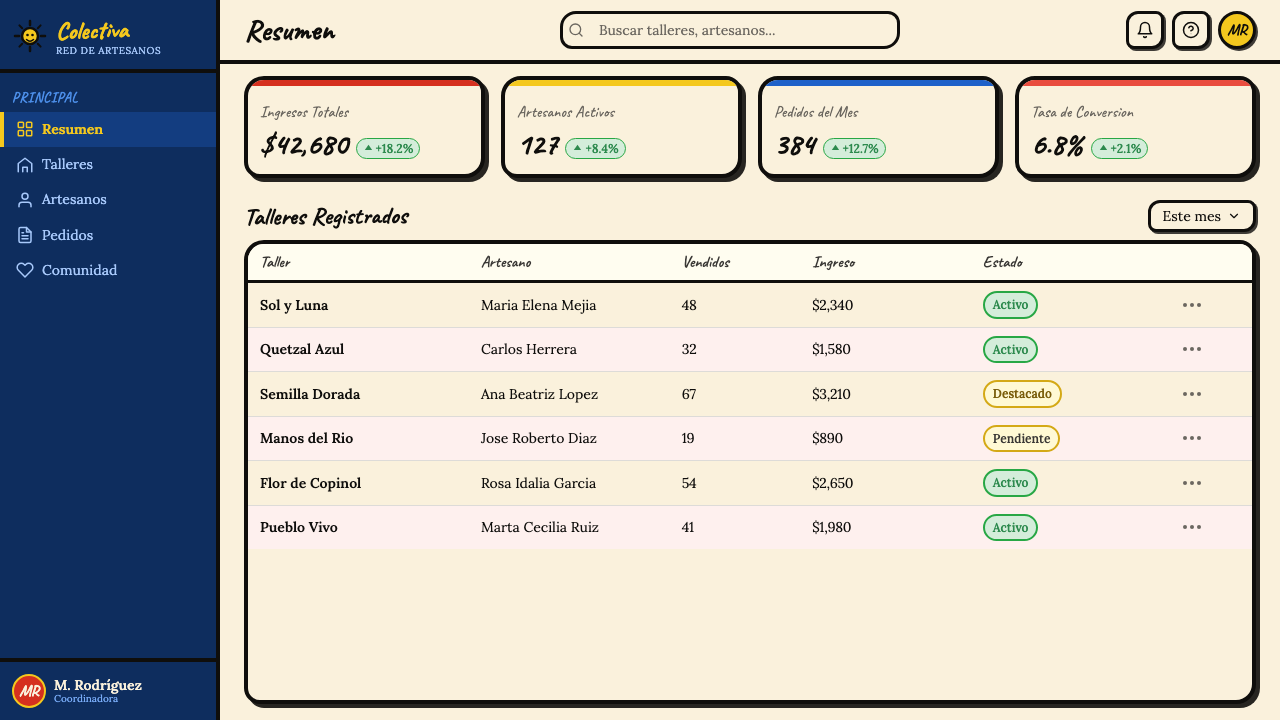
For web interfaces, the style is most at home in sites for cultural organizations, artisan marketplaces, festival platforms, and community-focused services where a sense of place and handmade warmth is a feature rather than a liability. The key technical translation is maintaining the outlined-form quality: use bordered containers with visible, rounded corners rather than frameless cards; use color fills that are flat and fully saturated rather than gradient-softened; and use imagery that references the decorative motifs — doves, florals, sun-forms — as illustrative elements rather than photographs. Navigation and utility components should be clean and minimal to avoid clashing with the richness of the decorative layer.
For editorial and marketing work, the style supports vivid feature imagery and celebration-focused campaigns particularly well. A poster or social media graphic in this style places the primary scene — a festival, a product, a milestone — within the compositional logic of a La Palma painting: cobalt background, flat foreground forms, rich polychrome fills, and a border treatment that frames the whole as a deliberate object. Marketing copy should be set in type that reads at the same register of warmth — rounded forms, generous spacing — rather than in the geometric sans-serifs that characterize colder modernist styles.
A common mistake when applying this style is treating the thick outline as merely decorative and reducing it to a thin border, or omitting it entirely to achieve a cleaner look. The outline is the structural principle that holds everything else together; without it, the flat color fills become disconnected patches rather than forms, and the composition loses its folk-art legibility. A related error is applying the cobalt sky color to every surface, which flattens the crucial warm-cool contrast that gives the palette its energy. Reserve cobalt for background and sky fields, and let the warm colors occupy the foreground.
Salvadoran Fernando Llort Naïf — FAQ
Is this style specifically Salvadoran, or does it belong to a broader Central American folk tradition?
The La Palma naïf style is specifically Salvadoran in its origin and development — it emerged from a single community in Chalatenango department and was shaped by that community's particular history, including the civil war, the Liberation Theology movement, and the artisan cooperative model. While it draws on broader Central American and Latin American folk-art traditions, and while it shares some visual territory with other naïf movements across the region, its specific iconographic vocabulary (the cobalt sky, the sun-faces, the dove motifs, the campesino farmhouses) and its cooperative economic structure are distinctively La Palma. Applying it as a generic Latin American folk art label misses the point of its specificity.
How does this style relate to the naïf art tradition more broadly?
Naïf art — sometimes called folk art, primitive art, or outsider art in different cultural contexts — refers broadly to work made outside academic training conventions, characterized by formal simplicity, direct emotional expression, and a non-illusionistic approach to space and form. The La Palma style fits within this family but is distinguished by its conscious fusion of the naïf sensibility with structural lessons from Cubism and Mexican muralism — particularly in its treatment of form as flat interlocking shapes separated by strong outlines rather than modeled volumes. Llort's academic training meant that the style was not naïf in the sense of untutored; it was naïf in the sense of deliberate formal choice.
Can this style work for dark-mode or dark-background applications?
The La Palma palette is canonically light-ground in one specific sense — the cobalt sky is a deep, saturated cool tone, not a neutral dark — and the style is built around warm colors reading against that cool field. A fully dark neutral background (near-black) can work, but it requires adjustment: the warm foreground colors may need to be slightly more luminous to maintain their vibrancy against a neutral dark rather than the cool cobalt blue. The strong black outlines also become less effective against very dark backgrounds, so a slightly lighter outline tone — deep charcoal or dark indigo — may serve better. The key is preserving the warm-cool contrast that drives the palette's energy.
How should digital applications handle the hand-drawn quality of this style?
The hand-drawn quality — slight irregularities in outlines, organic imprecision in forms, visible brush texture in color fills — is a core property of the style, not a limitation to be corrected. In digital applications, this can be preserved through the use of illustrated assets drawn with intentional imperfection (brush-stroke SVGs, hand-rendered icon sets) rather than geometrically perfect vector shapes. Type choices should also honor this quality: rounded humanist letterforms will feel more at home than purely geometric sans-serifs. Where perfect digital precision is unavoidable (UI components, data tables), keep those elements minimal and let the illustrated decorative layer carry the style's personality.
Is the Semilla de Dios cooperative still active, and does using this style raise any cultural attribution considerations?
The Semilla de Dios cooperative and the broader community of La Palma artisans remain active, and the style continues to be the primary livelihood for many craftspeople in Chalatenango. Using this style in commercial applications raises genuine cultural attribution considerations — the visual language is the intellectual and cultural property of an identifiable living community, not a generic historical resource. Thoughtful application means acknowledging the La Palma origin explicitly, avoiding direct reproduction of specific artisans' compositions, and considering whether commercial use of the style might compete with or undervalue the source community's own commercial production. At minimum, documentation and marketing materials should credit Fernando Llort and the La Palma tradition by name.
Related design styles
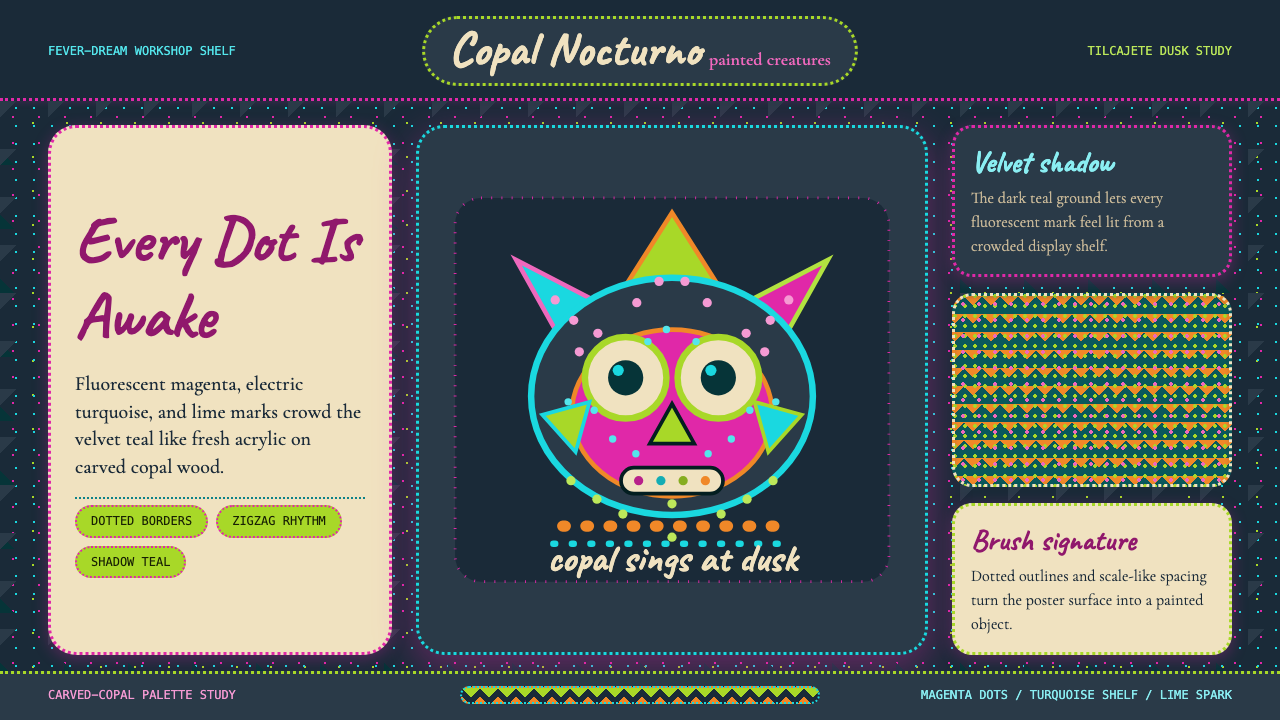 Mexican Alebrije Oaxaca (Linares 1936)Fever craft glows. Velvet teal carries magenta dots, turquoise zigzags, and C…
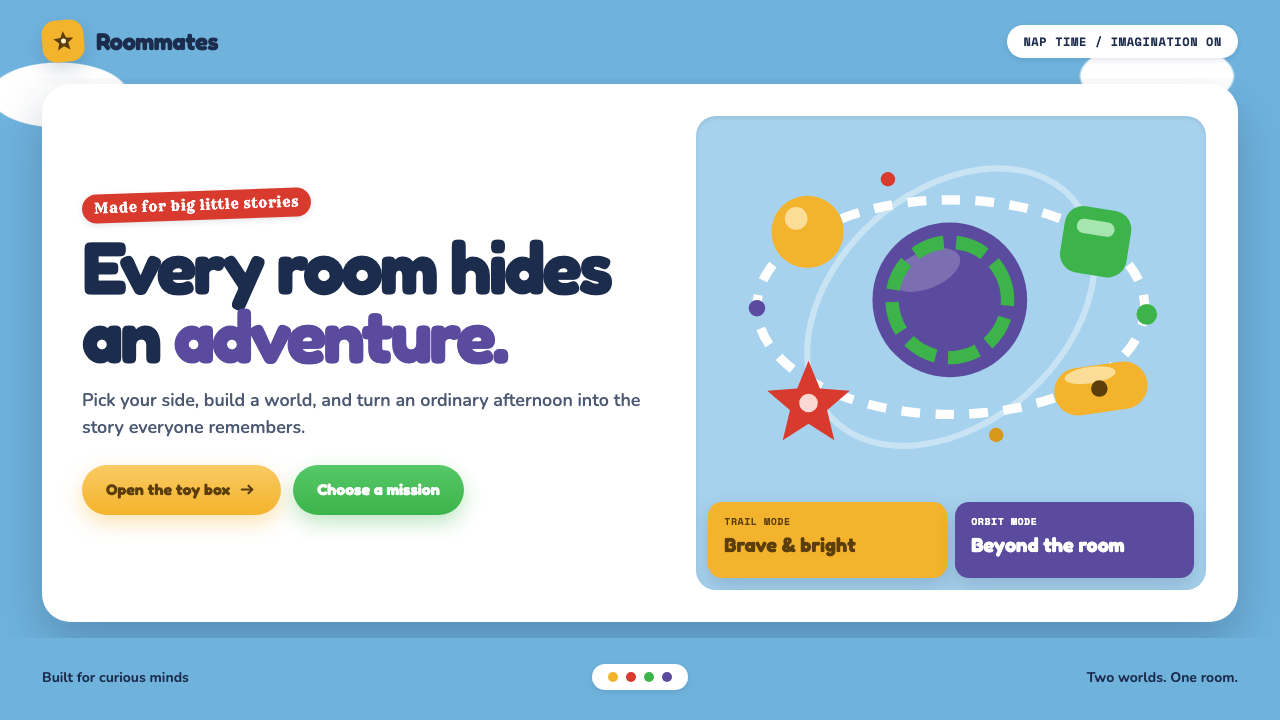 Toy Story (1995)Playtime becomes a whole world. Cloud blue, chunky type, and glossy two-tone…
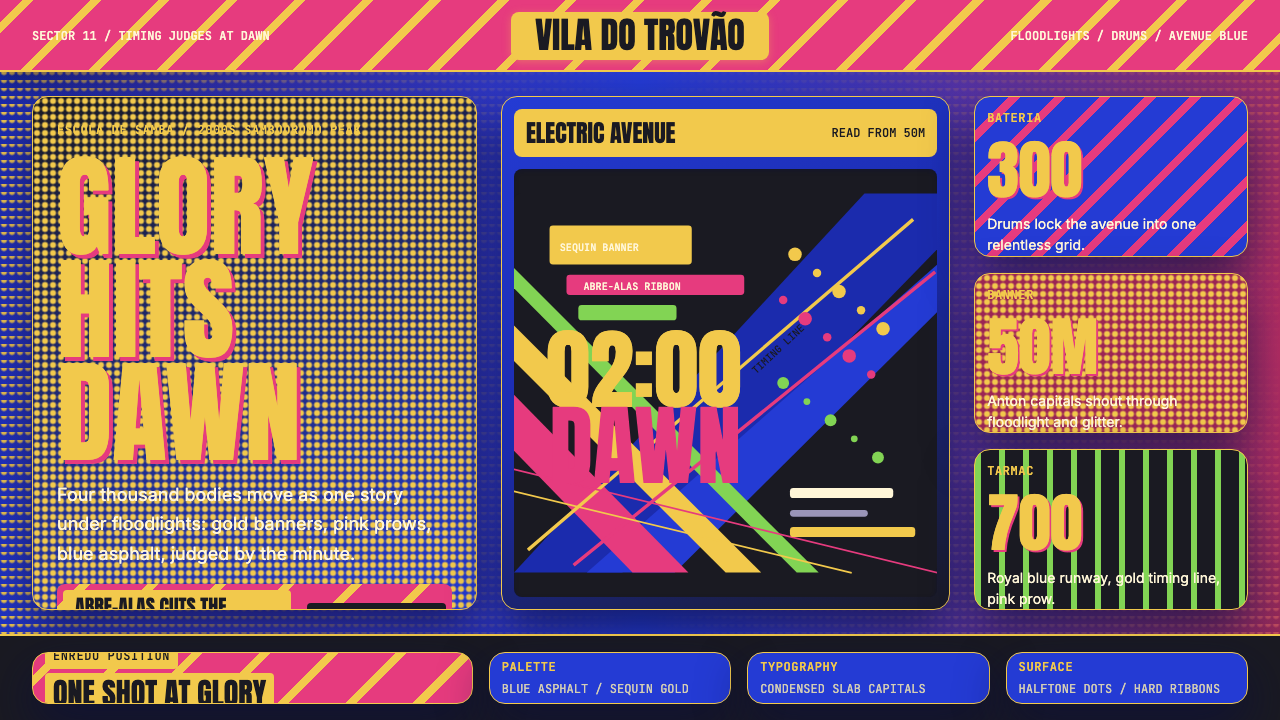 Brazilian Samba School (2000s Carnaval)Parade at floodlight volume. Royal blue asphalt, sequin gold type, pink ribbo…
 Dragon Ball (1984)Adventure lands with comic force. Gi-orange panels, amber spheres and crisp h…
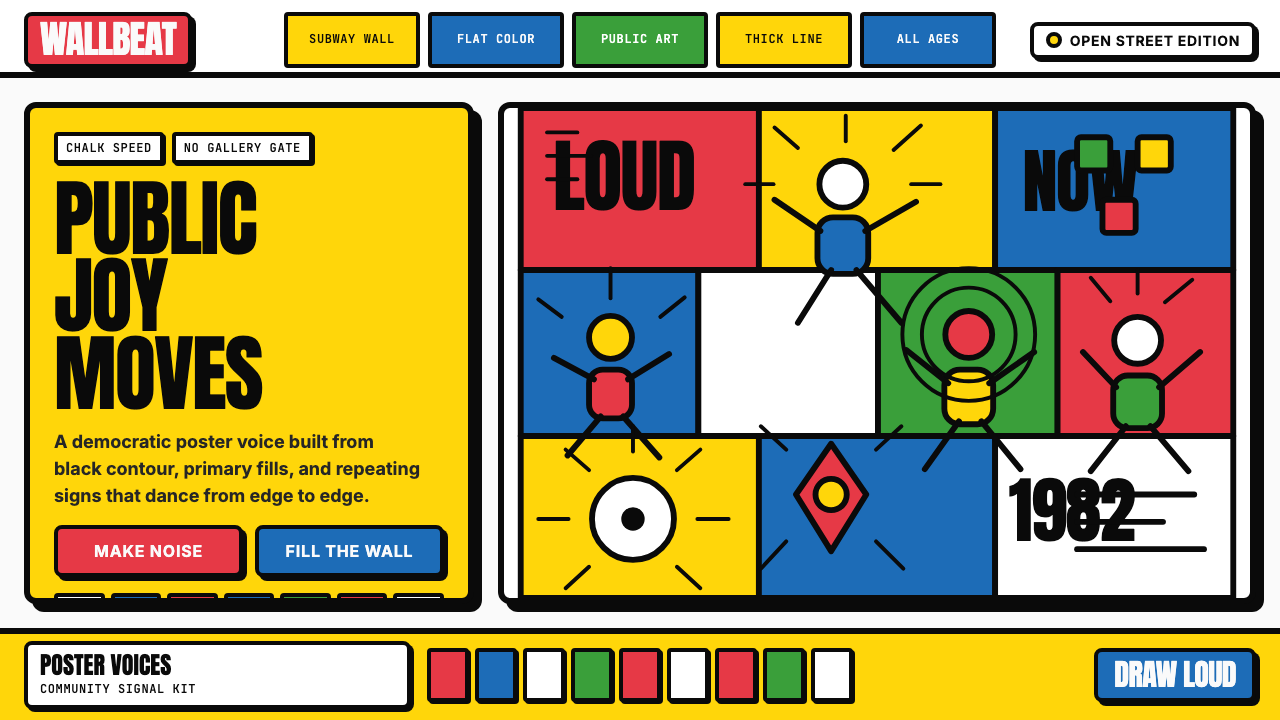 Keith Haring PopJoy refuses the gallery. Thick black contours pack primary color into a danci…
 The Simpsons YellowCartoon warmth misbehaves. Yellow ground, cobalt panels, thick wobbly black l…