What is The Simpsons Yellow?
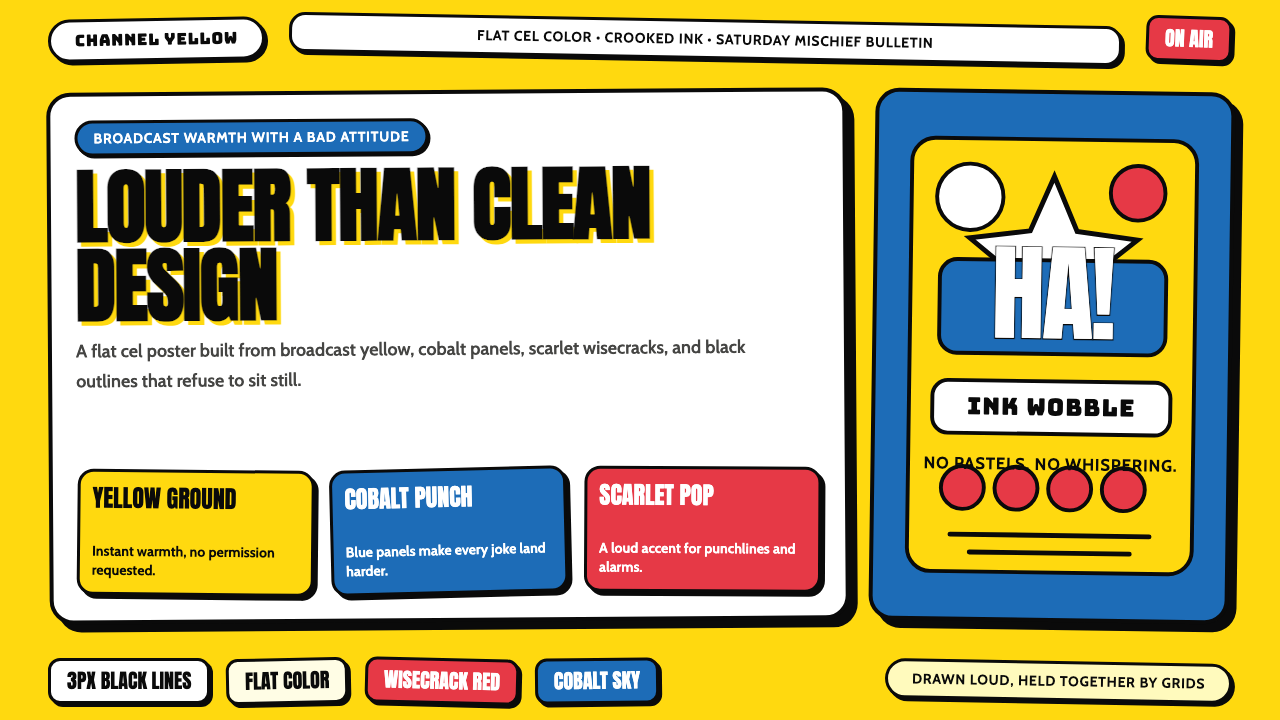
The Simpsons turned a single shade of cartoon skin into the most recognizable color on broadcast television — saturated, irreverent, and impossible to ignore.
The Simpsons Yellow in brief
The Simpsons Yellow is the visual language of adult animation at its most self-aware: a flat, hand-cel palette built around the warm, slightly acidic yellow that covers every member of the Simpson family. It is not a neutral background color or a decorative accent — it is the dominant presence, the ground on which cobalt blue skies, chalk-white eyeballs, and thick wobbling black outlines all perform. The system captures what the show itself embodies: irreverence, warmth, and the refusal to take any convention at face value.
Where most design systems use yellow as a secondary signal — a highlight, a warning, an energetic accent — The Simpsons Yellow reverses the hierarchy entirely. Yellow is the skin of every character, the wallpaper of the world, the thing that is always already there. Against this saturated ground, the cobalt blues read as sky and depth, the reds carry emotional heat, and the blacks define every edge with the confidence of a felt-tip pen drawn without hesitation. The result is a palette that feels simultaneously handmade and hyper-legible — unmistakably animated, instantly warm.
As a design aesthetic, this system draws on the full lineage of American popular cartooning: the bold flat colors of mid-century cel animation, the exaggerated proportions of comic strips, the slightly unsteady line quality that signals human touch rather than mechanical precision. Applied beyond the show itself, it carries instant pop-culture recognition and a specific emotional register — humor, nostalgia, accessibility — that few other visual systems can claim.

Where does The Simpsons Yellow come from?
The Simpsons premiered on Fox on December 17, 1989, as a spin-off of the short animated segments Matt Groening had created for The Tracey Ullman Show beginning in 1987. Groening, who had built his reputation on the underground comic strip Life in Hell, drew the family in a hurry on the way to a meeting — which is partly why the character designs retain a quality of deliberate crudeness. The yellow skin tone was a creative decision made during early production discussions with director David Silverman and producer James L. Brooks: a talking head on television is typically skin-toned, and the animators wanted viewers channel-surfing to stop and wonder what they were seeing. A color that did not exist in nature for human skin, broadcast at full saturation, would be impossible to mistake for live-action footage.
The technical constraints of late-1980s broadcast television shaped the palette as much as any artistic intention. NTSC broadcast standards of the era had a tendency to bleed saturated colors — particularly reds and oranges — causing halation and edge artifacts on cathode-ray tube screens. The animators, working with Klasky-Csupo during the first several seasons, learned which hues stayed stable and which bled, and built the palette accordingly. The warm yellow-gold that became the characters' skin sat in a sweet spot: saturated enough to read as bold on a television screen, stable enough not to bleed, and distinct enough from any realistic flesh tone that the artifice was always legible. Cobalt blue, used for skies and backgrounds, was similarly chosen for broadcast stability.
The graphic lineage of the show runs through several distinct American traditions. MAD Magazine, which had been satirizing American consumer culture since 1952 with grotesque caricature and deliberately garish color, is an acknowledged influence — Groening has cited it repeatedly. Underground comix of the 1960s and 1970s, with their hand-drawn lettering and exaggerated physical comedy, contributed to the wobbly line quality and the willingness to make characters physically repulsive in the service of a joke. Early Hanna-Barbera television animation, produced on tight budgets with simplified character designs and a limited cel-painting palette, established the visual grammar of flat broadcast color that The Simpsons inherited and then elevated.
During what many critics consider the show's golden era, roughly 1993 to 2002, the visual style reached its mature form under the oversight of supervising directors including David Silverman and a rotating team of writers and animators who maintained remarkable consistency across hundreds of episodes. Art director Bill Oakley and others established the specific spatial logic of Springfield — the fictional Midwestern town whose geography is famously inconsistent but whose color palette is absolutely fixed. By the mid-1990s, the yellow had become so culturally embedded that it functioned not just as a character color but as a brand signal: any yellow-skinned figure with overbite and four fingers was immediately legible as a Simpsons reference, regardless of context.
What defines the The Simpsons Yellow look?
Dominant Yellow Ground
The defining characteristic of the palette is that yellow is not an accent — it is the ground itself. Character skin occupies the largest surface area of any scene, which means the warm, slightly acid yellow is always the visual baseline against which everything else is measured. This reversal of conventional color hierarchy is what makes the system so immediately identifiable: you are not looking at a design with yellow in it, you are looking at a yellow world with other colors visiting.
Cobalt Sky and Structural Blue
Against the warm yellow ground, cobalt blue performs two roles simultaneously: it reads as sky and outdoor space in narrative context, and it provides the coolest, deepest contrast available in the palette. Backgrounds, shadow areas, and framing panels that use this blue create an immediate sense of depth and structural separation without requiring any actual rendering of three-dimensional form. The blue and yellow together produce a vibration that is characteristic of broadcast animation — energetic and slightly electric.
Thick Wobbly Black Outlines
Every form in the Simpsons visual system is bounded by a thick black outline that is not entirely straight. The wobble is not an accident or a production artifact — it is the index of the human hand in the drawing process. These outlines perform multiple functions: they separate adjacent shapes of similar color, they give characters weight and physical presence, and they carry the graphic energy of underground comix and newspaper strips. In contemporary applications, the equivalent is any element whose border carries visible drawing character rather than perfect geometric precision.
Comic-Book Drop Shadows
Shadows in this system are not soft, diffuse, or gradient — they are hard-edged, offset at a consistent diagonal, and rendered as flat shapes in a deeper version of the primary color or in solid black. This is the same shadow logic used in mid-century comic books and newspaper cartoons: shadow as a geometric declaration rather than a lighting simulation. The effect gives dimensionality to flat forms without abandoning the system's fundamental flatness — objects read as having sides and presence while remaining unambiguously drawn.
Saturated Broadcast Color
The entire palette operates at a saturation level calibrated for cathode-ray tube broadcast — higher than print, higher than most contemporary digital interfaces, and higher than what most designers would consider safe for extended screen use. This saturation is structural: it ensures legibility at low resolution and across a wide range of display conditions, and it produces the visual heat that makes the style feel alive. Desaturating the palette in an attempt to make it feel 'sophisticated' removes precisely the quality that makes it work.
Rounded, Chunky Forms
The geometric vocabulary of the Simpsons aesthetic favors roundness: bulbous heads, eyes that are simple ovals, mouths that curve in exaggerated arcs, buildings with rounded corners, cars with swollen proportions. This roundness is not softness — it carries the visual weight of the thick outlines and saturated color, and it reads as comedic and approachable rather than elegant. In applications, this translates to a preference for rounded rectangles, pill shapes, and thick-bordered containers over sharp-cornered geometric precision.
Flat Color with No Gradient Fill
Within the outlines, every area is filled with a single, flat, unmodulated color. There are no gradients, no subtle value shifts, no textural variation within a color field. This flatness is the visual signature of cel animation, where each color was physically painted onto a separate transparent acetate sheet. The discipline of using exactly one value per bounded shape gives the system its characteristic graphic clarity — every color decision is absolute, every boundary is decisive.

Who shaped The Simpsons Yellow?
The creator of The Simpsons and the originator of its visual vocabulary, Groening had already developed a highly idiosyncratic drawing style through Life in Hell, his alternative newspaper comic strip. His character designs for the Simpson family — developed rapidly and retaining an intentional crudeness — established the proportional system and the thick-outline aesthetic that the entire production then systematized. Groening's aesthetic instincts, shaped by MAD Magazine, underground comix, and a deliberately anti-slick sensibility, are the direct source of the palette's irreverence.
As supervising director and key animation director across many of the show's formative years, Silverman was responsible for translating Groening's loose sketches into a consistent animated visual system. He directed the first episode and oversaw the development of the show's specific movement vocabulary — the timing of takes, the exaggeration of emotional expressions, the spatial logic of Springfield. Silverman's work in establishing visual consistency across a large team of animators is a large part of why the style reads as a coherent system rather than a collection of individual interpretations.
The executive producer who shepherded The Simpsons from concept to broadcast, Brooks brought the institutional authority of a Hollywood television veteran to a project that Fox network executives were deeply uncertain about. His insistence that the show function as genuine character comedy — with emotional investment in its characters — rather than pure satire or animation novelty shaped the tonal register that the visual style had to serve. The palette's combination of warmth and absurdity reflects the show's dual commitments: the yellow had to be funny, but it also had to be home.
A writer and showrunner during some of the series' most celebrated seasons in the 1990s, Oakley contributed to the crystallization of Springfield's visual and narrative identity. His involvement during the period when the show's aesthetic references — the specific architecture of the town, the visual grammar of recurring locations — were being established makes him a key figure in the codification of the style beyond individual episode decisions. The Simpsons Yellow as a consistent, world-building presence rather than a character-specific color is partly the result of the editorial discipline that Oakley and his collaborators imposed.
The animation production studio founded by Arlene Klasky and Gábor Csupó handled the first several seasons of The Simpsons and was instrumental in translating the palette from concept to consistent broadcast output. Working under significant time and budget pressure, Klasky-Csupo's teams developed the practical painting and filming conventions — the specific color mixes, the outline weights, the cel-painting discipline — that turned Groening's drawings into a reproducible visual system. The slightly rougher quality of the early seasons, which many viewers regard as the style at its most authentic, is a direct product of Klasky-Csupo's methods.
How do you use The Simpsons Yellow today?
The Simpsons Yellow is a high-personality style that works best when the project has a clear need for warmth, humor, or pop-culture legibility — and when the audience is expected to recognize the reference or respond to its emotional register. Before applying it, the fundamental question is whether the content can afford to be irreverent. A serious financial dashboard, a medical platform, or a luxury brand will fight against the style's inherent comedy. A community tool, an entertainment product, a youth-facing marketing campaign, or any project that benefits from being taken lightly is a natural fit.
For presentation slides, the style delivers maximum impact on cover pages built around the signature yellow ground. A cover image — whether an illustration or a flat graphic — that uses the full palette against a saturated yellow field immediately signals the tone of everything that follows. Content slides work best when they adopt the system's flatness and outline logic: heavy borders around content blocks, flat icon graphics rather than photographic images, and typographic hierarchy defined by weight and size contrast rather than color variety. Data slides take on a cartoon-diagrammatic quality that can make complex information feel more approachable — bar charts become solid, flat colored shapes; labels are set in bold, rounded type; and any data-driven narrative benefits from the palette's tendency to make everything feel a bit more consequential and a bit less stressful.
For web interfaces and dashboards, the style is well-suited to contexts where density and data volume need to be offset by a sense of personality and approachability. Pricing pages built in this system benefit from the palette's natural hierarchy: the warm yellow serves as a background or highlight tier, cobalt panels differentiate plan levels, and the thick-outline convention translates directly into bold card borders that make options visually distinct without requiring shadow or depth effects. Navigation and UI controls should feel drawn rather than rendered — rounded buttons with visible borders, flat icon treatment, no ambient glow or soft shadow. The risk with dashboards is over-applying the yellow at high saturation across large screen areas, which can create visual fatigue; the solution is to treat the yellow as a selective accent and use near-white or light ground for most content areas.
For editorial and marketing work, the palette's most powerful application is the large-format poster or hero image, where its saturated broadcast quality translates directly into visual stopping power. A marketing hero built around the yellow ground with cobalt blue panels and bold, wobbly-outlined typography will read as instantly distinctive even at small sizes or in competitive visual environments. Editorial applications work well when the style is used as a framing device rather than a total-environment approach — yellow headers, outlined pull-quote boxes, flat icon illustrations — against a more neutral content ground. Social cards and thumbnail images benefit enormously from the palette's contrast and saturation, which ensures legibility at the small sizes and compressed formats typical of social media feeds.
A common mistake is treating the thick-outline convention as purely decorative rather than structural. In the source material, outlines exist because they separate adjacent color areas and give weight to forms — they are doing real visual work. When applied to interface elements without this structural purpose, outlines quickly read as retro pastiche rather than as a coherent system. Similarly, the wobbly quality of the original line is the result of human drawing — attempting to replicate it with geometric shapes and border-radius values produces something that looks imitative rather than genuine. The best applications of this style either commit to actual illustrated elements or use the palette's color and proportion logic without attempting to replicate the line quality through digital means.

The Simpsons Yellow — FAQ
Does The Simpsons Yellow work in professional or corporate contexts?
It can, but the framing matters enormously. The style carries an irreverence that reads as intentional — an audience encountering it in a corporate context will assume the brand is making a deliberate, self-aware choice to be playful. That can be a strength for products in entertainment, gaming, community platforms, or any sector where approachability and personality are competitive advantages. In regulated industries, formal enterprise software, or any context where authority and seriousness are expected, the style works against the product's goals. The yellow specifically triggers cartoon associations that are difficult to suppress even with disciplined application — the question is whether those associations are assets or liabilities.
How is this style different from other cartoon or retro-animation aesthetics?
The Simpsons aesthetic is specifically adult animation from the broadcast television era — which distinguishes it from several adjacent styles. It is warmer and more character-driven than mid-century UPA graphic animation, which tends toward cooler, more abstract forms. It is looser and more hand-drawn than the clean vector aesthetic of 1990s motion graphics. It is grittier and more satirical in feeling than the pastel warmth of Disney feature animation from the same era. The specific combination of warm yellow dominance, cobalt blue, thick wobbly outlines, and comic-book drop shadows is sufficiently distinctive that it reads as a reference to this specific visual tradition rather than to cartooning generally.
Can the style work in dark mode or on dark backgrounds?
Dark-background applications of this palette are possible but require significant rethinking of the hierarchy. The warm yellow that reads as a skin-tone ground on a light background becomes an aggressive, almost fluorescent accent when placed on a dark or black ground. This can be effective for theatrical or nighttime contexts — concert promotions, late-night event materials, horror or thriller themes with a comedic register — but it shifts the emotional tone considerably, from sunny warmth to something more electric and slightly ominous. The cobalt blue also becomes more prominent on dark backgrounds, which can push the palette toward a more electronic, neon-influenced quality. The thick outlines and flat color logic work well in both light and dark contexts; it is primarily the color balance and temperature that requires adjustment.
Is it possible to use this style without making everything look like a Simpsons parody?
Yes, with careful selection of which elements to adopt. The full system — character-yellow ground, cobalt blue, wobbly outlines, comic-book shadows, rounded chunky forms — is so strongly coded that it reads as direct parody. But individual elements can be extracted and applied more selectively. The palette's saturation and warmth, without the wobbly outline convention, reads as cheerful broadcast graphic design. The flat-color-within-hard-outlines approach, applied to geometric rather than character-derived forms, references the cel animation tradition more broadly. The key is to decide in advance which associations you want to carry and which to leave behind, then apply only the elements that serve those associations. The style becomes parody when all elements are present simultaneously at full intensity; it becomes a sophisticated design reference when applied selectively and with intention.
What type of typography pairs best with this aesthetic?
Typography that has warmth and visible personality — either through a slight geometric roundness, an explicit display quality, or a letterform that suggests it could have been hand-drawn — works best with this palette. Heavy weights read as more authentic than light or thin ones. All-caps settings can amplify the graphic, poster-like quality of the style. Comic and display typefaces designed to evoke mid-century cartoon lettering are an obvious and direct choice, though they risk tipping into parody territory quickly. A more versatile approach uses rounded display sans-serifs at headline scale and a plain, legible workhorse sans-serif at body scale — preserving the warmth and roundness associations at the level where they are most visible while maintaining readability in longer text. Script or serif typefaces generally work against the system's flat, graphic logic.
Related design styles
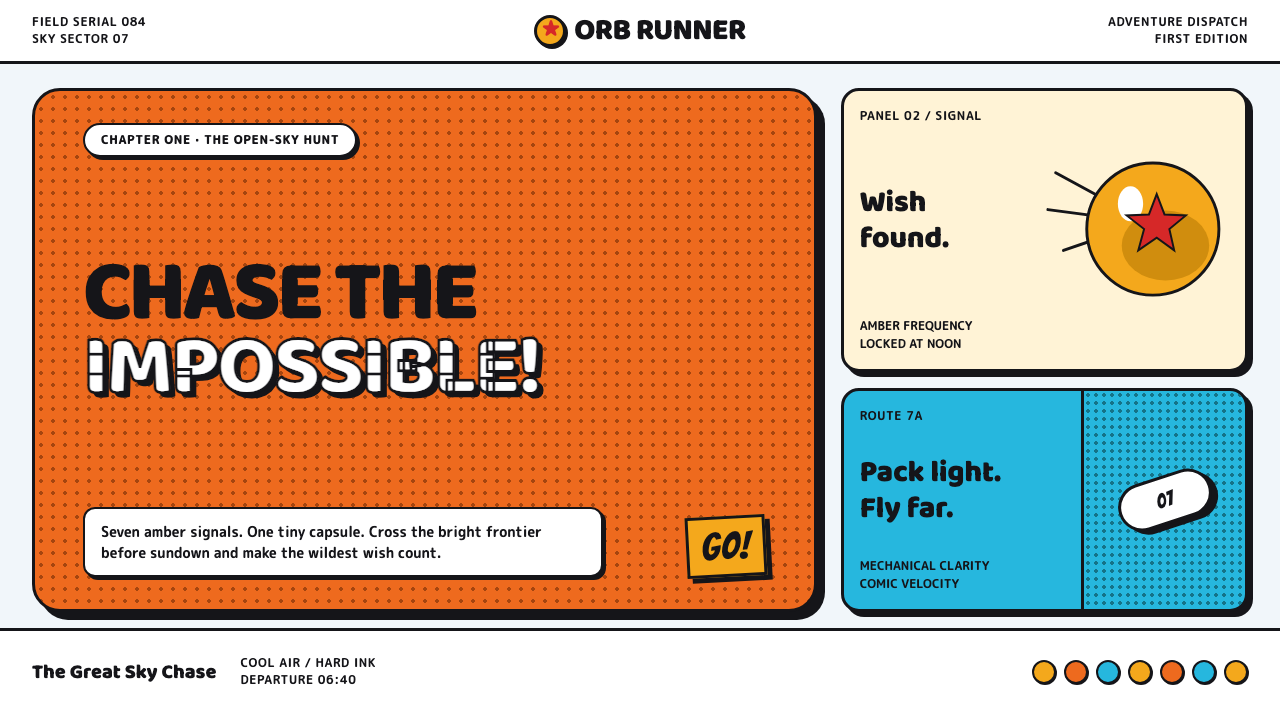 Dragon Ball (1984)Adventure lands with comic force. Gi-orange panels, amber spheres and crisp h…
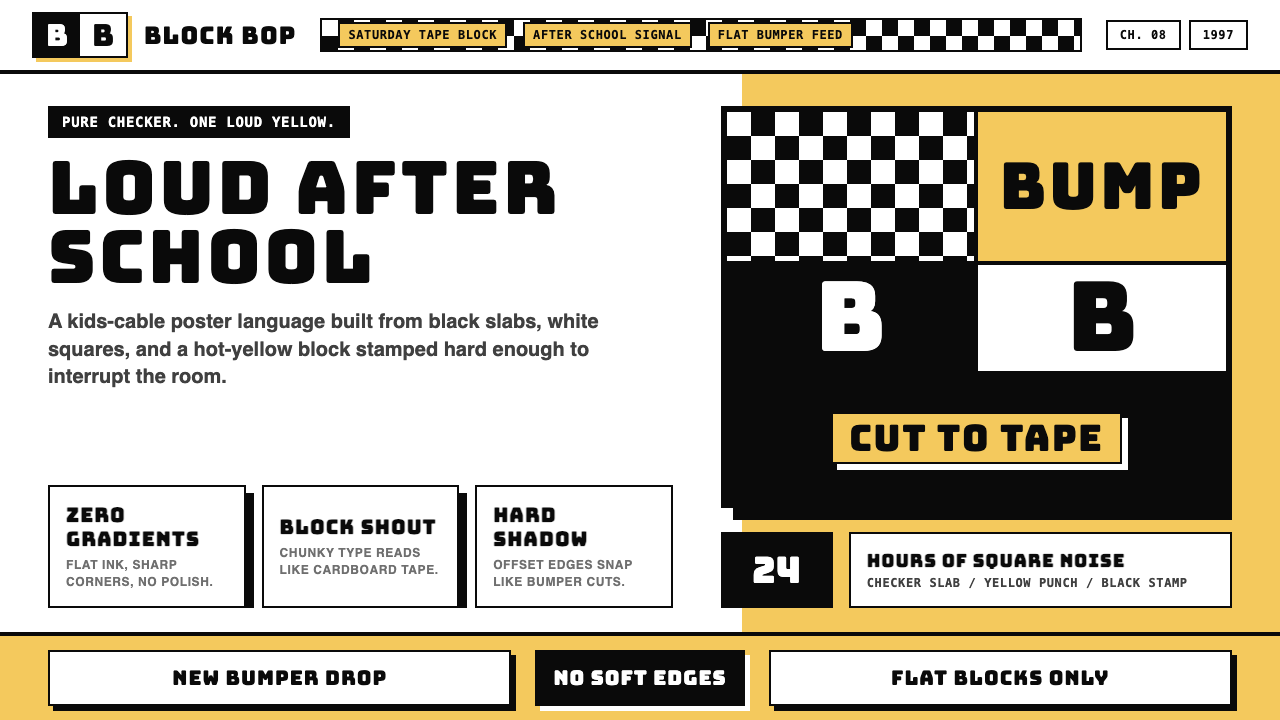 Cartoon Network 90s BlocksKids-cable noise, squared. Black-white checkerboards crash into hot-yellow Bu…
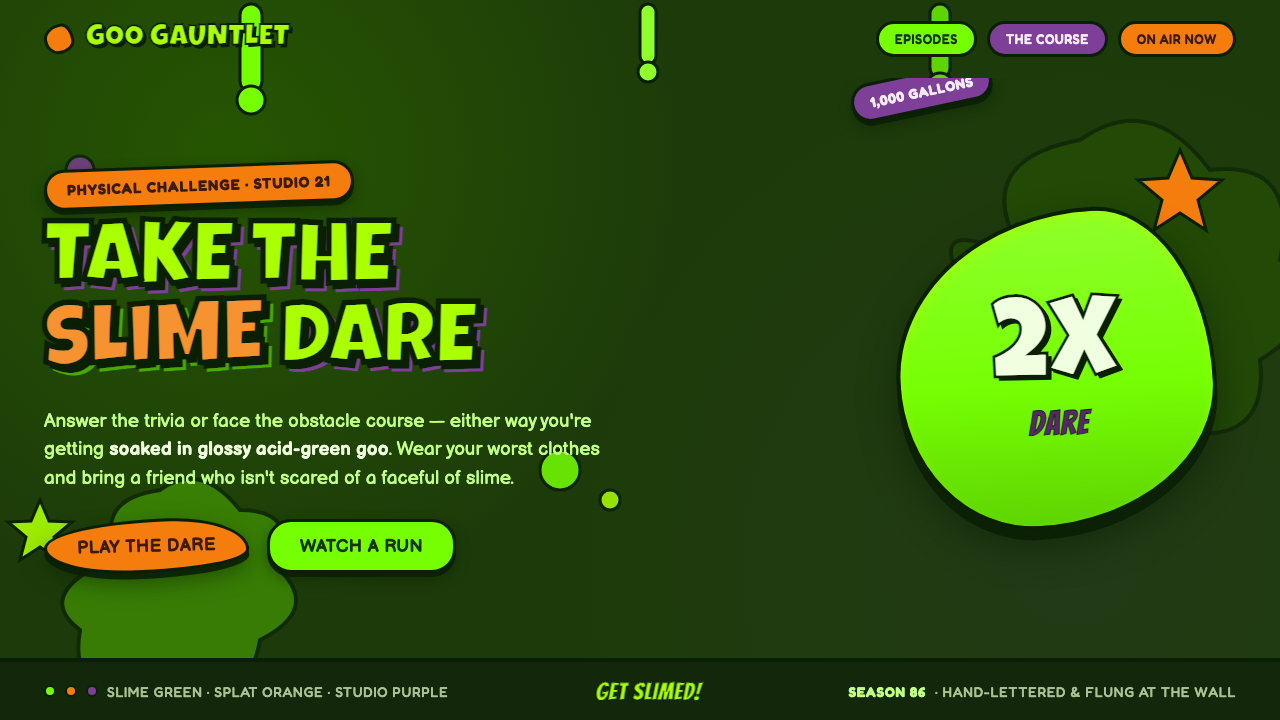 Nickelodeon Double Dare SlimeGet slimed. Glossy acid-green goo on deep slime ground, balloon caps and spla…
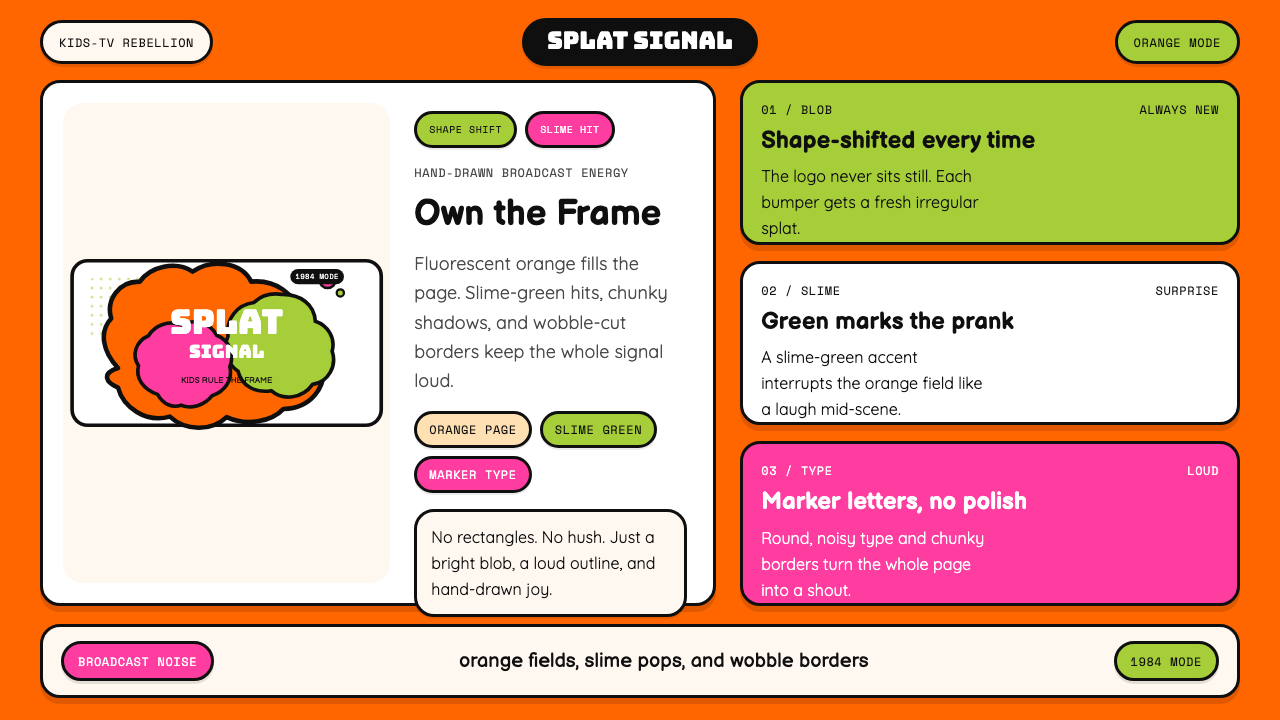 Nickelodeon Orange Splat (1984)Kids own the screen. Orange fields, slime-green pops, and wobble borders do t…
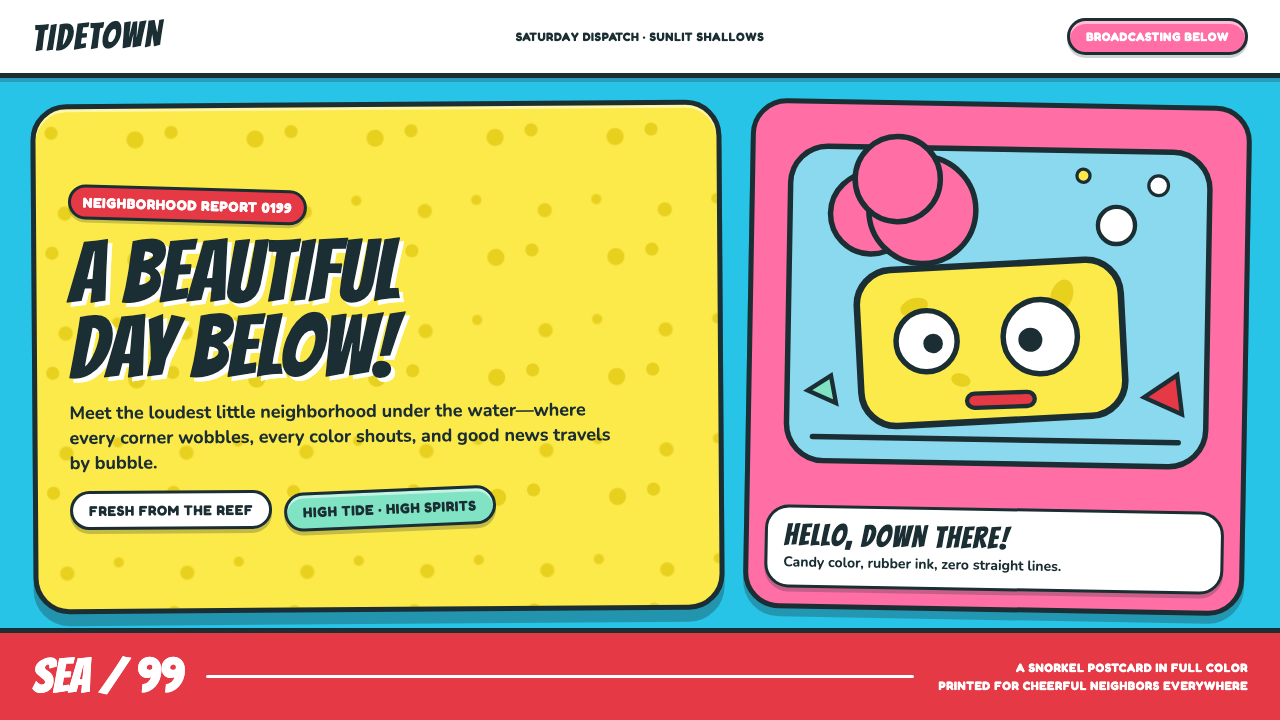 SpongeBob Bikini Bottom (1999)Undersea suburbia shouts with joy. Banana yellow and cyan bounce inside fat,…
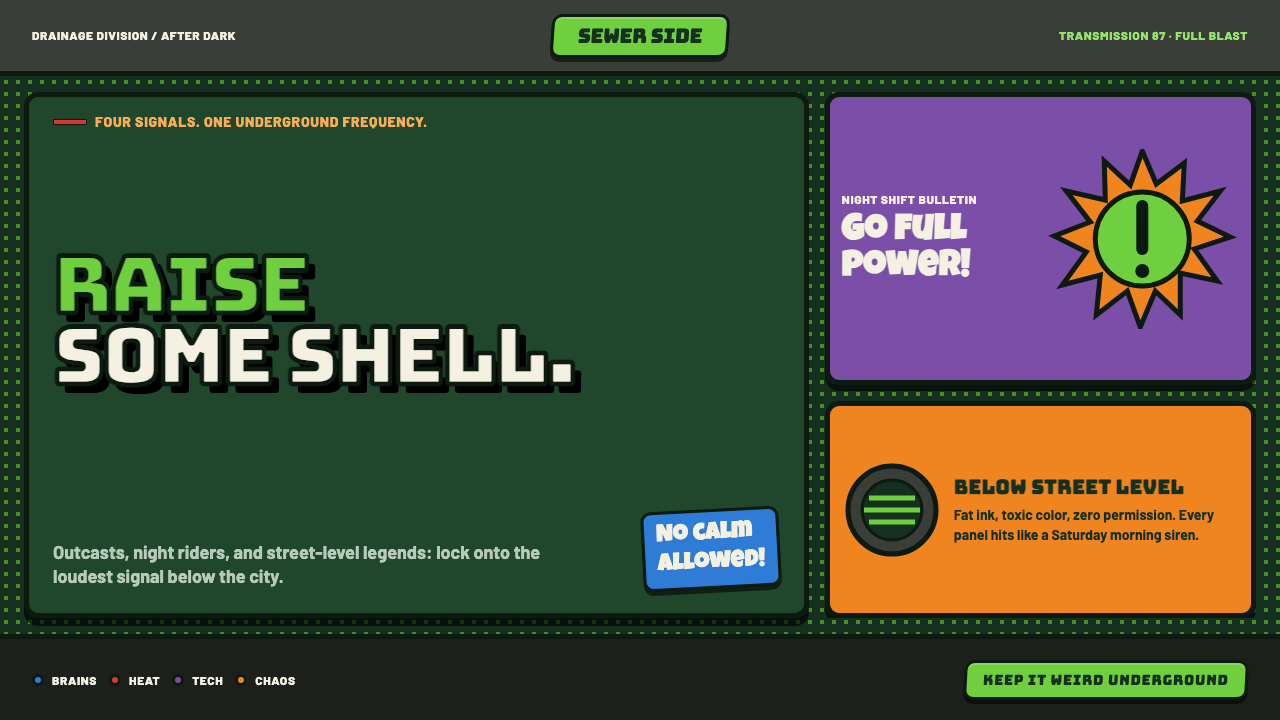 TMNT (1987 Saturday-Morning)Saturday-morning chaos, full blast. Sewer green, bandana brights and clogged…