What is Sesame Street (1969)?
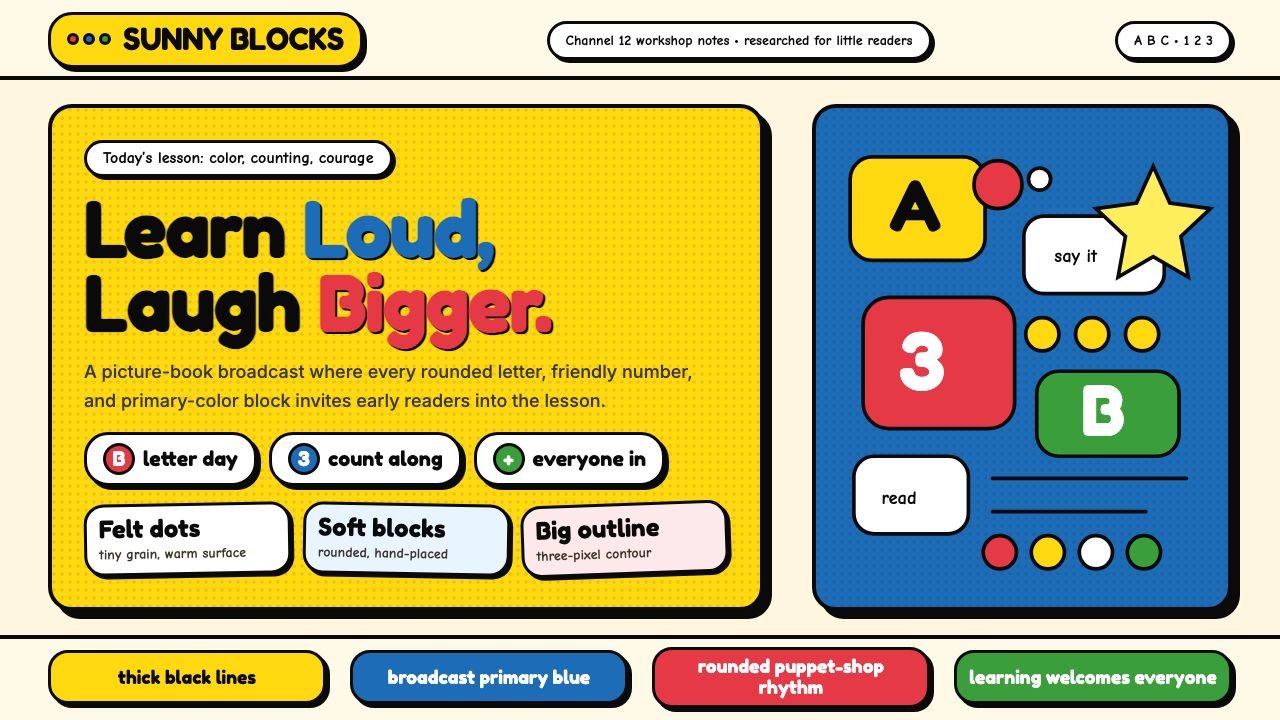
Sesame Street turned the television screen into a felt-and-puppet classroom where every color, letterform, and monster was calibrated by child-development science to say: learning is bright, friendly, and made by hand.
Sesame Street (1969) in brief
Sesame Street is the most rigorously researched children's visual language in the history of broadcast media. Launched in 1969 by the Children's Television Workshop, the program's every design decision — palette, letterform, character proportions, scene composition — was tested with child-development psychologists and reviewed against empirical viewing data before a single frame aired. The result is not a casual aesthetic but a deliberate visual system built to be legible, emotionally warm, and cognitively accessible to children aged two through five.
The visual language rests on three foundations: saturated broadcast-primary colors that read clearly on the cathode-ray televisions of the era, chunky black outline strokes that give every shape a crisp boundary at low resolution, and felt-and-foam textures that communicate handcraft and tactile warmth. Big Bird's signature yellow and Cookie Monster's deep blue anchor the palette as complementary emotional poles — one sunny and gentle, one gruff and comedic — while Elmo's vivid red introduced a third playful voice in the early 1980s. Together these colors never feel harsh because they are always accompanied by the visual softness of fabric, fur, and hand-painted surfaces.
What distinguishes Sesame Street visually from other children's media of its era is the studied imperfection of its forms. Letterforms are rounded, slightly uneven, almost wobbly — more like a child's own handwriting than a typeset page. Shapes are blob-like and organic rather than geometrically rigid. Nothing is slick or machined. The aesthetic deliberately rejects the polish of commercial animation in favor of the warmth of the Henson puppet workshop, signaling to every child viewer that the people who made this show did so with their hands.

Where does Sesame Street (1969) come from?
Sesame Street was born from a simple but radical hypothesis: if children were already spending hours in front of the television, could television be designed to teach them? The idea was developed in 1966 by Joan Ganz Cooney, a television producer, and Lloyd Morrisett, a psychologist at the Carnegie Corporation. Cooney's landmark feasibility study, published in 1966, argued that a sustained, broadcast-quality children's show combining entertainment with curriculum goals could measurably improve school readiness, particularly for children from lower-income households who lacked access to pre-kindergarten education. The Children's Television Workshop was founded in 1968, and the first episode aired on November 10, 1969.
The visual and puppet design of the original series was the work of Jim Henson and his collaborators, most importantly Frank Oz and the broader Muppet workshop. Henson had spent the previous decade developing the Muppet form on variety shows and commercials, refining the principles of foam-and-felt puppet construction that would define Sesame Street's physical aesthetic. The choice of soft, tactile materials was not merely practical — it was communicative. Foam rubber and fleece read on camera as warmth and approachability in a way that rigid plastic or painted wood could not. The characters' exaggerated features — enormous eyes, oversized mouths, simplified body shapes — were calibrated to be readable on the small-screen televisions of 1969 and to project emotion legibly from across a living room.
The street set itself — a brownstone block in an unnamed American city, clearly coded as inner-city New York — was a deliberate departure from the idealized suburban settings of most children's television. The design team, working with producers and researchers, wanted the show's environment to reflect the lived reality of the urban children it most needed to reach. Trash cans, stoops, fire escapes, and a neighborhood fix-it shop were not just set dressing but signals of cultural recognition. The warm, slightly worn quality of the set was maintained throughout the original run: surfaces were never too new, colors never too clean, communicating the lived-in warmth of a real neighborhood rather than a designed one.
The golden era of the show's visual innovation ran from 1969 through roughly 1985, spanning the full period of Henson's direct involvement. During this period, the animated inserts — short films commissioned from independent animators to illustrate letters and numbers — introduced an extraordinary range of graphic styles, from psychedelic rotoscopy to cut-paper collage to chalk-on-blackboard hand-drawing. These inserts collectively created a visual pluralism within the show's larger identity: the linking thread was always warmth, handcraft, and primary-color clarity, even when the specific visual style varied wildly from segment to segment. This eclecticism within a unifying visual philosophy is one of the most sophisticated design achievements of the original series.
What defines the Sesame Street (1969) look?
Color
The palette is built from saturated broadcast primaries — the golden yellow of Big Bird, the vivid blue of Cookie Monster, and the bright red of Elmo — chosen and tested for maximum legibility on the cathode-ray television sets of the late 1960s. These hues are always warm, never clinical; they carry the chromatic intensity of primary colors without the harshness, because they are consistently deployed against soft textures rather than hard surfaces. Secondary colors appear frequently in supporting roles — the green of Oscar's trash can, the orange of fruit and background props — but the primary trio retains emotional anchor status throughout.
Outline and Boundary
Every significant form in the Sesame Street visual vocabulary — characters, props, typographic elements in animated segments — is defined by a substantial black outline. This stroke is not a stylistic flourish but a functional device: it separates figure from ground at low resolutions, gives shapes clear boundaries when adjacent colors are similar in value, and creates the comic-book legibility that allows a toddler to parse a crowded screen. The weight of the outline is always chunky, never delicate; it communicates the same handmade quality as a thick crayon stroke.
Texture and Material
The dominant surface quality of Sesame Street is textile warmth: fur, fleece, felt, foam, and fabric are the physical materials of its characters, and their visible texture communicates tactile approachability. In the live-action and animated segments, this material sensibility extends to hand-painted backgrounds, chalk-drawn lettering, cut-paper shapes, and clay-modeled forms. The aesthetic consistently signals that objects in this world were made by human hands — pinched, stitched, painted, and assembled — rather than manufactured or generated. This tactility is as much an emotional argument as a visual one.
Typography
Letters in the Sesame Street visual system are rounded, chunky, and deliberately imperfect. They derive their character from hand-drawn and hand-painted sources rather than typeset conventions, and they share the same formal vocabulary as the show's puppet characters — blob-like, organic, slightly wobbly. Uppercase letters tend to dominate, because capital forms are the ones young children first learn to recognize. In the animated inserts, letters are frequently given personalities, shown dancing, marching, or transforming — treating the alphabet not as a system to be memorized but as a cast of characters to be befriended.
Character Design
Sesame Street characters are designed around exaggerated, simplified features that maximize emotional readability: eyes are enormous relative to the head, mouths are wide and expressive, body proportions are soft and non-threatening. The design rule is consistent across human Muppets and monster Muppets alike — clarity of emotional state takes priority over anatomical realism. Each character is given a dominant color that becomes their visual signature, so that even very young children can identify them instantly at a distance or in a cluttered frame. The combination of simplified form and distinctive color is directly analogous to the show's approach to teaching letters: make the essential feature unmistakable.
Handmade Imperfection
Unlike the polished animation of the major studios, Sesame Street cultivates visible imperfection as a positive aesthetic value. Puppet seams are not hidden, painted backgrounds carry visible brushstrokes, animated segments often wobble and jitter with the evidence of hand-drawn frame-by-frame construction. This imperfection is not a production limitation — it is a communication strategy. It tells the child viewer that the adults who made this chose to make it with their hands, that the world of Sesame Street is crafted rather than manufactured, and by extension that the child's own hand-drawn letter or cut-paper shape belongs in the same tradition of making.
Visual Pluralism
One of the most architecturally sophisticated features of the original Sesame Street design is its deliberate embrace of multiple visual styles within a single show. The live-action puppet segments, the animated letter-and-number inserts, the documentary street scenes, and the parody commercials each have distinct visual identities — psychedelic animation, cut-paper collage, chalk-on-blackboard, painted cel animation — united only by their shared commitment to warmth, legibility, and handcraft. This pluralism models visual literacy: children learn not just letters and numbers but how to read different kinds of images in different registers.

Who shaped Sesame Street (1969)?
Cooney was the co-founder of the Children's Television Workshop and the originating intellectual force behind Sesame Street. Her 1966 feasibility study — commissioned after a dinner-party conversation with Lloyd Morrisett — established the framework of research-driven educational television that would govern the show's production for decades. Cooney's conviction that design decisions should be empirically tested, not intuitively made, was the direct reason that the show's visual language became as rigorously developed as its curriculum. She led the Children's Television Workshop from its founding through 1990, overseeing the creation of multiple educational properties that extended the Sesame Street model.
Henson was the creator of the Muppets and the designer of Sesame Street's central cast of puppet characters. Working with his ensemble of builders, performers, and writers, he developed the foam-and-fleece puppet construction techniques and the performance conventions — including the direct address to camera and the eye-level framing that came to define the show's intimate register — that made Sesame Street's characters feel like real inhabitants of their world rather than theatrical props. Henson's contribution was not limited to craft: his insistence that the Muppets be performed with emotional depth and comedic intelligence elevated what could have been a didactic show into genuine storytelling.
Oz was Henson's closest creative collaborator and the primary performer of several of Sesame Street's most iconic characters, including Cookie Monster, Bert, and Grover. As a performer and co-director, Oz helped establish the performance language of the Muppets — the timing, physical expressiveness, and vocal character work — that transformed the puppet form from variety entertainment into a vehicle for nuanced emotional storytelling. His performances gave the characters the psychological depth that allowed children to form genuine emotional attachments to them, which in turn made the educational content far more effective than any purely didactic approach could have been.
Spinney was the performer of Big Bird and Oscar the Grouch for nearly fifty years, from 1969 until 2018. His dual role — the naive, curious, yellow-feathered child-surrogate who learns alongside the audience, and the gruff, irascible green recluse who models that negative emotions are acceptable — gave him responsibility for the show's two most psychologically complex characters. Big Bird in particular became the visual and emotional anchor of the entire series: the character's scale (at roughly adult height despite childlike psychology), warm golden color, and gentle curiosity defined the show's invitation to learning more than any other single element.
The research division of the Children's Television Workshop — led initially by developmental psychologist Edward Palmer and involving ongoing collaboration with Harvard's Graduate School of Education and other academic partners — was the organizational force that translated the show's educational goals into specific visual and narrative decisions. The team ran systematic viewing studies with child audiences, measuring attention, comprehension, and retention for individual segments before they were incorporated into finished episodes. This research-production feedback loop was unprecedented in children's television and was the structural reason that Sesame Street's visual language became more than intuition: it was an empirically validated communication system.
How do you use Sesame Street (1969) today?
The Sesame Street visual vocabulary is far more transferable than its children's-television origin might suggest. At its core, the system is about making complex information feel approachable, warm, and immediately legible — which are useful goals in adult design contexts too. The key is understanding which specific mechanisms create those qualities: saturated but warm primary colors, chunky and rounded forms, visible texture, and the deliberate embrace of imperfection as a trust signal. Deploying these correctly in a contemporary design context means adapting the underlying logic rather than literally replicating the puppets.
For presentation slides, the Sesame Street aesthetic works particularly well for educational, onboarding, and explainer contexts — anywhere the primary challenge is making unfamiliar material feel non-threatening. A cover slide in this mode should anchor on one dominant warm primary color — golden yellow or a warm red — set against an off-white or cream background, with a large rounded display letterform for the title. Body slides should use chunky, slightly rounded section headings to distinguish hierarchy, and any illustrative elements — icons, diagrams, character figures — should carry visible hand-drawn or imperfect qualities rather than crisp vector polish. Data slides benefit from the system's color logic: use warm, saturated fills for bars and segments rather than muted corporate palettes, and surround numerical elements with enough white space that they read as friendly rather than clinical.
For web interfaces, this visual language is most appropriate for products aimed at learners, children, community platforms, or any context where reducing intimidation and building trust are primary UX goals. On a dashboard or product page, the approach translates to: rounded corners pushed to near-circular on interactive elements; thick, visible borders on cards and inputs rather than hairlines; icon sets that feel hand-drawn or illustrated rather than geometric and precise; and background colors in warm off-white or cream rather than cool gray. Avoid the trap of deploying the full palette simultaneously — one dominant warm primary as the brand color, supported by neutral ground tones, is more coherent than trying to work all three primaries into the interface at once.
For editorial and marketing work, the Sesame Street aesthetic can be highly effective for campaigns around education, community, early childhood, social programs, or any initiative that needs to communicate warmth and accessibility without sacrificing visual impact. Posters and social cards in this mode work best with a single dominant saturated color as background, white or cream lettering in a rounded display face, and a hand-drawn or illustrated supporting element. The imperfection principle is especially valuable in editorial contexts: deliberately rough textures, uneven ink fills, or hand-lettered callouts communicate authenticity and community investment in a way that polished vector work cannot.
The most common mistake when applying this visual language is conflating it with generic children's design — using it in contexts where it signals immaturity or unsophistication rather than warmth and accessibility. The distinction lies in execution: Sesame Street's visual system is empirically calibrated and deeply intentional, which means that the roughness is controlled, the colors are specific, and the imperfections are deliberate. Cheap imitations use garish colors without the warm saturation, blunt letterforms without the rounded care, and scattered layouts without the underlying legibility logic. A second common mistake is over-illustrating — loading every surface with characters and imagery when the actual power of the system comes from strategic deployment of warmth within clear compositional structure.

Sesame Street (1969) — FAQ
Is the Sesame Street visual style appropriate for adult audiences, or does it read as childish?
It depends entirely on execution and context. The underlying principles — warm saturated color, rounded forms, tactile texture, legibility-first hierarchy — are not inherently childish; they become childish when applied without sophistication or in contexts where the audience expects a different register. Used with intention in adult educational platforms, community organizations, social campaigns, or early-stage consumer products that want to signal approachability over authority, the style communicates warmth and trust effectively. The key is calibrating the degree of imperfection and illustration density: a light touch that retains the color warmth and roundness while reducing the overt hand-drawn wobble will read as friendly to adults without tipping into juvenile.
How does Sesame Street's visual approach differ from other children's animation styles of the same era?
The most important distinction is intentionality. Most children's animation of the 1960s and 1970s was designed primarily for entertainment, with visual choices made by artists working within commercial production constraints. Sesame Street's visual language was designed to teach — which meant every choice had to be justified against research findings about child cognition, attention, and learning. The result is a system that is simultaneously more constrained and more varied than typical children's animation: more constrained in its palette, legibility rules, and character design principles; more varied in its embrace of different animation styles across segments. The show also uniquely combined live action, puppetry, and multiple animation approaches within a single episode — a pluralism that most children's television avoided in favor of consistent style.
What happened to the visual identity of Sesame Street after the Henson era ended in 1990?
The post-Henson era brought gradual changes. Through the 1990s and early 2000s, the show maintained most of its foundational visual principles — saturated primaries, rounded forms, puppet-centered warmth — while the animation styles in inserts became more polished and computer-influenced. The 2016 move to HBO, followed by a simultaneous PBS Kids broadcast, marked a more significant visual update: backgrounds became somewhat slicker, animation segments adopted contemporary digital aesthetics, and some of the productive roughness of the original was smoothed away. The core character designs have remained largely faithful to the Henson-era originals, which means the emotional anchor of the visual system — the characters themselves — has been preserved even as the surrounding design language has evolved.
Can the research-driven design methodology of Sesame Street be applied to contemporary digital product design?
The methodology is in many ways the most durable and transferable aspect of the Sesame Street legacy. The core principle — that design decisions affecting communication and cognition should be tested against the responses of actual users before being finalized — is now standard practice in product design under different names: usability testing, A/B testing, user research, iterative prototyping. What made Sesame Street's approach distinctive was the depth of the research collaboration (ongoing partnerships with academic developmental psychologists, not one-time focus groups) and the rigor with which research findings were translated into specific design revisions. The lesson for contemporary designers is not to replicate the visual output but to take seriously the idea that no design decision about how information is presented should be made on the basis of aesthetic preference alone.
Is Sesame Street's palette too culturally specific to work in international or non-American design contexts?
The palette itself — saturated warm primaries — is not culturally specific; primary colors read as warm, energetic, and approachable across most cultural contexts, and the warmth of handcraft and textile materials is broadly universal rather than specifically American. What is culturally specific is the set of associations that the Sesame Street brand carries for audiences who grew up watching it — the nostalgia, the specific character associations, the emotional memory. If you are designing for an audience with those associations, you have a strong positive asset. If you are designing for an audience without them, you are simply working with a warm, rounded, handcraft-inflected visual language that communicates accessibility and warmth, which translates well across cultural contexts. The show itself was adapted for dozens of countries — Takalani Sesame in South Africa, Alam Simsim in Egypt, Sesamstrasse in Germany — each with locally designed characters that preserved the visual system while adapting the cultural content.
Related design styles
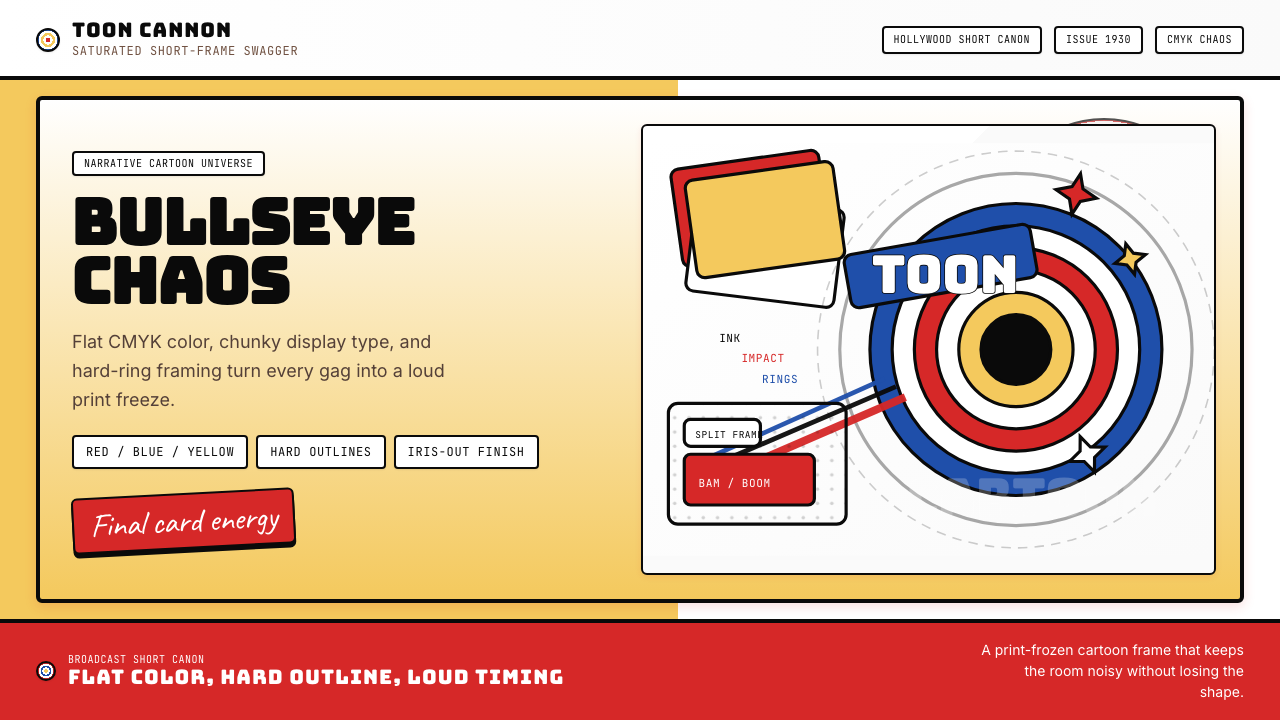 Looney Tunes (Warner Bros.)Pure cartoon chaos. Bull's-eye rings, Bungee type, and red-blue-yellow blocks.
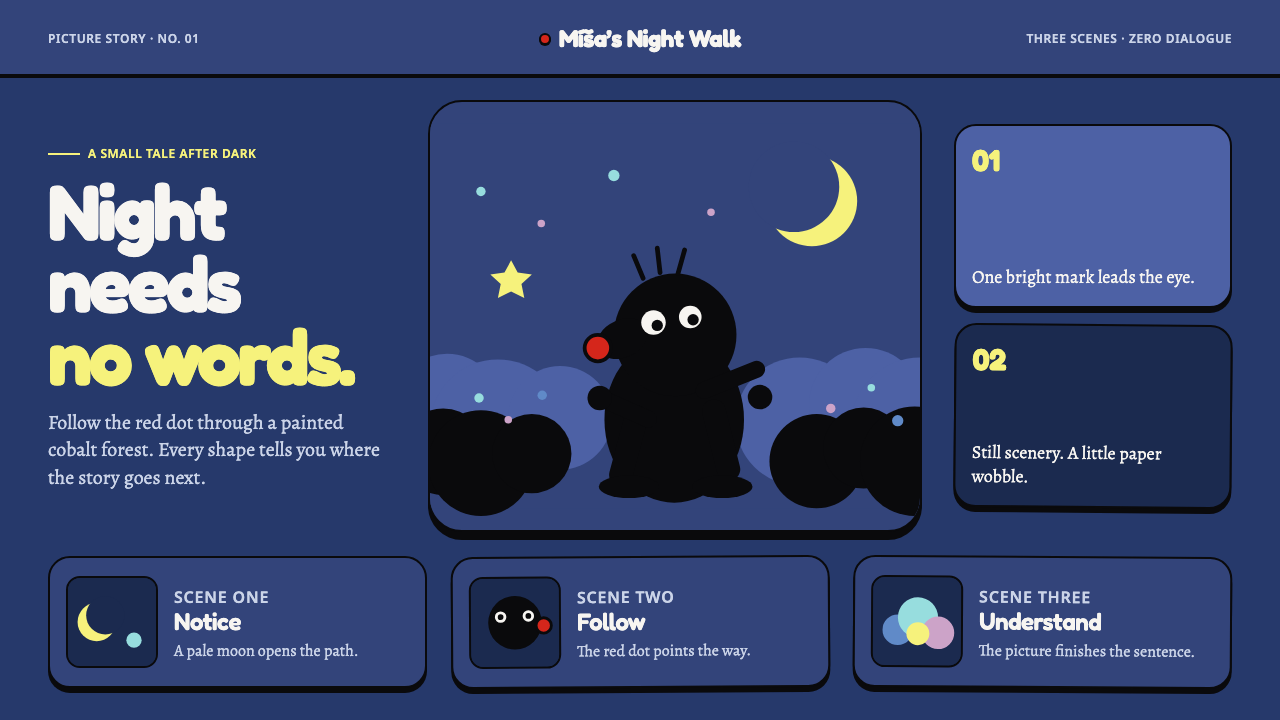 Krtek AnimationWordless wonder. Cobalt gouache stages black paper forms, guided by one red d…
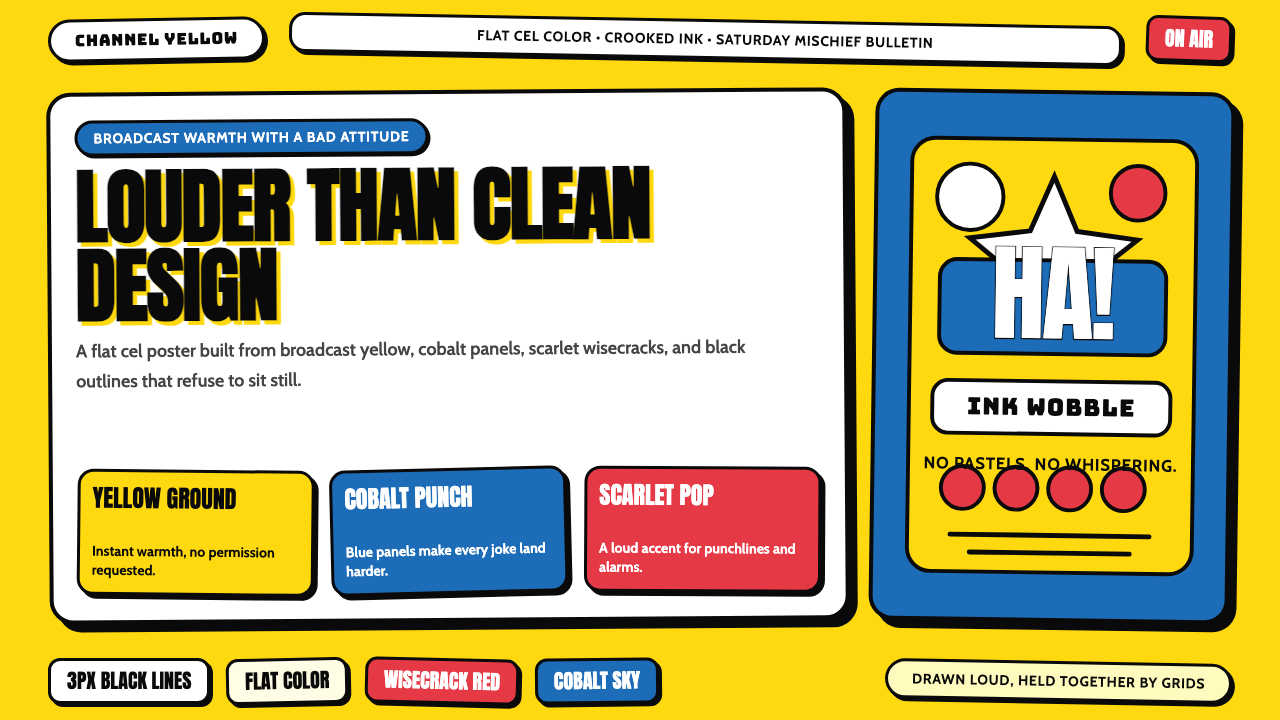 The Simpsons YellowCartoon warmth misbehaves. Yellow ground, cobalt panels, thick wobbly black l…
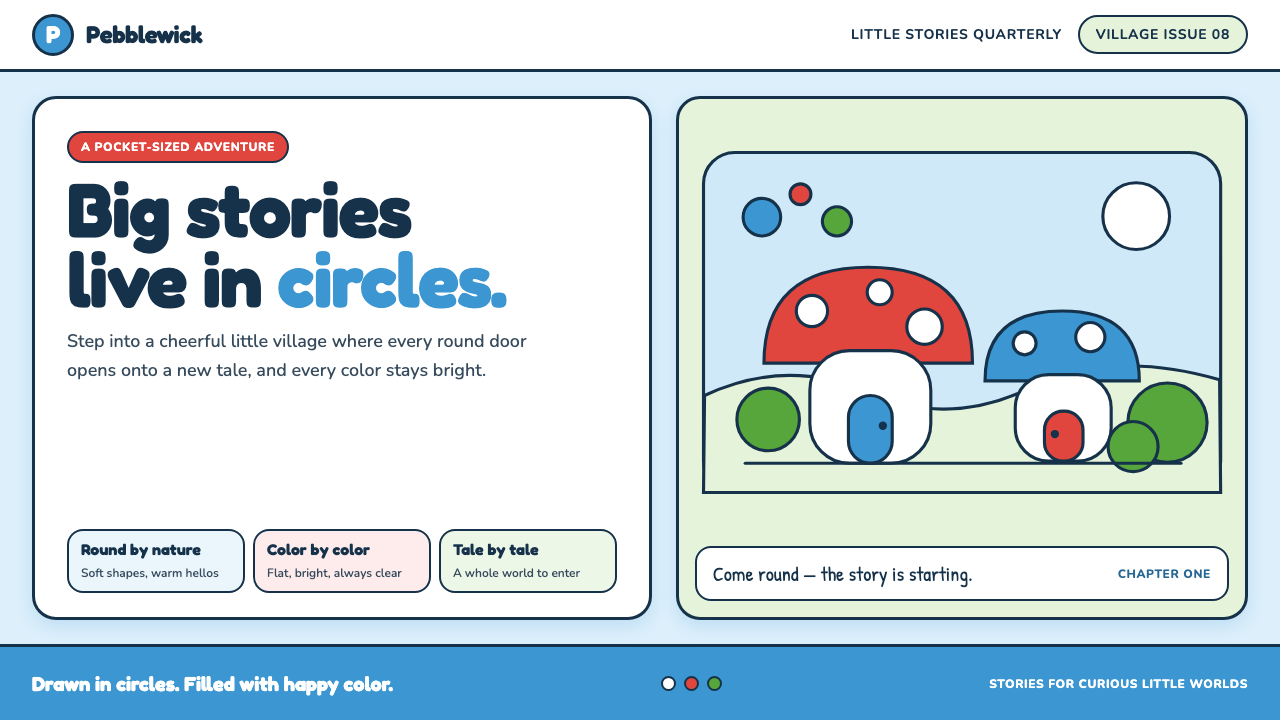 The Smurfs (Peyo, 1958)Joy comes full circle. Sky blue, candy red and soft ink outlines build a flat…
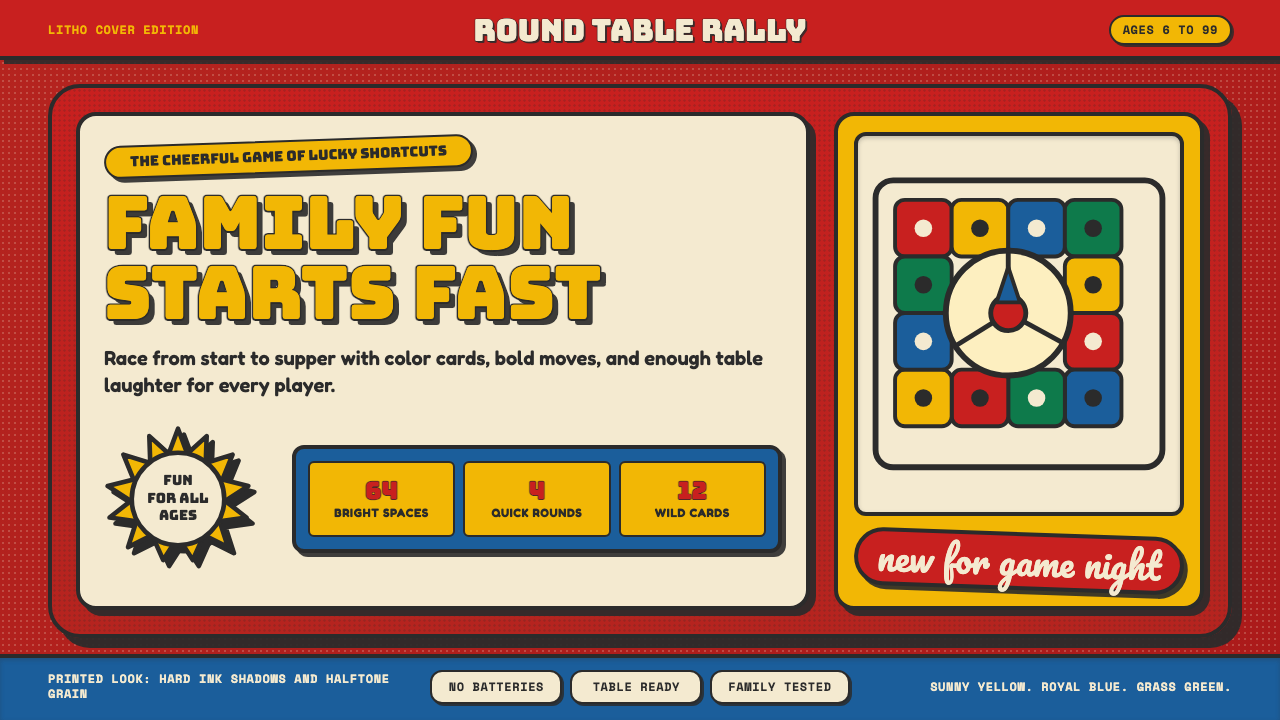 Vintage Board Game BoxShelf appeal shouts. Fire-engine red, Bungee lockups, yellow bursts, and ink…
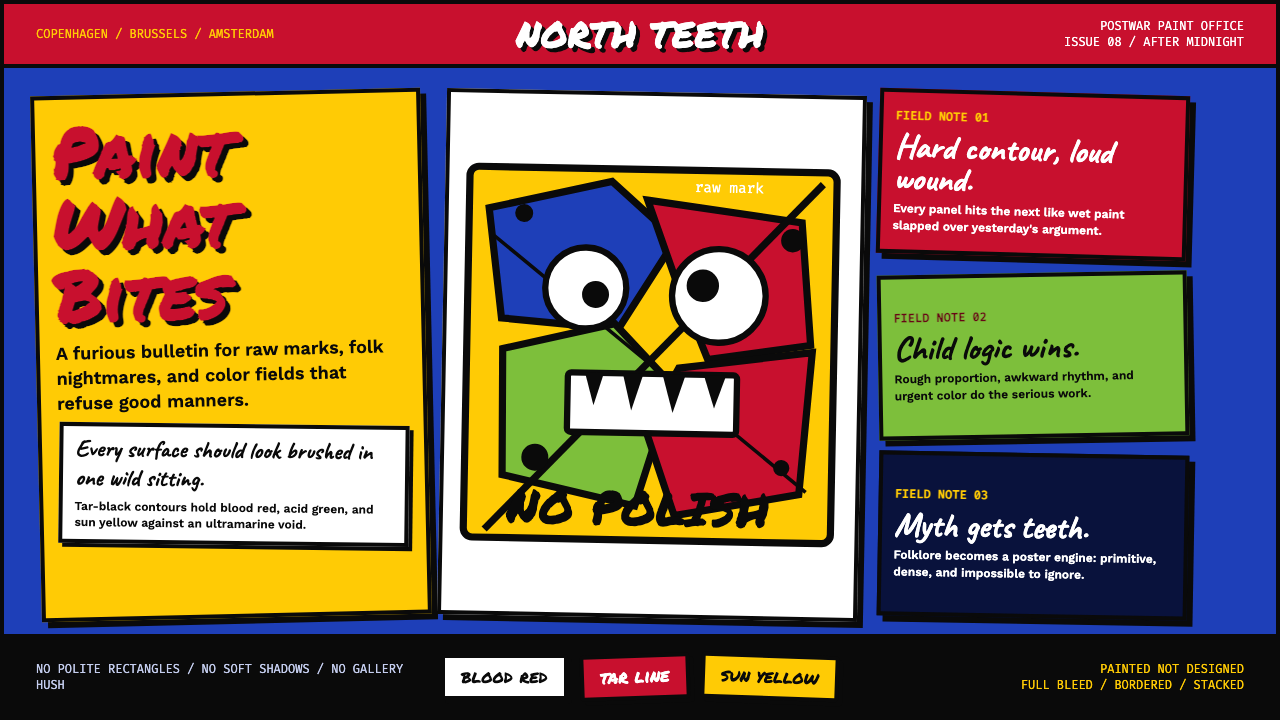 CoBrA (Asger Jorn, 1948)Paint refuses polish. Ultramarine ground, blood red slabs, and marker type th…