What is Converse Chuck Taylor?
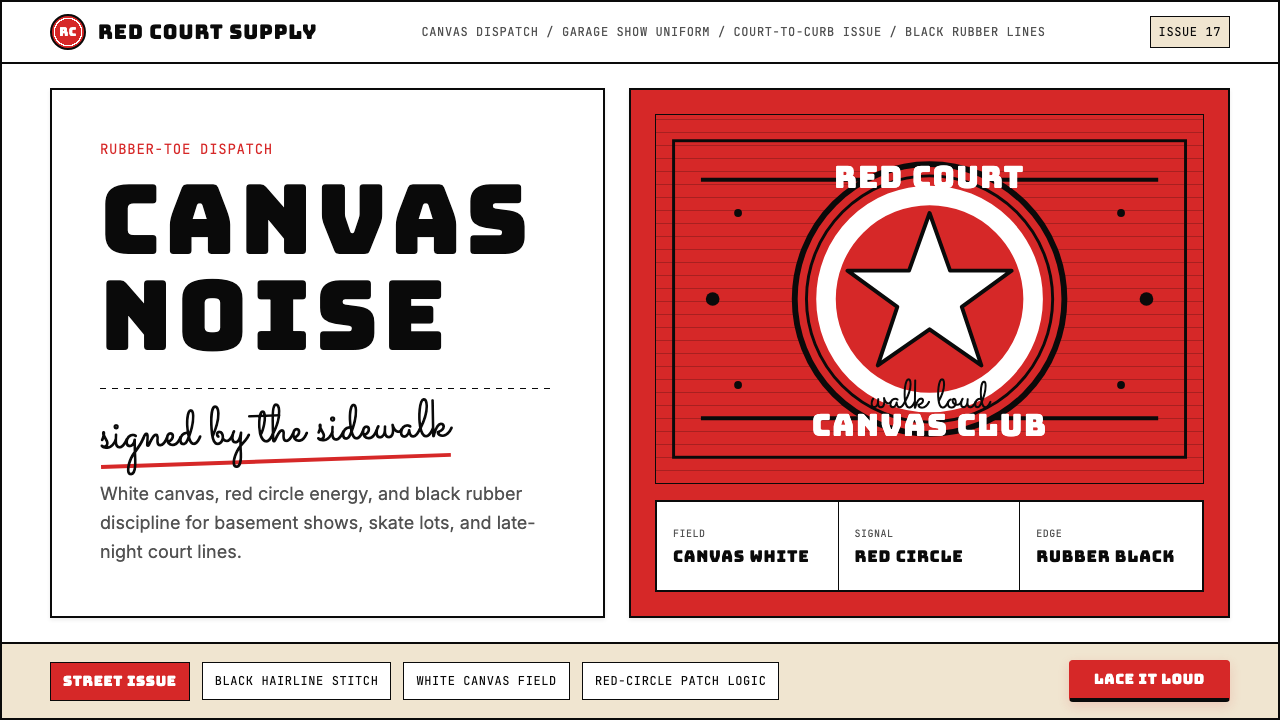
A century of red, white, and black on canvas — the Chuck Taylor All Star turned a basketball shoe into the world's most democratic design icon.
Converse Chuck Taylor in brief
Converse Chuck Taylor All Star is not merely a sneaker — it is one of the most immediately recognizable visual systems in American material culture. The design vocabulary is ruthlessly economical: saturated red against white canvas, anchored by deep black rubber at the toe and a bold circular ankle patch bearing a five-pointed star. Everything in the system is load-bearing. Remove the red circle and it becomes a different shoe; replace the canvas texture with synthetic smoothness and the warmth disappears. The constraint is the identity.
As a design language, Chuck Taylor operates on populist principles that are almost the inverse of high modernism. Where Bauhaus or Swiss Style pursued rational order and institutional clarity, the Chuck Taylor system carries the warmth of hand-craft: visible stitching lines, a cursive script signature at the ankle, a canvas ground that absorbs wear and character over time. The type is chunky and loud rather than geometric and precise. The star is a badge, not a symbol. The overall effect reads as something signed, personal, and deeply American.
The three-color discipline — Converse red, white, and black — is what makes the system translatable into other media. Strip away the physical shoe and the color logic still holds: a saturated warm red at full intensity, a pure or near-pure white field, and black used exclusively for definition and structure. No gradients, no pastels, no neutral grays diluting the contrast. The system works because it refuses to negotiate.

Where does Converse Chuck Taylor come from?
The story begins in 1908 in Malden, Massachusetts, when Marquis M. Converse founded the Converse Rubber Shoe Company. The early business made galoshes and winterized footwear, but by 1917 Converse had introduced its first athletic canvas shoe — a high-top designed specifically for basketball, a sport that was itself less than three decades old. The design was functional and unadorned: vulcanized rubber sole, white canvas upper, a distinctive circular rubber patch protecting the ankle. That patch, originally a structural reinforcement, would become the most important piece of real estate in sneaker history.
The transformation from athletic shoe to cultural icon began in 1921 when Charles 'Chuck' Taylor, a traveling salesman and semiprofessional basketball player from Indiana, walked into the Converse offices in Chicago complaining that his feet hurt. Rather than simply fitting him with a new pair, Converse hired him. Taylor spent the next four decades crisscrossing America in a car packed with shoes, running basketball clinics at high schools and YMCAs and military bases, teaching the game while selling the shoe. In 1932, Converse added Taylor's signature to the ankle patch — a cursive script that transformed a rubber reinforcement into a personal endorsement. No one paid Taylor royalties for decades; what he got instead was his name on every shoe.
Through the mid-twentieth century, the Chuck Taylor was the dominant basketball shoe in America. By the 1960s and 1970s, as professional athletes migrated toward leather high-performance alternatives, the Chuck began its second life — not as the best shoe for the sport but as the shoe of the counterculture. Punk musicians wore them on stage. Skateboarders discovered that the flat sole gave precise board feel. Art students wore them as a uniform rejection of corporate footwear. The shoe's affordability, its blankness as a canvas (often literally decorated with marker or paint), and its refusal to signal status made it the default shoe of people who distrusted defaults.
The visual language solidified through decades of consistent production rather than deliberate brand strategy. Converse's red-circle-on-white remained essentially unchanged from the 1930s through the early 2000s. In 2003, Nike acquired Converse for 305 million dollars, but retained the original design language intact — the acquisition validated rather than altered the visual identity. Since then, the Chuck Taylor has become a platform for collaboration, with Comme des Garçons PLAY, Off-White, and hundreds of other designers reworking the silhouette while the ankle-patch system and three-color discipline remain constant. The heritage is the constraint, and the constraint is what makes it legible.
What defines the Converse Chuck Taylor look?
The Three-Color Discipline
The entire visual system rests on three colors used at full intensity: a saturated warm red, pure white, and deep black. No tints, no shades, no graduated transitions between them. Red commands attention and carries the identity; white provides the canvas ground and breathing room; black defines structure, silhouette, and legibility. In application, the three colors are always deployed in the same relational hierarchy — red as focal point, white as field, black as line — which is why the system remains coherent whether it appears on a shoe, a poster, or a screen.
The Circular Badge
The red circle with its star and wordmark is the visual anchor of the entire system — a logo that predates modern branding theory by decades. Its geometry is blunt and direct: a bold red disc with a centered star and stacked sans-serif lettering in black and white. The circle functions as a seal rather than a symbol, conferring authenticity the way a wax stamp or a hand-signed label does. In design applications, referencing this badge motif — a contained circular form with interior type — imports the Chuck Taylor's sense of handmade authority.
Script Warmth Against Block Volume
The typographic tension that gives Chuck Taylor its personality is the pairing of opposing registers: a flowing cursive script — Taylor's actual signature — against chunky, high-contrast display type. The script carries intimacy and human presence; the block type carries volume and broadcast energy. Neither would work alone. In contemporary design applications that reference this system, this opposition translates to pairing a handwritten or calligraphic element with something blunt and industrial — the combination signals both personal origin and mass confidence.
Canvas Texture as Honest Ground
The white canvas of the All Star is not a neutral surface — it is a material declaration. Canvas shows wear, holds ink, takes paint, and records use over time. Its woven texture is visible at close range, lending a warmth and tactility that polished or coated surfaces cannot replicate. In two-dimensional design work referencing the Chuck Taylor aesthetic, a slight paper or textile grain in the background field achieves the same effect: the ground feels lived-in rather than clinical, receptive rather than finished.
Stitch Lines as Structural Ornament
The black stitching that runs along the canvas panels of the Chuck Taylor is functional — it holds the shoe together — but it also reads as drawn line, marking seams and transitions with the rhythm of craft rather than the precision of machining. These visible construction lines are one of the few decorative elements in the system, and they are permitted precisely because they are also structural. In graphic applications, this principle argues for making structural elements visible: grid lines that double as design elements, borders that mark genuine content boundaries, and rules that appear where information actually breaks.
Populist Scale and Flatness
Unlike luxury sneaker aesthetics — which rely on material scarcity, complex colorways, and exclusive silhouettes — the Chuck Taylor visual system is deliberately accessible. Forms are bold enough to read at a distance; colors are primary enough to survive reproduction in any medium; the overall composition is flat rather than dimensional. This populist flatness means the design system translates well across contexts: it is as legible on a poster across the street as on a phone screen held at arm's length. Accessibility of perception is a core aesthetic value, not an afterthought.
Counterculture Openness
One of the Chuck Taylor's most distinctive design qualities is its blankness — the white canvas is literally a surface for personal expression. Artists, musicians, and teenagers have drawn on, painted, and customized their Chucks for decades, and this culture of modification is baked into the aesthetic. The design system tolerates addition: a marker drawing on a Chuck is not vandalism, it is participation. In design applications, this translates to leaving deliberate space for user-generated content, handwritten annotation, or visible revision — the system should feel like an invitation rather than a finished statement.

Who shaped Converse Chuck Taylor?
Converse founded his rubber shoe company in Malden, Massachusetts in 1908, initially producing galoshes and winterized footwear. His decision to pivot toward athletic canvas shoes in 1917 — entering a market that barely existed — produced the All Star, the design that would outlast every other sneaker of its era. Converse's instinct that a sport-specific shoe could carry broad cultural meaning beyond its athletic function proved correct in ways he could not have anticipated, and the company he founded remained independent for nearly a century before its 2003 acquisition.
Taylor was a semiprofessional basketball player and natural salesman from Columbus, Indiana who joined Converse in 1921 after walking in to complain about foot pain. For the next four decades he drove across America conducting basketball clinics — teaching the game to coaches and players at schools, YMCAs, and military installations while fitting them with Converse shoes. His signature added to the ankle patch in 1932 turned a rubber reinforcement into a personal endorsement and created one of the earliest examples of athlete-brand fusion. Taylor never received royalties; he received something rarer — permanent nominal authorship of a design that would outlast him by generations.
The Japanese fashion house's PLAY line — identified by its heart-with-eyes logo — began collaborating with Converse in the early 2000s and produced one of the most successful luxury-meets-populist design fusions of the era. The collaboration placed Rei Kawakubo's graphic icon directly on the Chuck Taylor silhouette, creating a shoe that simultaneously belonged to two radically different design vocabularies. The CDG PLAY Chuck demonstrated that the All Star's visual system was strong enough to absorb a completely foreign graphic element without losing coherence — a test that few design systems pass.
Virgil Abloh's Off-White label approached the Chuck Taylor as a design-critical object — subjecting it to the same deconstructive analysis that Abloh applied to Nike Air Jordans in his landmark 'The Ten' collaboration. By making the shoe's construction language explicit through quotation marks, arrows, and text callouts, Abloh treated the Chuck as a readymade whose meaning could be reconfigured through annotation rather than redesign. The approach highlighted something already present in the original: the Chuck Taylor is a shoe that invites interpretation, and the visual system is robust enough to survive being read against itself.
No single designer accelerated the Chuck Taylor's transition from athletic wear to cultural symbol more than the musicians who adopted it as their de facto uniform. The Ramones wore matching black high-tops on stage and in photographs, fusing the shoe's working-class affordability with the confrontational aesthetic of early punk. Across subsequent decades — through new wave, grunge, indie rock, and DIY art scenes — the Chuck Taylor accumulated layer upon layer of subcultural meaning precisely because it was cheap, available everywhere, and carried no corporate fitness or performance aspiration. The absence of performance branding became the point.
How do you use Converse Chuck Taylor today?
The Chuck Taylor visual system is immediately applicable to any design context that benefits from bold populist energy, hand-crafted warmth, and high-contrast legibility at a distance. The key to applying it correctly is understanding that this is not a minimalist system — it is a maximum-impact system with a restricted palette. Every element should earn its place by contributing to the three-color hierarchy: red anchors, white breathes, black defines. When all three are present at full saturation, the composition should still read clearly from across a room or at thumbnail size.
For presentation slides, the Chuck Taylor language works powerfully on cover pages built around a single bold focal element — a large red circle, a chunky wordmark, or a star motif — set against a white or near-white field with all structural annotation in black. Content slides should resist the temptation to use red for every header; instead, reserve red for the single most important element per slide and let black-on-white carry the information hierarchy. Data slides translate naturally into this system: bar charts become red rectangles on a white field, sorted and annotated in black, with no background color muddying the signal.
For web interfaces — particularly dashboards, pricing pages, and product landing pages — the system's flat, high-contrast character suits contexts where scannability is paramount. Apply a white or very light warm ground, use black for all body text and labels, and deploy the saturated red only for primary calls to action, active states, and tier highlights. Card components work best with visible black borders rather than soft shadows, echoing the stitched-edge quality of the shoe itself. Navigation should be typographic and bold rather than icon-heavy, with labels large enough to feel confident rather than dense.
For editorial and marketing contexts — posters, social cards, event branding, print campaigns — the Chuck Taylor system licenses boldness that more restrained styles cannot. A full-bleed red panel with a white star and black type has instant stopping power. For longer editorial formats, use the white field as the primary reading surface, punctuate section breaks with a bold horizontal black rule, and drop in red as a chapter opener or pull quote accent. Marketing pages benefit from alternating content blocks: white-on-red for hero moments, black-on-white for detail sections, with the saturated red preventing the page from feeling neutral or corporate.
The most common mistake when applying this system is treating the red as a highlight color in a more conventional palette rather than as a structural primary. Adding coral, orange, or burgundy alongside the Converse red introduces color competition that the original system does not have room for. A second common error is softening the contrast by using off-whites, light grays, or warm neutrals as the background field — this immediately dilutes the populist intensity that makes the system work. The Chuck Taylor aesthetic depends on edges that are decisions, not accidents: keep the boundaries hard, keep the palette to three, and trust the star.

Converse Chuck Taylor — FAQ
How does the Chuck Taylor style differ from other American sportswear aesthetics?
Most American sportswear aesthetics — Nike, Adidas, Jordan Brand — evolved toward technological signaling: gradients, layered color panels, performance-derived forms that communicate speed, engineering, and innovation. The Chuck Taylor system moved in the opposite direction, becoming simpler and flatter as the culture around it grew more complex. Where competitor aesthetics accumulate visual complexity to justify premium pricing, the Chuck Taylor system proves value through refusal: it has had the same ankle patch since 1932 because the patch was correct. The result is a design language that reads as honest rather than aspirational — it does not promise to make you faster or stronger, it promises to be itself.
Can the Chuck Taylor aesthetic work in a premium or luxury positioning?
It can, but only when the tension is made explicit. The most successful luxury applications of Chuck Taylor's visual language — the Comme des Garçons PLAY collaboration, certain Off-White treatments — work precisely because they acknowledge the populist origin and create deliberate friction with the premium context. A luxury brand that adopts the red-white-black three-color discipline without acknowledging the source reads as generic high-contrast branding rather than as a sophisticated reference. The system signals authenticity and accessibility; layering luxury on top of that requires the designer to be in on the joke, not above it.
The source material is a canvas shoe. How does the tactile quality translate to screen or print?
Canvas texture is warm and woven — it has grain, slight irregularity, and the sense of something made by accumulation rather than precision. In screen contexts, this quality is best approximated through a very subtle paper or textile grain applied to the background field, keeping the overall ground warm rather than clinically white. In print, uncoated or lightly textured stock achieves it directly. The critical point is that the texture should read as ground character rather than decorative effect — the grain should be present at close range but not detract from the high-contrast foreground elements. A Chuck Taylor design that reads perfectly on a pure white background but gains warmth on a slightly textured one is correctly calibrated.
What contexts are a poor fit for the Chuck Taylor visual language?
The system performs poorly wherever subtlety, sophistication, or institutional gravitas are required values. Financial services, healthcare, and legal communications rely on visual languages that signal precision, stability, and expertise — the Chuck Taylor's boldness, handmade warmth, and populist energy read as too casual and too loud in those contexts. Similarly, the system is a poor fit for design work that requires a wide typographic range: because the visual identity depends on bold primary contrast, fine typographic gradations — such as the multiple gray-toned hierarchies used in dense editorial design — become invisible. When your content requires nuance, the Chuck Taylor palette will flatten it.
How should red be proportioned relative to white and black in a composition?
The authentic Chuck Taylor proportion treats red as accent rather than ground: the ankle patch covers a small fraction of the shoe's total white canvas surface, and the star within it covers a fraction of the patch. In application, this translates to a general principle: let white hold the majority of the spatial budget, use black to define edges and type, and deploy red for the single focal element or the primary call-to-action state. When red expands to cover more than roughly a third of a composition, it stops being a focal point and starts being a mood — the tension between ground and accent collapses. There are exceptions for intentional full-bleed red moments — a poster panel, a hero block — but even then, the white and black elements should feel like they are cutting through the red rather than floating on it.
Related design styles
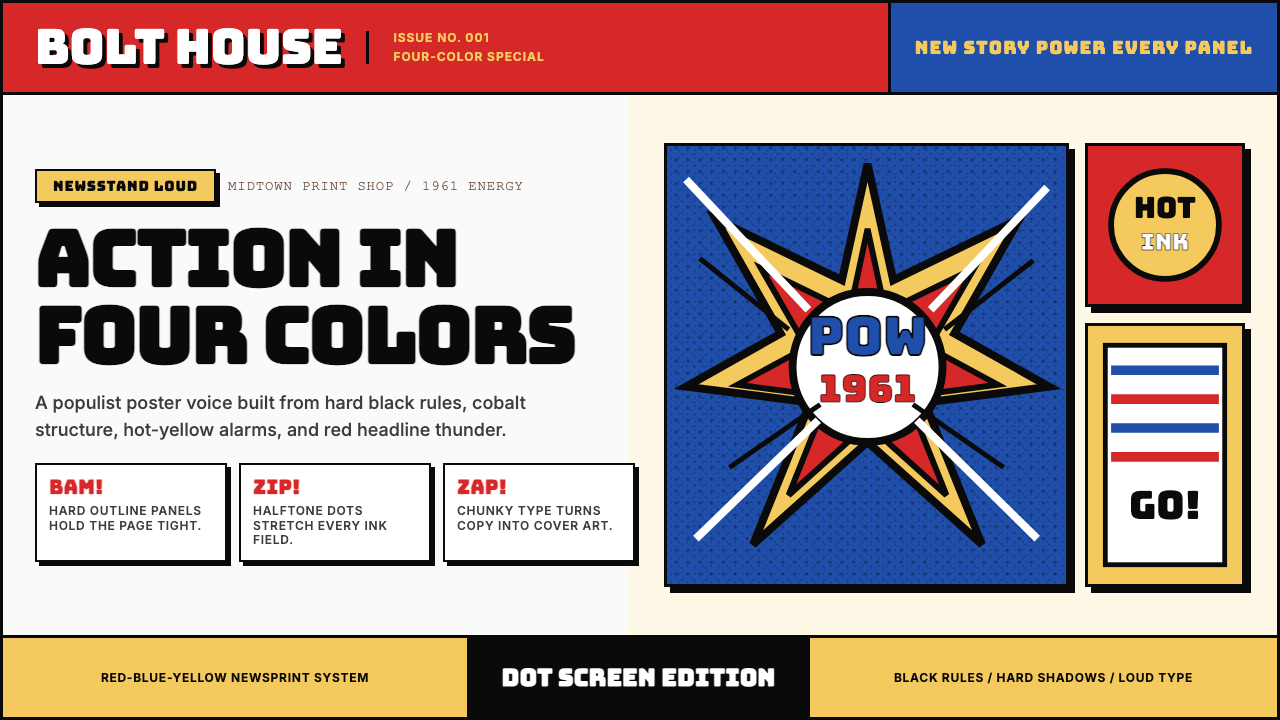 Marvel Comics (Kirby Era)Populist color hits hard. Red-blue-yellow panels, black rules, and halftone d…
 Caribbean Rastafarian (Jamaica)Warm faith, loud color. Red-gold-green bands and black poster type carry the…
 Looney Tunes (Warner Bros.)Pure cartoon chaos. Bull's-eye rings, Bungee type, and red-blue-yellow blocks.
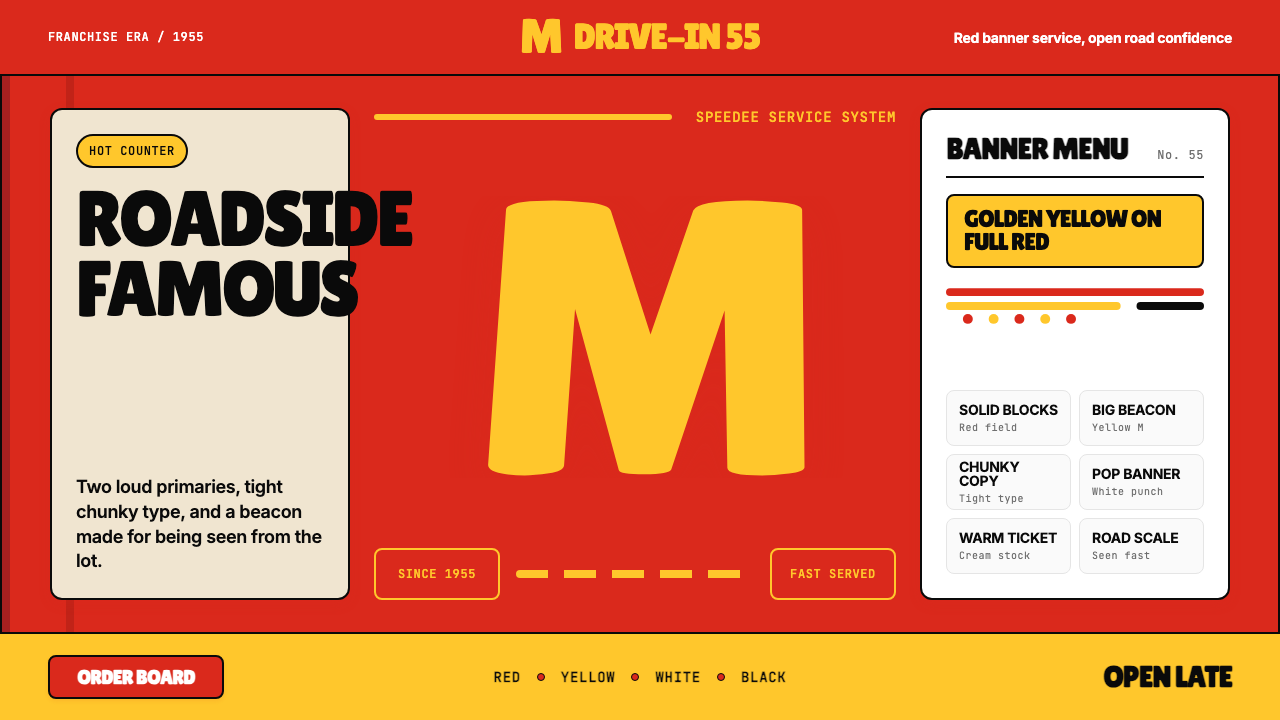 McDonald's Golden ArchesRoadside famous. Saturated red, hot yellow, and chunky type shout from 1955.
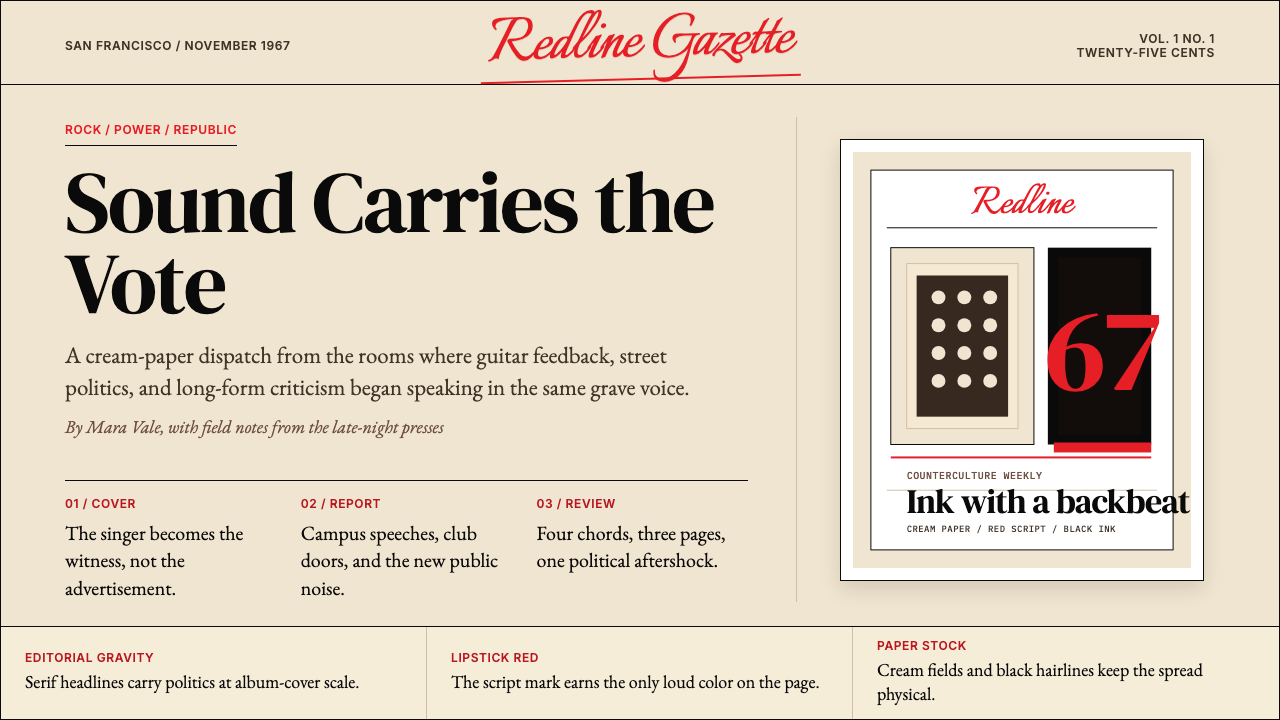 Rolling Stone MagazineCounterculture gets editorial weight. Cream paper, lipstick red script, serif…
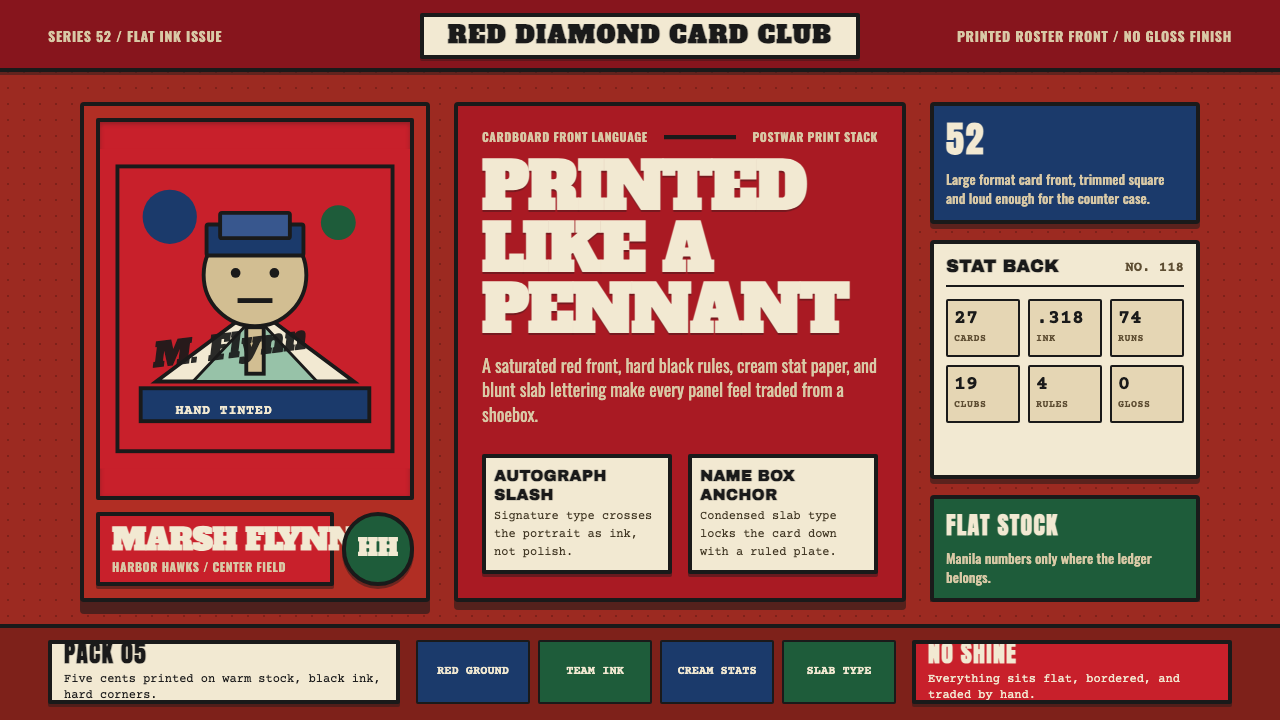 Topps Baseball CardCardboard heat. Brick-red slab panels, cream stats, and condensed type feel p…