What is Googie / Space Age (1960s)?
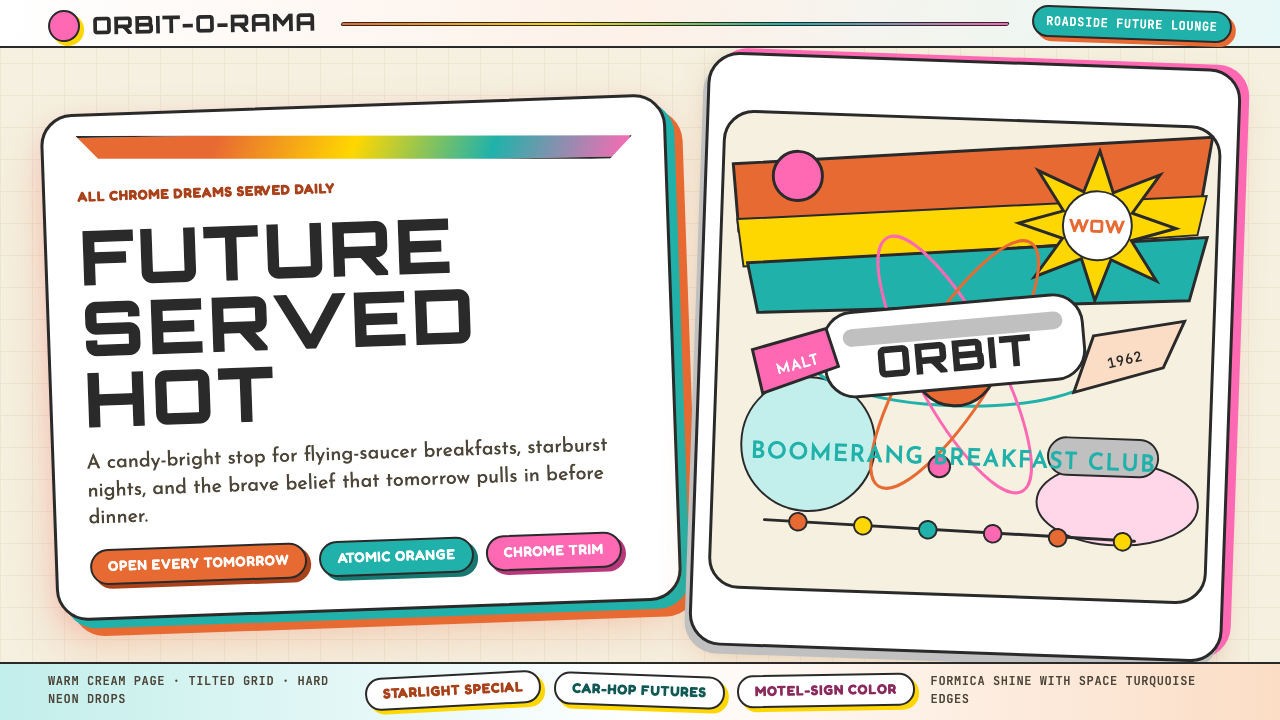
Googie is the visual shout of postwar American optimism — boomerang rooflines, starburst signs, and the unshakeable belief that tomorrow would arrive in chrome and candy color.
Googie / Space Age (1960s) in brief
Googie — also known as Space Age or Populuxe — is the mid-century American design style that made roadside architecture look like the future had already arrived. It emerged in Southern California in the late 1940s and peaked between 1955 and 1965, spreading from coffee shops and motels to bowling alleys, car washes, and the original Tomorrowland at Disneyland. The name itself comes from John Lautner's 1949 coffee shop on Sunset Strip in Los Angeles, and it stuck because it sounded as playful and forward-looking as the buildings looked.
The visual language of Googie is defined by exuberance and speed. Nothing sits at a right angle when it can lean, sweep, or launch upward. Rooflines soar at dramatic angles. Signs explode into starbursts, atomic orbits, and boomerang silhouettes. Colors are saturated to the point of near-fluorescence — the palette runs to atomic orange, space turquoise, flamingo pink, and chrome silver, always pushing toward the brightest, most candy-sweet version of each hue. Chrome trim catches every available ray of California sunlight. Everything signals motion, energy, and optimism about a future that was, in this vision, going to be absolutely fabulous.
Googie was not a fine-art movement or an academic project. It was vernacular commercial design — the architecture and graphics of diners, motels, gas stations, and shopping centers built for a car-driving, suburb-dwelling, television-watching American public that had survived the war and now believed the atomic age was going to be wonderful. Its designers drew inspiration from the space race, jet aviation, and atomic science — the starburst motif echoes both the hydrogen bomb's detonation pattern and the rings of Saturn. The style is inseparable from its context: without the postwar boom, the suburban highway, and the optimism of a generation that saw technology as pure promise, Googie does not exist.

Where does Googie / Space Age (1960s) come from?
The immediate birthplace of Googie was postwar Los Angeles, a city expanding outward along newly built freeways at a pace that outran any established architectural tradition. The suburb needed to be seen from a moving car. Signage had to compete with highway speed. Buildings had to announce themselves at a glance. John Lautner, a student of Frank Lloyd Wright, designed the Googie's coffee shop in 1949 with a cantilevered roof that swept upward at the corner — visible, dramatic, and immediately legible to a driver doing forty miles an hour. It was architecture adapted to the automobile age, and it set the template.
The broader context was the postwar American love affair with technology and the future. The atomic bomb had ended the war; atomic energy was going to power the future. The space race, ignited by Sputnik in 1957, turned orbital mechanics and rocket silhouettes into cultural imagery. Jet aviation was shrinking the continent. Television was bringing the world into the living room. Googie absorbed all of this — its starburst signs echoed atomic diagrams, its swooping rooflines referenced jet wings and flying saucers, its color palette suggested the candy-colored optimism of science fiction illustration. The style was not commenting on the space age from a distance; it believed it was the space age, happening right now at this coffee shop.
Wayne McAllister and the firm Armet & Davis were among the most prolific designers of the style's peak years, creating dozens of coffee shops and roadside buildings across Southern California in the late 1950s and early 1960s. Their work — Norm's Restaurants, Pann's, Ships — defined the Googie coffee shop typology: a kidney-shaped or boomerang-plan interior, floor-to-ceiling glass walls, a cantilevered roofline that extended well beyond the structural walls, and signage that used neon, animated elements, and explosive graphic forms. The style also extended to gas stations, motels, bowling alleys, and retail buildings, each finding its own version of the swept-upward angle and atomic ornament.
Googie's reach extended beyond architecture into popular culture. Hanna-Barbera's animated television series The Jetsons, which debuted in 1962, brought the visual vocabulary of Space Age design into American living rooms every Saturday morning — transparent bubble roofs, elevated platforms on retractable poles, rounded pod-shaped rooms. The 1961 expansion of Los Angeles International Airport produced the Theme Building, a flying-saucer structure on four sweeping arched legs that remains one of the purest expressions of Googie at an institutional scale. By the mid-1960s, the style was so embedded in American commercial visual culture that it was effectively invisible — it simply looked like the present, not like a style at all.
What defines the Googie / Space Age (1960s) look?
Color
The Googie palette is saturated, warm, and deliberately upbeat — atomic orange, space turquoise, flamingo pink, sunburst yellow, and chrome silver are the core hues. These are not subtle colors; they are chosen for visibility at highway speed and for their associations with novelty, technology, and optimism. Turquoise in particular carried powerful Space Age associations in mid-century America, evoking swimming pools, the sky, and the color of early rocket insignia. Colors are used boldly and in close contrast with one another — orange against turquoise, pink against white — rather than harmonized in the conventional sense. The effect is festive, energetic, and impossible to miss.
Form and Angle
Nothing in Googie sits level. The defining formal move is the dynamic angle — rooflines, sign edges, canopies, and structural elements consistently tilt between roughly five and twenty degrees from horizontal. This tilt implies speed and forward motion, as though the building itself is about to take off. Alongside the tilted angle, Googie favors sweeping curves — boomerang shapes, kidney forms, and parabolic arches — that suggest the aerodynamic profiles of jets and spacecraft. Sharp points and acute angles appear in starburst motifs and zigzag trim, adding a sense of explosive energy to the overall composition.
Starburst and Atomic Ornament
The starburst — a central point radiating lines or elongated lozenges outward in all directions — is the signature ornamental motif of Googie, appearing on signs, light fixtures, tile patterns, fabric, and anywhere else that welcomed decoration. It reads simultaneously as an exploding atom, a stylized sun, Saturn's rings seen from above, and the spark of a new idea. Alongside the starburst, Googie uses atomic orbit diagrams (electrons in elliptical paths), boomerang shapes, and kidney curves as recurring visual vocabulary. These motifs give the style its distinctive sense of being plugged directly into the scientific and technological imagery of the era.
Chrome and Reflectivity
Chrome is the material soul of Googie. It appears as trim on signs, as structural columns, as edging on countertops and furniture, and as the finish on every surface that could plausibly be polished to a mirror. Chrome's appeal in this context is both functional and symbolic: functionally, it is durable, easy to clean, and catches light dramatically; symbolically, it represents the industrial future — machines, spacecraft, laboratories — rendered in a form accessible at the roadside coffee shop. In graphic applications of the style, chrome is translated into highly reflective metallic treatments, beveled lettering with bright highlights, and surfaces that suggest polished metal without necessarily reproducing it literally.
Typography
Googie lettering is expressive, constructed, and often physically dimensional. Sign letters are frequently built up in three-dimensional form — pushed out from a backlit panel, assembled from individual metal characters mounted on a sign face, or formed from neon tubing. Letterforms tend toward the rounded and the italic: a slight forward lean reinforces the sense of speed, while rounded terminals soften the overall effect into something friendly and fun rather than aggressive. Script and brush lettering appear alongside constructed letterforms, especially for informal applications like menu signage and secondary identifiers. The overall effect prioritizes legibility at a glance and a personality that is optimistic and approachable.
Space and Openness
Googie interiors and facades favor transparency and visual openness. Floor-to-ceiling glass walls blur the boundary between inside and outside, allowing the dramatically angled interior to be read from the parking lot and the neon-lit exterior to wash into the dining room. This openness is both practical — maximizing the visibility of the business to passing traffic — and expressive of the era's confidence that technology (in this case plate glass and steel-frame construction) had removed barriers. In graphic applications, the equivalent sensibility appears as generous spacing around type and illustration, compositions that breathe rather than crowd, and a preference for bold single statements over complex layered arrangements.
Exuberant Optimism
More than any specific formal element, Googie is defined by its emotional register: unironic, forward-looking, and celebratory. The style does not hedge. It does not suggest that the future might be complicated. It announces — through every tilted angle, saturated color, and chrome flourish — that tomorrow is going to be tremendous, and that this hamburger stand is proof. This attitude is the style's greatest strength and its most important characteristic. Any technically correct application of Googie's visual vocabulary that fails to communicate genuine enthusiasm will feel like pastiche. The style demands commitment to its optimism.

Who shaped Googie / Space Age (1960s)?
Lautner studied under Frank Lloyd Wright at Taliesin before establishing his own practice in Los Angeles. His 1949 Googie's coffee shop on Sunset Strip gave the movement its name, but his contribution extended far beyond that single building. Lautner spent decades designing residential and commercial structures in Southern California that pushed structure and geometry to theatrical extremes — cantilevered roofs, hyperbolic paraboloid shells, and spaces that dissolved the boundary between architecture and landscape. His work established that the swept angle and the soaring roofline could be taken seriously as architectural ideas, not merely as roadside novelty.
McAllister was one of the earliest and most influential designers of the drive-in restaurant and roadside commercial building in the American West. His work in the 1930s through 1950s — including early drive-ins, casinos, and coffee shops in Las Vegas and California — prefigured many of Googie's formal moves: the circular plan, the dramatic sign tower, the building designed to be read from a car. His coffee shop designs in particular established the typological conventions that Armet & Davis and others refined into the classic Googie idiom of the late 1950s.
The Los Angeles architectural firm of Louis Armet and Eldon Davis was the most prolific producer of Googie coffee shops during the style's peak decade. Their designs for Norm's Restaurants, Pann's Coffee Shop, and dozens of other Southern California diners established the canonical Googie typology: kidney-shaped counters, boomerang-plan dining rooms, cantilevered rooflines extending dramatically beyond the glass walls, and internally illuminated sign pylons. Armet & Davis treated the coffee shop as a designed total environment, coordinating architecture, signage, furniture, and tableware into a single coherent vision of the atomic-age future.
When the animation studio Hanna-Barbera launched The Jetsons in 1962, they commissioned production designers to create a visual world that extrapolated the Space Age aesthetic into the far future. The result — transparent bubble homes elevated on retractable poles, rounded pod-shaped rooms, moving walkways, and robots with mid-century friendly faces — translated Googie's architectural vocabulary into a domestic, animated context that reached millions of American households weekly. The Jetsons did more to embed Space Age visual culture in the popular imagination than almost any built structure, and its imagery continues to define the shorthand for retro-futurism.
The architecture firm of William Pereira and Charles Luckman designed the iconic Theme Building at Los Angeles International Airport, completed in 1961. The structure — a flying saucer suspended above the terminal concourse on four sweeping parabolic arches — is the most photographed single expression of Googie at institutional scale. It brought the vocabulary of roadside Space Age design into the context of a major public infrastructure project, demonstrating that the style's optimism about technology and the future was not limited to coffee shops and bowling alleys but could serve as the face of a city's gateway to the world.
How do you use Googie / Space Age (1960s) today?
Googie translates into contemporary design work as a deliberately retro-futurist visual language — one that signals optimism, energy, and a playful relationship with technology. The key to applying it successfully is understanding its emotional core: this is not a style of restraint or ambiguity. Every element should feel like it is pointing forward, celebrating something, or radiating enthusiasm. Half-committed Googie looks like a mistake; committed Googie looks like a party.
For presentation slides, Googie is most effective on cover and section-break pages where visual impact matters more than information density. A cover works well with a starburst or atomic orbit motif as a full-bleed background element, the title set in bold rounded lettering with a forward lean, and the color palette limited to two or three of the core hues — a dominant saturated field with chrome or white lettering. Content slides should be pulled back toward legibility: the Googie sensibility can live in a single bold colored shape or icon alongside clean, well-spaced text, without attempting to reproduce the full exuberance of a roadside sign on a data-heavy page. Data slides benefit from the style's bold color logic — use the saturated palette to differentiate categories, and let bar charts or area charts take on something of the confident, graphic quality of mid-century illustration.
For web interfaces, Googie suits contexts where personality and energy are competitive advantages — entertainment platforms, event marketing, food and beverage brands, retro-themed products, and any application that wants to communicate that using it is going to be fun. Dashboard and pricing pages can incorporate the style through color field backgrounds in the signature hues, card components with bold colored borders or metallic-feeling header strips, and typography that leans toward the rounded and friendly end of the sans-serif spectrum. Navigation elements benefit from the style's emphasis on visibility: high-contrast color pairings, clear typographic hierarchy, and a boldness that makes interactive elements unmissable.
For editorial and marketing work, Googie provides a strong framework for retro-futurist campaigns, mid-century themed content, and any brand positioning around optimism, Americana, or technological excitement. Editorial layouts can use the boomerang and starburst as structural shapes that frame or separate content sections. Marketing pages benefit from the style's poster-like boldness: large, saturated color fields alternating with chrome or white sections, a single dominant hue per module, and headline typography that echoes the forward-leaning energy of neon sign lettering. The style works particularly well for event promotions, seasonal campaigns, and limited-edition product launches where the goal is to stand out immediately and create a sense of celebration.
A common mistake when applying Googie is deploying the color palette without the dynamic form language — using the saturated hues on a conventional, grid-aligned layout and wondering why it does not feel right. Googie color and Googie form are inseparable; the orange and turquoise mean something different on a tilted, sweeping shape than on a rectangular card. A related mistake is treating the style as ironic or nostalgic rather than sincere. The original Googie was not winking at you — it genuinely believed the future was going to be chrome and candy-colored. Contemporary applications that treat the style as camp or kitsch typically feel thin; those that commit to the enthusiasm, however anachronistic it might seem, tend to succeed.

Googie / Space Age (1960s) — FAQ
Is Googie the same as mid-century modern?
They overlap in era but diverge sharply in character. Mid-century modern — as the term is typically used in furniture and interior design — describes a relatively refined, internationally influenced aesthetic: clean lines, organic forms, natural materials, and a restrained palette that includes warm neutrals and earthy tones. Googie is the exuberant, commercial, American vernacular cousin of that sensibility. Where mid-century modern is tasteful and serene, Googie is loud and celebratory. Mid-century modern was designed for the living room; Googie was designed to be seen from a car doing fifty miles an hour on a four-lane highway. Both belong to the same cultural moment, but they address very different audiences and contexts.
Can Googie work for a serious or professional brand?
It depends entirely on what kind of seriousness the brand is communicating. Googie is not suited to contexts where gravitas, sobriety, or institutional authority are the primary values — legal services, financial planning, healthcare communications, or luxury positioning that depends on restraint. But for brands communicating that they are genuinely excited about what they do, that they see their work as forward-looking, and that engaging with them will be an energetic rather than a cautious experience, Googie can be used with real seriousness of purpose. Technology companies, creative agencies, food and hospitality brands, and entertainment platforms can all find authentic uses for the style without it tipping into kitsch — provided the application is committed and the rest of the brand's communication is coherent.
What is the difference between Googie and retro-futurism more broadly?
Retro-futurism is a broad category describing any aesthetic that imagines the future through the visual conventions of a past era — steampunk imagines the future through Victorian industry, dieselpunk through 1930s Art Deco, atompunk through 1950s atomic anxiety. Googie is a specific, historically grounded instance of retro-futurism: it is the actual visual language that mid-century Americans produced when they tried to picture the future. It is not an imagined or constructed aesthetic — it is a documented one, with specific buildings, designers, motifs, and a clear geographic and temporal origin. When contemporary designers invoke Googie, they are referencing something real, not assembling a pastiche from invented conventions.
How do I avoid making Googie look cheap or tacky?
The line between exuberant and cheap in Googie is mostly a question of restraint within exuberance. The original Googie buildings were not cheap — they used real chrome, quality neon, plate glass, and carefully engineered structural systems. The exuberance was in the form and the color, not in cutting material corners. In graphic applications, this translates to: do not use all the motifs at once. Choose one or two — a starburst, a boomerang curve, an atomic orbit — and develop them carefully rather than filling the composition with every available symbol. Keep the color palette to two or three hues, give each element room to breathe, and ensure the typography is clean and intentional. The style rewards confidence and penalizes timidity and clutter equally.
Does Googie work in dark-background layouts?
Dark backgrounds suit Googie well, perhaps better than many other historical styles — because the style's original context included neon signs against night skies, chrome catching artificial light, and lit interiors glowing through glass walls after dark. A dark Googie palette typically leads with space-black or deep midnight blue as the field, then brings the signature hues — particularly atomic orange, turquoise, and chrome white — forward as the active color layer. This combination has a strong night-drive aesthetic: the colors appear to glow rather than sit flat, which reinforces the neon-and-chrome energy of the original style. The main risk on dark grounds is that the palette can easily tip into a generic neon-cyberpunk look; anchoring the composition with the distinctive Googie motifs — the starburst, the boomerang, the rounded lettering — keeps it specific.
Related design styles
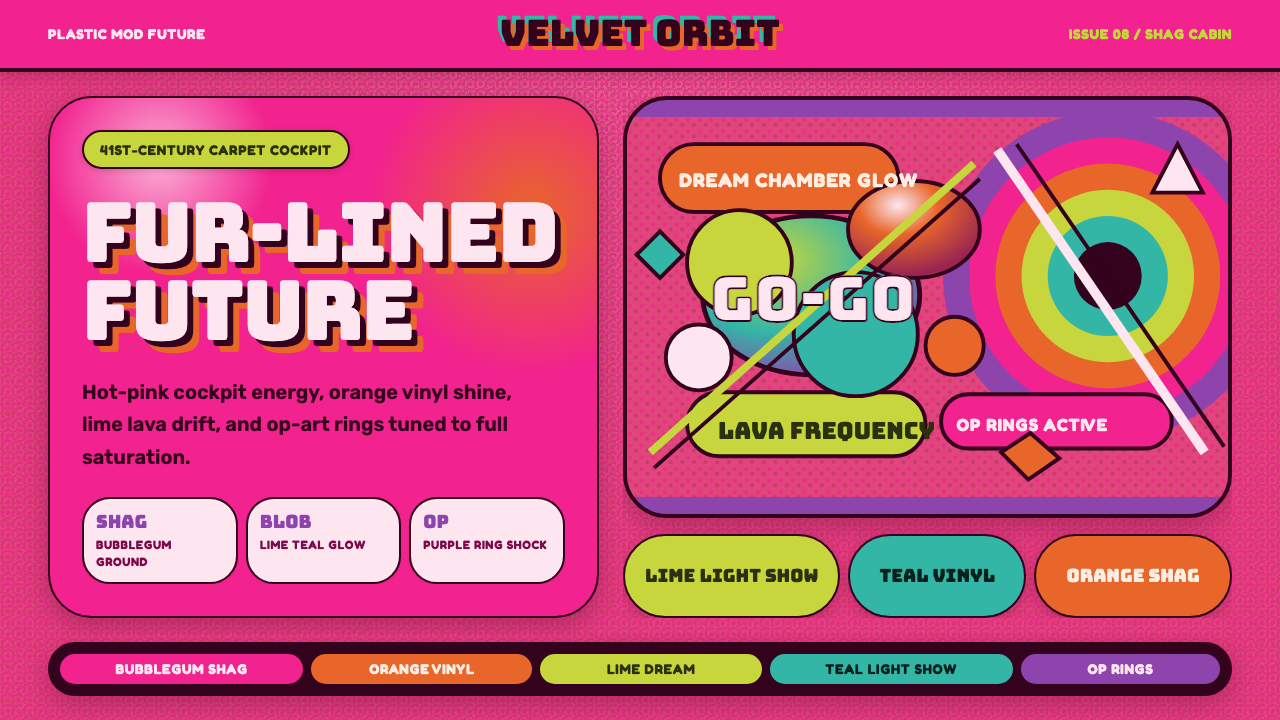 BarbarellaSpace-camp overload. Hot pink shag, lava blobs, and op-art rings collide.
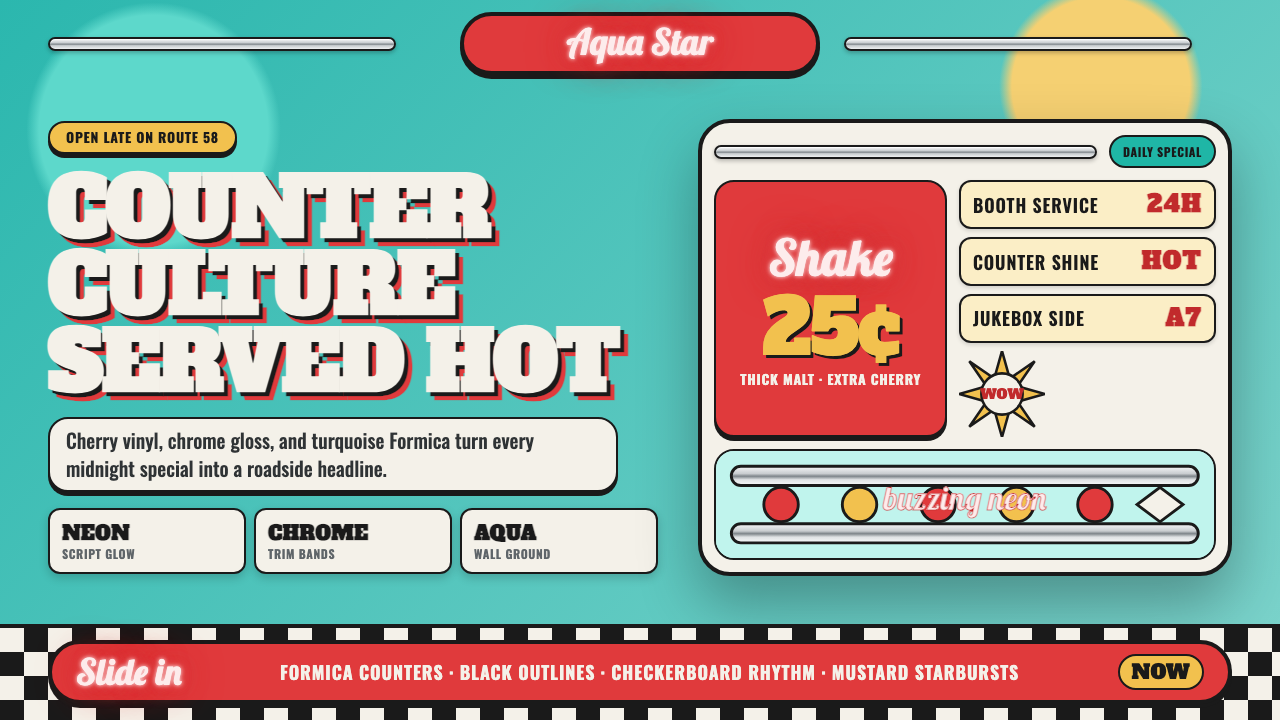 1950s Diner AquaRoadside optimism shouts. Aqua walls, cherry vinyl, chrome bands, and neon sc…
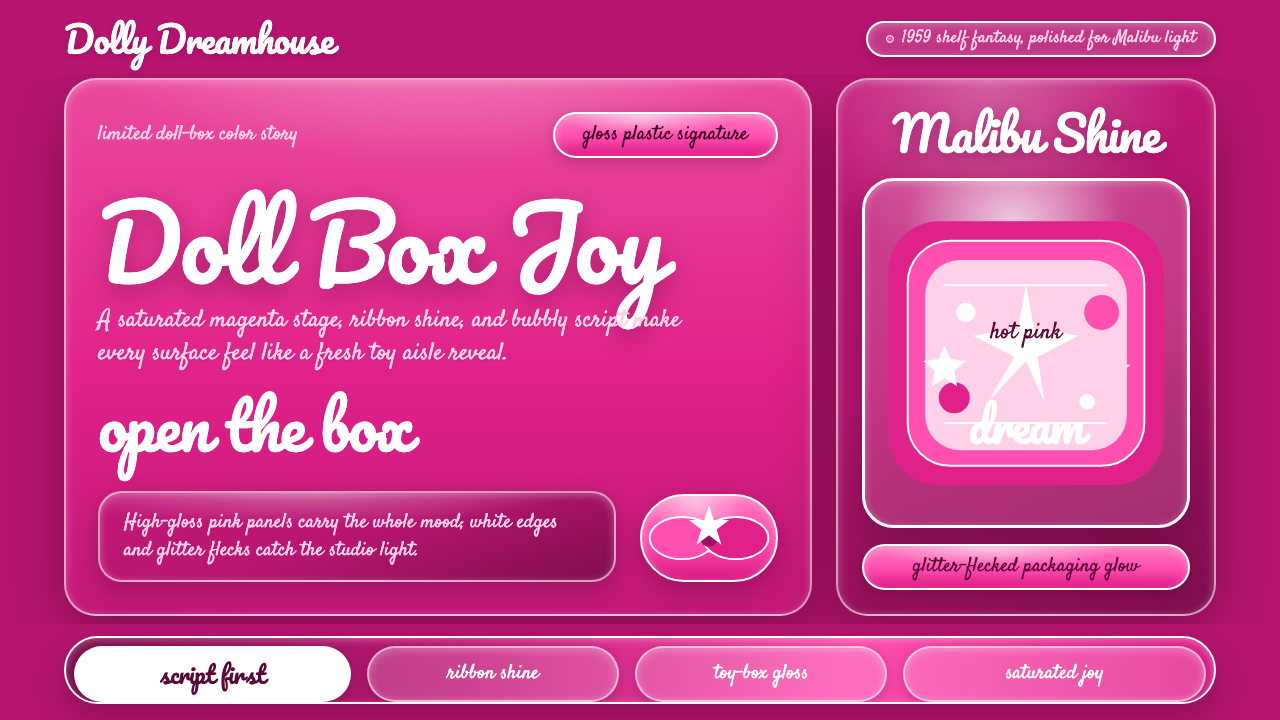 Barbie Hot Pink (Pantone 219)Saturated joy in plastic. Hot magenta, cursive script, gloss streaks, and gli…
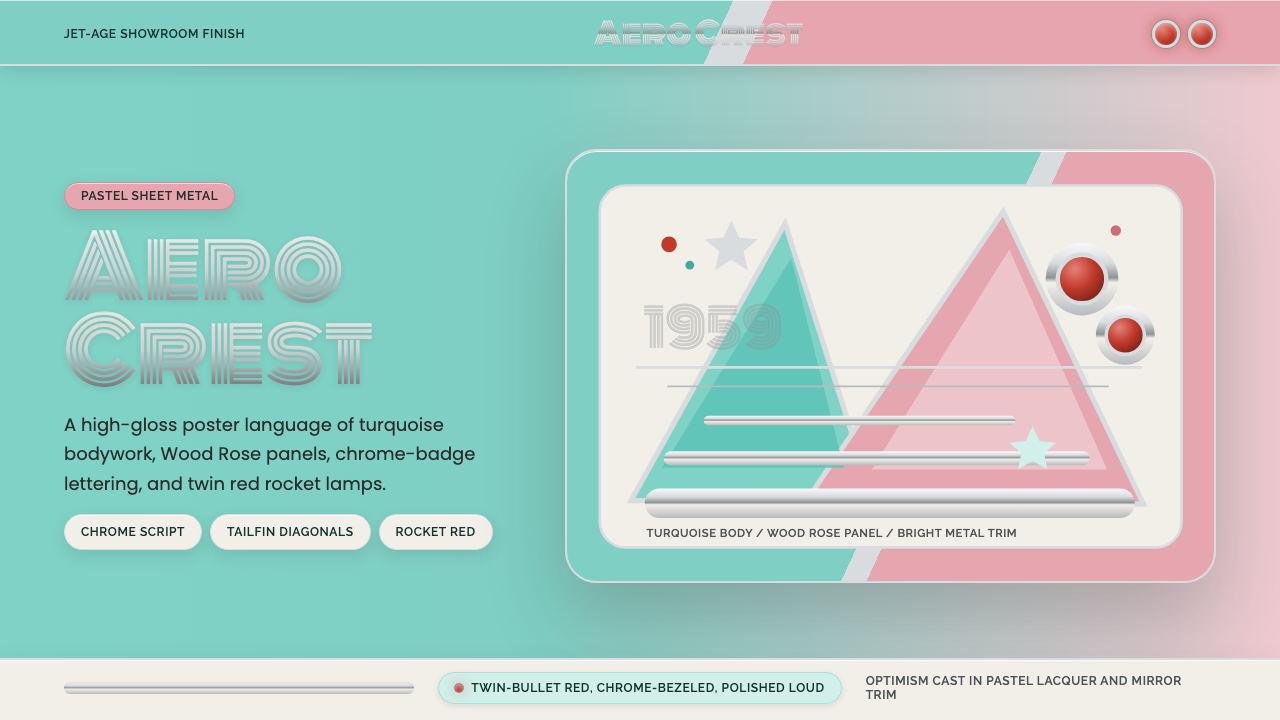 Cadillac TailfinShowroom optimism. Pastel aqua, Wood Rose panels, chrome Monoton, and rocket…
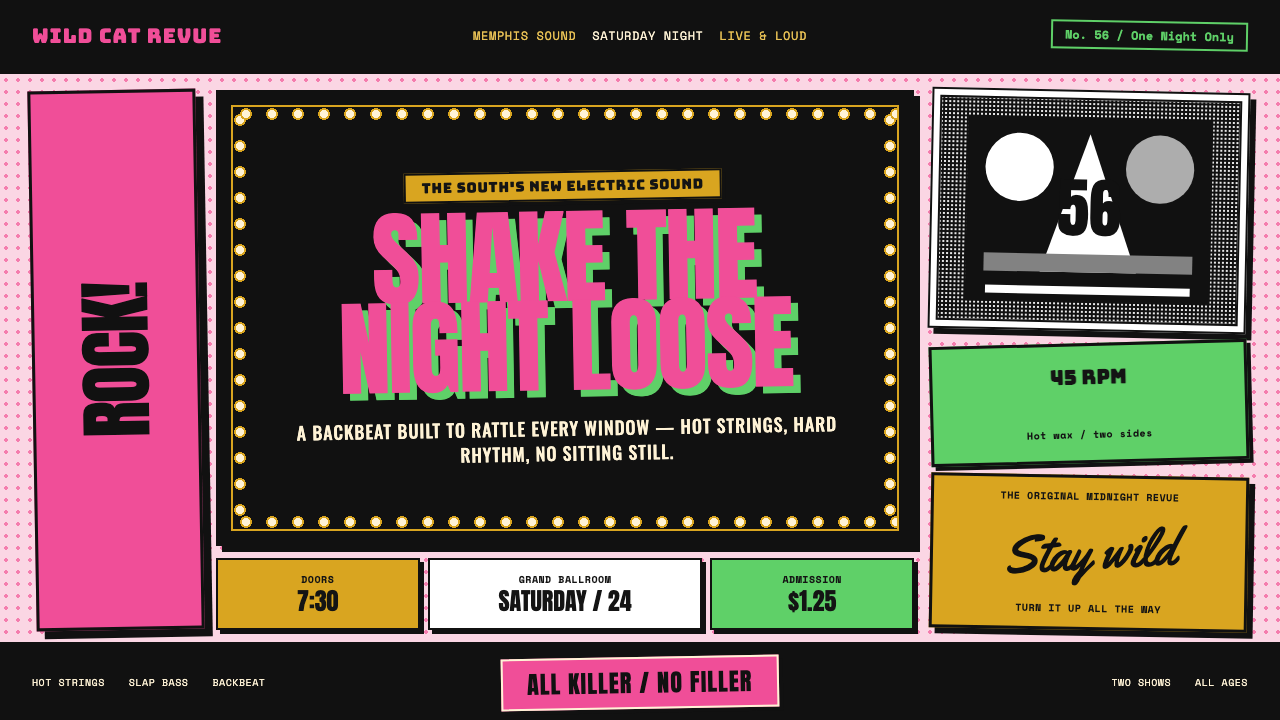 Elvis Presley (1956)Rock learned to shout. Bubblegum pink, acid green and jailhouse type land wit…
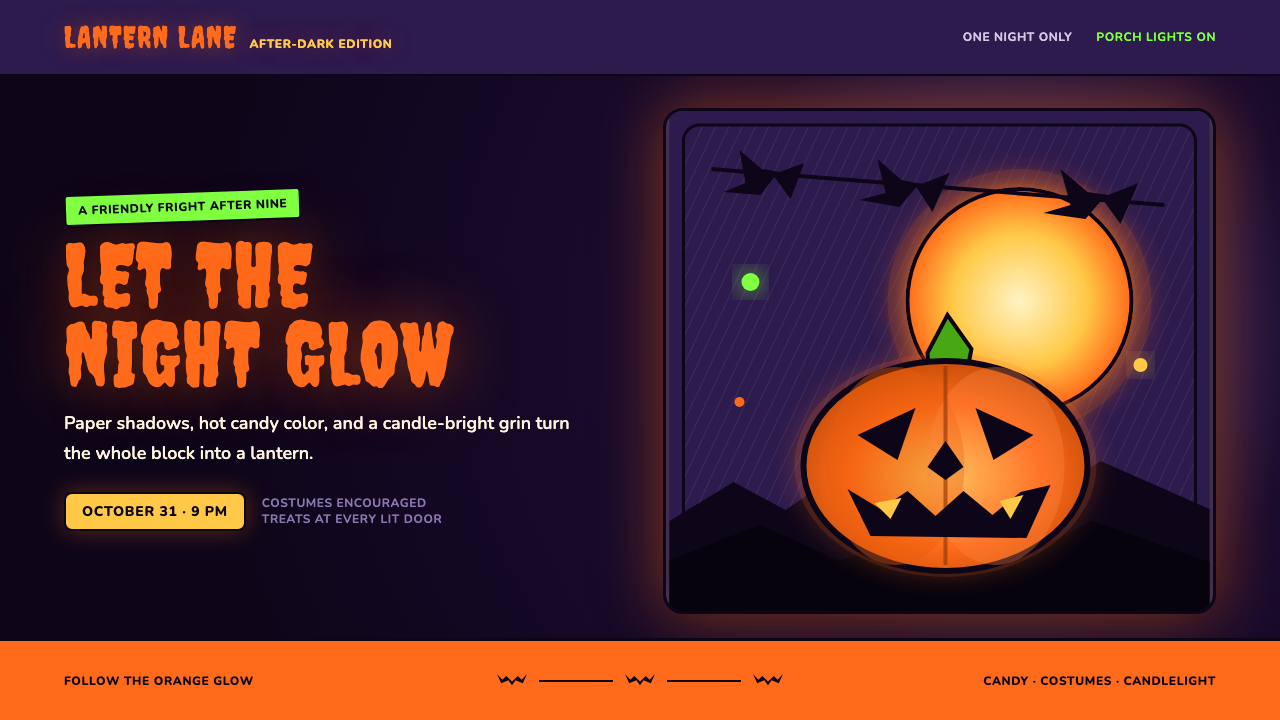 Halloween Jack-o'-LanternFriendly fright, lit from within. Pumpkin orange glows through ink-black cuts…