What is Studio Alchimia Anti-Design?
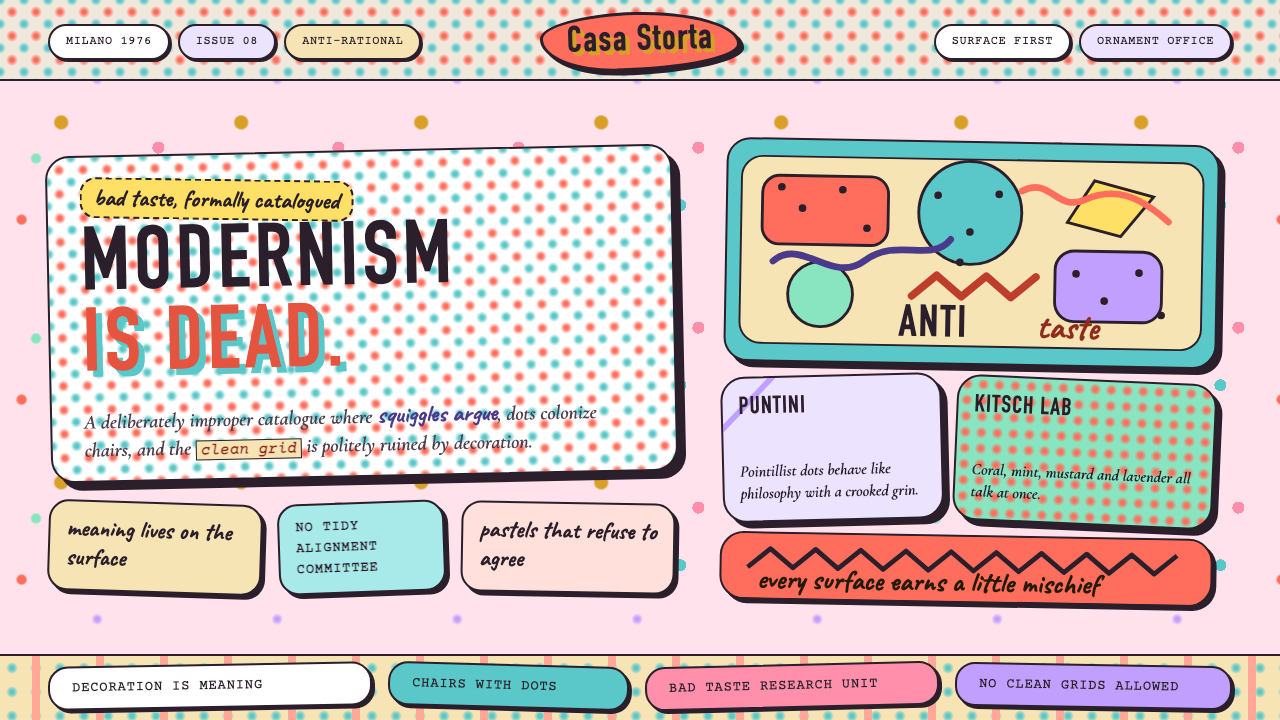
Studio Alchimia declared Modernism a corpse in 1976 and replaced its funeral white walls with coral dots, mustard squiggles, and gleeful, weaponized kitsch.
Studio Alchimia Anti-Design in brief
Studio Alchimia Anti-Design is the visual language born from a Milanese design collective that operated between 1976 and 1992. Where Modernism worshipped the clean surface, Alchimia desecrated it. Every work treats the surface as a site of argument: clashing pastels that have no business sitting together, geometric furniture smothered in pointillist dots, typography that mixes a chunky slab serif with an italic serif and a hand-lettered note all in the same column. The result looks chaotic by design — and the chaos is the point.
The aesthetic is built from contradiction. Colours that should neutralize each other are pushed together at full intensity: coral beside mint, mustard beside lavender, muted turquoise beside warm terracotta. Backgrounds are often cream or pale blush rather than stark white, which gives the overall surface a slightly warm, almost domestic quality — before the ornament moves in and refuses to behave. Patterns taken from low-status sources — terrazzo floors, wallpaper samples, cheap laminate — are elevated to hero surfaces, treated with the same seriousness a Modernist might give to a primary-color plane.
The movement's core intellectual move was to argue that decoration is not the enemy of meaning but its carrier. Alessandro Mendini, the group's leading theorist, wrote that every object is already full of cultural memory and historical association; stripping it bare, as the Bauhaus commanded, does not remove ideology — it just hides it behind a lie of neutrality. Alchimia's cluttered, ironic, historically promiscuous surfaces are therefore more honest than a plain white chair, because they admit that design is always already a form of rhetoric.

Where does Studio Alchimia Anti-Design come from?
Studio Alchimia was founded in Milan in 1976 by Alessandro Guerriero, a designer and gallerist who wanted to create a space where radical experimental objects could be made and exhibited outside the logic of industrial production. The name itself — Alchimia, alchemy — announced the ambition: the transmutation of base materials and discarded cultural forms into something revelatory. From the beginning the studio operated less like a product company and more like an avant-garde art collective, with exhibitions as its primary output.
The collective drew in the most restless minds of the Italian design scene. Alessandro Mendini joined early and quickly became the group's dominant intellectual voice, eventually serving as editor of the journal Casabella and later Domus, from which he could broadcast the Anti-Design critique to the international profession. Ettore Sottsass, already famous for his Olivetti typewriter work, brought a more sensual, almost mystical relationship to colour and surface. Andrea Branzi contributed theoretical rigour from his background in the Radical Design movement of the late 1960s. Michele De Lucchi brought a younger, more playful energy. Together they created a body of work that was simultaneously furniture, sculpture, and provocation.
The defining public moment came in 1978 with Mendini's Bauhaus Redesigned exhibition. Mendini took canonical pieces of Modernist furniture — chairs by Mies van der Rohe and Marcel Breuer — and covered them with pointillist dots and wavering linear patterns. The act was simultaneously homage and mockery: the Modernist skeleton remained, but it was dressed in everything Modernism had declared impermissible. The show was received with outrage in some quarters and euphoria in others, and it established Alchimia's international reputation as the most intellectually serious of the Anti-Design provocateurs.
The studio's influence reached its historical peak between 1978 and 1981, and then bifurcated. Sottsass, finding Alchimia's approach increasingly theoretical and insufficiently concerned with actual making, broke away in 1981 to found Memphis, the group that would become far more commercially visible. Memphis exported the Alchimia palette and ornamental exuberance to a global market; Alchimia remained more experimental, more textual, and more committed to objects as arguments rather than objects as products. Studio Alchimia continued in various forms until 1992, when the original collective effectively dissolved, though Guerriero has continued associated projects since.
What defines the Studio Alchimia Anti-Design look?
Clashing Pastel Palette
Alchimia colour is built on deliberate dissonance. Soft coral, sage mint, warm mustard, dusty lavender, muted turquoise, and pale terracotta are placed side by side without any mediating neutral to soften the collision. The ground is typically cream or blush rather than white, which prevents the pastels from reading as clinical and instead gives them a warm, slightly vintage domestic quality — like the interior of a house where several generations left their taste behind simultaneously. The dissonance is not accidental decoration; it argues that harmony in design is a form of aesthetic censorship.
Ornament as Argument
Every surface in Alchimia work is treated as an opportunity for pattern. Pointillist dot fields, undulating wave lines, sawtooth borders, terrazzo aggregates, faux marble veining, and grid-of-crosses motifs are layered onto objects that would otherwise read as straightforwardly functional. The patterns are not applied to beautify; they are applied to make a point. Each ornamental layer is a citation: of folk craft, of suburban taste, of the visual culture that high Modernism ruled inadmissible. To cover a Breuer chair in dots is to say that the chair was never innocent.
Promiscuous Typography
Where Modernism demanded type discipline — one sans-serif family, rigorously sized and spaced — Alchimia typography deliberately mixes what should not mix. A chunky Cooper-style display face, a classical italic serif in a smaller size, and a hand-lettered annotation in a different register might all coexist in a single text block. Weights vary without systematic rationale; decorative capitals appear without hierarchical justification. The approach mirrors the ornamental logic: typography is a record of cultural negotiation, not a neutral communication channel, so pretending otherwise — by enforcing typographic unity — is a form of dishonesty.
Kitsch as Source Material
Alchimia systematically elevated what sophisticated taste had condescended to: the patterns of cheap laminate furniture, the colours of mid-century commercial wallpaper, the ornamental vocabulary of mass-market ceramics, the decorative language of suburban interiors. These were not used ironically in the distancing postmodern sense — they were used directly, with a kind of affection, to argue that the hierarchy separating high design from popular taste is arbitrary and self-serving. The collective refused the connoisseur's sneer; the terrazzo floor tile and the Breuer chair were given equal architectural dignity.
Historical Promiscuity
Alchimia objects freely quote from multiple historical periods simultaneously. A single piece might carry Art Nouveau curves, Constructivist angles, baroque surface density, and Art Deco metallic accents at once — assembled not as pastiche but as argument. The implicit claim is that design history is a warehouse to be raided rather than a linear progress toward the correct solution. Modernism's insistence on starting fresh from rational first principles was, to Alchimia, a kind of amnesia. Their work insists on remembering everything, promiscuously and without apology.
Irony as Structural Device
Alchimia work is never earnestly decorative in the way historical revival styles were. The ornament is always slightly excessive, the colour combinations always slightly wrong, the typographic choices always a little too knowing. This calibrated wrongness is the ironic register: the work signals that it understands the rules it is breaking, and breaks them anyway, as a form of critique. The difference between Alchimia and mere bad taste is that Alchimia bad taste is performed with complete awareness, which transforms the transgression into a statement about where the rules came from and who they serve.
Object as Manifesto
Unlike design movements that produce design principles and then apply them to products, Alchimia worked in the opposite direction: each object is itself the argument. The furniture is the essay; the lamp is the polemic. This means Alchimia objects carry an unusually high conceptual density per square centimeter of surface — they reward close reading. It also means they resist being reduced to a style guide or a colour palette, because the aesthetic is inseparable from the intellectual position it embodies. You cannot extract the look without the argument that the look is making.

Who shaped Studio Alchimia Anti-Design?
Mendini was the theoretical centre of gravity for the entire Anti-Design movement. As editor first of Casabella and then Domus — two of the most influential design journals in the world — he had a platform to argue that design was a philosophical and political act, not merely a professional service. His 1978 Bauhaus Redesigned show, in which he covered classic Modernist furniture in dots and decorative pattern, was the movement's defining provocation. Later works, including the Proust armchair of 1978 — an eighteenth-century silhouette covered in a field of Pointillist colour — are now canonical examples of postmodern design objects. Mendini continued designing and writing until his death in 2019, remaining perhaps the most sophisticated theorist the Italian design world produced.
Guerriero founded Studio Alchimia and served as its organizational engine for the full span of its existence. Where Mendini provided the intellectual framework and Sottsass provided the sensory exuberance, Guerriero provided the institutional will: the space, the exhibitions, the relationships with galleries and cultural institutions that allowed the collective's work to reach audiences. His curatorial intelligence shaped which voices were invited in and which directions the collective pursued at different moments. Less publicly celebrated than the designers he gathered, Guerriero's contribution was structural — he made it possible for the arguments to be made.
Sottsass arrived at Alchimia already a significant figure — his work for Olivetti, particularly the red Valentine typewriter of 1969, had made him internationally known. Within Alchimia, he pushed the aesthetic toward sensory richness and almost spiritual colour intensity. His relationship with surface was more intuitive and less discursive than Mendini's: where Mendini wanted to make an argument, Sottsass wanted to make an experience. This tension between the cerebral and the sensory defined much of the studio's internal creative dynamic. In 1981 Sottsass departed to found Memphis, which commercialized many of the same formal ideas with greater popular success — but arguably with less theoretical depth.
Branzi brought to Alchimia the intellectual inheritance of the earlier Italian Radical Design movement, in which he had been a central figure through the group Archizoom. Where Archizoom had used conceptual architecture as its medium, Alchimia gave Branzi a context to work at the scale of objects and interiors. His theoretical writings, particularly the book The Hot House of 1984, remain essential documents for understanding the philosophical stakes of Italian postmodern design — the argument that design should address the complexity of contemporary culture rather than seeking to simplify or resolve it.
De Lucchi represented the younger generation within Alchimia, bringing an energy that was less polemical and more playful than his senior colleagues. His work within the collective explored primary and secondary colours with a directness that looked almost naive — deliberately so. After leaving for Memphis and subsequently building a major independent practice, De Lucchi became one of the most versatile Italian designers of the following decades, working across furniture, product design, and architecture. His Alchimia period is best understood as the formative moment when he learned to treat visual rules as propositions to be tested rather than constraints to be respected.
How do you use Studio Alchimia Anti-Design today?
Alchimia Anti-Design is one of the most challenging historical styles to apply in contemporary work, precisely because its power comes from intellectual position rather than visual formula. Getting the aesthetic right is the easier half; the harder half is understanding what the aesthetic is arguing, so that the application feels grounded rather than superficial. Used thoughtfully, it is one of the few design languages that can communicate both visual richness and conceptual intelligence simultaneously.
For presentation slides, the style works best when it is allowed to be unruly in a controlled way. A cover slide benefits from a cream or pale blush ground, one or two deliberately mismatched pastel shapes overlapping in a corner, and a headline set in a display face that is too heavy or too playful for what conventional wisdom would permit. The tension between the ground's warmth and the ornamental chaos is where the slide's character lives. Content slides should resist the urge to clean up: a data slide in this style can afford a patterned background panel — dots or a light wave motif — behind the chart, provided the data itself remains legible. The provocation is the point; the content earns it.
For web interfaces — particularly editorial sites, cultural institution pages, agency portfolios, and brand platforms that want to signal cultural sophistication — the style offers an alternative to both minimal modernism and aggressive maximalism. A pricing or feature page in the Alchimia register might use a cream background, section headers in a chunky display serif, decorative horizontal band patterns between sections, and an accent palette built from two clashing pastels rather than one safe brand colour. Dashboard applications should be approached with more caution: the ornamental density works best in contexts where the user is browsing and exploring rather than completing a high-frequency task.
For editorial and marketing work — book covers, event posters, cultural programme materials, brand identity for creative studios, and art direction for publications — Alchimia is at its most comfortable. The style's willingness to mix references, crowd a surface with pattern, and use colour with deliberately wrong harmony aligns naturally with cultural production contexts. An editorial spread can use a terrazzo or dot-field motif in the margin zone, a headline in a historically mismatched typeface combination, and pull-quote typography that ignores the system the body text establishes. Marketing for creative services firms can use the style's self-aware excess as a differentiator against the sea of restrained sans-serif branding that dominates that sector.
The most common mistake when applying this style is producing decoration without argument — surfaces that are busy and colourful but that carry no discernible intellectual position. Alchimia's clutter is motivated clutter; every excess is a citation or a provocation. If you cannot say what a given ornamental choice is arguing, it is probably just noise. A second common mistake is using the style's colour licence to produce combinations that are merely garish rather than deliberately dissonant — the difference lies in control. The pastels should clash on principle, not by accident. The third mistake is applying the style uniformly across an entire piece; the most effective Alchimia-adjacent work creates tension by allowing some surfaces or sections to be calm, which makes the ornamented zones feel charged rather than merely overwhelming.

Studio Alchimia Anti-Design — FAQ
How is Alchimia different from Memphis?
Memphis grew directly out of Alchimia when Sottsass departed in 1981, and the two share obvious visual DNA: the clashing pastels, the ornamental surfaces, the anti-Modernist posture. But the intentions diverged significantly. Alchimia remained committed to the object as a vehicle for intellectual argument — the work was dense, theoretical, and largely produced in small editions for a gallery audience. Memphis prioritized the experience of making and the pleasure of surface; it was far more willing to produce for a commercial market and far less interested in sustaining a polemical position. Visually, Memphis tends toward brighter, more primary-adjacent colours and more systematic pattern application; Alchimia's palette is warmer, murkier, and more eclectic. Alchimia is the thesis; Memphis is the popular edition.
Can this style work for digital product design, or is it only suited to print and cultural contexts?
It can work digitally, but it requires selectivity about where the ornamental density appears. A full Alchimia treatment of a functional interface — where the user needs to find information quickly and repeatedly — tends to produce friction rather than delight. The style is best used in digital contexts at the layer of identity and atmosphere rather than at the layer of task completion. Landing pages, about pages, editorial sections, and onboarding experiences that want to establish a distinctive cultural register are good candidates. The rule of thumb: the more a screen is navigated through, the lighter the Alchimia touch should be; the more it is read and experienced, the more the style can assert itself.
Is it possible to use the Alchimia aesthetic without it reading as nostalgic or retro?
Yes, but it requires anchoring the visual choices in a contemporary conceptual position rather than quoting the historical style as an end in itself. The risk of nostalgia arises when the ornamental vocabulary is used decoratively — when the dots and the pastels are chosen because they look pleasantly vintage. Alchimia's own work avoided nostalgia by using historical references as arguments rather than as atmosphere: every citation was a claim about design history and cultural hierarchy, not an expression of fondness for a particular era. Contemporary applications that maintain this argumentative relationship with the source material — using the aesthetic to make a claim about contemporary culture rather than to evoke a past one — can feel genuinely current.
What types of projects or brands should avoid this style?
Brands where trust, clinical precision, or institutional authority are the primary values should approach with caution: financial services, healthcare platforms, legal tech, and government-adjacent applications are environments where the style's deliberate wrongness and ornamental excess can undermine the credibility the brand depends on. Products aimed at audiences who would read the aesthetic as simply confusing rather than intellectually playful — where the irony does not land because the audience does not share the visual reference points — will also find it counterproductive. The style rewards a culturally literate audience that can recognise what is being argued; used on audiences for whom design history is not a frame of reference, the provocation simply becomes noise.
How do you keep the style from becoming visually exhausting?
Rhythm and relief. Even within Alchimia's densest pieces, there are surfaces or zones that are relatively quieter — not clean in the Modernist sense, but less ornamented, which allows the eye somewhere to rest before the next assault. In applied work, the equivalent is structural: dedicate some proportion of the composition to a calmer ground — a cream field without pattern, a margin with only typographic material — so that the ornamented zones are read as events against a background rather than as undifferentiated noise. The pace at which pattern appears also matters: if every section of a layout is equally busy, the style collapses into monotony. Varying the density of ornament across the composition — with genuine variation, not just token breathing room — is what keeps the aesthetic from becoming fatiguing.
Related design styles
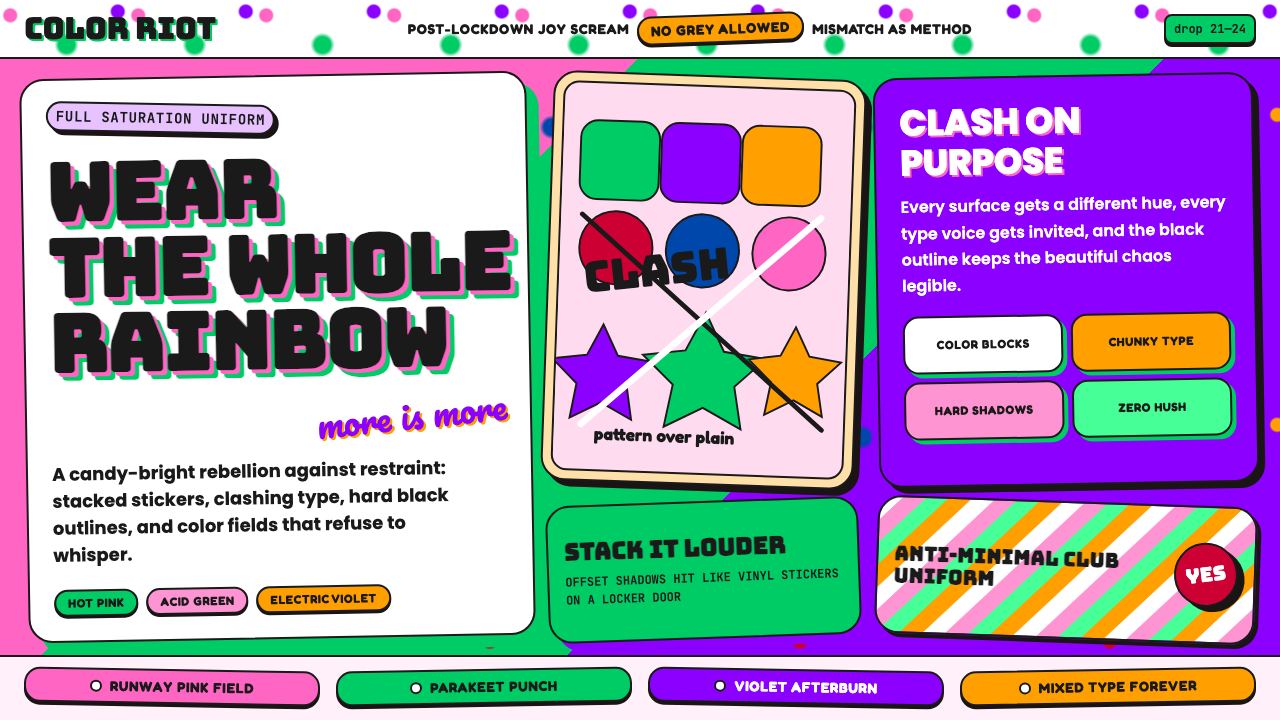 Dopamine Dressing / MaximalismJoy refuses restraint. Hot pink, parakeet green, Bungee type, and brick shado…
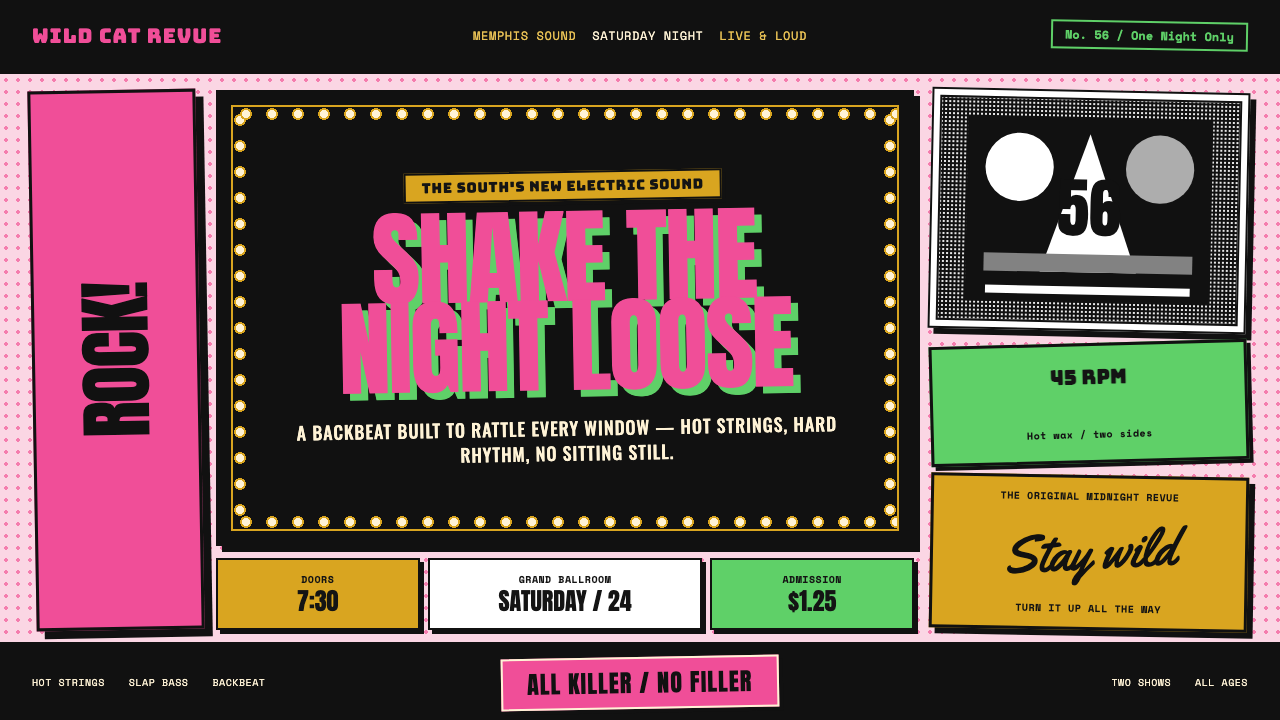 Elvis Presley (1956)Rock learned to shout. Bubblegum pink, acid green and jailhouse type land wit…
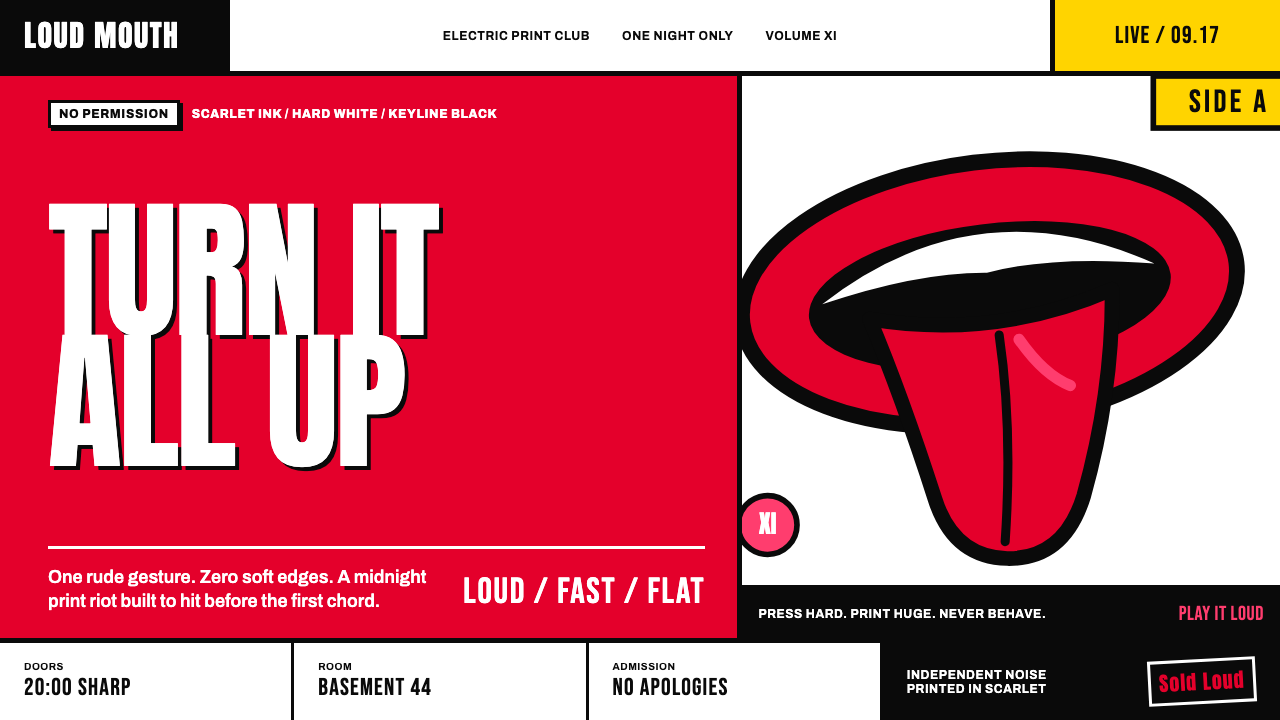 Rolling Stones Tongue (1971)Flat ink shouts loud. Scarlet curves, black keylines, and cropped poster scal…
 Ant Farm InflatablesTemporary architecture glows. Vinyl-blue domes swell over dark desert teal.
 Fela Kuti Afrobeat Album (1976)Protest rhythm made visual. Red-yellow-green blocks and compressed Anton shou…
 Filipino Jeepney (Chrome & Streamer)Maximalism has wheels. Sunshine yellow, chrome strips, Bungee route-sign type.