What is Bratz 2003?
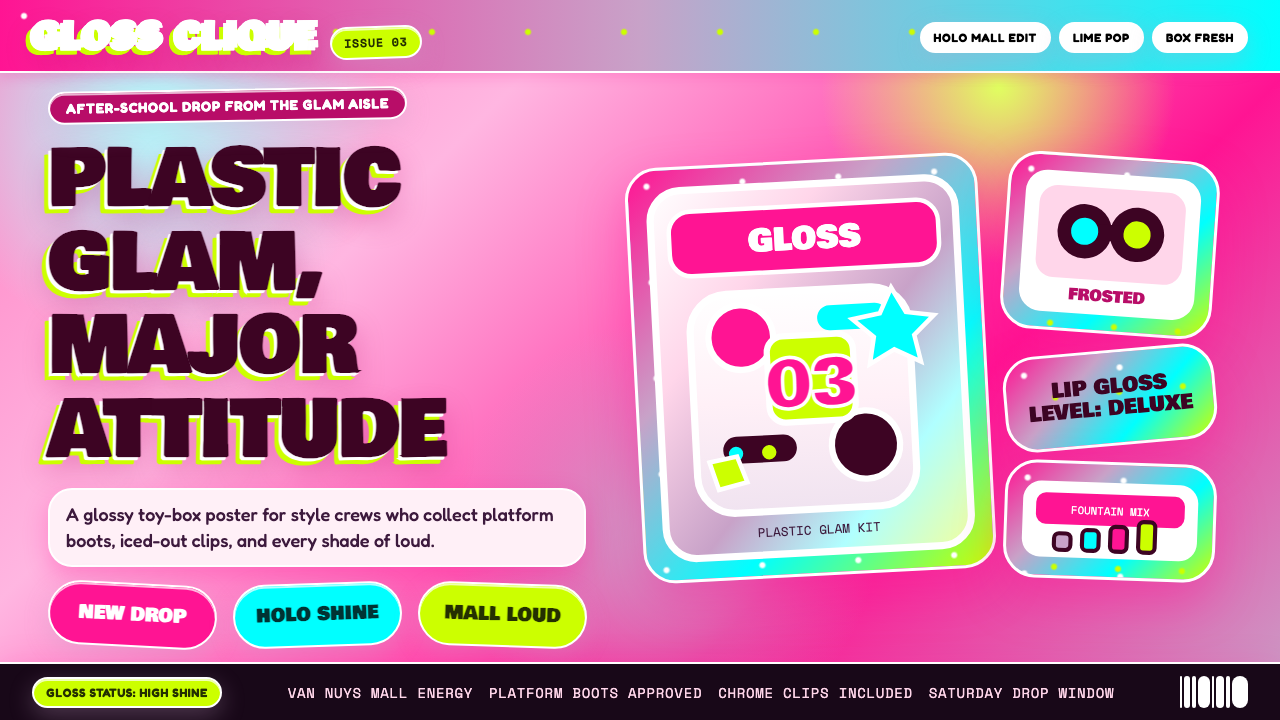
Bratz 2003 is the visual language of early-2000s mall-girl culture distilled into a design system — hot-pink gradients, holographic shimmer, and chunky attitude-laden type that radiates unapologetic maximalism.
Bratz 2003 in brief
Bratz 2003 is a visual design system rooted in the aesthetic of early-2000s American mall culture at its most oversaturated and unapologetic. It draws its core vocabulary from the original Bratz doll brand launched by MGA Entertainment in 2001 — a product deliberately conceived to challenge Barbie's dominance with attitude, edge, and a visual identity that refused to be subtle. By 2003, the brand's design language had reached its defining peak: hot-pink gradient fills, holographic lavender surfaces, chrome-effect highlights, rounded display type with heavy personality, and an overall sensibility that felt like opening a fresh doll box under the fluorescent lights of a shopping mall.
The style belongs to the broader Y2K maximalist movement — a short, intense period of graphic design culture roughly spanning 1999 to 2005, in which digital production tools first made gradients, glitter overlays, and complex color meshes effortlessly achievable, and designers embraced that possibility with gleeful excess. Bratz occupied a specific and influential corner of this moment: it was aimed at pre-teen girls, it was deeply commercial, and it was executed with a surprising degree of visual consistency that made it instantly recognizable and obsessively imitable. The palette of hot pink, holographic lavender, chrome silver, and white gloss became a coherent signature rather than accidental coincidence.
Decades later, Bratz 2003 re-emerged as a reference style in its own right. The Y2K aesthetic revival of roughly 2022 to 2024 drew directly on this visual language, and a new generation of designers — particularly those working in social media graphics, fashion branding, and nostalgic editorial — found that the Bratz visual system offered something that contemporary minimalism could not: exuberance, tactility, and immediate emotional legibility. Today it is used intentionally as a complete aesthetic position, not merely as retro decoration.

Where does Bratz 2003 come from?
The Bratz story begins in Van Nuys, California, at the offices of MGA Entertainment. Carter Bryant, a Mattel employee, sketched the original concept around 1999 and 2000: fashion dolls with oversized heads, exaggerated features, and a street-style sensibility that felt meaningfully different from Barbie's wholesome proportions. Bryant brought the concept to Isaac Larian, MGA's founder and CEO, and the first Bratz dolls reached stores in 2001. The launch was immediately controversial — Mattel would eventually file extensive intellectual property litigation — but commercially, it was a sensation. Bratz sold millions of units in its first year and established itself as the first genuine rival to Barbie's market dominance since the doll's introduction in 1959.
The visual identity that accompanied the doll line was not incidental to its success. MGA commissioned a graphic design language for packaging, advertising, and licensed merchandise that amplified the dolls' attitude into a coherent brand world. The palette — saturated hot pink as the dominant hue, softened by holographic lavender and anchored by chrome-effect metallics — was chosen to communicate energy, femininity, and desirability without Barbie's pastel restraint. Packaging designers used gradient mesh techniques that were technically demanding for print production of that era, giving boxes and blister cards a glossy, almost luminous quality that stood out aggressively on retail shelves.
The years 2003 to 2005 marked the brand's visual apex. Licensed products flooded into every category — stationery, clothing, electronics accessories, cosmetics, video games — and the visual system scaled across all of them with surprising consistency. The typography evolved toward chunky, rounded display letterforms with dimensional effects: beveled edges, inner glows, and drop shadows that gave text a plastic, almost sculptural quality echoing the physical dolls themselves. This was not accidental; the design brief effectively asked for type that looked like it could be a molded plastic logo on a toy package.
The broader cultural moment shaped the aesthetic as profoundly as any design brief. The early 2000s were a period when digital production tools — gradient mesh in Adobe Illustrator, layer styles in Photoshop — had become accessible enough for commercial print studios to use aggressively. The resulting aesthetic across advertising, packaging, and entertainment graphics was uniformly high-gloss: everything shimmer, everything gradient, everything catching light. Bratz sat at the premium end of this aesthetic for its target market, which meant that its designers pushed the gloss, the holographic effects, and the saturated palette further than most. The result was a visual language that was simultaneously of its moment and extreme enough to remain distinctly recognizable decades later.
What defines the Bratz 2003 look?
Color
The palette is built around a small set of extremely saturated, high-energy hues. Hot pink — vivid, warm, and insistent — functions as the dominant signature. Holographic lavender provides a cooler counterpoint with a shimmery, iridescent quality that shifts subtly depending on context. Chrome silver and white act as structural highlights, amplifying the sense of gloss and light-catching surface. Black is used sparingly and primarily for typographic contrast rather than as a field color. The overall effect is one of aggressive luminosity: every surface appears to glow or reflect, and no hue retreats into the background willingly.
Gradients and Gloss
Gradients are not a secondary element in this system — they are its defining structural technique. The characteristic hot-pink gradient does not transition simply from one tone to another; it moves through multiple steps, often incorporating a near-white highlight at one edge and deepening toward a more saturated magenta or cool rose at the other, with an inner glow suggesting an internal light source. Holographic surfaces layer additional color variation, implying that the material itself shifts color. These complex gradient meshes are what make the style technically challenging to replicate authentically: simple two-stop gradients miss the luminous, multi-tonal quality that defines the original.
Typography
Display type in the Bratz visual system is chunky, rounded, and loaded with dimensional effects. Letterforms are wide and heavy, with terminals that curve rather than cut. Beveling and embossing give type a plastic-molded appearance — the letters seem to have thickness, to protrude slightly from the surface, in deliberate visual reference to molded toy packaging. Inner glows and outer glows further dissolve the boundary between letter and background, creating a soft luminous halo effect. Script and italic variants are used for emotional emphasis, with exaggerated slopes and sweeping descenders. Hierarchy is established through extreme size contrast rather than weight variation alone.
Surface Texture and Glitter
Where the Bauhaus refused all surface texture on principle, Bratz 2003 treats texture as a primary expressive tool. Glitter overlays — tiny, randomized sparkle patterns rendered at high density — are applied to backgrounds, type fills, and decorative elements alike, giving the impression of a material that catches and throws light in multiple directions simultaneously. Holographic foil effects simulate the color-shifting quality of real iridescent materials. Soft, airbrushed gradients on skin tones and clothing suggest the smooth, almost poreless surfaces of the dolls themselves. These layered textural techniques create depth and richness without relying on hard shadow or photographic realism.
Geometry and Shape
The Bratz visual system shares one instinct with many playful commercial aesthetics of its era: a strong preference for rounded forms over angular ones. Corners are softened, containers become pill shapes or rounded rectangles, dividers use wavy curves rather than straight lines. Stars, hearts, and flowers appear as decorative motifs, typically rendered with the same gradient and glow treatments as type. Silhouettes of the dolls themselves — wide head, large eyes, pouting lips — function as recurring brand shapes that anchor compositions and signal the aesthetic immediately. This geometry communicates approachability and fun rather than structure and authority.
Layout and Composition
Compositions in this style are centripetal rather than grid-driven: elements cluster toward a central figure or focal point — typically a doll, a character face, or a typographic logo — with decorative elements radiating outward like sparks. Background space is rarely left quiet; it is filled with gradient fields, glitter texture, or secondary decorative motifs. This density is intentional and characteristic: the style does not use negative space as breathing room but as an opportunity for additional visual richness. Layering is deep — five or more distinct visual planes are common — and the overall effect rewards close looking, revealing details that are not immediately obvious at first glance.
Attitude and Emotional Register
Perhaps the most important characteristic of Bratz 2003 is its emotional posture. Unlike aesthetics grounded in authority, refinement, or restraint, this one is built entirely around self-expression, confidence, and playful defiance. The visual excess is not a failure of taste — it is the point. More is more. The glossier, the more saturated, the more layered, the better. This attitude shapes every design decision: typography should feel alive and expressive, color should feel loud and proud, surface should feel luxurious and indulgent. Designs that apply the palette and technique while restraining the attitude produce something that looks like a cautious imitation rather than a genuine realization of the style.

Who shaped Bratz 2003?
Carter Bryant was the designer who sketched the original Bratz doll concept while employed at Mattel, around 1999 and 2000. His central creative decisions — the oversized head, the exaggerated facial features, the street-fashion sensibility — established the physical identity that the graphic design system then had to serve. Bryant's aesthetic instinct was to create something deliberately at odds with Barbie's proportional idealism, and this confrontational spirit embedded itself in every downstream visual decision, from the hot-pink packaging to the attitude-laden typography. His departure from Mattel and move to MGA sparked years of litigation that became one of the most prominent intellectual property disputes in the toy industry.
Isaac Larian, founder and CEO of MGA Entertainment, made the commercial and creative bets that allowed the Bratz visual identity to become as extreme as it did. Where a more conservative executive might have moderated the hot-pink gradients or toned down the holographic effects to reduce production cost or risk, Larian backed the maximalist vision and the expensive print techniques required to execute it faithfully. His willingness to position Bratz as a genuine rival to Barbie — not just a market follower — meant that the brand had to project confidence and distinctiveness through its visual identity, which directly encouraged the designers to push further. Larian remained a combative public figure throughout the Mattel litigation and continued leading MGA through a Bratz revival in the 2010s.
The second life of Bratz 2003 as a design reference was not driven by a single creator or institution but by a diffuse community of designers, stylists, and visual artists active primarily on social media platforms between roughly 2020 and 2024. This community — operating under the broad umbrella of Y2K aesthetic revival — excavated, documented, and recontextualized the visual language of early-2000s commercial design, treating Bratz packaging and advertising as source material on equal footing with editorial fashion photography and MTV graphics. Their work gave a new generation of designers vocabulary and permission to use the style intentionally. The revival made clear that the Bratz visual system had coherence and staying power beyond nostalgia.
The anonymous in-house and contracted design teams at MGA Entertainment between 2001 and 2006 deserve recognition as the actual authors of the Bratz visual language. Working under commercial constraints and tight production schedules, they developed the packaging design, advertising graphics, and licensed merchandise templates that established and maintained the style across thousands of distinct products. The technical choices they made — the specific gradient techniques, the typographic dimensionality, the approach to holographic surface simulation — defined what Bratz looked like, and those choices proved stable enough to be replicated across an enormous licensed product ecosystem. Their work constitutes one of the most consistent applications of a single visual identity in mass-market toy history.
How do you use Bratz 2003 today?
Bratz 2003 is a maximalist style, and applying it requires committing to excess rather than restraint. The first principle is that every surface is an opportunity for visual richness: backgrounds should not be flat or neutral, type should not be simply colored, and decorative elements should not be held back for fear of clutter. Designers accustomed to working in minimalist or corporate systems often under-apply this style — the result looks like a timid approximation rather than a genuine realization. The correct approach is to lead with the gradient, layer the texture, and then evaluate whether the composition reads clearly before pulling anything back.
For presentation slides, the style works most powerfully on cover and section-break pages where bold visual impact is the priority. A cover built in this aesthetic should combine a dominant gradient background — moving from hot pink to a cooler lavender or rose — with a large, dimensionally treated title in centered or slightly off-center placement. Decorative stars, sparkle accents, or glitter-texture overlays can fill the remaining space without compromising legibility. Content slides require more discipline: the gradient background can be retained, but type must be large enough and contrasted enough to remain scannable. Data slides work when chart elements — bars, pie segments, line fills — carry the gradient treatment, turning the data visualization itself into an expressive visual object rather than a neutral diagram.
For web interfaces and digital products, Bratz 2003 is most appropriate for platforms aimed at younger audiences, fashion and beauty contexts, entertainment, and any brand positioning that relies on exuberance and fun over authority and professionalism. Landing pages and hero sections benefit from full-screen gradient backgrounds with heavily styled headline type; scrolling content sections can soften the treatment, using the palette at lower saturation with the bold gradient reserved for calls to action, highlights, and interactive states. Card components work well when given a gloss treatment — a subtle inner highlight at the top edge simulating a light source — and interactive elements such as buttons should carry the full saturated pink with white or chrome type rather than muted alternatives.
For editorial and marketing applications, the style is particularly effective for social media graphics, promotional posters, event branding, and fashion-adjacent editorial contexts. Social cards should fill the entire frame with gradient and texture, treating the background as a designed surface rather than a container for floating elements. Marketing emails can use the style for header blocks and promotional banners while maintaining a lighter, cleaner treatment for body content to preserve readability at the scale of body text. Physical print applications — poster design, packaging — are where the style was originally invented, and they reward the most committed application: the more layers of gradient, texture, and dimensional type, the more authentic the result.
A common mistake when applying Bratz 2003 is selecting the color palette and gradients while neglecting the dimensionality of the typography. Flat, unadorned type set in pink against a pink gradient background produces neither legibility nor authenticity — the original system works precisely because the type fights for its own visual presence through beveling, glow effects, and strong tonal contrast. A second common error is applying the style to contexts where it actively conflicts with the product's values: financial services, medical information, legal platforms, and professional B2B tools require trust signals that this style actively undermines. The aesthetic communicates play, energy, and self-expression — when those values align with the product, it works; when they do not, the mismatch reads immediately and damages credibility.

Bratz 2003 — FAQ
Is Bratz 2003 the same as the broader Y2K aesthetic?
They overlap but are distinct. The Y2K aesthetic is a broad umbrella covering graphic design, fashion, and product design from roughly 1998 to 2005, characterized by a shared enthusiasm for digital production techniques — gradients, chrome effects, translucency, and futurist geometry — across many different cultural contexts. Bratz 2003 is a specific and highly coherent subset of Y2K aesthetics, distinguished by its particular palette of hot pink and holographic lavender, its overtly feminine and attitude-laden posture, its emphasis on glossy rounded forms over metallic angular ones, and its deep roots in mass-market toy and mall culture. You can be working in the Y2K aesthetic without invoking Bratz — futurist chrome typography and alien metallics read as Y2K without reading as Bratz. But Bratz is always Y2K.
Can this style be used for professional or business contexts?
With care, yes — but the context must be chosen deliberately. Bratz 2003 communicates exuberance, playfulness, and self-expressive confidence; it does not communicate sobriety, precision, or institutional authority. It works in professional contexts where those values are assets rather than liabilities: fashion brand presentations, entertainment pitch decks, beauty and lifestyle product launches, youth-oriented marketing campaigns, and creative agencies positioning themselves as bold and culturally fluent. It does not work for financial reporting, medical information, legal documentation, or any context where users need to trust the source before they can engage with the content. The test is whether the aesthetic's emotional register matches the emotional need of the audience in that specific context.
How do I keep the style legible when everything is competing for attention?
Legibility in a maximalist style depends on establishing clear hierarchy through contrast rather than through restraint. The key principle is tonal contrast: text must be significantly lighter or darker than the background it sits on, regardless of how complex that background is. Glow effects around type — which are characteristic of the style — actually serve a legibility function, creating a local area of contrast immediately around each letterform. A second tool is size: in a visually busy composition, type that is large enough to claim its own territory does not compete with decorative elements — it dominates them. The mistake is using medium-sized, medium-weight type in a medium color against a complex background, which produces a composition where everything competes at the same visual weight and nothing wins.
How does this style age, and will it look dated quickly?
Bratz 2003 already aged once — it was considered dated from roughly 2007 to 2020 — and then experienced a significant critical and commercial revival. This pattern suggests something important: the style has enough internal coherence and cultural specificity to function as a deliberate historical reference rather than simply appearing accidentally old. Designs that use it knowing exactly what they are referencing — early-2000s mall culture, Y2K maximalism, the specific visual language of the Bratz brand — read as intentional and even sophisticated. Designs that use it inadvertently, because some of its surface characteristics drifted into current commercial aesthetics without the full system, will look dated faster. The key is intentionality: this is a style you cite, not one you accidentally wander into.
What is the right way to adapt Bratz 2003 without copying it literally?
The most generative approach is to identify which specific characteristics carry the most aesthetic weight and lead with those, while allowing the others to recede or be reinterpreted. The hot-pink gradient and the dimensional typography are the two elements most immediately recognizable as Bratz-specific; if you retain both, the style is clearly legible even if glitter, holographic lavender, and some of the other surface details are simplified or recontextualized. Conversely, using holographic effects and rounded type in a palette that does not include hot pink produces a visual that reads as Y2K or frosted-pop but not specifically as Bratz. Adaptation also works well when the style's attitude is retained while the color is shifted: a full-on maximalist gradient system in warm amber and cream, or in rich blue and silver, borrows the structural logic without reproducing the signature palette.
Related design styles
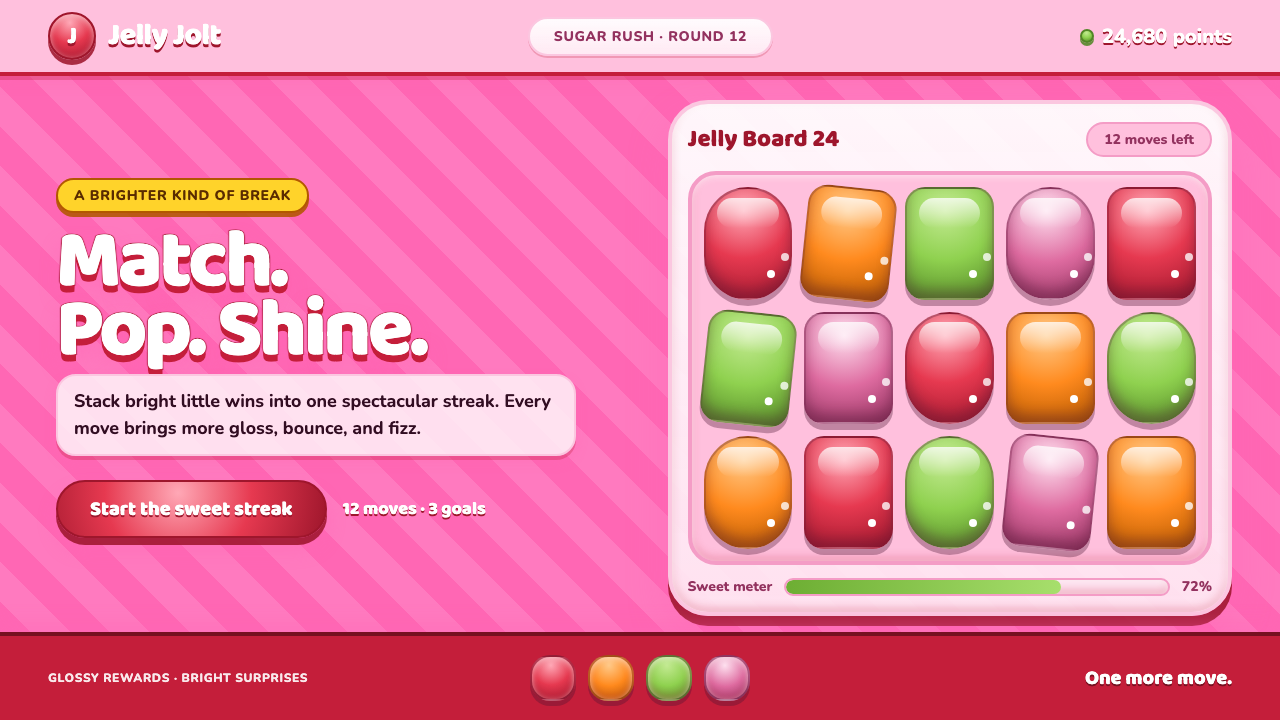 Candy Crush (2012)Sugar rush without restraint. Glossy candy tiles pulse across a striped bubbl…
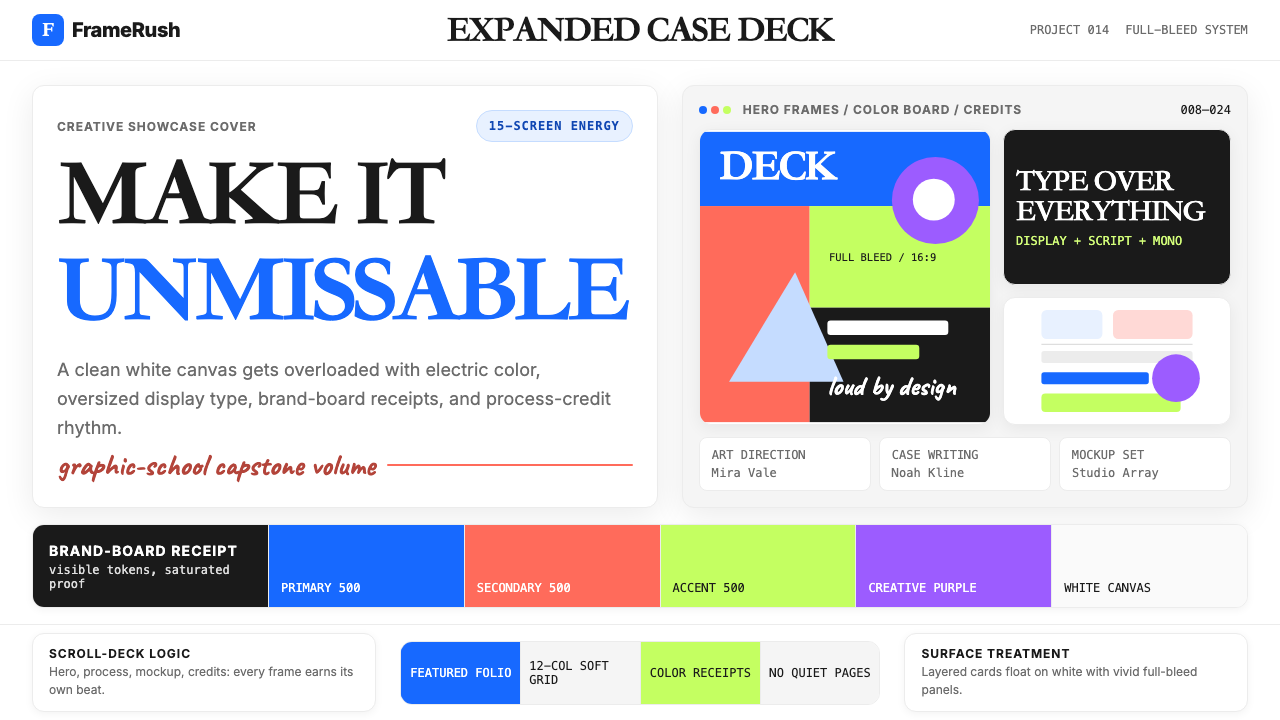 Behance Maximalist PortfolioPortfolio volume at max. Electric blue, coral and lime stack into a full-blee…
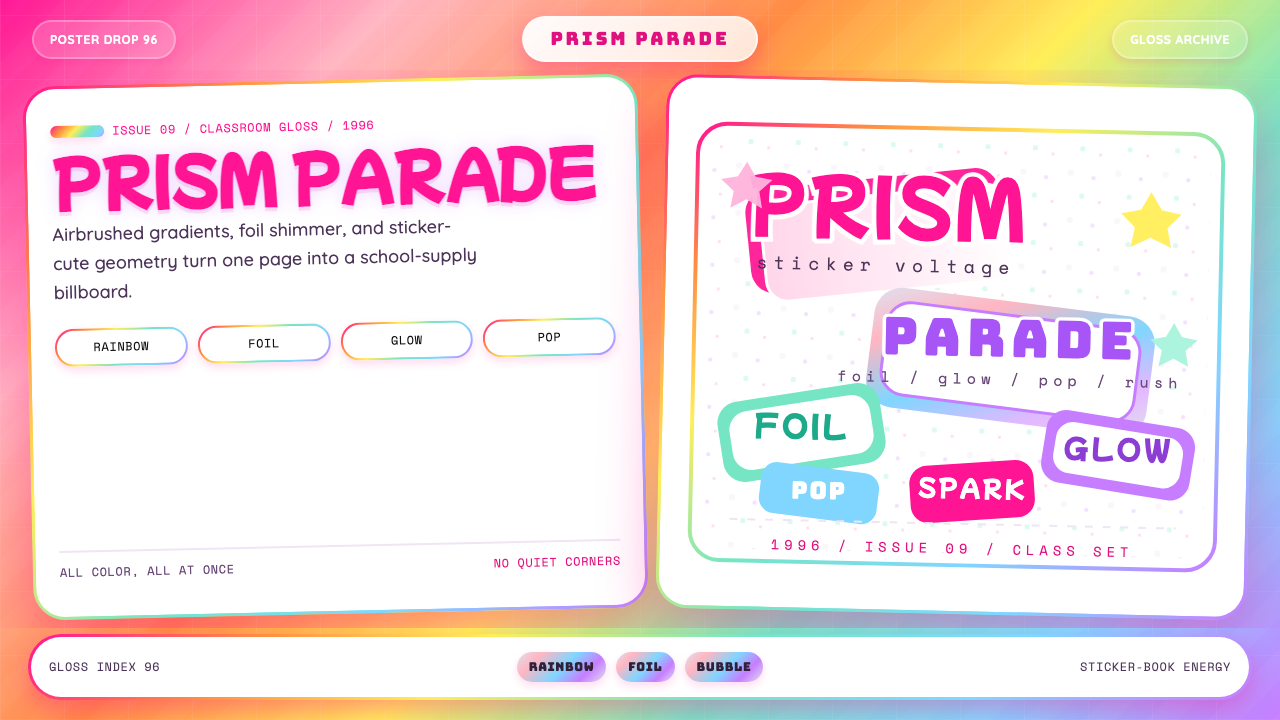 Lisa Frank Rainbow (90s)Pure sticker-saturation. Rainbow gradient, magenta glow, foil shimmer, bubbly…
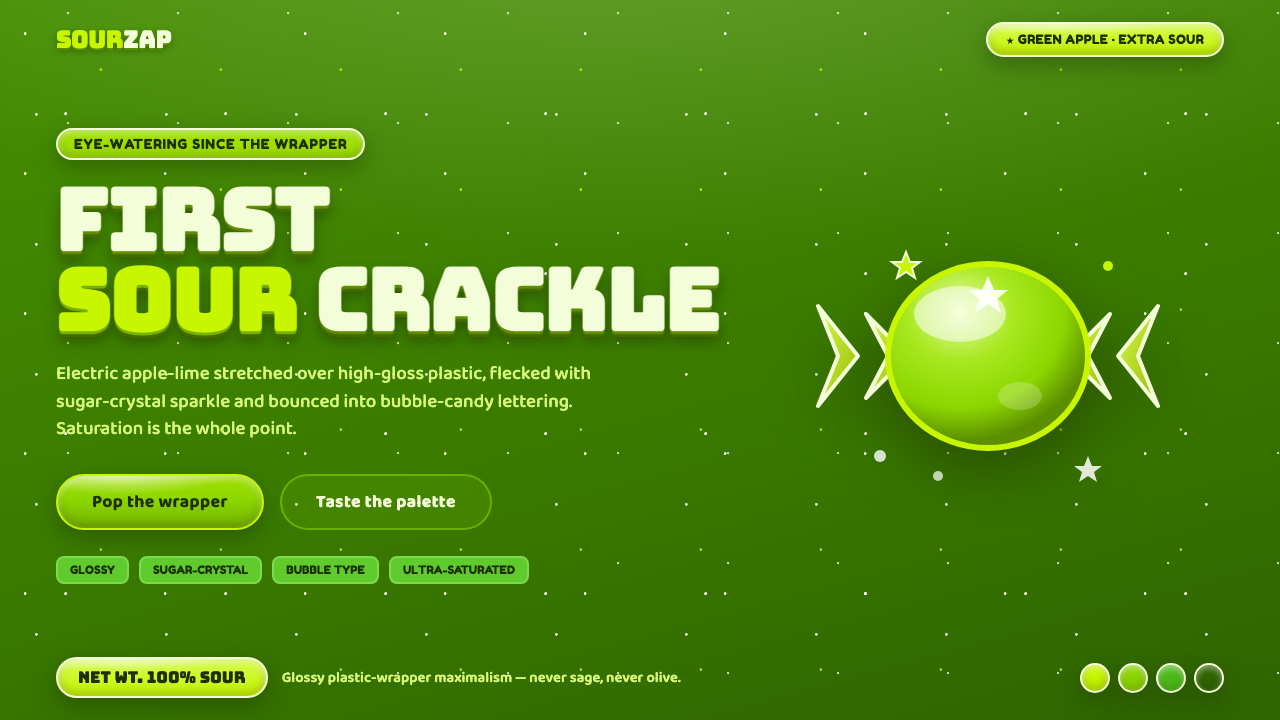 Sour Apple Candy GreenSaturation is the point. Electric apple-green on glossy plastic, sugar-crysta…
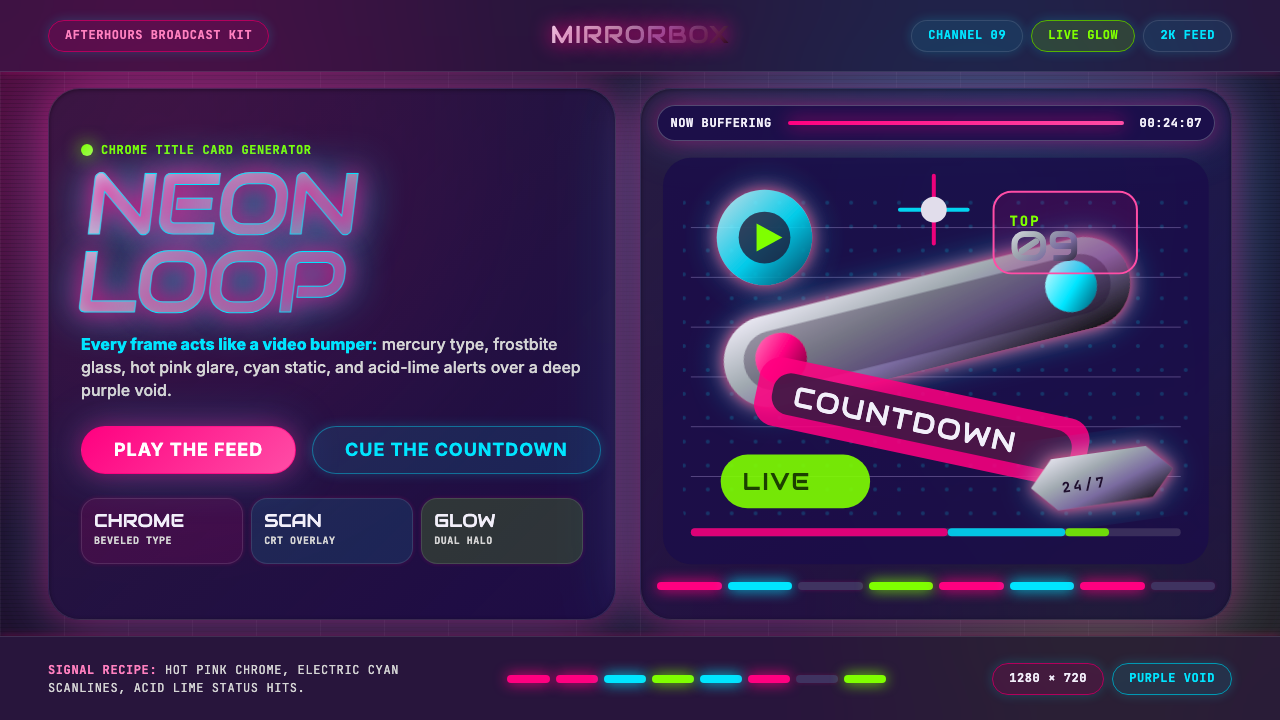 MTV Y2K (2000s)Maximum-volume Y2K. Hot pink chrome, cyan scanlines, and lime hits burn over…
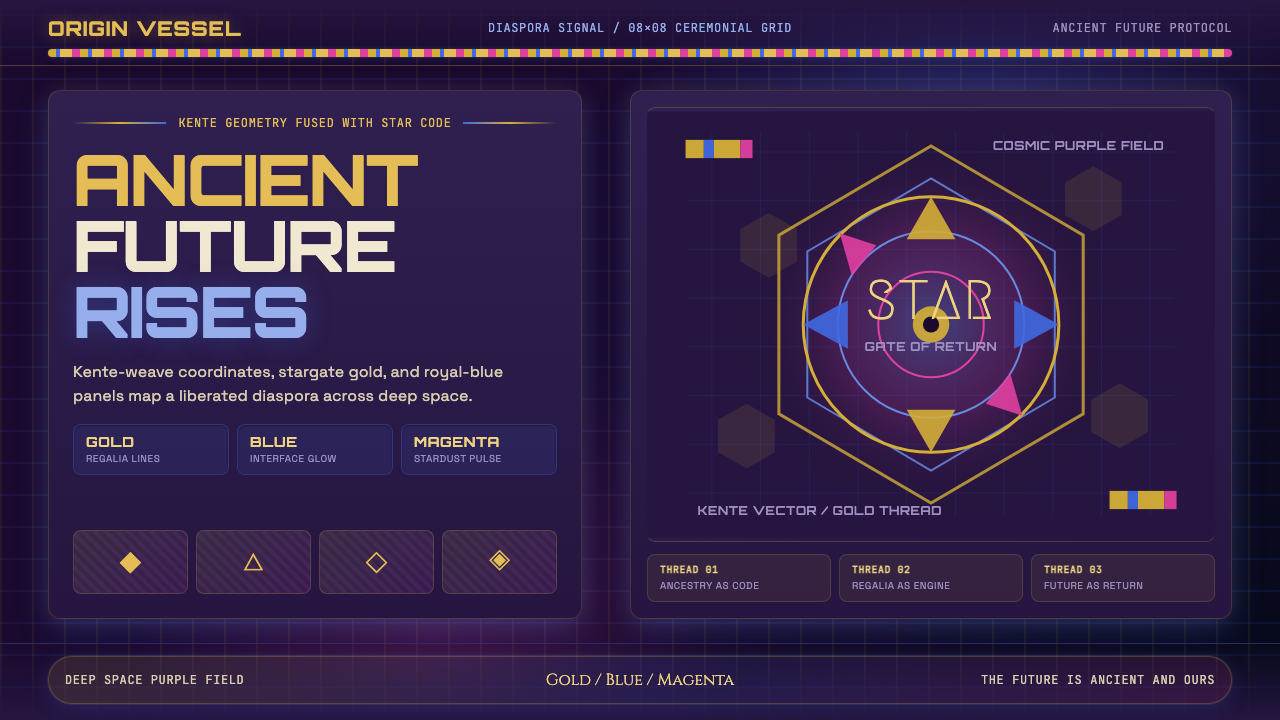 AfrofuturismAncient future, fully luminous. Gold kente grids cut through cosmic purple an…