What is Lisa Frank Rainbow (90s)?
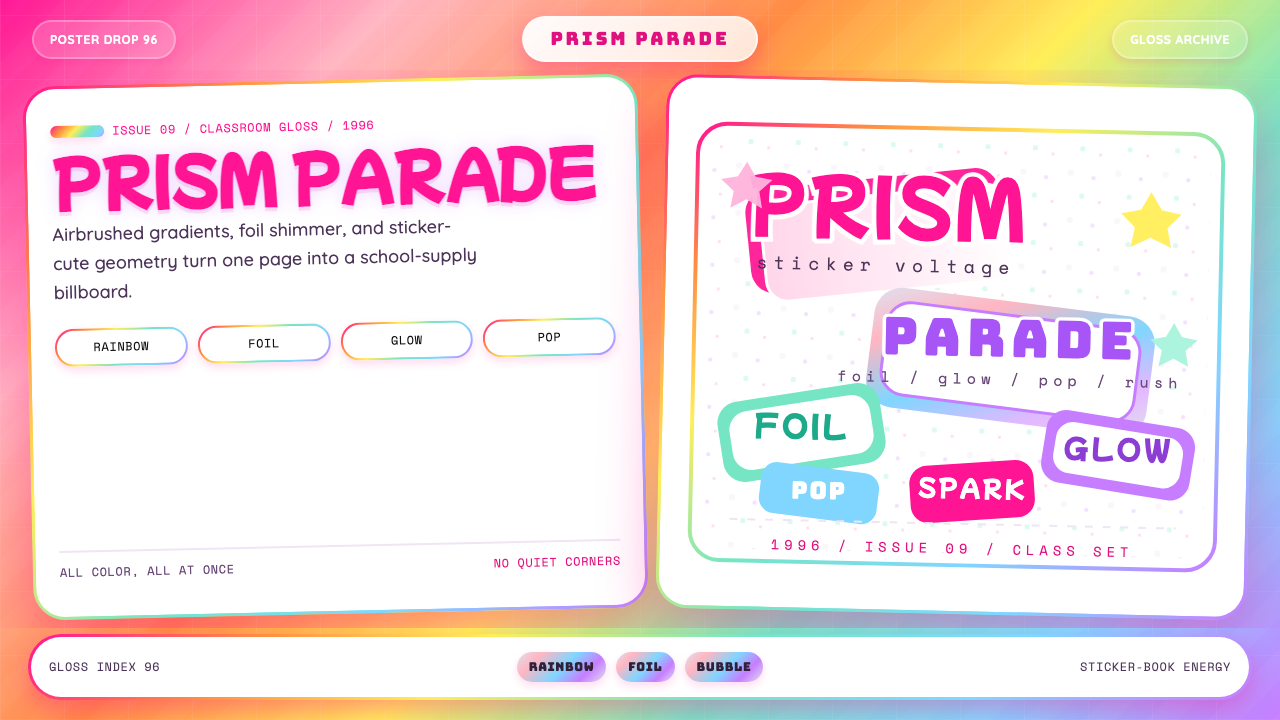
Lisa Frank turned every color of the rainbow up to maximum simultaneously — and made an entire generation of American kids believe that was the only correct setting.
Lisa Frank Rainbow (90s) in brief
Lisa Frank Rainbow is an American maximalist visual style rooted in the school-supply branding of the late 1980s and 1990s. Its defining qualities are total chromatic saturation — every band of the visible spectrum deployed at once, without hierarchy or restraint — combined with airbrushed gradients that blend those colors into seamless, luminous transitions. The aesthetic pairs this chromatic intensity with soft, rounded geometry: bubble-letter type, sticker-cute animal illustrations, and holographic foil surfaces that appear to shift color as they catch the light.
Where most design systems treat color as a tool for hierarchy — one hue leads, others support — the Lisa Frank system treats color as the message itself. The goal is not clarity or emphasis but pure sensory delight: an overwhelming, celebratory saturation that communicates abundance, joy, and a kind of gleeful refusal to be subtle. Animal subjects — dolphins, tigers, pandas, unicorns — appear in colors that have no relationship to nature, wrapped in gradient coats that cycle through pink, violet, teal, and gold within a single shape.
The style belongs to a specific moment in American commercial culture, when airbrushed illustration was the dominant technique for youth-market goods and holographic materials had just become affordable for mass-production packaging. It predates the internet era's flat-design aesthetic by a full decade, and its maximalism stands in near-total opposition to every subsequent design trend — making it immediately legible as a period artifact and giving it the nostalgic power that has driven its cult revival since the mid-2010s.

Where does Lisa Frank Rainbow (90s) come from?
Lisa Frank Inc. was founded in 1979 in Tucson, Arizona, by Lisa Frank, then in her early twenties, alongside her then-partner James Green. The company's initial product line centered on stickers — a format that suited Frank's illustration style: small, self-contained, intensely colored images that rewarded close inspection. The sticker format also established the visual logic that would define the brand: each image was a complete, fully saturated world in miniature, with no background left uncolored and no detail left dull.
The visual identity that would make the brand famous crystallized through the 1980s as airbrushing technology became more accessible and the school-supply market grew competitive. Frank's illustrators developed a house style built on photorealistic animal subjects — rendered with anatomical plausibility but draped in physically impossible color schemes — set against gradient backgrounds that moved from one saturated hue to another without any neutral break. By the mid-1980s, this style was appearing on Trapper Keeper binders, folders, lunch boxes, and pencil cases distributed through mass-market retailers across the United States.
The brand reached its cultural apex in the early-to-mid 1990s, coinciding with the peak popularity of holographic and iridescent materials in consumer goods. Foil accents — originally limited to metallic highlights in illustrations — expanded into fully holographic product surfaces: binders whose covers shifted between multiple colors as they tilted under fluorescent classroom lighting, sticker sheets backed with prismatic foil, notebooks whose spines caught and fractured light. Annual revenue reportedly exceeded sixty million dollars at this peak. The company employed hundreds of artists and operated a campus-like facility in Tucson that became locally legendary.
The brand's decline in the early 2000s followed broader shifts in youth culture — the rise of internet aesthetics, the mainstreaming of minimalism, and changing retail patterns as big-box office-supply chains displaced the variety stores where Lisa Frank products had thrived. The company contracted significantly but never disappeared. A cult revival began around 2010 and accelerated after 2017, driven by nostalgia content on social platforms and a broader cultural rehabilitation of 1990s maximalism as an antidote to the austerity that had dominated design for the preceding decade. Collaborations with fashion brands, cosmetics companies, and apparel retailers introduced the visual system to audiences who had not experienced its original context.
What defines the Lisa Frank Rainbow (90s) look?
Full-Spectrum Color
The palette does not select from the spectrum — it uses all of it. Red, orange, yellow, green, blue, violet, and magenta appear simultaneously, typically at their maximum chromaticity. No color functions as a neutral ground; even backgrounds are saturated. The hierarchy among colors, when it exists at all, is established by brightness and the direction of gradients rather than by restraint or proportion. Hot pink and electric teal are the two most characteristic anchor hues — the ones that most reliably signal the style at a glance.
Airbrushed Gradient
The defining technical signature is the soft, seamless gradient transition between saturated hues — a visual effect achieved historically through airbrush illustration and replicated digitally through radial and linear blends. Colors do not border each other with hard edges; instead they dissolve into one another through intermediate tones. These gradients appear in backgrounds, in the coats of animal subjects, and in letterforms, giving every element a softly glowing, almost luminous quality. The gradients never trend toward neutral — they move from one saturated color to another, sometimes cycling through three or four hues within a single shape.
Holographic and Foil Shimmer
A defining material accent of the original products was holographic foil — surfaces that fractured ambient light into prismatic rainbow fragments and appeared to change color as viewing angle shifted. In digital applications, this effect is approximated through iridescent gradient overlays, animated shimmer effects, and surfaces that seem to contain multiple hues simultaneously. The foil shimmer adds a dimension of optical instability: the style is not fully resolved from a fixed viewpoint but rewards movement, suggesting an almost magical material quality. This shimmer is a significant part of what distinguishes the style from ordinary saturated palettes.
Rounded, Sticker-Cute Geometry
Every hard corner is softened. Letterforms are chubby and rounded, as though inflated from within. Animal and character illustrations have large, rounded heads relative to their bodies, wide eyes, and simplified features that read clearly at small sizes. Compositional shapes — speech bubbles, borders, badges — are uniformly rounded-rectangle or oval. There are no sharp angles; the entire visual vocabulary refuses any geometry that could feel aggressive or adult. This softness is not minimalism but invitation — the shapes communicate safety, friendliness, and tactile appeal.
Magenta Glow and Shadow
Where drop shadows and glow effects appear, they lean heavily toward saturated magenta or hot pink rather than neutral gray or black. A magenta glow behind a white letterform does not suggest a light source in the physical sense — it intensifies the color temperature of the composition and creates the impression that elements are self-luminous. This colored glow is one of the most characteristic finishing treatments in the style: it integrates shadows and glows into the chromatic system rather than treating them as neutral structural scaffolding.
Impossible Animal Subjects
The brand's iconographic center is the animal subject rendered in chromatic impossibility: leopards with rainbow-gradient spots, pandas with violet and gold fur, dolphins leaping through skies the color of cotton candy. The animals are recognizable by silhouette and simplified anatomy but exist in color worlds entirely detached from nature. This combination — familiar creature, impossible palette — is central to the style's charm. The animals function as emotional anchors: they are cute, non-threatening, and relatable, while the color treatment elevates them into a kind of fantasy that belongs entirely to the visual system.
Chubby Display Type
Headline type in the Lisa Frank style is heavy, rounded, and often three-dimensional — letterforms that appear to have volume, sometimes with gradient fills that cycle through the same rainbow spectrum as the surrounding artwork. The type never reads as serious or authoritative; its roundedness and weight communicate playfulness and accessibility. Outlines in contrasting colors — white on a dark gradient, or a magenta ring around a yellow letterform — add definition and further integrate type into the chromatic system. Legibility is maintained through high contrast between letter fill and background, even when both are saturated.

Who shaped Lisa Frank Rainbow (90s)?
The founder and creative director whose name became synonymous with the style. Frank, born in 1955, began creating commercially licensed illustrations in the 1970s before establishing her own company in Tucson in 1979. She retained creative control over the brand's visual direction throughout its peak years, developing the house illustration style that combined photorealistic animal anatomy with maximally saturated, gradient-driven color. Her decision to target the school-supply market — a category with low aesthetic expectations that she dramatically upended — proved decisive. Frank's personal brand identity became inseparable from the company's, and her face, name, and signature appeared on products as part of the brand's appeal.
Co-founder of Lisa Frank Inc. and Frank's business partner during the formative years of the company. Green played a key role in the operational and commercial development of the brand through the 1980s, helping to secure the retail distribution deals that put Lisa Frank products into mass-market stores nationwide. The personal and professional relationship between Frank and Green — which eventually ended acrimoniously — became part of the brand's documented history, surfacing in later journalistic accounts of the company's internal culture during its peak period. Green's business influence helped transform what began as an illustration practice into a manufacturing and licensing operation at national scale.
The visual output associated with the brand was not the work of a single artist but of a large, closely managed team of illustrators working within strict brand guidelines at the Tucson studio. At its peak the company employed well over a hundred artists — a production model closer to animation studio or fashion house than to an individual illustrator's practice. The illustrators developed and refined the house style: the specific way gradients were blended, the proportion of animal features, the way holographic highlights were integrated. Their collective, largely uncredited contribution is the actual authorship of the visual style that became a cultural phenomenon.
Less a figure than a structural condition: the competitive landscape of the American school-supply industry in the late 1980s and 1990s created the specific demand environment that the Lisa Frank style was optimized to win. Mass-market retailers gave brands significant shelf space for back-to-school seasons, and differentiation through surface design was a primary competitive lever. The Trapper Keeper binder — licensed through Mead — became the style's most iconic vehicle, reaching millions of students annually. Understanding the style requires understanding this market context: it was designed to win the attention of an eight-to-twelve-year-old in a crowded retail aisle, and every visual choice reflects that specific performance requirement.
How do you use Lisa Frank Rainbow (90s) today?
The Lisa Frank style is a maximalist system, which means its rules operate differently from restraint-based aesthetics like Bauhaus or Swiss Style. Applying it correctly does not mean avoiding choices — it means committing fully. Half-measures read as failure: a layout that uses two saturated colors instead of the full spectrum, or rounds corners slightly but not dramatically, will feel like a broken version of the style rather than a thoughtful restraint of it. The question is not whether to use all the color, but whether the context calls for the style at all.
For presentation slides, the Lisa Frank style is most effective on cover and section-opener pages where sensory impact is the primary goal. A cover benefits from a full-spectrum gradient background — moving through multiple hues — with a chubby, rounded headline set in white with a magenta or violet glow. Animal or illustrated mascot elements can anchor corners or bleed off edges. Content slides require more discipline: maintain the gradient or saturated background but limit the number of active visual elements so that information remains readable. Data slides work against type in white or very light tones on saturated grounds, with accent colors drawn from the full-spectrum palette to differentiate categories. Avoid mimicking corporate data-visualization conventions — bars and charts in this style should feel like stickers, not spreadsheets.
For web interfaces, the style suits contexts where delight and personality are core product values: children's platforms, entertainment products, gaming, creative tools, or any brand that explicitly positions itself against corporate minimalism. Dashboards and utility interfaces are generally hostile territory unless the product's emotional register is intentionally playful. When applying the style to a web UI, use gradient backgrounds as hero and section-break treatments rather than for entire application chrome; reserve saturated interactive colors for calls to action and primary navigation; ensure that text sits against surfaces where contrast is unambiguous — the style's chromatic intensity can easily compromise legibility if text color is not managed carefully. Pricing and feature pages benefit from a bold header treatment with gradient-filled section backgrounds transitioning between hues.
For editorial and marketing applications, the style excels in contexts that want to signal nostalgia, energy, celebration, or a deliberate rejection of corporate seriousness. A marketing page built in this style should commit to the gradient at page-section level — alternating between different full-spectrum grounds rather than between gradient and white. Typography should be display-weight and rounded for headlines; supporting text can use a plainer typeface as long as it sits against a sufficiently contrasting ground. Sticker-style illustrated elements, speech bubbles, and badge-style callouts are appropriate compositional devices that reinforce the style's visual language. The style is exceptionally effective for social card formats, thumbnail imagery, and any square or vertical format where the ratio of background to content is high.
A common and decisive mistake when applying this style is treating it as a color palette exercise — selecting a few saturated colors and applying them to an otherwise conventional layout — rather than as a total aesthetic commitment. The style's power comes from chromatic simultaneity: the coexistence of multiple saturated hues at full strength, mediated by gradient transitions that unify them. A layout that picks two colors from the rainbow and leaves the rest out is not a restrained Lisa Frank — it is a different style entirely. Similarly, rounding corners slightly without embracing the full bubble-letter, sticker-cute geometry of the type and illustration style produces an incoherent hybrid. If the context does not permit full commitment, a different visual system will serve better.

Lisa Frank Rainbow (90s) — FAQ
Is Lisa Frank Rainbow suitable for professional or B2B contexts?
Rarely, and with significant caveats. The style communicates abundance, joy, and playful exuberance — values that can work in consumer entertainment, gaming, and youth-focused products, but that conflict sharply with the authority and clarity expected in enterprise software, financial services, legal tools, or healthcare. The few B2B applications where it succeeds tend to be brands that have made a deliberate, self-aware choice to stand against category convention — a creative tools company deliberately positioning against gray-and-white enterprise aesthetics, for example. Even then, the full-spectrum maximalism is usually modulated: gradient backgrounds without the full animal illustration vocabulary, rounded UI elements without the bubble-letter display type. Pure unmodulated Lisa Frank in a B2B context reads as a category error, not a bold choice.
How does this style differ from other pastel or kawaii aesthetics?
The critical distinction is saturation and simultaneity. Kawaii aesthetics — and most pastel design systems — operate at reduced saturation: colors are soft, light, and often close to white. They create a sense of gentleness and quiet. Lisa Frank operates at the opposite extreme: colors are fully saturated and multiple hues appear together at full strength, mediated only by gradient transitions. The effect is not quiet — it is loud, celebratory, and slightly overwhelming by design. Kawaii also typically limits its palette to a small set of soft hues and uses a great deal of white or near-white negative space. Lisa Frank leaves almost no neutral ground: every surface is occupied by saturated color. The rounded geometry and cute subject matter may look superficially similar, but the chromatic philosophy is fundamentally different.
Can this style work in a dark or night-mode layout?
Yes, and in some ways a dark ground enhances the style's luminous qualities. Saturated rainbow gradients on a very dark — near-black but not pure black — background read as glowing, which amplifies the holographic shimmer effect that is central to the style's appeal. The key adjustment is to treat the dark ground as a neutral field that makes colors pop rather than as a design statement in itself. Magenta glow effects and white outline treatments on letterforms become especially effective in dark contexts. The challenge is maintaining legibility: body text should be set in white or very light tones, and the number of simultaneously active saturated hues in any one section should be managed so that foreground and background elements remain distinguishable. A dark Lisa Frank variant also aligns well with the style's holographic heritage — foil and glitter read naturally against dark grounds.
What is the difference between authentic Lisa Frank style and generic 90s nostalgia aesthetics?
Generic 1990s nostalgia design tends to borrow surface markers — teal and purple together, bold geometric shapes, sans-serif type — without committing to the specific chromatic logic that makes Lisa Frank distinctive. Lisa Frank is defined by three interlocking qualities that must coexist: full-spectrum simultaneity (not just two or three 90s-ish colors, but all of them at once), airbrushed gradient transitions between those colors (not flat fills or hard-edged blocks), and the sticker-cute illustrated subject matter (usually animals, often in physically impossible chromatic schemes). A design that uses teal and magenta with some rounded shapes is borrowing 90s visual shorthand. A design that puts a rainbow-gradient dolphin against a magenta-to-violet-to-teal background with bubble-letter type and foil shimmer is doing Lisa Frank. The specificity of the gradient technique and the illustrated subject matter are the distinguishing features most often omitted in pastiche.
How should this style handle typography when the background is already extremely busy?
The standard solution in the original brand's product design was contrast through weight and outline, not through simplification of the background. Body text and headline type were set in white or near-white with a contrasting outline — typically a darker tone from the same hue family as the local background color — and often with a drop shadow in a saturated complementary color. This creates legibility not by quieting the background but by armoring the type against it. In practice, this means: use white as the primary type color across all saturated gradient backgrounds; add an outline in a contrasting dark or complementary saturated tone; reserve magenta or violet drop shadows for display headlines only; and avoid setting body text at small sizes against the most complex parts of gradient backgrounds — the sections where multiple hues are transitioning simultaneously are the hardest zones for type legibility.
Related design styles
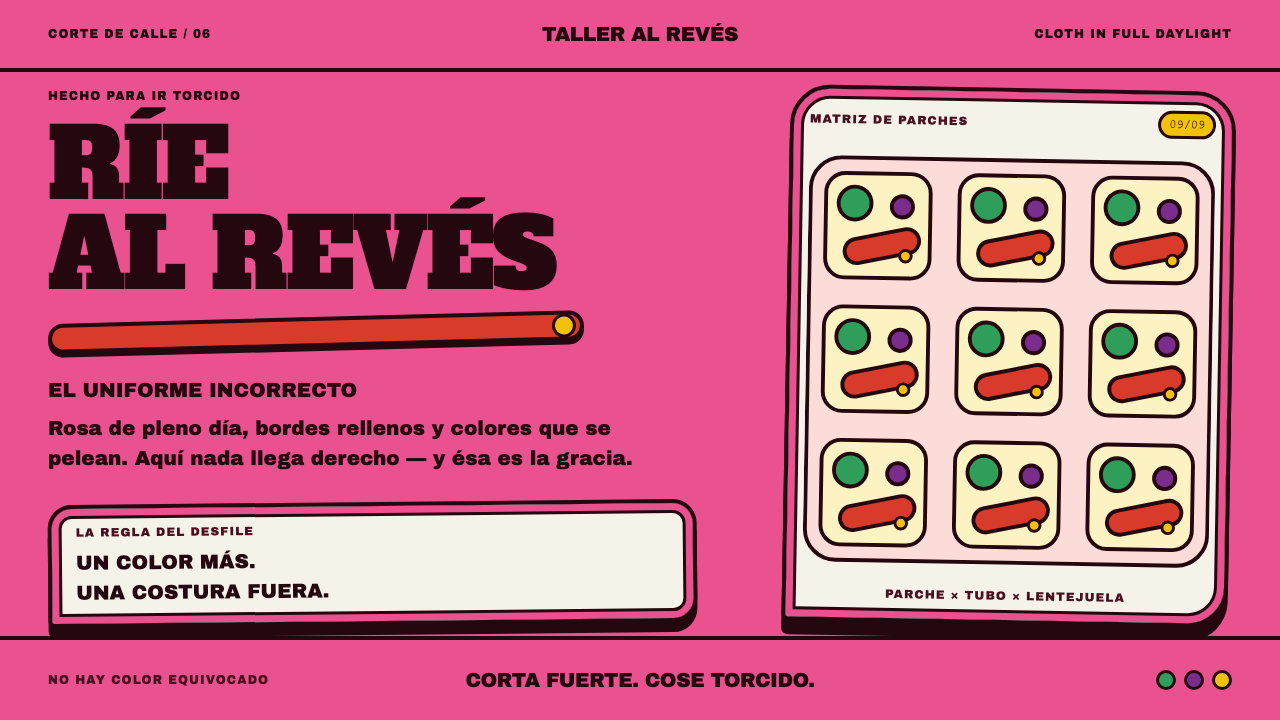 Marimonda MaskLoudness is the point. Rose cloth, padded black seams, and clashing red-yello…
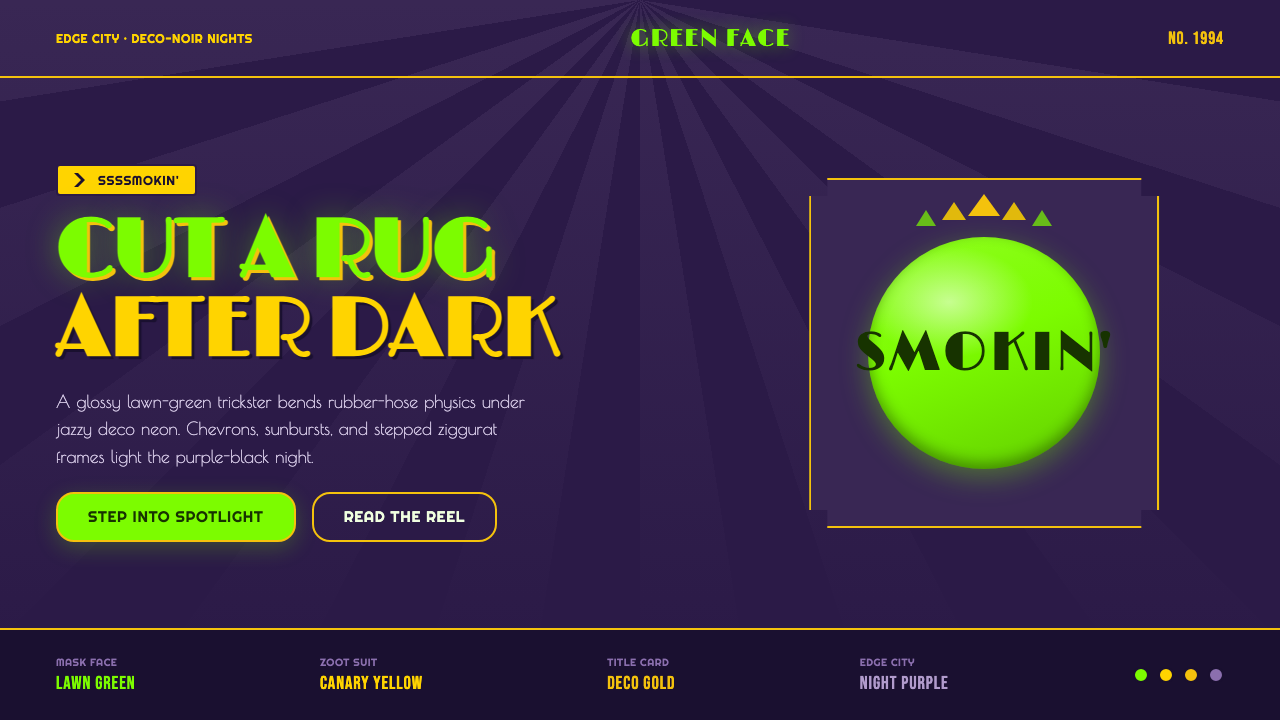 The Mask 1994 Green FaceLoud, theatrical, ssssmokin'. Lawn-green and canary-yellow scream against dec…
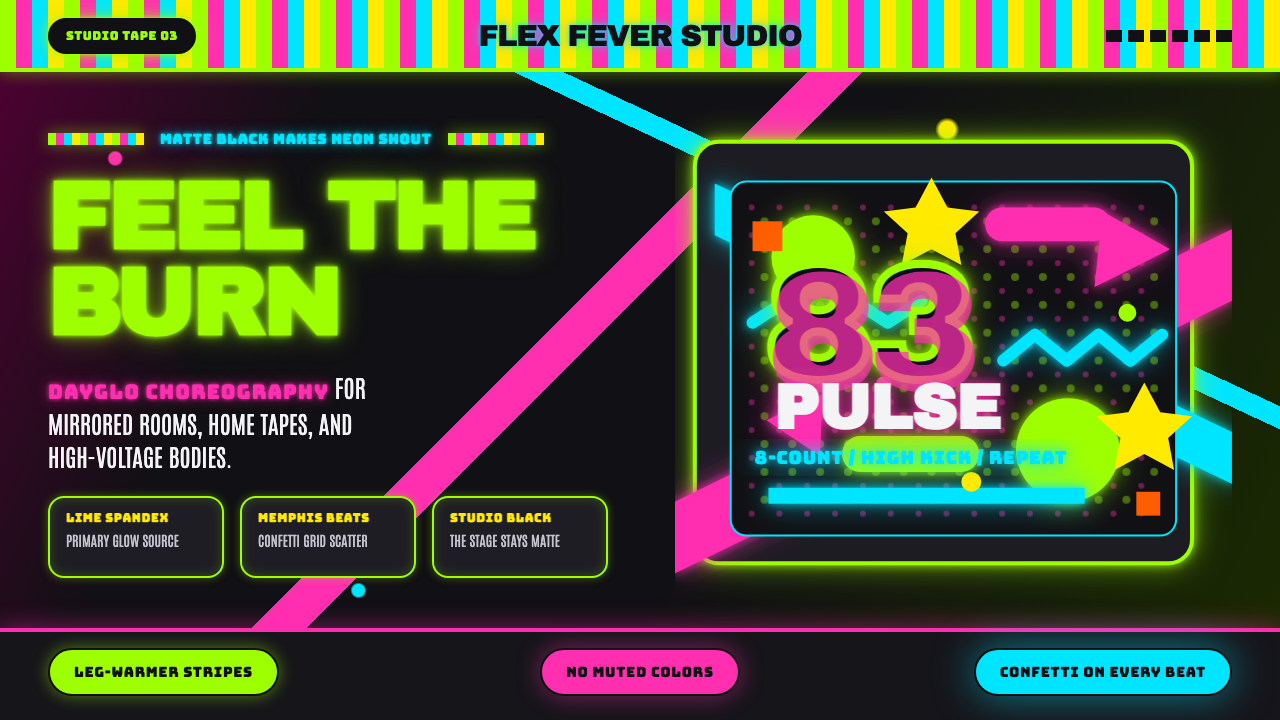 80s Aerobics Fluoro SpandexNeon refuses restraint. Lime spandex, pink-cyan confetti, and black-stage typ…
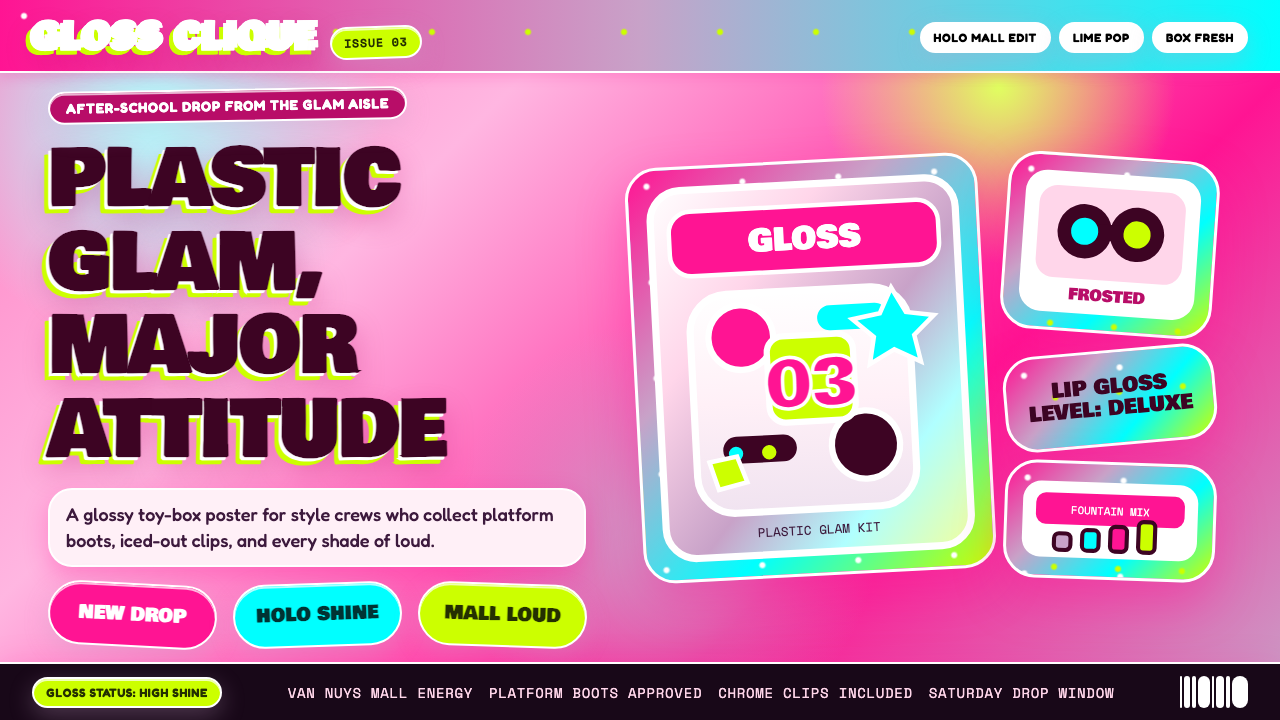 Bratz Doll 2003Y2K maximalism, mall-glossy. Hot-pink gradients, holographic lavender, chunky…
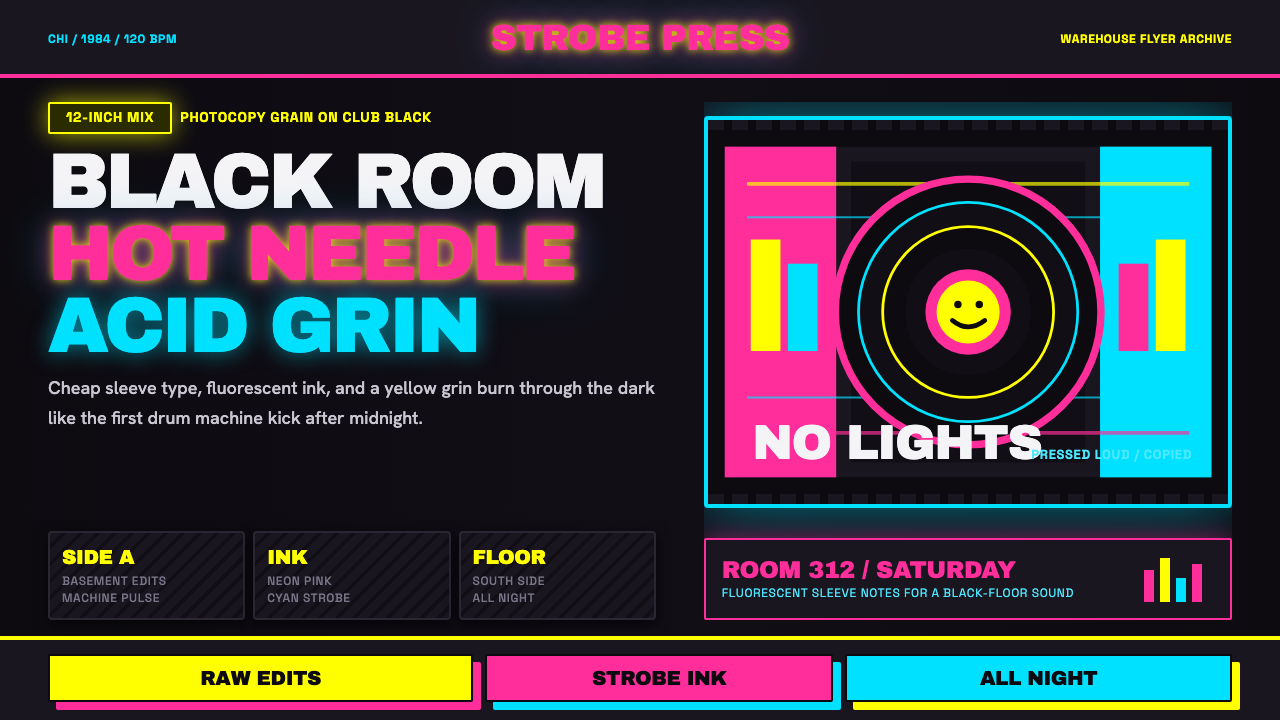 Chicago HouseDarkness starts the track. Neon pink, yellow and cyan hit black like Xerox st…
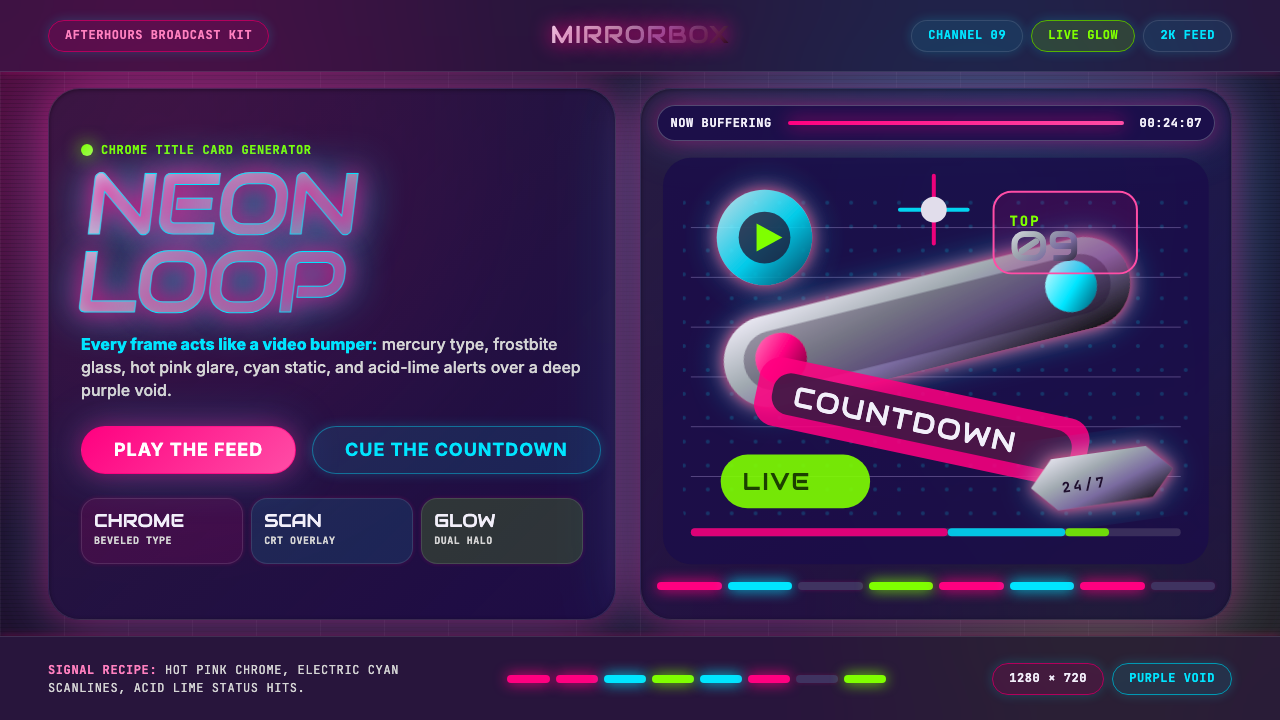 MTV Y2K (2000s)Maximum-volume Y2K. Hot pink chrome, cyan scanlines, and lime hits burn over…