What is Otl Aicher Munich Olympics?
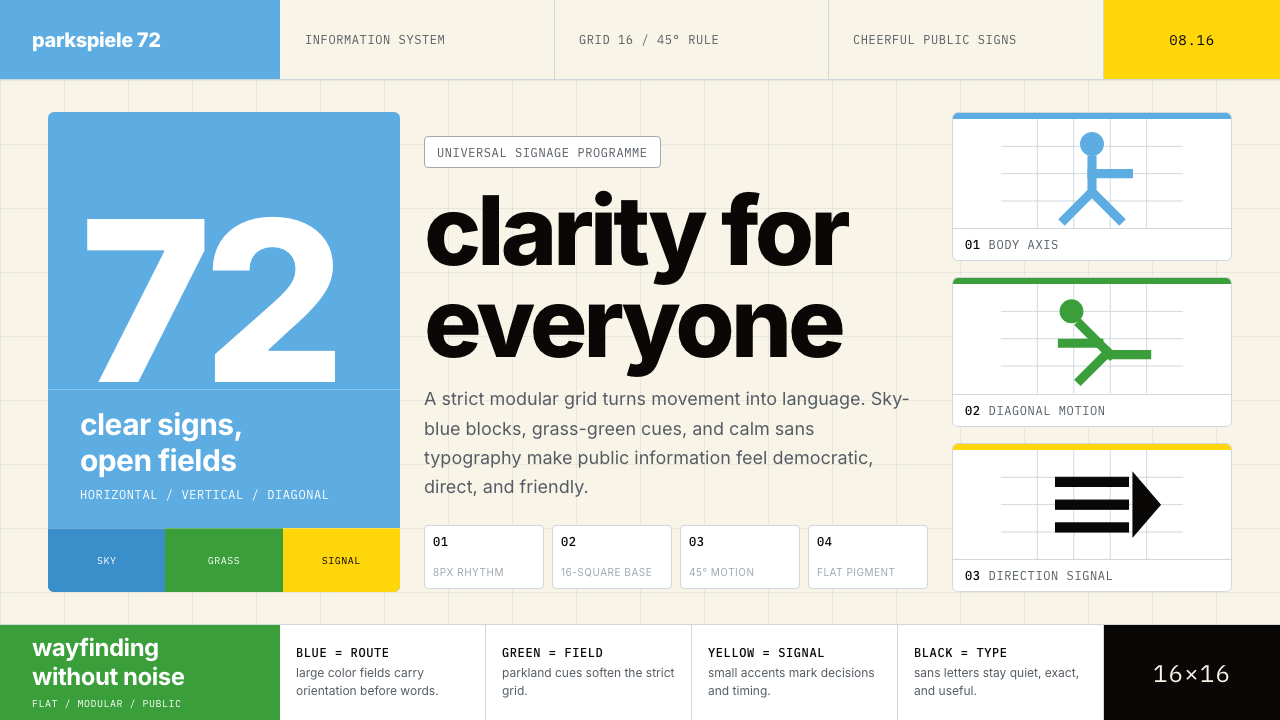
Otl Aicher turned the 1972 Munich Olympics into the world's first truly universal information-design system — proving that public communication can be simultaneously geometric, cheerful, and free of borders.
Otl Aicher Munich Olympics in brief
The Otl Aicher Munich Olympics system is the most consequential information-design project of the twentieth century. Commissioned for the 1972 Summer Games in Munich, it established a visual language built from three interlocking components: a restrained palette of sky blue, grass green, silver, and warm white; a family of sport pictograms drawn on a strict grid of horizontal, vertical, and forty-five-degree strokes; and a typographic hierarchy anchored in the Univers type family. Together these components created a system that could guide millions of visitors who spoke dozens of different languages across a vast, unfamiliar venue — without a single word of explanation.
The defining quality of the system is what Aicher called 'functional friendliness.' Unlike earlier wayfinding systems, which borrowed the visual authority of military or industrial signage, the Munich identity was deliberately light, open, and approachable. The palette avoided the heavy saturated primaries associated with ideological design and instead chose colors that read as sky, grass, and daylight — colors that belonged to the outdoor landscape of Bavaria rather than to any nation or institution.
More than fifty years after the Games, the system's influence is impossible to overstate. The pictogram grammar that Aicher's team developed — the figure reduced to clean geometric limbs, the pose simplified to its most legible angle, each sport rendered in a consistent vocabulary of strokes — became the global template for airport wayfinding, transport maps, public signage, and international sporting events from the 1972 Games forward. The system did not just communicate; it established a method.

Where does Otl Aicher Munich Olympics come from?
Otl Aicher came to the Munich Olympics project carrying one of the most rigorous design educations of the postwar period. He was a co-founder of the Hochschule für Gestaltung (HfG) in Ulm — the institution that, in the 1950s and 1960s, took up the Bauhaus ambition of unifying art, science, and industrial production and pushed it further toward systems thinking and semiotics. At Ulm, design was not a matter of personal expression; it was a discipline of analysis, method, and verifiable communication. This pedagogical background made Aicher uniquely suited to the challenge of designing for an audience of many millions across many cultures.
The political stakes of the commission were explicit and heavy. The 1936 Berlin Olympics had been weaponized as Nazi spectacle — a totalitarian display of red, black, and white, of monumental architecture and martial choreography. Munich's organizers, and Aicher himself, were determined to signal something categorically different: a democratic West Germany at ease with itself, open, civilian, and free. The phrase that guided the visual program was 'heitere Spiele' — cheerful games. Aicher's palette of sky blue and grass green was not an arbitrary aesthetic choice; it was a political argument made in color.
Aicher began work on the identity in 1967, five years before the Games opened. His team — which included Rolf Müller and other designers from the Ulm tradition — developed the pictogram system through an unusually rigorous generative process. Early sketches explored many approaches to representing the human figure in sport. The breakthrough was the grid: by constraining every stroke to horizontal, vertical, or forty-five-degree angles, the team achieved a family of pictograms that were visually consistent across all twenty-one sports while remaining distinct enough to be told apart at a distance and at speed. The grid was not decoration; it was the generative rule that made the system a system.
The broader identity extended far beyond pictograms. Aicher specified the use of Univers — the typeface designed by Adrian Frutiger in 1957 — in a tightly defined hierarchy of weights and sizes. He developed a color palette that was applied consistently across every touchpoint: uniforms, signage, print materials, vehicles, and architectural surfaces. He also regulated the use of photography and illustration, ensuring that the Games' visual environment maintained coherence from the smallest ticket stub to the largest stadium banner. The total integration of all these elements into a single, rule-governed system was the project's real innovation — and it defined the practice of corporate and institutional identity design for the decades that followed.
What defines the Otl Aicher Munich Olympics look?
Sky-and-Grass Palette
The system's defining colors are a clear sky blue and a fresh grass green, deployed against fields of warm white and light silver. These are landscape colors rather than symbolic or ideological primaries — they evoke an outdoor summer gathering rather than an institution or a flag. The palette was developed in explicit contrast to the saturated red-black-white of the 1936 Berlin Games. Black is used sparingly, for type and fine rules only; gold and warm ochre occasionally accent ceremonial materials without disrupting the lightness of the overall system.
The Grid-Constrained Pictogram
Every sport pictogram was constructed on a modular grid that permitted only horizontal, vertical, and forty-five-degree diagonal strokes. The human figure is abstracted to its structural minimum: a circle for the head, straight and diagonal lines for limbs, with each pose reduced to the single most legible configuration for its sport. No curves, no freehand, no expressive variation from figure to figure. The constraint produces visual unity across the whole family while keeping each symbol unambiguously distinct.
Modular System Logic
The Munich identity operates as a rule-governed system rather than a collection of designed objects. Every element — color, typeface choice, pictogram construction, grid structure, spatial relationships — is defined by a set of parameters that can be applied consistently across any medium and any scale. Aicher's approach was essentially algorithmic: given any design problem within the Games, there was a defined method for solving it. This systematic quality is what distinguishes the Munich work from earlier Olympic identities, which were largely composed of individual graphic decisions.
Typographic Restraint
The system is anchored by a single humanist sans-serif typeface used across all applications, from monumental venue signage to small-format printed schedules. Type is set in a limited range of weights, with size and weight contrast doing the work of hierarchy rather than decorative variation. Lettering is tightly spaced and always lower-case in directional signage — a choice that reduces visual noise and emphasizes the pictogram as the primary communicative carrier. No display scripts, no italics for emphasis, no mixing of typeface families.
Democratic Accessibility
The philosophical core of the system is the belief that public information belongs to everyone and should be understood by anyone, regardless of language, education, or cultural background. Aicher and his team worked to ensure that each pictogram communicated its meaning without prior knowledge or training — the figure performing a sport should be instantly identifiable to a visitor from any country. This principle pushed the team toward greater simplification at every stage: when a symbol required explanation, it was redesigned until it did not.
Landscape Integration
Aicher worked closely with the architect Frei Otto, whose tensile canopy structures over the Munich Olympic Park created one of the most distinctive architectural environments of the twentieth century. The visual identity was designed with that landscape in mind: the palette of sky blue and light silver echoes the translucent tent roofs, and the open, airy quality of the graphics reflects the openness of Otto's architecture. The result is a rare case in which a visual identity system and its physical environment genuinely reinforce each other.
Principled Rejection of Monumentalism
Every design decision in the Munich system points away from the monumental and authoritarian. Forms are light rather than heavy, open rather than closed, approximate to human scale rather than overwhelming it. The pictograms show figures in motion — athletes, not heroes or archetypes. The color palette breathes rather than commands. This is not minimalism for aesthetic reasons but restraint for political and ethical ones: a deliberate demonstration that public design in a democratic society should serve people rather than impress them.

Who shaped Otl Aicher Munich Olympics?
Aicher was the principal designer of the Munich Olympics identity and one of the most important information designers of the twentieth century. A co-founder of the HfG Ulm in 1953, he developed a design philosophy rooted in Enlightenment rationalism: design as a form of practical reasoning, not artistic expression. His work for Munich was shaped by his experience designing corporate identity systems for Braun and Lufthansa, both of which established his reputation for rigorous, system-based visual thinking. After Munich, he continued to develop his ideas in books including 'Analogue and Digital' and 'The World as Design,' in which he argued that visual form was inseparable from ethical and political commitment.
Müller was Aicher's key collaborator on the Munich project and took primary responsibility for the execution and systematization of the identity across all printed applications. Trained at the HfG Ulm, he brought the school's rigor to the practical challenge of specifying a system that could be applied consistently by many different hands across five years of production. After the Games, Müller continued as one of Germany's leading practitioners of systematic graphic design and corporate identity, and his work on Munich remained a reference point throughout his career.
Inge Aicher-Scholl was Otl Aicher's wife and the other co-founder of the HfG Ulm. Her role at Munich was less visible than Otl's but no less essential: it was her advocacy, her institutional relationships, and her ability to build political and financial support that made the HfG possible in the first place, and it was the intellectual environment she helped create at Ulm that shaped the entire approach to the Munich commission. Her earlier work documenting the White Rose resistance movement also gave the Aichers a particular moral relationship to German history — a relationship that inflected the political seriousness behind the Munich project's cheerful surface.
Otto was the structural engineer and architect responsible for the tensile roofscape of the Munich Olympic Park — a lattice of steel cables and acrylic panels that covered the main stadium, the swimming hall, and the sports hall in a continuous translucent canopy. His contribution to the Munich identity is often underestimated: Aicher's palette of sky blue and silver was partly a response to the translucent qualities of Otto's roofs, and the lightness of the graphics echoed the lightness of the architecture. The collaboration between Aicher and Otto produced one of the rare moments in twentieth-century design where graphic identity and architectural environment achieved genuine visual coherence.
Frutiger designed the Univers typeface in 1957 as a commission for the Deberny et Peignot type foundry — a systematic family intended to provide a complete range of weights and widths under a single design logic. Aicher's choice of Univers for Munich was deliberate: the typeface's humanist proportions are warmer and more legible at small sizes than the more geometric Helvetica, and its systematic structure — Frutiger's numbering system for weights and widths — aligned naturally with Aicher's preference for rule-governed design. Univers did not appear in Munich because it was fashionable; it appeared because it solved a specific communicative problem with verifiable rigor.
How do you use Otl Aicher Munich Olympics today?
The Munich Olympics system translates exceptionally well into contemporary design work because its principles are structural and replicable rather than ornamental and period-specific. Applying it well requires internalizing the system's operating logic: every element should serve a communicative function that can be stated explicitly, and every element not serving such a function should be removed. The palette, the grid, the pictographic reduction of complex information — these are not decorative choices but solutions to problems. Understanding what problems they solved is the prerequisite for using them correctly.
For presentation slides, the system is particularly strong on covers and data-heavy content pages. A cover built in this idiom uses the sky-blue field as the dominant ground, with the headline set large in a single humanist sans-serif at a weight that reads clearly across the room. A single pictogram-scale geometric symbol or silhouette shape anchors one quadrant. Content slides should treat every piece of information as a candidate for pictographic simplification: replace bullet-point text with icons where possible, use the grass-green accent exclusively for the most important data point on each slide, and define section structure through a strict typographic hierarchy rather than colored backgrounds or decorative rules. Data visualizations — charts, diagrams, maps — should be treated as pictograms in their own right: simplified to the minimum necessary encoding, colored from the two-color palette, with all non-data ink removed.
For web and product interfaces, the style is best suited to dashboards, analytics platforms, developer tools, and any product where clarity and navigability are the primary values. The approach mirrors Aicher's original challenge: guide a diverse user population through a complex environment without ambiguity. Define a modular grid and apply it rigorously; use sky blue for primary interactive states and navigational emphasis; reserve grass green for positive system states, progress indicators, or affirmative actions. Icons should be built on the same limited-angle vocabulary as the Olympic pictograms — no organic curves, no decorative detail, maximum legibility at small sizes. Pricing pages and feature comparison layouts benefit from the system's color-coded tier logic: each plan differentiated by its single assigned palette color, with no gradients or shadows to suggest premium status.
For editorial design, marketing materials, and brand collateral, the system supports a poster-like visual authority that works at both large and small formats. An editorial spread uses a narrow-measure body text column set in a single weight, a wide outer margin carrying pull-quotes or metadata, and section breaks marked by a full-width color rule in sky blue or grass green rather than ornamental dividers. Marketing pages work with the system's inherent boldness: alternate full-width blocks between white-ground and sky-blue-ground sections, use the pictogram vocabulary to represent product features rather than relying on photography or illustration, and keep calls to action in the grass green that carries through the entire system as the signal of affirmative intent.
A common mistake when working in this idiom is treating the palette's restraint as an invitation to add visual interest through other means — soft gradients, photographically textured backgrounds, or mixed typeface families. This immediately undermines the system's logic. The Munich identity's authority comes precisely from the completeness of its restraint: the moment a gradient appears, the viewer's attention shifts from information to decoration. Similarly, introducing a second typeface family — even a complementary one — breaks the visual unity that makes the system legible as a system rather than a collection of design decisions. Stay with one sans-serif family at multiple weights; let size, weight, and the two-color palette do all the work of hierarchy and emphasis.

Otl Aicher Munich Olympics — FAQ
What makes the Munich pictogram system different from other icon families?
Most icon families are drawn from a set of stylistic conventions — consistent stroke weight, consistent corner radius, consistent level of detail — but each icon is essentially an individual drawing. Aicher's pictograms are generated from a rule: every stroke must follow the horizontal, vertical, or forty-five-degree grid. This means the system is generative rather than curated. Any figure drawn according to the rule belongs to the family; any figure that departs from it does not. This generative logic is what makes the Olympic pictograms unusually coherent across twenty-one different sports — coherence produced by method rather than by visual matching.
Is the Munich color palette the same as Swiss International Style's?
They are related but distinct in intent. Swiss International Style, as developed by Josef Müller-Brockmann and others in the 1950s and 1960s, tends toward a neutral palette — black type on white or light grounds, with color used only where it carries information. The Munich palette is warmer and more specific: the sky blue and grass green were chosen for their associations with landscape and openness, not for neutrality. Swiss Style is about removing the designer's personality from the work; Munich is about encoding a specific emotional and political message — cheerfulness, democracy, outdoor Bavaria — into the color itself. Both approaches are rigorous, but they are rigorous about different things.
How does this style handle photography and realistic imagery?
The Munich system treats photography as secondary to the graphic system and uses it sparingly. Where photography appears, it is typically cropped to isolate a single subject, printed at high contrast, or positioned within a defined grid field rather than bleeding freely across a layout. The goal is to prevent photography from introducing a naturalistic visual logic that would conflict with the geometric clarity of the pictogram and color system. In contemporary applications of this style, the discipline holds: photography should be used only where it carries information that the graphic vocabulary genuinely cannot convey, and it should always be treated as a geometric element within the grid rather than as an expressive composition.
Can this style work for consumer brands, or is it too institutional?
The style works for consumer brands when the brand's values align with what the system communicates: clarity, openness, rational structure, trustworthiness, and a democratic relationship with the user. It is well suited to fintech products, health monitoring tools, productivity applications, educational platforms, and any brand that positions itself as transparent and user-empowering. It struggles where the product experience depends on warmth, sensory richness, playfulness, or cultural specificity — luxury goods, children's brands, food and beverage, or any context where organic texture and emotional softness are competitive advantages. The test is always the same: does the visual language match what the product is actually trying to make its users feel?
Why did Aicher choose a humanist sans-serif rather than a geometric one?
This was a considered choice that reflects the system's broader philosophy. Geometric sans-serifs — typefaces built from circles and straight lines — are visually cooler and more mechanical. They reinforce the geometry of the pictogram system, but they do so at the cost of legibility, particularly at small sizes and in continuous text. A humanist sans-serif retains the openness and neutrality of a geometric design but introduces slight optical corrections and proportional variations that improve readability across a wider range of conditions. For a wayfinding system that had to work on signage readable at thirty meters and printed schedules readable at thirty centimeters, those legibility differences mattered. The choice was not about aesthetics — it was about the system performing its communicative function reliably under every condition it would encounter.
Related design styles
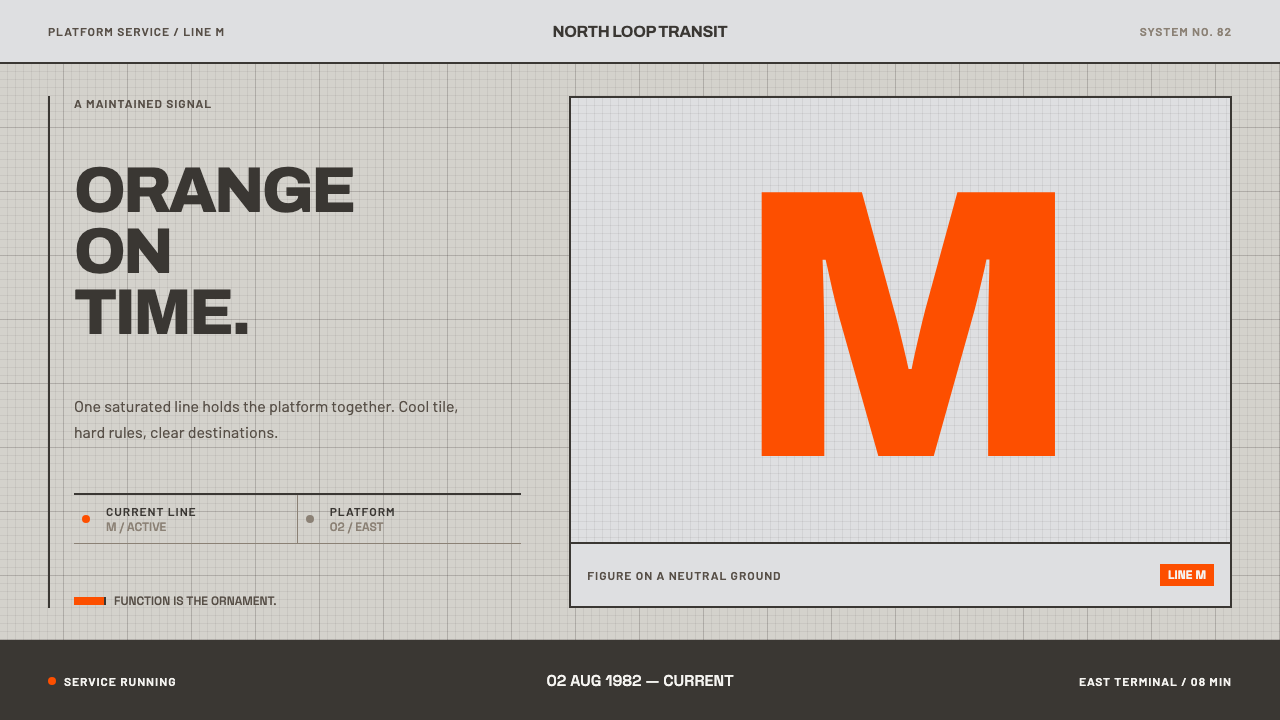 Helsinki Metro OrangeOne orange does the work. Archivo signage cuts across an 8px concrete tile gr…
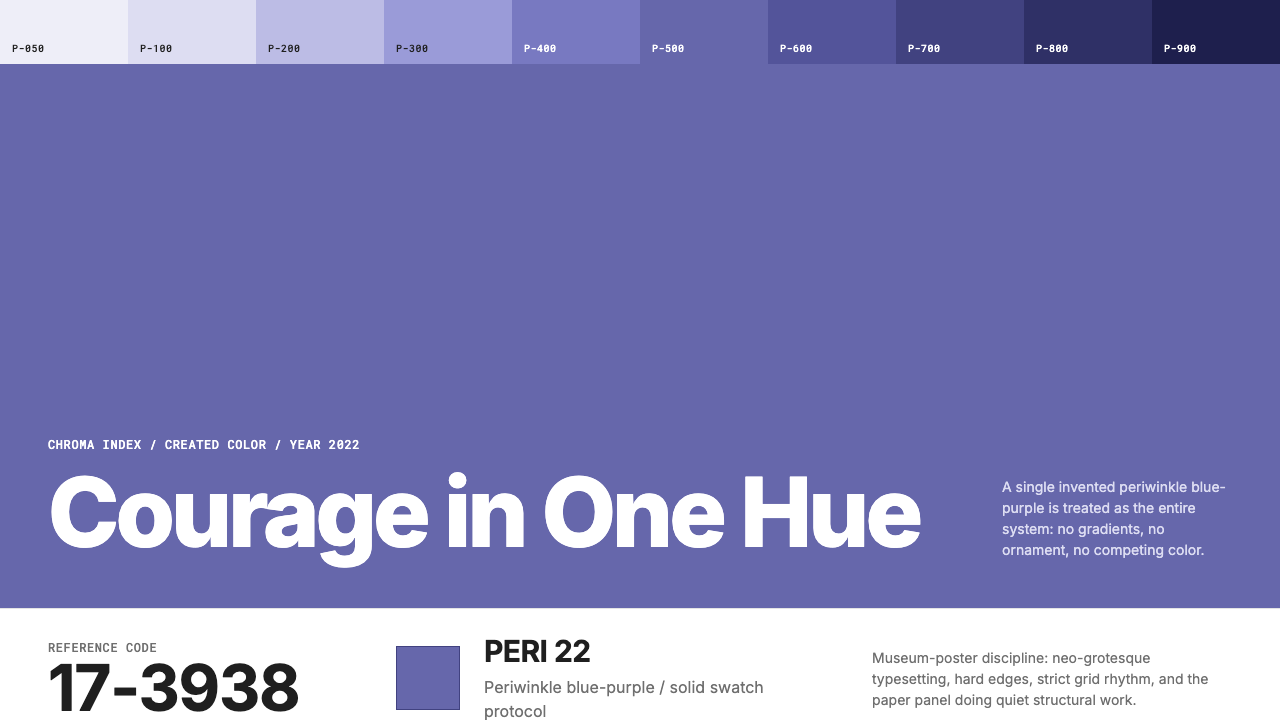 Pantone Very Peri (2022)Color becomes authority. Periwinkle field, reference codes, and white paper i…
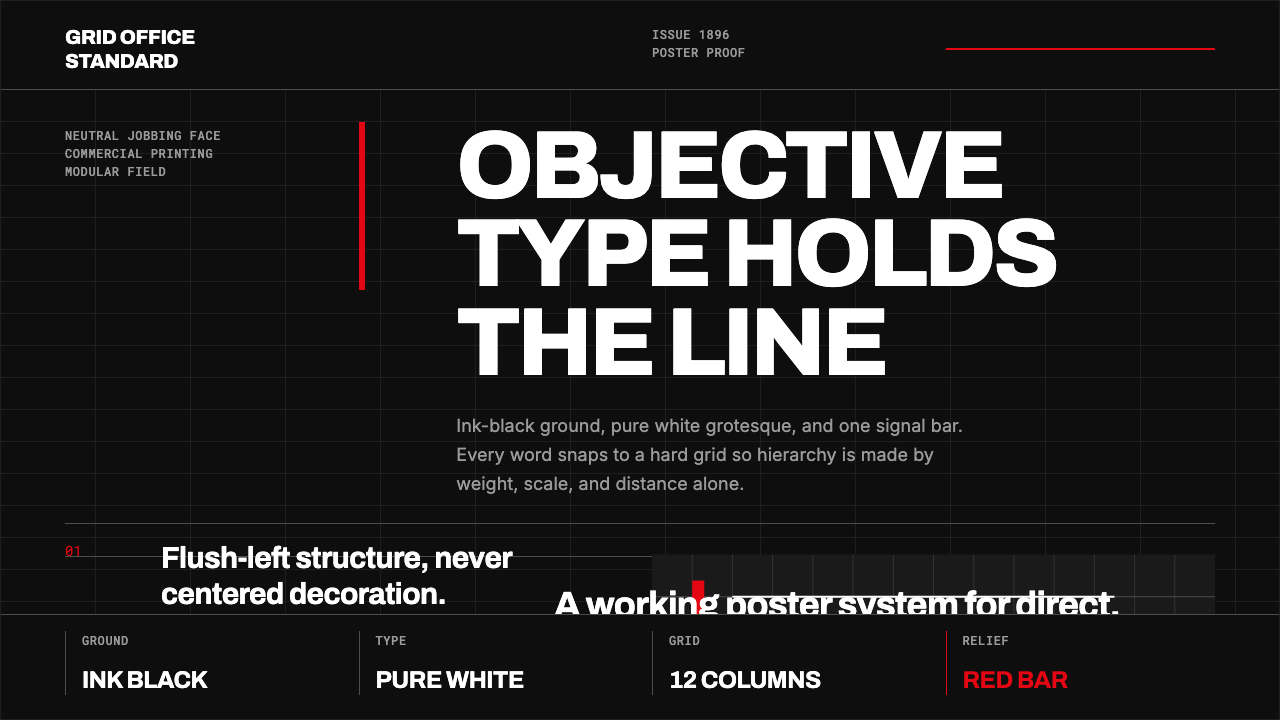 Akzidenz-Grotesk BertholdObjectivity in black ink. White grotesque type, hard grid, one rationed red b…
 Hospital Wayfinding 1970Colour removes hesitation. Enamel green rails and open grotesque plates lead…
 Israeli Bezalel ModernismForm follows the state. Hard Bauhaus discs and ochre bars on absolute blue, H…
 Lufthansa (Aicher)Systems speak first. Melon yellow, navy disc mark, lowercase Helvetica on a h…