What is The New Yorker Classic?
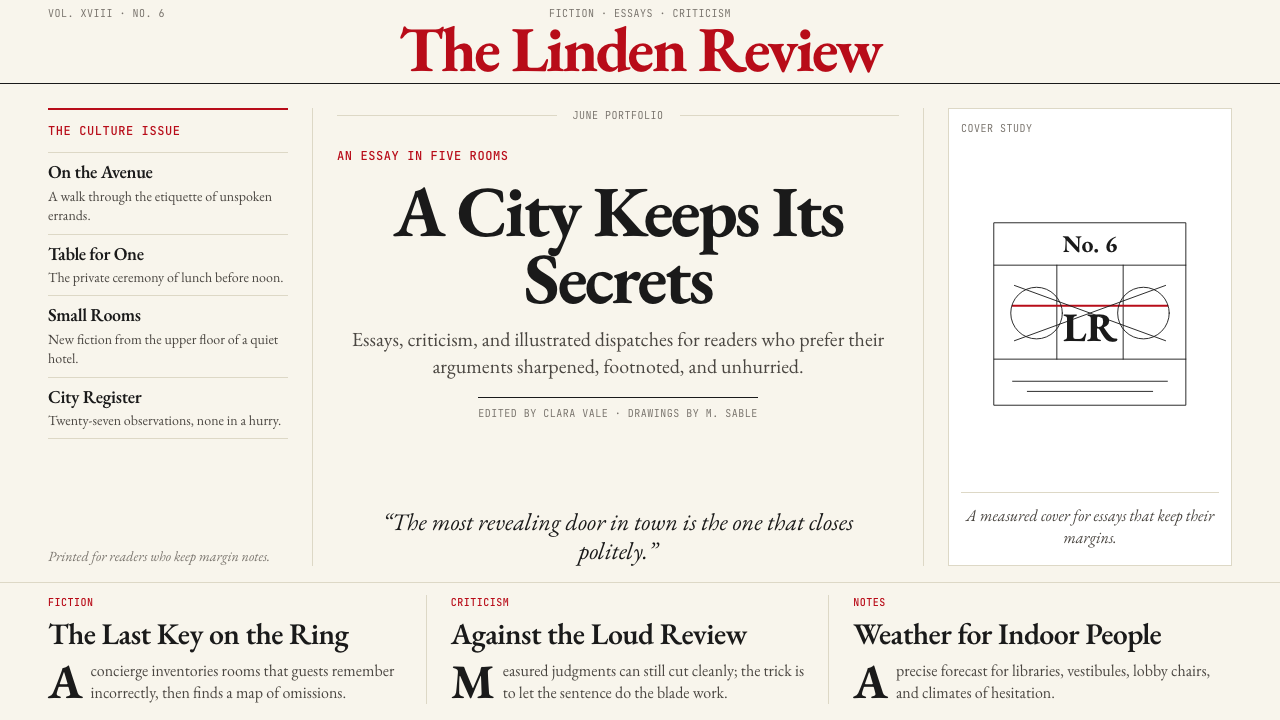
For a century, The New Yorker has proved that intellectual authority needs no ornament — only cream paper, deep ink, a single red rule, and type that trusts itself.
The New Yorker Classic in brief
The New Yorker Classic is the visual language of American literary editorial restraint — a system built on cream-toned grounds, deep black ink, classical serif typography, and a palette so disciplined it admits only the occasional flash of masthead red. Nothing in the system competes with the writing. Every design decision defers to readability and the quiet confidence that characterizes intellectual publication at its best.
Where many editorial styles announce themselves through decoration, this one asserts authority through what it withholds. Hairline rules divide columns without interrupting flow. Drop capitals signal the opening of a piece without theatrics. White space is distributed generously, not as an aesthetic gesture, but because the text requires room to breathe. The result is a page that feels considered and unhurried — the visual equivalent of a long-form essay read on a Sunday afternoon.
The style draws on a century of accumulated typographic decisions refined across thousands of issues, each building on the last without veering into novelty. Its visual consistency is itself a form of editorial statement: this publication does not chase trends. That conservatism, applied with genuine craft, produces a design language that feels neither stale nor fashionable — it simply feels authoritative.

Where does The New Yorker Classic come from?
The New Yorker was founded in February 1925 by Harold Ross, a Wyoming-born editor who had previously run Stars and Stripes, the American military newspaper. Ross conceived of a magazine for a sophisticated metropolitan readership — what he called the 'little old lady in Dubuque' not reading, meaning a publication written for urban, educated adults rather than a general national audience. From the very first issue, the design bore the imprint of Rea Irvin, a cartoonist and art director who would define the magazine's visual identity for decades.
Rea Irvin designed the iconic masthead lettering and the first cover, which depicted a Regency-era dandy examining a butterfly through a monocle — a figure who came to be known as Eustace Tilley and who appears on the anniversary cover every year. Irvin's masthead typeface, created specifically for the publication, combined old-style serif proportions with a slightly archaic, gentlemanly character that placed the magazine visually in the tradition of nineteenth-century literary periodicals while remaining readable and fresh. This typographic decision established the tonal register that every subsequent art director would inherit.
During the long editorship of William Shawn, who succeeded Ross after Ross's death in 1951 and remained at the helm until 1987, the magazine's visual identity deepened into something close to institutional permanence. Shawn was famously protective of the editorial atmosphere and resistant to visual change that might distract from the writing. Under his watch, the pen-and-ink cartoon became the magazine's most distinctive recurring visual element — single-panel drawings rendered in confident, economical line, punctuating prose and poetry alike with wit and compression. The cartoons established a graphic vocabulary as recognizable as the typography itself.
The transition to digital did not unsettle the visual fundamentals. David Remnick, who became editor in 1998, oversaw the magazine's expansion online and into audio without abandoning the aesthetic commitments that had accumulated since 1925. If anything, the digital era demonstrated the robustness of the original system: the cream-and-ink palette translated to screen with minimal adjustment, the typographic hierarchy remained legible at any size, and the single accent color — that flash of red — anchored identity across platforms. The New Yorker Classic is, in this sense, a design system that survived its own medium shift.
What defines the The New Yorker Classic look?
Palette
The color system is almost monastic in its discipline. The ground is cream or warm off-white — not clinical white, but the tone of aged quality paper that reads as cultured and unhurried. All type and ruling lines are set in deep ink black. The sole accent is a specific warm red reserved almost entirely for the masthead and occasional structural signals. This three-value palette — cream, black, red — functions as a complete system. Nothing is added to increase visual interest; the richness comes from typographic texture, not chromatic variety.
Typography
Classical serif type governs every text element — body, headline, caption, and byline. The letterforms carry old-style proportions: moderate stroke contrast, bracketed serifs, and slightly condensed capitals that trace their lineage to Renaissance printing. Body text is set at a generous measure with ample leading, making extended reading comfortable without requiring any visual interruption. Headings are distinguished by scale and weight rather than typeface change, maintaining a single-family coherence across the entire page. Drop capitals, used to open major features, are rendered in a style that references historical book typography without literal quotation.
Ruling Lines and Structure
Hairline rules — lines of the minimum weight that can be cleanly printed — serve as the primary structural device. They separate sections, define columns, and mark the boundary between departments without asserting themselves visually. A single bolder rule, used sparingly, can anchor a page header or close a major section. The ruling system derives from classical newspaper and magazine typography, where the rule was both structural and economical — a single stroke accomplishing what a decorative border would have required multiple elements to do.
Pen-and-Ink Illustration
The single-panel cartoon rendered in pen-and-ink line is the style's most culturally specific visual element. These drawings are executed in a confident, economical line that achieves character and humor without tonal complexity — no watercolor wash, no gradient fill, no photographic reference. The cartoons share a graphic quality with the typography: they are black on white (or cream), they use negative space actively, and they trust the viewer's ability to complete the image from minimal visual information. This illustration mode represents a commitment to craft over production value.
Column Architecture
The multi-column grid distributes text into a measured reading rhythm. Columns are typically narrow enough to minimize eye travel but wide enough to accommodate the longer words common to literary prose. Margins are generous on all sides, providing visual rest and room for the occasional pull quote or caption without crowding the primary text. The architecture is conservative by design — it rejects the variable-column experiments that periodically tempt editorial designers — because its function is to serve extended reading, not to create visual interest at a glance.
Editorial Restraint as Identity
What distinguishes this style from mere conservative typography is the coherence of its restraint. Every decision — the cream ground, the ink palette, the single accent color, the hairline rule, the pen-and-ink cartoon — reinforces the same editorial position: the writing is the thing. This is not minimalism adopted for aesthetic fashion; it is discipline maintained over a century because it serves the purpose. The restraint is itself expressive, communicating intellectual confidence, cultural authority, and a refusal to compete with its own content.
Typographic Wit
Within the severe overall system, a tradition of subtle typographic wit persists — in the headline phrasing style, the caption voice, and the occasional playful variation in section headings that breaks the system's gravity without abandoning its principles. This wit is entirely achieved through language and proportion, never through decorative technique. It reflects the editorial culture of the publication: serious about ideas, never solemn about presentation. The distinction between serious and solemn is one the visual system actively maintains.

Who shaped The New Yorker Classic?
Ross founded The New Yorker in 1925 and shaped its editorial identity until his death in 1951. His insistence on factual precision, long-form depth, and a specific kind of urbane wit established the content values that the visual design had to serve. Ross famously maintained that the magazine was not edited for 'the old lady in Dubuque' — a shorthand for the broad general audience that contemporary publications courted. This editorial exclusivity translated directly into visual decisions: a design that assumed a reader willing to slow down, and that rewarded that patience with typographic and editorial quality.
Irvin served as the magazine's first art editor and created both the masthead letterform and the foundational visual vocabulary that persists to this day. His Eustace Tilley cover of February 1925 — the monocled dandy and butterfly — established the magazine's self-aware, gently ironic persona. The masthead typeface Irvin designed placed the publication in the lineage of dignified print tradition while giving it a character specifically its own. Irvin's contributions represent one of the most durable acts of visual identity definition in American publishing history.
Shawn's editorship from 1952 to 1987 — thirty-five years — deepened and stabilized the visual identity into something approaching institutional definition. His resistance to visual change was not conservatism for its own sake but a principled understanding that the magazine's authority depended on accumulated consistency. Under Shawn, the typographic system and the cartoon tradition were treated as untouchable — not frozen, but evolved with great deliberateness. His tenure established the magazine as a visual and editorial landmark against which subsequent iterations would be measured.
Remnick became editor in 1998 and has overseen the magazine's expansion into digital formats, audio, and video without dismantling the visual fundamentals established by his predecessors. His tenure demonstrates that the New Yorker Classic system is genuinely portable — that its principles of typographic authority, disciplined palette, and editorial restraint can be applied to new media contexts without becoming costume. Remnick's stewardship has also seen the magazine's visual identity become, if anything, more globally recognized, as the masthead and its associated aesthetic have achieved a kind of universal signifier status for quality long-form journalism.
How do you use The New Yorker Classic today?
The New Yorker Classic translates most naturally to contexts where written content is the primary offering and where communicating intellectual seriousness and cultural authority matters more than visual novelty. Applying it well requires understanding that its restraint is a feature, not a limitation — the absence of decoration is what creates the atmosphere of confidence. Starting from that understanding prevents the most common failure mode: adding visual complexity because the plain version feels 'unfinished.'
For presentation slides, the style works with particular strength on both cover and long-form content pages. A cover in this mode benefits from asymmetric typographic composition — a substantial headline in classical serif type, set flush left against the cream ground, with the organization name or date in a smaller scale below, and perhaps a single pen-and-ink style illustration or a simple ruled border. Content slides should prioritize column-like text flow over fragmented bullet points. Data slides take on an editorial quality: charts and tables styled with clean rules rather than colored backgrounds, axis labels set in the same serif family as the body text, and one warm accent color used sparingly to indicate the most important data point.
For web interfaces and dashboards, the style suits information-dense environments where trust, legibility, and hierarchy are the design priorities. A dashboard in this mode uses a near-cream or warm white background, sets all body text and labels in a classical serif, and applies the accent color only to interactive states or critical alerts. Navigation is typographic rather than icon-driven. Pricing pages benefit from the style's inherent sense of quality — column-based layouts, hairline rule separators, and tier names set in elegant serif with supporting descriptive prose rather than bullet features lists.
For editorial and marketing materials — article layouts, newsletters, event programs, brand reports — the New Yorker Classic provides a reliable framework for content-first presentation. An article layout in this mode uses a multi-column grid with generous margins, reserves the outer margin for pull quotes or annotations set at a smaller scale, and marks section breaks with a single bold horizontal rule rather than decorative imagery. Marketing pages benefit from the style's quiet assertiveness: alternating full-width content blocks in cream-on-black and black-on-cream, with the accent color reserved for the single most important call to action per page.
A common mistake when applying this style is importing the aesthetic without the underlying editorial logic. Decorating a dense, visually noisy layout with cream backgrounds and serif fonts produces something that looks confused rather than authoritative. The style works because every element earns its place. If you find yourself adding elements to fill visual space, the problem is the element — not the space. The space is doing work. Similarly, introducing a second accent color, or substituting a display serif with high visual personality for the quieter classical proportions the system requires, will break the register immediately. The system depends on restraint being total, not partial.

The New Yorker Classic — FAQ
How is The New Yorker Classic different from generic editorial serif design?
Generic editorial serif design often uses classical typography as one element among many — combined with photographic imagery, varied accent colors, or structural grids that change between departments. The New Yorker Classic is distinguished by the totality of its system: the palette never exceeds three values, the illustrative tradition is pen-and-ink rather than photographic, and the structural vocabulary — hairline rules, drop caps, generous margins — is applied consistently across every element without exception. The system's authority comes from its coherence, not from any single element being especially distinctive.
Can this style work for brands outside editorial publishing?
Yes, but the fit depends on what values the brand wants to communicate. The style is well suited to any context where intellectual credibility, considered taste, and a certain cultural seriousness are genuine brand values — financial services positioning around expertise, consultancies communicating analytical depth, cultural institutions projecting curatorial authority, or premium consumer products where heritage and craft matter. It struggles in contexts requiring warmth, playfulness, or aspirational energy — lifestyle brands, youth-oriented products, or any context where the design needs to feel approachable and energetic rather than assured and unhurried.
Is it possible to use this style without classical serif typefaces?
The classical serif is so central to the style that removing it requires exceptional care. The serif carries the tonal register — the sense of accumulated tradition and considered taste — that the cream palette and hairline rules reinforce. A sans-serif substitution tends to shift the register toward the clinical or the corporate rather than the literary. If a sans-serif must be used for technical reasons, the best approach is to select one with humanist proportions and generous spacing that echoes the rhythm of the serif system, and to compensate by increasing the weight given to other system elements: richer cream tone, more prominent ruling structure, and illustration that maintains the pen-and-ink vocabulary.
How should the single accent color be deployed to avoid overuse?
The discipline is simple: the accent appears once per visual unit — once per slide, once per page section, once per card — and only on the element that carries the most important piece of information or the primary identity signal. On a cover, it belongs to the masthead or the issue descriptor. On a content page, it marks a single critical metric or the section header. On a navigation bar, it indicates only the active state. The moment it appears on two competing elements of equal importance, it loses its function as a signal and becomes decoration. If you find yourself uncertain where the accent should go, that uncertainty usually means the design has too many elements competing for primary attention.
Does this style work in digital dark mode?
Dark mode presents real challenges for a system whose identity is built on warm cream and deep ink. A simple color inversion — black ground, cream text — is technically possible and can retain some of the typographic character, but it loses the sense of printed-page warmth that gives the light version its particular atmosphere. The accent red, on a dark ground, can shift in perceived intensity and may need to be slightly cooled or deepened to avoid reading as aggressive. A more considered dark adaptation treats the dark ground not as a direct inversion but as a translation: deep cool-toned near-black that echoes the depth of aged ink, cream-toned type rather than pure white, and the accent used even more sparingly than in the light version.
Related design styles
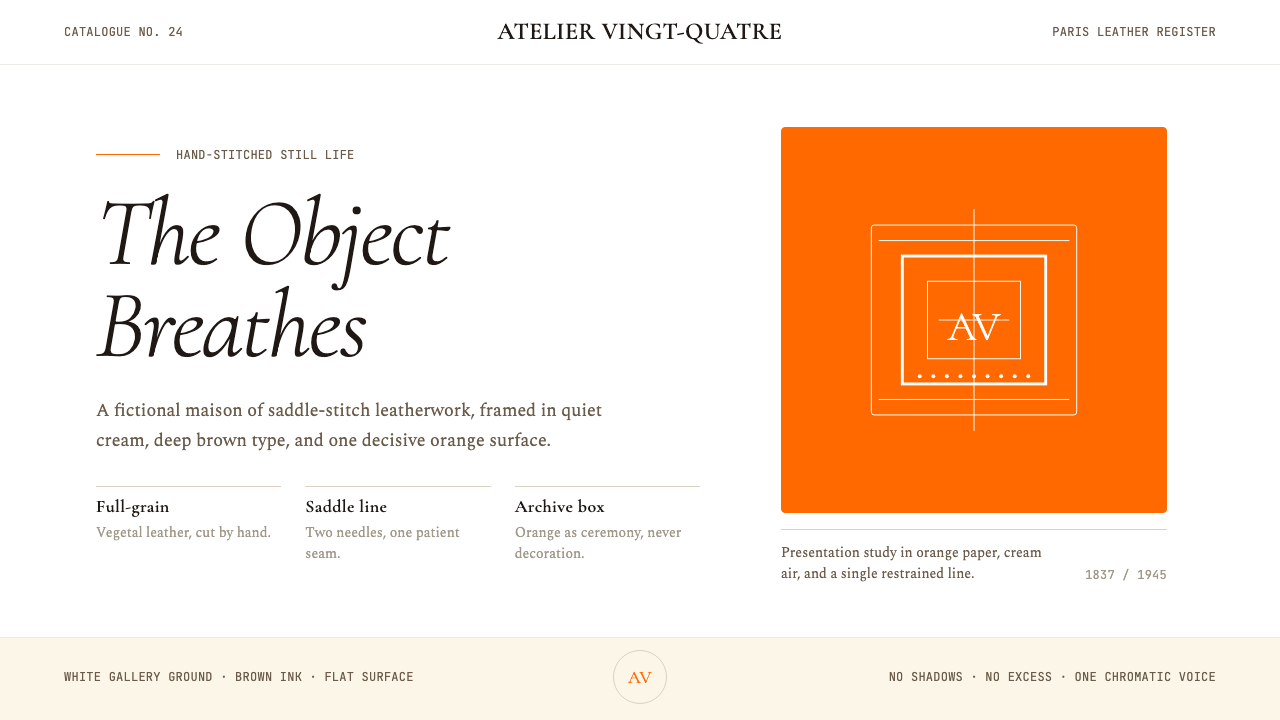 HermèsTwo centuries of restraint in orange. Brown serif on cream, gallery-quiet, ne…
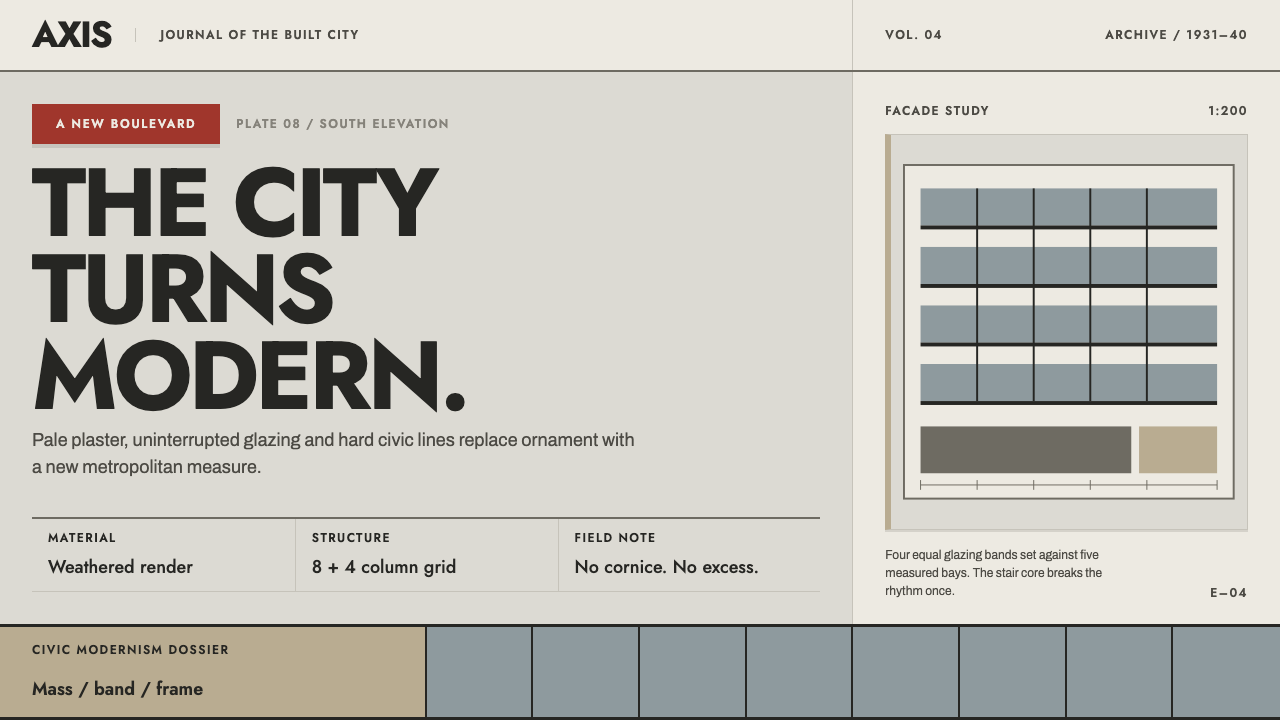 Bucharest Interwar ModernismModernism gathers civic weight. Sooted plaster, strict glazing bands and one…
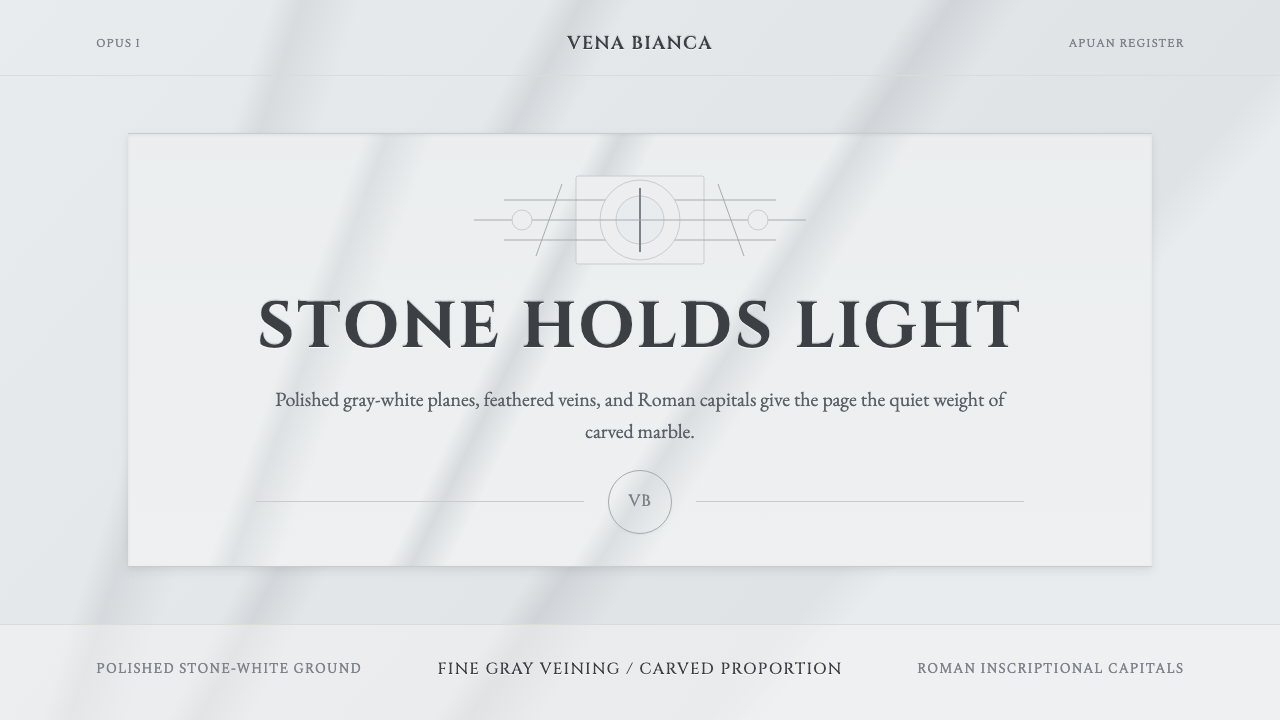 Carrara MarbleLuxury in restraint. Cool stone-white fields, feathery gray veins, and Cinzel…
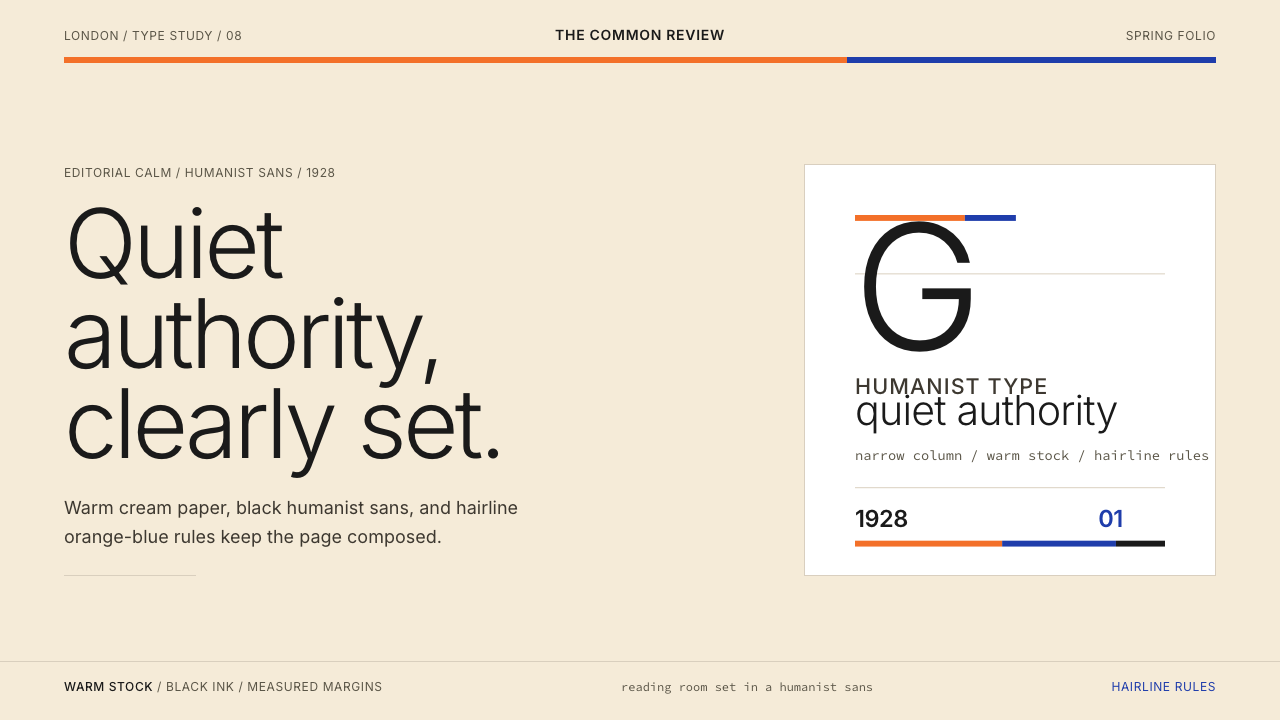 Gill Sans (BBC, 1928)Quiet authority, clearly set. Warm cream, black humanist sans, and hairline o…
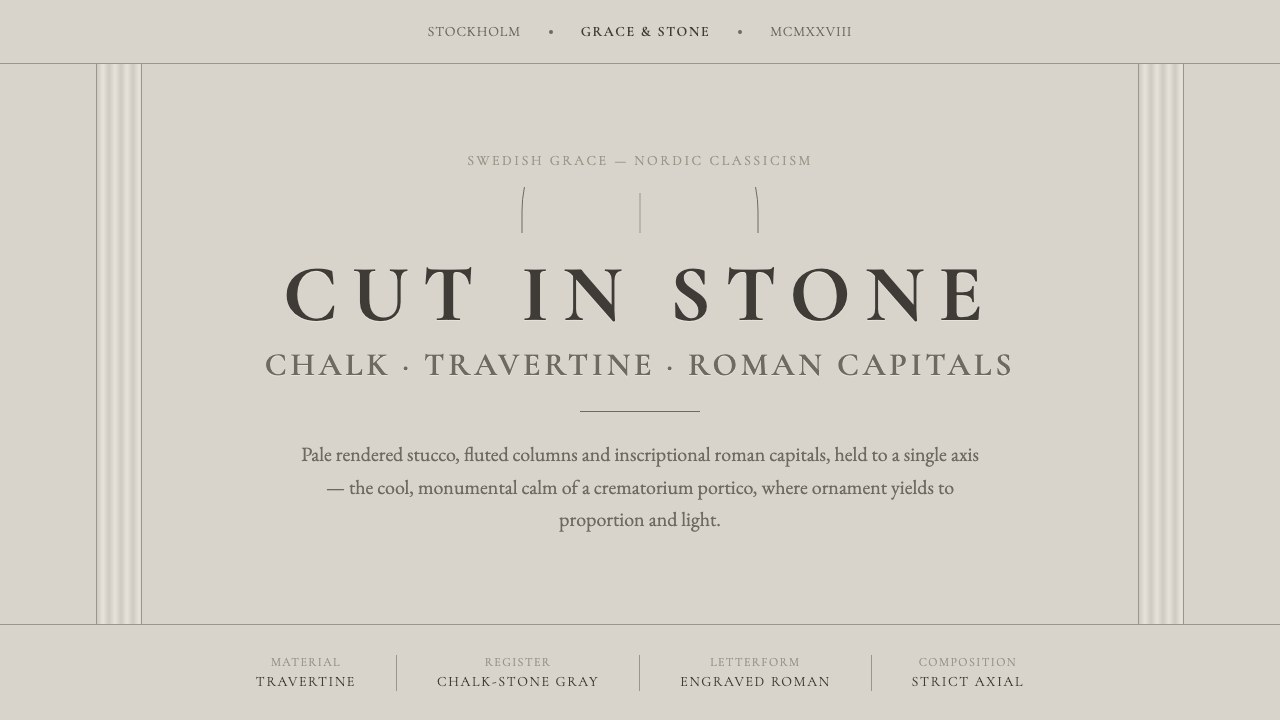 Nordic Classicism AsplundStone, not cream. Engraved Trajan capitals on cool chalk stucco, fluted colum…
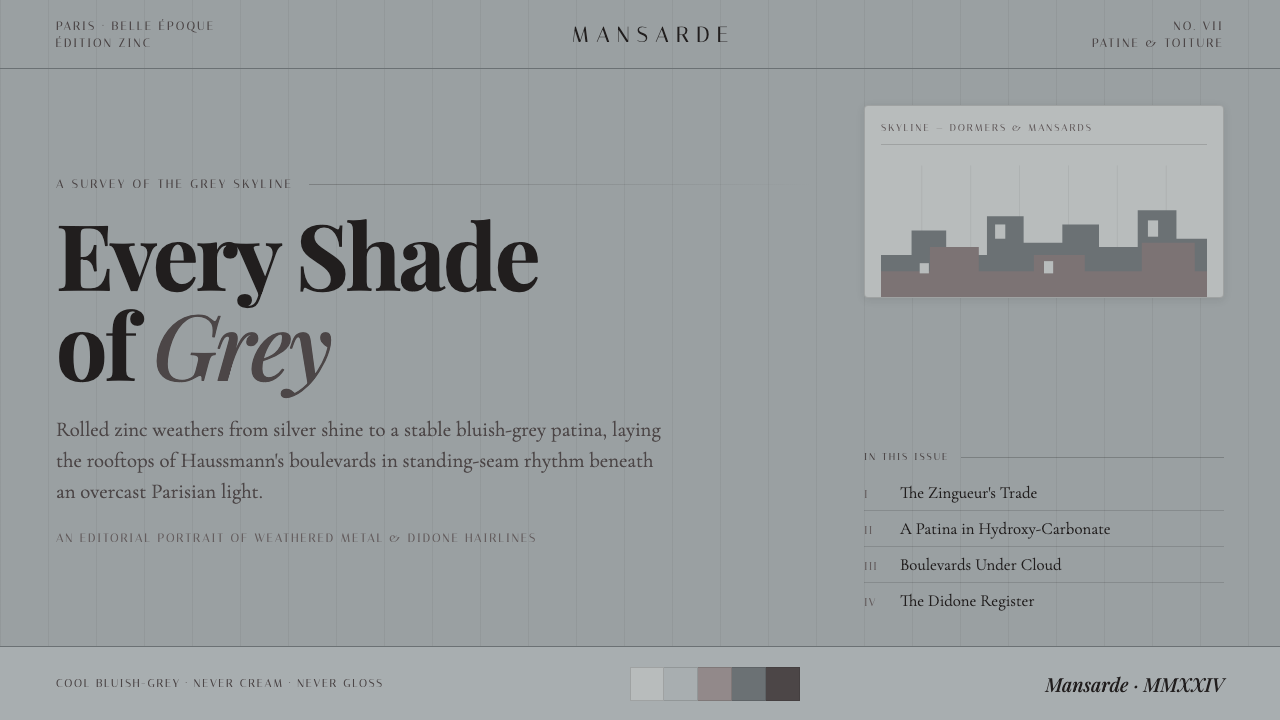 Paris Zinc RooftopsEvery shade of grey. One weathered zinc palette, set in high-contrast Playfai…