What is PNG Bilum (Looped String Bag)?
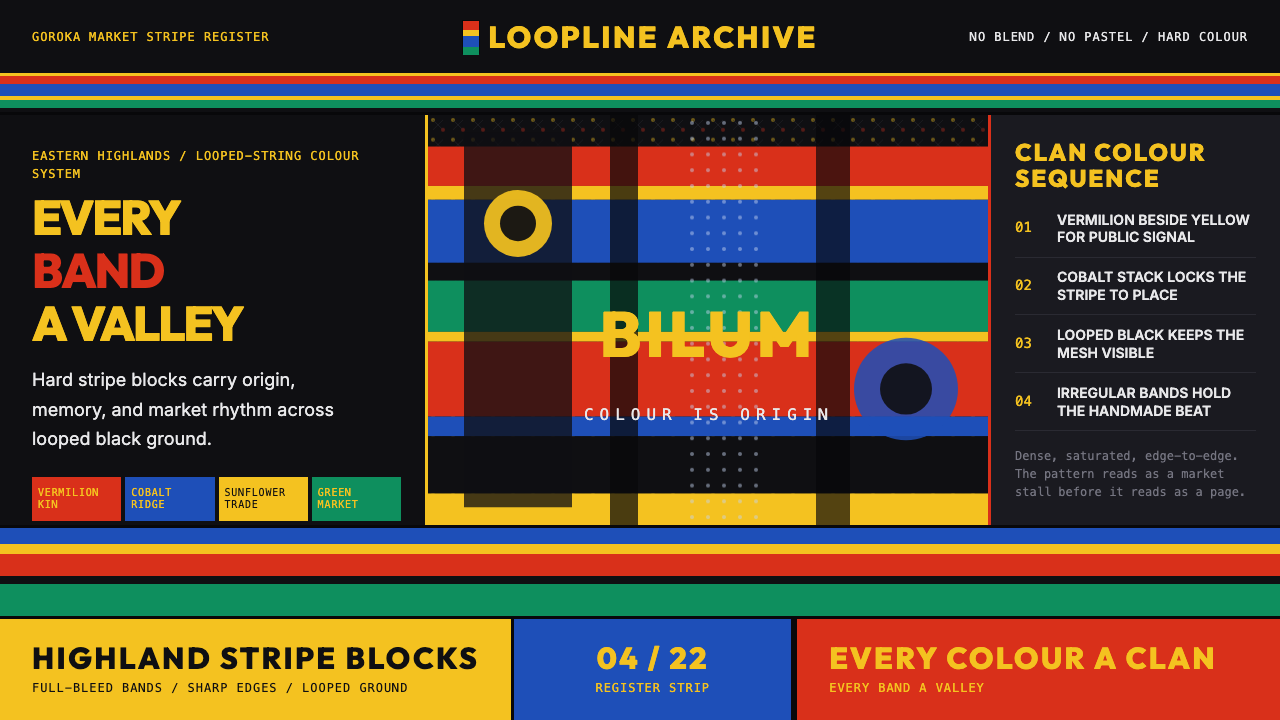
The bilum — Papua New Guinea's hand-looped string bag — encodes clan identity in stripe colour combinations so vivid they vibrate off the textile and into every digital surface they touch.
PNG Bilum (Looped String Bag) in brief
PNG Bilum (Looped String Bag) is a design language drawn from the living textile tradition of Papua New Guinea's highlands communities. At its core is a system of dense, saturated colour bands — vermilion, cobalt, sunflower yellow — set against a near-black ground, with stripe boundaries that are absolute and unblurred. No gradient softens the transition between one band and the next; each colour declares itself with full force before yielding to its neighbour.
The aesthetic is simultaneously tribal and graphic, ancient and billboard-loud. Where most design traditions counsel restraint in the use of high-saturation colour, the bilum tradition treats saturation as the medium itself — the higher the intensity, the more precisely clan identity is communicated. In a digital context, this translates to an interface language that feels bold, warm, and distinctly non-Western: a welcome corrective to the cool neutrality that dominates most contemporary screen design.
What distinguishes this style from mere bright-colour decoration is its structural rigour. The bands follow a rhythm — wide, narrow, wide — that creates a hierarchy within the stripe sequence. There is irregular, hand-looped texture implied beneath the boldness, a quality of being made rather than mechanically produced. Applied to screens, that organic tension gives the system depth without requiring actual depth effects: the composition breathes through colour contrast alone.
Where does PNG Bilum (Looped String Bag) come from?
The bilum is among the oldest continuously practised fibre arts in Oceania. Archaeobotanical evidence and oral tradition both place the looped-string bag in the New Guinea highlands long before European contact, with some scholars tracing its origin to communities that had no access to woven cloth and developed looping as a complete fibre technology for carrying, storing, and displaying. The bags were made from plant fibres — pandanus, orchid vine, tree bark — worked into loops by hand without the use of needles or looms.
When Australian colonial administration arrived in the twentieth century, trade wool and synthetic dyes entered the highlands through patrol posts and trade stores. The effect was not homogenisation but intensification: highland women adopted the new materials and used the expanded palette to push the stripe tradition further. Synthetic vermilion, cobalt, and aniline yellow were brighter and more colourfast than anything available from plant dyes, and communities quickly incorporated them into the existing vocabulary of clan-specific colour combinations. By the mid-twentieth century, the bilum had become a highly visible marker of regional and clan identity in a way that was partly traditional and partly a response to new colonial social dynamics.
After Papua New Guinea's independence in 1975, the bilum underwent a significant cultural revalorisation. It moved from being perceived as a purely functional or folk object to becoming a symbol of national identity. The Bank of Papua New Guinea featured bilum patterns on currency; government officials began carrying bilums at formal occasions as a statement of cultural pride. The Goroka market and its surrounding cooperative networks became important sites for both the production and the aesthetic standardisation of the highlands stripe tradition.
From the 1990s onward, a generation of PNG artists and fashion designers began working the bilum into contemporary art practice and international fashion. Florence Jaukae Kamel, Ruth Choulai, and Wendy Choulai are among those who developed the visual language into gallery and performance contexts, while the Bilum Wear Project and Goroka cooperative movement formalised production networks that allowed bilum aesthetics to reach international audiences. The tension between commercial adaptation and cultural custodianship remains active: contemporary applications of the style carry an implicit responsibility to acknowledge the living community from which it comes.
What defines the PNG Bilum (Looped String Bag) look?
Colour
The palette centres on a trio of high-intensity primaries — a warm vermilion red, a deep cobalt blue, and a sunflower yellow — deployed against a near-black ground. Each colour is used at its most saturated expression: no tinting, no desaturation, no blending. The near-black background is not neutral in the Western sense but weighted and velvety, giving the saturated bands maximum contrast and visual vibration. Secondary colours appear only as transitional bands and are never allowed to dominate. The overall effect is chromatic intensity without chaos, because each colour occupies its own clearly bounded stripe.
Stripe Structure
Stripes are the fundamental compositional unit. They run in one consistent direction — typically horizontal — and vary in width according to a hierarchy: a wide anchor band, a narrow transition band, a medium secondary band. This rhythm is not mechanical but intentional, producing a sequence that reads as both ordered and handmade. Boundaries between stripes are crisp and absolute; there is no feathering or softening at the edges. The stripe unit can be applied to backgrounds, borders, dividers, progress indicators, and header regions without losing its identity.
Texture and Mesh Rhythm
Beneath the bold colour blocking, the bilum tradition carries an organic mesh quality — the visible irregularity of hand-looped string, where each knot is slightly different from the last. In digital interpretation, this quality is expressed through subtle compositional asymmetries, slightly uneven spacing, and the occasional textural motif that breaks the rigidity of pure geometry. The effect is warmth within boldness: the system feels crafted rather than printed, rooted in human hands rather than machine output.
Scale and Density
The bilum aesthetic is dense. Colour bands fill the available space without generous margins; elements sit close together rather than floating in white space. This density reflects the physical textile, where loops pack tightly and no material is wasted. In UI application, this translates to a layout that feels generous with colour and content rather than with emptiness. Breathing room is created by the contrast between bands, not by surrounding them with neutral space.
Dark Ground
The near-black ground is not an afterthought but the structural foundation of the entire system. On a light background, the same saturated colours would appear differently — less vibrant, less dramatically weighted. The dark ground creates the optical conditions for maximum colour saturation: the bands appear to emit light rather than reflect it. This makes the system inherently suited to dark-mode interfaces and screen contexts where ambient light is low.
Communal Specificity
Every bilum colour combination belongs to a specific community or clan: the stripe sequence is not decorative but identificatory. In design application, this principle translates to a system where colour combinations carry meaning rather than being interchangeable. Choosing a specific palette within the bilum idiom implies commitment to that combination — it is not background decoration to be varied freely but a consistent identifier. This makes the style particularly suited to brand systems that value distinctiveness and community recognition over generic visual pleasantness.
Warmth and Vitality
Despite its visual boldness, the bilum aesthetic reads as warm rather than cold, festive rather than austere. This warmth comes from the handmade origins — no element is perfectly regular — and from the specific palette, which foregrounds warm reds and yellows rather than the cool blues and greys that characterise most contemporary dark-mode design. The system feels alive in a way that purely geometric dark-mode interfaces typically do not.
Who shaped PNG Bilum (Looped String Bag)?
One of PNG's most internationally recognised fibre artists, Kamel elevated the bilum from craft object to fine art through large-scale textile installations that interrogate gender, identity, and post-colonial belonging. Her work has been exhibited across the Pacific and in international contemporary art contexts, establishing a precedent for bilum aesthetics as a serious visual discourse rather than a cultural curiosity.
A painter and visual artist who drew extensively on PNG textile traditions, Choulai worked to bridge indigenous visual vocabularies with contemporary fine art practice. Her paintings incorporate the stripe logic and colour saturation of bilum-making into two-dimensional compositions that operate comfortably in international gallery contexts while remaining deeply rooted in Papua New Guinean visual culture.
A fashion designer and cultural advocate, Wendy Choulai is credited with bringing bilum aesthetics into international fashion dialogue through wearable garments that translate the looped-string visual language into contemporary clothing. Her work through the PNG contemporary fashion movement helped shift perceptions of Pacific fashion from ethnographic interest to global design relevance.
Not an individual but a networked community of highland women artisans centred on the Goroka market in Eastern Highlands Province, this cooperative movement shaped the aesthetic standardisation and commercial distribution of bilum work through the late twentieth century. The cooperatives established quality norms, training pathways, and market connections that allowed the bilum tradition to survive modernisation while remaining economically viable for the communities that practise it.
A writer and cultural commentator whose documentation of PNG craft traditions, including the bilum, contributed to international awareness of Papua New Guinean material culture. Wilson's work forms part of the broader effort to establish rigorous documentation of living Pacific craft traditions at a moment when they were beginning to attract commercial and artistic attention from outside the region.
How do you use PNG Bilum (Looped String Bag) today?
The bilum design language is one of the rare systems whose visual intensity translates directly into digital media without loss. Its foundational properties — high saturation on a dark ground, sharp stripe boundaries, handmade warmth — are screen-native qualities that work as well on a monitor as they do on the physical textile. The challenge is not amplification but discipline: restraint in how many colour combinations are used simultaneously, and rigour in maintaining the stripe logic rather than treating the palette as freeform permission.
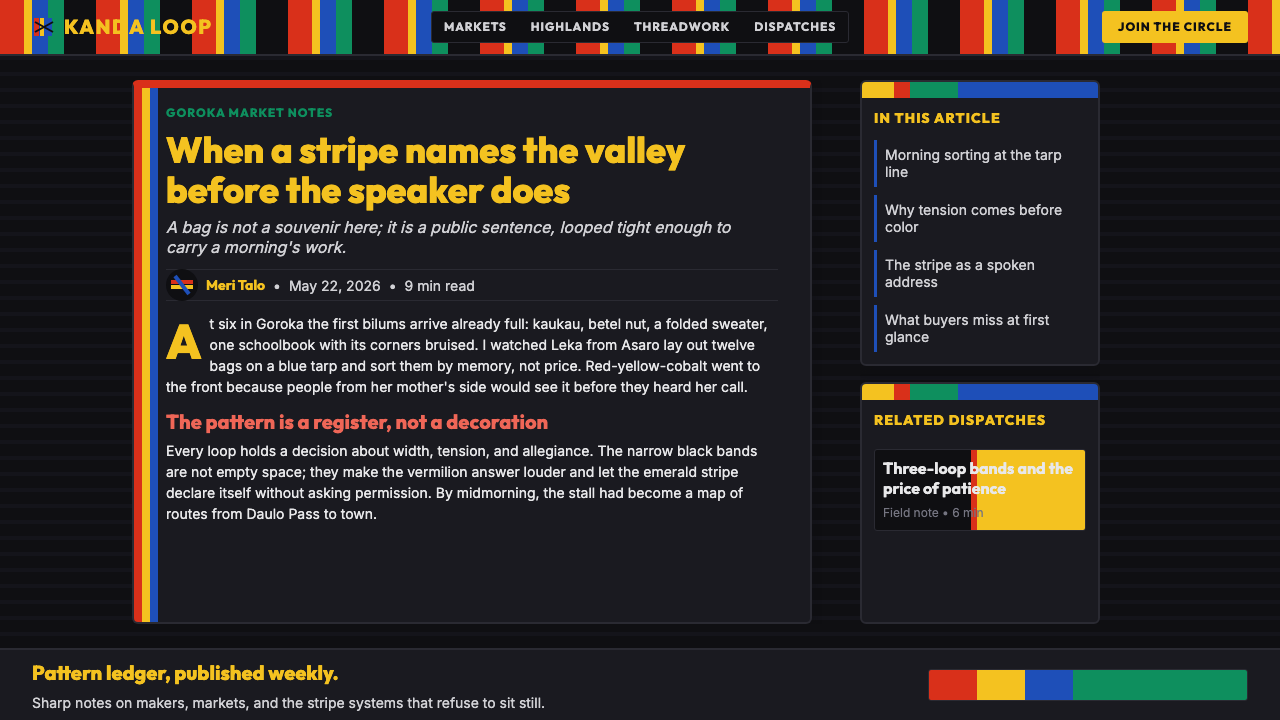
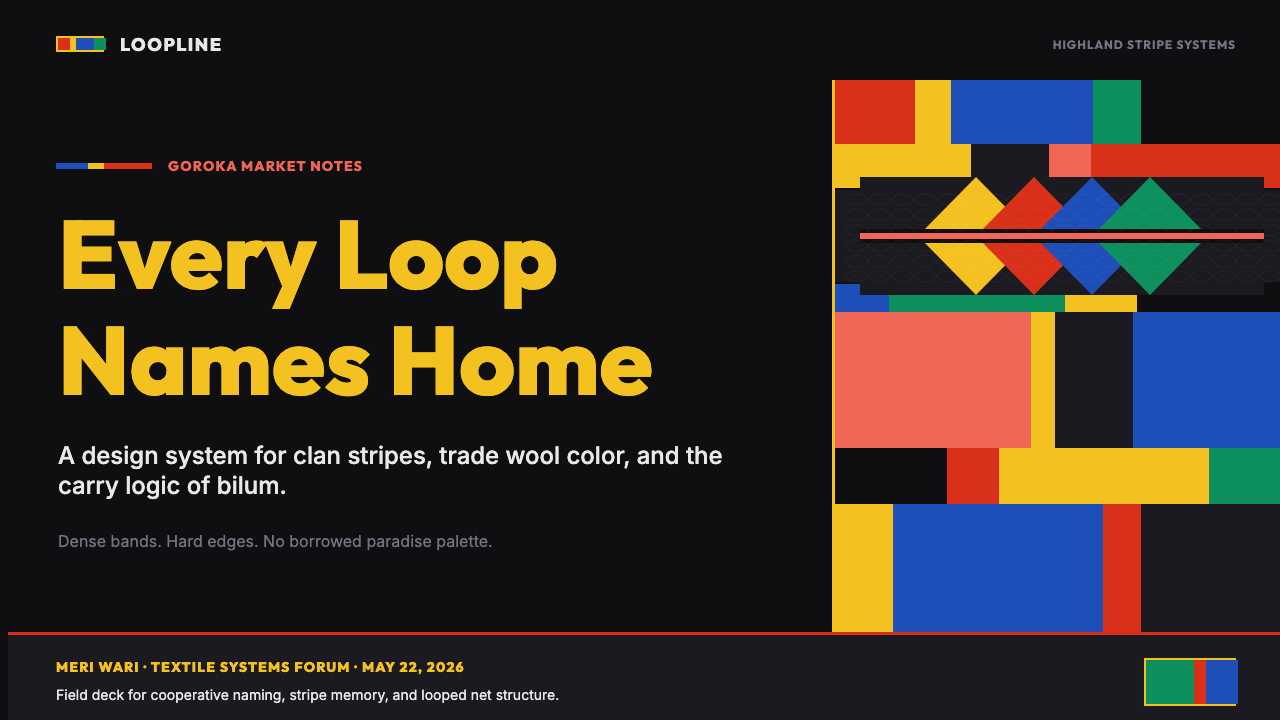
For presentation slides, the style has an immediate commanding presence that works exceptionally well for cover pages, section dividers, and data summaries. A cover slide benefits from a full-bleed stripe background — running horizontally across the frame — with title type reversed out in a light neutral against the dark field. For content slides, apply the stripe logic to the header band alone and keep the body field near-black with light type; this brings the identity mark down to a calibrated accent without competing with content. Data visualisations take on a distinctive character when chart elements — bar fills, line colours, segment hues — draw from the bilum primary trio rather than the standard business blue-and-grey.
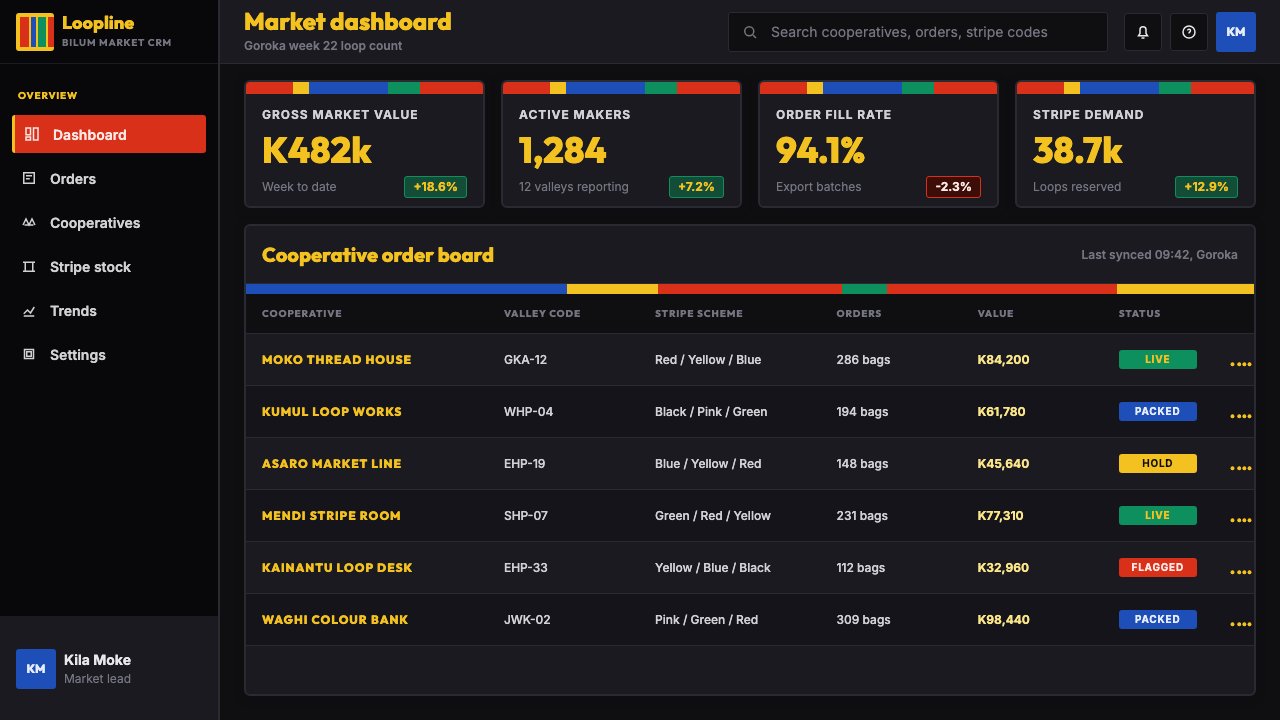
For web interfaces, the system is particularly suited to product pages, hero sections, landing pages, and navigation elements where identity impact is the priority. A dashboard or pricing page built on this system should treat the dark near-black as the base canvas and deploy colour bands as structural separators — between pricing tiers, between feature sections, between navigation levels. Interactive states and hover conditions benefit from drawing from the secondary colours in the bilum vocabulary; there is enough chromatic range within the palette to differentiate states without reaching outside the system.
For editorial and marketing work, the bilum aesthetic offers a powerful alternative to the neutral, cream-and-grey palettes that dominate contemporary editorial design. An article layout using this system might employ a full-width stripe band at the top of each major section, with pull quotes rendered in the primary vermilion or cobalt against the near-black field. Marketing materials — event posters, campaign headers, social media assets — benefit most from the style's poster-like intensity: a single wide stripe in one primary colour, a narrow accent in a second, and all text reversed against the dark ground.
A common error when working with this style is treating the three primary colours as interchangeable accent colours to be rotated freely. In the source tradition, each clan's stripe combination is fixed and identificatory; randomising colour order undermines the system's coherence. Choose a specific combination and commit to it throughout a project. A second frequent mistake is attempting to soften the style with gradients, blurs, or transparent overlays in the interest of appearing more contemporary — these additions destroy the optical tension between saturated bands and dark ground that gives the system its vitality. Trust the contrast and let it work.
PNG Bilum (Looped String Bag) — FAQ
Is it appropriate to use bilum aesthetics in commercial design work without deeper cultural engagement?
This is a genuinely contested question. The bilum is a living tradition belonging to specific highland communities in Papua New Guinea, not a historical artifact. Using its visual language — particularly the stripe colour combinations that encode clan identity — without acknowledgment carries risks of cultural appropriation. The more considered approach is to treat the style as an inspiration to be adapted rather than a template to be copied, to credit the source tradition explicitly in project documentation, and where possible to commission or consult with PNG artists and designers rather than simply importing the aesthetic. Many designers from the region have actively made bilum-derived work available for broader use, and engaging with those specific practitioners is preferable to anonymous adoption.
How does the bilum style work in light-mode interfaces given its dark-ground foundations?
The bilum palette is fundamentally dark-ground in origin — the near-black field is what creates the optical vibration of the saturated bands. A direct light-mode inversion does not work well: on white, the same colours become harsh and lose their luminous quality. However, the style can be adapted for light-mode contexts by treating the near-black as a textured dark-cream or deep warm grey, which retains enough contrast for the colour bands to sing while softening the overall visual weight. Alternatively, the stripe logic can be reduced to accent bands only — a narrow border at the top of a card, a section-header underline, a tag chip background — with the primary surface remaining near-white. This approach captures the identity mark of the style without requiring the full dark-ground commitment.
Can bilum aesthetics work for a professional services or enterprise product, or is it too bold?
Boldness is not the opposite of professionalism — it is the opposite of blandness. Several highly credible enterprise brands (construction, energy, logistics) use saturated colour systems precisely because they want to project confidence and visibility rather than cautious neutrality. The bilum system works well in enterprise contexts where identity differentiation, category ownership, and visual authority are valued. It is less suited to contexts that require clinical neutrality — medical, legal, financial services where understatement signals trust. The decision depends on what the enterprise wants to say: if the brand proposition is energy, directness, or distinctiveness, bilum aesthetics can support it credibly. If the proposition is restraint and precision, a different system will serve better.
What types of projects benefit most from the bilum visual language?
Projects that benefit most are those where visual identity, distinctiveness, and warmth are primary values — cultural festivals, creative agencies, fashion and lifestyle brands, community platforms, social impact organisations, and products targeting audiences who value craft authenticity and non-Western aesthetics. Event identity systems are a natural fit: the stripe logic scales from a small badge to a full-bleed backdrop without losing coherence. Editorial projects covering Pacific, Oceanian, or Papua New Guinean subjects benefit from the cultural grounding the style provides. Any project looking to move away from the dominant cool-minimalist aesthetic of contemporary tech will find the bilum vocabulary a distinctive and credible alternative.
How does bilum compare to other bold stripe-based design systems like Mondrian or Op Art?
The surface similarities are real but the underlying logic is different. Mondrian used primary colours and grid intersections to explore pure pictorial structure with no referential content; his stripes are actually lines that create fields. Op Art exploits optical illusion through precise geometric repetition to disorient the eye. Bilum stripes are neither structuralist nor illusionistic — they are identifiers: each combination means something specific to a community. This gives the bilum system a social and communicative weight that the other two lack. Visually, bilum is warmer (the palette includes the near-black ground rather than white), looser (hand-looped irregularity rather than mechanical precision), and denser (colour bands fill space rather than creating intervals). The most important distinction is orientation: Mondrian and Op Art are about formal properties of vision; bilum is about belonging.
Related design styles
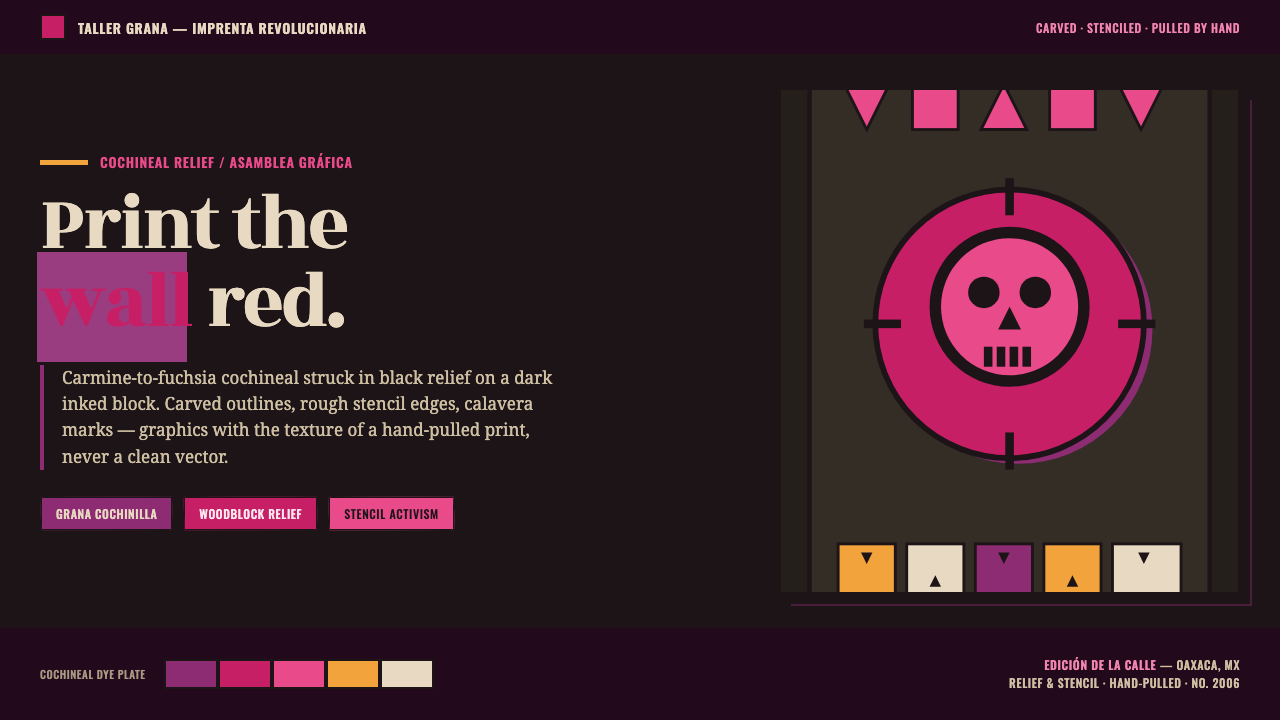 Oaxaca Indigenous-ModernActivist woodblock graphics. Cochineal carmine-fuchsia struck in black relief…
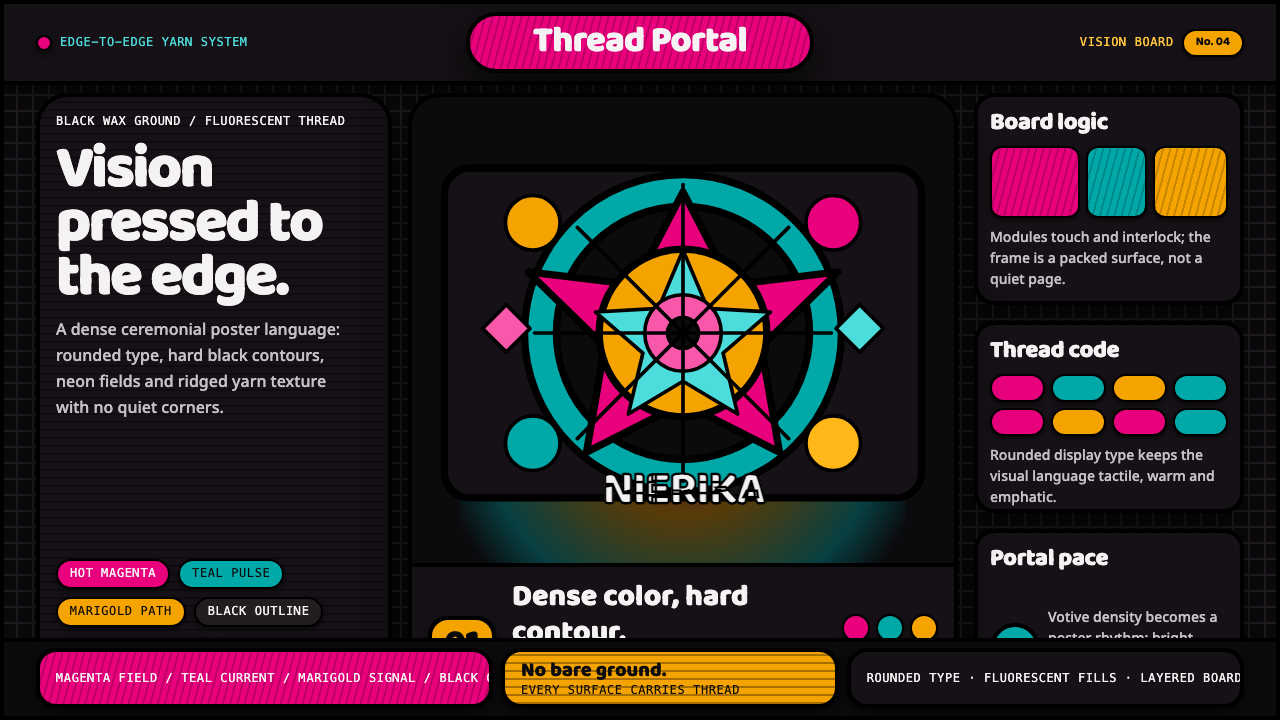 Huichol Yarn NierikaCeremonial density glows. Neon yarn colors lock into black-contoured, edge-to…
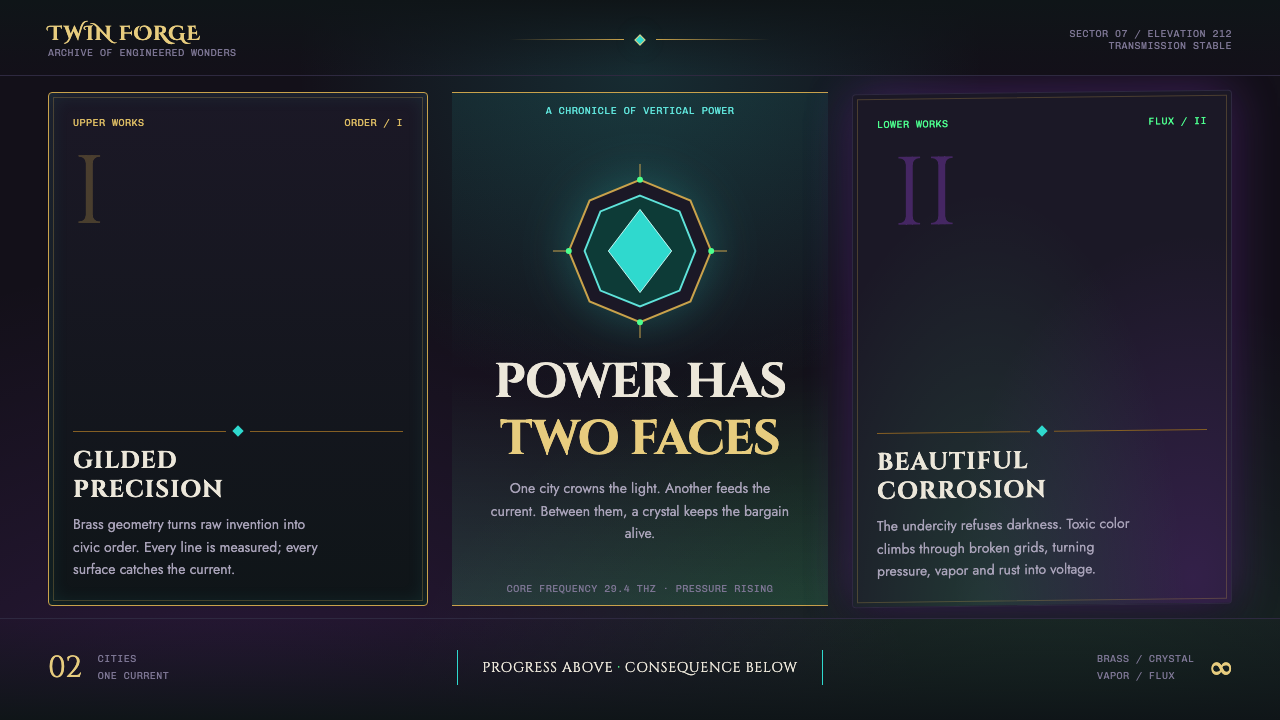 Arcane Hextech (2021)Progress and rot share a current. Brass symmetry meets teal crystal and toxic…
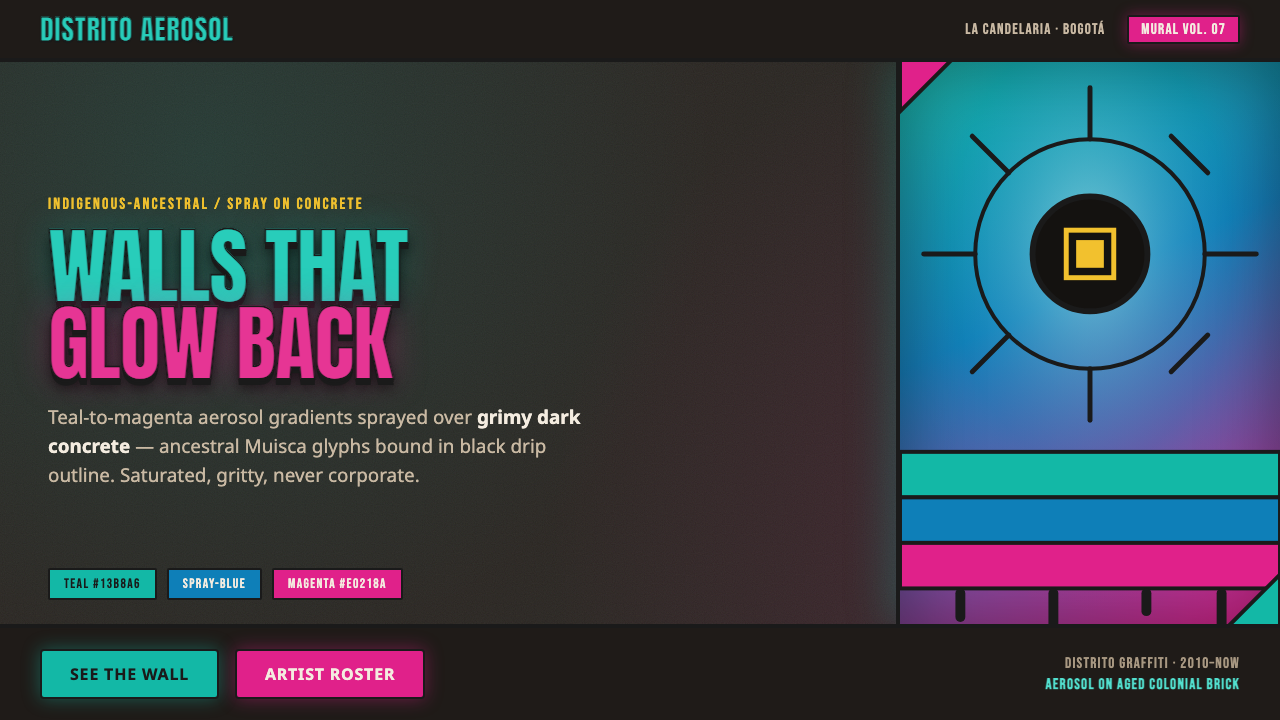 Bogotá Street MuralismNeon spray glowing off the wall. Teal-to-magenta aerosol on grimy concrete, i…
 Gauchito Gil ShrineDevotion burns red. Flag ribbons, brass borders, and slab signage glow on soo…
 Pakistani Truck ArtBlessing crowds every inch. Fuchsia, kelly green, and gold stack into scallop…