What is Africanfuturism Vibranium?
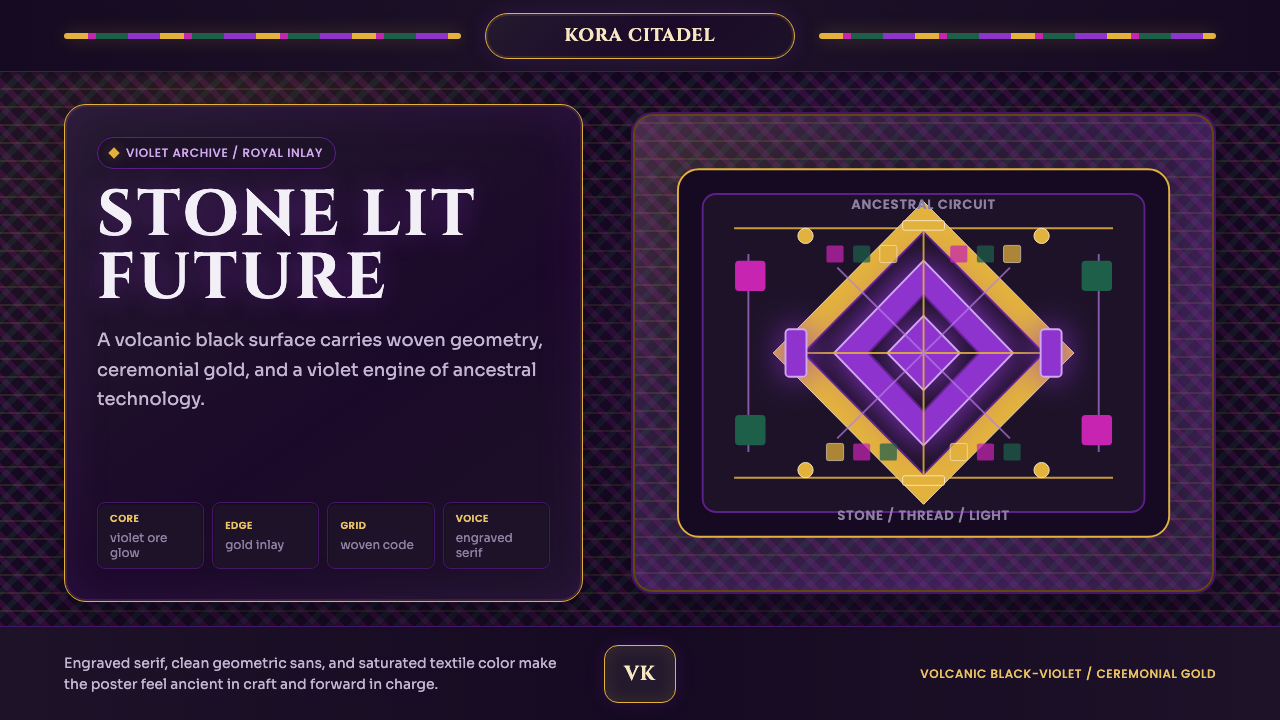
Africanfuturism Vibranium fuses ceremonial weight with electric luminance — a dark volcanic surface inlaid with woven geometric pattern and lit from within by a deep violet glow, carrying the voice of African cultures imagining their own futures on their own terms.
Africanfuturism Vibranium in brief
Africanfuturism Vibranium is a design system rooted in the literary and visual movement of Africanfuturism — a term coined by Nigerian-American author Nnedi Okorafor to distinguish work that centers African cultures and cosmologies imagining their own futures, rather than being filtered through a Western science-fiction lens. The visual style layers this philosophical stance onto the iconic Wakanda aesthetic: dark backgrounds evoking volcanic rock, geometric textile patterns derived from sub-Saharan weaving traditions, and a vibranium-violet inner glow that makes the surface feel alive.
Where Afrofuturism (the broader term) often blends African diasporic cultures with speculative futures, Africanfuturism grounds its speculation firmly on the African continent itself — its histories, spiritual traditions, oral literatures, and craft practices. In visual terms this means the decorative language is not simply 'futuristic with African motifs grafted on' but a genuine synthesis: ceremonial gold inlay reads as both ancestral and technological, geometric kente-influenced grids read as both textile and circuit board, and the dark ground reads as both earth and void.
The color palette is deep and saturated: violet and purple anchor the luminous register, ceremonial gold and warm amber carry cultural weight, and jewel-toned accent colors drawn from African textile traditions — saturated teals, reds, and ochers — punctuate the composition. Typography pairs an engraved-feeling serif for display text (evoking carved inscription) with a clean geometric sans for body and UI copy, holding ancient craft and high technology in deliberate tension.
Where does Africanfuturism Vibranium come from?
Nnedi Okorafor introduced the term Africanfuturism in 2019 to describe a strand of speculative fiction that is specifically and unapologetically rooted in African cultures, not in the African diaspora's relationship with American culture. Her novels — including the Hugo and Nebula Award-winning Binti trilogy and the Akata Witch series — draw on Igbo spiritual cosmology, Nigerian landscape, and pan-African mythology to imagine futures that do not depend on Western narrative frameworks. The distinction from Afrofuturism was deliberate: Okorafor argued that centering the diaspora experience, however vital, still orients African imagination around a Western axis. Africanfuturism asks what futures African cultures would envision entirely from within.
The visual dimension of Africanfuturism gained global recognition through the 2018 Marvel film Black Panther and its fictional nation of Wakanda — a vision developed by director Ryan Coogler and production designer Hannah Beachler. Beachler's research drew on the architectural traditions of the Ethiopian Aksumite Empire, the geometric textile arts of the Ghanaian kente and the Nigerian aso-oke, the beadwork of the Ndebele people of South Africa, and the sculptural traditions of the Dogon of Mali. The result was a visual language that refused both primitivism (Wakanda is not pre-modern) and simple Western futurism (Wakanda does not look like Silicon Valley with African faces). Vibranium — the fictional ore that powers Wakanda — became the metaphor for this synthesis: ancient material with impossible technological properties, lit from within by a violet luminescence that reads as both supernatural and scientific.
The broader tradition from which this aesthetic draws is centuries deep. West and Central African textile geometry — the interlocking diamond, chevron, and stepped-fret patterns of kente, kuba cloth, and mud cloth (bogolanfini) — developed sophisticated visual systems for encoding meaning, genealogy, and cosmological order long before contact with European design traditions. These patterns are not decorative in the Western sense; they are communicative, carrying clan identity, spiritual protection, and historical narrative in their structure. When this geometric visual vocabulary is placed onto a technological surface, the result is not pastiche but translation: the same depth of encoded meaning, now expressed through a different material register.
In the decades since Black Panther's release, Africanfuturism has expanded significantly as a visual design movement, appearing in book cover design, album art, fashion, game design, and brand identity work across Africa and its diaspora. Designers in Lagos, Nairobi, Accra, and Johannesburg have developed their own interpretations, drawing on locally specific craft traditions rather than the pan-African composite that Hollywood necessarily produced. The aesthetic has also entered conversation with Afrofuturism's longer legacy — the visual worlds created around artists like Sun Ra, Parliament-Funkadelic, Janelle Monáe, and the Afropunk movement — enriching both traditions with cross-pollination.
What defines the Africanfuturism Vibranium look?
Dark Volcanic Ground
The background is deep, near-black, with a quality that evokes volcanic rock or polished obsidian rather than a flat digital void. It carries texture in the imagination even when rendered as a smooth surface — a sense of geological depth and weight. This ground gives the luminous elements that float above it their dramatic force: nothing glows unless it has a dark field to glow against.
Vibranium Violet Glow
The signature luminous accent is a deep violet — not the purple of royalty in the European tradition, but a saturated inner-light hue that reads as simultaneously supernatural and bioluminescent. It appears as glow halos around key elements, as illuminated veins running through geometric patterns, and as the ambient light source that gives the whole system its otherworldly quality. The violet is warm enough to feel energized rather than cold, but saturated enough to never read as lavender or pastel.
Ceremonial Gold Inlay
Gold is deployed not as a luxury signal in the Western sense but as ceremonial inlay — thin lines, engraved edges, and structural accents that echo the goldwork of Ashanti regalia, the brass plaques of the Benin Kingdom, and the gold thread woven into West African kente. It reads as earned and significant rather than decorative. Gold rarely fills large areas; it traces, outlines, and marks — a definition of boundaries rather than a flood of richness.
Woven Geometric Pattern
The geometric vocabulary is drawn from sub-Saharan textile traditions: interlocking diamonds, chevrons, stepped-fret patterns, and grid structures that recall kente, kuba, and mud cloth. These patterns carry structural meaning — they are not wallpaper but encoded language. In the Africanfuturism Vibranium system, this textile geometry is placed onto technological surfaces, making circuit boards and data grids feel continuous with ancestral weaving. The patterns are densely structured but never chaotic; there is always a discernible rhythm and a clear hierarchy between background pattern and foreground element.
Engraved Serif and Geometric Sans
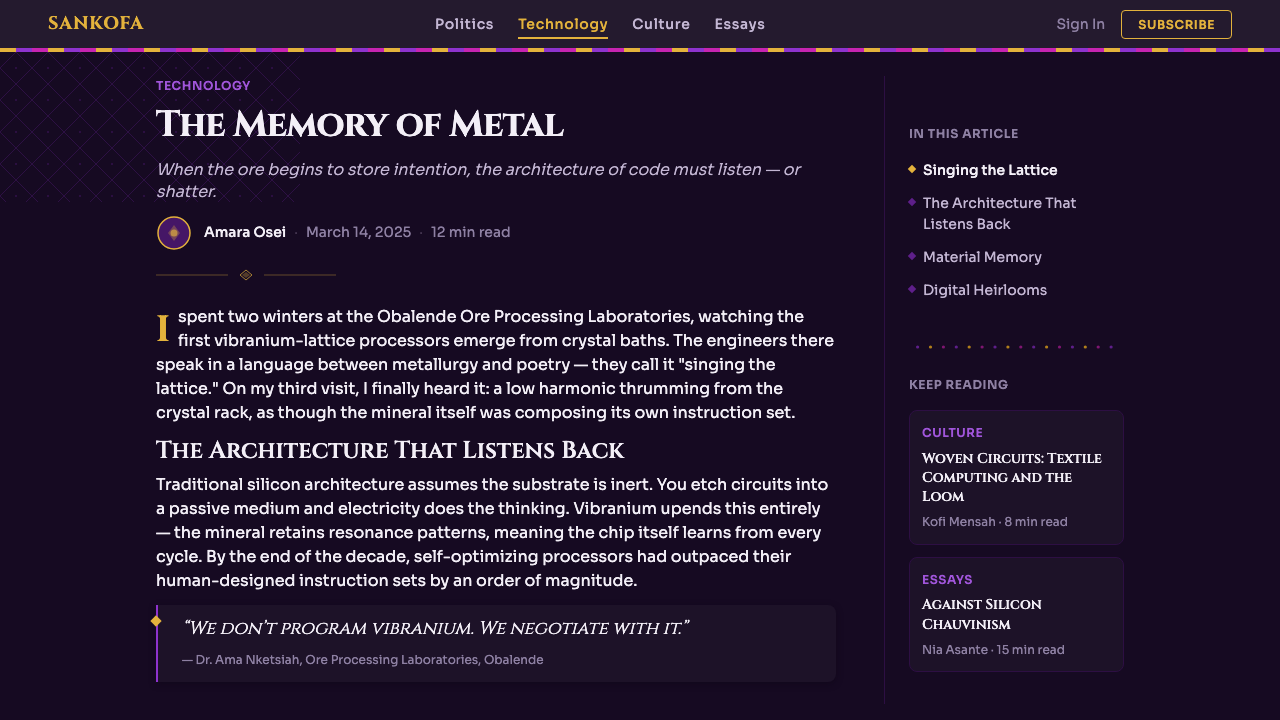
The typographic system holds two voices in deliberate opposition. Display type uses a serif with strong vertical stress and slightly carved-feeling strokes — not a classical book serif, but one that evokes inscription in stone or metal. This is paired with a clean, geometric sans-serif for body text and interface copy: rational, even-weighted, technically precise. The contrast between the two is not merely aesthetic but philosophical — carved letters carry history, geometric sans carries computation, and the two sitting on the same surface is the design's thesis statement.
Jewel-Tone Accents
Beyond the dominant violet-gold-black triad, the palette admits saturated jewel tones drawn from African textile colorways: deep teals, rich reds, warm ochers, and strong greens. These are never pastel or muted — they retain the full saturation of dye applied to fiber. They appear sparingly, as punctuation rather than as sustained fields, and they are always read against the dark ground rather than against white. This keeps them from competing with each other while preserving their individual vibrancy.
Luminous Depth, Not Flatness
Unlike modernist minimalist systems that prize flatness and zero depth, the Africanfuturism Vibranium palette actively courts a sense of luminous depth. Elements appear to glow from within or be illuminated by the violet ambient light rather than sitting flatly on a surface. This depth is achieved through layering — background pattern at low opacity, structural elements at full saturation, glow effects that bleed softly outward — creating an impression of looking through a surface rather than at one. The effect is reverential and atmospheric, like light filtered through ceremonial objects.
Who shaped Africanfuturism Vibranium?
Okorafor is the novelist who coined the term Africanfuturism and who has most systematically articulated its philosophical distinctions from Afrofuturism. Her Binti trilogy — winner of both the Hugo and Nebula Awards — creates an Afrofuturist heroine from the Himba people of Namibia who navigates interstellar conflict while remaining deeply rooted in her cultural identity and spiritual practice. Her theoretical essay 'Africanfuturism Defined' (2019) established the literary and conceptual framework that designers, visual artists, and filmmakers have drawn on to ground their work in African interiority rather than diasporic longing.
Beachler is the production designer of Black Panther (2018), the first Black woman to win the Academy Award for Best Production Design. Her research for Wakanda drew on over a dozen distinct African architectural and craft traditions, refusing to flatten the continent into a single 'African look.' She studied the monolithic churches of Lalibela in Ethiopia, the terracotta sculptures of the Nok culture, the geometric architecture of the Nubian pyramids, and the beadwork vocabulary of South African peoples. Her design bible for Wakanda — a detailed document governing every visual decision — is a landmark in the practice of building a fictional culture with real cultural depth.
The geometric visual grammar at the heart of this design system draws most directly from two West and Central African textile traditions. Kente cloth, woven by the Ashanti and Ewe peoples of Ghana and Togo, uses an interlocking strip-weaving technique to produce complex geometric patterns in which every color combination and pattern form carries a specific cultural meaning — particular patterns are reserved for royalty, others for mourning, others for celebration. Kuba cloth, woven by the Kuba Kingdom of present-day Democratic Republic of Congo, uses cut-pile embroidery and appliqué to produce dense geometric fields in which pattern encodes genealogy and cosmological knowledge. Both traditions treat geometric pattern as communicative language, not decoration — a principle the Africanfuturism Vibranium system carries directly into screen-based design.
The broader visual tradition that Africanfuturism builds on and responds to stretches back to the 1950s and 1960s. Musician and philosopher Sun Ra — who claimed to be from Saturn and whose performances blended ancient Egyptian iconography with futurist space mythology — established the core gesture of reclaiming the future as an African space. Parliament-Funkadelic's Mothership aesthetic of the 1970s developed this into a complete visual system of cosmic Black identity. Janelle Monáe's Metropolis and Dirty Computer eras systematized it further, and the Afropunk movement produced a global visual community. Africanfuturism differs from this lineage by insisting on African rather than diasporic centering, but it draws on and acknowledges this rich visual heritage.
Coogler directed Black Panther and co-wrote its screenplay, making the creative decisions that elevated Wakanda from a standard Marvel setting into a sustained exercise in Africanfuturist world-building. His insistence on grounding every design decision in specific African research — rather than a generalized 'African aesthetic' — is what distinguishes the Wakanda visual system from earlier Hollywood attempts to depict African civilizations. Coogler's approach demonstrated that culturally grounded specificity is not a constraint on mainstream commercial appeal but a source of it, influencing a generation of designers who now approach African cultural material with comparable rigor.
How do you use Africanfuturism Vibranium today?
Africanfuturism Vibranium carries significant ceremonial and narrative weight — it is not a neutral style and should not be applied to generic or culturally empty contexts. It works best where the product or message has genuine stakes: a platform centered on African creative work, a cultural institution, a tech brand that wants to assert presence and authority rather than approachability, or any context where power, legacy, and future coexist. Applied decoratively without that underlying alignment, the style risks feeling like costume rather than character.
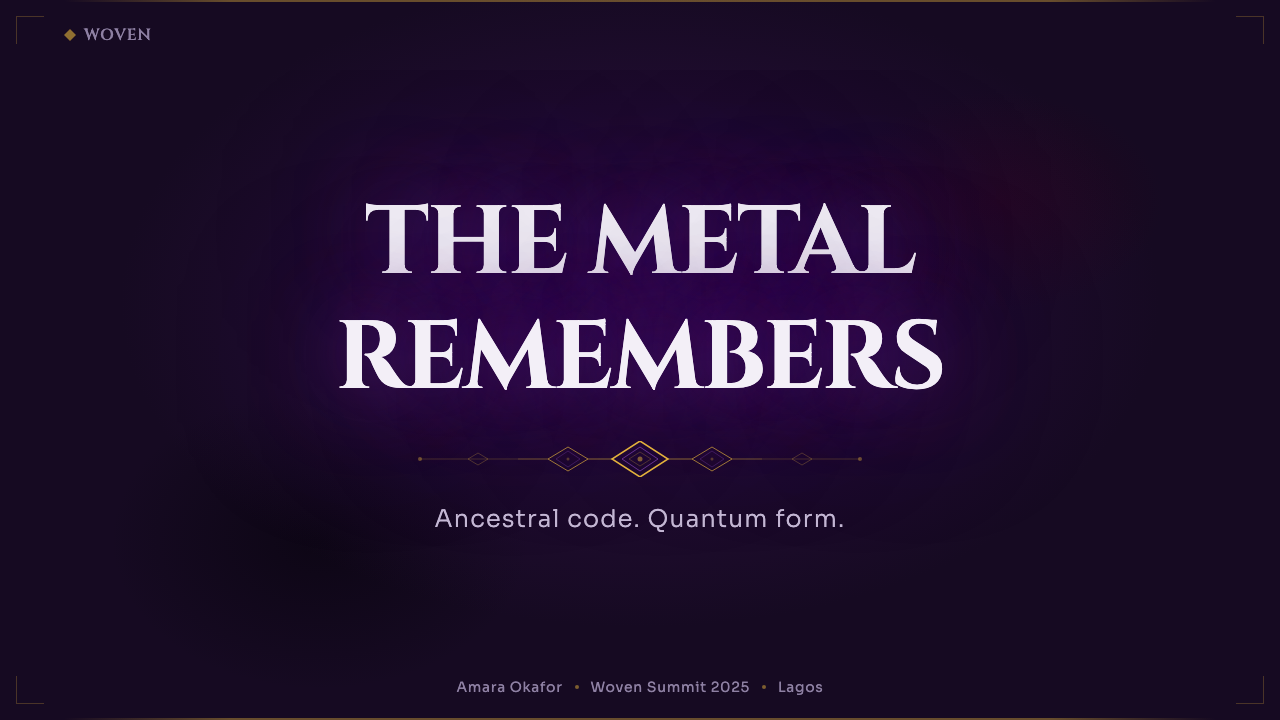
For presentation slides, the dark ground and luminous palette work powerfully on cover and section divider pages. A cover benefits from a single large geometric textile pattern across the full background at reduced opacity, with a strong typographic title in the engraved-feeling serif treatment centered or offset according to the composition's geometric logic. Content slides should keep the dark background but be sparse: one major data visualization per slide, rendered in the jewel-tone palette against the dark field, with minimal explanatory text in the geometric sans. The violet glow is effective as a highlight on the most critical number or metric — not applied to every element, but used to draw the eye to the argument's hinge point.
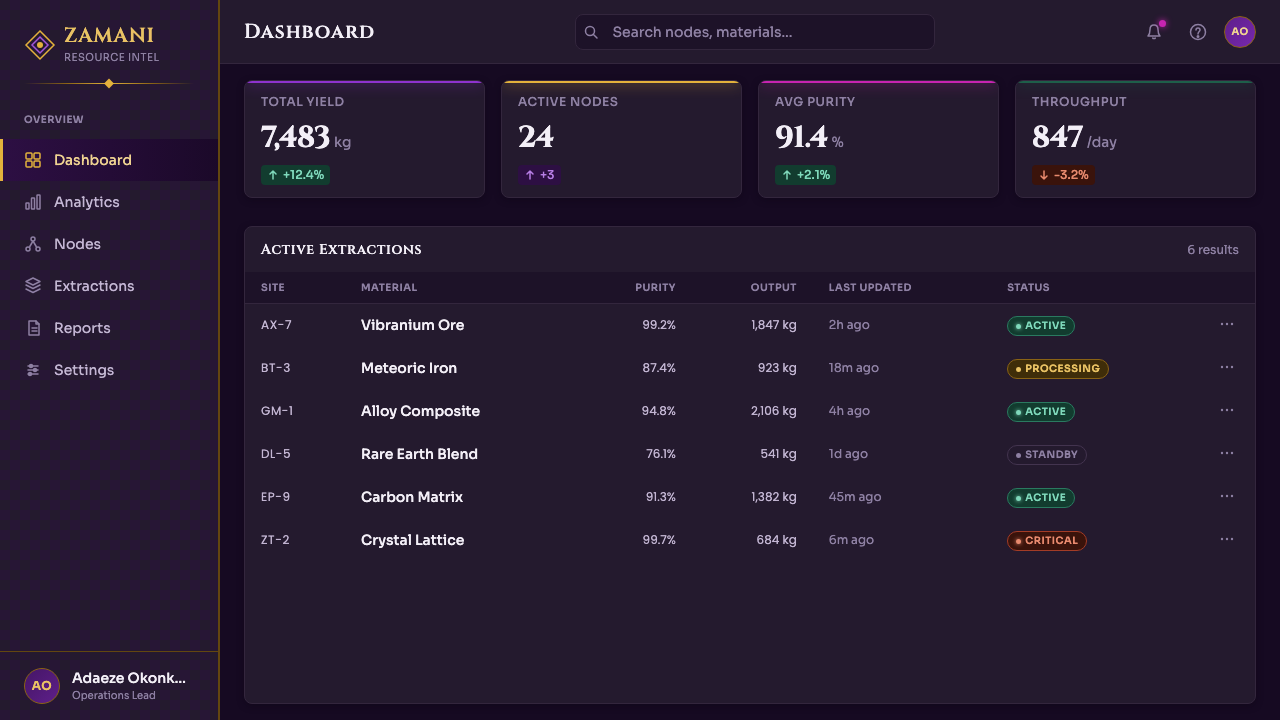
For web interfaces and dashboards, the system is well suited to contexts requiring both authority and visual richness — analytics platforms, creative portfolio sites, institutional pages for arts organizations. The approach: dark near-black backgrounds throughout, with the woven geometric pattern used as a subtle, low-opacity texture layer beneath content rather than as foreground decoration. Interactive elements — buttons, active states, selected items — use the vibranium violet glow effect. Navigation typography should be set in the geometric sans; page headings and hero text in the ceremonial serif. Data visualizations should use the jewel-tone palette in a consistent sequence, with the violet reserved for primary metrics or calls to action.
For editorial and marketing work, the style's poster-like quality makes it particularly effective for announcement pieces, event identities, and cultural brand campaigns. Full-bleed dark backgrounds with large-scale geometric textile patterns and centered typographic hierarchies read powerfully at billboard scale as much as screen scale. Marketing pages benefit from alternating full-width sections that use different jewel tones as secondary accents — keeping the violet as the through-line while teal, gold, or red punctuate individual sections. The engraved serif used at very large scale for hero text creates a monumental quality appropriate for proclamatory copy.
The most common mistake when applying this system is treating the violet glow as a generic 'neon' accent on a dark background — using it at high frequency, applying it to border effects and button hovers indiscriminately, until it reads as cyberpunk rather than Africanfuturist. The violet glow should be deployed with the same scarcity as ceremonial gold inlay: present at the moments of highest importance, absent elsewhere. A second common error is lifting the geometric textile patterns from their context and scattering them as random decoration — these patterns have structural and communicative logic, and should be used as coherent systems (a consistent grid, a single repeating unit) rather than as scattered ornament. The ceremonial weight of the style depends on its restraint.
Africanfuturism Vibranium — FAQ
Is Africanfuturism Vibranium appropriate for brands outside Africa or without African cultural connections?
This requires honest assessment. The visual system draws directly on specific African cultural materials — textile geometries, ceremonial color hierarchies, cosmological symbolism — that carry real cultural weight and are not generic 'exotic' decoration. Applied without cultural alignment or contextual justification, the style risks appropriation: borrowing the surface without understanding or acknowledging what the surface means. That said, the system can function effectively for brands that engage authentically with African creative communities, institutions, or content — even if the brand itself is not African-owned. The question to ask is whether the application serves to center African creative authority or to decorate with it. Centering is justified; decorating is not.
How does this style differ from general Afrofuturism aesthetics?
Afrofuturism as a visual tradition — rooted in the diaspora through artists like Sun Ra, Parliament-Funkadelic, and Janelle Monáe — typically features a wider range of color, a stronger influence from American funk, soul, and hip-hop visual culture, and a looser relationship with specific African craft traditions. It is as much about the African-American experience of exclusion and reclamation as it is about Africa itself. Africanfuturism is more specifically anchored: the geometric vocabulary comes directly from sub-Saharan textile and architectural traditions, the color logic references ceremonial rather than stage-lighting contexts, and the cultural referent is the African continent's own historical depth rather than its diaspora's experience in the West. The Vibranium Wakanda iteration in particular is rigorous in its use of documented African craft traditions as source material.
Can the style work in light-background applications?
The dark ground is structural, not incidental — the entire luminous quality of the system depends on the contrast between deep background and glowing foreground. A light inversion fundamentally changes the system's logic: gold inlay becomes gold text on white (readable but losing ceremonial weight), violet glow becomes violet accent on cream (which reads as lavender, losing its otherworldly quality), and the geometric textile patterns lose their sense of being illuminated from within. A partial light treatment can work for supporting elements — body text sections, documentation pages — but the distinctive character of the system requires committing to the dark ground for its most expressive applications. If light backgrounds are a hard requirement, consider using only the typographic and geometric vocabulary of the system rather than its color and luminosity logic.
How do I avoid making it look like a generic 'sci-fi Africa' or Hollywood pastiche?
The distinction between authentic Africanfuturist visual work and pastiche almost always comes down to geometric specificity and cultural source citation. Pastiche uses vaguely 'tribal' patterns with no specific origin — shapes that could be from any culture or no culture. Authentic work uses documented geometric systems: a specific kente strip-weaving pattern structure, the particular interlocking geometry of kuba raffia cloth, the chevron vocabulary of Ndebele beadwork. The difference is visible to informed viewers and felt even by uninformed ones as a difference in density and intention. The other differentiator is the relationship between past and future: pastiche treats African cultural material as historical (backwards-looking) or exotic. Africanfuturism treats it as technologically generative — the textile grid is the circuit, the ceremonial object is the interface. That forward orientation should be present in every compositional decision.
Is the vibranium violet glow a licensed Marvel element, and can it be used freely?
The vibranium violet glow as a specific named element originates in the Black Panther film and is associated with Marvel's intellectual property. However, the visual technique itself — deep violet inner-glow effects on dark surfaces — is a general design approach that predates the film and does not belong to any single rights holder. The Africanfuturism Vibranium design system uses this technique as part of a broader visual vocabulary rooted in Africanfuturist aesthetics, not as reproduction of specific Marvel-owned assets. Designers should exercise judgment about context: direct references to Wakanda, vibranium, or specific character likenesses require licensing; the general visual language of luminous violet against dark geometric backgrounds does not.
Related design styles
 Foundation AppleSacred empire in shadow. Cinzel capitals and gold geometry float on cosmic ch…
 miHoYo Game UIFantasy UI feels ceremonial. Indigo starfields, gold frames, and jewel chips…
 AfrofuturismAncient future, fully luminous. Gold kente grids cut through cosmic purple an…
 Bolivian Cholita FashionUnapologetic satin power. Hot pink fields, emerald stitches, centered pollera…
 Los Angeles LakersShowtime royalty. Forum Blue and metallic gold turn varsity type into arena g…
 Spanish Flamenco PosterPassion printed as ritual. Blood red, ivory paper, Didone type, and flat gold…