What is Los Angeles Lakers?
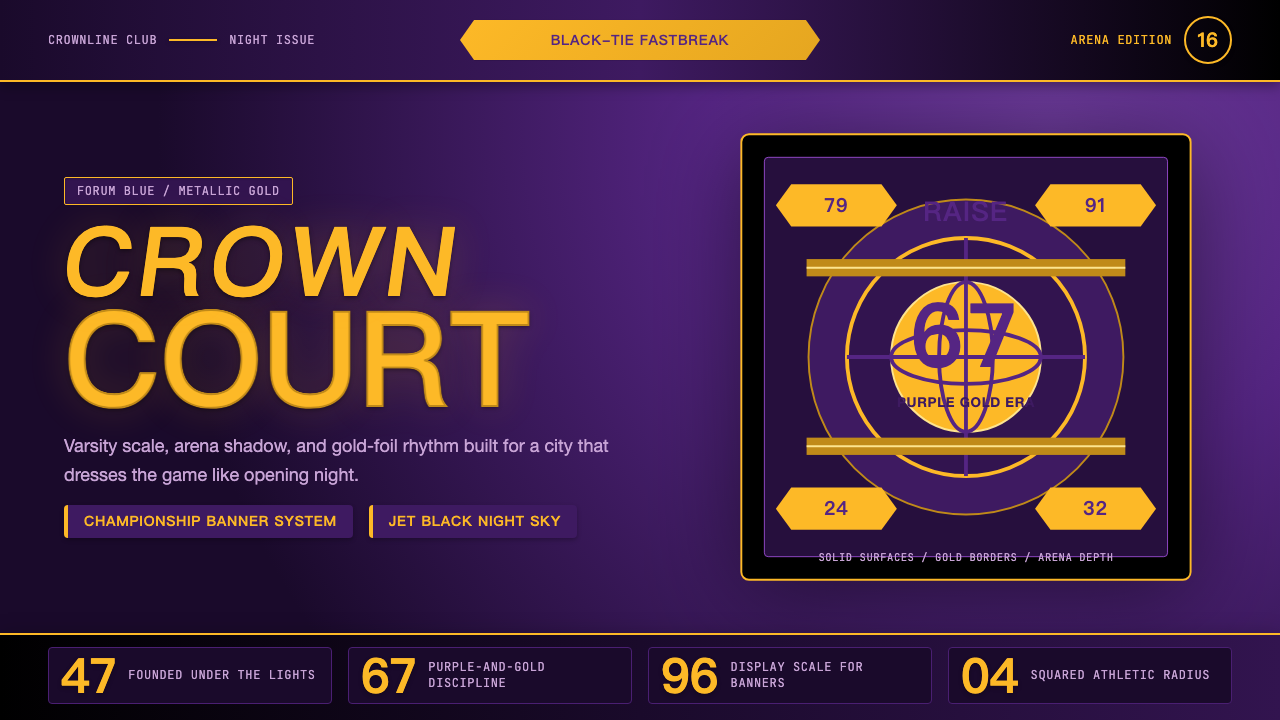
Forum Blue and gold against jet black — the Lakers palette turned a basketball franchise into Hollywood's most glamorous visual identity.
Los Angeles Lakers in brief
Lakers Purple-and-Gold is a sports design identity so visually commanding that it long ago transcended its athletic origins. Built on a triad of deep royal purple, warm metallic gold, and jet black, the system communicates power, ceremony, and urban glamour simultaneously. It is one of the rare sports palettes that functions as luxury branding — not because it borrows from fashion, but because every element of the system reinforces a single, coherent statement: this is the premier franchise in the most cinematic city in the world.
The visual vocabulary is rooted in varsity athletic tradition — arched wordmarks, bold block lettering, slab-serif numerals — but elevated by the choice of materials and finish. Where a typical collegiate identity stays matte, the Lakers system reaches for metallic foil, high-gloss laminate, and the sheen of a championship trophy. Gold is never flat; it catches light. Purple is never muddy; it holds depth. The black ground beneath them is absolute, functioning less as a background color and more as a stage.
What makes this palette distinctive in contemporary design applications is its refusal to be casual. Even in minimal treatments — a monogram on a white ground, a single gold wordmark on black — the system retains its formal authority. It is equally at home on a championship banner hanging from arena rafters and on a presentation deck cover. The combination of ceremonial color, muscular type, and restrained compositional structure gives it a versatility that few sports identities can claim.

Where does Los Angeles Lakers come from?
The franchise that would become the Los Angeles Lakers was founded in 1947 as the Minneapolis Lakers — a name tied to Minnesota's designation as the Land of Ten Thousand Lakes, not to any body of water in Southern California. The team relocated to Los Angeles in 1960 and brought with it the name alone, severed entirely from its geographic logic. The visual identity followed the move through several iterations before arriving at the purple-and-gold combination that would define the franchise beginning in 1967. That identity has remained, through refinements, the most recognizable in professional basketball.
The specific shade of purple adopted by the Lakers in the late 1960s was described internally as Forum Blue — a reference to the Great Western Forum, the arena in Inglewood where the team played from 1967 until 1999. The name was partly a rebranding of what the broader public called simply purple, giving the color an institutional weight and a proper noun. Forum Blue sits on the cooler, bluer edge of the purple spectrum, which prevents it from reading as red-violet and allows it to hold contrast against gold without the two colors fighting for warmth. The gold, rendered in metallic finishes rather than flat pigment, operates in the warm amber register rather than bright yellow, which gives the pairing its sense of maturity and occasion.
The Showtime era — roughly 1979 through 1991 — cemented the aesthetic's cultural meaning. Under owner Jerry Buss, who purchased the team in 1979, the Lakers became the intersection of Hollywood celebrity and athletic excellence. Jack Nicholson's courtside seat became as much a part of the visual narrative as Magic Johnson's no-look passes. Pat Riley's slicked-back hair and Armani suits on the sideline extended the palette's black-tie register into the coaching staff. The arena itself — lit for spectacle, populated by recognizable faces — turned every home game into something closer to a premiere than a sporting event. The design identity absorbed all of this cultural energy and held it.
The franchise's sixteen championship banners, from 1949 through 2020, gave the identity repeated ceremonial exposure at the highest level of the sport. Each banner hanging from the rafters reinforced the color pairing as the visual language of achievement. Kobe Bryant's two retired jersey numbers — visible from every seat in the arena — made the typographic register of the identity inseparable from his legacy. The result is a design system with a depth of cultural association that cannot be manufactured: it accumulated over decades of genuine sporting significance, Hollywood adjacency, and the stewardship of figures — Buss, Magic, Kobe, Riley — who understood spectacle as inseparable from competition.
What defines the Los Angeles Lakers look?
Color Palette
The system rests on three colors, each with a precise role. Royal purple — Forum Blue — occupies the mid-range of the purple spectrum, leaning blue enough to avoid the warmth of violet, rich enough to hold authority in large fields. Metallic gold operates in the warm amber register, always implying sheen and finish rather than flat pigment; it is the color of a trophy in arena light. Jet black functions as the ground: absolute, stage-like, the surface against which purple and gold become ceremonial. These three colors are never casual — each deployment is a statement of occasion.
Typographic Character
The type vocabulary is rooted in varsity athletic tradition: arched wordmarks whose curves mirror the ball's arc, bold block lettering that reads from the upper deck, and slab-serif jersey numerals whose thick strokes project physical mass. The overall effect is muscular rather than elegant — designed for distance and arena scale, not fine print. When the system is applied to smaller formats, this boldness must be preserved; the identity loses its character when reduced to a lighter, more refined typographic register.
Metallic Finish
The Lakers system is one of the very few sports identities where metallic finish is not an embellishment but a structural requirement. Gold rendered as flat color becomes ordinary; rendered with sheen, it becomes ceremonial. Foil stamping, high-gloss lamination, and reflective surface treatments are not luxuries in this system — they are the difference between the identity reading as collegiate and reading as championship. In digital environments, this quality must be approximated through gradient, highlight, and shadow treatments that simulate the play of light across a metallic surface.
Black as Stage
In most design systems, black is a neutral — an alternative to white for dark-mode treatments or typographic use. In the Lakers palette, black is load-bearing. It is the condition under which Forum Blue becomes royal and gold becomes luminous. A purple-and-gold composition on a white or cream ground loses approximately half of its ceremonial weight. The system is fundamentally dark-ground, and treating it otherwise is not a variation — it is a misreading. Black absorbs everything that is not purple or gold, which makes those two colors perform at maximum intensity.
Ceremonial Hierarchy
The palette enforces a strict hierarchy: gold leads in moments of primary communication — the wordmark, the championship designation, the key data point — while purple holds the field, and black frames everything. This hierarchy is not arbitrary; it mirrors the visual experience of the arena itself, where a gold trophy on a purple court under arena lighting tells the story before a word is read. Reversing the hierarchy — purple as accent, gold as field — produces a less legible, less authoritative composition. The system's power depends on maintaining this order.
Compositional Restraint
Despite its visual boldness, the Lakers identity is compositionally restrained. The wordmark occupies space without competing elements; the shield emblem stands alone; championship designations are listed, not designed. This restraint is itself a marker of confidence — the palette and form are strong enough to need no supporting ornamentation. Designs that add decorative filigree, starburst accents, or complex background patterns around the core identity elements are working against the system, importing complexity into something that derives its authority from simplicity.
Cultural Weight
Unlike design systems that build meaning from scratch, the Lakers identity arrives pre-loaded with cultural associations that span decades: championships, celebrity audiences, the Showtime fast break, Kobe's fadeaway, the Staples Center lights. This accumulated meaning is not separate from the design — it is part of what the colors communicate. When the purple-and-gold palette is applied in non-sports contexts, it borrows this freight deliberately. The association is glamour, achievement, and Los Angeles in its mythologized form — neither gritty nor casual, but cinematic.

Who shaped Los Angeles Lakers?
Jerry Buss purchased the Lakers in 1979 and immediately understood that the team's visual and cultural identity needed to match the ambition of the city it represented. He transformed the Forum into a destination — improving lighting, adding entertainment, filling the sideline seats with recognizable faces — and in doing so turned the arena environment into an extension of the design identity itself. Buss's instinct that sports and entertainment were the same business produced the Showtime era aesthetic: black tie on the floor, Hollywood in the stands, championship banners in the rafters. His stewardship gave the purple-and-gold palette its most durable cultural context.
Earvin 'Magic' Johnson joined the Lakers in 1979 and became the human embodiment of everything the Showtime identity aspired to communicate. His no-look passes and full-court vision made basketball feel like improvised jazz; his smile made the Forum feel like a party. More than any other figure, Magic translated the palette's promise — glamour, generosity, spectacle — into athletic gesture. Five championships and three MVP awards under his tenure gave the gold in the identity its championship meaning. When designers invoke the Lakers aesthetic, they are invoking the visual world Magic made famous.
Kobe Bryant's twenty-year career with the Lakers — the entirety of his professional life — made him the definitive figure of the post-Showtime identity. His two retired jersey numbers hang permanently in the arena, making the typographic register of the system inseparable from his legacy. Kobe brought a different emotional register to the purple-and-gold: where the Showtime era was celebratory and open, his era was intense and private. The palette absorbed both registers and held them simultaneously. His ability to treat the uniform as a vehicle for something beyond basketball — preparation, obsession, craft — elevated the identity to something closer to a philosophy than a color scheme.
As head coach from 1981 to 1990, Pat Riley extended the Lakers visual identity off the court in ways no coaching figure had done before. His impeccably tailored suits on the sideline — dark, precisely cut, worn with intention — treated the coaching role as a performance that had to be worthy of the arena and the audience. Riley understood that in Los Angeles, appearance and achievement were inseparable, and he dressed accordingly. His image contributed directly to the identity's black-tie register, demonstrating that the formal quality of Forum Blue and gold was not limited to the jersey or the banner — it extended to anyone who represented the franchise.
Elgin Baylor spent his entire career with the Lakers from 1958 to 1971, bridging the Minneapolis era and the Los Angeles identity. Before the purple-and-gold palette was codified, Baylor's artistry — hang time, improvised mid-air adjustments, a scoring fluency that anticipated everything that would follow — established the franchise's standard for what excellence looked like. His retired number in the arena rafters predates the championship era but belongs to the same visual conversation. Baylor represents the claim that the identity's depth does not begin with Showtime but with a longer tradition of play that the palette eventually came to represent.
How do you use Los Angeles Lakers today?
The Lakers palette is among the most context-sensitive in the Curio library. Its power derives from cultural association — glamour, achievement, Los Angeles — which means it arrives in any design pre-loaded with meaning. Applied thoughtfully, that pre-loading is an asset: the palette communicates prestige and ambition before a single word is read. Applied carelessly, it reads as costume — the visual equivalent of wearing a championship ring to a casual meeting. The first question before applying this style is always: does the context warrant this level of ceremony?
For presentation slides, the palette performs best in high-stakes contexts: investor decks, product launches, brand strategy presentations, award submissions, and any format where a sense of occasion is appropriate. A cover slide should commit fully: deep purple or black fills the entire frame, a gold wordmark or headline anchors the center or sits in asymmetric tension with a diagonal element, and the client or event name appears in a smaller, lighter treatment. Content slides work best on black grounds with gold used exclusively for headers, key metrics, and call-outs; body text sits in near-white for maximum legibility. Data slides take on a trophy-case quality — charts and graphs treated as objects of achievement, with bars and segments in gold against dark fields, and accent purple used to mark reference lines or secondary datasets.
For web interfaces and dashboards, the system is best suited to platforms where authority and exclusivity are selling propositions: premium analytics tools, sports data platforms, financial dashboards, or membership tiers for high-end products. The approach is to treat the dark background as the default state and reserve gold for interactive elements, primary actions, and tier markers. Navigation should be typographic and minimal — the identity does not need decoration, only structure. Card components work well with a subtle metallic shimmer on borders or headers, approximating the foil quality of physical materials. Pricing pages benefit from the palette's natural hierarchy: a gold-badged premium tier stands out without requiring additional visual complexity.
For editorial and marketing applications, the style supports layouts that feel like event programs rather than web pages — deliberate, formal, and designed for a moment of attention. Full-width feature blocks alternating between purple-on-black and gold-on-black create a cinematic scrolling experience. Pull quotes and key statistics presented in oversized gold numerals against dark fields carry the energy of an arena scoreboard. Marketing materials for product launches, championship announcements, or brand milestones benefit from the palette's ceremonial register: use the full triad — black ground, gold lead, purple structure — for documents meant to be saved rather than skimmed.
A common mistake when applying this palette is treating purple and gold as interchangeable. They are not. Gold is the active color — the headline, the call to action, the metric that matters. Purple is the structural color — the section divider, the secondary text container, the background for supporting information. When gold is reduced to an accent and purple is promoted to the primary communication role, the system inverts its own hierarchy and loses the clarity that gives it authority. A second common error is lightening the palette for contexts that feel 'too formal': adding cream or off-white backgrounds, softening gold to a muted yellow, or using purple only as a light tint. These adjustments destroy the system's character. If the context calls for warmth or casualness, a different palette is the correct answer — not a diluted version of this one.

Los Angeles Lakers — FAQ
Is this palette only appropriate for sports and entertainment contexts?
Not exclusively, but the cultural associations are strong enough that context selection matters enormously. The palette works well anywhere that prestige, achievement, and ceremony are appropriate: luxury product launches, award programs, financial platforms targeting high-net-worth users, premium membership tiers, and brand identities for companies that want to position themselves as category leaders. It works poorly for contexts requiring approachability, warmth, or inclusion — community products, children's platforms, healthcare applications, or brands positioning on openness and accessibility. The palette does not whisper; it announces. If that announcement is coherent with the product's values, it is an asset. If it creates a mismatch, it creates confusion.
Can the palette be used on light backgrounds?
It can be adapted, but with significant trade-offs. On a white or cream ground, the purple reads more as a traditional corporate color and the gold — especially in flat digital rendering — risks looking muddy or indistinct. The black-ground configuration is not a stylistic preference but a structural requirement for the palette to achieve its full contrast and ceremonial quality. A light-background application works best when it is treated as a secondary or supporting register — letterhead, document body, supporting materials — while primary communication surfaces (covers, hero sections, key pages) maintain the dark ground. Attempting to build an entire visual system on a light background using this palette typically results in something that looks less like the Lakers identity and more like generic collegiate design.
How should gold be rendered digitally when metallic finishes are unavailable?
The key is to use light and shadow to imply surface rather than rendering gold as a uniform flat color. A subtle gradient from a slightly lighter, more yellow-shifted tone at the top to a richer, deeper amber at the bottom suggests the play of light across a curved metallic surface. A thin highlight stroke along the top edge of a gold element and a slight deepening at its base reinforce the three-dimensional quality. This approach avoids the need for actual metallic materials while preserving the visual richness that distinguishes the system's gold from a generic yellow. The goal is for the color to look earned — like it has been polished — rather than simply selected from a color picker.
What is the difference between using this palette for a sports brand versus a non-sports brand?
For a sports brand — particularly one in basketball or adjacent entertainment — the palette carries direct categorical meaning, and the design challenge is to differentiate within the reference rather than despite it. The Lakers identity is a benchmark; working in the same space requires a clear point of distinction, whether through typographic treatment, compositional approach, or the way gold is deployed. For a non-sports brand, the reference operates at the level of feeling rather than category: the palette communicates achievement, glamour, and cinematic ambition without literally saying basketball. The design latitude is wider, but the responsibility to earn the palette's authority through the quality of the work is higher — the cultural freight only transfers if the execution is genuinely excellent.
Does this style work for data-heavy interfaces, or does the drama overwhelm the information?
The palette works well for data-heavy interfaces when information hierarchy is carefully maintained. The key insight is that the palette's drama comes from color contrast, not from visual complexity — which means a dark, high-contrast data environment can be both dramatic and highly legible. The discipline required is to use gold sparingly: reserve it for the most important number, the primary trend line, the metric that drives the decision. Supporting data in near-white, secondary data in a muted purple, and reference lines in a dim gray allow the gold-highlighted element to dominate without competition. The common failure mode is applying gold to too many data points simultaneously, which flattens the hierarchy and makes the display feel overwhelming. Used as a spotlight rather than a floodlight, gold in a data environment functions as a natural attention direction system.
Related design styles
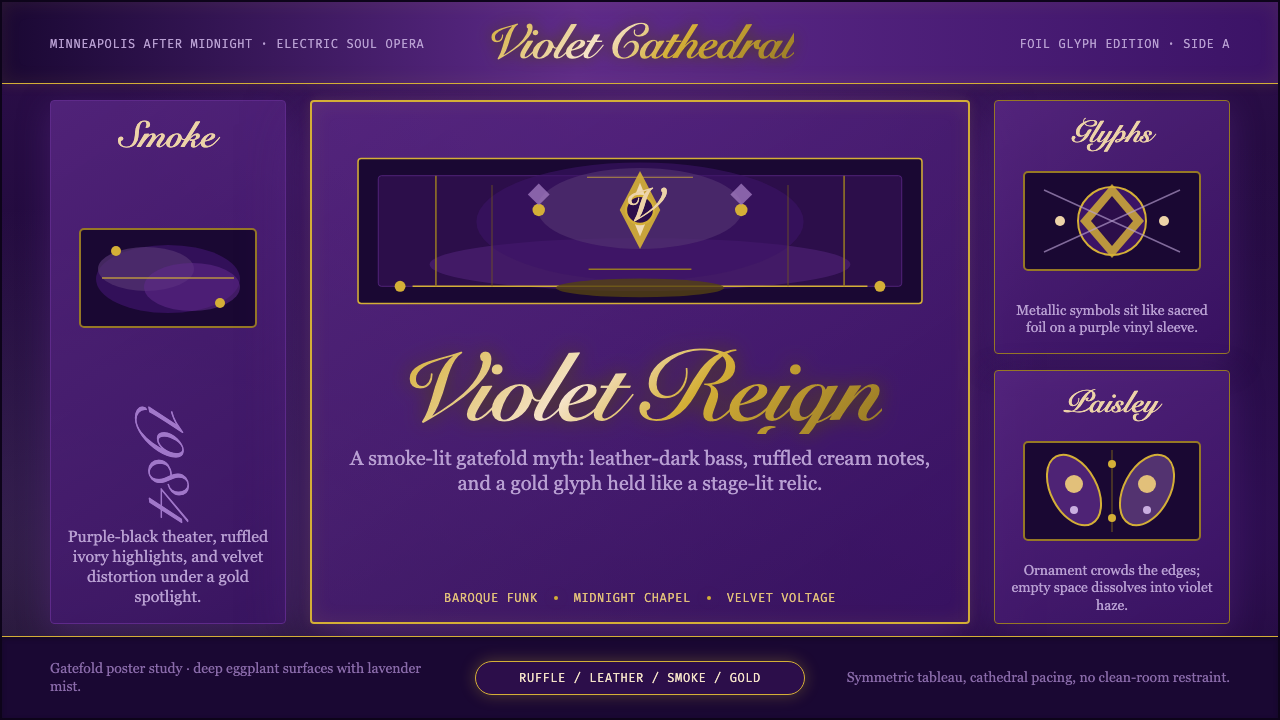 Prince — Purple Rain (1984)Decadence turns electric. Eggplant violet, gold foil glyphs, and smoky symmet…
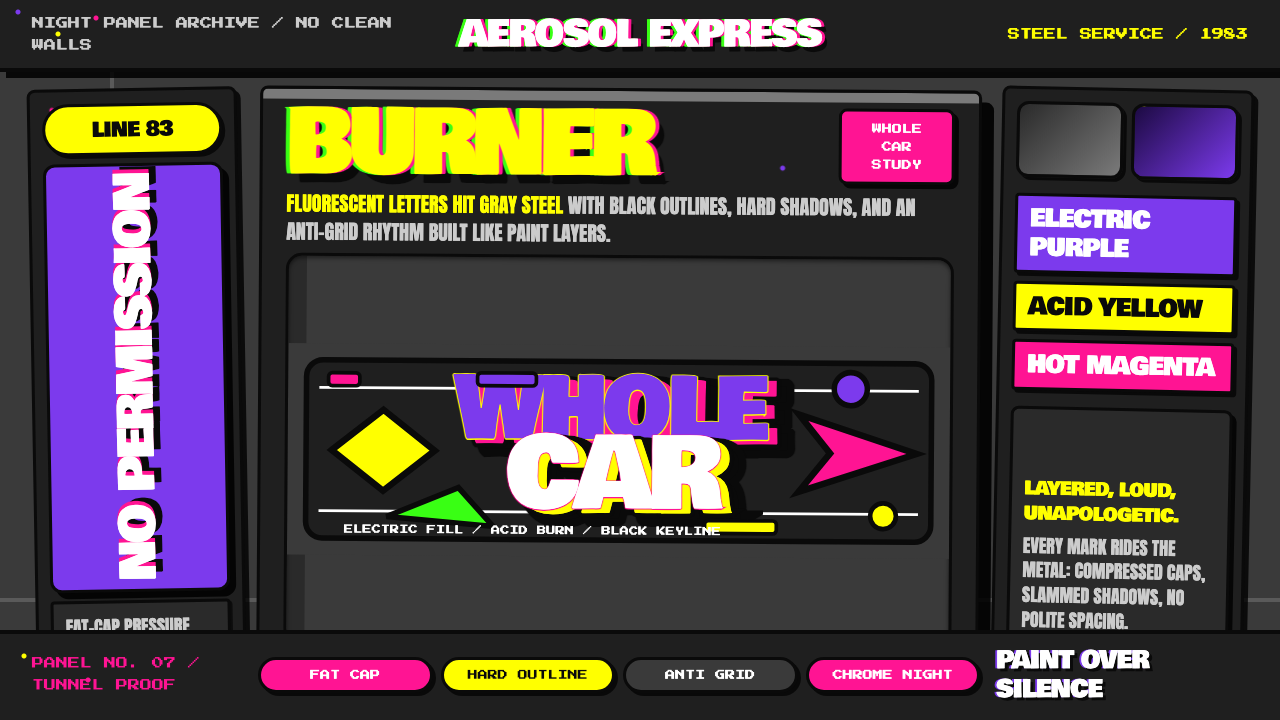 NYC Subway Graffiti (1983)Bombed steel gets loud. Electric purple and acid yellow stack as hard-outline…
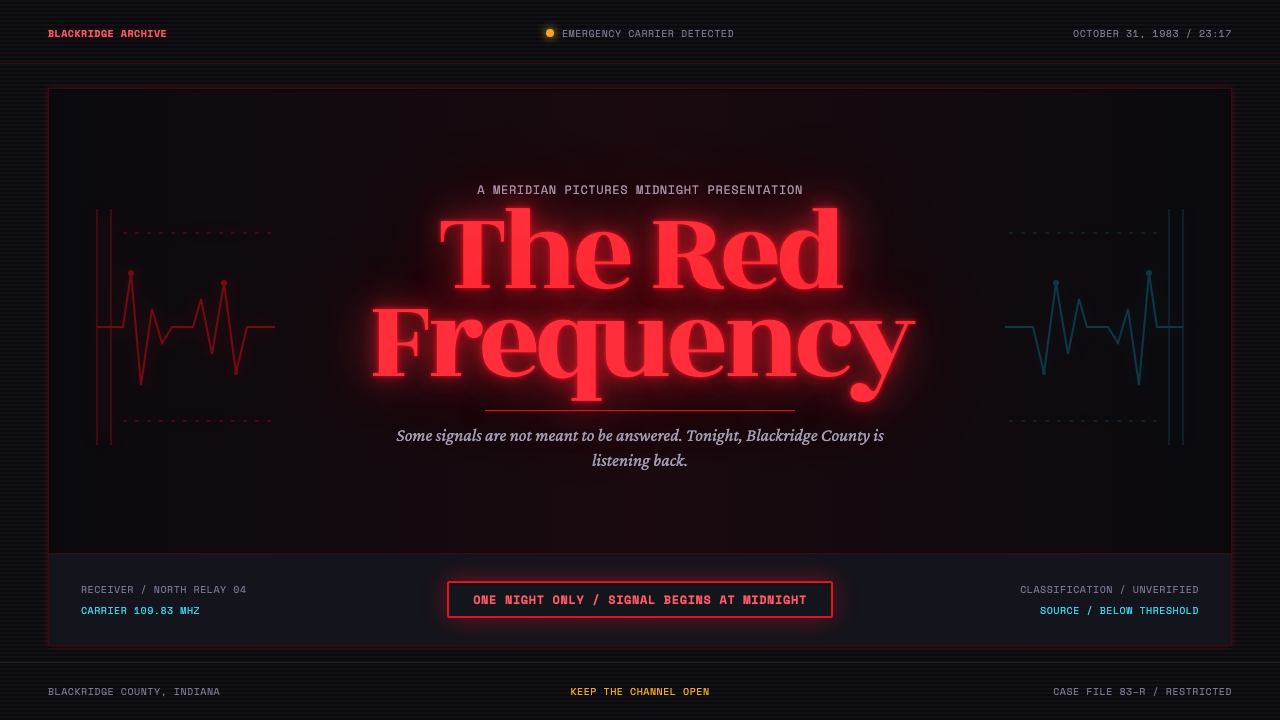 Stranger Things (1983)Red light breaks the void. A spurred serif blooms through VHS static and cold…
 The Wizard of Oz (1939 Technicolor)Color arrives like a curtain rising. Ruby, gold, and emerald blaze across a d…
 Thriller (1982)Stillness turns electric. Leather red and rhinestone gold ignite a neon pavem…
 Final Fantasy Crystal (1987)Silver fantasy meets machine logic. Crystal ink glows behind hard navy comman…