What is Prince — Purple Rain (1984)?
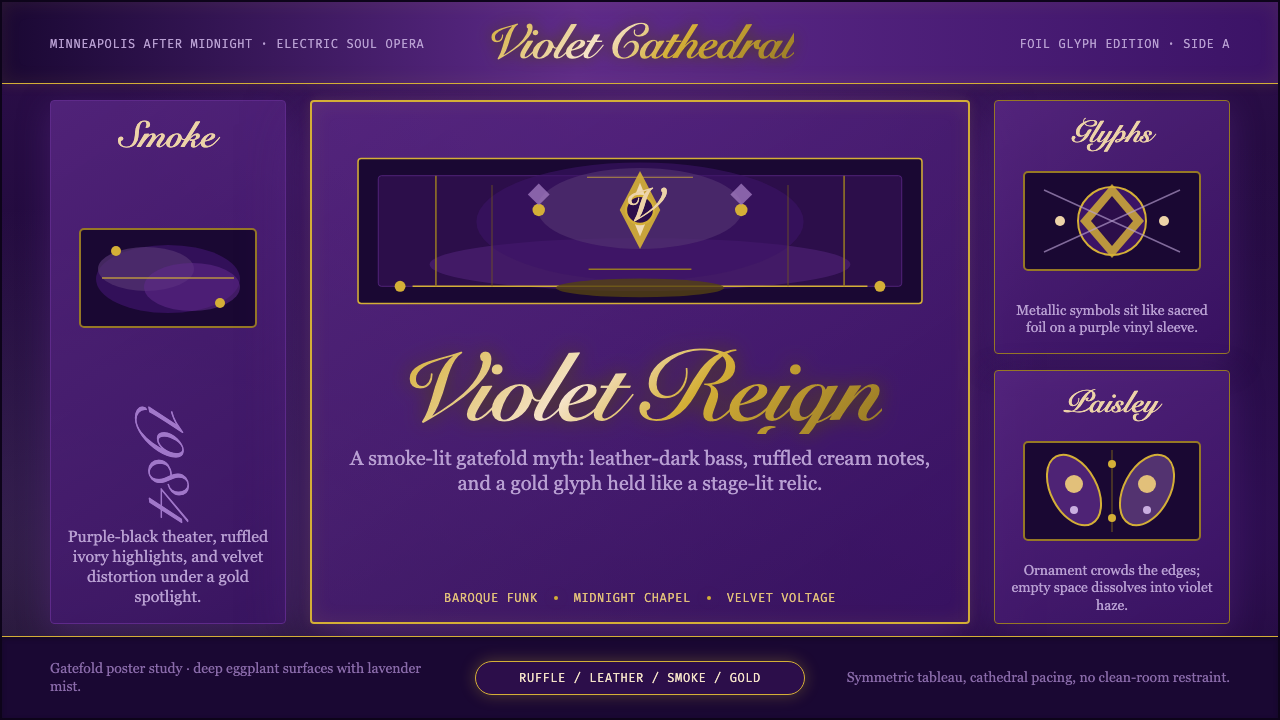
Prince turned Minneapolis into a purple-lit cathedral — eggplant violet, metallic gold, and smoke converging into the most theatrical design identity of the 1980s.
Prince — Purple Rain (1984) in brief
Purple Rain is the visual language born from Prince's 1984 album and film of the same name — a design identity built on deep eggplant violet, metallic gold, and the grammar of theatrical excess. Where most pop aesthetics of the era leaned toward neon brightness or stark minimalism, Prince's visual world went baroque: layered ornament, ruffled lace against motorcycle leather, rain-streaked photography, and the Love Symbol glyph elevated to the status of a religious icon.
The style is defined by a deliberate tension between the sacred and the sensual. Architectural forms — cathedral arches, columnar symmetry, candlelit depth — coexist with the unapologetically hedonistic: paisley teardrops, gold foil lettering, silk and velvet surface textures rendered through dramatic photographic lighting. This is not decoration applied to a design; the ornament is the design. Every surface is understood as a site for meaning-making.
As a transferable aesthetic, Purple Rain sits in a tradition of rock and soul visual grandeur that draws from glam, baroque portraiture, and 1970s blaxploitation. What distinguishes it is the specificity of its color world — that particular deep violet that reads simultaneously as royalty, spirituality, and danger — and the discipline with which metallic gold is deployed as the sole counterpoint, never diluted by neutral tones.

Where does Prince — Purple Rain (1984) come from?
Prince Rogers Nelson began developing his visual identity through the late 1970s and early 1980s, establishing a persona that fused the flamboyance of Little Richard and Jimi Hendrix with the precision of James Brown's theatrical control. The Purple Rain project — album, film, and accompanying visual campaign — crystallized this into a cohesive world. Released in June 1984, the album's cover photograph showed Prince astride a motorcycle in a purple haze, shot in a way that compressed glam-rock mythology and Minneapolis street reality into a single frame.
The visual execution of the project involved a close collaboration between Prince and his creative circle. Art director Laura LiPuma and photographer Sam Erickson were central to translating Prince's instincts into reproducible visual systems — establishing the palette, the lighting logic, the balance of regal symmetry against gritty authenticity. The album sleeve, posters, and film promotional materials shared a consistent visual grammar: deep violet grounds, high-contrast backlighting, gold as the only warm accent, and a typography that leaned on condensed, slightly gothic letterforms without ever fully committing to historical revival.
The design draws from a lineage that stretches from European baroque portraiture — the use of deep, dark backgrounds to make a single luminous figure emerge — through the concert poster traditions of 1960s psychedelia, with its rich, saturated color and ornamental letterforms, to the LP sleeve art of early 1970s artists who understood the album as a designed object rather than a packaging afterthought. Prince synthesized these without direct quotation, arriving at something that felt historically resonant without being retrospective.
The 1984 release coincided with a moment when music videos had become a primary medium for visual identity, and Prince's visual language translated exceptionally well to the moving image. The Purple Rain film — shot in and around Minneapolis, at venues like First Avenue — grounded the baroque visual fantasy in recognizable geography, giving the ornamental aesthetic an unlikely documentary texture. This tension between the mythological and the real-place specific became a signature of the Purple Rain world, and it distinguishes the style from contemporaneous glam productions that relied on pure fantasy staging.
What defines the Prince — Purple Rain (1984) look?
Color World
The palette is anchored by a deep eggplant violet — not the bright purple of heraldry, but a dark, almost bruised hue that reads as simultaneously regal and ominous. Against this ground, metallic gold functions as the sole warm accent: in letterforms, in glyphs, in trim details. The combination recalls ecclesiastical decoration — gold leaf on dark wood — while the photographic context grounds it in something more carnal. Black and near-black tones build depth and shadow throughout. Cool white appears rarely, as a highlight edge or a breath of light in smoke.
Theatrical Symmetry
Composition gravitates toward a centered, frontal symmetry that mirrors the visual grammar of altarpieces and portrait paintings. The lone figure placed at the center of the frame — backlit, elevated, slightly removed from the viewer — establishes a hierarchy of presence that is devotional in its structure. This symmetry is theatrical rather than rigid: smoke, rain, and backlighting introduce controlled asymmetric texture at the edges, preventing the composition from feeling static or formulaic.
Ornament as Identity
Where Bauhaus or Swiss Style would eliminate ornament as waste, Purple Rain treats it as the primary carrier of meaning. Paisley teardrops, ruffle details, lace textures, and the Love Symbol glyph are not embellishments applied to an underlying structure — they are the structure. Each decorative element carries biographical and symbolic weight: the paisley connects to a South Asian textile heritage recontextualized through 1960s psychedelia; the Love Symbol, later replacing Prince's name, functions as a logographic identity mark of the first order.
Photographic Drama
Photography in the Purple Rain visual world is characterized by hard backlighting against dark or smoky grounds, creating silhouette-dominant images where the figure is defined by the light it blocks rather than the light that falls on it. Foreground detail — the texture of leather, the fall of fabric — is revealed in isolated pools of warm light, while the middle ground dissolves into atmospheric haze. Rain, literal and implied, adds vertical movement to otherwise static compositions. This is not documentary photography; it is staged mythology.
Glyph and Logographic Identity
The Love Symbol — Prince's custom glyph combining elements of the symbols for male and female with an additional flourish — operates as a visual anchor throughout the era. Rendered in gold on dark grounds, it achieves the weight of a religious or alchemical symbol: compact, dense with implied meaning, recognizable at any scale. The broader typography of the era favors condensed letterforms with slightly gothic inflection — tall, narrow, with pointed arches — that reinforce the cathedral register without requiring literal historical reference.
Texture and Surface
Unlike flat-design aesthetics, the Purple Rain world is saturated with implied tactility: the sheen of silk, the weave of velvet, the grain of photographic film, the irregularity of rain on a lens. These textures are not rendered digitally — they are photographic facts that accumulate into a sensory richness. Gold foil stamping on physical print media adds a literal tactile dimension. The style resists any reduction to flat color fields; its depth is always material and atmospheric.
Sacred and Sensual Register
The defining tension of the Purple Rain aesthetic is its simultaneous invocation of the devotional and the erotic. Cathedral architecture, candlelight, and frontal symmetry evoke sacred iconography; leather, lace, bare skin under dramatic lighting, and paisley evoke pleasure and transgression. Neither register cancels the other — the collision is the point. This dual reading gives the style its particular voltage: it is not simply glamorous or simply spiritual, but insists on both at once.

Who shaped Prince — Purple Rain (1984)?
Prince was the primary author of the Purple Rain visual world, exercising close control over every dimension of the aesthetic — from clothing choices and stage design to album art direction and film visual language. His instinct for theatrical self-presentation drew from a wide range of influences including Little Richard, Jimi Hendrix, David Bowie, and James Brown, but the synthesis was entirely his own. The Love Symbol, the signature purple palette, and the fusion of sacred and sensual registers were not committee decisions; they were expressions of a singular creative vision sustained across decades.
As art director for the Purple Rain project, Laura LiPuma was responsible for translating Prince's instincts into a coherent visual system that could be reproduced across print, photography, and promotional materials. Her work established the specific graphic decisions — palette discipline, layout symmetry, typographic register — that gave the album's visual identity its consistency and longevity. The collaboration between Prince's vision and LiPuma's systematic design thinking is central to understanding why the Purple Rain aesthetic has remained legible and influential decades after its initial release.
Photographer Sam Erickson was instrumental in establishing the photographic language of the Purple Rain era — the backlighting logic, the use of atmospheric smoke and rain, the balance between silhouette and selective detail revelation. The visual choices made in his photography with Prince became templates for the broader aesthetic: how deep violet translates under studio lighting, how gold reads against dark grounds, how the human figure can be simultaneously mythologized and grounded in physical specificity.
Jimi Hendrix is not a direct contributor to Purple Rain but is its most important visual and musical precedent. Hendrix established that a Black rock musician could inhabit a maximalist, psychedelic visual world without apology — that extravagance of costume, color, and theatrical gesture were legitimate modes of artistic expression. Prince studied Hendrix's integration of visual identity and musical persona deeply, and the Purple Rain aesthetic carries that inheritance: the willingness to be spectacular, the use of the guitar as a theatrical prop, and the integration of spiritual and erotic imagery.
David Bowie's Ziggy Stardust and Aladdin Sane eras demonstrated that a pop musician could construct and inhabit a fully realized visual persona — that costume, makeup, hair, and designed imagery could constitute an artistic statement as significant as the music itself. Prince absorbed this lesson and pushed it in a distinctly American, distinctly Black direction. Where Bowie's theatricality was often cool and alien, Prince's was warm, funky, and explicitly sexual. The Purple Rain visual identity owes its ambition — if not its specific aesthetic choices — to Bowie's proof that total visual self-authorship was possible.
How do you use Prince — Purple Rain (1984) today?
The Purple Rain aesthetic is a high-commitment design language — it rewards full adoption and resists half-measures. Unlike Bauhaus, where a subset of principles can be applied cleanly, Purple Rain requires the full atmospheric stack to read as intentional: the deep violet ground, the metallic gold accent, the photographic or smoke-and-light texture layer, and the ornamental detail. Applying the palette without the texture produces something merely purple. Applying the texture without the palette produces something merely moody. The style only fully activates when all its registers operate simultaneously.
For presentation slides, the Purple Rain style works powerfully for covers, section openers, and high-stakes moments requiring an impression of gravity and grandeur. A cover slide benefits from a centered, symmetrical composition: deep violet ground, a central image or glyph in gold, a title set in condensed letterforms. Content slides should respect the atmospheric register — use the deep violet or near-black consistently, deploy gold sparingly for emphasis only, and allow generous negative space rather than filling the surface. Data visualizations in this style take on a jewel-like quality: charts rendered with deep-toned bars and gold highlight lines against dark grounds, where each data point feels weighted and significant.
For web interfaces and dashboards, Purple Rain suits premium, exclusive, or experience-forward products where the user expects to feel something before they analyze anything. A pricing page or membership tier layout in this style uses dark violet backgrounds with gold typographic hierarchy for tier names and featured pricing. Dashboard interfaces should be used selectively — the style carries high visual weight and is best reserved for key metrics or hero states rather than dense data tables. The ornamental register can be introduced through subtle textural backgrounds and gold border or separator details rather than full pictorial decoration.
For editorial and marketing applications, the style excels at premium product launches, music and entertainment branding, fashion editorial, and any context where luxury signaling and cultural connotation are desired. A full-page editorial spread works well with a centered portrait on deep violet, headline set in condensed gold-tinted type, and body text in a lighter warm tone for contrast. Marketing campaigns with this aesthetic should commit to a consistent color temperature throughout: cool whites and pale grays will break the atmospheric unity. Instead, work within the warm-dark range of the palette — plum, eggplant, near-black — and introduce light only as accent.
The most common mistake when applying the Purple Rain style is reaching for purple without establishing depth. A mid-saturation purple on a light background produces a generic, underpowered result — it reads as decorative rather than dimensional. The style depends on darkness as its foundation: the violet should be deep enough that gold appears luminous against it, and photographic or textural elements should add atmospheric density rather than surface clarity. A second common error is over-literal ornament — adding decorative borders or paisley patterns without integrating them into the structural logic of the design. In the source material, ornament is always materially motivated: it is the actual texture of a garment, the actual grain of a photograph, not applied decoration. When in doubt, let the lighting and the palette do the work; explicit ornament should be used with restraint.

Prince — Purple Rain (1984) — FAQ
Does the Purple Rain style only work for music-related projects?
No — while the style originated in a music context, its core components translate to any product or communication that benefits from associations of luxury, theatricality, spiritual depth, or premium exclusivity. Fashion brands, high-end experiential events, entertainment platforms, premium membership programs, and editorial work in culture and lifestyle verticals all have natural affinity with the aesthetic. The style struggles in contexts that require utilitarian clarity — dense data interfaces, consumer utilities, or brands positioning on accessibility and openness. The question is not genre but value alignment: does the product want to feel exclusive, ceremonial, and experiential? If yes, the style is available.
How do I avoid the style looking like generic 'dark luxury' design?
Generic dark luxury design typically uses silver or white as its metallic accent, cool blue-black as its dark ground, and serif typography with thin strokes — a vocabulary borrowed from high-end fashion and jewelry. Purple Rain is distinguished by its specific warmth: the violet is warm and slightly reddish, not cool or bluish; the metallic accent is yellow gold rather than silver; and the typographic register leans toward condensed, slightly gothic letterforms rather than elegant thin serifs. Additionally, the style carries an ornamental and sensual texture — a material richness — that generic dark luxury avoids in favor of restraint. Lean into the warmth, the gold, and the decorative texture to avoid the generic version.
Can the style be adapted for a light-background layout?
With care, yes — but light adaptation fundamentally changes the style's register. On a cream or pale ground, the violet palette shifts from its characteristic depth and menace toward something closer to romantic or nostalgic. The atmospheric qualities — smoke, darkness, backlit luminosity — cannot exist in the same way on a light ground; they depend on darkness to function. A light adaptation works best for printed collateral like invitations or editorial features where the violet appears as a strong accent hue rather than as the encompassing ground. Use deep violet for typographic elements and decorative details, gold sparingly, and rely on rich photographic imagery to carry the sensory weight. Expect a substantially different emotional effect than the dark canonical form.
How should the Love Symbol glyph or custom iconography be approached in new work?
The Love Symbol itself is Prince's intellectual property and cannot be used directly in commercial work without licensing. More broadly, the lesson of the Love Symbol for new design work is about logographic identity: the idea that a brand or creative entity can be represented by a single custom glyph that operates simultaneously as a signature, an icon, and a symbol carrying layered meaning. If working in the Purple Rain aesthetic for a new project, consider designing a custom mark — a glyph, monogram, or abstract symbol — that can function in the role the Love Symbol plays: rendered in gold on dark ground, scaled to be impactful at small sizes, and carrying enough visual distinctiveness to be recognizable without supporting text.
How does Purple Rain relate to contemporary dark-mode design trends?
Contemporary dark mode, as implemented across operating systems and applications from the mid-2010s onward, is primarily a functional response to screen use in low-light environments — it prioritizes reduced eye strain, battery efficiency on certain display types, and a sense of premium refinement. Its palette is typically neutral: very dark grays rather than true blacks, and cool-tinted mid-tones, with minimal use of saturated color. Purple Rain shares the dark ground but departs from dark mode conventions in almost every other way: it uses deep saturated violet rather than neutral gray, it embraces warm metallics rather than cool neutrals, and it privileges atmospheric richness and ornament over the clean utility that dark mode is designed to serve. Purple Rain is theatrical darkness; dark mode is functional darkness. Using Purple Rain principles within a dark-mode product context creates a strong and intentional contrast — appropriate when the product wants to feel experiential rather than merely efficient.
Related design styles
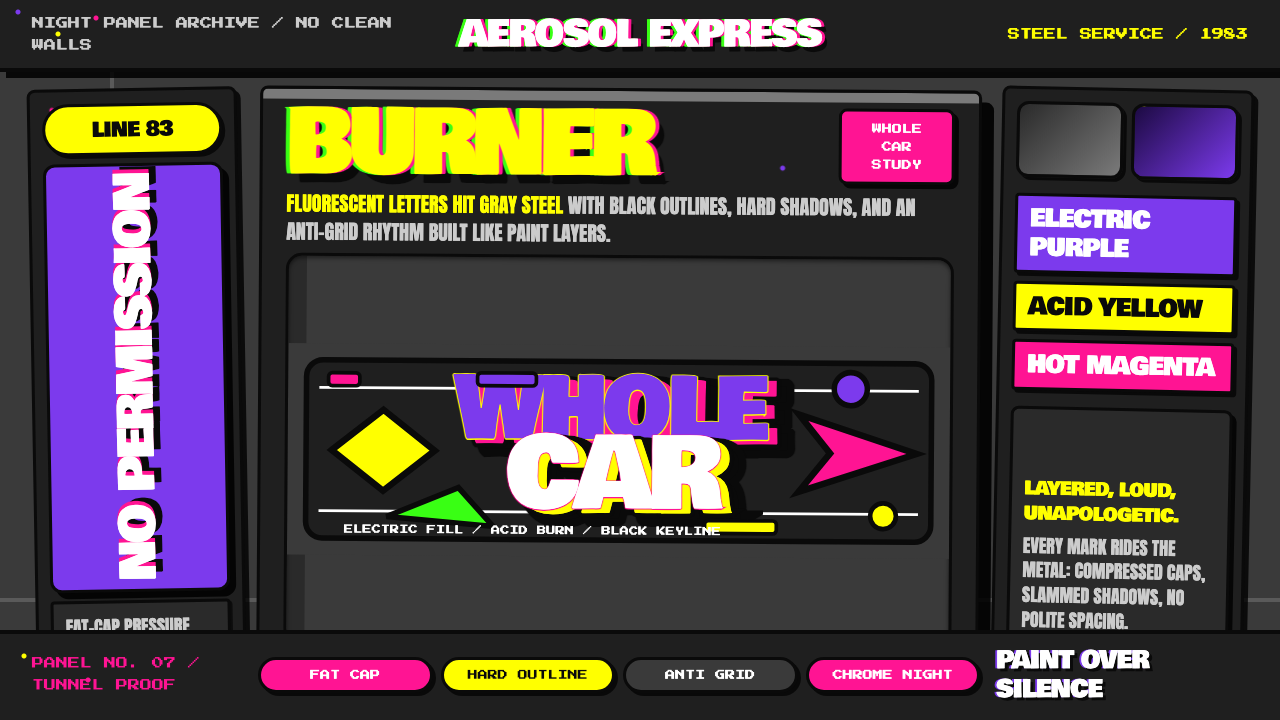 NYC Subway Graffiti (1983)Bombed steel gets loud. Electric purple and acid yellow stack as hard-outline…
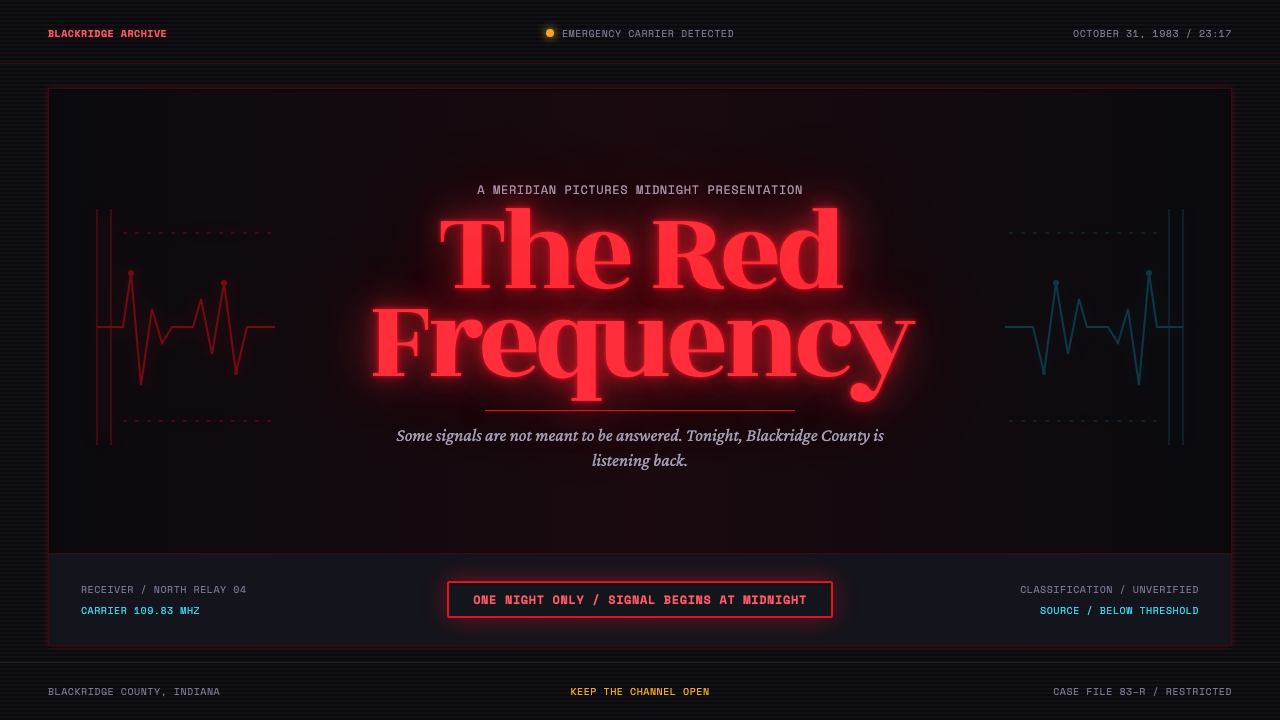 Stranger Things (1983)Red light breaks the void. A spurred serif blooms through VHS static and cold…
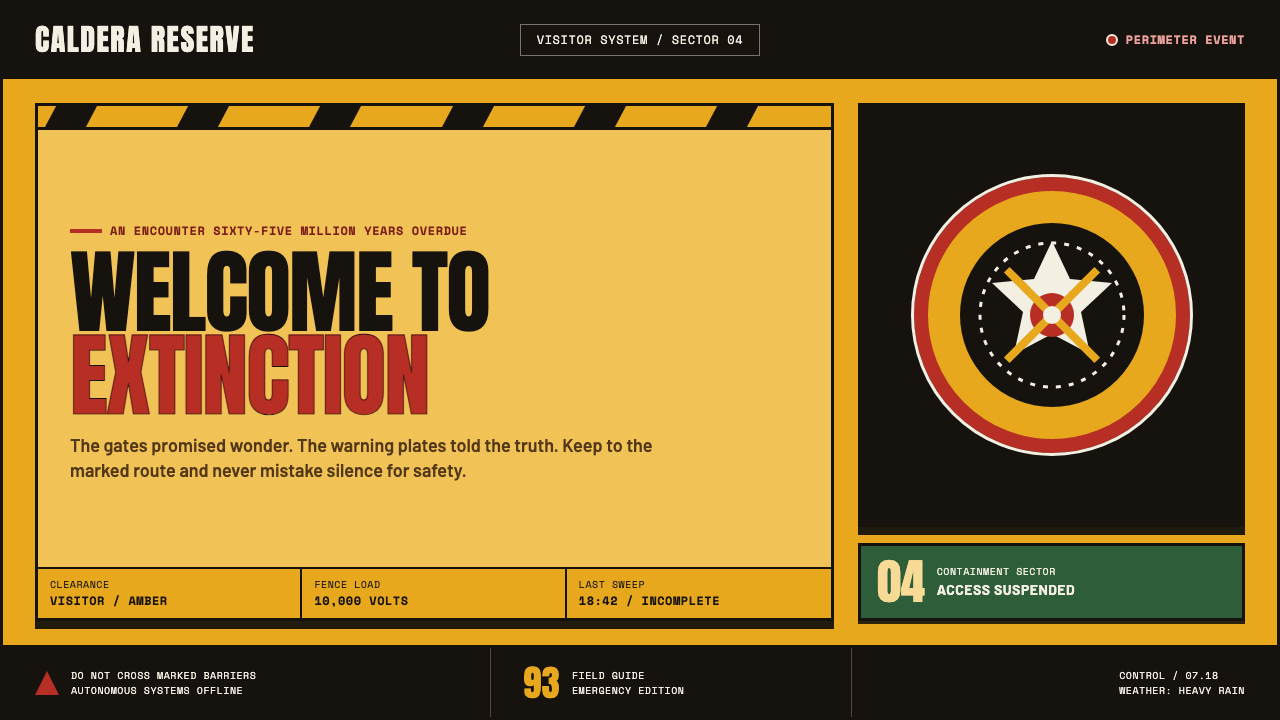 Jurassic Park (1993)Warm welcome, lethal edge. Amber plates, red rings and black chevrons turn aw…
 Nollywood VHS CoversEvery inch shouts. Magenta, warning yellow, hard shadows, and part stamps pac…
 Hulk Gamma GreenDon't make us whisper. Muscle green, trouser purple, inked panels, Ben-Day ha…
 Kryptonite GreenRadioactive pulp glows hard. Neon green shard, black gutters, Ben-Day grit.