What is Argentine Malbec Wine?
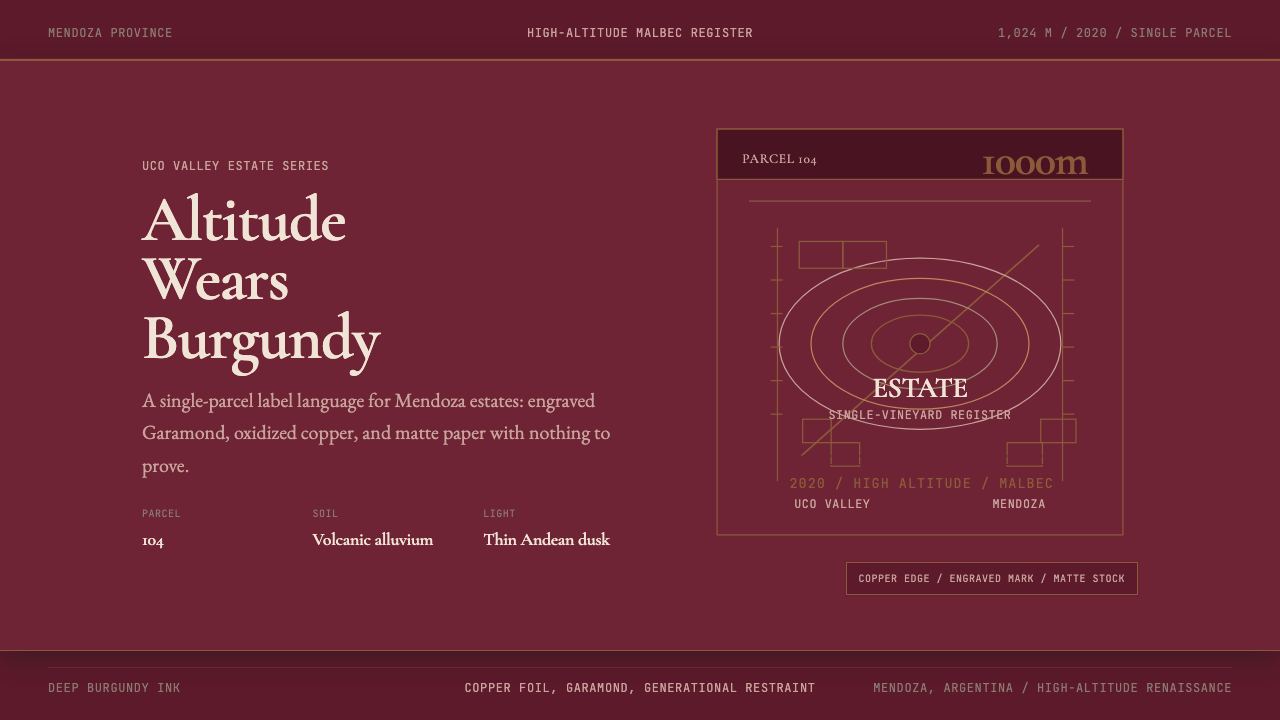
Born in the shadow of the Andes, Argentine Malbec wine branding weaponizes restraint — deep burgundy ink, oxidized copper foil, and engraved letterforms pressed into uncoated paper that speaks of altitude, volcanic soil, and generational stewardship.
Argentine Malbec Wine in brief
Argentine Malbec wine branding is a visual system forged from the landscape of Mendoza's high-altitude valleys. It draws on deep burgundy as its dominant tone — not the aggressive crimson of a mass-market label, but the mature, darkened hue of an aged Malbec at rest in the glass. Against this ground, oxidized copper foil and engraved Garamond estate marks create a surface that feels less printed than pressed, less designed than inherited.
This aesthetic emerged as a deliberate counter-statement to the cartoon labels and fruit-forward imagery that flooded wine shelves in the 1990s and early 2000s. Where those labels shouted, Malbec estate branding whispers. Every element earns its place through restraint: a single engraved vineyard map, a minimal estate seal, a typeface chosen for its historical weight rather than its legibility at a glance. The design does not explain the wine — it presupposes that a wine of this character requires no explanation.
The system channels the visual language of the great Mendoza estates — Catena Zapata, Bodega Norton, Achaval-Ferrer — and translates it into a transferable design vocabulary. Thick uncoated stock replaces the glossy label; tactile impression replaces color contrast as the primary differentiator. In digital contexts, this translates to a palette built around warm near-blacks, aged parchment tones, and the controlled use of a single metallic or oxidized accent. The result is an aesthetic of quiet confidence: a design that knows exactly what it is.

Where does Argentine Malbec Wine come from?
Malbec's story in Argentina begins with French emigration and agrarian ambition. The grape — known in its homeland of Cahors, France, as Côt or Auxerrois — arrived in Argentina in 1853 when the agronomist Michel Pouget carried cuttings to Mendoza at the invitation of the provincial governor. The vine adapted with startling success to the high desert plateau east of the Andes: the thin air, intense ultraviolet radiation, and dramatic diurnal temperature swings produced a fruit with a density and aromatic complexity that the original French plantings rarely achieved. By the early twentieth century, Malbec had become the backbone of Argentine wine production, though primarily for the domestic market and with little attention to label design beyond utilitarian identification.
The transformation of Malbec into a globally recognized prestige wine — and the birth of the visual system that defines it today — began in earnest in the 1990s. The pivotal figure was Nicolás Catena Zapata, who had spent time at UC Davis studying viticulture and returned to Mendoza convinced that the Uco Valley's high altitudes, rising above a thousand meters, could produce world-class wine. Catena invested in single-vineyard identification, minimal intervention winemaking, and — crucially — label design that communicated permanence and seriousness to export markets. The Catena Zapata pyramid label, with its Andean architectural reference and engraved gravitas, set the visual standard that other estates began to follow. By the late 1990s and into the 2000s, Argentine wine exports surged, and with them came a coherent aesthetic language: dark, earthy, precise, and unhurried.
The wine renaissance of this era produced a generation of winemakers who treated design as an extension of winemaking philosophy. Susana Balbo, trained as an oenologist and one of the first women to lead a major Argentine winery, approached her label design with the same rigor she applied to her wines: nothing decorative that did not also communicate. Roberto de la Mota, consulting for estates across Mendoza and the broader Cuyo region, helped articulate a house style built around terroir transparency — the label as a statement of place rather than of brand personality. Laura Catena, continuing her father's legacy while also publishing academic research on high-altitude viticulture, reinforced the intellectual seriousness of the movement's self-presentation.
The visual identity that coalesced from these efforts draws on a specific set of material and historical references. The engraved letterform echoes the tradition of French grand cru estate typography — Bordeaux chateau labels with their centuries-old typefaces — but filtered through an Argentine lens that emphasizes the Andean landscape rather than European heritage. The use of oxidized or aged metallic foils speaks of time, of cellaring, of the patience that altitude-grown wine demands. The choice of thick uncoated paper over laminated stock is a rejection of the visual noise of commercial wine shelves in favor of tactile honesty. This was not an aesthetic of nostalgia but of aspiration: Argentina making the case, through visual form, that its wines deserved a place among the world's finest.
What defines the Argentine Malbec Wine look?
Color Palette
The dominant tone is a deep burgundy — a near-black red that reads as dignified rather than aggressive, evoking the color of an aged Malbec held up to candlelight. Against this, aged parchment or warm off-white grounds provide breathing room without suggesting clinical brightness. The accent is oxidized copper or antique gold: not the harsh gleam of commercial foil, but a muted, weathered metallic warmth. A very limited range of earthy secondary tones — slate, volcanic grey, dry earth brown — may appear, but the system never uses more than two or three values at once. Saturation throughout is low to medium; the palette deliberately avoids the high-contrast primary colors associated with mass-market wine labels.
Typography
Engraved or letterpress-feeling serif typefaces are the typographic foundation. The model is classical French estate typography — the kind found on Bordeaux chateau labels — with the character that comes from metal type pressed into heavy paper rather than digitally rendered on a smooth surface. Display text is set with generous letterspacing, giving each character room to breathe and reinforcing the sense that nothing here was designed in haste. Body text, where it appears, is set at a small measure with quiet authority. Italics carry the weight of provenance notes, vineyard names, and vintage information. Modern sans-serif type is conspicuously absent; its presence would dissolve the aesthetic.
Surface and Materiality
Uncoated, heavyweight paper stock is as much a design decision as any typographic choice. Where glossy labels catch light uniformly, uncoated stock absorbs it differently depending on angle, creating a living surface that changes under different lighting conditions. In digital applications, this material logic translates into textured grounds — subtle paper grain, faint aged vellum tones — applied with restraint so they read as atmosphere rather than decoration. The system's attitude toward surface is always one of honest materiality: the design should feel as though it could be touched and found to have substance.
Ornament and Illustration
When figurative elements appear, they are engraved in style — thin cross-hatched lines evoking the tradition of intaglio printmaking rather than digital illustration. Common motifs include vineyard topographic maps rendered as fine-line engravings, Andean mountain silhouettes, and estate seals with heraldic geometry. Crucially, these illustrations are not decorative additions — they carry specific information about place, elevation, and identity. The distinction between ornament and information is taken seriously: anything that could be removed without loss of meaning should not be there.
Composition and Hierarchy
Composition is formally centered or near-centered — a marked contrast to the asymmetric dynamism of modernist design systems. The estate name anchors the center or upper register, the vintage occupies a quiet secondary position, and the appellation or vineyard designation appears below in a smaller but equally deliberate typeface. White or parchment space is used generously; crowding is treated as a quality signal in the wrong direction. The hierarchy communicates that the wine's name and its place of origin are the only things that truly matter, and everything else is supporting annotation.
Restraint as Aesthetic Principle
More than any single visual element, the defining quality of this aesthetic is its confidence in subtraction. Every decision — fewer colors, heavier paper, more space, quieter illustration — is a decision to let the wine speak rather than the design. This restraint is not minimalism in the contemporary sense; it is not about achieving a sleek, tech-inspired simplicity. It is the restraint of something that does not need to compete for attention because it already knows what it is worth. The aesthetic is aristocratic without being arrogant, classical without being archaic.
Altitude and Terroir as Visual Language
What sets Argentine Malbec branding apart from European estate aesthetics is its explicit reference to landscape and geography. The Andes are not a backdrop — they are a protagonist. Labels frequently reference elevation in meters, locate the estate on a small map of Mendoza's sub-appellations, or name specific vineyard parcels with the precision of a land survey. In digital or presentation contexts, this translates to a design language that treats geographical specificity as a prestige signal: the more precisely a wine can name its place, the more serious it is. Maps, topographic lines, and elevation data appear as visual elements rather than purely informational footnotes.

Who shaped Argentine Malbec Wine?
Nicolás Catena Zapata is the central figure in the transformation of Argentine Malbec from a domestic wine into a global prestige product. After studying viticulture at UC Davis in the 1980s, he returned to Mendoza convinced that the Uco Valley's extreme altitudes could produce Malbec of world-class quality. His investments in high-altitude single-vineyard wine — and in the architectural, engraved label design that communicated this ambition visually — established the visual and winemaking template that the entire Argentine prestige wine industry followed. The Catena Zapata label, with its Andean pyramid motif and classical typography, became the reference against which all subsequent Argentine premium labels defined themselves.
Laura Catena, daughter of Nicolás, extended the family winemaking legacy while also providing the intellectual articulation that gave the aesthetic its authority. Her academic research on high-altitude viticulture — published alongside her wine work — positioned Argentine Malbec within a serious discourse of terroir science rather than pure marketing. Through her Zuccardi and Catena Institute of Wine projects, she helped establish the language of single-parcel, elevation-specific wine identification that became a cornerstone of the visual system: the idea that a wine's label should function as a precise geographical document.
Susana Balbo, one of the first female oenologists to lead a major Argentine winery, brought a rigorous, no-decoration-for-its-own-sake philosophy to both winemaking and label design. Her Susana Balbo Wines labels exemplify the principle that restraint is not poverty but precision: a clean typographic hierarchy, the producer's name as primary identifier, and the grape variety and vintage as secondary — with nothing present that does not need to be. Her influence reinforced the idea that the design vocabulary of Argentine Malbec should reflect the same discipline applied in the winery itself.
Roberto de la Mota, consulting winemaker for estates across Mendoza and beyond, articulated a winemaking philosophy centered on terroir transparency that directly informed the visual identity of the wines he worked with. His approach — letting the specific geography of each vineyard express itself rather than imposing a house style across the range — pushed label design toward greater geographical specificity. The estates he consulted for frequently feature vineyard maps, elevation notations, and parcel names as primary visual elements, because de la Mota's winemaking philosophy made these facts the wine's most important story.
The founding team of Achaval-Ferrer — established in Mendoza in 1998 — represented the internationalist ambition of the Argentine wine renaissance. By bringing together an Argentine businessman, an Italian winemaking consultant, and a focus on single-vineyard parcels in Luján de Cuyo, they produced wines that required a label language capable of speaking to sophisticated European and American collectors. The Achaval-Ferrer labels, with their restrained typography and estate-mark gravity, helped define the visual register of Argentine Malbec for the export market at the moment when that market was being created.
How do you use Argentine Malbec Wine today?
Argentine Malbec wine branding translates most naturally into contexts that need to communicate premium quality, geographical authenticity, and patient craftsmanship — without the cold authority of Swiss modernism or the exuberance of tropical lifestyle branding. The system works because its visual vocabulary is deeply specific to what it represents: a wine from a precise elevation, in a precise valley, made by people who have committed decades to a single type of grape. Applying it correctly means preserving that specificity rather than borrowing only the surface color palette.
For presentation decks, the aesthetic performs exceptionally well on both covers and content slides. A cover built in this language works with a near-black or deep burgundy full-bleed ground, a centered or near-centered estate-style title in a serif typeface with generous letterspacing, and a single subdued metallic or warm off-white accent for the subtitle or date. Content slides should resist the impulse toward bullet points in favor of a single strong typographic statement per page, with supporting text set at a quieter scale below. Data slides take on an engraved, cartographic quality — charts styled with thin ruled lines, muted fills drawn from the earthy palette, and axis labels set in a small, spaced serif rather than a modern sans. The overall effect is a deck that feels like a document you would keep, not a deck you swipe through.
For web interfaces — particularly product pages, pricing tiers, and dashboard welcome screens — the system rewards discipline. A near-black or deep burgundy header with parchment-toned body background, serif headings, and restrained use of a single warm metallic accent for primary calls to action will establish the correct register immediately. Navigation should be typographic, with generous spacing and no icon clutter. Card components work well with a faint border and a very subtle paper-texture ground rather than drop shadows. Pricing tiers benefit from the system's innate hierarchy: the premium tier presented in the dark ground with lighter type, the standard tier on parchment — the visual weight does the communication work that tier labels alone cannot.
For editorial layouts and marketing materials, the style supports long-form content that wants to feel authoritative. A Malbec-aesthetic article page uses a narrow single column of body text at a comfortable reading size, with ample margin space reserved for pull quotes or provenance annotations set in italics. Section breaks are marked by a thin horizontal rule — not a decorative divider, not a color block, just a line. Marketing campaign visuals work well with full-bleed photography of the Andean landscape treated as a near-monochrome base, with the editorial typographic system laid over it in parchment or oxidized gold. The effect is cinematic in scale but restrained in execution.
The most common mistake when applying this aesthetic is to import only its color signature while retaining modern design conventions — a deep burgundy background with a geometric sans-serif typeface and rounded corners on card components, for instance. This hybrid reads as inconsistent because it borrows the palette without the underlying logic: the system's authority comes not from the color alone but from the combination of classical typography, material-referencing surfaces, and the confidence of generous negative space. A second common error is over-using the metallic or copper accent as if it were an interactive color — the system breaks down if the accent appears on more than one or two elements per composition. Reserve it for the single most important element on the screen or page.

Argentine Malbec Wine — FAQ
How is Argentine Malbec branding different from French Bordeaux label design?
The visual DNA overlaps considerably — both use classical serif typography, engraved illustration, restrained palettes, and the authority of negative space. The critical difference is geographical self-consciousness. Bordeaux labels often foreground the chateau as an institution, its architecture and heraldic history. Argentine Malbec labels foreground the land: elevation figures, vineyard maps, sub-appellation coordinates. This reflects a different prestige logic — Bordeaux derives authority from centuries of classified estates; Argentina derives it from the specificity and extremity of its high-altitude terroir. The result is that Malbec labels tend to feel more geological, more landscape-oriented, and more explicitly scientific in their geographical claims.
Can this aesthetic work for a non-wine product or brand?
Yes, but only when the underlying values align. The Argentine Malbec aesthetic communicates: altitude-earned quality, geographical precision, patient craftsmanship, and the quiet confidence of something that does not need to compete for attention. These values transfer well to other premium craft products — specialty coffee, single-origin chocolate, aged spirits, artisanal olive oil — and to professional services that want to signal expertise without showmanship: law firms, independent financial advisory practices, bespoke architecture studios. The aesthetic struggles for brands that need approachability, warmth, or mass-market accessibility; its register is inherently exclusive and its visual temperature inherently cool.
What is the right way to handle typography in a digital application of this style?
The challenge in digital contexts is that the engraved, letterpress quality of the original style comes from physical impression on uncoated paper — a quality that digital rendering cannot directly replicate. The correct approach is to choose a classical serif typeface with strong historical credibility rather than a fashionable contemporary serif. Wide letterspacing in headlines is essential; it signals deliberateness. Body text should be set at a comfortable reading size with generous line height — the aesthetic is never cramped. Avoid bold weights in body text; the style's authority comes from restraint rather than emphasis. The one place where weight is appropriate is in a single large typographic display element — an estate name, a year, a provenance line — where the size alone provides the hierarchy.
How should the oxidized copper or metallic accent be used, and what should it never touch?
The metallic accent should be reserved for one element per composition that carries the highest prestige signal: the estate name on a label, the primary call-to-action button on a web page, the section title on a deck cover. Its power comes from scarcity. Once it appears on secondary elements — navigation links, data labels, decorative borders — it loses its semantic weight and the composition flattens into visual noise. It should never appear on interactive states like hover or focus by default; in those cases, a subtle typographic shift or opacity change signals interaction without cheapening the accent. It should also never appear on error states, system messages, or any utilitarian interface element — those should be handled by the neutral parchment-and-near-black palette.
Does Argentine Malbec wine branding work in a dark-mode or dark-background application?
The deep burgundy or near-black ground is in fact the canonical dark application of this system — unlike, say, Bauhaus, which was fundamentally conceived on a light ground. A dark-first approach works naturally here: near-black or deep burgundy field, parchment or warm off-white type, and the oxidized copper accent. The inversion that should be approached with care is a light-on-dark layout where the background is very dark but the accent is pushed too bright — the moment the copper reads as a saturated orange rather than a weathered metal, the entire aesthetic collapses. The trick is to ensure that even in a dark application, the metallic accent retains its quality of being muted, aged, and non-competitive with the type.
Related design styles
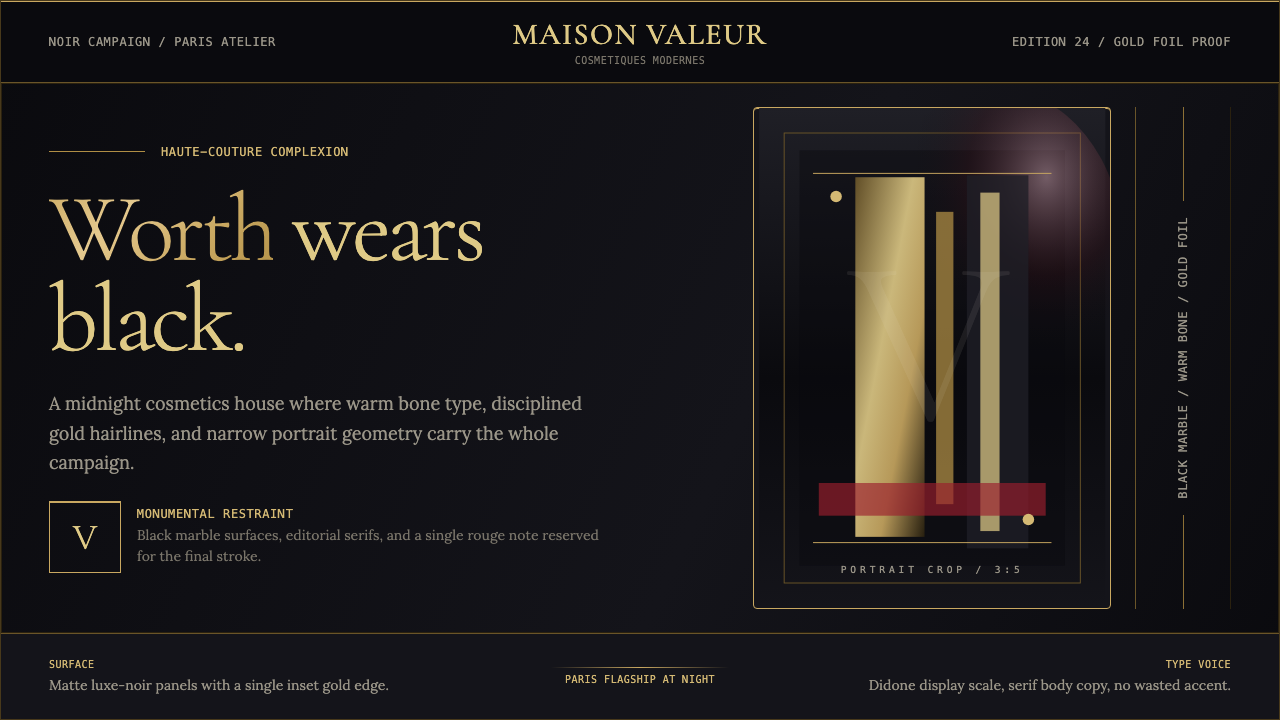 L'Oréal Paris CosmeticsMonumental restraint. Black marble fields, gold Didone type, and narrow portr…
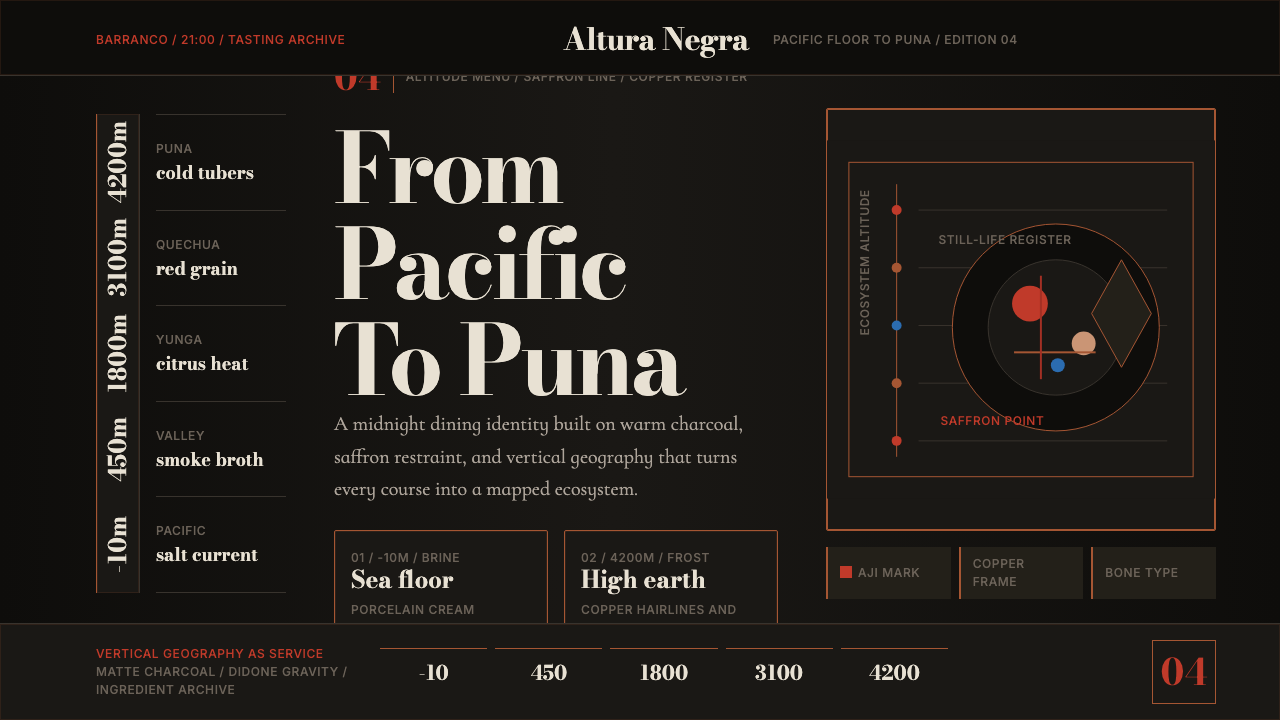 Lima Nuevo Andino CuisineAltitude turns luxurious. Charcoal fields, copper hairlines, and saffron-red…
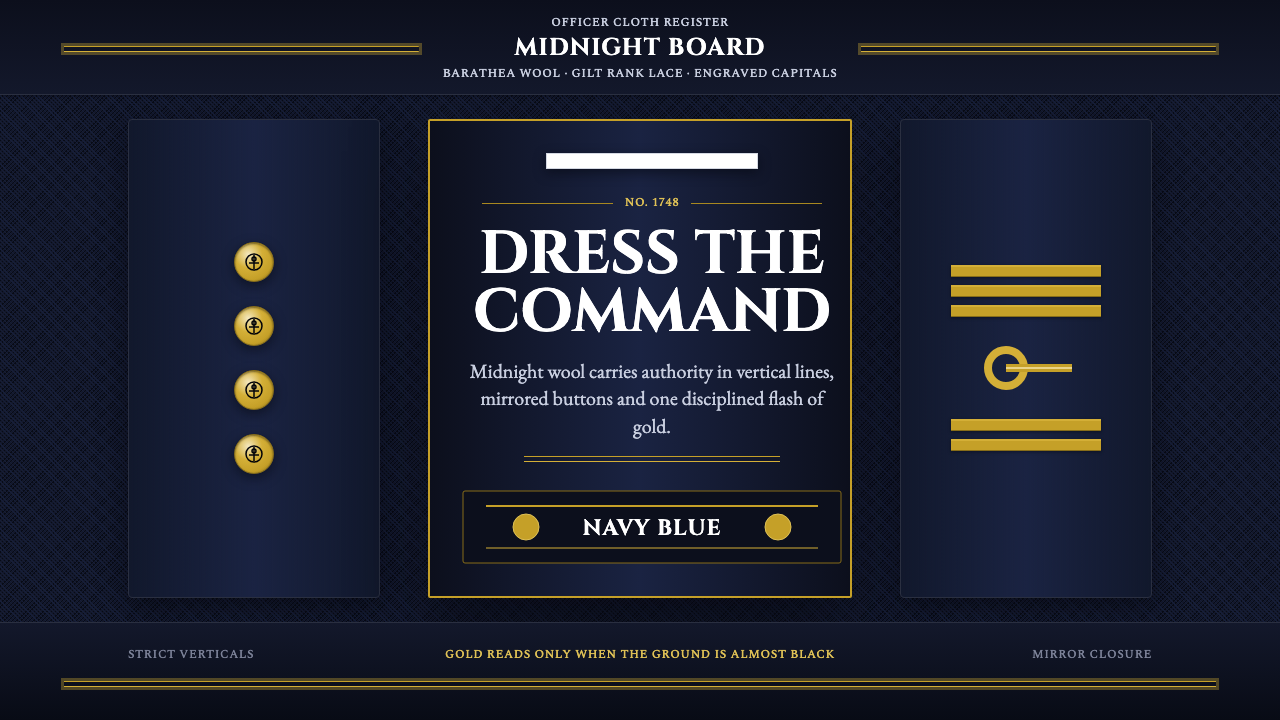 Naval Dress UniformAuthority in midnight wool. Cinzel capitals, gold lace and button symmetry ho…
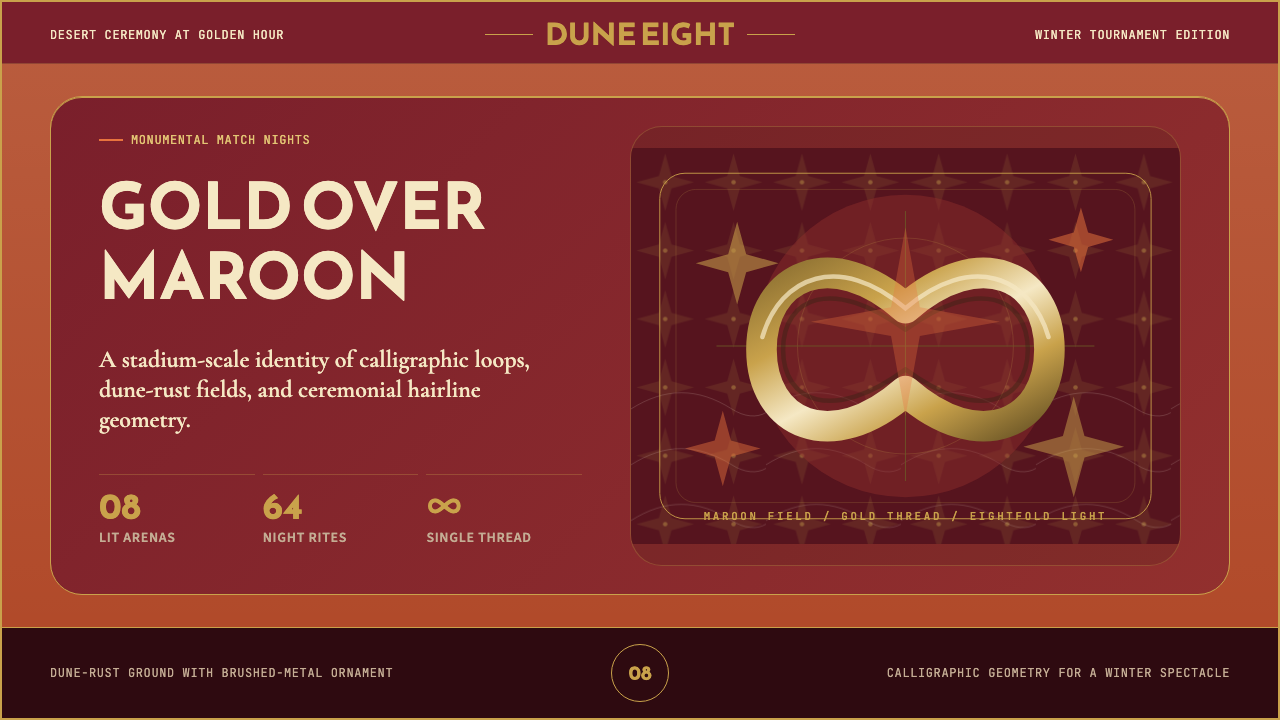 Qatar World Cup 2022Desert spectacle in gold. Maroon fields, Reem Kufi scale, and eightfold star…
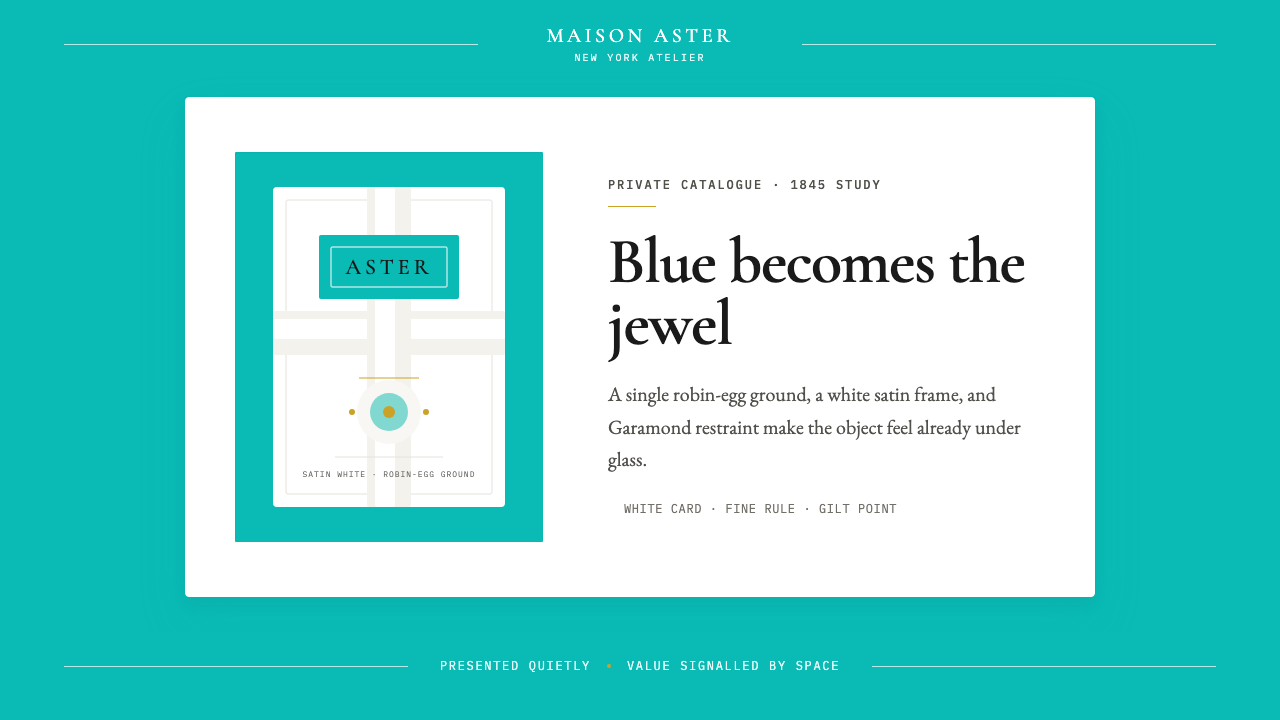 Tiffany Robin-Egg BlueBlue is the luxury signal. Robin-egg ground, white satin rules, Garamond rest…
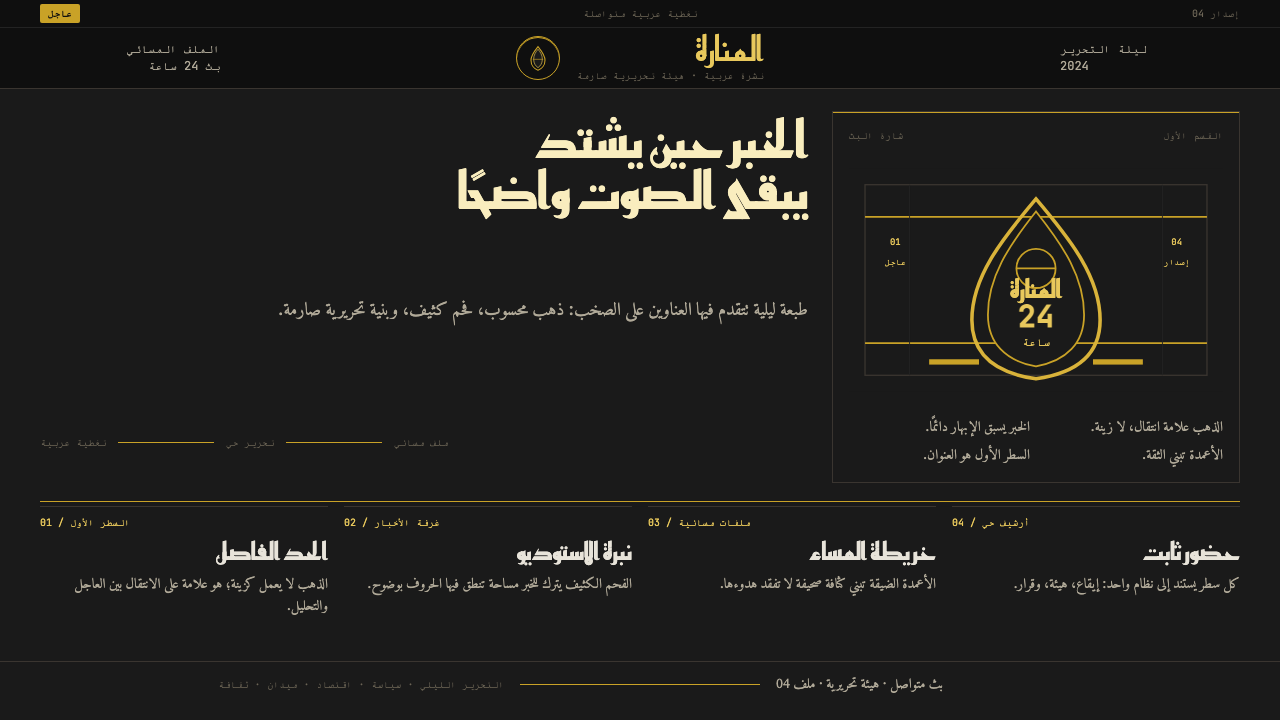 Al Jazeera Arabic NewsAuthority, stripped bare. Gold seal, dense Arabic type, matte charcoal.