What is Emirates Airline (Red-Gold)?
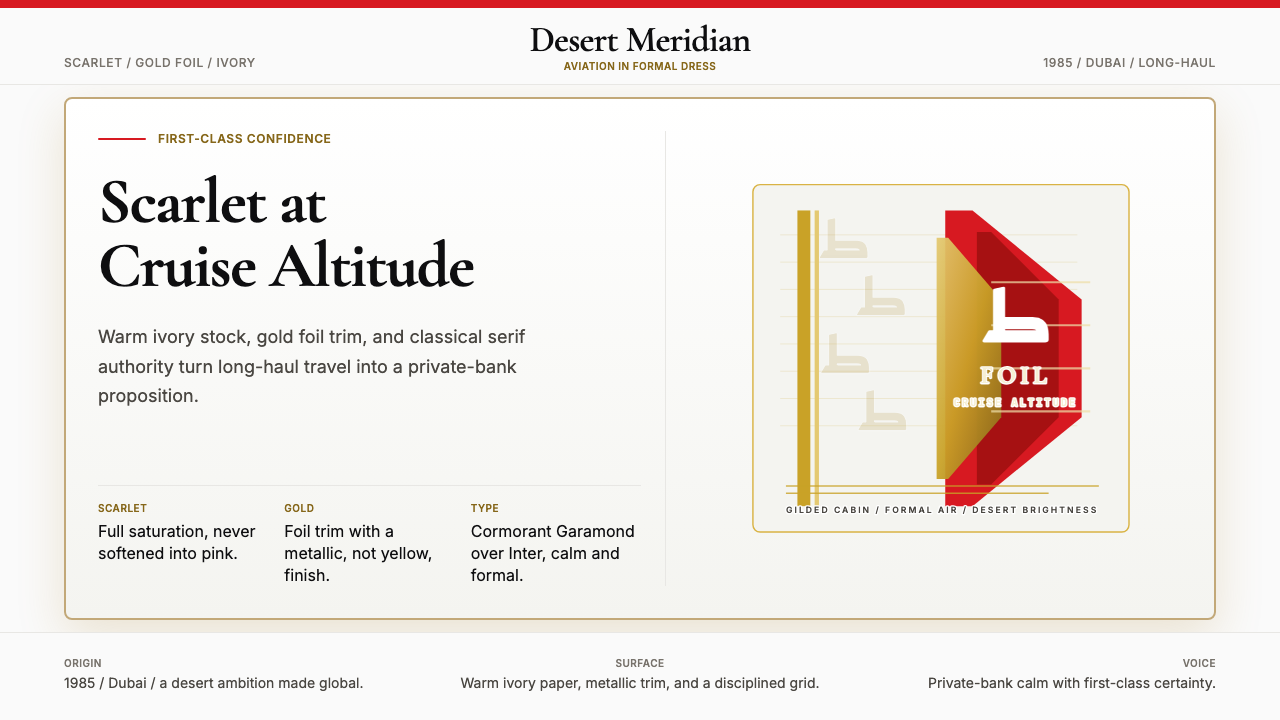
Emirates turned a desert crossroads into a global aviation icon by committing, without compromise, to scarlet confidence and gold authority.
Emirates Airline (Red-Gold) in brief
Emirates Airline (Red-Gold) is the visual identity system of one of the world's most recognised carriers, built on two absolutes: a scarlet red applied at full saturation and a gold rendered as genuine metallic foil rather than flat pigment. Together they form a palette that signals luxury without ambiguity — not the muted earth tones of wellness brands, not the icy greys of fintech, but the unambiguous warmth of a first-class cabin at altitude.
Every surface in the Emirates visual world reads as warm ivory paper stock trimmed with calligraphic gold, anchored by classical serif typography that refuses the sans-serif vernacular of the tech industry. Arabic calligraphy is not an accent or a cultural footnote — it is load-bearing, occupying equal visual weight alongside Latin letterforms and serving as the primary ornamental register of the system.
The result is aviation branding that feels closer to a private banking house or a grand hotel than to a low-cost carrier. The identity signals that the passenger is not merely transported but hosted — a distinction that every visual decision, from the livery stripe to the in-flight menu card, is engineered to reinforce.

Where does Emirates Airline (Red-Gold) come from?
Emirates Airline was founded in March 1985, backed by the government of Dubai with a seed investment and two leased aircraft. The airline's creation was not born from market demand analysis but from state ambition: Sheikh Mohammed bin Rashid Al Maktoum and his advisors, including the veteran aviation executive Maurice Flanagan, conceived Emirates as an instrument of Dubai's transformation from a regional port into a global hub. The visual identity was designed from the outset to carry the weight of that aspiration — it needed to look, from day one, like a carrier that had always existed at the highest tier.
The core palette — scarlet and gold — draws on a visual tradition deeply embedded in Gulf culture and Islamic decorative arts, where red signals vitality and authority, and gold signals divine favour and material abundance. These were not chosen for trend but for permanence: colours that carry cultural resonance across Arabic, South Asian, East Asian, and European markets simultaneously. The use of gold as metallic foil rather than flat print was a deliberate production decision, ensuring that even at small scales — a luggage tag, a boarding card — the material quality reads as physical rather than printed.
The calligraphic Arabic script that appears alongside the wordmark is not decorative overlay but identity-founding. Emirates operates out of a city where the script is the primary visual language of public life, and the decision to give Arabic equal billing with the Latin logotype was both culturally genuine and commercially shrewd — signalling to the Gulf's elite travellers that the airline was theirs, while to international passengers signalling cultural confidence and specificity rather than global anonymity.
The identity reached its most refined contemporary form through a gradual evolution across the late 1990s and 2000s, arriving at what is broadly referred to as the current identity around 2008. The visual refinements of that period — tightening the proportions of the wordmark, standardising the treatment of gold across all media, and establishing the ivory ground as mandatory rather than optional — produced a system stable enough to persist essentially unchanged through the 2010s and into the 2020s. Stability, in this context, is not stagnation: it is the mark of an identity that was correctly resolved.
What defines the Emirates Airline (Red-Gold) look?
Scarlet as Foundation
The red in the Emirates identity is not brick, not crimson, not rose — it is scarlet at absolute saturation, applied with the confidence of a material that does not negotiate. On aircraft livery it occupies the tail and engine nacelles; on printed collateral it anchors headers and borders. The colour reads as warm but not casual, bold but not aggressive. It is the visual equivalent of a formal handshake.
Gold as Material, Not Colour
Gold in the Emirates system is never flat. It is always rendered as foil, metallic ink, or a carefully calibrated warm tone that implies physical reflectance. This distinction is essential: flat gold reads as decoration; foil gold reads as material. The calligraphic Arabic wordmark and the logotype flourishes are the primary carriers of this gold register, and they must be reproduced at sufficient scale and with sufficient material quality to maintain the intended effect.
Arabic Calligraphy as Structural Ornament
Unlike most international brands that treat non-Latin scripts as secondary or footnote elements, Emirates positions its Arabic calligraphy as co-equal with the Latin wordmark. The script is rendered in a classical, fluid hand — not a digitally simplified version — and its rhythmic curves provide the only organic form in an otherwise rectilinear identity system. This calligraphic register is what prevents the identity from reading as merely corporate; it locates the brand geographically and culturally.
Ivory as the Ground Register
Pure white is not the Emirates ground. The system uses a warm ivory — the tone of high-quality uncoated stock, of a card that has mass in the hand — as the default background across print collateral, menu cards, and formal communications. This ivory warmth softens the contrast between red and gold without diluting either, and it reinforces the sense of material quality: this is paper, not screen.
Classical Serif Typography
Where text is set in Latin script, Emirates uses typefaces rooted in classical serif tradition — proportioned letterforms with bracketed serifs, optically balanced stroke contrast, and the dignified rhythm of traditional book typography. This is a deliberate refusal of the geometric sans-serif that dominates aviation and travel branding. The serif choice positions Emirates alongside private banking, fine hospitality, and luxury retail — industries where typographic tradition signals trustworthiness and permanence.
Livery as Moving Architecture
The aircraft livery translates the brand system into architecture at the scale of a seven-storey building moving at cruise altitude. The scarlet tail, the gold calligraphic wordmark running the length of the fuselage, and the white body create a tripartite composition that reads clearly from approach distances, in photographs, and in video at any compression level. Nothing in the livery is incidental — every stripe width and every letterform position has been resolved to survive the rendering conditions of an aircraft exterior.
Restraint in the Third Dimension
Despite the opulence of the palette, the Emirates identity exercises strict restraint in its spatial composition. Layouts are not busy. White and ivory fields are generous. Elements do not compete — the calligraphic wordmark owns its zone, the red field owns its zone, and body text is given space to breathe. This spatial confidence is itself a luxury signal: only brands that have resolved their hierarchy can afford to leave this much room.

Who shaped Emirates Airline (Red-Gold)?
As the architect of Dubai's modern transformation and the primary patron of Emirates Airline, Sheikh Mohammed shaped not only the airline's commercial strategy but the aesthetic ambition embedded in its identity. His vision of Dubai as a global hub — not merely a regional one — demanded a brand capable of standing alongside the oldest and most prestigious carriers in the world from day one. The red-and-gold identity reflects his broader philosophy: that a young institution can claim visual authority if it commits without hesitation to the highest register of its chosen tradition.
Flanagan was the founding president of Emirates and the operational brain behind its rapid ascent. A veteran of British Caledonian and Gulf Air, he brought to Emirates the understanding that service design and brand design are inseparable — that the identity promise made by the livery and the collateral must be delivered in the cabin. Flanagan championed the decision to pursue a premium positioning from launch rather than growing into it, which is why the visual identity was resolved at the luxury register from the outset rather than evolved toward it.
As the creative figure associated with key periods of the Emirates identity's development, Negus Sangaré represented the design intelligence responsible for translating the airline's aspirational brief into a resolved visual system. The challenge was substantial: producing a brand that could operate at full integrity across the extreme scale range from aircraft livery to in-flight menus, in both Arabic and Latin scripts, and across the thermal and mechanical stresses of physical aviation environments. The identity's durability across decades is evidence of the rigour applied at its founding resolution.
As Emirates president through much of the airline's global expansion, Tim Clark oversaw the periods during which the visual identity was standardised and globalised — applied to a fleet that grew from dozens to nearly three hundred aircraft, across a route network spanning every continent. Clark's tenure coincided with the identity's transition from a regional airline mark to one of the most photographed liveries in the world, appearing in the background of airport photography on six continents and becoming, in effect, a global visual shorthand for premium long-haul aviation.
The Emirates wordmark draws on a centuries-deep tradition of Arabic script as a fine art form. Classical Arabic calligraphy — in styles such as Naskh, Thuluth, and Diwani — was historically used to adorn mosques, royal decrees, and manuscripts of the highest cultural importance. By grounding the Emirates logotype in this tradition, the brand implicitly claims that lineage. The calligraphy is not pastiche: it is an authentic continuation of a living typographic tradition into the medium of commercial aviation, and it is the element of the identity that most clearly differentiates Emirates from every other carrier in the world.
How do you use Emirates Airline (Red-Gold) today?
The Emirates Red-Gold identity is among the most demanding historical references a designer can work with, because its power depends entirely on the correct relationship between three elements — scarlet, gold, and ivory — none of which can be substituted without collapsing the system. Applying it correctly requires understanding what the palette is doing structurally: scarlet commands attention and anchors primary hierarchy, gold marks calligraphic or prestige elements, ivory provides the warm breathing ground between them. Remove any one element and the remaining two lose their meaning.
For presentation slides, the Emirates identity translates to a cover and content system of considerable visual authority. A cover slide works best with a full-bleed scarlet field occupying the upper third or full background, the title set in a classical serif at generous scale in ivory or warm white, and a thin gold rule or calligraphic flourish as the sole decorative element. Content slides should be predominantly ivory-ground, with scarlet used only for section headers or call-out borders, and gold reserved for data highlights or key figures. The temptation to use both scarlet and gold on the same content slide should be resisted — their combined presence is high-voltage and will overwhelm body text at typical reading distances. Data visualisation within this system should favour warm tones for positive values and use the scarlet sparingly as an alert or emphasis register rather than as a charting primary.
For web interfaces and dashboards, the Emirates palette translates best to contexts requiring perceived premium status: pricing pages for high-value services, executive dashboards, hospitality booking flows, and financial product interfaces where trust and stability are the primary emotional goals. The approach is to establish ivory or very warm off-white as the page ground, use scarlet for primary interactive elements — the call-to-action button, the active navigation state, the selected tier indicator — and deploy gold only at the smallest and highest-prestige scale: a premium badge, a selected plan border, a headline flourish. Dark mode should be approached with caution in this system; the identity is fundamentally a light-ground one, and the warm ivory-scarlet-gold relationship does not translate directly to a dark background without significant rebalancing.
For editorial and marketing work, the Emirates style supports long-form content with strong positional authority. A feature article layout using this identity would give the opening page a full-width scarlet masthead with gold lettering, transition to ivory-ground body pages with scarlet drop capitals and gold rule section dividers, and use generous margins throughout. Marketing pages work best as a sequence of full-width panels: an ivory panel with scarlet headline and gold accent rule, followed by a scarlet panel with ivory type, followed by a near-black panel with gold type — a rhythm that uses tonal alternation to create forward momentum without relying on animation or motion effects. Print collateral — invitations, menus, loyalty programme communications — is where the identity reaches its full expression, because physical print is the only medium in which the foil gold behaves as intended.
The most common mistake when working with this identity is treating the gold as a colour rather than a material. A flat golden-yellow applied at large scale reads as mustard or ochre and immediately cheapens the effect; gold in the Emirates system only functions as a metallic accent at relatively small scale and high material quality. The second common mistake is using scarlet as a background for body text — extended reading against a saturated red ground causes rapid eye fatigue and undermines the legibility the identity requires. Scarlet should be used in large fields only when text is absent or very sparse. The third mistake is replacing the classical serif with a contemporary sans-serif for reasons of modernisation — this eliminates the typographic register that distinguishes the identity from generic luxury branding and reduces it to a red-and-gold colour scheme without cultural specificity.

Emirates Airline (Red-Gold) — FAQ
Can the Emirates palette work for brands outside aviation and travel?
Yes, but the context must support the signals the palette carries. Scarlet-gold-ivory communicates luxury, cultural authority, and material substance — these are values that translate well to private banking, fine hospitality, high-end event design, premium food and beverage, and institutional communications where gravitas is required. The palette struggles in contexts that call for approachability, informality, or technical neutrality: software tools, healthcare interfaces, consumer fintech, and children's products are poor fits. The key test is whether the brand genuinely wants to make the claim that red-gold makes — that it belongs at the highest tier — because the palette will make that claim forcefully whether or not the product can support it.
How does this identity handle digital screen reproduction, where foil gold is impossible?
This is the central technical tension of the Emirates system on screen. The solution used in Emirates digital properties is to calibrate the gold tone toward the warm, slightly orange end of the spectrum rather than the cool lemon-gold end — this produces a screen colour that reads closer to metallic gold without actually being reflective. The gold is also used more sparingly on screen than in print: as icon fills, thin borders, and single-word accent treatments rather than as large blocks. Motion design can partially compensate by animating a light-sweep effect across gold elements, simulating the way foil catches ambient light. What should never be done is substituting a flat yellow or a saturated amber — these read as completely different colours and destroy the premium register.
Is this identity appropriate for dark-mode layouts?
The Emirates identity is fundamentally a light-ground system, and dark mode requires significant rebalancing rather than simple inversion. On a dark background, the scarlet must be desaturated slightly to avoid overwhelming the composition; the gold tone must shift toward a brighter, more luminous value to maintain visibility; and the ivory ground disappears entirely, removing the element that softens the red-gold contrast. The result, if done carefully, can work as a premium night-mode — the aircraft livery itself is essentially a light-on-dark reading, with ivory type on a scarlet-and-dark-body aircraft. The risk is that without the ivory mediating between red and gold, the palette reads as either a sports brand or a generic luxury treatment. Dark mode works best in this system when the scarlet is removed almost entirely and only gold accents appear against a near-black ground.
How should the Arabic calligraphy element be handled by designers who cannot read Arabic?
With caution and verification. The Arabic calligraphy in the Emirates system is not a decorative flourish — it is a text element that carries specific semantic content, and misuse or distortion will be immediately apparent to a large portion of the intended audience. Designers working in this style should treat the calligraphic elements as fixed assets: use official Emirates artwork files, do not attempt to hand-trace or redraw calligraphic letterforms, do not stretch or compress the letterforms to fit a layout, and do not separate or rearrange individual letter components. If the design context requires original Arabic text rather than the Emirates wordmark, engage a native Arabic-speaking calligrapher or a type designer with verified Arabic expertise. Using a generic Arabic system font as a stand-in for calligraphic text is a category error equivalent to substituting a stock photo for a commissioned oil portrait.
What distinguishes this identity from generic red-and-gold luxury branding?
Three things: specificity of tone, the role of the Arabic calligraphy, and the ivory mediation. Generic red-and-gold luxury branding — found across Chinese New Year campaigns, casino brands, and certain hospitality chains — typically uses a broader range of reds (from burgundy to vermilion) and treats gold as a colour rather than a material. Emirates is specific: one red, one gold register, one ground tone. The Arabic calligraphy is the second differentiator — no other global carrier brand has calligraphy as a co-equal structural element of its logotype, which means the identity is immediately and irreducibly located. Third, the ivory ground prevents the identity from reading as a festival or celebration palette: ivory is sober, ivory has mass, ivory says institution rather than occasion. These three specifics together are what prevent the Emirates look from being generically 'luxurious' and make it instead specifically powerful.
Related design styles
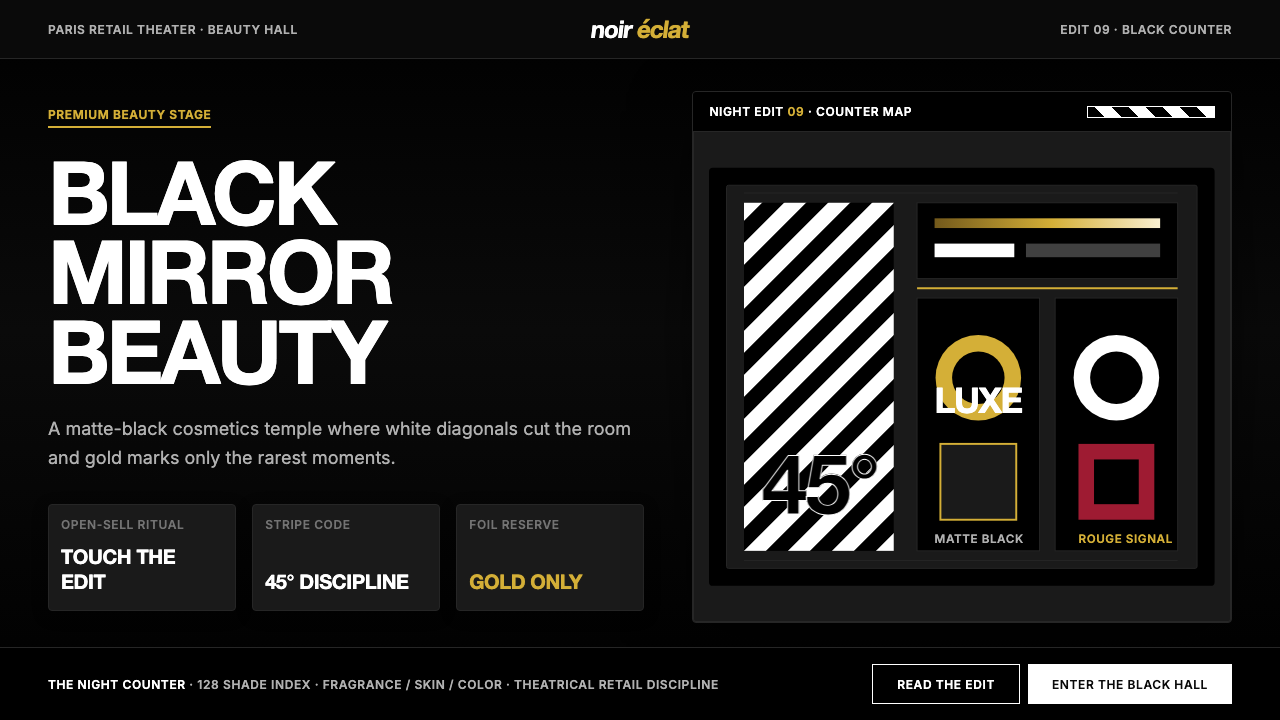 SephoraBlack is the stage. White 45° stripes and restrained gold foil make cosmetics…
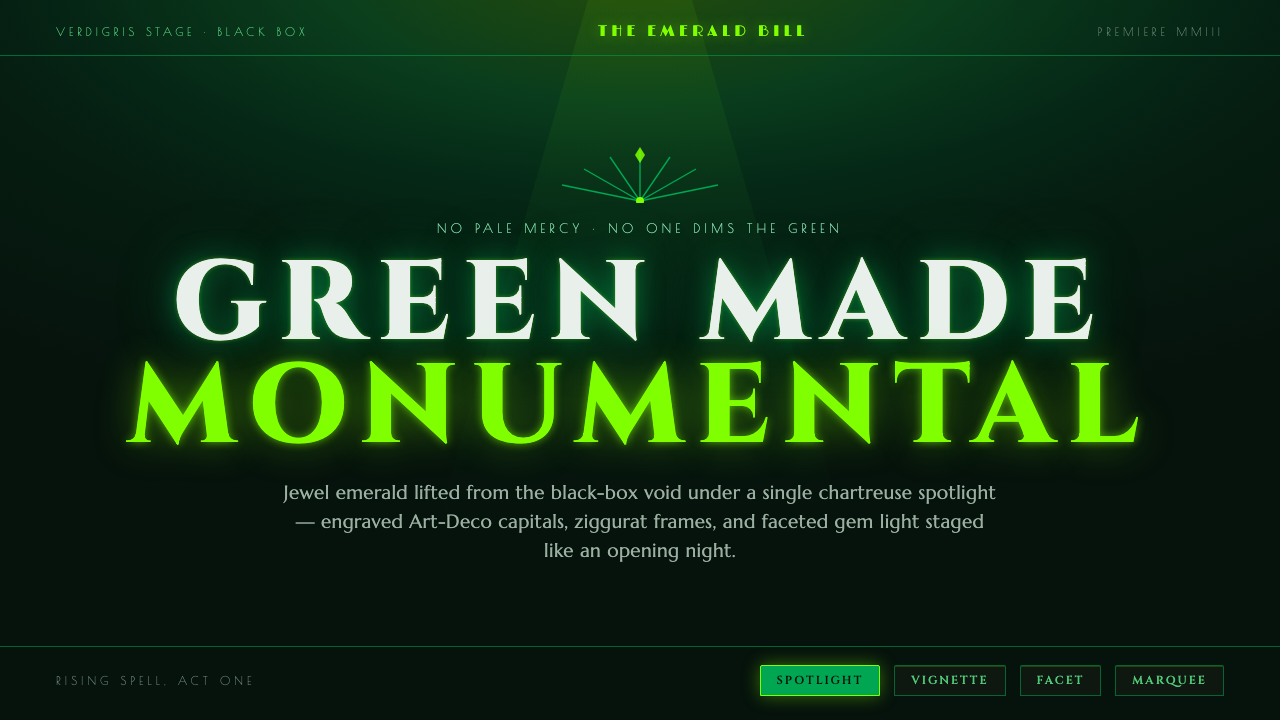 Wicked Elphaba EmeraldGreen made monumental. Jewel emerald spotlit on a black-box void, in engraved…
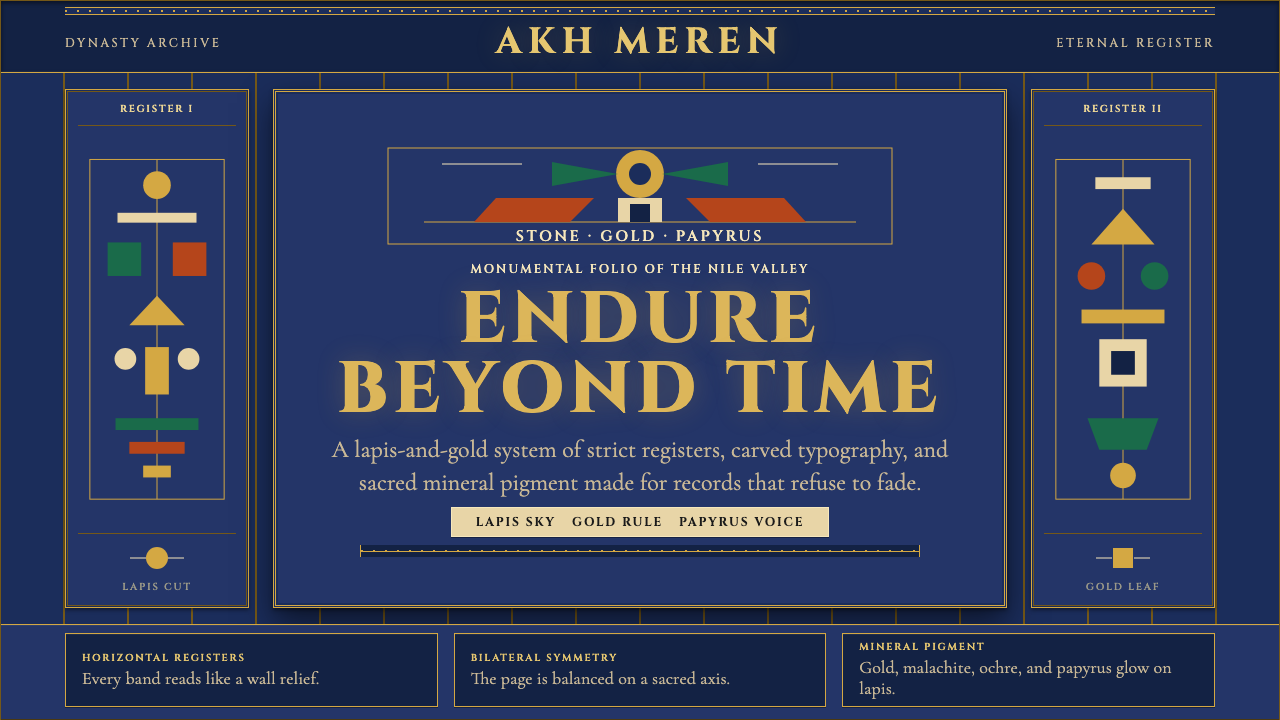 Egyptian PharaonicRegal permanence. Gold rules and Cinzel capitals carve papyrus registers into…
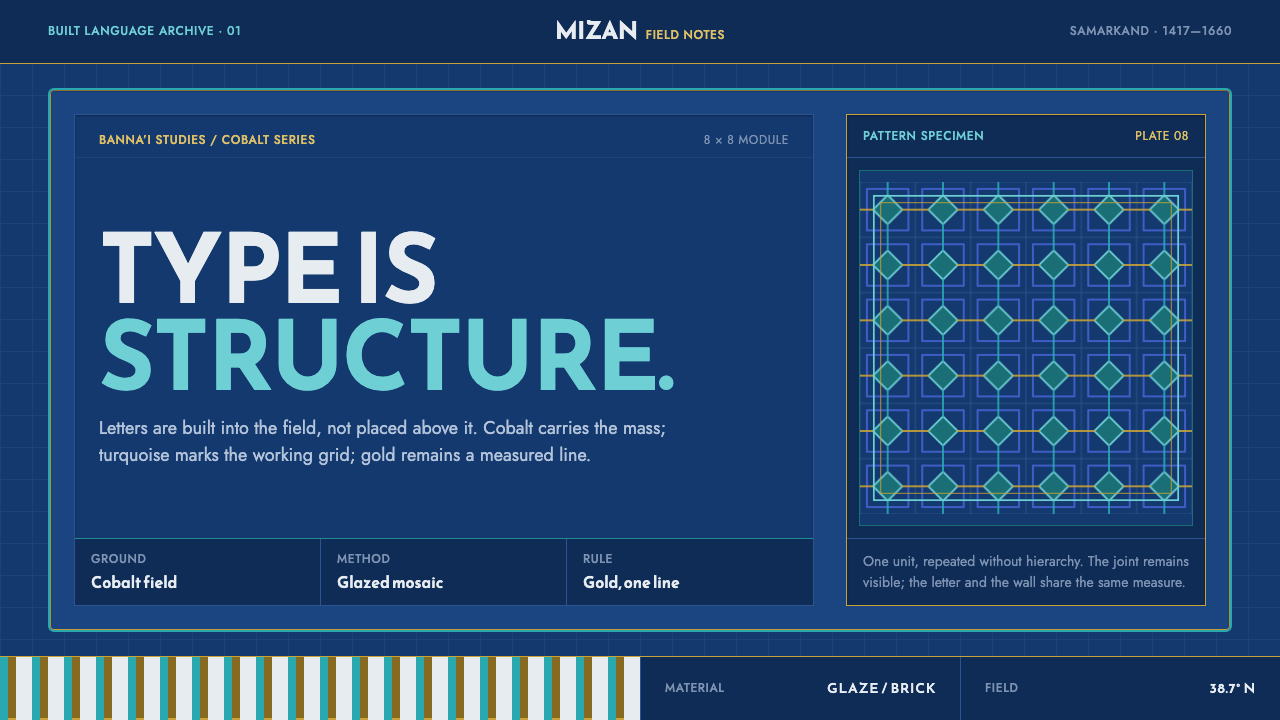 Registan TileworkType becomes structure. Turquoise geometry locks into cobalt, edged with spar…
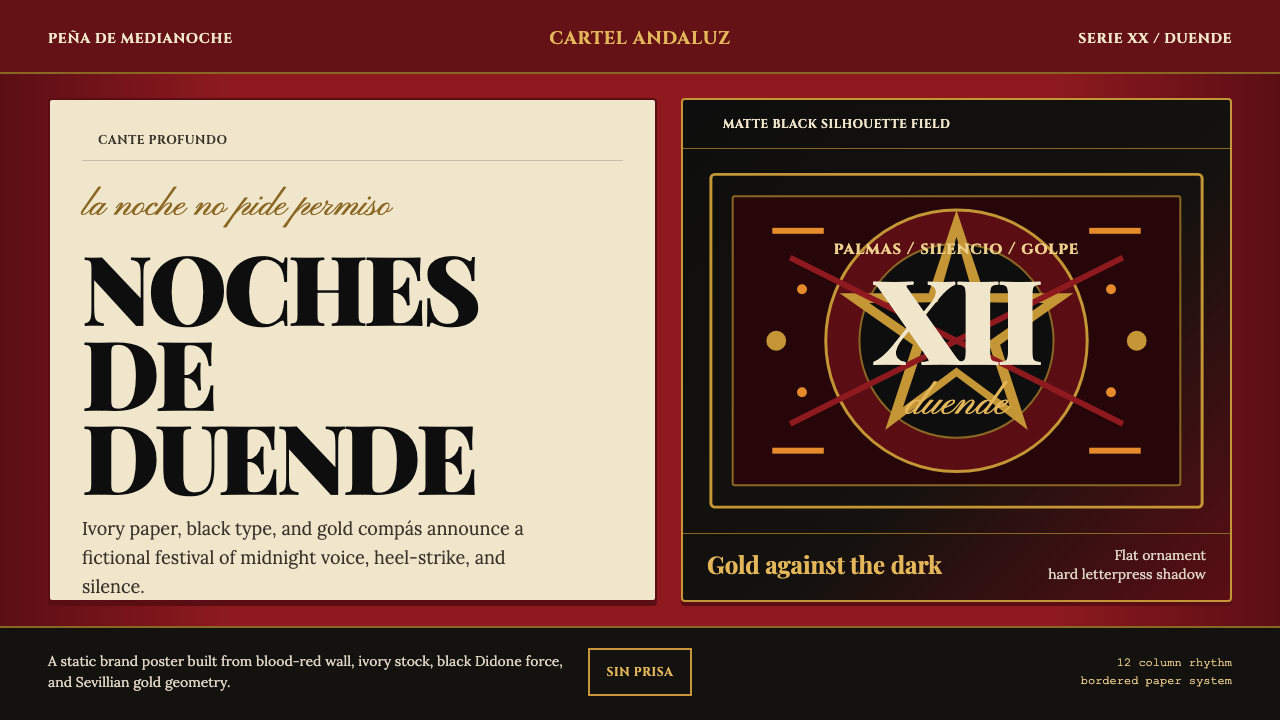 Spanish Flamenco PosterPassion printed as ritual. Blood red, ivory paper, Didone type, and flat gold…
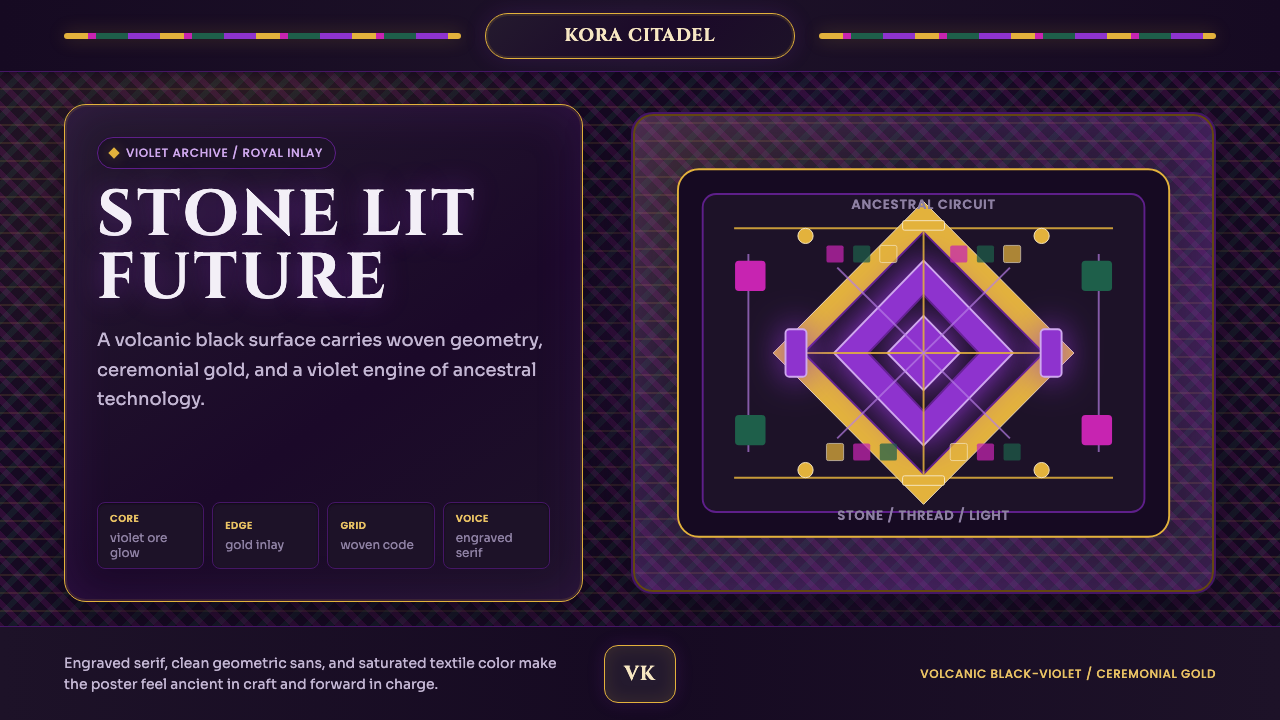 Africanfuturism VibraniumCeremony goes electric. Violet glow and gold inlay thread a volcanic textile…