What is Burj Khalifa Tower?
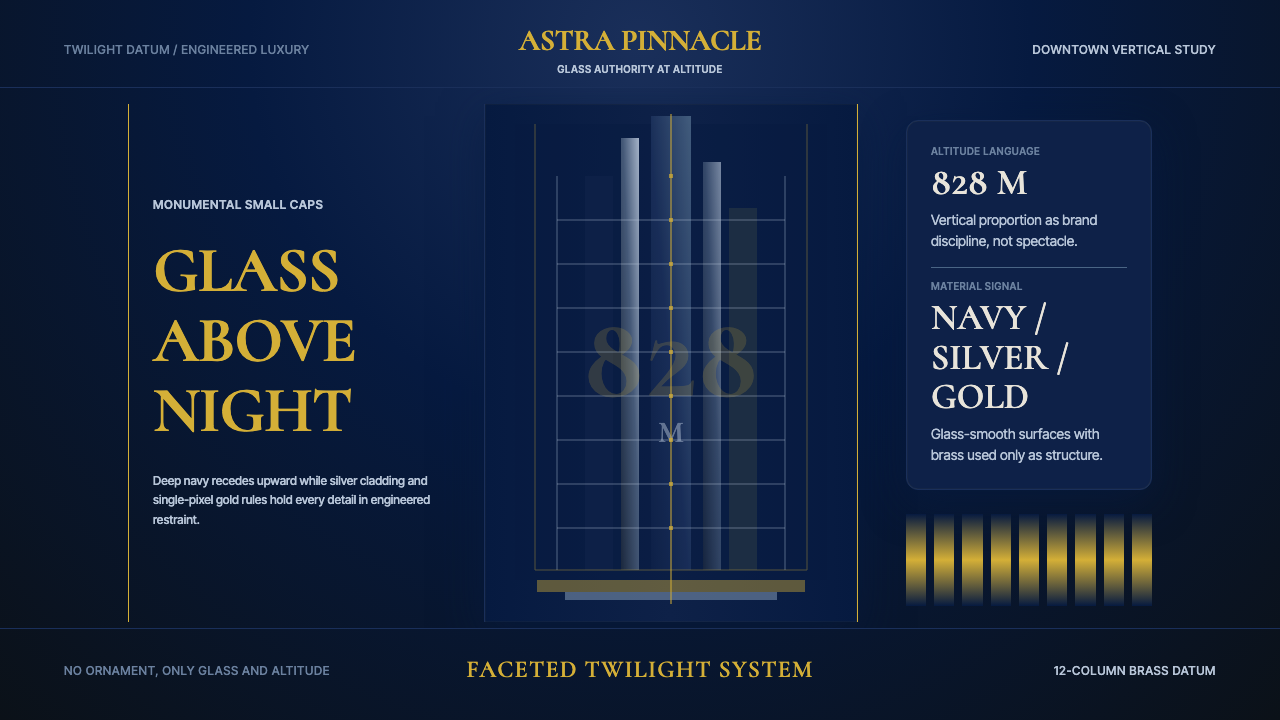
Altitude becomes authority — the Burj Khalifa design system distills the visual experience of twilight at the base of the world's tallest tower into a palette of desert-night navy, silver-glass cladding, and hairline gold that climbs without end.
Burj Khalifa Tower in brief
The Burj Khalifa design system takes its visual logic from the tower itself — a structure that tapers through progressive setbacks as it rises, shedding mass and accumulating lightness until its spire dissolves into sky. Translated into two-dimensional work, this logic becomes a vertical hierarchy of weight: heavy, dark grounds at the base of a composition give way to progressively lighter, more luminous elements as the eye travels upward. The overall mood is one of engineered grandeur — opulent in material quality, restrained in ornament.
Color in this system operates through extreme contrast and deliberate scarcity. Deep navy — the color of Dubai sky just after sunset, dense enough to absorb light rather than reflect it — serves as the primary field. Against this ground, silver registers as the luminous surface of the tower's glass-and-aluminum cladding, catching available light with a metallic precision that reads simultaneously as contemporary and eternal. Gold appears last and least often, functioning structurally rather than decoratively: a single hairline rule, a title set in small capitals, a threshold marking the boundary between content zones. It never floods a surface; it marks a line.
The system's character is vertical. Proportions favor tall, narrow forms over wide horizontal bands. Whitespace is architectural — not merely breathing room but the visual equivalent of the tower's open sky plaza, deliberate and load-bearing. Every element is held to a standard of finish that reads as engineered rather than hand-made: smooth gradients of tone rather than abrupt shifts, precision rather than expressiveness, weight rather than warmth.

Where does Burj Khalifa Tower come from?
The Burj Khalifa was designed by Adrian Smith of Skidmore, Owings and Merrill beginning in 2003, with structural engineering led by Bill Baker. Construction ran from 2004 to 2010, and at its opening the tower stood as the tallest human-made structure in history, surpassing the previous record-holder by a substantial margin. The project was conceived as the centerpiece of Downtown Dubai, a master-planned urban district built largely on reclaimed desert, and it was intended from inception to function simultaneously as real estate, infrastructure, and global symbol. Its name honors Sheikh Khalifa bin Zayed Al Nahyan, ruler of Abu Dhabi and president of the UAE, who provided the financial support that allowed the project to complete after the 2008 global financial crisis threatened to halt construction.
Smith's design draws from two overlapping sources: the traditional geometry of Islamic architecture and the engineering science of supertall structures. The tower's floor plan is a modified Y-shape derived from the Hymenocallis flower, a botanical form whose triple-armed radial symmetry distributes load efficiently while providing maximum perimeter — and therefore maximum glazed surface — at every floor. As the tower rises, each of the three wings steps back in a spiraling pattern, reducing wind load and breaking up the vortex-shedding effect that causes supertall buildings to sway. This aerodynamic tapering is not stylistic convention but structural necessity converted into aesthetic language.
The construction itself represented an extension of computational facade engineering into territory that had not previously been attempted at this scale. The exterior cladding system — nearly twenty-six thousand individual glass panels and aluminum-and-stainless-steel spandrel panels — was designed to withstand ambient temperatures that swing from desert cold to extreme heat, and to resist the sand-laden winds characteristic of the Gulf region. The reflective quality of the glass was specified not for appearance but for solar management: the cladding system reduces the thermal load on the building's interior while producing the silver luminosity that defines the tower's visual character at distance.
The design system that takes the Burj Khalifa as its source draws not from any single architectural drawing or branded guideline but from the phenomenological experience of the building: the color of sky behind glass at altitude, the geometry of the setback profiles viewed from below, the quality of a hairline structural seam catching light against a deep shadow. In this sense, the design system is an act of translation — from a physical experience of scale and material into a set of visual principles applicable to screen, print, and presentation work. The visual language that results belongs to a contemporary luxury category that is neither purely minimalist nor decorative: it is monumental, and it is precise.
What defines the Burj Khalifa Tower look?
Color Field
The dominant ground is a deep desert-night navy — a blue so dark it reads almost as black until adjacent to true black, at which point its blue-teal undertone becomes visible. This is not a corporate navy or a fashion indigo; it is saturated from within and dense enough to give objects set against it a quality of floating in controlled darkness. Silver occupies the middle register as the color of light reflected off engineered surfaces — glass, polished aluminum, water at dusk. Gold is the most restricted hue in the system, used only where a structural accent is required, and it is always hairline in weight: a rule, a separator, a small-cap title. It never appears as a fill color.
Verticality and Proportion
Compositions favor tall, narrow proportions that echo the tower's silhouette. Layout containers, text columns, image frames, and card components are oriented vertically whenever the format permits. Horizontal elements, when they appear, are thin — a rule, a data bar, a navigation divider — and serve to create rest points within a predominantly vertical reading movement, not to compete with the upward thrust of the overall composition. This proportional preference is not arbitrary; it consistently reinforces the primary metaphor of ascent.
Light and Luminosity
The system treats luminosity as the primary signal of importance. Elements that need to attract attention are not made larger or bolder in the conventional sense; they are made lighter — given a silver or near-white tonal value that causes them to emerge from the dark ground as if lit from within. This approach reverses the conventional dark-on-light reading convention and rewards careful calibration: too many bright elements collapse the hierarchy, while too few produce a composition that feels inert and unlit. The ideal is a single point of maximum luminosity — a title, a key figure, a featured image — with all surrounding elements stepping back in a controlled gradient of tone.
Typography and Monumental Weight
Display type in this system carries the weight of carved inscription rather than printed text. Small capitals — classically proportioned letterforms rendered at reduced height — are used for titles and section headers, giving them authority without requiring aggressive point sizes. The contrast between display type (classical, architectural, weighted with historical association) and body type (geometrically precise, neutral, efficient) mirrors the contrast between the tower's ornamental spire and its functional curtain-wall body. Line spacing is generous; text is never crowded. Each line of type is a horizontal element in a vertical composition and is treated accordingly.
Structural Ornament
Decoration in this system is always structural. The gold hairline rule does not embellish; it defines a boundary. A thin separator between content zones is not there for visual interest; it is there because two zones need a defined threshold. This principle is closely related to the architecture it references: the Burj Khalifa's setback profiles, the exposed structural fins on its exterior, the geometry of its crown — all are engineering decisions that happen to produce visual beauty. In design work, every decorative-seeming element should be able to justify its presence through function. If it cannot, it should be removed.
Surface Finish and Precision
The system demands a quality of finish that reads as engineered rather than crafted by hand. Edges are crisp, not soft. Tonal transitions, where they occur, are smooth and controlled rather than abrupt. Components align precisely and are never left to settle through visual intuition alone; the underlying grid is never decorative. This precision is not clinical coldness — it is the precision of a curtain-wall system engineered to millimeter tolerances across hundreds of meters of facade. The effect should feel intentional down to the smallest detail, as if any imprecision would compromise the structural logic of the whole.
Dark-Field Composition
Unlike most contemporary digital design systems that default to light backgrounds, this system is primarily dark. The dark field is not a mode or an option; it is the canonical state, reflecting the fact that the tower's most memorable appearance is against the Dubai night sky or twilight. Working on a dark field reverses many conventional design decisions: contrast is achieved through lightness rather than darkness, hierarchy is expressed through luminosity rather than size alone, and the primary challenge is maintaining clarity without introducing so many bright elements that the darkness collapses. The dark field creates a sense of depth and controlled drama that is the system's most distinctive characteristic.

Who shaped Burj Khalifa Tower?
Adrian Smith served as design architect at Skidmore, Owings and Merrill and was the principal designer of the Burj Khalifa. His design synthesized two demanding constraints: the structural requirements of a supertall building and the cultural expectation that the tower reference Islamic architectural tradition. The Y-shaped plan derived from the Hymenocallis flower form, the spiraling setback sequence, and the faceted crown were all Smith's formal contributions. After completing the Burj Khalifa, Smith founded his own practice, where he continued working on supertall projects, including the planned Jeddah Tower in Saudi Arabia, which was designed to surpass the Burj Khalifa in height.
Bill Baker served as structural engineering partner at Skidmore, Owings and Merrill and is credited with the buttressed core system that makes the Burj Khalifa's height possible. The buttressed core — a central hexagonal shaft supported by three buttressing wings — distributes the lateral wind loads that would otherwise make a structure of this height impossible to build economically. Baker's structural innovation directly produced the tower's distinctive silhouette: the three-winged tapering form is not an aesthetic preference applied to a conventional structural frame but the visible expression of the structural logic itself. Baker has described the design process as one in which structure and architecture were developed simultaneously rather than sequentially.
Sheikh Khalifa bin Zayed Al Nahyan, ruler of Abu Dhabi and president of the United Arab Emirates, provided the financial intervention that allowed the Burj Khalifa to complete construction after the 2008 global financial crisis threatened to halt the project. The tower was named in his honor at completion in January 2010, having previously been known as Burj Dubai during construction. His role in the project's completion made the tower's naming not merely a diplomatic gesture but a recognition that the building's existence as a finished structure was contingent on Abu Dhabi's support — a fact that itself reflects the political geography of the UAE.
Mohamed Ali Alabbar, chairman of Emaar Properties, was the development authority behind the Burj Khalifa and the broader Downtown Dubai master plan. Emaar commissioned the project in the early 2000s as the centerpiece of what would become one of the most ambitious urban development projects in modern history — a district built largely from scratch on desert land, incorporating the Dubai Mall, the Dubai Fountain, and extensive residential and hotel towers. Alabbar's role was to translate a political and economic ambition — the repositioning of Dubai as a global city — into a specific architectural and real estate program, and the Burj Khalifa was its clearest single expression.
How do you use Burj Khalifa Tower today?
The Burj Khalifa design system is well-suited to presentation work where authority, exclusivity, and monumental scale are the desired impression. For cover slides, the system's strongest move is a full-bleed deep navy ground with a single silver or white title set in small capitals, positioned in the lower third of the frame — a compositional echo of looking up at something vast. A hairline gold rule above or below the title is the only additional element required; everything else is controlled darkness. Content slides should maintain the dark ground but reduce the luminosity of supporting elements to a mid-toned silver-gray, reserving near-white for the single most important piece of information per slide. Data slides become stark and powerful when bar charts and numerical figures are rendered in silver against navy, with gold hairlines marking key thresholds or reference lines.
For web user interfaces, the system is best applied to products in the luxury, financial, real estate, or enterprise analytics categories — contexts where the dark field reinforces perceptions of depth, security, and sophistication. Dashboard interfaces built in this language use deep navy as the primary background, silver-toned cards and panels that appear to float above the ground, and gold-hairline separators between functional zones. Interactive states — hover, selected, active — are expressed through increased luminosity rather than color change: an element brightens when activated rather than changing hue. Navigation is typographic, using small capitals for primary labels, with no icon decoration beyond minimal geometric indicators.
For editorial and marketing applications, the system supports the visual vocabulary of luxury brand communication — annual reports, property marketing materials, financial product prospectuses, and conference keynote decks. The characteristic move in editorial work is the alternation between full-dark spreads (content on a navy ground) and near-white spreads (dark type on a pale silver-gray or cream ground) — the rhythm mirrors the tower's day and night appearances. Pull quotes and section headings are set in small capitals with hairline gold rules as punctuation. Marketing materials benefit from the system's poster-like quality: a single large image or geometric element commanding a full field, with the headline and subhead occupying a narrow column to one side in precise typographic hierarchy.
The system also performs strongly in financial and data-heavy communication where the dark field gives numerical content an authoritative, instrument-panel quality. Pricing tables, comparison charts, and technical specifications feel precise and considered rather than clinical when the dark-field palette is applied consistently. The key discipline is maintaining the scarcity of gold: in a table with many rows, gold hairlines should appear only at the most structurally significant divisions — total rows, category headers — not as repeated decoration throughout.
A common mistake when applying this system is treating the dark ground as an invitation to use gold expansively. Authentic application uses gold with extreme restraint — one hairline rule per composition, a single accent on one word in a title, never as a fill color for a button or a card background. A second common error is softening the system with warm lighting effects, glows, or diffused drop shadows that suggest natural illumination. The system's character depends on the absence of simulated light sources; luminosity is achieved through tonal value, not through bloom or haze. Any warmth introduced undermines the engineered precision that is the style's defining quality.

Burj Khalifa Tower — FAQ
Is this system appropriate for light-background applications?
The system can be inverted to a near-white or pale silver-gray ground, but the dark field is the canonical form and should be used wherever the format and audience permit. When inverted, the navy becomes a dark typographic color used for headlines and structural rules, silver becomes a subtle mid-tone for secondary text and dividers, and gold remains a hairline accent used even more sparingly than on the dark ground. A fully inverted light version reads as refined and precise but loses the sense of depth and controlled drama that is the dark-field system's primary emotional register. Consider the light variant for extended reading contexts — long reports, documentation, multi-page editorial — where sustained dark-field reading would impose visual fatigue.
How does this system differ from generic luxury dark-mode design?
Generic luxury dark-mode design tends to rely on gold fills, glowing gradients, soft ambient shadows, and texture overlays — techniques that simulate material richness by imitating the appearance of gold leaf, velvet, or polished marble. The Burj Khalifa system explicitly excludes these approaches. Its gold is structural and hairline; its silver is the color of reflected light on glass, not a simulated metallic texture; its shadows, where they exist, are hard-edged and geometric rather than ambient and atmospheric. The distinction is between simulated luxury and engineered precision. One borrows the visual vocabulary of precious materials; the other derives its authority from exactness of form and control of luminosity.
What kinds of products or brands should avoid this system?
The system is poorly suited to products or contexts that depend on warmth, organic texture, approachability, or cultural playfulness. Consumer food brands, children's education products, wellness and health applications, community platforms, and any product positioning around accessibility or inclusivity will find the system's severity works against the brand's core values. The dark field and the architectural precision carry implicit messages — exclusivity, distance, authority — that are assets in the right context and liabilities in others. A fintech product serving retail investors might find the system conveys unwelcome complexity; a platform designed to feel collaborative or communal will read as cold under this palette. The test is whether the product's values align with the system's values, not whether the aesthetic is technically well-executed.
Can the system accommodate photography or illustration?
Photography works well within the system when it is treated as a tonal element rather than a documentary record. Images shot at dusk, at altitude, through glass, or in conditions of dramatic contrast — deep shadows against silver or white highlights — integrate naturally with the palette. Photography should be processed to increase contrast and reduce mid-tone warmth; a slight blue or cool-neutral cast reinforces the system's color logic. Images are best used full-field, bled to edges, without decorative borders or drop shadows. Illustration is rarely appropriate in this system; when figurative or diagrammatic elements are needed, they should be reduced to flat geometric forms in the system's palette colors, rendered with the same precision as the typographic and layout elements. Organic, hand-drawn, or textural illustration styles are incompatible with the system's values.
How should animation and motion be approached in this system?
Motion in this system should reference the tower's physical qualities: slow, controlled, inevitable. Transitions are not playful or elastic; they are linear or gently eased, suggesting weight moving through resistance. The primary motion vocabulary is vertical — elements enter from below and settle upward, or exit upward and disappear. Reveals of content should feel like something being uncovered from darkness rather than appearing from nothing; a panel emerging from a navy ground is more appropriate than a panel fading in from transparent. Gold hairlines should not animate independently; they should appear with the elements they define, not before or after. Speed should generally be slower than typical digital animation conventions — unhurried, monumental, suggesting that what is being shown is worth waiting for.
Related design styles
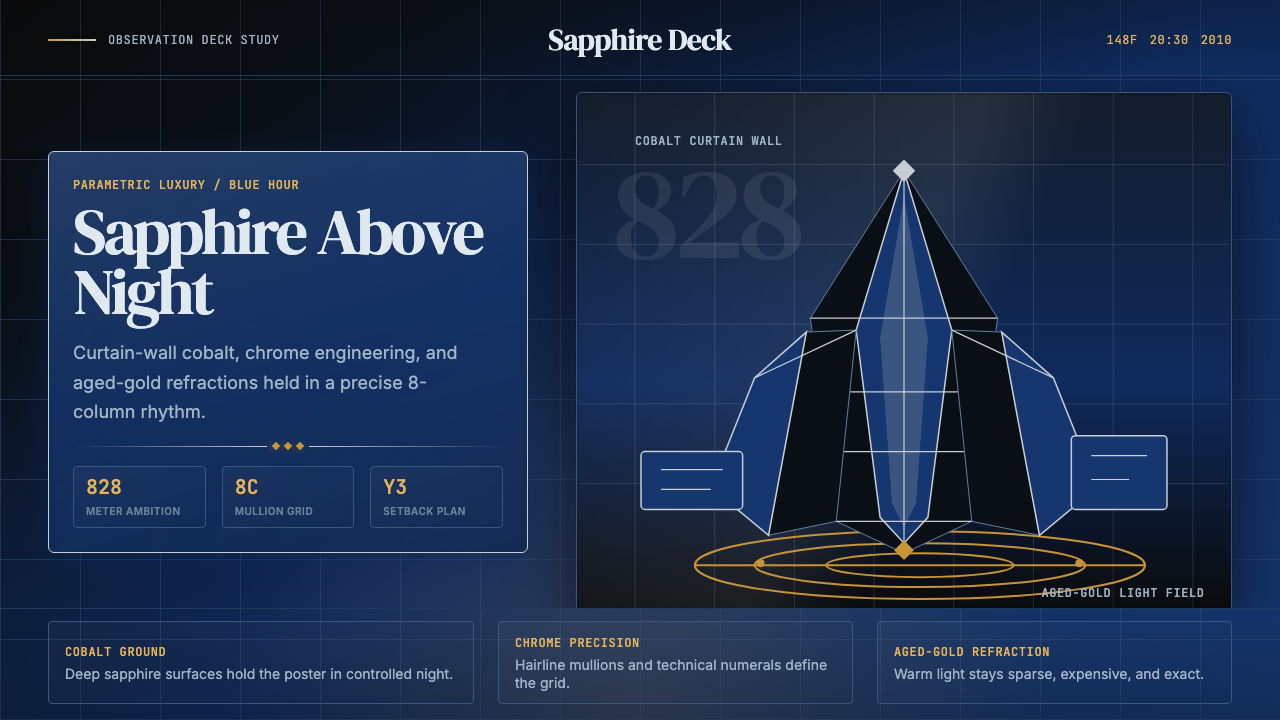 Emirati Burj Khalifa Sapphire (2010)Commanding height, controlled light. Sapphire glass, chrome grid, aged-gold g…
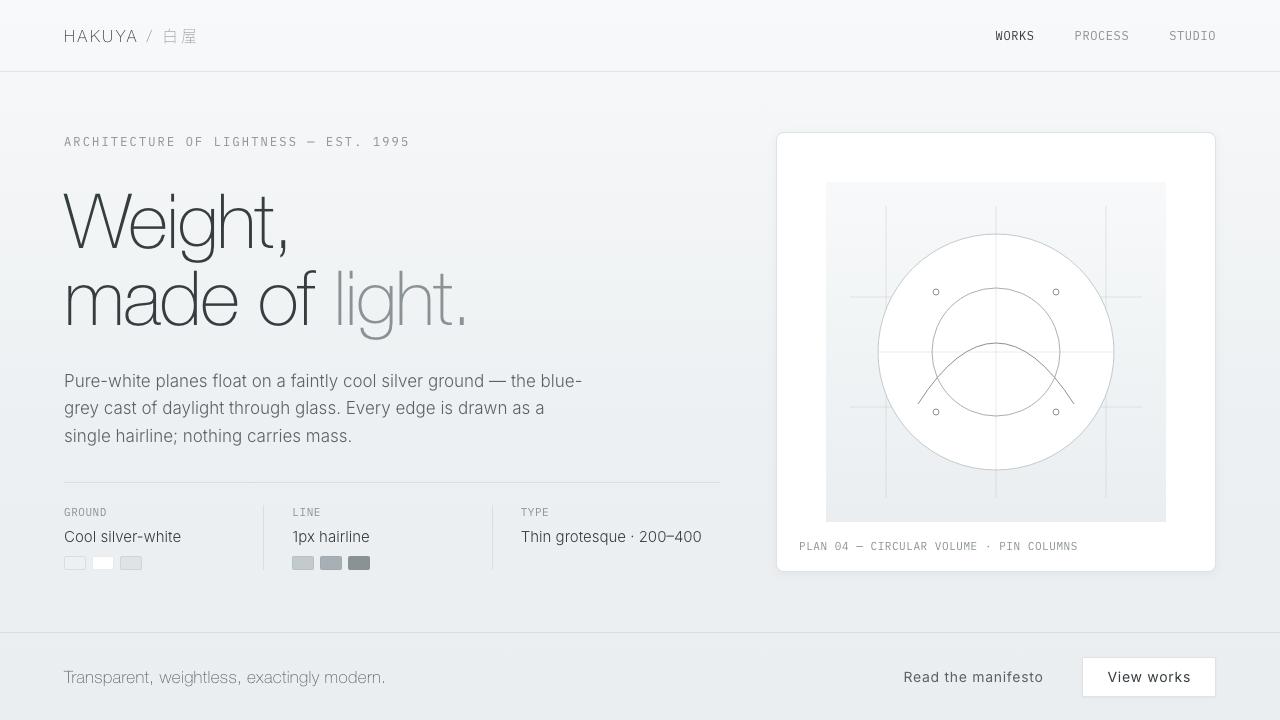 SANAA White LightnessArchitecture made of light. White planes float on cool silver-grey, edged in…
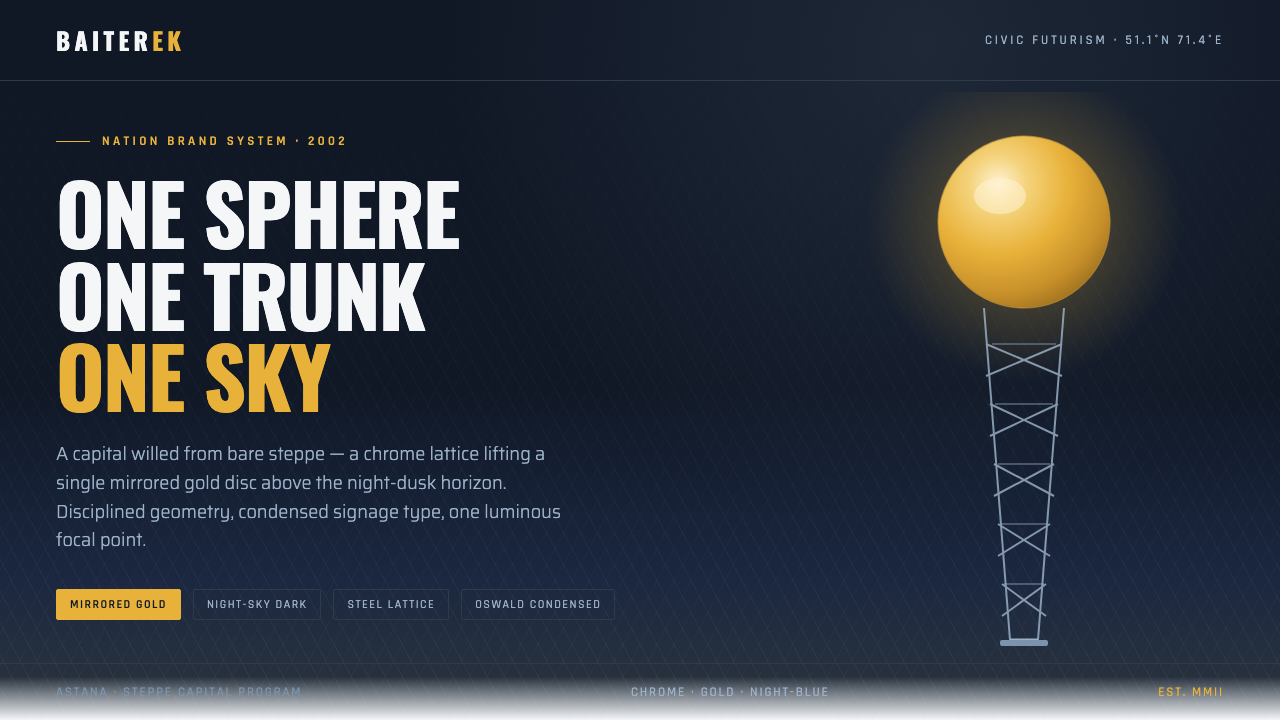 Astana Baiterek TowerCivic optimism in chrome and gold. A mirrored sphere crowns a white lattice t…
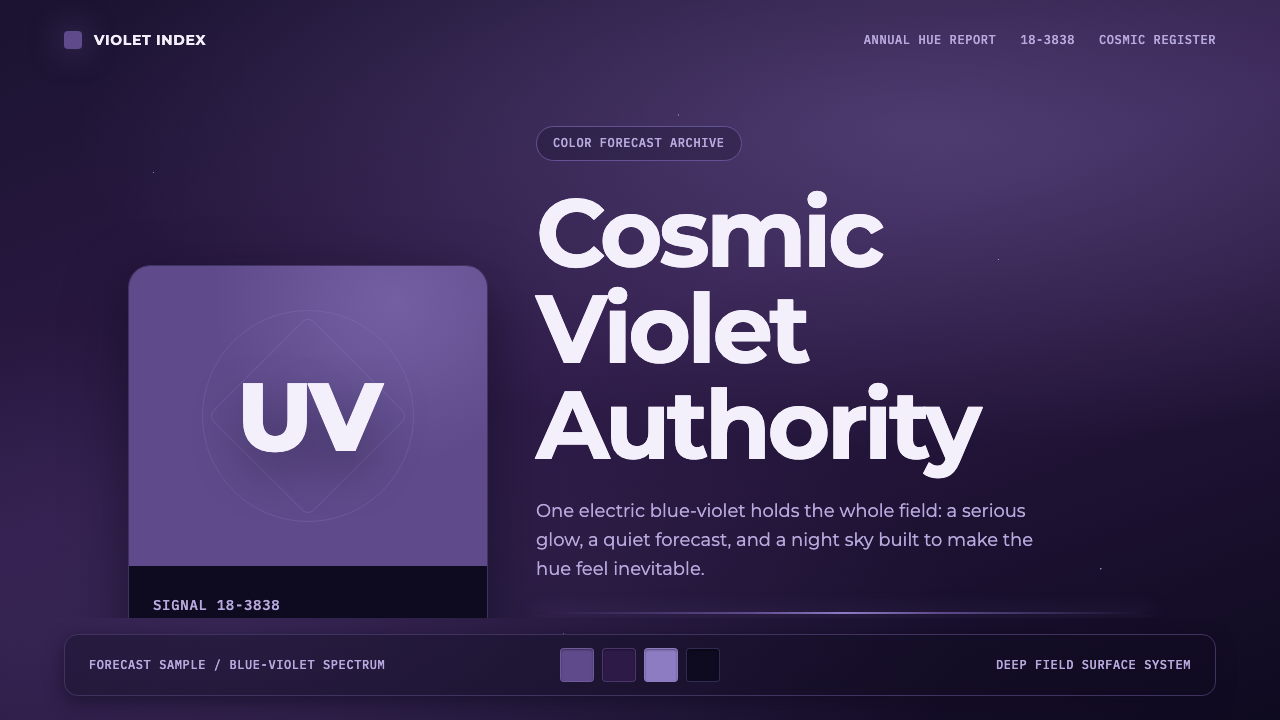 Pantone Ultra VioletCosmic authority. Ultra Violet glows through chip blocks, Montserrat, and dee…
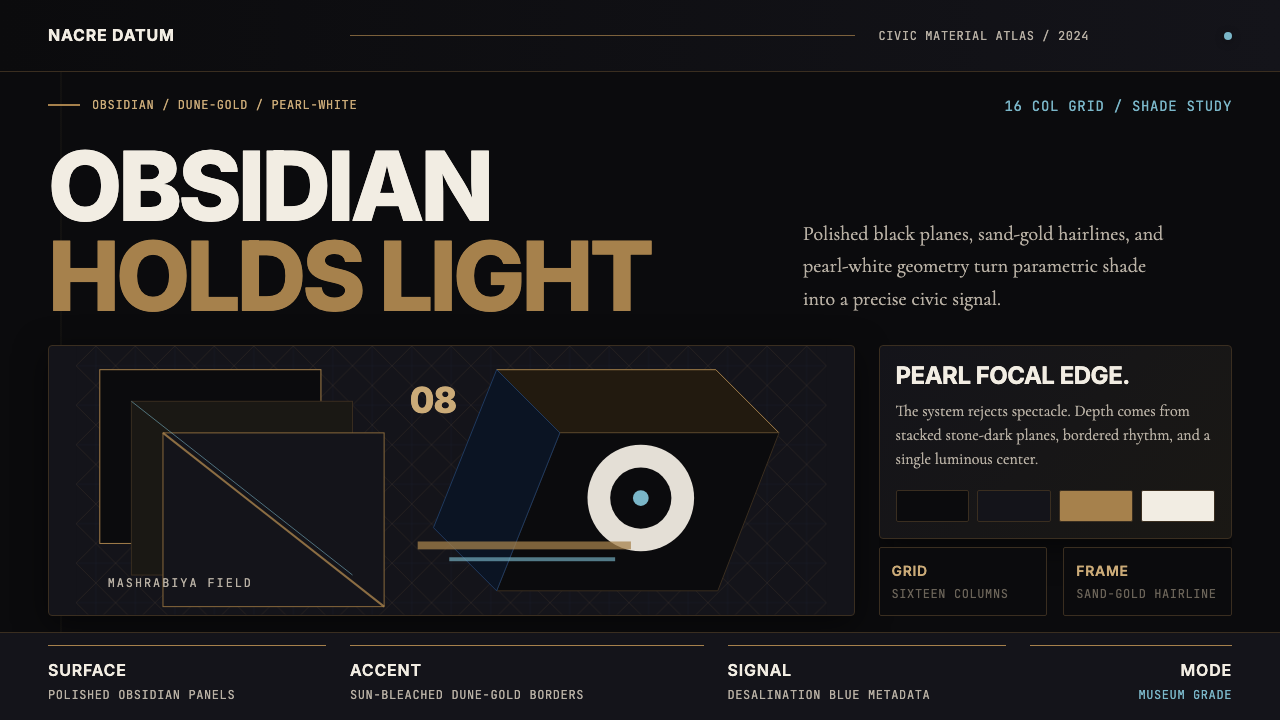 Qatari Pearl Modern Architecture 2024Monumental restraint. Obsidian panels, sand-gold gridlines, pearl-white geome…
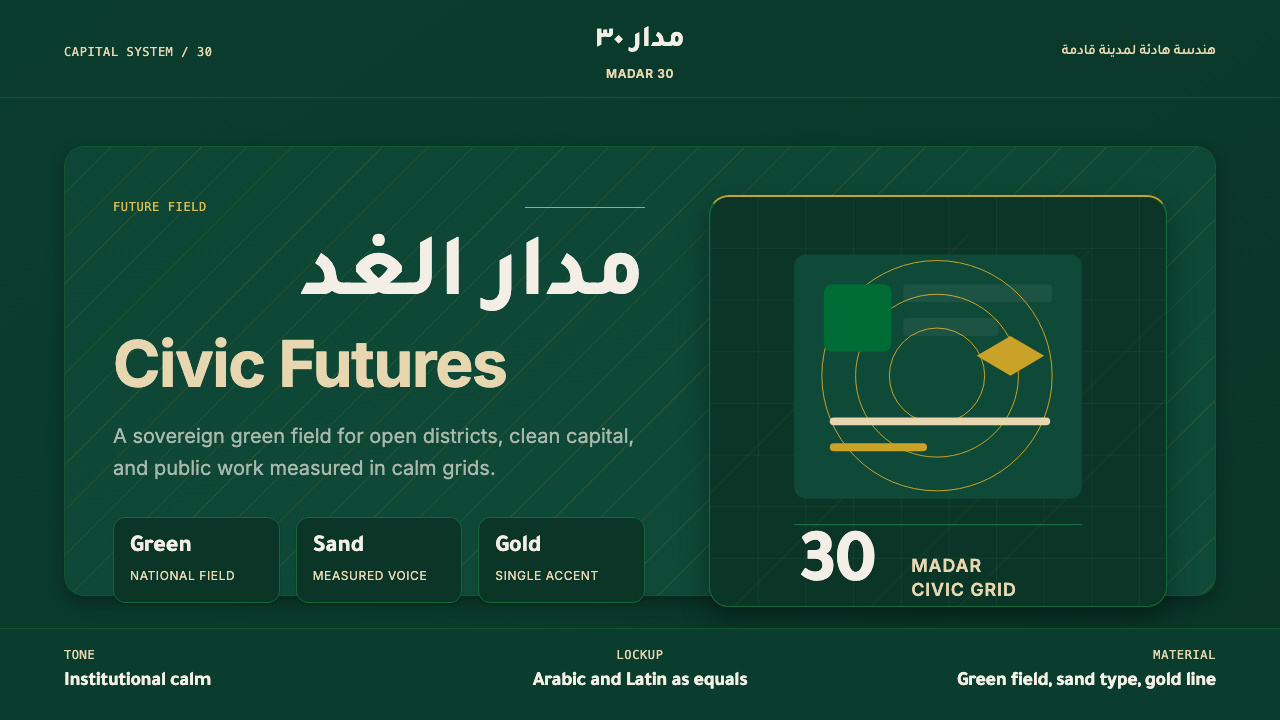 Riyadh Vision 2030Sovereign futurism. National green, sand type, and gold hairlines hold a calm…