What is Emirati Burj Khalifa Sapphire (2010)?
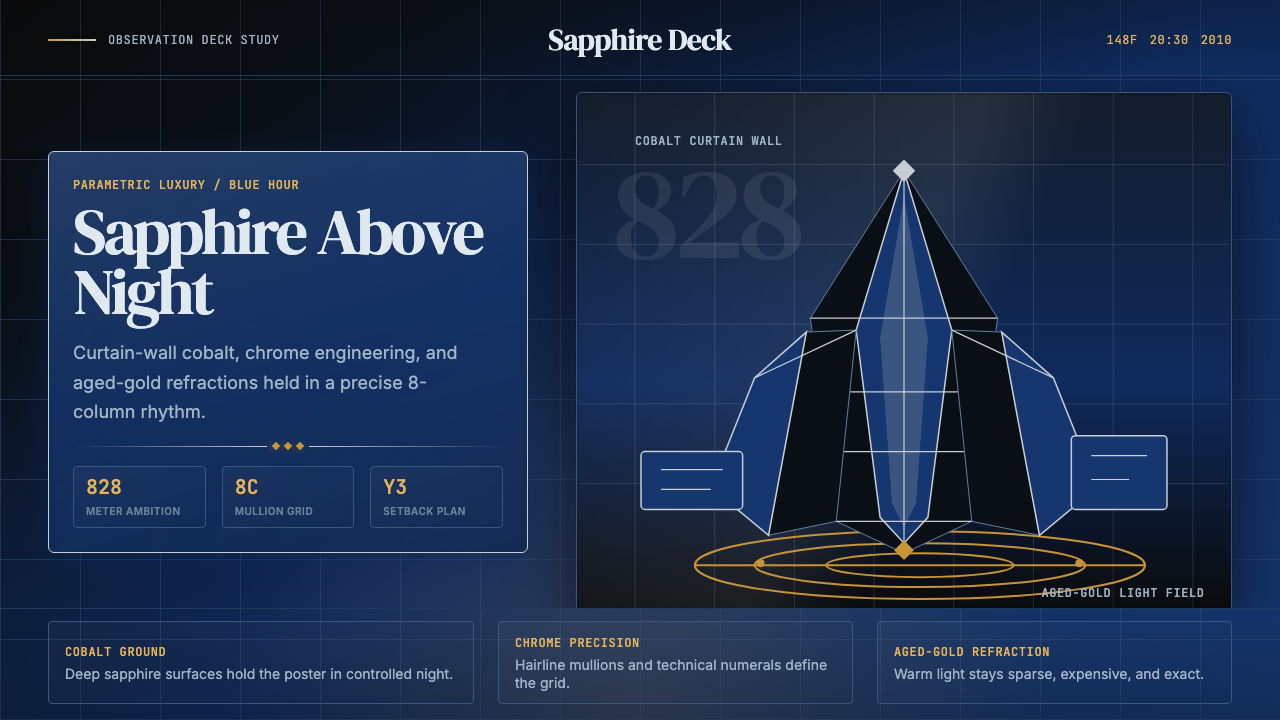
Burj Khalifa brought supertall architecture to its most theatrical extreme — a sapphire-and-steel shard rising 828 meters from the desert floor, whose design language turned engineering precision into an aesthetic of commanding, luminous darkness.
Emirati Burj Khalifa Sapphire (2010) in brief
The Emirati Burj Khalifa Sapphire design system is drawn from the visual experience of the world's tallest structure at blue hour — the deep indigo moment between sunset and full night when Dubai's curtain wall shifts from cobalt-blue to jet-black, and the illuminated spire reads as a fragment of the night sky itself. It is a dark, jewel-toned visual language that fuses the precision of parametric engineering with the opulence of Gulf luxury.
At its core, the style pairs a deep sapphire ground — layered and refractive rather than flat — with chrome-silver structural accents and aged-gold light sources. These three values do not compete; they establish a hierarchy in which darkness dominates, metallic precision defines structure, and warm gold is deployed sparingly as the source of all luminous energy in the composition. The result reads as both architectural and atmospheric, simultaneously cold and rich.
The system draws its authority from the Burj Khalifa's actual material and formal characteristics: the triple-lobed Y-plan derived from the Hymenocallis desert lily, the setback profiles that narrow the tower as it ascends, the reflective curtain-wall glass that absorbs and re-emits the sky, and the base-level choreography of the Dubai Fountain with its gold LED illumination dancing across the Burj Khalifa Lake. This is not an abstract style — it is a distillation of a specific building at a specific hour in a specific place.
Where does Emirati Burj Khalifa Sapphire (2010) come from?
The Burj Khalifa's story begins with a political and economic imperative that shaped its every design decision. By the early 2000s, Dubai's leadership under Sheikh Mohammed bin Rashid Al Maktoum had embarked on an ambitious transformation of the emirate from an oil-dependent economy into a global hub for commerce, tourism, and real estate investment. A world-record skyscraper was understood not merely as a building but as a declaration — evidence that the UAE had arrived as a peer to New York, Shanghai, and London on the global stage. Mohamed Alabbar, chairman of Emaar Properties, championed the project and oversaw its development from conception through opening.
Skidmore, Owings and Merrill was selected to design the tower, and the project was led by Adrian Smith, one of the firm's most accomplished tall-building designers, with structural engineering by William F. Baker, who invented the buttressed core system that made the height possible. Baker's solution — three structural wings arranged around a central hexagonal core, braced against one another to resist wind and torsion — is what gives the tower its distinctive triple-lobed silhouette in plan view. Smith drew the massing from the geometry of the Hymenocallis flower, a desert lily native to the Gulf region, both as a formal reference and as a symbolic gesture toward the place of origin.
Groundbreaking occurred in 2004, and the construction proceeded as one of the most technically demanding projects in the history of the built environment. The concrete and steel required pumping concrete to heights never previously achieved, solving thermal expansion challenges across an enormous temperature range, and managing wind effects at altitudes where a conventional building's structural logic begins to fail. The tower opened officially on January 4, 2010, named in honor of Sheikh Khalifa bin Zayed Al Nahyan, ruler of Abu Dhabi and president of the UAE, in recognition of Abu Dhabi's financial support during the 2008 financial crisis.
The visual character of the system — deep sapphire, chrome steel, and aged gold — emerged from the building's material and contextual properties rather than from graphic decision-making. Dubai's desert atmosphere scatters light differently than a temperate climate: sunsets are abrupt and saturated, blue hour is compressed and intense, and nightfall in a city of high-contrast artificial illumination produces a visual environment unlike that of any other world capital. The curtain wall's cobalt-to-steel gradient at dusk, the tower's white spire catching the last visible light, and the Dubai Fountain's gold LED spectacle below are not incidental — they are the visual facts from which the entire system is derived.
What defines the Emirati Burj Khalifa Sapphire (2010) look?
Depth and Ground
The foundational surface is not a flat dark field but a layered sapphire depth — suggesting the visual complexity of high-altitude glass that simultaneously reflects sky, absorbs color, and transmits light from within. This ground has variation rather than uniformity: darker at the base, lighter and more refractive toward the upper registers, as if the viewer is looking up from street level toward a sky that the tower has partially swallowed. The darkness is not empty; it has interior luminosity.
Structural Metallic Precision
Chrome-silver and cool steel tones define the structural vocabulary — the grid lines, edge treatments, and delineating marks that articulate form within the deep ground. These metallic accents do not warm the composition; they cool and sharpen it. They reference the actual material reality of the curtain wall's aluminum framing and the tower's steel spine, imposing a sense of engineered exactitude. Lines are fine, precise, and purposeful — never decorative flourishes but load-bearing visual elements.
Aged-Gold Luminosity
Gold is the single source of warmth in an otherwise cold system, used as the system's primary light energy — analogous to the Dubai Fountain's LED illumination reflected across the Burj Khalifa Lake at night. The gold is not bright or primary-saturated; it is aged, deep, and amber-tinted, suggesting precious metal rather than commodity decoration. It appears at focal points — as the terminal glow at the top of the spire, as the refractive flares across water surfaces, as the highlight edge catching illumination. Every other element recedes; the gold commands.
Tripartite Geometry
The Burj Khalifa's plan is a Y-shape — three wings radiating from a central core, a form derived from the three-petaled Hymenocallis flower. This tripartite logic permeates the design system: compositions favor three-register structures, elements are often grouped in threefold symmetries, and the vertical axis is divided into three ascending bands that mirror the tower's setback progression. The number three here carries both formal and symbolic weight — it is the geometry of the building, the flower, and the cultural context of the region.
Verticality and Ascent
The dominant visual direction is vertical, not horizontal. Compositional weight gathers at the base and attenuates toward the top, mirroring the tower's structural setbacks. Elements taper, fade, or compress as they ascend, creating a sense of height even within a bounded frame. This verticality is not aggressive — it is elegant and controlled, the visual equivalent of the building's extraordinary slenderness ratio, which at its upper reaches makes the structure appear almost dematerialized against the sky.
Refractive and Specular Surface
Where most dark systems flatten surfaces to matte, the Burj Khalifa Sapphire system insists on optical complexity — surfaces that catch and redirect light, suggesting glass and polished metal rather than stone or matte paint. This specularity is controlled, not chaotic: reflections appear as deliberate compositional elements, not accidental glare. The result is a surface that feels alive and atmospheric, shifting slightly depending on the angle of viewing, the way the actual building reads differently in morning haze, noon clarity, and blue-hour intensity.
Luxury Restraint
Despite the richness of the source material — a record-breaking monument funded by Gulf oil wealth in one of the world's most extravagant cities — the design system is restrained rather than maximalist. Ornamentation is absent; decorative pattern is absent; any gesture toward arabesque or regional cultural motif is sublimated into pure form. The luxury is communicated through material quality and scale, not through applied decoration. This distinguishes the style from generic 'luxury dark' aesthetics and gives it the gravity of genuine architectural authority.
Who shaped Emirati Burj Khalifa Sapphire (2010)?
Adrian Smith was the design partner at Skidmore, Owings and Merrill who led the Burj Khalifa project through design development, overseeing the formal decisions that gave the tower its distinctive profile. His approach drew on the Hymenocallis flower's tripartite geometry as a guiding massing principle, and he was responsible for the curtain wall's visual language — the deep sapphire glass, the setback progressions, the tapered spire. After completing the Burj Khalifa, Smith founded his own firm and continued working on supertall projects, including the Jeddah Tower, which aims to surpass the Burj Khalifa's height.
Baker is the structural engineering partner at SOM who invented the buttressed core system that enabled the Burj Khalifa's unprecedented height. His solution — three structural wings braced against a central hexagonal core, each wing acting as a buttress to stabilize the others — resolved the aerodynamic and load challenges that would have defeated conventional tube or outrigger systems. Baker's engineering work is inseparable from the building's aesthetic: the Y-plan that drives the visual system is directly a consequence of the structural logic he devised. He is widely regarded as one of the most influential structural engineers of the early twenty-first century.
As ruler of Dubai and Prime Minister of the UAE, Sheikh Mohammed was the ultimate client and strategic vision behind the Burj Khalifa project. His broader ambition — transforming Dubai from an oil economy into a global city — gave the tower its geopolitical meaning. The building was conceived as a flagship for the Downtown Dubai development and as a signal to international investors that the emirate offered world-class infrastructure, ambition, and permanence. The aesthetic system that surrounds the Burj Khalifa reflects his administration's preference for the dramatic and the superlative over the merely competent.
Alabbar, chairman of Emaar Properties, was the developer who championed the Burj Khalifa from concept through completion. His insistence on the project at a moment of maximum ambition in Dubai's development history shaped the conditions under which the design team operated: height, spectacle, and global statement were non-negotiable priorities. Emaar's management of the surrounding Downtown Dubai district — including the Dubai Fountain, the Dubai Mall, and the broader waterfront design — created the visual and experiential context that the Burj Khalifa Sapphire system derives from.
The British engineering and design consultancy WS Atkins contributed to several aspects of the Burj Khalifa's technical and architectural detailing, particularly in the MEP and facade engineering systems that make the building's glass curtain wall perform in Dubai's extreme thermal and wind conditions. Their work on the facade is directly relevant to the visual identity: the curtain wall's specific spectral properties — its capacity to shift from reflective to absorptive across the day — are in part a result of the technical solutions developed for thermal performance, not purely aesthetic choices.
How do you use Emirati Burj Khalifa Sapphire (2010) today?
The Burj Khalifa Sapphire system is purpose-built for contexts where dark luxury, precision, and commanding presence are the intended values. It performs best when the product or communication needs to signal world-class quality, technical authority, and a kind of cool magnificence — without resorting to the warmer, more approachable registers of mainstream luxury. The system's natural territory includes premium technology products, financial services, high-end real estate, aerospace interfaces, and any product positioning itself as the highest point in its category.
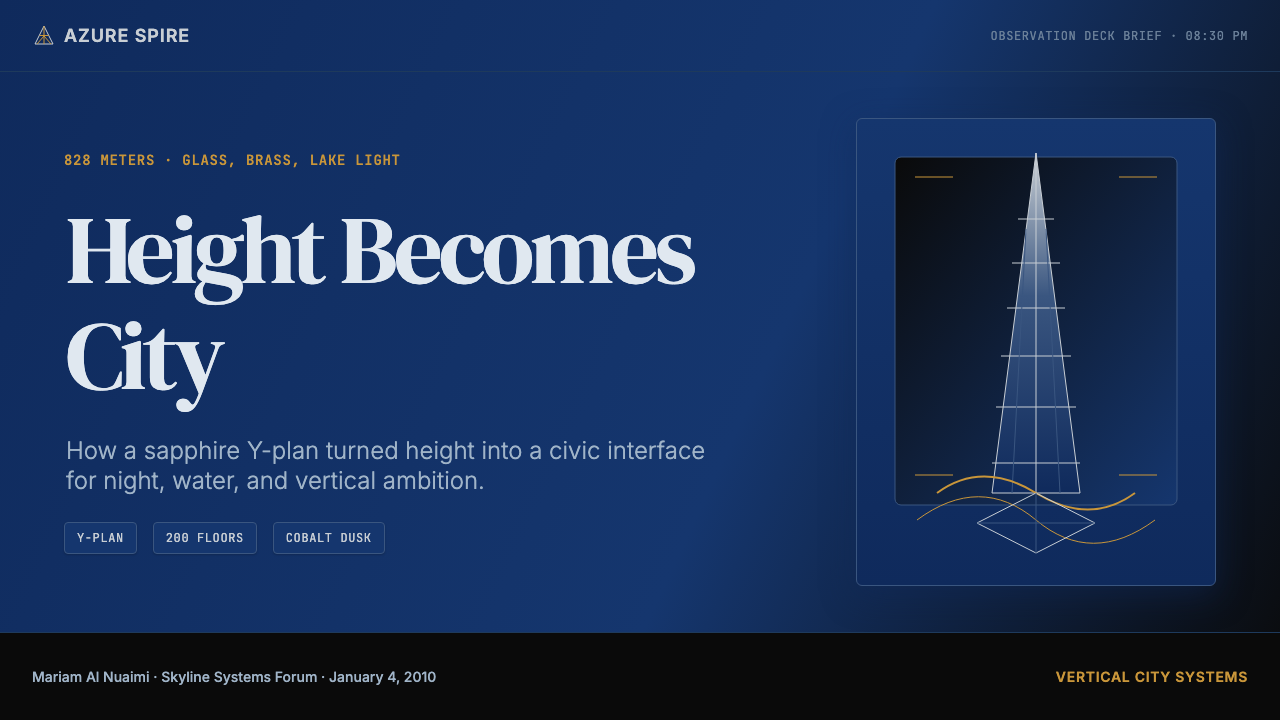
For presentation slides, the system works powerfully on covers and section breaks. A cover should use the deep sapphire ground almost full-bleed, with the presentation title set in a luxury display serif — tall, wide-set, and refined — placed in the lower third to evoke the tower's ground-level proportions. The gold accent should appear only once on the cover: at the typographic focal point, a single element catching light. Content slides require discipline: white or near-white body text on a deep ground, with chrome-silver for metadata and supporting text. Data visualizations take on an architectural quality when bars and lines are rendered in the steel-and-gold palette against the dark field — they read as structural diagrams, not decorative charts.
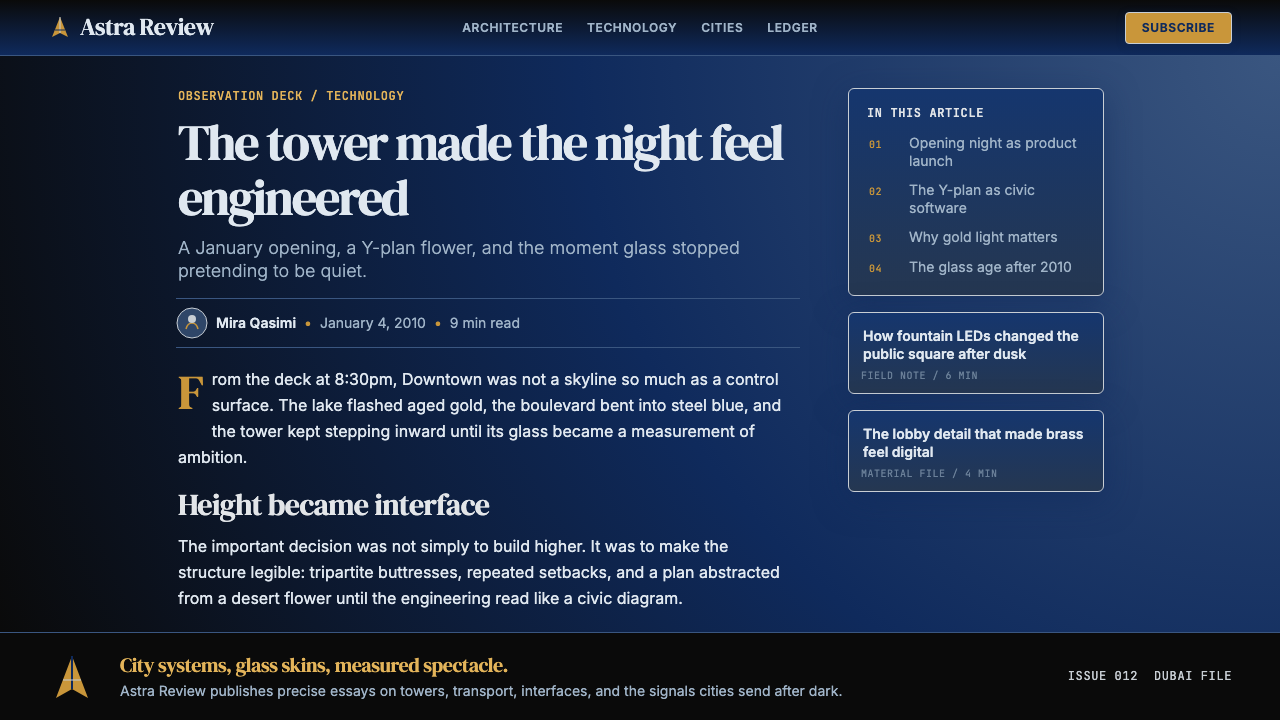
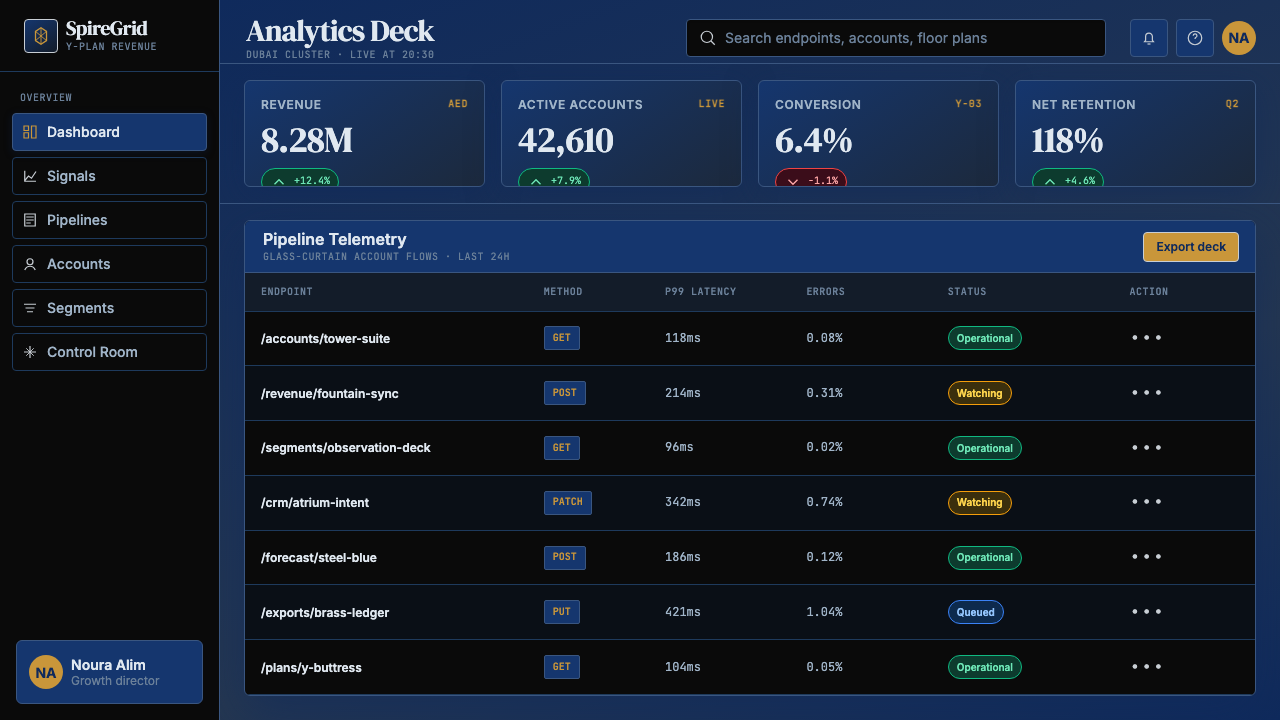
For web interfaces and digital dashboards, the system suits any product where the dark ground communicates seriousness and precision rather than consumer warmth. Navigation should be spare and metallic — no vivid accent colors competing with the gold, no decorative iconography. Card components work well when they carry the refractive surface quality: a subtle inner light at the top edge, a fine chrome-silver border, and a shadow that deepens the perceived distance from the ground. Pricing pages benefit from the system's natural hierarchy: the recommended tier should receive the gold accent treatment, while other tiers remain in the chrome-silver register.
For editorial and marketing work, the system's greatest strength is commanding visual silence — the deep ground reads as authority and restraint simultaneously. Full-bleed feature blocks in the deep sapphire anchored by a single gold headline create a gravity that lighter systems cannot match. The system works especially well for award announcements, annual reports, product launches in the premium technology or luxury real estate sector, and any communication that needs to say 'this is the best version of this thing that exists.' Avoid using it for content that requires warmth, invitation, or accessibility — the system's coldness is a deliberate feature, not a limitation to work around.
The most common mistake when applying this system is treating the gold as a general highlight color rather than as a singular light source. In authentic applications, the gold appears once or at most twice per composition, always at the primary focal point. Distributing gold across multiple elements — headers, borders, icons, interactive states simultaneously — destroys the hierarchy on which the system's power depends. The second common mistake is lightening the ground to improve legibility: the depth of the sapphire field is structural, not merely atmospheric. Introduce white or pale text generously, introduce gold sparingly, but do not dilute the ground itself.
Emirati Burj Khalifa Sapphire (2010) — FAQ
Is this a UAE or Gulf regional style, or does it work universally?
The style's origin is specific — the Burj Khalifa in Downtown Dubai — but its visual language is universal. The deep sapphire, chrome steel, and aged gold palette does not read as culturally regional to most viewers; it reads as premium, architectural, and authoritative. This is by design: the Burj Khalifa was built to make a global statement, not a regional one, and its aesthetic registers accordingly. The system works as well for a Tokyo product launch or a London financial report as it does for a Dubai real estate presentation. That said, designers working in contexts where the Gulf region has specific resonance — architecture, luxury real estate, sovereign wealth investment — can leverage the source building's actual identity as an additional layer of meaning.
How does this system differ from generic dark luxury aesthetics?
Generic dark luxury typically relies on warm dark grounds — near-black with warm brown or burgundy undertones — combined with cream, champagne gold, or serif typography to signal high-end consumption. The Burj Khalifa Sapphire system is cooler, more architectural, and less sensory. The ground is cool blue-black rather than warm, the metallic accent is chrome-silver rather than warm brass, and the gold is aged and deep rather than bright and celebratory. The system communicates precision and height rather than warmth and pleasure. It is the difference between the aesthetic of a private jet interior and the aesthetic of the aircraft's instrumentation — both are luxury, but one is warm and inhabited, the other is exact and commanding.
Can the system accommodate color photography or illustration?
Photography works within the system when it is treated architecturally rather than naturalistically. Images shot at blue hour, in high-contrast industrial settings, or with a strong aerial or upward perspective integrate well. Photographs that carry warm daylight, human warmth, or organic outdoor texture fight against the system's values and disrupt the visual hierarchy. If photography must be used in contexts where the subject is warm or approachable, a cool-toned color grade that draws the image toward the sapphire-and-steel palette can preserve coherence. Illustration works when it adopts the system's geometry and palette rather than introducing competing visual logic — architectural diagrams, structural schematics, and data-driven infographics in the system's metallic tones integrate naturally.
How should typography be approached in this system?
The system calls for two contrasting type roles. Display headings should use a luxury serif — tall, high-contrast between thick and thin strokes, refined rather than heavy — which echoes the tower's own proportional elegance: extreme height, tapered toward the top, precise at every detail. Body and interface text should use a clean, engineering-grade sans-serif — neutral, highly legible at small sizes, without personality quirks — which echoes the curtain wall's structural precision. The contrast between these two roles is important: the serif carries aspiration and identity, the sans-serif carries information and function. Mixing them at the same scale undermines the system; keeping them in distinct typographic registers is what gives the hierarchy its authority.
What is the right context for the aged-gold accent, and when does it become too much?
The aged-gold accent earns its authority precisely because it is rare within the composition. Think of it as the equivalent of the Burj Khalifa's lit spire at night: it is the single brightest point in an otherwise dark skyline, and its power comes entirely from contrast and singularity. Used at this register — once per composition, at the apex of the visual hierarchy — it commands without effort. Introduce it twice and it begins to compete with itself. Introduce it three or more times and the scarcity that generates its authority evaporates, leaving only decoration. The practical test: if you can identify more than two gold elements on a single composition without looking hard, the system has been over-applied.
Related design styles
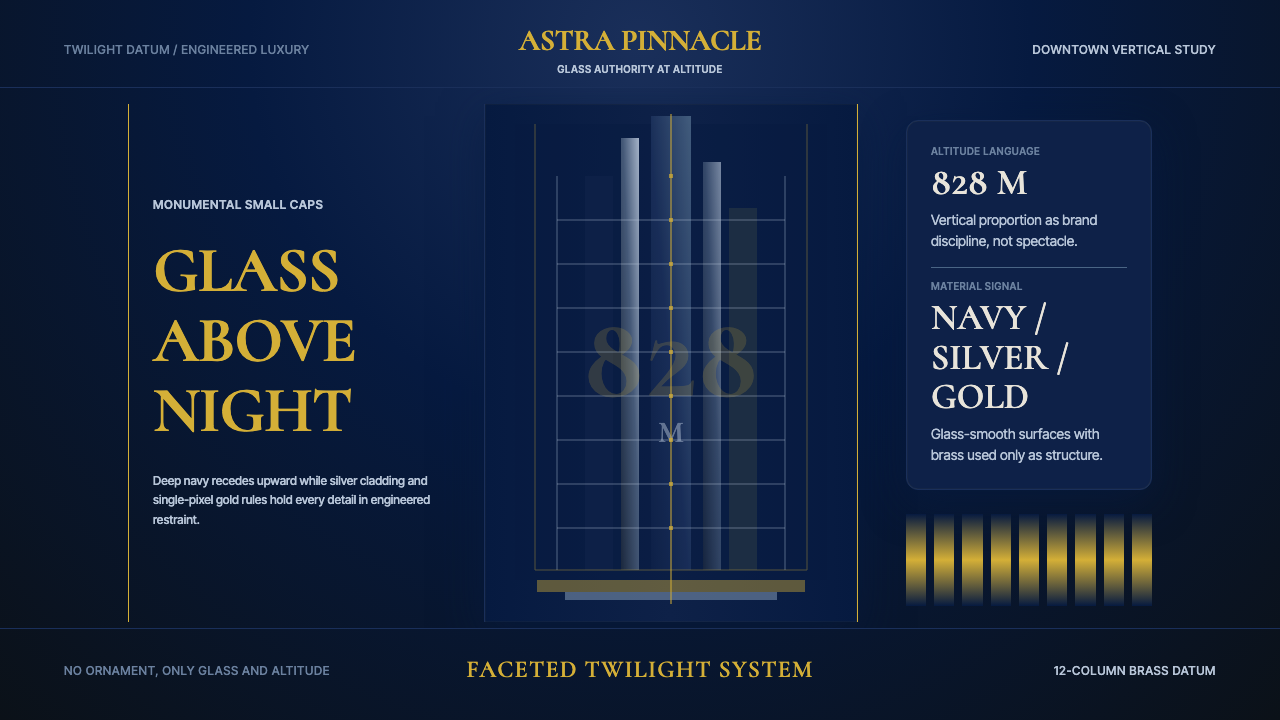 Burj Khalifa TowerAltitude becomes authority. Navy glass, silver facets, and hairline gold rule…
 Paytm Indian FintechTrust at street scale. Saturated blue, Hind numerals, and QR grids make payme…
 Altered CarbonNeon screams off noir. Magenta glass, cyan scanlines, and stacked vertical si…
 Dark AeroGlass glows after dark. Black lacquer, cyan bokeh, and beveled panels turn Ae…
 Deus Ex: Human RevolutionDystopia wears gold. Near-black panels glow with amber bevels and hex motifs.
 Apple Fitness Rings Closed (2024)Midnight feels exact. Magenta, green, and cyan rings lock onto OLED black.