What is American Express Centurion?
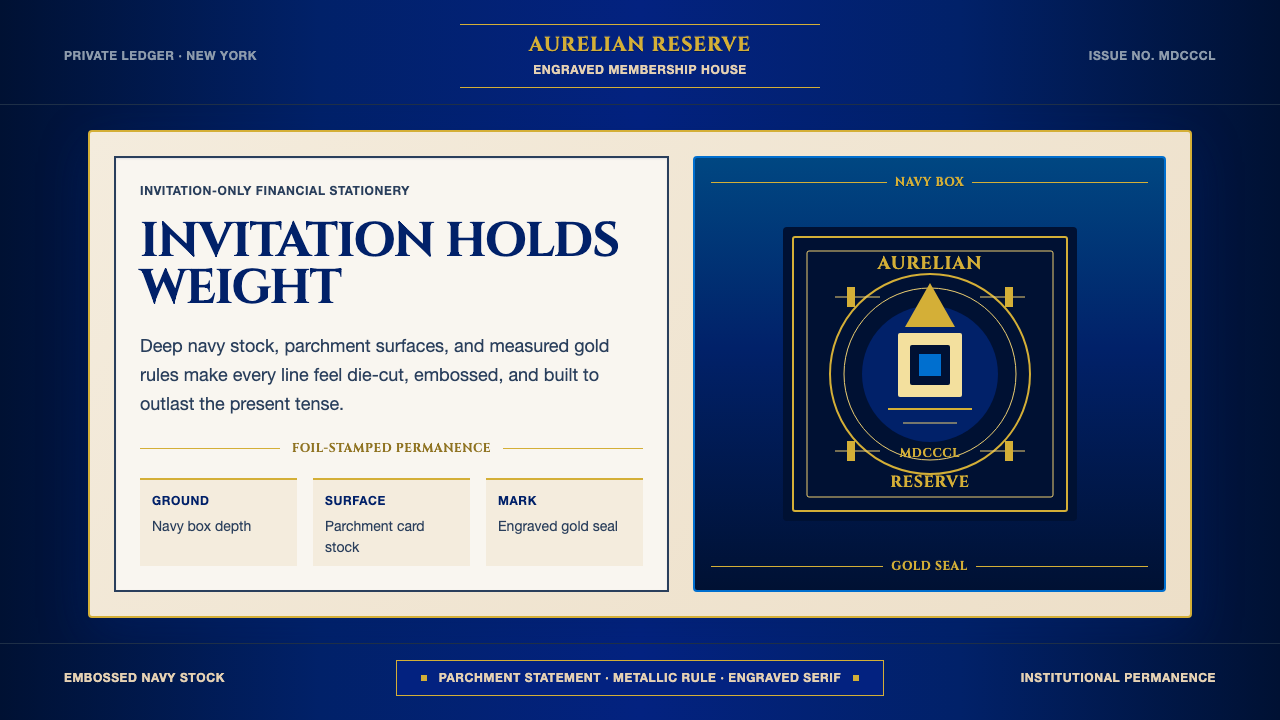
American Express Centurion translates 170 years of institutional financial prestige into a visual language of deep navy, engraved serif letterforms, and metallic gold — a system that feels stamped and embossed rather than designed on screen.
American Express Centurion in brief
American Express Centurion is a luxury financial design system rooted in the visual grammar of nineteenth-century engraving, bank note typography, and prestige correspondence. Its defining palette — a deep, authoritative navy offset by parchment-warm panels and thin gold rules — reads as permanent rather than fashionable. Every surface within the system carries the implied tactile weight of embossed card stock, hot-stamped seals, and formally printed statement paper.
The visual identity pivots on two anchors: the Blue Box, a precise square enclosure that signals institutional containment and order, and the helmeted Centurion gladiator portrait, a heraldic symbol of enduring authority. These marks resist the restlessness of contemporary brand refreshes. They are meant to communicate that the institution existed before the viewer was born and will persist after — a quality sometimes called permanence signaling, and one that luxury financial brands prize above novelty.
What distinguishes this system from generic luxury design is specificity of reference. The aesthetic deliberately cites engraved banknotes, copper-plate invitation printing, and classical Roman iconography rather than the glossy minimalism favored by consumer fintech. The result is a design language that earns trust by looking expensive in an older, more credentialed sense of the word — less about visual freshness and more about institutional depth.

Where does American Express Centurion come from?
American Express was founded in 1850 in Buffalo, New York, by Henry Wells, William Fargo, and John Butterfield as an express mail and package delivery company — a rival to the U.S. Post Office in an era when private courier services competed openly. The company's first financial product, the American Express Money Order (1882), was itself a trust artifact: a printed document whose value depended entirely on the institution's reputation for reliability. This origin in guaranteed paper instruments — documents whose authority derived from the issuing body rather than the bearer — is embedded in the visual culture the brand would later develop.
The charge card launched in 1958 introduced the now-iconic Green Card and established American Express as a financial services company rather than a courier. The brand's visual identity in this period was functional but unremarkable. The transformation came in the early 1960s when the company engaged the San Francisco design firm Landor Associates. Landor refined the Centurion figure — a profile portrait of a helmeted Roman soldier — and established the Blue Box as the primary mark. The choice of a Roman centurion was deliberate: Roman imagery in mid-century American financial culture connoted discipline, legal authority, and civilizational permanence. The blue square framing it imposed geometric order on heraldic symbolism.
The Centurion Card itself — the legendary black card with no spending limit issued by invitation only — launched in the United Kingdom in 1999 and in the United States in 2000. The card's existence had been rumored for years before its formal release; cardholders passing the physical object across a table generated the kind of status theater that no advertising campaign could replicate. This mythology became inseparable from the visual identity: the system had to look worthy of the object's reputation, and so the design language doubled down on materiality, engraved texture, and gold.
The subsequent evolution of the visual identity, including significant work by Pentagram in the 2010s and ongoing refinements through the early 2020s, modernized the system for digital environments without abandoning its core grammar. The challenge was translating embossed card stock and hot-stamped gold foil — inherently physical sensations — into screen-based surfaces. The solution was to treat texture and material quality as atmospheric references rather than literal simulations: a color palette that implies metal without using gradients, a typographic hierarchy that implies engraving without being illegible on screen, and a compositional logic that implies formal print layout without being rigid on responsive displays.
What defines the American Express Centurion look?
Color Palette
The system is anchored by a deep, saturated navy that reads as institutional and permanent rather than digital or fashionable. Against this ground, parchment-toned panels introduce warmth without softness — the warmth of aged paper and formal stationery rather than the warmth of hospitality brands. Metallic gold, applied as a thin rule, border, or accent element, completes the triad: it is used sparingly as a premium signal, never as a background fill. The combination deliberately evokes the visual register of engraved invitations, bank certificates, and diplomatic correspondence.
Typography
Engraved serif letterforms sit at the core of the typographic system. The serifs are fine and formal — the kind associated with copper-plate printing and formal proclamation documents — rather than the humanist serifs of editorial publishing or the geometric serifs of modernist revivals. Headline type is set with generous letterspacing, evoking the deliberate pace of formal engraving. Body text is dense and compact, as if economizing on precious paper. Scale contrast is pronounced: a principal headline commands its field through sheer size and weight, while supporting copy recedes to secondary hierarchy without color differentiation.
Gold Rule and Border Work
Thin gold rules — horizontal lines, border frames, and dividing elements — serve as the system's primary structural device. They are characteristically hairline-thin: fine enough to suggest the precision of engraved printing rather than the bluntness of digital decoration. A gold border enclosing a text block transforms a screen element into something that reads like a formal enclosure or certificate panel. Used consistently, these rules create a sense of architectural framing — each section of a layout is not merely positioned but formally declared.
Centurion Heraldry
The helmeted Centurion portrait functions as a heraldic emblem rather than a logo in the contemporary sense. It is rendered as a flat silhouette or profile rather than a detailed illustration — close in logic to the cameos and intaglios of classical antiquity, where recognizable profile portraits carried authority across coin and seal. When applied at large scale, the Centurion anchors a composition with symbolic weight. When reduced to its smallest reproduction size, it retains legibility as a silhouette, which is characteristic of well-designed heraldic marks across centuries of formal identity practice.
Engraved Texture Atmosphere
Rather than using literal texture overlays or skeuomorphic surfaces, the system implies physical engraving through compositional choices: compressed spacing, deliberate geometric framing, and the consistent application of hairline rules that read as if incised rather than rendered. This atmospheric approach to texture means the design works equally well in print and on screen without requiring different treatments for different media. The engraved quality is an attitude rather than an effect — a restraint and precision in every element that collectively produces the sensation of something labored over rather than quickly produced.
Composition and White Space
Layouts are formal and centered or near-centered, contrasting with the asymmetric dynamism of Bauhaus or Swiss International Style. The formality references classical document design: a centered title, a formal border, a signature field at the base. White space and parchment space are used generously, but not in the open, airy manner of contemporary minimalism — rather in the way that formal paper documents preserve margins as marks of seriousness and quality. Every element earns its position through hierarchy, not through visual energy.
Dark Mode as Default Register
Unlike most design systems where dark mode is an optional inversion, the Centurion system treats deep navy as its primary ground — the canonical reading experience is light on dark rather than dark on light. Parchment type and gold rules read as illuminated against the navy field, producing a quality closer to candlelit formal correspondence than to digital screen text. This default dark register reinforces the premium signal: dark backgrounds in physical contexts (velvet card boxes, black card surfaces, dark-lined envelopes) have long been associated with luxury packaging.

Who shaped American Express Centurion?
Wells co-founded American Express in 1850 and served as its first president. His background in express freight and the western expansion of commerce established the company's foundational identity as a trustworthy guarantor of value in transit — a premise that would later transfer seamlessly to financial instruments. Wells also co-founded Wells Fargo in the same year, demonstrating an instinct for building institutional credibility at scale. The documentary and contractual culture of early American Express — the signed money order, the guaranteed delivery receipt — planted the seeds of the brand's later visual grammar of formality and permanence.
William Fargo, co-founder of American Express, brought the operational discipline of the express freight business to the company's early structure. His tenure helped establish American Express as a nationwide network of reliable agents, each operating under the authority of the central institution. This federated trust model — where local agents represented and reinforced the central brand — established a kind of distributed prestige that later design systems would need to encode visually. The institutional marks, borders, and formal typography that would come to define American Express's visual identity are in part visual solutions to the problem of signaling consistent authority across geographies.
Walter Landor, founder of Landor Associates, is the designer most responsible for establishing the visual grammar of American Express as it is recognized today. Working with the company in the early 1960s, Landor refined the Centurion figure into a precise, reproducible silhouette and established the Blue Box as the enclosing mark. Landor's methodology — treating brand identity as a system of interrelated elements rather than a single mark — gave American Express a visual language capable of expanding across cards, checks, traveler's cheques, correspondence, and eventually digital interfaces. The Centurion portrait's longevity across six decades is itself a testament to the quality of the original design decision.
Pentagram, the international design partnership, has undertaken significant identity work for American Express in the contemporary period, particularly in adapting the brand's visual language for digital environments and premium card programs. Their challenge was to preserve the institutional weight and tactile references of a system built for physical media while making it function on screens, in apps, and across the full spectrum of digital customer touchpoints. Pentagram's work demonstrates the difficulty and the discipline of evolving a prestige brand identity without diluting the qualities — formality, permanence, material richness — that make it valuable in the first place.
The Centurion Card — colloquially known as the Black Card — was not designed by a single named designer but emerged from the accumulated mythology around American Express's most exclusive product tier. Its launch in 1999 required the design team to create a physical artifact that could live up to years of rumor and aspiration. The solution was radical material restraint: a card made of anodized titanium (later transitioning to other premium materials), virtually blank except for the embossed Centurion figure and the minimum required text. The card's design teaches a lesson that the broader visual system learned well — that conspicuous absence of decoration is itself the most powerful luxury signal.
How do you use American Express Centurion today?
The American Express Centurion system is most effective when applied to contexts where institutional authority, exclusivity, and long-term trust are the primary values to communicate. This is a narrower brief than many design systems: it is not appropriate for brands seeking approachability, warmth, or technological progressiveness. Where it excels — luxury financial services, premium membership programs, high-value professional services, private banking communications, and any context positioning itself as the credentialed option in a crowded market — it excels precisely because it refuses the visual strategies of every other category.
For presentation slides, the system rewards commitment. A cover slide built on deep navy with parchment-toned headline type and a gold rule beneath the title produces a distinctively formal opening — appropriate for a high-stakes pitch or a premium product reveal, less appropriate for a casual internal review. Content slides should treat the gold rule as the single decorative element: one horizontal line can demarcate sections without introducing visual clutter. Data visualizations adopt the palette's logic — navy backgrounds, gold or parchment data series, with navy-on-parchment or reversed treatments for emphasis. The engraved-serif typographic hierarchy should be maintained consistently across all slides, resisting the temptation to introduce friendlier sans-serif type for subheadings.
For web interfaces, the system maps well onto premium dashboard experiences, private client portals, and exclusive membership landing pages. The approach: establish deep navy as the primary surface color, use parchment-toned text and interface elements for primary content, and deploy gold rules as architectural dividers between page sections. Card components should have defined borders rather than soft shadows — the border is structural, not decorative. Navigation typography should be formal and letterspaced rather than compact and approachable. Call-to-action elements work best in parchment or gold against the navy ground, never in a bright contrasting accent color that would break the tonal unity. For pricing and tier comparison pages, the system's association with exclusivity makes it powerful: the highest tier naturally reads as the canonical option when the surrounding design language suggests institutional gravity.
For editorial and marketing work — luxury brand campaigns, annual reports, premium service brochures, and invitation-format communications — the system's roots in formal print culture give it particular authority. Editorial layouts should use a formal column structure with generous margins, body text set in engraved serif at a reading-comfortable size, and section openers treated as formal announcements with generous leading and centered or near-centered alignment. Headlines deserve their own field — not competing with imagery but framed by it. Marketing materials translate the card's material restraint into print: a full bleed navy background, a single centered Centurion mark, and minimal text set in gold or parchment against the dark ground. This approach works for printed invitations, events signage, and packaging inserts.
A common mistake when applying this system is treating the gold as a primary color and using it at full coverage for backgrounds, large blocks, or extended text. Gold in the Centurion system is an accent and structural element — it reads as precious precisely because it is scarce. Covering a large surface in gold produces the opposite of the intended luxury effect, reading as ostentatious rather than restrained. A related error is mixing the Centurion aesthetic with contemporary fintech visual conventions — flat illustration, rounded sans-serif type, bright accent colors, or casual photography — which produces a tonal incoherence that undermines both styles. Applying this system requires wholesale commitment to its formal vocabulary; selective borrowing of individual elements weakens the institutional authority the system is designed to project.

American Express Centurion — FAQ
Is this system appropriate for digital-native financial products, or only for traditional banking?
It is suited to any financial or professional services product where longevity, trust, and exclusivity are the primary signals — regardless of whether the product is digital-native. Several digital wealth management platforms, private lending services, and invitation-only fintech products have adopted variations of this aesthetic precisely because it creates immediate visual distance from the casual, approachable register of mass-market financial apps. The key question is not whether the brand is old or new but whether its value proposition depends on making clients feel they have been selected rather than acquired. If it does, the Centurion grammar is a strong fit.
How does the Centurion system handle color on light-background implementations?
Light-background implementations flip the ground from deep navy to the parchment or cream tone, with navy type and gold rules reading against the warm light field. This variant is most appropriate for formal documents, printed correspondence, and long-form editorial reading experiences where the dark-ground version would create reading fatigue. The gold rule retains its accent role in either implementation. What changes is not the palette but the ground: the tonal hierarchy — deep, warm, and metallic — remains consistent. The light-ground variant reads as formal correspondence; the dark-ground variant reads as premium packaging and card surfaces. Both are canonical within the system.
Why does this system use centered composition when most contemporary design systems favor grid-based asymmetry?
The centered composition is not a design failure or an inherited legacy — it is a deliberate claim. Centering in formal document design (certificates, proclamations, invitations, diplomas) signals that the content is addressed to the reader personally and authoritatively, not optimized for scanning or visual energy. It is a posture of declaration rather than navigation. Contemporary asymmetric grid systems are optimized for efficiency and information hierarchy across long pages of varied content; the Centurion system is optimized for formal moments of singular authority — a cover, a headline, a principal mark. The two approaches have different use cases rather than one being superior.
Can the Centurion aesthetic work for non-financial brands?
Yes, but context determines appropriateness. The aesthetic transfers well to luxury hospitality (private clubs, premier hotel programs), legal services positioning themselves as established firms rather than accessible startups, premium professional associations, and invitation-format cultural institutions. It is poorly suited to consumer retail, technology products, healthcare, or any brand where warmth and accessibility are primary values. The system's core communication is: 'We have been doing this for a long time, at the highest level, for a small number of people who understand the difference.' A brand whose value proposition matches that statement can borrow the grammar legitimately. One whose proposition diverges from it will read as aspirational pretense rather than earned authority.
How do you apply this system without it reading as dated or stuffy?
The system reads dated when it is applied as historical recreation rather than as contemporary practice rooted in historical values. The distinction is in the editing: authentic application identifies which elements carry essential meaning — the navy ground, the gold rule, the serif hierarchy — and executes those with precision and restraint, while allowing contemporary proportions, generous spacing, and clean digital rendering to provide the modern sensibility. Stuffy results usually come from over-application: too much border work, too many gold elements, too small a type size, and too little breathing room. The Centurion card itself is the best guide — it is almost entirely blank. Maximum authority with minimum means.
Related design styles
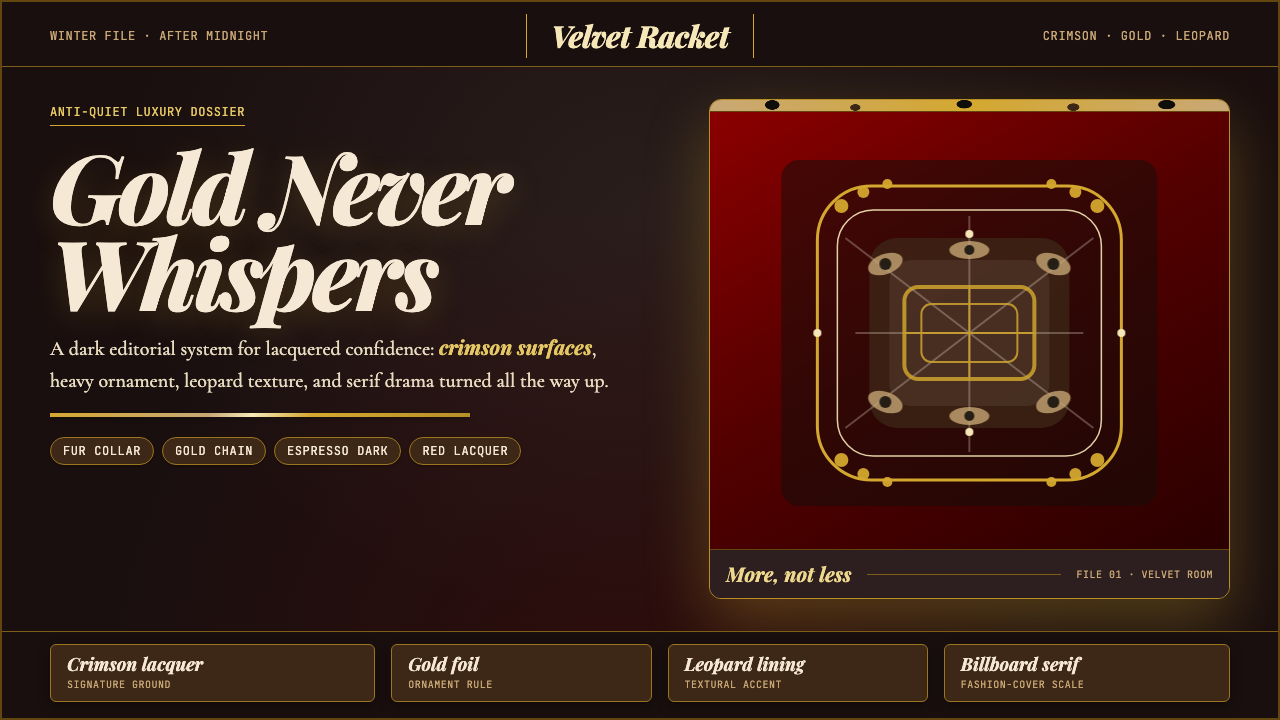 Mob Wife AestheticGlamour refuses restraint. Crimson lacquer, gold foil, leopard texture, billb…
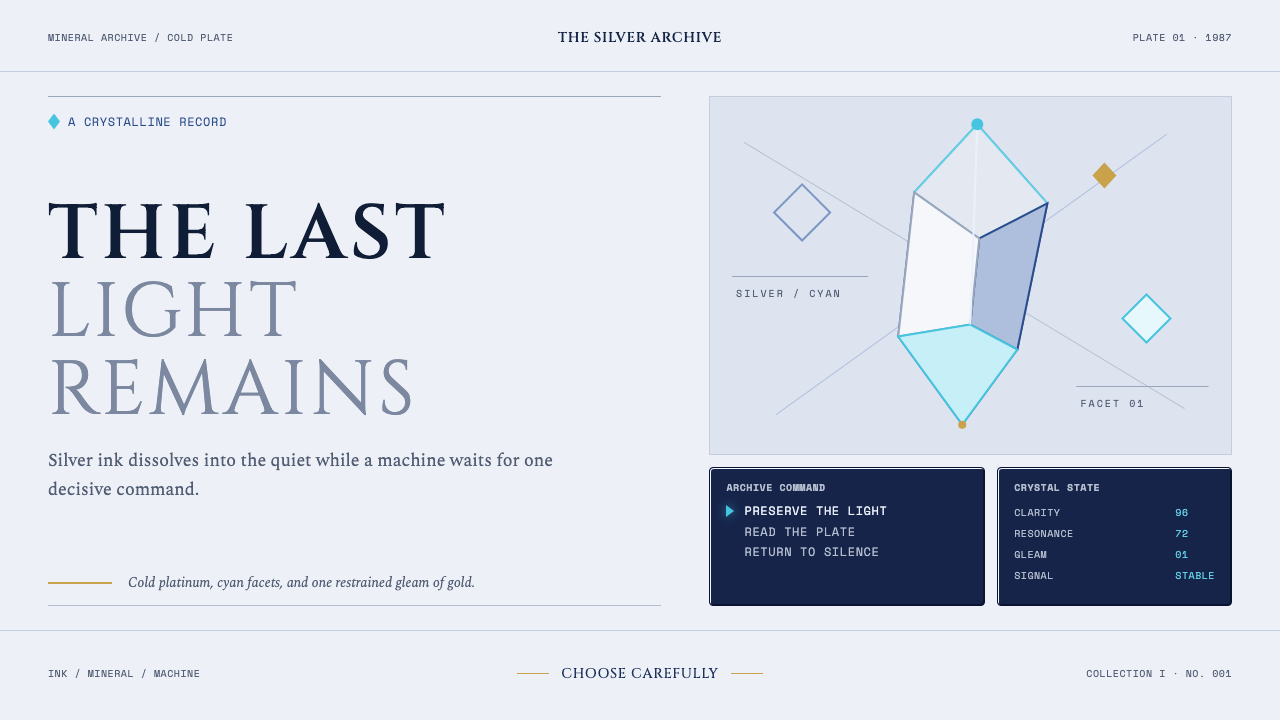 Final Fantasy Crystal (1987)Silver fantasy meets machine logic. Crystal ink glows behind hard navy comman…
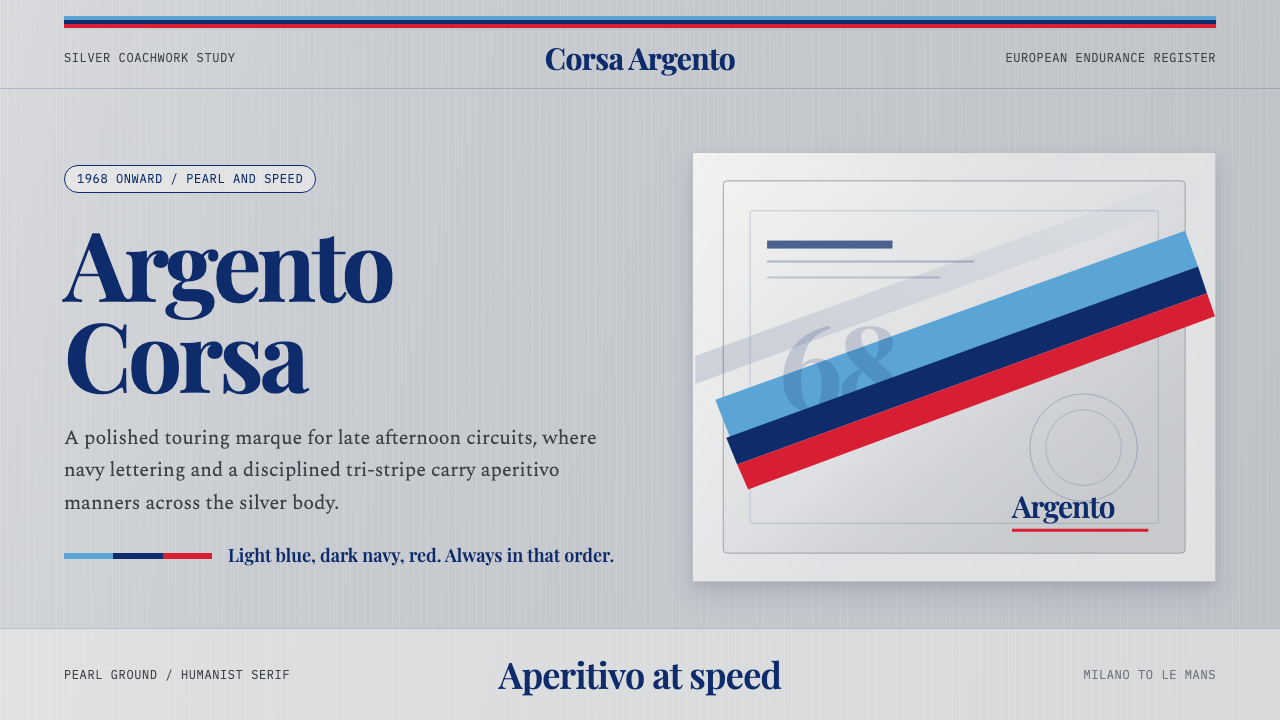 Martini Racing StripesAperitivo elegance at speed. Silver ground, Playfair serif, and a blue-navy-r…
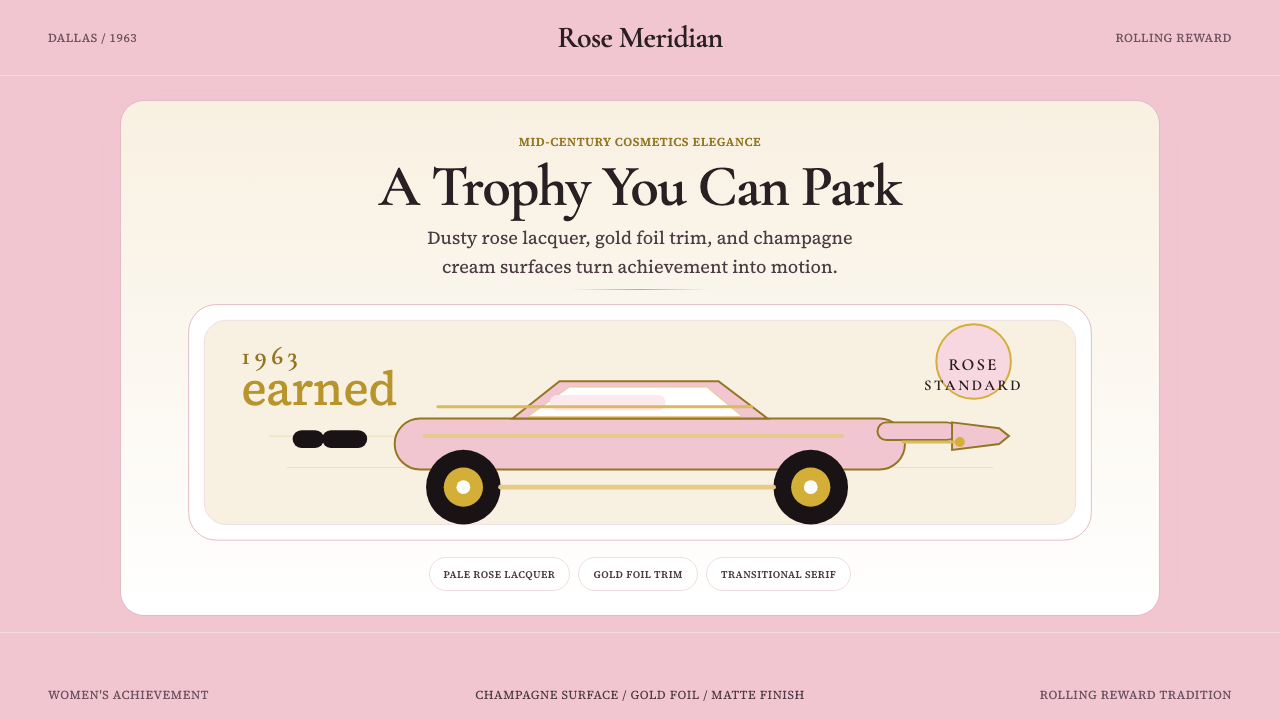 Mary Kay Pink Cadillac (1963)Earned elegance in pale rose. Champagne cream, gold foil, and serif ornament…
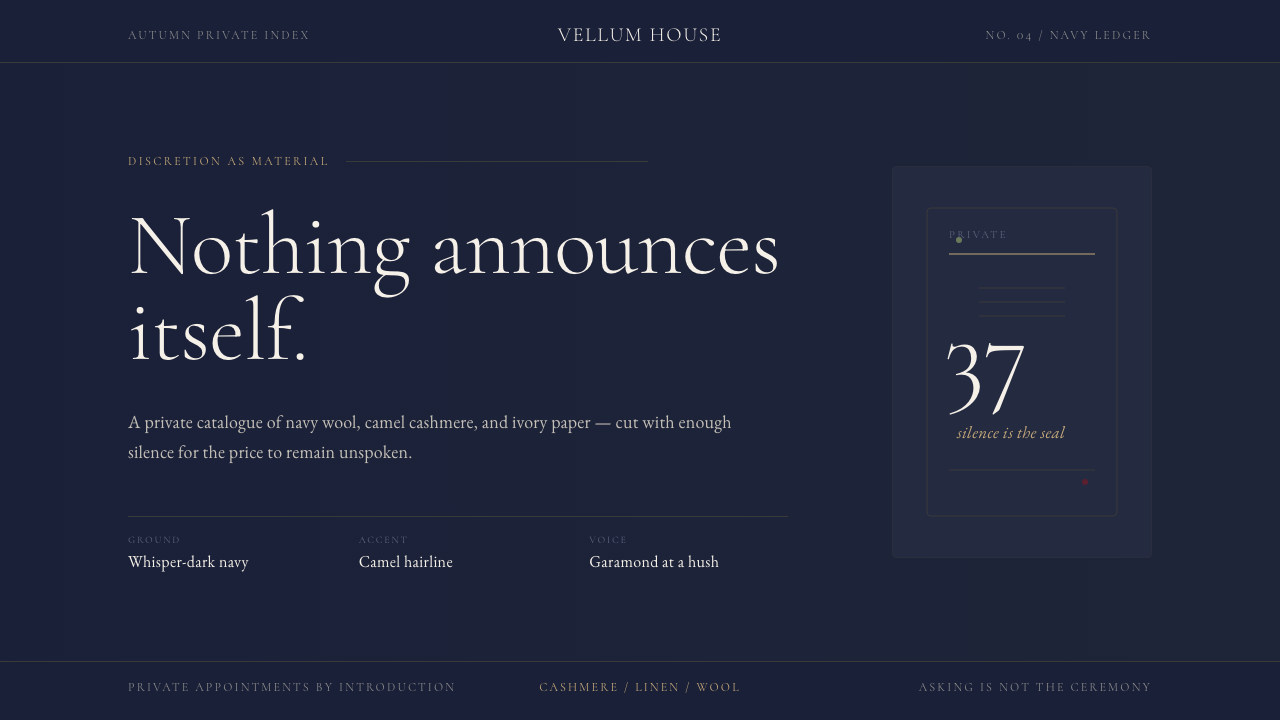 Quiet Luxury / Old MoneyLuxury refuses to raise its voice. Navy fields, camel hairlines, and thin Gar…
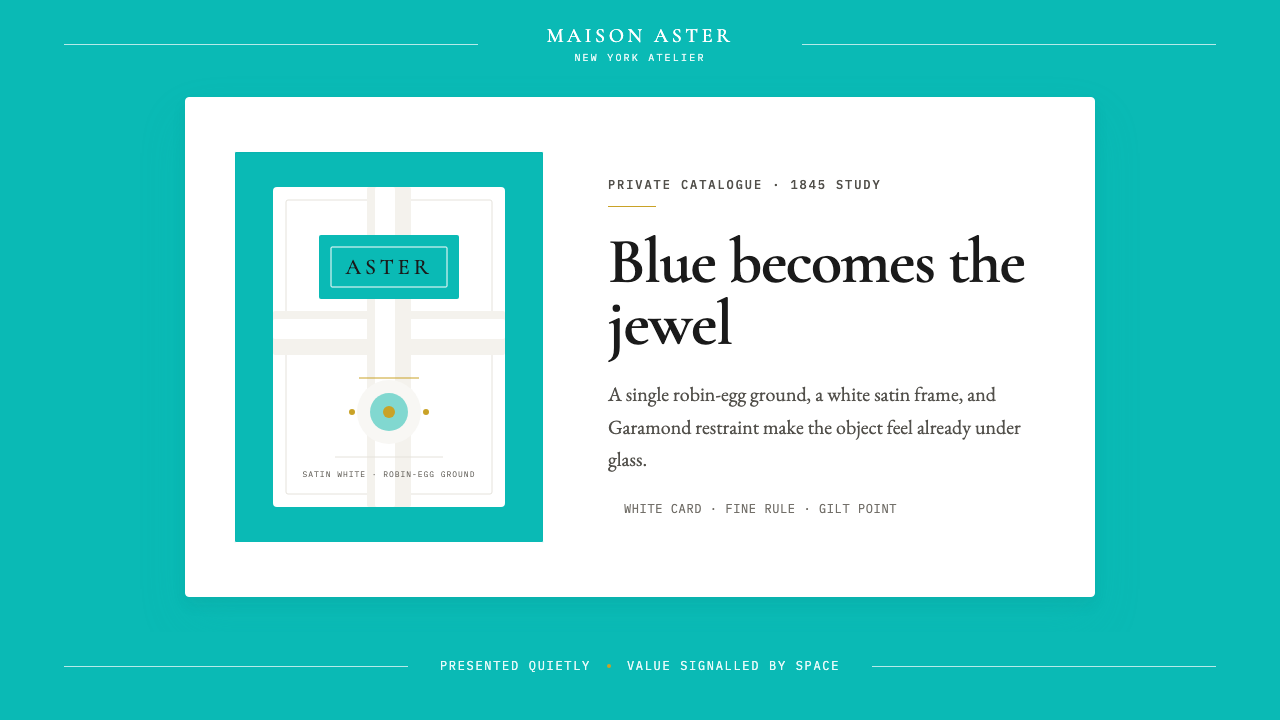 Tiffany Robin-Egg BlueBlue is the luxury signal. Robin-egg ground, white satin rules, Garamond rest…