What is Argentine Tango Poster (1940)?
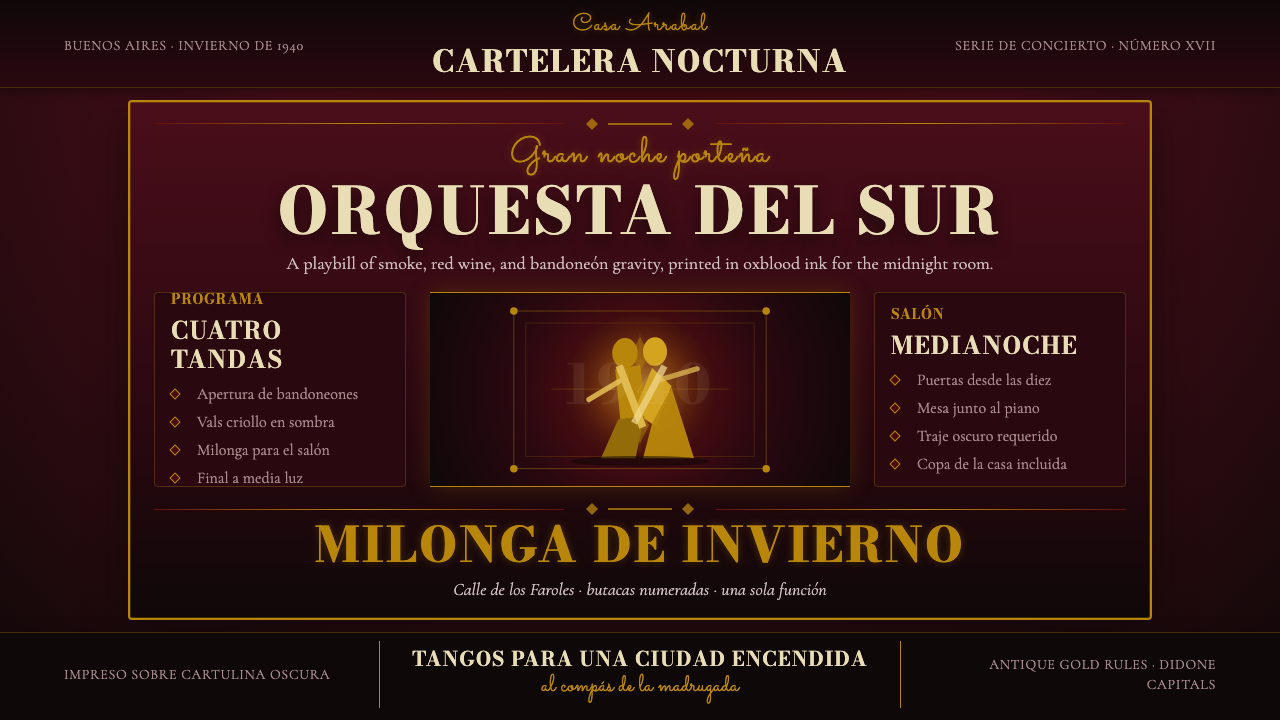
A Buenos Aires concert hall announces tonight's orquesta típica through ink-black grounds, oxblood shadows, and gold letterforms cut with the precision of a copperplate engraver's burin.
Argentine Tango Poster (1940) in brief
The Argentine Tango Poster of the 1940s is the visual system of tango's Golden Age — a design language built from deep oxblood grounds, antique gold ornament, Didone display type, and dancer silhouettes that seem to move even in stillness. Concert posters pasted outside the milongas and confiterías of Buenos Aires used every tool of the commercial lithographer to communicate drama, elegance, and the promise of a night that would not be forgotten.
At the centre of this aesthetic is a deliberate tension between darkness and luminance. The ground is never simply black — it carries the warmth of aged wine, of candlelit rooms, of leather and lacquer. Against that depth, gold rules and ornamental frames glow with the authority of a jewelry craftsman's work. Letterforms in the Didone tradition — fine hairlines contrasting with swelling strokes — push that tension further, declaring the name of the bandleader with the gravity of an opera playbill.
This design system is not Art Deco, though it borrows from that vocabulary. It is something more specifically porteño: denser, more theatrical, more willing to crowd the frame with curling flourishes and layered typographic hierarchies. Where European posters of the same era were tending toward austerity, Buenos Aires tango posters embraced abundance — because the milonga itself was about abundance, about the density of bodies, music, and emotion in a single room.

Where does Argentine Tango Poster (1940) come from?
Tango's Golden Age — roughly 1935 to 1950 — was a cultural phenomenon with few parallels in twentieth-century popular music. The orquestas típicas that filled the vast dance halls of Buenos Aires were large, sophisticated ensembles: orchestras of ten to fifteen musicians performing complex arrangements for thousands of dancers every weekend. Their concert posters were correspondingly ambitious. These were not handbills — they were announcements of events that carried genuine civic significance, and they were designed to stop a pedestrian in mid-stride.
The visual tradition the posters drew from was equally rich. Buenos Aires had developed a mature lithographic printing industry by the 1880s, producing labels, packaging, and commercial graphics that absorbed European influences — particularly the ornamental traditions of French and Italian commercial printing — and reinterpreted them through local taste. By the 1930s, local print workshops were capable of producing multi-color lithographs of exceptional quality. The Didone typefaces (sometimes called Modern style serifs) that dominate tango poster typography were well-established in the Buenos Aires type specimen books of the era, favored for their combination of formal elegance and high legibility at large display sizes.
The oxblood and deep-crimson color palette has a dual origin. Practically, it reflected the ink and pigment traditions of Buenos Aires commercial printing, where warm dark grounds were achievable and fashionable for theatrical announcements. Culturally, these colors resonated with the visual world of tango itself — the red of passion, the darkness of desire, the gold of aspiration. The palette was also well-suited to the candlelit and lamp-lit environments where the posters would be read: dark grounds with luminous gold details are extraordinarily legible in low-light conditions, which is exactly the environment of a Buenos Aires street at night outside a milonga.
The key artistic figures whose music these posters announced — Carlos Gardel, Aníbal Troilo, Osvaldo Pugliese, Edmundo Rivero — were not graphic designers, but their musical aesthetics shaped what the posters communicated. Gardel's romantic melancholy, Troilo's emotional depth, Pugliese's drama and complexity: these were the qualities that the visual language had to convey. The poster designers of Buenos Aires rose to that challenge by making every element of the composition feel saturated, intentional, and alive with suppressed energy. The Buenos Aires lithography tradition, meeting the European Art Deco sensibility filtered through a specifically Argentine emotional register, produced something that could not have emerged anywhere else.
What defines the Argentine Tango Poster (1940) look?
Ground and Atmosphere
The foundation of this design system is the dark ground — not a flat black but a deep, warm oxblood or dark-crimson that reads as the interior of a Buenos Aires milonga at midnight. This ground is never neutral; it is already emotionally saturated before a single letter or ornament is placed on it. All other elements must fight to assert themselves against it, which is why the accent values — gold, ivory, pale gold — must be used at maximum luminance. The ground is the drama; everything else is the cast.
Gold Ornament and Rule Lines
Ornamental rule lines, corner brackets, and curvilinear flourishes in antique gold define the poster's architecture. These are not decorative afterthoughts — they are the structural skeleton that holds the typographic content in place and signals the formality and prestige of the event being announced. The quality of the gold matters: it should read as hammered metal or aged gilding, not as a flat color fill. Corner ornaments draw from copperplate engraving traditions, with their precise, tapered lines and symmetrical curlicues.
Didone Typography
Didone letterforms — the high-contrast serif tradition that includes Bodoni and its related families — are the typographic voice of tango posters. The extreme contrast between hairline strokes and swelling main strokes creates a visual tension that mirrors the tension between stillness and explosive movement in the dance itself. Headline type is set large, tightly, and with great deliberateness; secondary information in smaller, lighter weights creates a strict hierarchy. Italics are used for performer names and as a gesture toward the flowing, cursive quality of tango's physical movement.
Dancer Silhouettes
The paired dancer silhouette — typically a man and woman caught mid-figure in the close embrace of the milonga hold — functions as both pictographic content and compositional anchor. These silhouettes are rendered in gold or ivory against the dark ground, with enough detail to convey the specific elegance of the embrace but without photographic literalism. The silhouette form was practical for lithographic reproduction and aesthetically powerful: reduction to outline transforms two human bodies into an almost heraldic emblem, timeless and iconic.
Typographic Hierarchy and Drama
Tango posters typically present three to five distinct typographic hierarchies: the name of the orquesta or bandleader at maximum scale, the venue name in a secondary weight, the date and time in a smaller tertiary weight, supporting performers in the smallest size, and sometimes a decorative subtitle or tagline in italic script. These hierarchies are not arranged as a reading list — they are composed as a visual drama, with the most important element claiming the largest territory and the supporting elements arrayed around it in diminishing intensity.
Border and Frame Architecture
The outer border of a tango poster is never a simple line — it is a system of nested frames, each with its own character: a thick outer rule, a narrow inner hairline, and between them an ornamental band of repeated geometric or floral motifs drawn from the copperplate tradition. This framing system performs a cultural function as much as a visual one: it declares that what is contained within is not ordinary commerce but an event of cultural significance, worthy of the formality associated with opera programs and luxury printing.
Density and Saturation
Unlike European poster traditions of the same era that were moving toward whitespace and reduction, tango poster design in its authentic form is dense. The frame is filled; every tier of hierarchy occupies its territory; the ornament is present in multiple registers simultaneously. This density is not a failure of restraint — it is a deliberate mirror of the milonga itself, where the floor is crowded, the music is layered, and the emotional atmosphere is thick. Applied today, this density should be controlled but not avoided: a tango-derived design that breathes too freely loses its essential character.

Who shaped Argentine Tango Poster (1940)?
Gardel (1890–1935) was the defining voice of tango before the Golden Age, and his image — the slicked hair, the white scarf, the smile that seemed to contain everything — became so deeply embedded in tango's visual culture that it continued to shape poster aesthetics for decades after his death in a 1935 plane crash. His recordings established the emotional vocabulary of the genre: romantic longing, urban melancholy, masculine elegance. Poster designers invoked his legacy through a visual register of theatrical restraint — formal, grave, and luminous against darkness — that Gardel himself would have recognized as the correct register for the music he sang.
Known as 'Pichuco,' Troilo (1914–1975) led one of the most beloved orquestas típicas of the Golden Age, playing bandoneon with a lyrical depth that made his performances events of emotional consequence. His concerts were among the most heavily advertised in Buenos Aires, and the posters announcing his appearances at venues like the Gran Rex and the Club Armenonville set a standard for visual grandeur. The Troilo aesthetic — intimate despite its scale, emotional despite its formality — is the quality that tango poster design at its best aspires to replicate: something that looks like an institution but feels like a confession.
Pugliese (1905–1995) represented the dramatic, complex pole of Golden Age tango — his arrangements were dense, rhythmically intricate, and filled with a theatricality that demanded visual equivalents. His political commitments (he was an openly Communist musician in an era of political repression, and a red carnation on his piano became a symbol of solidarity when he was detained) gave his persona an additional layer of gravity and resistance. The visual language of tango posters, with their dark grounds and luminous gold, is perhaps best calibrated to announce a Pugliese concert: heavy, serious, full of suppressed drama, and unmistakably on the side of the night.
Rivero (1911–1986) was a singer whose bass voice carried the Buenos Aires underworld — the arrabal, the compadrito, the city's rougher and more nocturnal margins — into the concert halls of the Golden Age. His persona drew on the lunfardo argot and the darker, more dangerous imagery of tango's origins in the immigrant neighborhoods of the Río de la Plata. Posters for Rivero's performances were often the most visually confrontational of the era: deeper grounds, heavier type, less ornamental filigree and more raw graphic power. He represents the element in tango poster design that resists prettification — the dark thing at the center that the gold ornament is simultaneously announcing and barely containing.
The anonymous craftsmen of the Buenos Aires commercial printing workshops — the lithographers, typesetters, and ornament compositors who produced Golden Age tango posters — deserve recognition as a collective creative force. Working under commercial deadlines and within the technical constraints of multi-stone lithography, they developed a visual language of remarkable consistency and refinement. The craft traditions they drew on included Spanish chromolithography, Italian operatic poster design, and the ornamental typeface culture of French commercial printing. Their synthesis produced a specifically Argentine visual identity that was neither European imitation nor naive folk art, but something genuinely hybrid and genuinely powerful.
How do you use Argentine Tango Poster (1940) today?
Argentine Tango Poster style is one of the richest historical design systems to apply to contemporary work precisely because its core aesthetic — dark ground, gold accent, high-contrast type, ornamental framing — translates across media without losing its essential character. Applying it correctly requires understanding the logic of the original: this is a system built on drama, and drama requires contrast, hierarchy, and deliberateness. Every element must be intentional; nothing can drift into casualness.
For presentation slides, the style works powerfully on cover pages and section dividers. A cover slide uses the deep oxblood or near-black ground as its entire background; the title is set in a large Didone-style display face in gold or ivory, with a double-rule border framing the composition. Section dividers can carry a dancer silhouette or a single ornamental element to signal transition. Content slides, by contrast, should lighten significantly — cream or pale warm ground, dark type, with gold used sparingly for pull-quotes, data labels, or section indicators. Keeping the full dark register only for structural moments gives the content slides breathing room and makes the dramatic moments feel genuinely dramatic. Data visualizations work best in a warm-tinted version of the palette: bars and lines in gold, ivory, and a muted crimson against a dark or warm-neutral ground.
For web interfaces, the style suits event promotion pages, cultural institution homepages, music and entertainment platforms, and any product where the promise of an experience — rather than a utility — is being sold. The approach: commit to a dark mode as the default, using the deep warm ground as the primary background; reserve gold and ivory for headlines, calls to action, and key UI elements; use Didone or high-contrast serif type for display and a legible humanist serif or transitional serif for body text. Navigation benefits from ornamental rule lines as section dividers rather than generic hairlines. Pricing or tier comparison pages can use the framing system — bordered cards with ornamental corner details — to give each tier a sense of formality and significance.
For editorial and marketing work, the style creates an immediately distinctive visual identity that communicates cultural seriousness and sensory richness. A magazine spread in this register uses full-bleed dark grounds for feature openers, with the article title in large Didone display set in gold or ivory; body text moves to a lighter ground for legibility. Marketing campaign assets — social graphics, event banners, email headers — benefit from the poster-like boldness of the system: a single strong typographic statement in high contrast, a dancer silhouette or ornamental element, and the event or product name in the most formal type treatment the medium allows. The style is particularly well-suited to event promotion, cultural sponsorship announcements, luxury product launches, and any context where an atmosphere of glamour and theatrical gravity is a genuine asset.
A common and damaging mistake when applying this style is reducing it to decoration: adding gold rules and Didone type to an otherwise conventional layout and assuming the aesthetic has been achieved. The authentic logic of the tango poster is atmospheric and holistic — the dark ground must be committed to, the ornament must be structural, and the typographic hierarchy must carry genuine weight. A second common error is reaching for too many accent colors: the palette has its power precisely because it is restricted to the near-black ground, the gold or ivory accent, and at most one additional warm hue. Introducing cool colors, bright saturated accents, or a crowded palette immediately breaks the spell. Finally, the density of the original tradition should be respected: this is not a style for sparse, airy layouts. If the composition feels too empty, the solution is to invest in the typographic hierarchy and ornamental structure — not to add white space.

Argentine Tango Poster (1940) — FAQ
How is this style different from European Art Deco?
Art Deco and Argentine Tango Poster design share a common ancestry in the early twentieth-century European decorative tradition, but they diverge significantly in character. Art Deco — as expressed in Parisian fashion plates, American skyscraper ornament, and the graphic design of the 1925 Exposition — tends toward streamlined geometry, stepped forms, stylized sunburst motifs, and a palette that balances black with gold, silver, and cool jewel tones. Argentine Tango Poster design is warmer, denser, more operatic, and more willing to embrace curvilinear ornament derived from copperplate engraving rather than industrial geometry. The emotional register is different too: Art Deco projects confidence, modernity, and luxury; tango poster design projects desire, nocturnal drama, and the weight of feeling. Both are sophisticated, but they are sophisticated in different directions.
Can this style work in light mode, or is the dark ground essential?
The dark ground is deeply essential to the style's identity — the drama of gold against darkness is not a surface choice but a structural one. A genuine light-mode inversion loses the atmospheric core of the system. That said, a restrained light-mode variant is possible: a warm ivory or aged-paper ground, dark espresso-brown or near-black type, antique gold as the primary accent, and ornamental elements drawn from the same copperplate tradition. The effect is closer to a formal printed menu or a luxury event program than to a milonga poster, but it retains the typographic and ornamental DNA of the style. What should never be done is simply inverting colors and calling it the same system — the pale equivalent needs its own careful tonal calibration to preserve any authentic feeling.
Is this style appropriate for digital products, or is it too rooted in print?
The style is rooted in print but translates well to digital contexts with thoughtful adaptation. The core elements — dark grounds, high-contrast type, gold accents, ornamental borders — are all renderable in digital interfaces without loss of fidelity. The challenge is the ornamental density: tango posters work at a scale and a level of visual complexity that can overwhelm smaller screen sizes or component-level interface design. The solution is to treat the style as a register rather than a literal template: apply the color system, the typographic hierarchy, and the framing architecture to your digital components, but simplify the ornamental detail to what reads clearly at the actual display size. Full ornamental complexity is best reserved for large-format moments — hero sections, modal overlays, full-screen event cards — where the viewer has room to encounter it properly.
What kinds of projects are a poor fit for this style?
Argentine Tango Poster style is a poor fit for any context that depends on neutrality, clinical precision, or approachability. Healthcare interfaces, children's educational products, civic information systems, or enterprise software dashboards where cognitive load is already high would be poorly served by the style's atmospheric density and dramatic color register. It is also unsuitable for contexts where the product or brand promise is built on transparency, lightness, or simplicity — the style carries too much visual weight and too strong an emotional charge to recede into the background when the content needs to lead. Minimal-lifestyle brands, clean-tech products, and anything positioning itself against excess would find the tango poster register working against their message.
How do you achieve the gold effect without actual metallic ink in digital work?
In the original Buenos Aires posters, the gold was achieved through metallic letterpress or lithographic inks that had genuine reflective properties — a quality no digital display can exactly replicate. In contemporary digital work, the goal is to achieve the perceptual impression of antique gold rather than to simulate the physics of metallic reflection. The key is tonal calibration against the dark ground: gold against a deep warm dark needs to be warmer and slightly more amber than it would need to be against a neutral dark, because the warm ground absorbs some of the cool yellow wavelengths. The effect of aged gold — as opposed to bright gold — comes from slightly desaturating the hue and adding warmth. Gradient effects that suggest a highlight on a curved metallic surface quickly become gaudy; the flat, tonal approach is more faithful to the lithographic original and more refined in digital contexts.
Related design styles
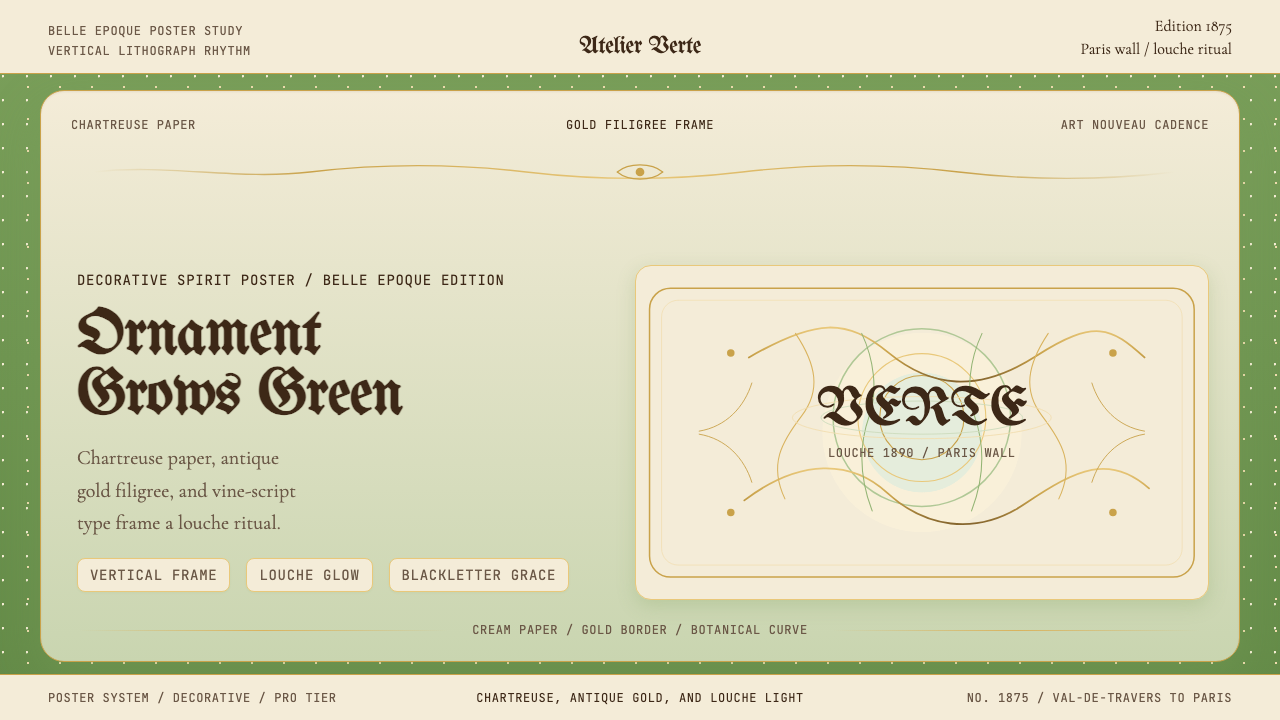 Absinthe Art Nouveau Green (1875)Ornate and verdant. Chartreuse field, gold filigree, vine-script type, and lo…
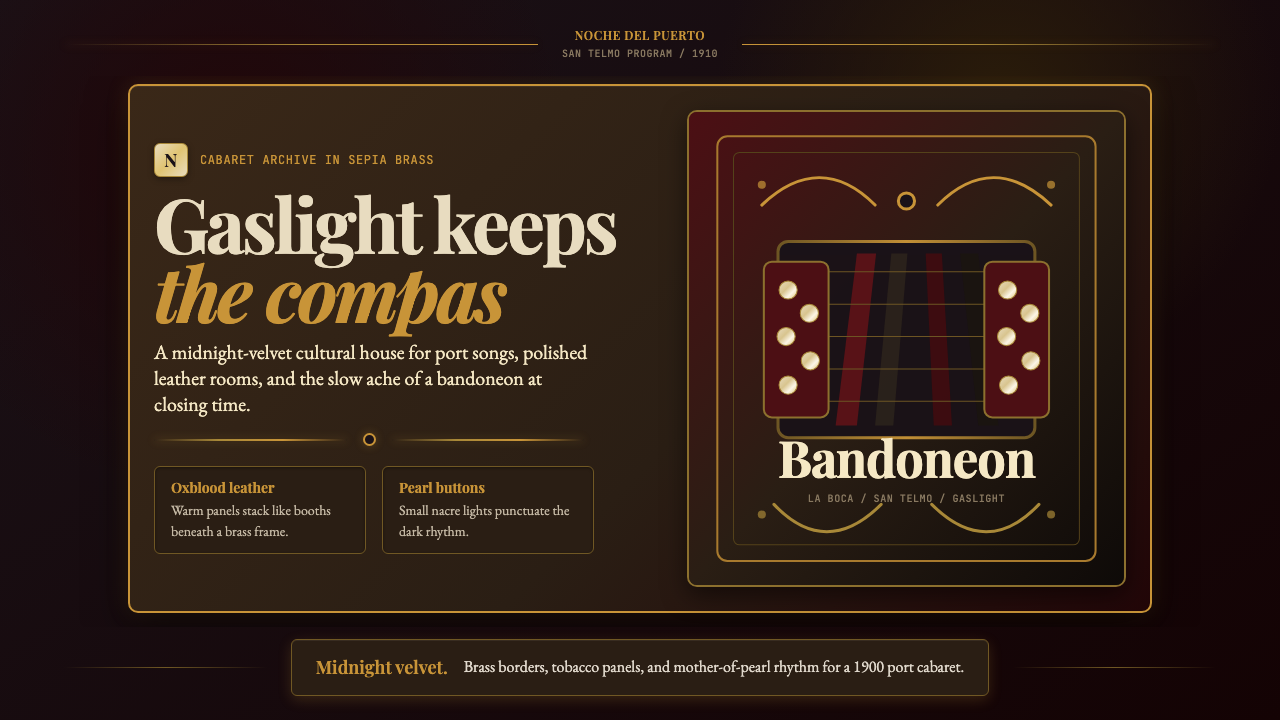 Argentine Bandoneón 1900 (Tango)Gaslit tango luxury. Midnight velvet, brass fileteado, and pearl-button geome…
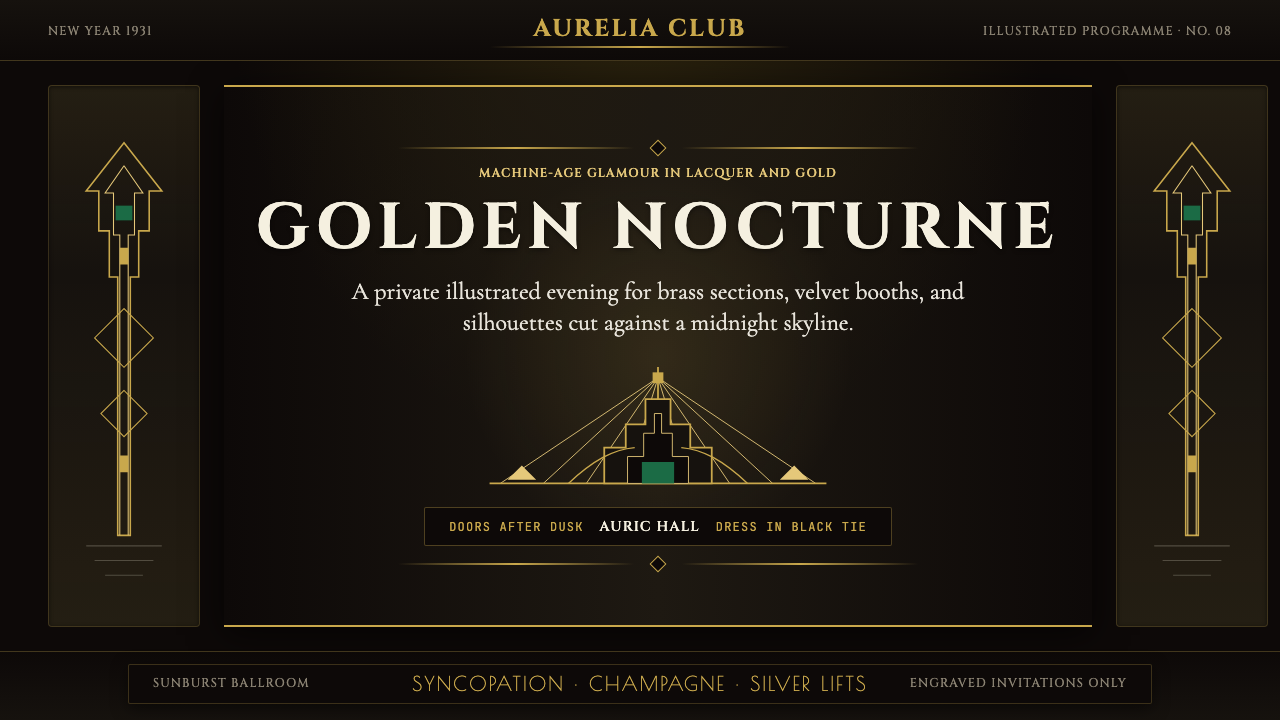 Art Deco Jazz AgeJazz Age glamour. Sunburst rays, stepped ziggurats, gold on black — Chrysler…
 Babylonian Hammurabi SteleAuthority carved in stone. Basalt-black grids, parchment panels, and imperial…
 Benin Bronze (Edo, 1500)Royal memory, cast in bronze. Cream plaques and gilded lines carry museum gra…
 Cambodian Angkor Tourism ModernQuiet authority at dawn. Ochre ground, Bodoni serif, jasmine panels, one lotu…