What is Chalkboard Cafe Menu (2010)?
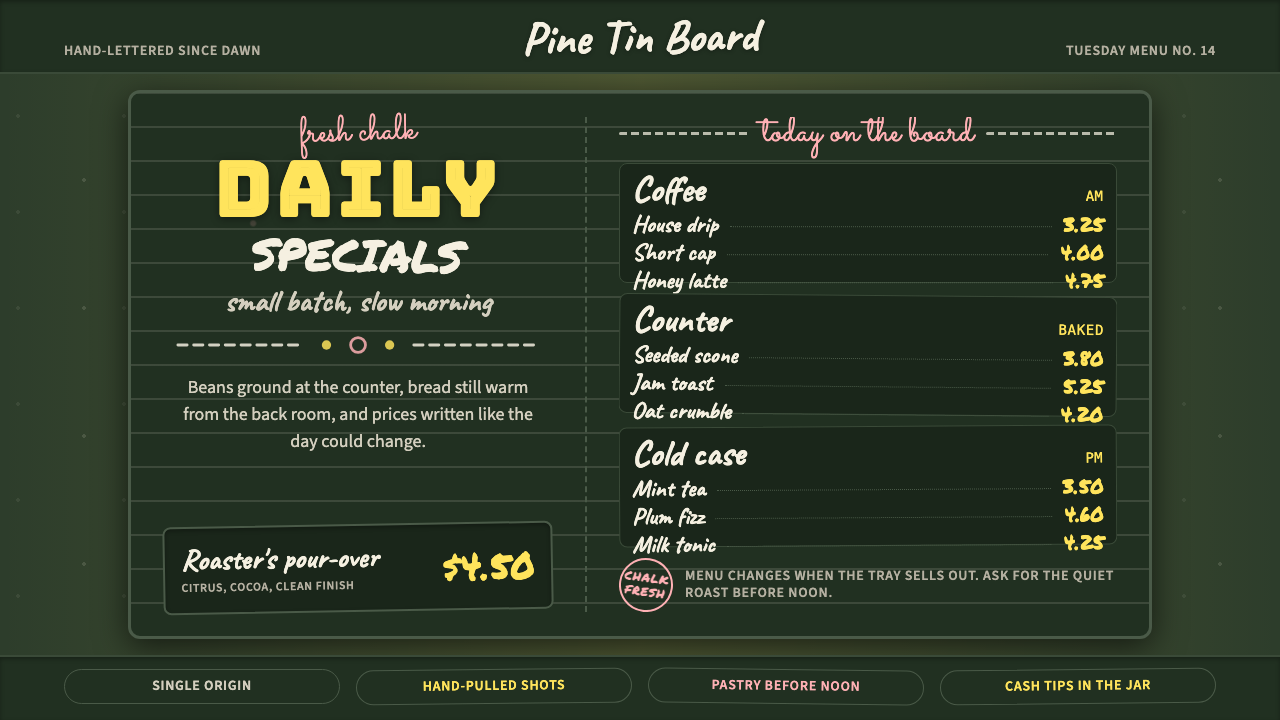
Chalk on slate turned every café into a gallery — and every barista into a hand-lettering artist.
Chalkboard Cafe Menu (2010) in brief
The chalkboard café menu is vernacular typography at its most democratic — a visual tradition in which imperfection is not a flaw to be corrected but the entire aesthetic point. Multiple typefaces stack vertically on a dark ground, hand-drawn flourishes curl around prices, and the slight wobble of a chalk stroke signals authenticity rather than carelessness. The style belongs to the broader hand-lettering revival of the late 2000s and 2010s, but its visual logic is distinctly its own: warm, artisanal, and saturated with the feeling of a neighborhood café on a rainy morning.
The palette is built on contrast between a deep, matte dark ground — the color of a weathered chalkboard — and the soft, slightly chalky white of lettering applied by hand. Warm yellows mark prices and headings; dusty pinks and sage greens provide secondary accent strokes and flourishes. Nothing is sharp or saturated in the digital sense: every color reads as slightly faded, as if the board has been wiped down a hundred times and redrawn. This controlled softness is what separates a convincing chalkboard composition from a harsh digital imitation.
Typography within the style is deliberately layered and mixed. Script letterforms suggest the flowing hand of a calligrapher; blocky serif display letters provide weight for section headers; hand-printed capitals in a rougher, more casual form label categories. The interplay between these three or four voices — flowing, heavy, casual, decorative — produces a richness that no single typeface could achieve. Flourishes, arrows, banners, botanical sprigs, and decorative borders fill the negative space between text columns, giving the composition a hand-assembled quality that invites lingering.

Where does Chalkboard Cafe Menu (2010) come from?
The visual DNA of the chalkboard café menu stretches back to Victorian Britain, where traveling merchants and street vendors painted their prices and offerings directly onto portable slate boards. By the mid-nineteenth century, the practice had moved indoors: butchers, fishmongers, and grocers displayed chalk-lettered specials on fixed boards behind their counters. The hand of the shopkeeper was itself a kind of authenticity mark — proof that the prices were current, the produce fresh, the establishment human-scaled rather than corporate.
American diner culture of the 1940s through the 1960s absorbed and amplified the tradition. The roadside diner blackboard became a fixture of the vernacular landscape: a daily-special board behind the counter, lettered in block capitals or casual script by whoever was first in that morning. The boards were functional above all else — communicating changing menus quickly and cheaply — but over decades they accumulated an aesthetic weight. By the time of the 1970s and 1980s nostalgia cycles, the diner blackboard had become a cultural shorthand for honest, unpretentious American food.
The third-wave coffee movement of the late 1990s and early 2000s transformed the chalkboard from a functional object into a design statement. Cafés in Portland, Melbourne, Brooklyn, and London began investing deliberate creative labor in their menu boards, hiring calligraphers and graphic artists to letter them. The boards became a visual identity system for an entire ideology of hospitality: locally sourced, carefully prepared, priced honestly, and presented with personality. The chalkboard said, implicitly, that the person behind the counter cared about more than commerce.
Between 2008 and 2018, Pinterest and Instagram amplified a pre-existing hand-lettering revival into a global phenomenon. Lettering artists such as Sean McCabe, Lauren Hom, Stefan Kunz, and Tobias Saul built substantial audiences by sharing process photographs and finished compositions. The chalkboard café menu aesthetic crossed from physical boards into digital design, illustration, and wedding stationery — anywhere a designer wanted to communicate warmth, craft, and a slight nostalgia for the analog. By 2013 or 2014, the style had achieved such saturation that a minor critical backlash emerged, dismissing it as derivative or overused. This did not stop its spread; it only clarified its cultural positioning as the visual language of a particular moment in artisanal consumer culture.
What defines the Chalkboard Cafe Menu (2010) look?
Dark Ground
The foundational element is a deep, matte ground in the color of aged slate or weathered chalkboard — a dark green with gray undertones rather than pure black. This ground is not flat in the digital sense: it reads as slightly textured, absorbing rather than reflecting light. Everything else in the composition sits on top of this surface, and the ground's matte depth is what gives chalk-white lettering its characteristic soft luminosity. Without this specific quality of darkness, the style collapses into generic dark-mode design.
Chalky White Lettering
The primary text color is not pure white but a slightly warm, slightly uneven chalky white that reads as physically applied rather than digitally rendered. Strokes vary subtly in opacity along their length — thicker at the start and end of a stroke, thinner in the middle — mimicking the pressure and release of actual chalk on slate. This textural variation is the most critical detail distinguishing authentic chalkboard aesthetic from a merely dark-background design. Where pure white would look electronic and harsh, chalky white reads as handmade and warm.
Mixed Lettering Voices
No single typeface dominates; the visual richness comes from the layering of three or four distinct lettering styles within a single composition. A flowing script handles names of drinks or dishes, conveying elegance and craft. Heavy block serifs or slab letters carry section headers, providing visual anchors. Rough hand-printed capitals label categories with casual authority. Inline or outlined letterforms add a vintage poster quality for featured items. The discipline is in the orchestration: each voice has its role, and they are harmonized by consistent color and shared imperfection rather than by formal similarity.
Warm Accent Colors
Against the dark ground and chalky white, two or three accent colors do the work of hierarchy and visual warmth. A warm, slightly dusty yellow marks prices, nutritional callouts, or featured items — it reads as highlighter-bright without being neon. A muted, dusty pink or rose provides decorative flourishes, borders, and botanical details. A sage or olive green may appear as a third accent, echoing the ground but at a lighter value. None of these colors are fully saturated; they all carry a slightly faded quality consistent with chalk pigment rather than digital color.
Flourishes and Decorative Fill
Empty space is not left empty. Botanical sprigs, swash strokes, arrow indicators, double-line frames, dotted borders, and small illustrative vignettes — coffee cups, wheat stalks, simple leaf forms — fill the gaps between text columns and between the edge of the composition and the nearest letterform. These decorative elements serve a structural purpose as much as an aesthetic one: they unify the composition, establish consistent visual weight across the surface, and prevent the eye from drifting off the board. Their hand-drawn quality — slightly imprecise, slightly variable — is essential; a mechanically perfect flourish reads as decoration, while an imperfect one reads as craft.
Vertical Stacking and Centered Composition
Where Bauhaus or Swiss style would use an asymmetric grid, the chalkboard café menu is almost always centered and read top-to-bottom in vertical stacks. Each item or section occupies a horizontal band, with the lettering centered on an invisible vertical axis. This centered, stacked structure derives directly from the physical constraints of a board viewed head-on by someone standing at a counter — it is a reading convention, not a formal choice. The result is a composition that feels both carefully organized and hand-assembled, like a stack of hand-lettered signs arranged by someone with a good eye.
Intentional Imperfection
The style's most philosophically significant characteristic is its embrace of imperfection as a positive value. Slightly uneven letter spacing, minor variations in stroke weight, a flourish that curls a little differently than its mirror on the other side — these are not errors to be fixed but signals to be preserved. They communicate that a human hand was involved, and that hand-made labor has a worth that justifies a slightly higher price for whatever is on the menu. The entire aesthetic is organized around the semiotics of authenticity: visual proof that something was made carefully, individually, and with intention, even if — especially if — it shows the evidence of its making.

Who shaped Chalkboard Cafe Menu (2010)?
Lauren Hom is one of the most widely recognized figures of the hand-lettering revival that defined the chalkboard café menu's digital phase. Working across editorial, advertising, and personal projects, she became known for compositions that combined typographic sophistication with deliberate warmth and color — qualities directly aligned with the chalkboard aesthetic. Her viral campaign lettering food-related quotes on chalk surfaces for a daily project in the early 2010s drew widespread attention to the artistic possibilities of the medium beyond the café context.
Sean McCabe built an influential body of work and a substantial online following through systematic documentation of his hand-lettering practice, including tutorials, process videos, and finished compositions shared extensively across early Instagram and Pinterest. His emphasis on the craft dimension of lettering — the deliberate practice required to produce apparently effortless results — helped establish hand-lettering as a distinct professional discipline rather than a subsidiary of traditional calligraphy or type design. His work contributed to legitimizing the chalkboard style as worthy of serious design attention.
Stefan Kunz developed a distinctive approach to lettering that blended rigorous technical execution with organic, flowing forms — qualities that translate directly into the chalkboard café aesthetic's most polished expressions. As an educator as well as a practitioner, he contributed to spreading systematic lettering methodology through workshops and online instruction, ensuring that the techniques underlying the chalkboard style were taught consistently and documented thoroughly across the global hand-lettering community.
Tobias Saul represented the European strand of the hand-lettering revival, bringing a formal discipline influenced by Central European lettering traditions to a style that had its strongest cultural roots in the American artisanal café scene. His work demonstrated that the chalkboard aesthetic was not culturally specific to one region but could absorb different lettering heritages and remain coherent — contributing to its successful global spread from Portland and Brooklyn to Melbourne, London, and Tokyo.
How do you use Chalkboard Cafe Menu (2010) today?
The chalkboard café menu aesthetic transfers well to presentation slides when the goal is to establish warmth, personality, and a sense of craft — particularly for brands in food, hospitality, wellness, specialty retail, or any context where the producer-to-consumer relationship is meant to feel personal and values-driven. A cover slide works best when it commits fully to the dark ground and mixed lettering voices: a large script treatment of the presentation title, a smaller block-letter subtitle, and a botanical or illustrative accent element positioned asymmetrically to avoid the look of a template. The ground should feel like a surface, not a color field.
Content slides in this style require restraint. The temptation is to carry all the decorative energy of the cover into every slide, but dense flourish work competes with the information being communicated. A more effective approach uses the dark ground and chalky white as the typographic baseline, reserves the warm yellow for data callouts and key figures, and uses decorative elements sparingly — a single hand-drawn divider between sections, or a small botanical accent at the corner of a slide rather than a full decorative border. Section header slides can afford more decoration; data and body slides should pare back.
For web interfaces and digital product design, the style is best deployed in contexts with explicit artisanal positioning: menus for food-delivery platforms, specialty coffee or tea brand sites, farm-to-table restaurant experiences, or editorial platforms covering food, craft, or slow living. Dashboard and pricing applications are difficult territory — the style's deliberate imperfection and visual complexity work against the scannability and hierarchy clarity those contexts demand. Where the style does work for interfaces, key decisions include treating cards as boards with slightly textured dark grounds rather than standard white containers, using hand-lettered display type for feature labels while keeping body text in a clean, readable face, and using warm yellow as the primary interactive and alert color.
In editorial and marketing work, the chalkboard aesthetic is particularly effective for seasonal campaigns, limited-edition product launches, and any initiative that needs to signal authenticity and small-batch character. A campaign executed in this style benefits from genuine hand-lettered elements — even if digitized after the fact — rather than purely digital simulations; the slight inconsistencies introduced by actual chalk or brush work are visible and meaningful at typical viewing distances. For social media formats, the style's vertical stacking and centered composition translate well to portrait-format cards and story templates, where the board metaphor aligns naturally with the frame.
The most common mistake when applying this style digitally is overcleanness. Designers who appreciate the aesthetic but work primarily in vector tools often produce compositions where the dark ground is perfectly flat, the white lettering is perfectly opaque, the flourishes are perfectly symmetrical, and the accent colors are fully saturated. The result reads as a reference to the chalkboard aesthetic rather than an expression of it. The discipline required is counter-intuitive for tool-native designers: deliberately introduce texture into the ground, reduce the opacity of lettering strokes along their middles, allow flourishes to vary slightly from their expected symmetry, and dial accent colors toward dusty and faded rather than clean and vivid. Imperfection, in this style, is not the absence of craft — it is the evidence of it.

Chalkboard Cafe Menu (2010) — FAQ
Is the chalkboard café style truly handmade, or is it produced digitally?
Both, and the distinction matters for quality. The original physical boards — the ones in actual cafés that defined the aesthetic — are genuinely handmade, lettered in real chalk on real slate or painted surfaces. The digitally produced versions range from scans of actual hand-lettered work (the most convincing) to digital compositions using textured brushes and chalk-effect overlays (effective when done carefully) to purely clean vector compositions with dark backgrounds that merely reference the style without capturing its character. The easiest way to tell the difference is to look at the stroke variation and texture density: genuine chalk work shows consistent micro-variation that digital shortcuts rarely replicate at the same level of naturalness.
How does the chalkboard café style differ from general vintage or retro design?
Vintage and retro design typically reference historical graphic styles — Art Deco geometric ornament, 1950s advertising illustration, Victorian letterpress typography — and organize their nostalgia around a specific historical period. The chalkboard café style is not historically specific in the same way: it is a living folk tradition that has been continuously practiced, not a revival of something that stopped. Its nostalgia is not for a decade but for a mode of production — the human hand, the impermanent surface, the daily refresh. This gives it a warmth and immediacy that period-specific vintage design sometimes lacks, but it also means it carries less historical authority and more risk of feeling trendy rather than timeless.
Can this style work for non-food brands or contexts?
Yes, but with care. The chalkboard café aesthetic carries strong cultural associations with artisanal food and coffee specifically — associations that work in its favor when deployed by brands whose values align with craft, locality, and personal care, regardless of category. It has appeared effectively in wellness, stationery, education, and even some music and cultural event contexts, where the hand-lettered quality reads as community-made rather than corporate. Where it struggles is in any context that requires projecting precision, scale, or technical authority — financial services, enterprise software, medical or scientific communication. In those contexts, the aesthetic's core signal (imperfection as authenticity) directly contradicts the brand's need to communicate competence and reliability.
Why did the chalkboard style become so widespread, and is it still relevant?
The style spread because it arrived at the intersection of three simultaneous cultural currents: the third-wave coffee movement's premium artisanal positioning, the social media image economy that rewarded shareable visual content, and a broader consumer reaction against corporate visual homogeneity. Pinterest and Instagram provided both the audience and the incentive structure for hand-lettering artists to develop and share work prolifically. By the mid-2010s, the style had achieved the saturation that typically leads to backlash — and the backlash did come — but the underlying values it expresses (craft, authenticity, human scale) remain durable. The style itself has matured: the most skilled contemporary applications are more refined and intentional than the crowded, flourish-heavy compositions of peak chalkboard saturation around 2013 to 2015, and this maturation has given it longer cultural legs than many trend-driven aesthetics.
How do I avoid making this style look dated or clichéd?
The clichés to avoid are specific and well-established: the mason jar vignette, the bicycle illustration, the word 'artisan' or 'craft' written in quotation marks, and the composition that attempts to include every lettering style simultaneously without hierarchy. The path to avoiding datedness is the same as with any historical style — understand the underlying logic rather than copying surface features. A chalkboard composition that applies the dark-ground-plus-chalky-white contrast with restraint, uses two lettering voices rather than five, and commits to the imperfection principle without overdoing the texture effects will read as considered and current rather than 2012-era Pinterest. The deeper principle is that the style's emotional core — warmth, hand-work, authenticity — ages well; only the most specific trend-markers from its peak period feel stale.
Related design styles
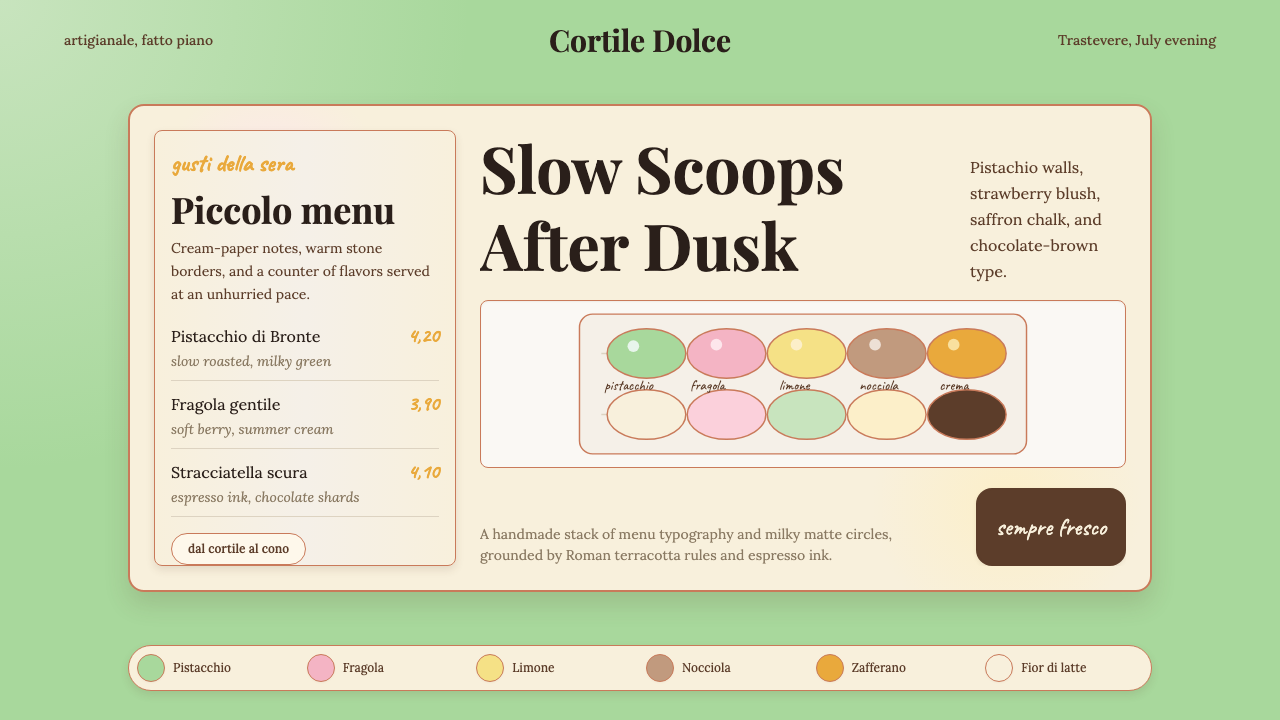 Italian Gelato ShopWarmth is hand-scooped. Pistachio green, cream panels, high-contrast serif, c…
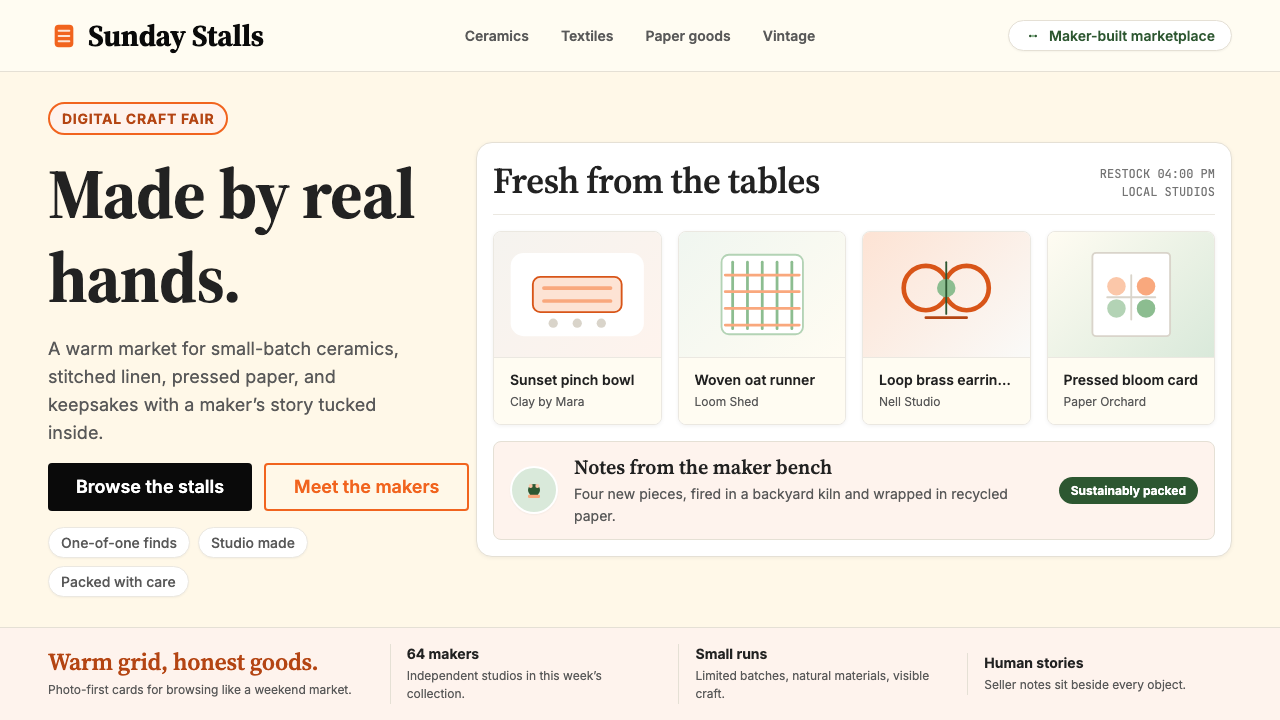 Etsy HandmadeA digital craft fair, in orange. Hand-drawn accents, cream backgrounds, delib…
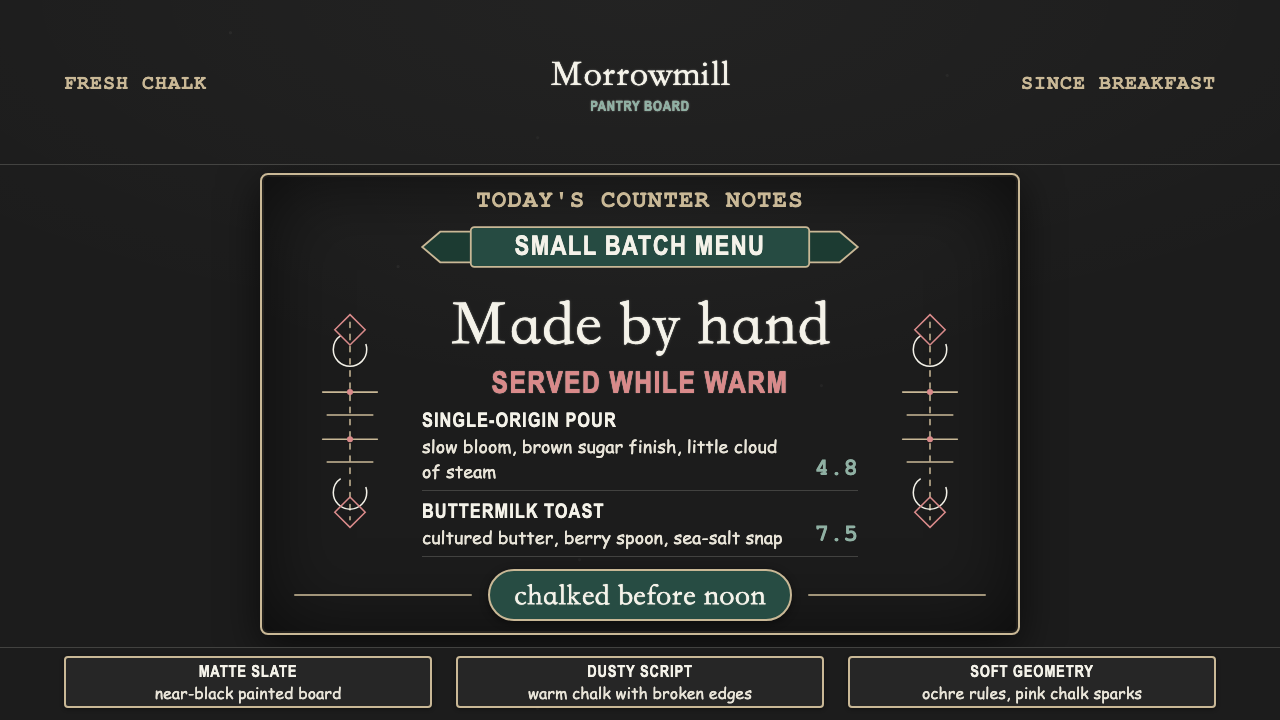 Chalk Café BoardWarmth written by hand. Dusty chalk script on graphite slate, framed by soft…
 Channapatna Lacquered ToysGloss feels handmade. Lac-red ground and turmeric-indigo bands turn pixels in…
 Cook Islands TivaivaiPatient generosity. Rose appliqué geometry blooms on linen with emerald stitc…
 Cork Board StudioWarm ideas stay tactile. Cork tan, Caveat handwriting, pinned paper, and tape…